


24, Jul 2026
SK Telecom Launches Dedicated AI Data Center Business Development Company to Kick Off ‘Asia’s AI Infrastructure Hub’ Push
SEOUL, Korea, July 24 — SK Telecom (NYSE: SKM, hereafter “SKT”) announced that its Board of Directors has approved the establishment of ‘SK Hyper,’ a new company dedicated to AI data center (AIDC) business development, along with an investment of KRW 750 billion by 2030 to lay the groundwork for the business.
The name ‘SK Hyper’ embodies the meaning of transcending all limits to unlock infinite possibilities, and reflects the company’s determination to rapidly expand the AIDC business to hyperscale.
SK Hyper will focus on business development to enable the build-out of 15GW of AIDC capacity over the mid-to-long term. It will be responsible for securing sites, constructing and operating substations, acquiring customers, and commercializing the AIDC business.
SKT will retain 100% ownership of SK Hyper and provide phased capital contributions as needed through 2030, within the approved investment limit.
With the newly established company, SKT is expected to accelerate the build-out of AIDCs to help achieve the government’s mega project. Centered on SK Hyper, SKT targets a phased opening of 5GW of AIDC capacity in 2029 as the first phase.
Taking market demand and other factors into account, SKT plans to commence sequential expansion toward a total capacity of 15 GW in 2035.
Recently, SKT also established the AIDC Integrated Development Division reporting directly to the CEO to consolidate the Group’s full‑stack AI capabilities.
SKT plans to build out AI infrastructure by region, starting with a GW‑class AIDC cluster in Ulsan and adding additional GW‑class AIDCs in the Chungcheong and Honam regions.
On the same day, SK Hyper’s Board of Directors appointed Chung Suk-geun as the inaugural CEO of SK Hyper. CEO Chung is recognized for deep expertise in the AIDC business, currently serving as SKT’s Head of the AI CIC (Company-in-Company). He also heads SKT’s AIDC Integrated Development Division, tasked with connecting SK Group’s AIDC execution organizations and accelerating the delivery of the project.
“SK Hyper’s role is to turn SK Group’s blueprint for Asia’s AI Infrastructure Hub into reality,” said Chung Suk-geun, CEO of SK Hyper. “Through systematic and rapid execution, we will secure core infrastructure and customers, and contribute to Korea’s advancement to AI G3.”
- 0
- By Neel Achary

24, Jul 2026
AAEONPrioritizes Durability with the Release ofNewCOM Express Type 6 Modules

AAEON’s latest COM Express Type 6 Modulesoffer cost-efficient Intel Atom and Processor N-series performancefor transportation, signage, and healthcare applications.
(Taipei, Taiwan – July 24, 2026) Leading provider of Computer-on-Modules AAEON (Stock Code: 6579) today introduced the COM-TWLC6 Rev.B, COM-ASLC6 Rev.B, and COM-ADNC6 Rev.B COM Express Type 6 modules, powered by Intel Atom and Processor N-seriesCPUs.
Thislineupdifferentiates itself from AAEON’s previous Amston Lake and Alder Lake-N powered COM Express Type 6 modules through a number of subtle, yet important design choices. One example of this is the presence of 16GB of soldered LPDDR5x system memory compared to the SODIMM-based DDR5 previously supported.This switch serves to bolster module durability for high-vibration applications, as well as providingthe typical benefits that come with LPDDR5x’s lower power profile.
Also of note is 128GB of onboard eMMC storage, which further contributes to the modules’ reliability and shock resistance, while also reducing reliance on external SSD wiring to carrier boards to host OS, configuration files, and system logs.Given these changes, the modules are primarily positioned as foundations upon which to build rugged, cost-efficient solutions across transportation, signage, and healthcare.
A range of interfaces are provided for routing to custom carrier boards, including a total of ten USB (USB 2.0 x 8, USB 3.2 Gen 2 x 2) and 2.5GbE. Options useful for industrial setups also feature, with 2-Wire UART, a GPIO 8-bit, SMBus, and I2C available. For expansion, each are equipped withflexible PCIe 3.0 lane configurations of PCIe [x2] x 1 + PCIe [x2] x 1 + PCIe [x1] x 2, alongside optional SATA co-lay functionality.
For digital signage and industrial HMI applications, the modules possessa well-rounded selection of display options. For the former, the modules present with dual display port interfaces (3840 x 2160 @60 Hz), while the latter is catered to through18/24-bit single or dual-channel LVDS (1920 x 1080), co-layed with eDP (3840 x 2160).
For proof-of-concept and software validation purposes, AAEON lists the ECB-920A-A11COM Express evaluation carrier board for the modules.For more specific needs, AAEON also has theQ Service Plus program, which offers schematic review, design consulting, and customized carrier board development tailored toproject needs.
For detailed specifications and more information about the COM-TWLC6 Rev.B, COM-ASLC6 Rev.B, and COM-ADNC6 Rev.B, please visit their respective product pages on the AAEON website or contact an AAEON representative via AAEON’s dedicated contact form.
24, Jul 2026
AAEON Prioritizes Durability with the Release of New COM Express Type 6 Modules
AAEON’s latest COM Express Type 6 Modules offer cost-efficient Intel Atom and Processor N-series performance for transportation, signage, and healthcare applications.
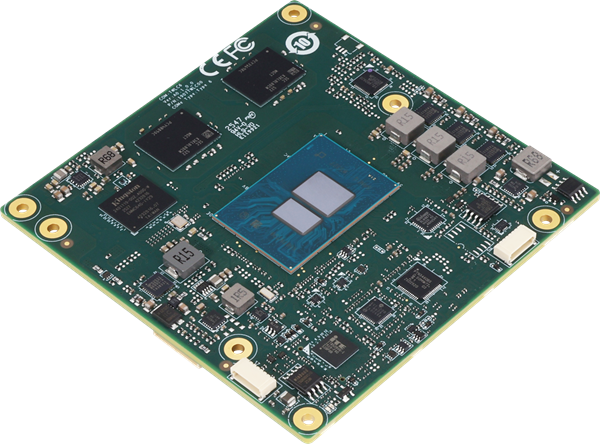
Taipei, Taiwan – July 24: Leading provider of Computer-on-Modules AAEON (Stock Code: 6579) today introduced the COM-TWLC6 Rev.B, COM-ASLC6 Rev.B, and COM-ADNC6 Rev.B COM Express Type 6 modules, powered by Intel Atom and Processor N-series CPUs.
This lineup differentiates itself from AAEON’s previous Amston Lake and Alder Lake-N powered COM Express Type 6 modules through a number of subtle, yet important design choices. One example of this is the presence of 16GB of soldered LPDDR5x system memory compared to the SODIMM-based DDR5 previously supported. This switch serves to bolster module durability for high-vibration applications, as well as providing the typical benefits that come with LPDDR5x’s lower power profile.
Also of note is 128GB of onboard eMMC storage, which further contributes to the modules’ reliability and shock resistance, while also reducing reliance on external SSD wiring to carrier boards to host OS, configuration files, and system logs. Given these changes, the modules are primarily positioned as foundations upon which to build rugged, cost-efficient solutions across transportation, signage, and healthcare.
A range of interfaces are provided for routing to custom carrier boards, including a total of ten USB (USB 2.0 x 8, USB 3.2 Gen 2 x 2) and 2.5GbE. Options useful for industrial setups also feature, with 2-Wire UART, a GPIO 8-bit, SMBus, and I2C available. For expansion, each are equipped with flexible PCIe 3.0 lane configurations of PCIe [x2] x 1 + PCIe [x2] x 1 + PCIe [x1] x 2, alongside optional SATA co-lay functionality.
For digital signage and industrial HMI applications, the modules possess a well-rounded selection of display options. For the former, the modules present with dual display port interfaces (3840 x 2160 @60 Hz), while the latter is catered to through 18/24-bit single or dual-channel LVDS (1920 x 1080), co-layed with eDP (3840 x 2160).
For proof-of-concept and software validation purposes, AAEON lists the ECB-920A-A11 COM Express evaluation carrier board for the modules. For more specific needs, AAEON also has the Q Service Plus program, which offers schematic review, design consulting, and customized carrier board development tailored to project needs.
23, Jul 2026
Rohde & Schwarz presents new software for three-phase power analysis on MXO series oscilloscopes
July 23: With the new R&S MXO-K333 3-phase power analysis software option, Rohde & Schwarz brings power analyzer-style insights directly to its MXO series oscilloscopes. Designed for engineers developing and debugging three-phase AC systems, the option delivers more than numerical results alone. It combines key power measurements with full waveform visibility, enabling users to quickly correlate power behavior with real signal events and troubleshoot issues faster.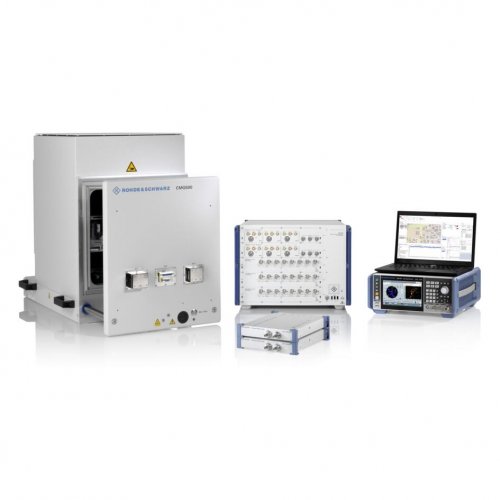
Caption: The R&S MXO-K333 software option provides comprehensive measurement functions for analyzing three-phase power systems.
Rohde & Schwarz has introduced the new R&S MXO-K333 software option for three-phase power analysis on its MXO series oscilloscopes. The software adds in-depth measurement and analysis functions for testing and debugging three phase power systems, drives and inverters.
Available for all four and eight channel models of the MXO 3, MXO 4, MXO 5 and 5C oscilloscopes, it supports the analysis of voltage and current signals in three-phase AC systems. This innovative test solution keeps the captured waveforms visible during measurement, allowing engineers to review power values and check transient behavior in the same instrument. Other oscilloscope functions such as math, spectrum analysis, measurement tracking and zone trigger remain available for further analysis.
A guided setup wizard assigns the oscilloscope channels to the voltage and current probes used for the three-phase analysis. It verifies the wiring and supports common two-wire, three-wire and four-wire configurations (2V2A, 3V3A and 3VN3A). After setup, the software provides cycle-by-cycle calculations for RMS values, power factor, active power, reactive power and total power. By defining the input and output configuration, users can also calculate the system’s three-phase efficiency. Additional analysis views include phasor display, harmonic analysis and THD measurements in line with IEC 61000-3-2 and MIL-STD-1399.
As an oscilloscope-based solution, the R&S MXO-K333 enables engineers to correlate three-phase power results directly with the underlying voltage and current waveforms in real time. This is especially valuable during R&D and debugging, when power behavior often must be analyzed alongside switching events, transients, control signals and communication activity. Users can combine the three-phase analysis with inherent MXO capabilities such as advanced triggering, FFT, automated measurements, track functions and protocol decoding. This allows engineers to move from power measurement to root-cause investigation in a single instrument.
23, Jul 2026
Rising Fuel Costs Accelerate EV Push as Automakers Expand Electric Vehicle Line-Up
New Delhi, July 23: Automakers in India are accelerating their electric vehicle (EV) strategies as rising crude oil prices and growing demand for cleaner mobility solutions drive increased focus on electric transportation.
The shift towards electric mobility has encouraged manufacturers to introduce new EV models across different price segments, offering consumers more choices while supporting the country’s transition towards sustainable transportation.
Among the latest developments, Kia has launched the Syros EV with prices starting from Rs 13.49 lakh, expanding its presence in India’s growing electric vehicle market.
Industry experts said higher fuel costs, environmental concerns, and advancements in battery technology are key factors encouraging consumers and companies to move towards electric vehicles.
Automakers are increasing investments in EV platforms, charging infrastructure, and new technologies to meet changing customer preferences and strengthen their position in the evolving automotive market.
The growth of the EV ecosystem is also expected to support India’s goals of reducing dependence on fossil fuels, improving energy efficiency, and promoting sustainable mobility.
With more manufacturers entering the electric vehicle segment, competition is expected to increase, providing consumers with wider options and accelerating innovation in the sector.
23, Jul 2026
CSIR Launches IoT-Based Rural Water System, Transfers Four Indigenous Technologies
July 23: The Council of Scientific and Industrial Research (CSIR) has strengthened India’s innovation ecosystem by transferring four indigenous technologies and launching an IoT-based rural water management system aimed at improving water resource monitoring and management.
The newly unveiled digital water solution uses Internet of Things (IoT) technology to enable real-time monitoring of water systems, helping improve efficiency, transparency, and decision-making in rural water supply management. The initiative is expected to support sustainable water management and enhance access to reliable water services in rural areas.
The transfer of four homegrown technologies marks another step towards promoting research-based solutions and encouraging collaboration between scientific institutions and industry partners. These technologies are expected to support practical applications across different sectors and contribute to India’s goal of strengthening self-reliance in science and technology.
CSIR highlighted that the initiatives demonstrate the organisation’s commitment to converting scientific research into impactful solutions for society. Through technology transfer, innovation partnerships, and industry engagement, CSIR continues to bridge the gap between laboratory discoveries and real-world applications.
The launch reflects India’s growing focus on indigenous technological development and the use of advanced digital tools to address key challenges related to infrastructure, sustainability, and public welfare.
23, Jul 2026
AI Goes Mainstream: Gemini User Base Soars to 950 Million Worldwide
July 23: Google’s artificial intelligence platform Gemini has crossed 950 million monthly active users, marking a significant milestone in the global adoption of generative AI technologies, Google CEO Sundar Pichai announced.
Pichai said the rapid expansion of Gemini reflects the growing interest in AI-powered solutions among individuals, businesses, and developers. The platform has gained momentum by offering advanced capabilities designed to assist users with tasks including information discovery, content creation, productivity enhancement, learning, and problem-solving.
The milestone highlights the accelerating growth of the artificial intelligence ecosystem, as companies and users increasingly integrate AI tools into everyday digital activities. Google has continued to expand Gemini’s capabilities across its products and services, focusing on improving user experiences and enabling more efficient workflows.
The increasing adoption of Gemini comes as competition in the AI sector continues to intensify, with technology companies investing in next-generation models, infrastructure, and innovative applications. Google has emphasized its commitment to developing AI responsibly while making advanced technologies more accessible globally.
Pichai said the company will continue to invest in AI research and development to enhance Gemini’s performance, expand its applications, and support users across consumer and enterprise segments.
23, Jul 2026
SK Telecom Leads Global Technical Standardization for Physical AI
SEOUL, Korea, July 23 — SK Telecom (SKT) announced that a new standardization work item on robot data production and utilization systems was adopted at the International Telecommunication Union Telecommunication Standardization Sector (ITU-T) international standardization meeting held in Geneva, Switzerland from July 14 to 22.
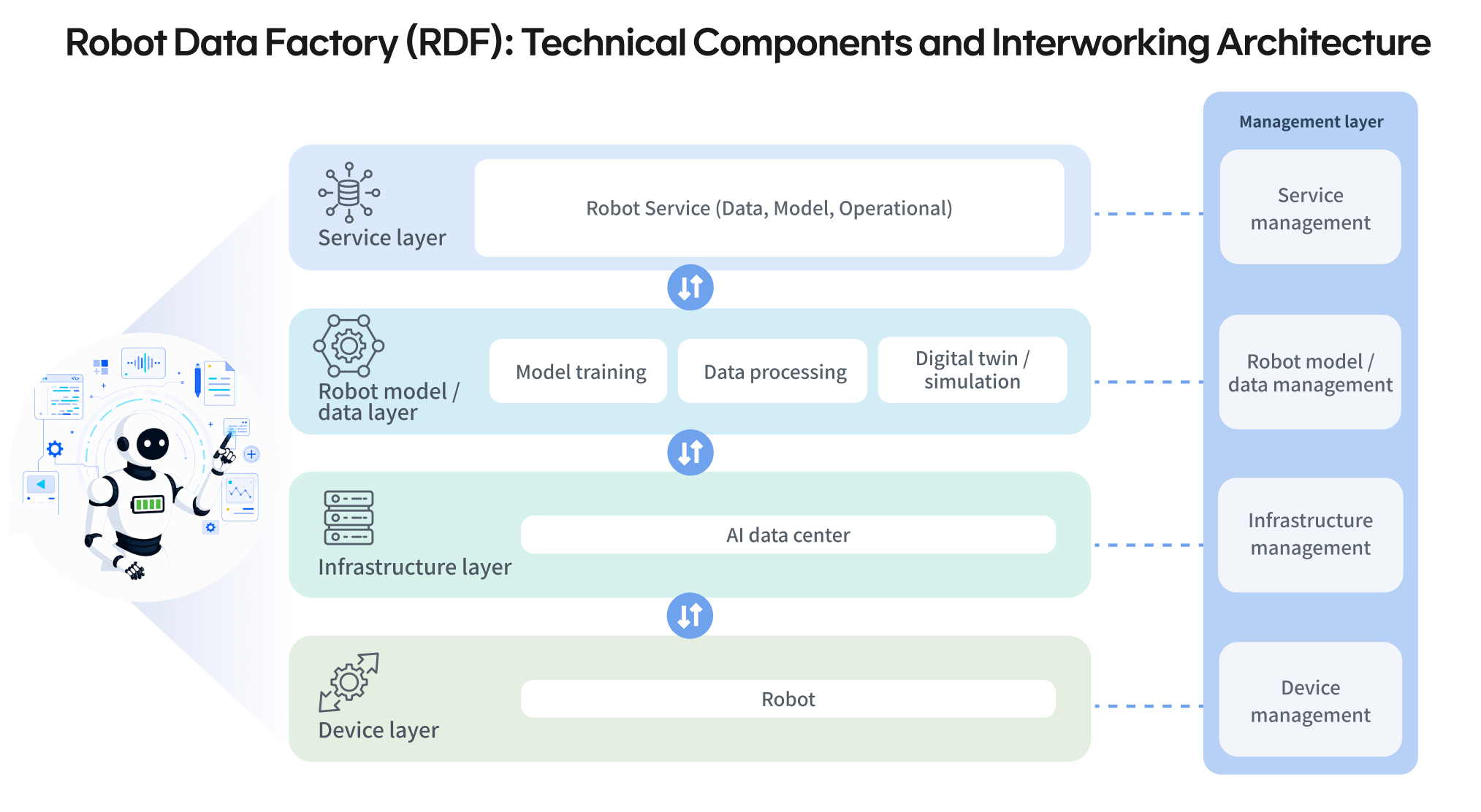
The adopted work item, “Signalling Requirements and Architecture for Robot Data Factory (RDF),” is SKT’s proposal to systematically produce and utilize data required for AI training of intelligent robots such as humanoids.
ITU-T is the telecommunication standardization sector of the International Telecommunication Union (ITU), a specialized agency of the UN, and develops international standards in the information and communications field. ITU has around 1,000 institutions, companies, and research organizations from some 190 member countries participating.
Robot motion data is akin to “practice problems” used to train robot AI. For robots to become smarter, they need “many” “good problems.” However, the way this data is created and exchanged differs by robot model and onboard software, making it difficult to achieve compatibility between different systems.
With the recent growth of the robot industry, demand has been increasing for large-scale, high-quality motion data needed for robot AI to learn how to grasp and move objects and use tools. However, because institutions and companies have collected and managed data in different ways, it has been difficult to secure sufficient scale and consistent quality.
Accordingly, SKT proposed a new standardization work item to ITU-T Study Group 11 (SG11) to define the roles of the key functions comprising RDF, its interworking structure, and data exchange methods. Following review and discussion by ITU-T members, the proposal was adopted as a new standardization work item at the July meeting
This work item divides the RDF structure into five layers: Service, Robot Model·Data, Infrastructure, Device, and Management.
SKT plans to establish the role of each layer and the interworking specifications between layers, enabling functions to be easily connected, replaced, and expanded across different robots and platforms.
SKT has been working to build and advance a digital twin platform for manufacturing AI. Building on this, the company is expanding into a robot learning platform that generates robot task data for use in AI training. SKT explained that the adoption of this work item was made possible by the digital twin, AI, and data capabilities it has accumulated over time.
Through this standardization work item, SKT plans to strengthen the utility of its digital twin-based robot learning platform, which is being prepared for launch in the second half of the year. Furthermore, building on this international standardization discussion, SKT aims to expand cooperation with domestic and international robotics and AI companies and research institutions, contributing to the revitalization of the robot data ecosystem.
“With the adoption of this new standardization work item, SKT has established a foundation for leading international standards discussions, leveraging the digital twin and AI capabilities it has accumulated in the Physical AI field,” said Choi Dong-hee, Head of AI Strategy Planning Office at SKT. “Going forward, building on our technological competitiveness spanning robot learning platforms and AI models, we will continue to spearhead international standardization in robotics.”
22, Jul 2026
Kore.ai Names Uma Sandilya Chief Commercial Officer, Placing Sales, Marketing, and Strategy Under One Leader
Appointment follows a year of accelerating customer growth, the launch of the Artemis edition of the Kore.ai Agent Platform, and Leader placements from Gartner and Forrester
SAN MATEO, Calif., July 22, 2026 – Kore.ai, the global leader in enterprise AI platforms and agentic applications, today named Uma Sandilya Chief Commercial Officer. Sandilya takes end-to-end ownership of sales, go-to-market (GTM), marketing, and strategy, uniting the company’s commercial functions under a single leader as enterprise buyers move agentic AI from pilots into production.
Enterprise AI has reached the moment Kore.ai was built for. Buying decisions that once sat with individual departments now consolidate at the CIO level and cover the full lifecycle of AI agents rather than single tools. This appointment gives Kore.ai one commercial owner to meet it, accountable from first contact through delivered value.
Sandilya joined Kore.ai in 2025 as Chief Growth Officer, bringing more than two decades of enterprise AI experience working with C3.ai and McKinsey. As Chief Commercial Officer, he takes direct leadership of the global sales organization, including the Americas and International sales teams, along with the growth, marketing, and corporate strategy functions.
“Enterprise AI is entering its third wave, where governance, observability, and trust define success at scale,” said Raj Koneru, Founder and CEO of Kore.ai. “The next phase of our growth requires a commercial organization built the way we built our platform: one foundation with one accountable owner. Uma has shaped our commercial engine since the day he joined, and he is the right leader to run it end to end.”
The move caps a year of accelerating customer growth and expanding industry recognition. In May, the company launched the new-generation Kore.ai Agent Platform, Artemis edition. Gartner named Kore.ai a Leader in the Magic Quadrant™ for Conversational AI Platforms in 2025 and again in 2026. Forrester named the company a Leader in The Forrester Wave™ Conversational AI Platforms in multiple categories: Cognitive Search, Customer Service, and Employee Service. The Kore.ai platform now powers more than 11 billion interactions per year and has supported more than 500 large enterprises worldwide.
“Every enterprise I’ve sat across the table from this year has asked the same question: how do we accelerate time to value from agent deployments? What sets Artemis apart is that it’s built for what comes after the first ten agents – the governance, the observability, the reliability enterprises need to scale,” said Sandilya. “My focus is to bring Artemis to more of the market through a unified growth, sales, and marketing engine, and deliver tangible business outcomes for our customers.”
Kore.ai also appointed Rajavardhan Nalluri as Chief Customer Operations Officer, reporting directly to the CEO. Nalluri has spent more than 11 years at Kore.ai, where he has led engineering through multiple phases of growth while working directly with customers across industries. In the new role, he leads the company’s forward-deployed engineering, customer support, and cloud operations and infrastructure organizations. His mandate is to make customer delivery a competitive edge by ensuring predictable deployments, stronger support, deeper partner enablement, and measurable customer satisfaction as agentic AI moves into production.
Alongside these two major appointments, Kore.ai also expanded the integrated demand generation organization under Chief Marketing Officer Peter Mullen. The commercial structure matches the position Kore.ai staked out with Artemis. Much of the market sells tools that create agents or control layers added after the fact. Kore.ai has built the harness: a single platform that builds, deploys, manages, and optimizes enterprise AI agents, with governance defined from the first line and enforced separately from the model. Artemis compiles that governance before any agent goes live, which lets enterprises operate AI systems that they can audit and scale.
22, Jul 2026
Veraify Launches Groundbreaking AI-Native Security Platform Built for the AI Workforce Era
New Platform Puts Enterprises in the AI Drivers Seat, with More Control over Shadow AI, AI Workforce, and Sensitive Data Movement, Securing AI Adoption Without Slowing Innovation
SUNNYVALE, CA – July 22, 2026 – Veraify today introduced a new AI-native security platform designed to help enterprises safely adopt artificial intelligence at scale, powered by Cloudbrink. Veraify’s comprehensive, AI-native approach combines endpoint intelligence, AI-aware policy enforcement, data protection, and secure high-performance connectivity in one platform for AI governance, visibility, and protection.
Built for a world of AI agents, copilots, autonomous workflows, and shadow AI, Veraify gives organizations the visibility, governance, data protection, and guardian agent capabilities, along with the high-performance secure access required for the next generation of enterprise operations. Delivered under a new platform brand from Cloudbrink, Veraify is a next-gen approach to securing AI that addresses how AI gets used in a way that traditional ZTNA and SASE architectures don’t.
“As we evaluated AI security platforms, we found that many approached the problem using architectures designed for the SASE or web browsers,” said Aziz Kapadia, Field CISO at Cogent Security. “They could inspect browser traffic and some app traffic, but they weren’t built to provide visibility into the growing number of AI agents, desktop applications and embedded AI capabilities running directly in apps and on endpoints. We selected Veraify powered by Cloudbrink because its architecture was designed for where enterprise AI security is actually heading, not where it was yesterday.”
Veraify builds on Cloudbrink’s proven high-performance connectivity architecture and expands it into a complete AI security platform designed for how work is changing.
For the last decade, enterprise security architectures were built around humans accessing applications. AI changes that model.
AI agents, copilots, coding assistants, and autonomous workflows now access data, applications, APIs, and infrastructure directly. These interactions create new security challenges that traditional cloud proxy and browser-centric architectures were never designed to solve. According to a Gartner study, 69% of organizations suspect or have evidence that employees are using prohibited public GenAI tools. This unapproved “shadow AI” can significantly increase risk to an organization, leaving them vulnerable to privacy breaches and data loss from employees entering customer or employee data, proprietary company information, or code into an AI prompt while looking for help.
“Every major technology shift creates a new security architecture. The PC created endpoint security. The cloud created SASE. AI requires something different,” said Prakash Mana, CEO of Cloudbrink. “AI agents and assistants are becoming digital workers with access to enterprise data, but most companies have very limited visibility or control over what this AI technology is doing. We created Veraify to give enterprises the confidence to adopt AI safely.”
Veraify solves the most urgent AI security challenges by empowering organizations to:
- Discover Every AI Interaction. Identify sanctioned and unsanctioned AI tools, agents, copilots, and services. Agent-based policy enforcement captures all AI traffic and enforces policy at the source/endpoint. AI traffic cannot bypass the agent, ensuring full visibility, governance controls, and evidence recording for compliance.
- Protect Sensitive Data Before It Leaves. Prevent employees and AI agents from exposing private information, code, customer data, or intellectual property. Advanced DLP capabilities include a built-in PII catalog to begin AI protection within minutes and eliminate constant DLP policy updates when PII data types and formats change. Multi-level content inspection monitors and secures PII across AI prompts, documents, or images, including images inside files uploaded to AI.
- Anticipate and Prepare for New AI. Automated learning and discovery of new AI platforms and agents that are not in the integrated top 100 AI catalog eliminates the need for customers to continually manually configure the detection logic for new platforms
- Govern Humans and AI Agents Together. Apply identity, device, data, and AI-aware policies from a unified control plane regardless of the origin.
- Secure AI Without Sacrificing Performance. Enable AI adoption without forcing users into slow legacy SASE and DLP architectures they then bypass, leveraging the Cloudbrink high-performance connectivity architecture.
Veraify is powered by Cloudbrink’s proven high-performance secure connectivity architecture, which was built from the beginning for a world where users, applications, and data are distributed everywhere. Veraify incorporates and expands the SAFE AI capabilities previously introduced by Cloudbrink, layering on new technology to give broader AI visibility, governance, endpoint-aware protection, and secure access capabilities into a unified AI-native platform.
Unlike traditional security models that force traffic through centralized inspection points, the Cloudbrink architecture provides the foundation for Veraify’s AI-native approach — delivering endpoint intelligence, zero-trust access, AI-aware policy enforcement, and high-performance connectivity without compromising the user experience.
“Cloudbrink provides the technology foundation. Veraify defines the next generation platform for securing AI adoption,” said Manohar Reddy, Head of Products at Cloudbrink. “Veraify extends the foundation we built with Personal SASE into this AI-native era — combining secure access, AI visibility, data protection, and performance into one platform. With Veraify, customers do not have to choose between enabling AI innovation and protecting the business. Organizations can get the controls they need to govern AI adoption while preserving the fast, seamless experience users expect.”
Veraify powered by Cloudbrink is available now. Current Cloudbrink customers can request Veraify for free for a limited time. For a demo of Veraify’s capabilities, go to: https://veraify.ai/book-a-


