


16, Jun 2026
Flir Thermal Imaging Helps Reveal Hidden Text in Ancient Herculaneum Papyri
Flir thermal imaging technology is helping researchers in Italy unlock hidden text from the Herculaneum papyri, a unique collection of ancient manuscripts carbonized during the eruption of Mount Vesuvius in 79 AD.
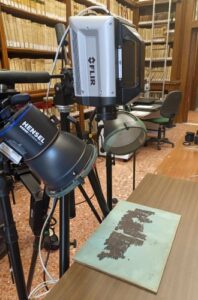
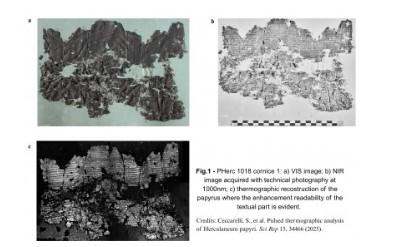
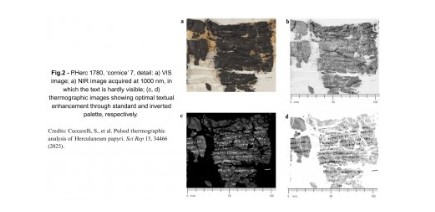
June 16: Flir thermal imaging technology is helping researchers in Italy unlock hidden text from the Herculaneum papyri, a unique collection of ancient manuscripts carbonized during the eruption of Mount Vesuvius in 79 AD. Using pulsed thermography that leverages the 2.775 MHz fast analog lock-in input port offered by advanced Flir thermal imaging cameras, scientists are recovering writing previously invisible to the naked eye while also gaining new insight into the fragile internal structure of the documents. All images are sourced from S. Ceccarelli et al., SciRep 15, 34466 (2025).
The vital project is being led by researchers at the Institute of Heritage Science, part of the National Research Council of Italy (CNR), who are exploring non-destructive ways to study and preserve what remains the only surviving library from the ancient Greco-Roman world.
Discovered during excavations in the 18th century at the Villa dei Papiri in Herculaneum, the scrolls survived the volcanic eruption through carbonization caused by intense heat and burial beneath volcanic material. While this extraordinary process preserved the manuscripts, it also created major challenges for historians and conservators attempting to read and protect them.
Many of the papyri were mechanically unrolled centuries ago and mounted to supporting boards. However, the resulting fragments are extremely fragile, often heavily layered, and in many cases almost unreadable.
Conventional Imaging Falls Short
One of the principal challenges facing researchers is that both the carbonized papyrus substrate and the ink are black, making differentiation extremely difficult using conventional imaging methods as the contrast in the visible range is lost. Other more sophisticated techniques like X-ray can work, particularly in combination with artificial intelligence, but are more complex and expensive, requiring transportation of the papyri to special labs where these techniques are available.
To address these challenges, conservators turned to pulsed thermography, a technique that combines controlled light excitation with high-speed thermal imaging. The method works by illuminating the papyrus with a short pulse of light and recording the resulting thermal response over time.
Surface inscriptions become visible almost immediately in the first few infrared frames after excitation because the ink absorbs light differently to the surrounding papyrus material. As heat propagates through the sample over the following seconds, deeper structural details and underlying features begin to emerge. This time-based thermal behavior provides researchers with a way to distinguish writing from substrate material.
Advanced Thermal Imaging
Central to the project is the use of Flir X-Series thermal imaging cameras. Combining high-speed, high-sensitivity infrared imaging with advanced thermal management capabilities, the cameras are ideal for scientific and research environments where precision and data integrity are vital.
Operating in the mid-wave infrared spectrum, Flir X-Series cameras enabled researchers to capture rapid thermal events with exceptional sensitivity, allowing subtle temperature differences between inked and non-inked areas of the papyri to become visible during pulsed thermography analysis. The X-Series features a fast analog lock-in input port designed to receive external reference signals, enabling high-speed thermal analysis at a sampling rate of 2.775 MHz. This capability allows researchers to detect faint signals or minute temperature differences in materials.
The researchers used dual flash lamps to generate controlled excitation while limiting temperature increases within the papyri to 2-3°C, well below any level considered harmful to the ancient material. Special filtering systems also prevented ultraviolet exposure and minimized unwanted infrared reflections.
According to the project team, the high sensitivity, spatial resolution and advanced recording capabilities of the Flir X-Series proved particularly important when identifying fine thermal contrasts and preserving image clarity throughout the acquisition process.
The ability to stream and record thermal data continuously without dropped frames also supported detailed post-processing and analysis using Flir Research Studio software.
Notably, the method remains entirely non-contact and non-destructive, a critical requirement when working with fragile cultural heritage artefacts that cannot be physically manipulated or removed from their historical supports.
Beyond Text Recovery
While the primary objective of the project involves revealing hidden text, pulsed thermography also provides valuable structural information for conservation specialists.
As heat diffuses through the papyrus over longer timescales, the thermal data begins to reveal features such as fiber patterns, overlapping layers, and adhesion points between the papyrus and its supporting board. These details help conservators better understand the physical condition of the manuscripts and identify areas where deterioration or detachment may be occurring.
The ability to investigate both writing and substrate morphology from the same thermal dataset provides significant advantages for restoration planning and long-term preservation strategies. The technique is particularly useful because some regions of the manuscripts contain multiple compressed layers created during the historical unrolling process. In these areas, underlying sections remained attached rather than separating cleanly, creating a complex structure that is difficult to analyze using traditional imaging methods.
The researchers also noted that some competing technologies can involve bulkier equipment, more restrictive positioning requirements, or lower image definition when examining layered material.
Future Potential
One of the remaining challenges involves identifying text located on the reverse side of the papyri or buried within heavily layered sections where only limited excitation light can penetrate. Although possible to detect residual thermal information from deeper layers, the resulting signals become increasingly weak and blurred as heat diffuses through the material.
To help overcome these limitations, the CNR team is now exploring the use of AI-based processing techniques. AI-assisted analysis could further enhance differentiation between the ink and the papyrus substrate, potentially improving readability and supporting future interpretation of the texts.
Whatever the future holds, the team is confident that pulsed thermography is set to become an increasingly valuable complementary tool alongside other advanced heritage science techniques. This exciting project has demonstrated the growing role of Flir thermal imaging technology in scientific research and preservation. By combining high-speed thermal acquisition with advanced analysis methods, researchers are now able to study some of the world’s most fragile historical artefacts in ways that were previously impossible.
- 0
- By Neel Achary

16, Jun 2026
AVer Wins GHP Healthcare & Pharmaceutical Awards 2026 as Best Telehealth Communication Technology Solutions
Taipei, Taiwan – June 16, 2026: AVer Information Inc., an award-winning provider of AI audio-video solutions, has been honored as the “Best Telehealth Communication Technology Solutions” at the prestigious Healthcare & Pharmaceutical Awards 2026 presented by UK‑based Global Health & Pharma (GHP). The international accolade recognizes AVer’s commitment to advancing remote healthcare communication for patients and caregivers worldwide.

This achievement was made possible by AVer’s comprehensive portfolio of medical grade cameras, engineered to meet the demanding needs of clinical settings. From teleconsultation and virtual rounding to patient monitoring and cross-site medical collaboration, AVer’s technologies help healthcare teams communicate more clearly through reliable video, audio, and intelligent clinical support.
A prime example of AVer’s ongoing telehealth innovation is the MD331UI Medical Grade PTZ Camera, the newest addition to its line of medical grade cameras. Built with 4K clarity, 30X optical zoom, and embedded two-way audio, the MD331UI is designed to support more natural and effective communication between patients and remote care teams. Its latest Audio Processing AI captures the patient’s voice clearly while minimizing environmental background noise, helping clinicians hear every word with greater focus during virtual rounding and remote consultations. To help care teams stay focused on patient communication rather than equipment operation, the MD331UI also features effortless camera positioning, allowing nurses to manually fine-tune1 the camera’s angle without recalibration. With 12–24V wide voltage input, optional Wi-Fi® connectivity, and image stabilization, the camera can be seamlessly integrated with battery-powered medical carts, enabling flexible deployment as part of a complete telehealth solution.
Also worth noting are two well‑established models in AVer’s medical grade cameras line — the MD720UIS and MD330UI. They deliver dependable 4K video, clear audio, and straightforward integration for telemedicine, virtual rounding, and telesitting. Their proven reliability and simple deployment have made them go‑to options for providers seeking trustworthy telehealth tools, and both are Zoom‑certified for seamless collaboration on a widely used platform.
“We are proud that our solutions are helping medical teams provide safer, smarter, and more connected patient care in hospitals and clinics around the globe,” said AVer President David Kuo. “This award fuels our commitment to innovate further, ensuring that every caregiver, no matter where they are, can deliver the highest standard of care with confidence.”
16, Jun 2026
AAEON Outlines Plans for Four Intel Core Series 3-Powered Platforms
Following the release of the Intel Core Series 3 processors (formerly Wildcat Lake), AAEON has announced four upcoming platforms set to feature them.
(Taipei, Taiwan – June 16) Following the unveiling of the new Intel Core processors (Series 3) (formerly Wildcat Lake) in April, AAEON’s UP brand (stock code: 6579) has announced its development timeline for four new platforms that will feature the processor line, with both developer boards and edge systems included.
Expected to enter mass production in late Q3, 2026, the developer boards included in AAEON’s roadmap are the UP WCL and UP Nexus WCL. The first of these is a credit card-sized board consistent with the original UP board’s form factor, while the UP Nexus WCL represents a branding shift for the UP Squared Pro form factor, measuring 101.6mm × 101.6mm. Both boards will also offer a fully embedded edge system version, the UP WCL Edge and UP Nexus WCL Edge, designed to appeal to customers requiring plug-and-play systems.
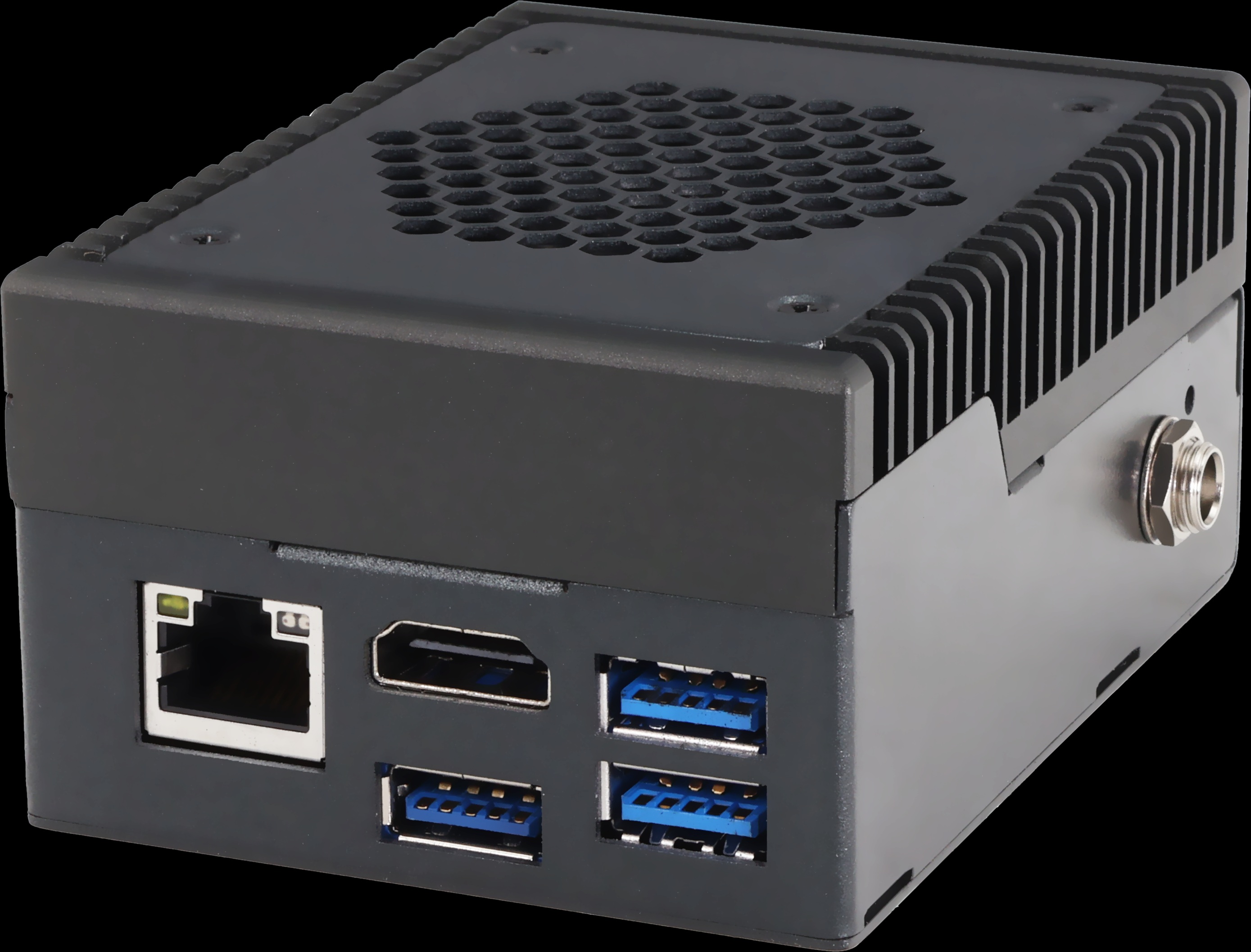
All four platforms will be available with the option of Intel Core 7 processor 350 and Intel Core 5 processor 320 CPUs from the Wildcat Lake family, while the UP WCL will also provide SKUs with the Intel Core 3 processor 304. Delivering up to 40 TOPS of AI performance via integrated GPU and NPU but with a CPU prioritizing low power E-cores, the Intel Core series’ first integrated heterogeneous compute architecture sees AAEON position its upcoming products as suitable for building advanced applications across market segments, but with the benefit of a lower power footprint than platforms tailored to high-performance computing needs.
Both the UP WCL and UP Nexus WCL present a number of notable improvements on previous generations. For the UP WCL, a substantial boost in available system memory from the previously capped 8GB can be found, with standard UP WCL SKUs equipped with 24GB of onboard LPDDR5. Meanwhile, the UP Nexus WCL, which had previously only seen a maximum of 16GB of LPDDR5 for its UP Squared Pro line offers up to 48GB. The standard 64GB of eMMC storage typically found listed among UP product specification sheets has also seen an upgrade, with both the UP WCL and UP Nexus WCL both coming with 256GB of UFS3.1.
Standing out among the preliminary specifications for the UP WCL are a 10-pin wafer for I2C, PWM, and SPI, GPIO 8-bit, 2.5GbE LAN, and three USB 3.2 Gen 2 ports. Meanwhile, the UP Nexus WCL retains the conventional 40-pin GPIO offered by traditional UP boards, while adding two 10-pin headers for RS-232/422/485, two 2.5GbE LAN ports, and both dual USB Type-A (USB 3.2 Gen 2) and dual USB Type-C (USB 3.2 Gen 2×2) ports.
With respect to OS compatibility, all four offerings list support both Windows 11 LTSC and Linux Ubuntu 24.04 LTS.
The UP WCL, UP Nexus WCL, and their corresponding edge systems are expected to enter mass production in late Q3, 2026. However, preliminary specifications are already available on the product pages located on the UP product series section of the AAEON website.
16, Jun 2026
AI is changing what is possible in the $10 trillion food industry. Anterra Capital is backing what comes next
Specialist food and agriculture investor announces $100 million first close of Fund III as the sector enters the most attractive deployment moment in twelve years.
AMSTERDAM and BOSTON – June 16; Food and agriculture has been through a noisy capital cycle. A lot of money chased capital-intensive stories that attempted to rebuild the food system from scratch. Anterra Capital’s view is simpler and more practical. The food system is too large and too entrenched to be replaced, but it can be transformed from within, particularly by companies operating at deep leverage points that can scale on existing industry infrastructure, on economics that make sense from day one.
The close
Fund III’s first close, at $100 million against a target of $200 million, marks an important milestone for Anterra. The firm was built on the conviction that the tools that had already transformed other industries — life science tools that reshaped human health, and software that rewired sectors from logistics to financial services — would eventually transition to, and transform, food and agriculture.
“The firm has now successfully navigated two capital cycles in food and agriculture,” said Maarten Goossens, Partner at Anterra Capital. “Each one rewarded the same discipline: backing companies that deliver real returns for their customers and to their investors. What’s different this time is that the real-world industries we operate in — large, complex and historically resistant to change — are now ready to be rewired, and the tools to do it have arrived.”
Why Fund III, why now
Food and agriculture remains the largest industry on the planet, roughly $10 trillion in size, employing around 1.3 billion people, nearly 40% of the world’s workforce. It is also where a set of structural forces is converging — margin volatility, food security, climate and water constraints, tightening regulation, and health outcomes increasingly tied to what the system produces — each one a reason the old way of operating no longer holds.
Those same forces drew a wave of capital chasing the change they promised. Global investment in food and agriculture technology surged to a historical peak of nearly $52 billion in 2021 before falling back to roughly $16 billion — 2016 levels. Much of that generalist capital backed ambitious, capital-intensive bets that failed to scale: indoor vertical farms, plant-based processed meat alternatives and 10-minute grocery delivery. Anterra took a different approach — backing science-backed companies built on real unit economics and designed to scale through existing industry channels. That retreat of capital from hype back to fundamentals is precisely what now opens the door for disciplined specialists.
And now there is AI — the defining technology shift of our era, and its impact runs deepest in the industries the last generation of software never reached: those which still run on manual workflows, fragmented data and analogue infrastructure. None is larger than food and agriculture. Two engines are now firing at once: vertical AI, the fastest-growing category in enterprise technology with investment tripling in a single year, is finally digitizing how these industries operate; in biology, AI is compressing R&D timelines, shrinking teams and slashing the capital needed to reach a first commercial milestone — unlocking a generation of opportunities that were previously out of reach for venture capital. The capital cycle has cleared the noise. And Anterra has spent twelve years building the knowledge and relationships to deploy into both.
Track record
Anterra’s investment thesis has been consistent across two funds — and with valuations reset and AI now changing the economics of building in both software and biology, the moment has finally arrived to deploy it at scale.
Anterra’s first two funds have produced top tier returns and multiple exits, including one of the largest exits ever in early-stage veterinary medicine, a Nasdaq IPO, and several other acquisitions by industry leading strategics across the value chain.
Company-building is a core part of how Anterra operates, deployed where the firm identifies white space the market has not filled. Its first company creation, Enko Chem, is discovering & developing next-generation crop protection chemistry through rational design to replace old, ineffective and unsafe products such as glyphosate, and partnering with key industry leaders, including Syngenta and Bayer Crop Science. Invetx, founded in 2018 and built by the firm from the ground up, applied proven biological approaches from human medicine to veterinary medicine and was acquired by Dechra Pharmaceuticals for over half a billion dollars within 6 years of inception.
Investor base
Anterra’s investor base spans institutional investors, food system operators and industry innovators across North America, Europe and APAC. It includes the world’s largest food and agriculture bank, one of the largest life sciences investors globally, a leading Asian sovereign wealth fund, and the world’s largest animal health company — institutions that understand both the scale of the opportunity and what it takes to capture it. Alongside them sit operators who between them farm more than 13 million acres and include leaders of some of the world’s largest CPG, bakery, produce logistics and food retail businesses.
“The vote of confidence from our investor base is what gives this close its weight,” said Adam Anders, Partner at Anterra Capital. “The combination of leading global asset managers, the institutions that know our sector backwards and the operators who farm millions of acres all backing the same thesis is an unrivalled force supporting the Anterra portfolio”.
What’s next
Fund III has already backed Anchr, an AI-native platform modernizing the back office of food distribution — a trillion-dollar industry still running largely on paper — alongside a16z Speedrun. The fund’s second investment is Animerra, a veterinary biologics company founded and built by Anterra, applying proven biological approaches to our sector and advancing its science with a lean team at a pace that would not have been possible five years ago.
“We’ve spent twelve years and two funds proving you can build category-defining companies in food and agriculture — and generate real returns doing it,” said Brett Wong, Partner at Anterra Capital. “What’s changed is that the world has finally caught up to that thesis. The technology is here, the valuations make sense, and the founders building in this sector are the best we’ve ever seen. This is the most exciting moment in our firm’s history, and Fund III is how we intend to make the most of it.”
15, Jun 2026
The MENA Fintech Association and Swiss Fintech Association Forge Strategic Alliance to Accelerate Global Fintech Integration…
The MENA Fintech Association and Swiss Fintech Association Forge Strategic Alliance to Accelerate Global Fintech Integration, Cross-Border Innovation, and Ecosystem Empowerment

June 15 – Abu Dhabi, UAE – The MENA Fintech Association (MFTA) and the Swiss Fintech Association (SFTA) announced a landmark strategic partnership designed to advance a new era of cross-border collaboration, ecosystem integration, and innovation-led financial transformation across global markets.
This alliance reflects a shared conviction that the future of financial services will be defined by interconnected ecosystems, seamless knowledge exchange, and the collective empowerment of institutions, innovators, and talent across geographies.
The Memorandum of Understanding (MoU) was formally signed with the Swiss Fintech Association, represented by its President, Phillip Weights, marking a significant milestone in strengthening institutional ties between the two ecosystems. The engagement was held under the presence and facilitation of H.E. Arthur Mattli, Ambassador – Embassy of Switzerland to the United Arab Emirates & Kingdom of Bahrain, whose support underscored the strategic importance of deepening bilateral cooperation in financial innovation and reinforcing cross-border ecosystem linkages.
Philip J. Weights, SFTA President, comments: “This strategic MOU between the Swiss FinTech Association (SFTA) in Zurich and the MENA Fintech Association (MFTA) in Dubai creates a powerful cross-border corridor for wealth, innovation, and digital finance. It establishes a bridge between two of the world’s most prominent financial technology hubs.”
“This alliance is a defining step toward deepening cross-border collaboration and co-creating the future of financial innovation between our two ecosystems. It reflects a shared ambition to enable sustainable growth and global connectivity in fintech.” — Nameer Khan, Chairman, MENA Fintech Association
15, Jun 2026
AAEON to Demonstrate Next-Generation Vision-Guided Robotics at Automate 2026
Make sure to visit AAEON at Booth #4251 of McCormick Place, Chicago, IL to see the latest in intelligent automation technology.

Orange, California – June 15: AAEON, an industry-leading provider of industrial automation and edge AI platforms, announced that it will present a range of new and upcoming products from across its portfolio at Automate Show and Conference, one of the largest and most influential automation events in the Americas.
Taking place from June 22nd to June 25th, 2026, at McCormick Place in Chicago, Illinois, Automate is expected to host thousands of professionals from over 100 countries to explore solutions driving the future of industry.
Date: June 22nd – 25th, 2026
Booth: #4251
Venue: McCormick Place, 2301 S Martin Luther King Dr, Chicago, IL 60616
At booth 4251, AAEON will present a live robotics demonstration featuring its upcoming CEXD-INTRBL, an open robotic development system powered by the new Intel Core Ultra Series 3 processors. Custom-built for the next generation of advanced robotics development, the CEXD-INTRBL will be used as the primary edge device for a robotic arm capable of 360° GMSL camera-guided manipulation, demonstrating how manufacturers can accelerate the deployment of vision-guided robotics, reduce integration complexity, and advance robotics toward greater autonomy.
Alongside its live demonstration, AAEON will also present a range of products from across its business units. One of the stand-out products on show will be the BOXER-8741AI, powered by NVIDIA Jetson T5000 module. Also from AAEON’s AI system collection will be the BOXER-8645AI, an AI@Edge Fanless Embedded AI System powered by NVIDIA Jetson AGX Orin, which was honored with the Golden Award at the COMPUTEX 2025 Best Choice Award.
From its single-board and development kit lineup, AAEON will showcase products across form factors, selected for their suitability as foundations upon which automation solutions can be built. Particularly noteworthy products on show include the UP Xtreme PTL Edge, built on Intel Core Ultra Series 3 processors, and the uCOM-Q6490, an upcoming SMARC module powered by the Qualcomm Dragonwing QCS6490 SoC.
Make sure to visit AAEON at booth #4251, where experts from both AAEON and will be on-site to provide full rundowns of the demonstration, give insight into the platforms on show, and explore how AAEON’s product roadmap can help visitors implement AI-powered automation platforms for their projects.
12, Jun 2026
AutoFlight V2000CG Granted World’s First eVTOL Overseas Type Certificate Validation in Indonesia

June 12| SHANGHAI: AutoFlight’s V2000CG CarryAll has been granted a Validated Type Certificate (VTC) in Indonesia, becoming the world’s first eVTOL to secure overseas type certificate validation.
The certification confirms that the V2000CG’s design complies with the airworthiness requirements of both the Civil Aviation Administration of China (CAAC) and Indonesia’s Directorate General of Civil Aviation (DGCA). Formally issued on 3 June 2026, the certificate clears the 2-ton unmanned cargo eVTOL to begin commercial operations in the Indonesian market.
The V2000CG first obtained its Type Certificate (TC) from the CAAC in March 2024, following extensive compliance verification and flight testing. AutoFlight submitted its VTC application to the DGCA in July 2025. The validation process drew on comparative analysis of airworthiness standards, multiple rounds of technical consultation, a comprehensive documentation review, and on-site inspections in China by Indonesian authorities, after which the DGCA confirmed full compliance with Indonesian regulations.
With more than 17,000 islands, Indonesia faces significant logistics challenges. Maritime transport is slow, while conventional air cargo depends on costly runway infrastructure. With a maximum take-off weight of 2,000 kg, a cruise speed of 200 km/h, and a range of 200 km, the V2000CG addresses these constraints through a fully electric lift-and-cruise configuration that takes off and lands vertically without runways. This makes it well suited to inter-island transport of high-value goods, including fresh produce, pharmaceuticals, and emergency supplies, and delivers a reliable low-altitude logistics solution for Southeast Asia.
The V2000CG is the only ton-class eVTOL in the world to hold the full set of CAAC airworthiness certificates of TC, Production Certificate (PC), and Airworthiness Certificate (AC). It has already demonstrated its operational capability in offshore logistics, island resupply and emergency response missions in China.
The Indonesian VTC accelerates the full industrial chain, from technical validation and airworthiness certification through to overseas commercial deployment. The milestone establishes an operational foundation for commercial eVTOL services in Southeast Asia and advances AutoFlight’s broader strategy for global market expansion.
12, Jun 2026
Checkmarx and Carahsoft Partner to Deliver Prevention-First Approach to Application Security for Government Agencies
PARAMUS, N.J. and RESTON, Va., June 12: Checkmarx and Carahsoft Technology Corp., The Trusted Government IT Solutions Provider®, today announced a partnership. Under the agreement, Carahsoft will serve as Checkmarx’s Master Government Aggregator®, making the company’s application security solutions available to the Public Sector through Carahsoft’s reseller partners and NASA Solutions for Enterprise-Wide Procurement (SEWP) V, E&I Cooperative Services Contract and The Quilt contracts.
“Partnering with Carahsoft enables us to expand access to our application security platform across the Public Sector,” said Jonathan Kozimor, VP of Channel Americas at Checkmarx. “Carahsoft’s deep expertise in Government procurement and its extensive reseller ecosystem make the company an ideal partner to help agencies strengthen their application security posture. Together, we can empower organizations to integrate security seamlessly into modern development environments, reduce risk across the software lifecycle and accelerate the delivery of secure, mission-critical applications.”
Checkmarx delivers a unified, AI-native application security platform designed to secure modern software development across the agentic development lifecycle (ADLC)—from code creation through runtime. The platform consolidates multiple security capabilities, including static and dynamic application security testing (SAST and DAST), software composition analysis (SCA), API security, container and infrastructure-as-code security and application security posture management (ASPM), into a single, integrated solution. By correlating risk signals across the ADLC, Checkmarx provides real-time visibility into vulnerabilities and prioritizes the most critical risks. Its agentic AI-driven capabilities embed security directly into developer workflows, enabling continuous detection, automated remediation guidance and policy enforcement without slowing development velocity.
Built to address the increasing complexity of AI-driven and cloud-native environments, the platform helps organizations eliminate fragmented tooling and replace it with a centralized, always-on security layer. This unified approach enables teams to reduce noise, focus on exploitable risks and remediate issues earlier in the development process, minimizing rework and improving overall software resilience. With seamless integration into existing DevOps ecosystems and real-time governance dashboards, Checkmarx supports secure, scalable innovation while ensuring continuous compliance, visibility and control across even the most complex application environments.
“We are pleased to partner with Checkmarx to bring its innovative application security platform to the Public Sector,” said Brian O’Donnell, Vice President of Cybersecurity Solutions at Carahsoft. “As agencies continue to modernize their development environments, it is critical they have access to solutions that embed security throughout the software lifecycle. Together with our reseller partners, we are enabling Government organizations to adopt a proactive, integrated approach to application security—helping them reduce risk, protect sensitive data and accelerate the delivery of secure, mission-critical applications.”
Checkmarx’s application security solutions are available through Carahsoft’s SEWP V contracts NNG15SC03B and NNG15SC27B, E&I Contract #EI00063~2021MA and The Quilt Master Service Agreement Number MSA05012019-F. For more information, contact the Carahsoft Team at (703) 889-9710 or Checkmarx@carahsoft.com; or register for this complimentary webinar, Application Security for Federal Environments. Explore Checkmarx’s solutions here.
12, Jun 2026
Airrived Named Gartner Tech Innovator for the Second Time, Recognized in AI Agent Management Platforms
Gartner spotlights Airrived’s Agentic OS as critical infrastructure for enterprises deploying, scaling and managing custom AI agents
DUBLIN, Calif.- Airrived, the company behind the Agentic OS, today announced it has been named a Gartner Tech Innovator in the “Emerging Tech: Tech Innovators in AI Agent Management Platforms” report (May 27, 2026). This marks Airrived’s second Gartner Tech Innovator recognition, following its prior inclusion in the “Emerging Tech: Tech Innovators in Agentic AI” report (September 16, 2025).
Airrived was recognized for its Agentic OS, which enables enterprises to deploy, scale, and manage custom AI agents—positioning the company as a leader in domain-specialized agentic AI for enterprise security, IT, and business operations.
According to the report, “Airrived’s primary innovation is unique in impact and feasibility, as it serves as a comprehensive ‘Agentic Operating System’ that allows organizations to either use prebuilt agentic applications or create their own. The platform is structured across three foundational layers: an ‘Apps’ layer for ready-to-use solutions, an ‘Agents’ layer functioning as modular ‘Lego blocks’ to connect AI with enterprise data, and an ‘AI Tools’ layer to build custom agents from scratch. Its enabling technology relies on a diverse mix of agents, including reinforcement learning with human feedback (RLHF) agents, classical ML clustering agents, and deep reasoning agent meshes to process and analyze data. Airrived differentiates itself heavily through its strict cybersecurity pedigree, advanced data sovereignty, and customer intellectual property (IP) guarantees.”
“Our vision is simple: democratize AI so that every business user can become an AI expert,” said Anurag Gurtu, Co-Founder and CEO of Airrived. “Historically, building AI applications required data scientists, machine learning engineers, and significant technical expertise. We believe that should no longer be a requirement, and that shift is what Gartner recognized with our Tech Innovator designation in AI Agent Management Platforms.”
A Different Kind of Foundation
While much of the market remains fixated on copilots, wrappers, and orchestration layers dressed up as intelligence, Airrived is building something categorically different: the Agentic OS — a new foundational layer for the enterprise that doesn’t just assist, but executes, adapts, governs, and scales.
The Agentic OS combines fine-tuned domain models, deep reasoning, multi-agent orchestration, and policy-driven control into a single governed infrastructure. It transforms autonomous AI from experimental capability into trusted, production-grade operation. Others are enabling AI to act. Airrived is defining how AI can be trusted to act.
At the center of this vision is AetherClaw — Airrived’s flagship security capability and the clearest expression of its mission: autonomous systems that operate across every domain of the enterprise, governed by design, and trusted by default.
Already in Production
Months after emerging from stealth in February 2026, Airrived is not a promise — it is a platform. The company is already deployed in production at some of the world’s most demanding enterprises:
- Airrived and Wisdom Technology launched Qatar sovereign cloud with Agentic AI, powering secure, intelligent operations for energy, government, and financial institutions.
- A Fortune 150 insurance company, running high-volume, mission-critical agentic workflows at enterprise scale.
- A global bank, with governed autonomous agents operating across regulated financial environments.
- One of the largest fast-casual restaurant chains in the world, deploying operational intelligence at scale.
- A major telecom infrastructure provider, running autonomous operations across complex, high-availability infrastructure.
These deployments are not pilots. They are proof that governed, reliable, scalable agentic intelligence is not a future capability — it is a present one.
Industry Recognition
Since emerging from stealth, Airrived has earned major recognition: 2x Gartner Tech Innovator in Agentic AI • Inc. Best Workplaces • Globee Pioneers Award “Best of Category” in AI-Powered App Development Disruptors • Cybersecurity Excellence Award, Agentic AI Platform (highest votes) • Global InfoSec Award, Most Advanced in Agentic AI • Security Today CyberSecured Award • BIG Innovator in Agentic AI • 2026 AI Excellence Award, Business Intelligence Group.
These honors are not accolades collected at a distance. They are independent validation that Airrived is delivering what the industry has long demanded: agentic AI that enterprises can actually trust.
What Comes Next
Gartner’s report makes clear that the urgent imperative for enterprises is to move beyond single-task AI toward multi-agent systems capable of orchestrating complex, cross-domain workflows at scale. The question is no longer whether agentic AI will transform the enterprise. The question is who will build the infrastructure that makes it safe to do so.
Airrived has answered that question.
12, Jun 2026
Serving AI Solutions on Tap: LaunchLemonade Prepares AI Marketplace Launch

LaunchLemonade, the no-code AI platform enabling creators to build and monetise AI agents, has begun beta-testing their marketplace feature, allowing users to buy and sell ready-to-go agentic AI workflows.
LaunchLemonade is continuing to develop its platform in its mission to democratise access to advanced AI tools. With the introduction of the LaunchLemonade store, the platform is aiming to solidify its capabilities in allowing users to buy, sell and deploy ready-to-use intelligent AI solutions, transforming how individuals and businesses access automation and intelligent digital services.
Following a successful oversubscribed pre-seed investment round and a $300,000 grant from Google, LaunchLemonade is accelerating development of its platform, with the marketplace positioned as a core component of its long-term vision. The company plans to roll out an initial version of the marketplace by late summer, with in-house products being made available to buy. Broader capabilities are expected later in the autumn, where users can publish their own agents for sale. This phased rollout will enable iterative improvements based on user feedback while expanding the platform’s capabilities at pace.
Founded in 2024, LaunchLemonade was created by CEO and Founder, Cien Solon, to simplify the process of building, deploying and monetising intelligent AI solutions that automate workflows, generate content and make smarter decisions. Unifying over 300 AI models, LaunchLemonade’s interface formulates specialised agents that complete tasks from content creation to report analysis and research. These agents can be trained from users’ unique data, allowing for highly personalised and context-aware outputs without requiring technical expertise.
With the introduction of the LaunchLemonade store, users will gain access to ready-to-go agentic AI workflows designed for a wide range of use cases, from marketing and operations to finance and research. Each agent listing includes descriptions, capabilities, pricing and user reviews, offering a consumer-friendly experience while delivering significantly more powerful, outcome-driven functionality. Rather than simply installing software, users will be able to deploy goal-orientated AI agents that can actively complete tasks and integrate into existing workflows.
The marketplace will also create new opportunities for developers and creators to monetise their work. By publishing their AI agents on the platform, developers can generate revenue through subscription or usage-based models, while benefiting from LaunchLemonade’s infrastructure, distribution and user base. For businesses and end users, the marketplace removes the need to build AI solutions from scratch, significantly lowering the barrier to adopting automation and enabling faster, more cost-effective implementation.
As the wider platform evolves, LaunchLemonade plans to introduce deeper interoperability between agents, allowing users to chain multiple workflows together into more complex automated systems. This vision positions the marketplace not just as a distribution channel, but as an ecosystem of intelligent, collaborative AI agents capable of handling end-to-end processes.
CEO and Founder Cien Solon said: “The launch of our AI marketplace represents a major milestone in making advanced AI even more accessible and usable for everyone. We’re proud to be building an ecosystem where innovation can scale rapidly and where even smaller businesses can access powerful AI capabilities without technical barriers.”
With its initial marketplace launch set for late summer and further capabilities planned later in the autumn, LaunchLemonade is positioning itself at the forefront of the emerging AI agent economy, aiming to redefine how AI solutions are built, shared and deployed at scale.
Cien concludes by saying: “Big players have dominated the AI economy, which has incidentally held back innovative AI applications from smaller businesses. With our marketplace, we are democratising the AI economy for smaller players, diversifying the talent and solutions on offer, championing those who are solving unique challenges, breaking innovation bottlenecks, and closing the AI literacy gap in businesses.”
To learn more about LaunchLemonade, visit their website on https://launchlemonade.app/


