


29, Apr 2026
Fusion Signage achieves ISO 27001 certification and hits 20,000 user licence milestone
BRISBANE, 29 April 2026 – In what is turning out to be a month of major achievements Fusion Signage, often referred to as Australia’s user-friendliest digital signage software, has officially achieved ISO 27001 certification and hit their 20,000 user licence milestone all in the same week.
ISO 27001 is the leading international standard for information security management.

Fusion Signage MD James Ingram explained, “It’s truly been a momentous few weeks. We’ve achieved both SOC 2 Type II attestation and ISO 27001 certification, alongside reaching 20,000 active licences. For our customers, this instils confidence as, firstly, very few companies have both their SOC 2 Type II attestation and are ISO 27001 certified. Secondly, while it took a few years to get to 10,000 licences, it only took half that time to get another 10,000. For us, that’s a clear sign our platform is delivering real value and scaling with the businesses using it.”
Fusion Signage’s ISO 27001 certification means their customers’ data and content are managed under a globally recognised security standard with clear processes, regular audits and controls in place.
Ingram added, “As an Australian business supporting customers across a wide range of industries, we have always believed that protecting data isn’t a requirement it is a responsibility. With that in mind we are very proud that our commitment to security is now further enhanced and backed by an official ISO 27001 certification.”
In truth the Fusion Signage team started the process of setting out, formalising and strengthening the security practices the company had already been living by over 12 months ago.
Ingram said, “It wasn’t a quick project or a checkbox exercise. It was a deep, organisation‑wide effort to evaluate, refine and document how we handle information at every level. From internal processes to platform development, to how we support our customers on a day‑to‑day basis our team has been dedicated to building a secure foundation that scales with our customers and the digital signage industry.”

The results and benefits of having both SOC 2 Type II attestation and ISO 27001 certification are clear for Fusion Signage’s customers and users as their content and data are managed through clear, audited security processes. Risks are identified and handled early, not after something goes wrong and security is built into the Fusion Signage platform, not layered on later.
Ingram said, “This all means that while you’re uploading content, scheduling campaigns or managing multiple locations, everything runs on a secure foundation without you needing to think twice. While the ISO 27001 certification is new, the mindset behind it isn’t. Fusion Signage has always been built on reliability, transparency and customer trust. This achievement simply reinforces what has guided our platform from the very beginning – a platform you can trust to just work. In the world of digital signage this is no mean feat. In short and as a very highly regarded member of our industry said last week, Fusion Signage is making an already trusted platform even more trustworthy.”
Fusion Signage’s ISO 27001 certification audit was carried out by Sensiba, the internationally recognised certification body well-known for its thorough and transparent approach to information security reviews.
Ingram explained, “Our certification covers the entire Fusion Signage platform end to end, from the operational systems that support the product to the way we build and maintain our software to how we handle and protect information internally. It’s a large scope that reflects our commitment to keeping security front and centre across all areas of the business, not just within the platform itself.”
This ISO 27001 certification is one of the biggest undertakings in Fusion Signage’s history as committing to ISO 27001 also meant dedicating a significant amount of time, resources and focus. Entire roles were redirected, development priorities were reshaped and countless internal processes were rebuilt from the ground up. It was a major behind‑the‑scenes effort that customers rarely get to see.
James Ingram concluded, “This was a serious investment and one we chose because as the technology evolves with the likes of AI and increasing data breaches, security has never been more important for our customers. Every process we refined and every control we implemented was done with our customers in mind. In truth that’s the whole point of Fusion Signage and our digital signage software solution – adding safe, secure and reliable value to our customers and their businesses no matter what their size.”

- 0
- By Neel Achary

29, Apr 2026
TestMu AI Launches Kane CLI, the New Browser Automation Tool Built for AI Agents and Developers
The terminal-native browser verification tool ships today with native support for Claude Code, Codex CLI, Cursor, and Gemini CLI, and it’s free to start
San Francisco, CA – April 28, 2026 — TestMu AI (formerly LambdaTest), the world’s first full-stack Agentic Quality Engineering platform, today announced the launch of Kane CLI, a new browser automation tool that runs directly from the terminal. Kane CLI is the first tool designed simultaneously for human developers and AI coding agents, closing the gap between code generation and verified browser execution.
AI coding agents have transformed how software gets written, as AI agents are shipping code faster than any QA team can click through flows manually. Features ship from prompts. Bugs get fixed in seconds. But the development loop has never fully closed: no agent can open a browser and verify that what it built actually works. That step still falls to a human. Kane CLI is built to close this loop.
Teams build features, spot bugs, ship code, and run agents. Kane CLI is the verification layer for all of it. Developers and QA engineers describe the flow and get pass or fail with a full step trace and screenshot before the PR goes up. Designers and PMs verify fixes and broken flows without filing a ticket or waiting for a developer, then drop the shareable evidence link straight into Slack or Jira. And when AI agents like Claude Code, Codex CLI, Cursor, and Gemini CLI build a feature; Kane CLI is the missing tool that tells them whether it actually works in the local Chrome browser.
Key Capabilities of Kane CLI include:
- Intent-based browser control: Operates purely on intent, requiring no selectors or underlying code.
- Resilient runs: Kane CLI does not return halfway. It adapts and pushes through, up to 50 steps per flow, until the full journey is verified. Other tools break on the first change. Kane CLI finishes the run.
- Playwright export: Converts plain English test flows into native Playwright test code with one command.
- Automated bug discovery: Actively monitors and surfaces unexpected behaviors while the test flow is running.
- Vision-based dynamic waiting: Detects loaders and animations on screen before acting. Not network-based. Handles canvas, Shadow DOM, and element frameworks that cannot be resolved.
- Ask the tool for OTPs and CAPTCHAs: When an automated flow hits an OTP screen or a CAPTCHA, it does not fail silently. Kane CLI pauses, asks the human to handle that one step, and then continues the run. For AI agents, this is human-in-the-loop without stopping the entire workflow.
- Two-way script migration: Convert existing Playwright or Selenium scripts to Kane CLI. Convert Kane CLI tests back to Playwright. No rewrite from scratch.
- Inbuilt Test Manager sync: Every test case created locally is also saved remotely. Shareable proof attached automatically.
- CI/CD ready: Runs headlessly in GitHub Actions, GitLab CI, Jenkins, and Bitbucket Pipelines. Standard exit codes plug into pipeline control flow without any custom scripting.
- Contextual authoring: Give Kane CLI context about your app, and it authors parallel test cases across multiple browser sessions from a single prompt.
Three Ways to Run
Kane CLI ships with three modes so humans and agents can consume it the same way from the same terminal.
- Interactive TUI – No arguments needed. A full terminal UI opens for exploring, iterating, and chaining tests across a live browser session.
- Headless CLI – Add –headless for scriptable, display-free runs. Built for shell scripts and CI pipelines.
- Agent Mode – Add –agent –headless. Outputs structured NDJSON that Claude Code, Codex CLI, and Gemini CLI read natively to decide what to do next.
Asad Khan, CEO & Co-Founder, TestMu AI, said, “For years, the bottleneck in software was writing the code. Vibe coding removed that. Teams are shipping more software, faster, than at any point in the history of our industry. But it exposed a new bottleneck most teams haven’t named yet: trust. Every feature that ships from a prompt is a feature nobody has actually verified. At agentic speed, ‘a human will click through it later’ is not a plan — it’s a liability, compounding at the speed of AI. it’s a growing pile of unverified work. That’s why we built Kane CLI. One terminal command, a real browser, pass or fail. Software has always trusted the people who wrote it. Now, for the first time, it has to trust the machines. Kane CLI is how trust scales in the agentic era.”
As part of its launch, TestMu AI is offering bonus credits for the first three months to teams that activate a paid plan during the introductory period. The offer is designed to give engineering and quality teams full access to Kane CLI’s cloud capabilities.
Kane CLI is available today, free to start. Install via npm or brew, log in, and run your first flow.
Installation command for Kane CLI via npm – npm install -g @testmuai/kane-cli
Installation command for Kane CLI via Homebrew – brew install LambdaTest/kane/kane-cli
Or building with an AI agent? Point it to testmuai.com/kane-cli/agents.md
29, Apr 2026
Richtech Robotics Announces Installation of ADAM Service Robot at tm:rw in Times Square; First Coffee Served to NBA Superstar Shaquille O’Neal
ADAM to serve coffee and beverages at NYC tech store focusing on future trends, technology, culture, and entertainment
Las Vegas, April 29, 2026 — Richtech Robotics Inc. (Nasdaq: RR) (“Richtech Robotics” or “the Company”), a Nevada-based provider of AI-driven service robots, announces the installation of its ADAM service robot at tm:rw, a tech store in Times Square, New York. ADAM is situated at the front of tm:rw, serving coffee and beverages to visitors and passersby. The first coffee from ADAM was served to tm:rw brand ambassador, NBA superstar Shaquille O’Neal on April 9, 2026.
“Our collaboration with tm:rw is emblematic of our approach to our business. tm:rw is focused on what’s next in tech, entertainment, and culture, and we believe ADAM is paving the way for innovation in service robotics. This is an exciting collaboration for Richtech Robotics, and we look forward to continued opportunities to demonstrate ADAM and our other offerings to consumer brands,” said Richtech Robotics’ CEO Wayne Huang.
Richtech Robotics’ robots aim to enhance business operations by working alongside employees in both the Commercial and Industrial sectors. The Company’s technology is designed to directly address key challenges within the hospitality and service sectors, such as labor scarcity, escalating overhead, and the need for reliable, round-the-clock automation.
ADAM is Richtech Robotics’ flagship robot accelerated by NVIDIA Jetson Thor. It is a dual-armed beverage service robot that can interact with customers, provide drink recommendations, and adapt to changes in its environment.
29, Apr 2026
Airrived & Wisdom Launch Qatar Sovereign Cloud with Agentic AI
DOHA, Qatar & DUBLIN, Calif.– Airrived, the company behind the industry’s first Agentic OS for Cybersecurity, IT, and Business Operations, today announced a strategic partnership with Wisdom Technology to launch a Qatar-based sovereign cloud platform purpose-built for energy operators, government entities, and financial institutions—sectors where security, sovereignty, and operational precision are mission-critical.
Powered by Wisdom’s secure Qatar data center infrastructure and Airrived’s Agentic OS, the joint solution enables organizations to fine-tune large language models, build deep-reasoning AI systems, and operationalize intelligent workflows without hiring scarce AI talent or building complex infrastructure.
Aligned with the Qatar National Vision 2030, this initiative enables national-scale AI adoption within sovereign boundaries, ensuring that data, models, and intelligence remain fully controlled within Qatar.
“This is about operationalizing AI where it matters most—inside the core systems of national infrastructure and enterprise operations,” said Anurag Gurtu, CEO of Airrived. “Energy companies, government agencies, and financial institutions in Qatar can now deploy advanced AI—fine-tuned, reasoning-driven, and fully governed—without building AI teams from scratch. The power of AI is now accessible, sovereign, and ready for production.”
Purpose-Built for Qatar’s Most Critical Sectors
The Airrived–Wisdom Technology sovereign cloud is designed to address the unique demands of Qatar’s economy:
Energy & LNG Operators
- Optimize operations and risk management across upstream, midstream, and downstream environments
- Deploy AI-driven threat detection and response for OT and IT systems
- Enable predictive insights and automated decision-making in high-value assets
- Maintain full data sovereignty while deploying AI across ministries and public services
- Enable secure, auditable automation for citizen services, risk, and compliance
- Ensure transparency and accountability with built-in governance and explainability
- Strengthen cybersecurity posture with autonomous detection and response
- Automate compliance, fraud detection, and risk management workflows
- Deploy AI aligned with regulatory requirements and data residency mandates
Advanced AI Without the Complexity
The joint platform removes the traditional barriers to AI adoption by delivering:
- Fine-Tuning as a Service (SFT + LoRA) to create domain-specific models using enterprise data
- Deep Reasoning Systems for complex, multi-step decision-making across operations
- Training and Inferencing Services fully deployed within Qatar’s sovereign environment
- Built-in Governance, Auditability, and Human-in-the-Loop Controls
All capabilities are delivered as part of a fully managed sovereign platform, eliminating the need for expensive AI talent, fragmented tooling, or external dependencies.
A Marketplace of Ready-to-Deploy Intelligence
In addition to core AI capabilities, the platform introduces a marketplace of pre-built, enterprise-grade agentic applications, enabling immediate value across:
- Cybersecurity (Agentic SOC, Threat Intelligence, Exposure Management, and Identity Governance)
- IT Operations (AIOps, Service Management, Observability, and Autonomous Remediation)
- Business Functions (Risk, Compliance, and Process Orchestration)
These applications are production-ready from day one, while remaining fully customizable—allowing organizations to rapidly deploy and evolve AI aligned to their operational needs.
“This is not just infrastructure, it is a sovereign intelligence layer powering the nation’s most critical operations,” said Ehab Al‑Saqqa, CEO of Wisdom Technology. “Our customers gain immediate access to advanced AI capabilities, ready‑to‑use applications, and the ability to scale intelligence securely and seamlessly, without added complexity.”
He added: “Our partnership with Airrived marks a transformative milestone for the Middle East and Qatar. Together, we are introducing a new era of AI innovation that will redefine how governments and enterprises build, deploy, and scale intelligent systems. This collaboration is set to become a true game‑changer for the region’s digital economy and the future of AI.”
From AI Strategy to Execution at National Scale
The Airrived–Wisdom Technology platform enables organizations in Qatar to transition:
- From AI ambition → to production-grade execution
- From talent dependency → to built-in intelligence
- From fragmented tools → to a unified, sovereign AI operating environment
This ensures that AI adoption is not experimental—but operational, governed, and aligned with national priorities.
Advancing Qatar’s Leadership in AI and Digital Infrastructure
Designed for energy, government, financial services, and critical infrastructure sectors, the platform ensures that AI innovation is developed, deployed, and governed within Qatar—supporting long-term national resilience and competitiveness.
By combining sovereign infrastructure with accessible, enterprise-grade AI, Airrived and Wisdom Technology are establishing a new standard for secure, intelligent execution across the region’s most critical industries.
28, Apr 2026
India’s Fintech Funding Grows Modestly, Late-Stage Firms Lead
New Delhi, Apr 28 (BNP): India’s fintech sector raised $513 million in the first quarter of 2026, registering a slight increase compared to last year, even as the number of funding deals declined.
A recent report indicates a clear shift in investor preference toward larger, established companies, with late-stage funding witnessing strong growth. In contrast, early-stage and seed funding saw a decline, reflecting a more cautious investment approach.
The digital lending segment attracted the majority of investments, accounting for nearly 60% of total funding, highlighting a focus on business models with proven performance.
Mumbai emerged as the leading funding hub during the quarter, followed by Bengaluru, driven by the growth of lending and financial services firms.
Overall, the trend suggests that India’s fintech sector is moving toward a more stable and mature investment phase, with emphasis on scale, sustainability, and profitability.
28, Apr 2026
Google AI Hub Launched in Visakhapatnam with Dollar 15 Billion Investment
Visakhapatnam, Apr 28 (BNP): The foundation stone for the Google Cloud India AI Hub was laid in Visakhapatnam, marking a major milestone in India’s digital infrastructure growth.
The project, backed by an estimated $15 billion investment, was launched by Andhra Pradesh Chief Minister N. Chandrababu Naidu along with Union Minister Ashwini Vaishnaw.
The upcoming facility will feature a 1-gigawatt data centre capacity and will be developed across nearly 600 acres in Andhra Pradesh, aiming to strengthen artificial intelligence and cloud computing capabilities.
The City of Destiny shall shape the destiny of tomorrow’s technology. Welcome to Vizag, @Google!#GoogleBreaksGroundInVizag #ChooseSpeedChooseAP pic.twitter.com/NaOm7iIVyV
— N Chandrababu Naidu (@ncbn) April 28, 2026
Officials said the AI Hub will enhance digital connectivity, support advanced technology services, and generate significant employment opportunities in the region.
The project is also expected to boost India’s global digital presence through improved cloud infrastructure and subsea connectivity linking major international regions.
With this development, Visakhapatnam is set to emerge as a key centre in India’s growing AI and technology ecosystem.
28, Apr 2026
Google Breaks Ground on India AI Hub, Launching a National Industrial Ecosystem Alongside India’s Digital Infrastructure Milestone
April 28: Today, Google officially broke ground on its landmark AI hub in Visakhapatnam (Vizag), Andhra Pradesh. This marks the start of construction on the company’s largest investment in India’s digital future to date, as well as reinforces Google’s commitment to being a long-term partner and catalyst for India’s economic and environmental resilience.
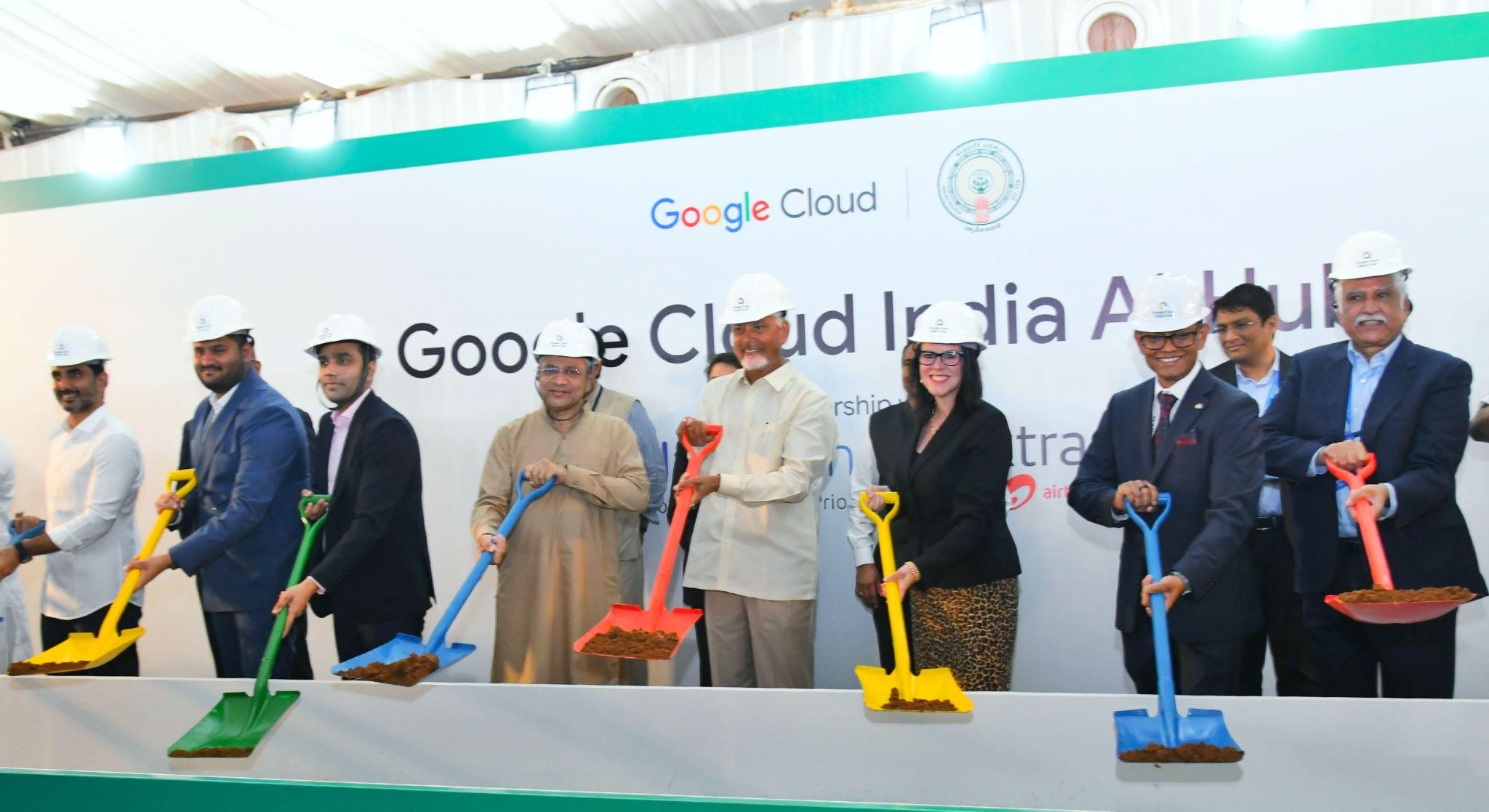
The groundbreaking ceremony, celebrated together with AdaniConneX and Nxtra by Airtel, took place at Tarluvada, Andhra Pradesh, with key dignitaries: Shri Ashwini Vaishnaw, Minister for Railways, Information & Broadcasting and Electronics & Information Technology, Government of India; Shri Nara Chandrababu Naidu, Hon’ble Chief Minister of Andhra Pradesh; Shri Nara Lokesh, Hon’ble Minister for Information Technology, Electronics and Communications, RTG and HRD, Government of Andhra Pradesh; Shri Bikash Koley, Vice President, Google Cloud; Shri Karan Adani, Director, Adani Group; Shri Jeet Adani, Director, Adani Group; and Shri Rakesh Mittal, Vice Chairman, Bharti Enterprises.
From L to R
- Shri. Nara Lokesh – Minister for HRD ITC&E and RTG, Government of Andhra Pradesh
- Shri. Jeet Adani Garu – Chairperson of Adani Group
- Shri. Karan Adani – Managing Director of Adani Ports & SEZ
- Shri. Ashwini Vaishnaw Sir – Hon’ble Union Minister for Railways, Information & Broadcasting, Electronics and Information Technology, Govt. of India
- Shri. Nara Chandrababu Naidu – Hon’ble Chief Minister, Government of Andhra Pradesh
- Smt. Laura Williams Garu – U.S. Consulate General
- Shri. Bikash Koley Garu – Vice President of Google Global Infrastructure, Google Cloud
- Shri. Rakesh Mittal Garu – Vice-Chairman, Bharti Enterprises
Shri Ashwini Vaishnaw, Hon’ble IT Minister, Government of India:
“The groundbreaking ceremony of India AI Hub in Visakhapatnam reflects Hon’ble Prime Minister Narendra Modi Ji’s vision of making India a global leader in technology. Thanks to the support and commitment of Hon’ble Chief Minister of Andhra Pradesh, N. Chandrababu Naidu Ji, in realising this vision.The India AI
Hub and three subsea cables landing in Visakhapatnam will become very important infrastructure for the country’s journey forward.
Thank you Google for your continued trust in India.”
Shri N. Chandrababu Naidu, Chief Minister of Andhra Pradesh:
“Andhra Pradesh is emerging as India’s premier investment destination, powered by speed, trust, and ease of doing business. Google’s AI hub in Visakhapatnam will be a cornerstone of our growing tech corridor, driving innovation, creating high-value opportunities for our youth, and strengthening our position in the global digital economy. Our vision goes beyond attracting investment – we want local talent, startups, and enterprises to become active partners in this technology-driven growth story. With the strong support of the Central Government and in line with the vision of a developed India, this partnership with Google reflects our commitment to combining cutting-edge innovation with inclusive growth, ensuring opportunities reach every community across Andhra Pradesh.”
Thomas Kurian, CEO, Google Cloud:
“Today’s groundbreaking is a powerful realization of our shared vision with the Indian government, and an inflection point for the country’s AI-native future. Together we are laying the foundation for Viksit Bharat, and opening new doors for economic opportunity nationwide. The Google AI hub will serve as a catalyst for growth built on deep community partnerships.”
Jeet Adani, Director, Adani Group:
“India’s AI moment will be defined by infrastructure. What we are building in Visakhapatnam, nearly 1 GW in a single location, signals that shift. When energy becomes more affordable and increasingly powered by clean sources, intelligence becomes more accessible and that is how India will lead the next phase of digital growth.”
Gopal Vittal, Executive Vice Chairman, Bharti Airtel:
“Through our strategic partnership with Google and Adani to build this landmark AI hub, we will help advance India’s digital ambitions. With Visakhapatnam emerging as a new hub on the world’s AI map, we will ensure that India sets the pace for innovation, and sustainable growth, not just for our people, but for the whole world. Our full stack of best-in-class data centers, use of green power, pan-India ultra-low latency fiber and a next-gen cable landing station will enable large-scale, world-class AI infrastructure in Vizag.”
A US$15 Billion Blueprint for “Viksit Bharat”
Today’s groundbreaking marks a significant milestone in Google’s $15 billion investment over five years (2026-2030) to establish a comprehensive AI ecosystem in India, designed to be an important contributor to the government’s Viksit Bharat 2047 vision.
First announced in October 2025, this project includes India’s first gigawatt-scale AI hub comprising three data center campuses. AdaniConnex and Nxtra by Airtel will lead the construction of the data center buildings and connecting infrastructure, enabling Google to deploy advanced AI capabilities and scale digital services across India.
The AI hub also comprises the America-India Connect initiative for an expanded fiber-optic network; and a long-term clean energy strategy that prioritizes bringing new clean energy supply to the electricity grid, accelerating India’s national goal of reaching 500 GW of non-fossil fuel capacity by 2030.
The AI hub will deliver the high-performance, low-latency services that businesses and organizations need to build and scale their own AI-powered solutions, accelerate research and development, and ultimately help India secure its place as a global leader in the AI-driven future.
Driving Multi-Generational Impact and Community Resilience
Beyond technical and industrial significance, the Google India AI hub represents a long-term investment in local job training, community projects, and the responsible stewardship of shared resources.
Everywhere it operates, Google takes a community-first approach that translates global investment into local opportunity. In Vizag, Google conducted a thorough community
impact assessment based on community consultations to guide its investments well before beginning construction.
Today, Google announced a comprehensive set of community development initiatives to protect natural resources and economic security in Visakhapatnam:
- Securing Water Futures: In line with its commitment to water stewardship, Google is partnering with Sponge Collaborative to launch an integrated watershed management and community empowerment plan that addresses existing hydrological stress and coastal ecosystem sensitivities around its data center campuses. This will also link watershed restoration with community needs such as integrating clean drinking water systems like reverse osmosis plants and ‘Water ATMs,’ while enhancing resilient livelihood opportunities in local agriculture and fisheries.
- Modernizing Maritime Trades: Integrating traditional maritime practices into the digital economy is a vital step toward long-term economic security for coastal residents. Through a strategic partnership with the Sambhav Foundation, Google is launching a program to equip over 1,000 individuals from the fishing community with GPS navigation and weather-forecasting applications to enhance safety and operational efficiency, and provide training in cold-chain management and value-added processing. The program also aims to bridge the digital divide by facilitating
UPI-based financial literacy and streamlining enrollment in marine welfare schemes.
- Empowering Grassroots Innovation: Working with ChangeX, the Google Udaan India Fund provides direct grants to local schools and social enterprises to advance community projects in the Visakhapatnam Metropolitan Region. These projects include AI-led skilling labs, digital literacy programs, local entrepreneurship, and climate-focused interventions.
- Scaling Women-Led Enterprises: In collaboration with the Learning Links Foundation, Google is introducing the NARI Shakti program to support women from low-income backgrounds in building sustainable livelihoods and achieving long-term financial self-reliance. This incubator program focuses on transitioning home-based work into a stable source of income for 10,000+ existing and aspiring entrepreneurs. By providing targeted training in financial literacy, business planning, and digital tools, the initiative equips participants with the essential resources needed to successfully establish and grow their own micro-enterprises.
- Building a Future-Ready Workforce: As Visakhapatnam grows into a major digital hub, Google is introducing the Skills Trade and Readiness (STAR) program to create sustainable career paths for local talent while developing a homegrown workforce ready to drive India’s digital acceleration. With hands-on training in high-demand fields like construction, welding, and facility operations, the program aims to prepare more than 1,000 people in the local workforce for vital roles in developing the city’s digital infrastructure. To support long-term career success, the initiative integrates employability coaching and an AI Literacy Mission. In tandem, Google is partnering with ICT Academy to train 1,200+ local students and educators to gain access to specialized tracks in cloud computing and generative AI.
As development of the Google India AI hub progresses, these and other new community-centric programs will continue to scale in direct response to evolving regional needs. This commitment ensures localized investments transcend immediate infrastructure requirements to drive sustainable, generational impact across Andhra Pradesh.
Building India’s AI Industrial Corridor: The Bharat AI Shakti Conclave
The groundbreaking ceremony was accompanied by the Bharat AI Shakti Conclave, a first-of-its-kind conference organized in strategic partnership with the Government of Andhra Pradesh and the Hon’ble Minister Shri Nara Lokesh. The Conclave served as a unique platform for convening suppliers, industry partners, and infrastructure stakeholders to explore how to translate and accelerate Google’s anchor investment into a tangible economic value chain for the region.
Themed ‘Collaborating to Deliver India’s AI Corridor,’ the Conclave reflects a deliberate industrial strategy: Google’s investment in Visakhapatnam is designed not only to build world-class infrastructure, but to catalyze a broader technology ecosystem that multiplies the benefits to the local economy. From prioritizing a local-first procurement approach for vital infrastructure activities, to integrating local small and medium enterprises (SMEs) under Google’s global safety and operational frameworks, the project aims to facilitate capacity building and effectively raise the competitiveness of regional industry players for future large-scale infrastructure work.
28, Apr 2026
AVer Unveils Next-Generation Matrix Tracking Box, Redefining Simplicity in Multi-Camera Production for High-Impact Venues
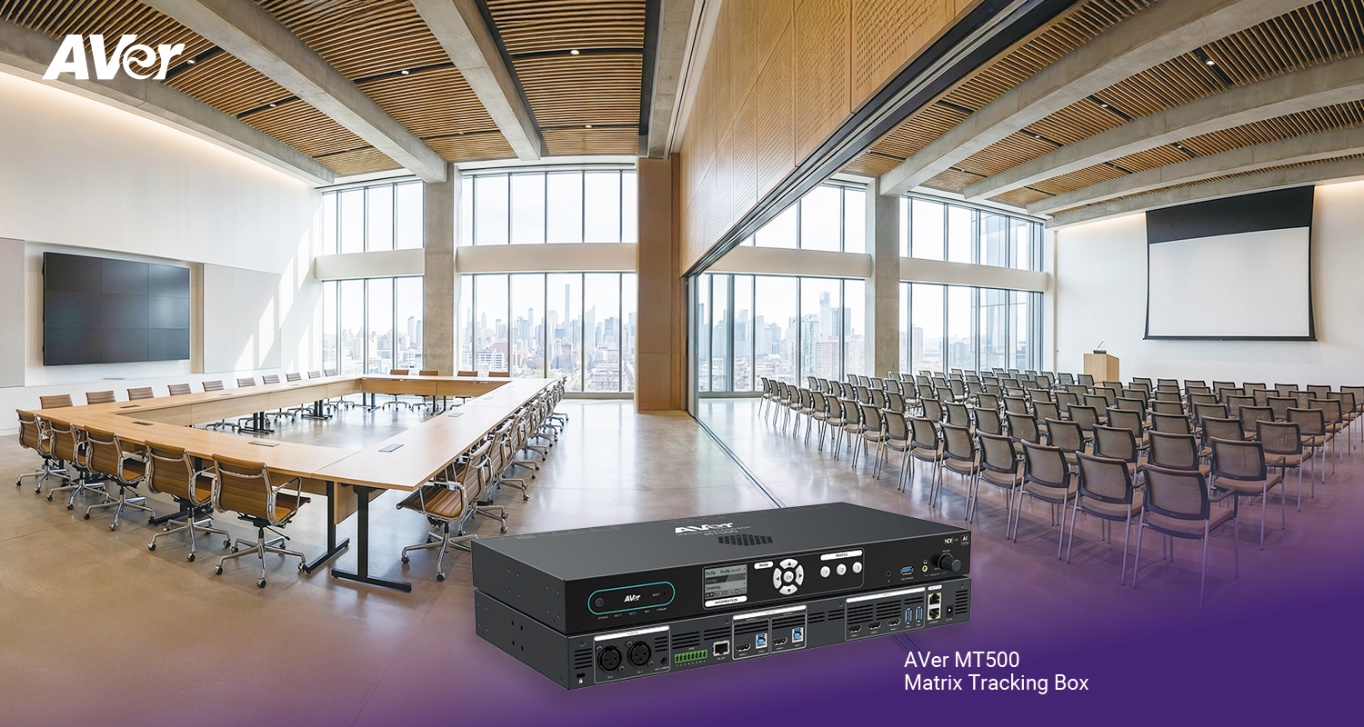
Taipei, Taiwan – Apr 28: AVer Information Inc., an award-winning provider of AI audio-video solutions, announces the MT500 Matrix Tracking Box, designed as the successor to the industry-favorite MT300 to empower venues like large lecture halls, government chambers, and corporate boardrooms to manage multi-camera setups effortlessly. With native Dante AV-H1 and NDI® support2, the MT500 removes the “cable mess” of traditional Pro AV, allowing high-quality video and audio to travel over a single standard network cable. Besides, the MT500 delivers dual 4K video outputs for simultaneous lecture capture and in-room display alongside hassle-free AI features. This new addition to AVer’s line of Matrix Tracking Boxes is a remarkable all-in-one device that delivers seamless, high-impact communication.
Multi-Camera Tracking and Switching for Higher Engagement
With built-in PTZ Link Premium, the MT500 connects AVer cameras to 8 world-leading microphone brands together to create synchronized Voice Tracking while intelligently switching between diverse camera angles based on voice location, always providing the best angle of the active speaker. It employs AI algorithms to understand the “flow” of a conversation, switching angles naturally to maintain visual interest.
AI-Driven Automation for Minimized Manual Effort
The MT500 incorporates a suite of AI features to ensure a clear and professional visual experience for every participant. By automating focus, switching, and configuration, FaceFocus, IntelliSwitch, and InstaConfig3 provide zero-touch multi-camera adjustments. Together, these innovations strengthen operational efficiency by eliminating manual technical setups and reducing the configuration time required for complex hybrid environments.
Key Benefits at a Glance
The MT500 Matrix Tracking Box redefines how organizations approach multi-camera environments by prioritizing ease of use and professional results. Key benefits include:
- Operational Efficiency: Eliminates the need for a dedicated human operator through fully automated AI tracking and switching.
- Versatile Distribution: Serves two audiences at once with dual-output streams for simultaneous in-room and remote viewing.
- Seamless Integration: Reduces technical overhead by unifying NDI®, Dante®, and local audio mixing into a single, compact hub.
- Optimal Visual Engagement: Ensures remote participants feel included with broadcast-quality, and the most professional angle of every speaker.
- Long-Term Peace of Mind: Drives higher student retention and stronger corporate alignment backed by AVer’s industry-leading 5-year warranty.
28, Apr 2026
Google Cloud AI Hub Launched in Visakhapatnam to Boost India’s AI Push
Visakhapatnam, Apr 28 (BNP): Union Electronics and IT Minister Ashwini Vaishnaw attended the groundbreaking ceremony of the Google Cloud India AI Hub in Visakhapatnam on Monday, marking a major milestone in India’s expanding digital infrastructure ecosystem.

The new facility, being developed by Google, is expected to strengthen artificial intelligence capabilities, cloud computing infrastructure, and data-driven innovation in the country.
Speaking at the event, Vaishnaw highlighted India’s growing digital transformation journey and compared Visakhapatnam’s emerging role in AI to Hyderabad’s evolution into a global IT hub. He noted that just as Cyberabad became synonymous with India’s IT services growth, Visakhapatnam could evolve into a major AI centre in the future.
He described the city’s development trajectory as a significant step toward building a strong “AI and data hub ecosystem” in India, supported by advanced infrastructure and global technology partnerships.
Officials said the AI hub is expected to boost investment in high-end technology infrastructure, create new employment opportunities, and support innovation across sectors such as cloud services, artificial intelligence, and digital platforms.
The initiative is also seen as part of India’s broader strategy to position itself as a global leader in emerging technologies and strengthen its digital economy under the vision of expanding AI-driven growth across major cities.
28, Apr 2026
OptOps AI Delivers Massive Kubernetes Savings with Zero Production Risk
Gurugram, Aprl 28: OptOps.ai today announced the official launch of its autonomous Kubernetes cost and performance intelligence platform, designed to help enterprises reduce cloud waste while maintaining full control and zero production risk.
As Kubernetes adoption continues to grow globally—powering a majority of production containers—enterprises are facing rising cloud costs, with a significant portion attributed to inefficiencies and over-provisioning. OptOps addresses this challenge by combining real-time AI analysis with a safety-first, advisory-driven optimization model.
Redefining Cloud Cost Optimization
Unlike traditional FinOps tools that provide retrospective insights or require deep infrastructure access, OptOps delivers:
- Real-time detection of cost leakages
- Actionable optimization recommendations
- Single-click automation with full user control
The platform ensures that organizations can optimize infrastructure without compromising stability or security.
Leadership Commentary
Prince Khanna, CEO of OptOps.ai, said:
“Enterprises today are forced to choose between visibility and control when it comes to cloud optimization. With OptOps, we are redefining that equation by combining AI-driven intelligence with a safety-first approach, enabling real-time cost optimization without compromising stability.”
Ashutosh Dubey, Co-Founder & CTO, added:
“Cloud waste is not just a cost issue—it’s a visibility and intelligence gap. Our platform empowers engineering teams with actionable insights to eliminate inefficiencies while retaining full control over their systems.”
Advanced Architecture for Enterprise Needs
OptOps is built on a lightweight four-layer architecture, including:
- A deployable in-cluster read-only agent (under five minutes)
- An ML-driven optimization engine
- An advisory-first action layer
- An executive dashboard for DevOps and business teams
The platform operates without accessing sensitive data or impacting production workloads, ensuring zero production risk.
Driving Efficiency and ROI
Key capabilities include:
- Real-time anomaly detection
- Pod rightsizing and node-level optimization
- Automated insights to reduce manual intervention
- Rapid ROI, often within the first week of deployment
By eliminating the need for constant monitoring and manual tuning, OptOps enables teams to focus on innovation while improving infrastructure efficiency.
A New Era in DevOps & FinOps
With a value-based pricing model aligned to customer savings, OptOps.ai positions itself at the forefront of next-generation cloud management where automation, intelligence, and trust are critical to scaling modern infrastructure.