


10, Apr 2026
AI and Industry Collaboration Drive BIMTECH’s Future-Ready Education Push
The Birla Institute of Management Technology (BIMTECH) is positioning itself as a future-focused business school by combining global exposure, industry partnerships, and technology-driven learning to prepare students for evolving management careers.
At the centre of this transformation is the leadership vision of Dr. Prabina Rajib, Director of BIMTECH, who has emphasised building an institution rooted in innovation, industry integration, student development, and global engagement.
A key milestone in this journey is BIMTECH being recognised as a 2026 AACSB Global Impact Award winner for its “AI-Enabled Interview Mastery” initiative. The project, honoured in the Teaching & Learning Excellence category, uses AI-powered interview simulations to provide students with real-time feedback, helping them improve communication skills and professional readiness.
Beyond digital learning tools, the institute is expanding its global footprint through international academic collaborations, including programmes with Singapore Management University. It has also strengthened ties with industry leaders such as Swiss Re and UNIQLO, offering students direct exposure to real-world business environments.
BIMTECH has further enhanced experiential learning through facilities like the Bloomberg Financial Markets Lab and a Centre of Excellence established with Hexalog Technologies. These platforms allow students to work with industry-standard tools and engage in applied, hands-on problem-solving.
Officials said these initiatives are helping the institute strengthen key academic performance areas, including teaching quality, research output, industry engagement, and graduate outcomes. Over time, this approach is expected to improve BIMTECH’s national rankings and global academic reputation, positioning it as a modern benchmark in management education.

- 0
- By Neel Achary

10, Apr 2026
CasaDigi Launches Indore Centre Focused on Immersive Smart Home Technology
Indore, Apr 10 (BNP): CasaDigi, a global player in luxury residential intelligence, in partnership with DigiValet, has inaugurated its flagship Experience Centre in Indore, marking a major step in showcasing advanced integrated automation across residential, hospitality, healthcare, and commercial spaces.
Designed by reD Architects, the new centre introduces an immersive concept titled “Maestro of Immersive Design,” aimed at redefining how smart environments are experienced and understood.
Unlike a conventional showroom filled with screens and interfaces, the Indore Experience Centre has been developed as a fully functional interactive space. It demonstrates how intelligent systems can operate seamlessly in the background, enabling a more intuitive and fluid user experience.
The company said the philosophy behind the centre is to shift from reactive automation to proactive intelligence, where technology anticipates user needs rather than simply responding to commands.
Visitors to the centre can experience real-time applications of smart automation in living spaces, highlighting how integrated systems can enhance comfort, efficiency, and convenience.
CasaDigi noted that the launch represents a significant milestone in its vision to transform modern living through intelligent, design-driven technology solutions.
10, Apr 2026
SK Telecom Signs MOU with Arm and Rebellions for Next-Generation AI Infrastructure Innovation
Seoul, Korea, Apr 10 – SK Telecom (NYSE: SKM, hereinafter referred to as “SKT”) announced that it has signed a Memorandum of Understanding (MOU) with Arm and Rebellions to drive innovation in next-generation AI infrastructure.
Through this agreement, the three companies will jointly develop a solution that combines Arm’s newly launched AGI CPU and Rebellions’ upcoming RebelCard™, scheduled for release in the third quarter of this year, to enhance AI inference performance. The solution will be tested and verified in SK Telecom’s AI data centers.
Arm AGI CPU is optimized for high-density inference environments and large-scale AI deployment. Rebellions’ ‘RebelCard™’ is an AI accelerator chip specialized for large-scale AI inference. Recently, heterogeneous computing architectures that combine CPUs and AI accelerator chips are gaining significant attention in the AI server market. In this structure, the CPU handles general-purpose computing such as data processing and system operation, while the AI accelerator chip is dedicated to AI inference computation.
Compared to GPU-based servers, this architecture offers higher power efficiency and processing efficiency for AI inference tasks, as well as reduced operating costs. As a result, it is recognized as an efficient server architecture for data centers running large-scale AI services.
SKT plans to deploy servers equipped with this solution in its AI data centers to validate performance and stability. In particular, the company is reviewing the possibility of operating its sovereign AI foundation model, A.X K1, on these servers. Through this collaboration, SKT aims to secure low-power, high-efficiency AI inference infrastructure and further strengthen its competitiveness in the AI data center business.
Arm is a leading AI compute platform powering the world’s most advanced technologies. While Arm has traditionally focused on chip design, the company on March 24 announced the launch of its first Arm-designed silicon, Arm AGI CPU — a data center CPU optimized for high-density inference environments and large-scale AI deployment.
In March, at the “Arm Everywhere” event, Arm and Rebellions combined their respective chips to deliver a live demonstration of an agentic AI service based on OpenAI’s GPT OSS 120B, highlighting the potential applicability of this heterogeneous CPU–accelerator architecture to large-scale data center workloads.
Lee Jae-shin, Head of AI Business Development at SK Telecom, said, “By offering a full package that combines infrastructure optimized for inference with our sovereign AI foundation model A.X K1, we will further enhance the competitiveness of our AI data centers.”
Eddie Ramirez, Vice President of Go-to-Market, Cloud AI Business Unit, Arm, said, “The rapid growth of AI inference is driving demand for new data center infrastructure designed for large-scale deployments. Partners like SK Telecom and Rebellions played an important role in helping us build the Arm AGI CPU and modernize AI inference infrastructure.”
Oh Jin-wook, CTO of Rebellions, said, “By providing our ‘RebelCard’—which offers overwhelming performance and power efficiency—alongside our full-stack software, Rebellions has become a core pillar supporting next-generation AI data centers. We expect this ‘one-team’ collaboration of experts to serve as a significant precedent in the industry for building AI-specialized infrastructure.”
9, Apr 2026
Aviation Safety Concerns Slow 5G Deployment Near Indian Airports
New Delhi, Apr 9 (BNP): The deployment of 5G networks in India is encountering challenges due to potential interference with older aircraft radio altimeters, which are critical for safe landings. Some legacy altimeters are not compatible with 5G signals and could also face issues with future 6G networks operating in the upper C-band (4.4–4.8 GHz).
Bharat Bhatia, president of the ITU-APT Foundation of India, which collaborates with the government and industry on telecom policies, said that replacing these older altimeters is the only long-term solution. However, the process could take time due to similar replacement demands in other developing countries.
Currently, regulatory rules in India restrict 5G operations near airports: within 2.1 km of runway ends and 910 metres of the runway centerline, covering the terminal areas of most Indian airports. These measures aim to prevent interference and ensure aviation safety while 5G networks continue to expand.
Officials emphasized that coordinated efforts between telecom providers and aviation authorities are essential to maintain both technological growth and flight safety. Upgrading aircraft altimeters will be a gradual process, balancing the country’s push for faster networks with aviation requirements.
9, Apr 2026
QNu Labs Validates Real-World Performance of ARMOS QKD in Independent Global Study with VIAVI
Delhi, April 09: QNu Labs a global leader in end-to-end hybrid quantum cybersecurity solutions, has announced the findings of a research study conducted in association with VIAVI Solutions, a global leader in network test and measurement. The study leverages VIAVI’s industry-recognised MAP-300 platform to assess the real-world performance and deployment readiness of QNu Labs’ patented, certified and globally deployed Quantum Key Distribution platform, ARMOS.

The study establishes ARMOS as a robust, field-ready solution capable of enabling quantum-safe communication across enterprise and critical infrastructure networks. Evaluated under controlled conditions using VIAVI’s advanced test environment, the system demonstrated secure key generation over distances of up to 200 KM of standard telecom fibre (40 dB loss) without signal amplification, while consistently maintaining Quantum Bit Error Rates below 4 percent, well within safe operating thresholds.
At typical metro distances (~50 km), ARMOS achieved secure key generation rates of up to 8,000 secure bits per second, enabling real-time encryption for high-value data flows. Even at extended ranges of 200 KM, the system sustained performance at approximately 200 secure bits per second, reinforcing its ability to operate reliably across varying network conditions.
A key highlight of the study is ARMOS’ ability to operate seamlessly alongside 10 Gbps classical data traffic on the same fibre, with no measurable degradation to the quantum channel, effectively addressing a major barrier to QKD adoption by enabling integration without network redesign.
The platform also demonstrated strong operational resilience, autonomously detecting and recovering from simulated fibre cuts within minutes, while maintaining stable performance (i.e. self-restored secure key generation) without any manual intervention under real-world conditions such as attenuation and polarisation fluctuations, reinforcing its readiness for large-scale deployment.
Central to this performance is QNu Labs’ proprietary decoy-state Differential Phase Shift (DPS) protocol, which extends operational tolerance to up to 40 dB of channel loss, effectively doubling the transmission range compared to conventional QKD systems without compromising security.
Commenting on the milestone, Mr. Sunil Gupta, Co-founder and Chief Executive Officer, QNu Labs, said,
“As the industry moves closer to a quantum-driven reality, the need for proven, deployment-ready security solutions becomes critical. This validation reflects the depth of engineering and real-world readiness we have built at QNu Labs, with VIAVI’s globally recognised testing environment further reinforcing the robustness of our approach. It demonstrates that quantum-safe communication can be implemented at scale, without compromising on performance or disrupting the existing network architectures.”
Adding to this, Sameh Yamany, Chief Technology Officer, VIAVI Solutions, said,
“VIAVI brings deep expertise in optical, photonics, security, and critical systems testing to accelerate quantum-safe communications into real-world networks. We deliver independent validation with uncompromising rigor so these technologies perform at scale under real telecom conditions. We’re proud to partner with Qnu Labs to validate the ARMOS QKD platform, a key step toward operational, quantum-resilient infrastructure.”
“Quantum security is at an inflection point where intent needs to translate into informed adoption. What this study enables is a shift from abstract promise to demonstrable capability, giving stakeholders the confidence to engage with quantum-safe technologies more decisively. For us, it is equally about shaping how these conversations evolve globally, positioning India-built sovereign indigenous innovation like QNu’s at the forefront of credible, scalable cybersecurity solutions”, said Ms.Sudiptaa Paul Choudhury, Chief Marketing Officer, QNu Labs.
The report also outlines the next phase of research, including testing under higher classical data loads, extended link performance beyond current benchmarks and deeper modelling of hybrid quantum-classical networks. These efforts are expected to support further the development of scalable and deployable quantum-secure communication frameworks.
Developed in India, ARMOS reflects QNu Labs’ continued focus on advancing quantum-safe technologies aligned with both national priorities and global security requirements. The findings from this study mark a significant step in enabling organisations to transition toward quantum-resilient infrastructure with greater confidence.
9, Apr 2026
AVer UE1 & HUB30 Now Compatible with Barco ClickShare for BYOM Meeting Rooms
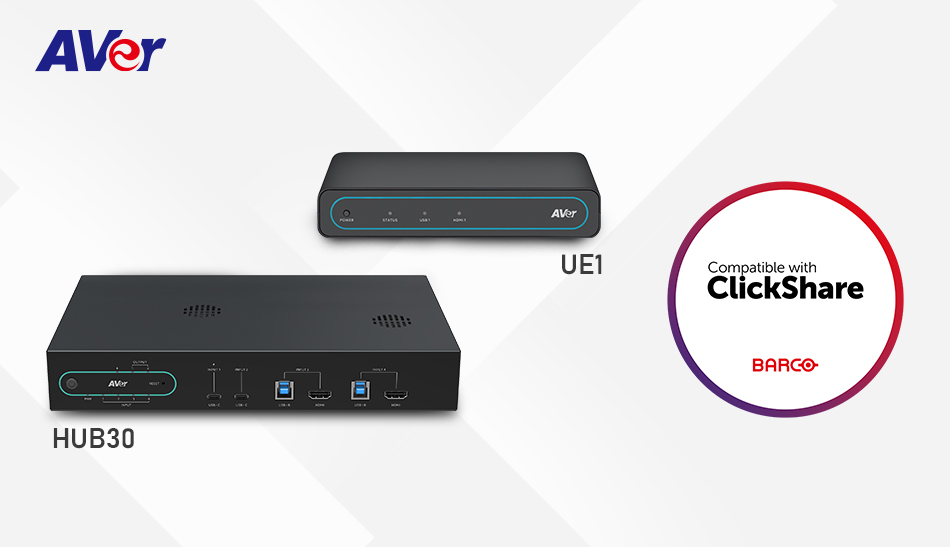
Taipei, Taiwan – Apr 09: AVer Information Inc., an award-winning provider of AI audio-video solutions, today announces that the UE1 USB Extender and the HUB30 4K BYOM Matrix Switcher have officially joined the Barco ClickShare Alliance as Compatible peripherals, providing users with a simple, reliable BYOM meeting room solution. Listed under Barco’s “USB-Hub/Switch/Extender” category, these solutions are now validated to provide a stable hardware foundation for Barco’s “Bring Your Own Meeting” (BYOM) wireless ecosystem, helping cameras and peripherals connect instantly when users launch their meetings from their laptop.
Validated Stability for Pro AV Infrastructure In complex meeting environments, the distance between the camera and the ClickShare Base Unit often exceeds standard cable limits, which can lead to meeting delays and the need for additional technical support. By achieving official compatibility, AVer ensures that its connectivity infrastructure maintains the signal integrity and power delivery required for enterprise grade video conferencing, so rooms stay reliable even when devices are spread across large spaces.
- UE1 (Pro AV Camera Extender): As a high-performance USB extender, the UE1 is specifically designed for AVer’s Pro AV and PTZ cameras. It allows integrators to overcome the 5-meter USB cable limit, enabling integrators to place cameras where they capture the best view of participants. This compatibility guarantees that when a user clicks the ClickShare Button, the Pro AV camera at the far end of the room is instantly recognized without latency or signal loss, so meetings begin smoothly without last‑minute troubleshooting.
- HUB30 (BYOM Switcher): The HUB30 acts as a 4×2 Matrix Switcher and the central “brain” of a professional meeting room. It enables intelligent switching between multiple cameras and sources while providing 100W USB-C PD charging to the host laptop. Additionally, its compatibility with ClickShare CX-series units ensures that the complex switching of Pro AV peripherals happens seamlessly in the background.
“While many partners focus solely on the camera, AVer recognizes that the success of a wireless meeting depends on the reliability of the infrastructure behind it,” said David Kuo, President at AVer. “By bringing the UE1 and HUB30 into the Barco ClickShare Alliance program, we are providing IT managers with a validated blueprint for extending Pro AV capabilities into the wireless BYOM era.”
Why Official ClickShare Compatibility Matters for Meeting Rooms
- Validated Interoperability: Rigorous testing ensures that AVer’s extension and switching logic work in harmony with ClickShare’s wireless handshake, so devices show up reliably and meetings start on time.
- Pro AV Scalability: The UE1 allows for large-room deployments where the ClickShare unit and PTZ cameras cannot be co-located, simplifying upgrades to bigger spaces without having to redesign cabling from scratch.
- Intelligent Power Delivery: The HUB30 maintains a “one-cable” experience for the user by managing laptop charging alongside the wireless ClickShare workflow, reducing cable clutter.
Experience the AVer x Barco Integration
Ready to simplify your professional meeting space? Explore how AVer and Barco ClickShare work together to deliver a frictionless BYOM experience, and view our officially compatible USB hubs, switches, and extenders on the Barco ClickShare Alliance Page.
9, Apr 2026
OrbitronAI Launches NovaOS: Governed AI Agents for the Legacy Architecture That Runs Regulated Industry
OrbitronAI has announced the launch of NovaOS, a platform designed to support the deployment and management of AI agents in regulated industries such as aerospace, energy, government and industrial enterprises, enabling organizations to deploy AI within legacy enterprise infrastructure without replacing existing systems.
The system introduces a structured approach to AI operations, focusing on auditability, human oversight, and compliance. NovaOS acts as a control layer on top of existing enterprise systems, allowing organizations to manage how AI agents are deployed and operated without replacing current infrastructure.

“The bottleneck holding enterprises back from AI is not model quality – it is governance, isolation, and operational control,” said Saul Adomaitis, Founder and Global CEO of OrbitronAI. “NovaOS closes that gap. Regulated industries can now deploy AI agents that are fully auditable, human-supervised, and compliant by design – not as an afterthought.”
The platform is architected around a six-layer value stack in which every agent action passes through policy enforcement, approval gates, and a complete audit trail. Human-in-the-Loop supervision is embedded at the platform level: high-risk actions always require human approval before execution.
Core capabilities include a visual workflow builder (NovaOS Studio) with pre-built components and natural-language Copilot, enterprise integrations via Model Context Protocol (MCP) Gateway enabling connection to ERP and CRM systems without custom code, and knowledge and document intelligence (RAG) that turns internal data into actionable insights.
The platform also supports persistent cross-session memory across multiple dimensions, an agent marketplace for managing deployments across business units, and full observability with evidence export, ensuring that all actions are logged, traceable, and audit-ready.
NovaOS supports four deployment strategies – Managed Cloud, Bring Your Own Cloud (AWS, Azure, GCP), On-Premise, Air-Gapped, and Hybrid – with production regions active in Middle East, Europe, and North America. All deployment options include tenant isolation, data residency compliance, and encrypted communication between services.
The platform is AI model agnostic, allowing organizations to run agents on the large language model of their choice without vendor lock-in. The platform is designed for organizations where data sovereignty, SOC 2 and ISO 27001 compliance, and Arabic NLP readiness (roadmap Q3 2026) are strategic requirements.
9, Apr 2026
AAEON’s BOXER-6845-BTL Blends Bartlett Lake Processing with Workstation-Class GPU Support
High-performance GPU support, Intel Core Series 2 processing, and a compact design see AAEON’s BOXER-6845-BTL positioned as a solution for AI inference server, workstation, and robotics applications.
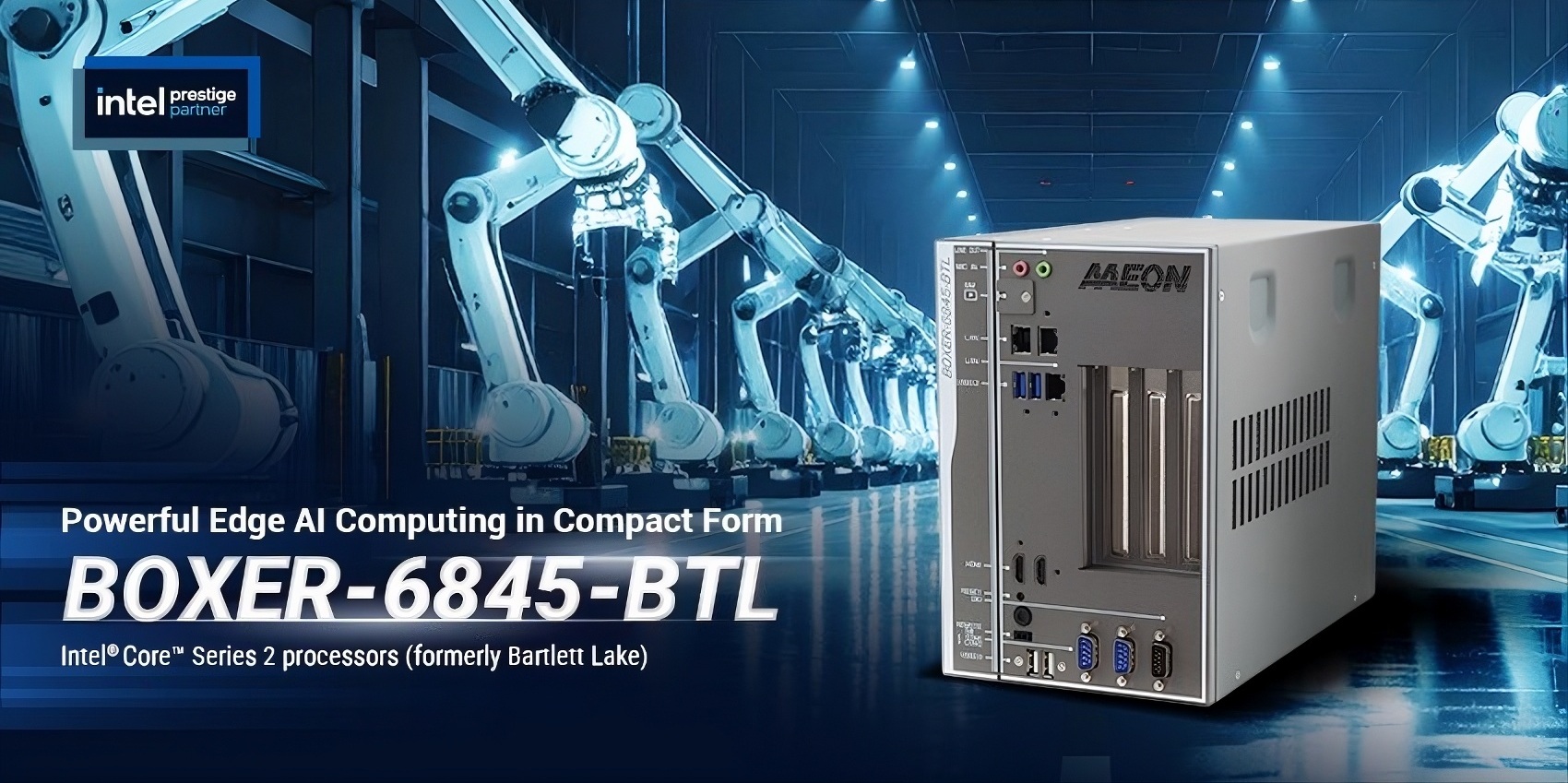
(Taipei, Taiwan – Apr 09) Leading provider of industrial PC solutions AAEON announced the BOXER-6845-BTL, an Expansion Box PC powered by up to 65W CPUs from the new Intel Core Processor Series 2 range (formerly Bartlett Lake), including SKUs with dedicated performance-core architecture.
While the selection of supported processors represents a substantial improvement on previous offerings from AAEON’s Expansion Box PC series, the most noticeable advances can be seen in the BOXER-6845-BTL’s expansion options and compact size. At 150mm x 270mm x 225mm, the BOXER-6845-BTL is 43% smaller than its predecessor, which AAEON has indicated is in response to increasing demand for platforms that can offer high-performance computing while still being suitable for deployment in tight spaces, such as cabinets and mobile robotic units.
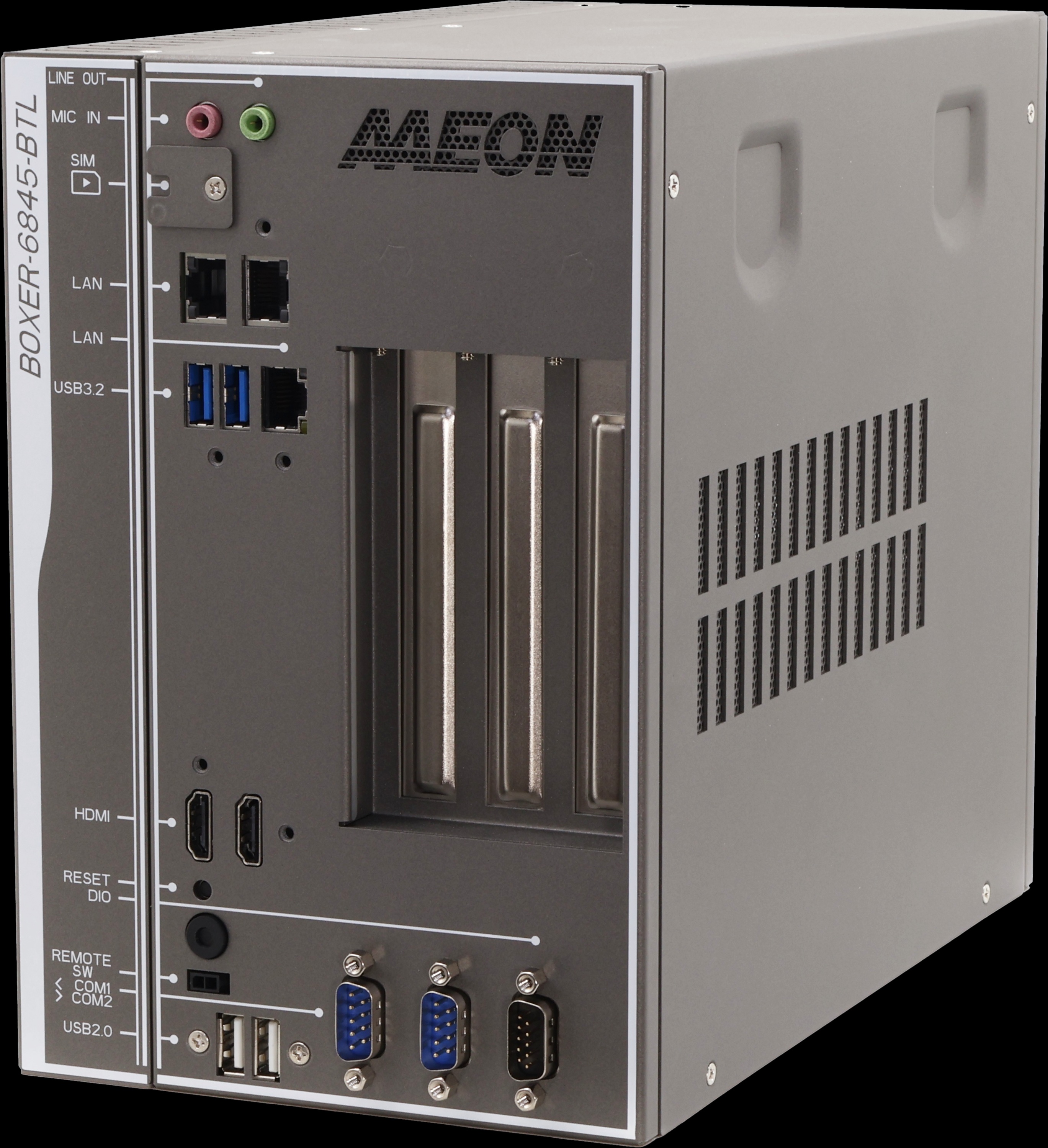
The BOXER-6845-BTL is available in two system SKUs, each equipped with a riser card offering either a PCIe x16 + PCIe x4 configuration (A1 SKU) or a PCIe x4 + PCI slot configuration (A2 SKU). As such, the BOXER-6845-BTL’s A1 model is built to host exceptionally powerful GPUs, such as the NVIDIA RTX PRO 4000 Blackwell SFF Edition, for heavy edge AI inference workloads. Meanwhile, its A2 SKU offers support for legacy PCI cards like motion controllers, frame grabbers, and industrial communication cards.
Additional expansion for Wi-Fi and 5G is available through an M.2 E-Key slot and two M.2 B-Key slots, one of which also offers a front-access Nano SIM slot. For storage, the system is equipped with two 2.5” SATA drive bays with RAID support alongside two M.2 2280 M-Key slots for NVMe. As such, the system is designed to handle both the heavy real-time processing and long-term data retention required by industrial robotics and machine vision applications.
The BOXER-6845-BTL’s I/O features three lockable RJ-45 LAN ports, two USB 3.2 (10 Gbps) ports, two DB-9 ports for RS-232/422/485, as well as a DB-15 port for 8-bit digital I/O. For operating system support, the system is compatible with Windows 10 IoT 2021 LTSC, Windows 11 IoT LTSC, and Ubuntu 24.04.
9, Apr 2026
Sightview Offers ASCRS 2026 Attendees Early Access to Enhanced EHR Solution
New user experience and workflows further advance leading technology for ophthalmologists
Durham, NC — April 9, 2026 — Sightview, the only electronic health record and practice management partner focused solely on eyecare, will offer early demo access to its new flagship EHR platform, named Sightview, at the 2026 ASCRS Annual Meeting. Attendees will get an interactive first look at the enhanced solution, which includes a modern, intuitive design that makes daily operations easier for ophthalmology professionals.
“Sightview is one of the most established technology partners for eyecare, and it’s critical we continue updating our offerings to keep up with the new needs and demands placed on eyecare professionals,” said Tycene Fritcher, CEO of Sightview. “Our new Sightview platform maintains the purpose-built functionality that ophthalmologists rely on, with modernized interfaces and workflows to further reduce frictions in their day-to-day tasks.”
The new solution introduces a cleaner look and feel for Sightview’s end-to-end, ophthalmology-specific EHR and PM offering. Simplified clinical and front-end processes enhance the solution’s existing single-screen exam view and make it easier to access and manage every aspect of the practice. Reimagined on a more agile platform, the new solution natively includes integrations such as automated payments and text-to-pay, clearinghouse support and claims management via TriZetto, and ONC-certified ePrescribe via DrFirst, among others.
“This more unified, streamlined platform has been in the works since my first day at Sightview,” said Fritcher. “We can’t wait for clients to experience our hard work firsthand and play around with a tool that I think will change the game for many eyecare practices across the country.”
Sightview will offer interactive demos of the new Sightview platform, which is expected to be available to existing and new Sightview practices in Q2 2026, in booth #527 at ASCRS Annual Meeting (April 10-13).
9, Apr 2026
Rackspace Technology Appoints Paul Soligon and Marco Tesini to Senior Leadership Roles
SAN ANTONIO, TX | Apr 09 — Rackspace Technology® (NASDAQ: RXT), a leading end-to-end hybrid cloud and AI solutions company, announced the appointments of Paul Soligon as Senior Vice President of Operations and Marco Tesini as Senior Vice President of International for the company’s Private Cloud business unit.
Soligon will be responsible for unifying key operational functions to drive growth and strengthen customer retention. In this role, he will lead Business and Sales Operations as well as Customer Success with a focus on advancing analytics and insights as well as elevating customer experience.
Soligon brings extensive leadership experience from over 25 years in high-growth technology environments. Most recently, he served as Senior Vice President at USAN, where he built and scaled significant new go-to-market partnerships and revenue expansion. Prior to that, he spent nearly a decade at Amazon Web Services (AWS) as Vice President and General Manager of Sales, leading a 700-person organization responsible for more than $2.2 billion in revenue and securing over $4 billion in strategic enterprise agreements.
Tesini will lead all markets outside of the US with a focus on expanding the company’s global presence, deepening customer relationships, and scaling innovative solutions. He brings more than 25 years of experience driving business transformation and profitable growth for leading IT organizations, such as Unisys and Hitachi Vantara. Most recently, Tesini served in senior leadership roles at Hitachi Vantara, where he led large-scale regional turnarounds and consistently delivered double-digit growth.
“Paul and Marco join Rackspace at a moment when demand for a governed, enterprise AI backbone is accelerating faster than most organizations can deliver against it,” said Gajen Kandiah, CEO of Rackspace Technology. He added, “Paul’s experience scaling a multi-billion-dollar business at AWS gives us the operational rigor to match that demand. Marco is a proven growth and turnaround leader who has built and rebuilt international businesses at scale, most recently at Hitachi Vantara. They strengthen our ability to do what the market increasingly needs: put AI into production on governed private cloud with the operational discipline that enterprise customers require.”


