


8, Oct 2026
AAEON Heads to Scanautomatic 2026 to Deliver New Platforms, Demos, and More
Join AAEON at the premier meeting point for industrial automation and digital transformation.

Taipei, Taiwan – Oct 09: AAEON (Stock Code: 6579), a leading Edge AI platform provider, will present a range of new products at Booth #B06:29 of Scanautomatic 2026, held from October 20 to October 22, 2026.
Date: October 20 – October 22, 2026
Booth: #B06:29
Venue: Mässans Gata/Korsvägen Göteborg, Sweden
With the show acting as a cross-industry meeting point, AAEON will join over 250 exhibitors from across the larger automation and industrial digitalization ecosystem. Over the three days, Scanautomatic will also play host to over 60 seminars and feature a broad showcase of over 600 product categories.
Among an array of new products on show at booth #B06:29, visitors will also note a live physical AI-guided defect detection demonstration developed with Awentia’s AVT Physical AI Core. Running on the BOXER-8622AI, a Compact Fanless Embedded AI System powered by NVIDIA Jetson Orin Nano with Super Mode, the application utilizes 3D reconstruction to map product defects in real-time, illustrating the potential that combining machine vision with physical AI has for precision manufacturing quality control.
Throughout the show, AAEON will host a static lineup of products conducive to bringing new capabilities to the automation sphere, including the upcoming UP Display ASL15, the first smart display kit to be released by AAEON’s UP brand. The product, which features an Intel Processor N-series computing base with a 15.6″ projected capacitive multi-touch panel and fully integrated industrial I/O, was released earlier this month and positioned for human-machine interfaces and edge-based industrial automation solutions.
Another particularly interesting platform on show will be the EATX-W890A, a workstation motherboard powered by Intel Xeon 600 processors and equipped with up to seven 16-lane PCIe Gen 5 slots. The board, which will be geared towards more server-grade industrial applications, is expected to be launched during H1, 2027.
AAEON will also present a wealth of additional platforms from across its single-board computer, embedded AI system, and developer board ranges equipped with technologies from leading chip providers such as Intel, NVIDIA, MediaTek, NXP, and Qualcomm.
Visitors are encouraged to join AAEON at Booth #B06:29, where representatives will be available to discuss AAEON’s product roadmap and provide details of the products on display.
- 0
- By Neel Achary

7, Oct 2026
Kore.ai Launches Autoloop, the Optimization Engine That Keeps AI Agents Performing at Production Scale
SAN MATEO, Calif.—October 7, 2026 – Kore.ai, the global leader in enterprise AI platform and agentic applications, today announced general availability of AutoloopTM, the optimization engine of the Kore.ai Agent Platform, Artemis edition. Enterprises set the goals. Autoloop builds the agents, measures them against those goals, and keeps optimizing them automatically, from first draft through production. The launch marks a shift in how enterprise AI is run: from agents tuned by hand to those that self-improve against the goals set by the business.
Today, most enterprises maintain agents through a cycle of fixing individual failures, and a fix for one problem often creates another. The cost of that approach is now measurable: the 2026 Kore.ai Agent Productivity Index found that 79% of enterprises have reversed an action taken by an AI agent, and 70% have faced a failure their teams could not trace. However, the industry is shifting, and Gartner predicts that by 2030, autonomous learning techniques will be present in a majority of AI agents, up from less than 5% in 2026.
“Every enterprise knows what it wants from its agents: finish the job, follow the rules, stay safe, and do it at a sensible cost,” said Raj Koneru, Founder and CEO of Kore.ai. “With Autoloop, your agents keep improving against the goals you set. The companies that scale AI will be the ones using AI to build, govern, and optimize AI.”
Autoloop starts from goals, not prompts. Teams define what success looks like across the dimensions that matter to the business, and Autoloop optimizes against all of them at once:
- Task completion: the agent finishes what the user came to do, handing off to a human only when it should.
- Accuracy and grounding: every answer is correct and backed by the enterprise’s own data, with no fabricated facts.
- Business-rule adherence: complies with policies, eligibility checks, and limits on every interaction.
- Guardrails and safety: no data exposure, off-policy actions, or unsafe responses.
- Consistency: consistent behavior across phrasings, languages, channels, and edge cases.
- End-user experience: fewer turns, less repetition, and lower latency across chat and voice.
- Cost efficiency: the same outcome with fewer, faster, and more affordable model calls and tokens.
Against these goals, Autoloop runs one continuous loop spanning: build, evaluate, diagnose, optimize, and re-verify. Before launch, it builds the agent and its test coverage from the enterprise’s own operating procedures and iterates until the agent meets every goal. In production, real interactions start new optimization cycles. Every change is scored against all goals at once, so a gain on one, such as lower token spend, cannot quietly hinder another, such as task completion or safety.
Automatic optimization requires complete visibility into agent activity and control over how they change. Two Kore.ai innovations give Autoloop these capabilities:
- StateTrace delivers the visibility, evaluating agents against their full production execution context. It traces every handoff, delegation, state, tool call, and piece of context across the agent network, so Autoloop knows where and why a goal was missed. A patent-pending five-layer validation architecture makes most checks deterministic, which keeps continuous optimization affordable at enterprise scale.
- Agent Blueprint Language (ABL) delivers the control by compiling supervision, routing, handoffs, delegation, tools, business rules, and guardrails into an executable state machine. Every step in a trace maps back to the blueprint, so Autoloop changes exactly the part that caused the miss, and nothing else.
Kore.ai runs the same discipline on its own engineering, where AI agents now produce roughly 6,500 commits a month on a production codebase of 2.6 million lines, governed by 68 always-on guardrails.
“You can’t optimize what you can’t see, or fix precisely what you can’t express precisely,” said Prasanna Arikala, Chief Technology Officer and Chief Product Officer at Kore.ai. “StateTrace lets Autoloop see exactly what agents did, and ABL allows it to change anything that needs changing. These are the technologies that make automatic optimization a reality.”
Today’s launch extends the ground Kore.ai has staked out in the market. Much of the industry sells tools that create agents, or control layers added after the fact. Kore.ai builds the harness: a single layer that builds, deploys, manages, and optimizes enterprise AI agents, with governance defined from the first line. Autoloop completes it, because only an agent built and governed in one layer can be optimized in that same layer, automatically and with evidence.
7, Oct 2026
Zapata Quantum Joins IBM Quantum Network to Accelerate Mission-Driven Quantum Application Development
Effort builds on prior collaboration to translate high-value use cases into practical applications running on IBM quantum computers
BOSTON, Massachusetts – October 7, 2026 – Zapata Quantum (OTCQB: ZPTA) (“Zapata” or the “Company”) today announced it has joined the IBM Quantum Network with plans to use IBM’s world-class quantum computers with Zapata’s deep expertise in use-case discovery and application development. The Company’s effort aims to help close the quantum application gap by translating advances in quantum computing into mission-critical applications and real-world impact.
“The rapid progress IBM is making on the path to fault-tolerant quantum computing brings the quantum application gap into sharper focus,” said Sumit Kapur, CEO of Zapata Quantum. “These advances must be matched by progress in identifying, evaluating and developing the applications that will deliver real-world value. We are excited for Zapata’s Quantum Application Intelligence™ to translate organizations’ highest-mission priorities into practical quantum applications.”
“IBM’s roadmap to fault-tolerant quantum computing is one of the most credible in the industry, and superconducting qubits remain one of the most capable paths to advantage because their hardware is fast,” said Jonny Olson, VP Strategy and Co-Founder of Zapata Quantum. “Joining the IBM Quantum Network lets us better identify valuable opportunities for organizations that need the fastest systems, and then prepare those organizations for the precise moment that quantum gives them real ROI.”
Joining the IBM Quantum Network builds on a history of joint IBM and Zapata research done on early quantum devices. Zapata used IBM quantum computers in a landmark study published in Nature Biotechnology that produced experimentally validated candidates targeting KRAS and was selected as one of the journal’s Top 10 Articles of 2025.¹ Scientists from the two companies also co-authored research published in npj Quantum Information, which advanced the understanding of variational quantum factoring on a superconducting processor.2
Being part of the IBM Quantum Network also reflects Zapata’s broader strategy of working with technology leaders across the quantum and AI ecosystems. Insights from being part of the IBM Quantum Network will inform Quantum Pilot™, Zapata’s hardware-agnostic platform that helps enterprises identify, prioritize, and develop quantum applications as hardware matures.
7, Oct 2026
Riverain Technologies Expands Access to ClearRead™ Advanced Chest Imaging AI Through RapidAI’s Enterprise Platform
ClearRead Chest integration extends Riverain’s clinically proven cardiothoracic AI suite of solutions through a unified enterprise workflow designed to reduce fragmentation and accelerate action
MIAMISBURG, Ohio, October 7, 2026 — Riverain Technologies, a leader in cardiothoracic imaging AI, today announced that its FDA-cleared ClearRead™ Chest suite will be available through RapidAI, a global leader in enterprise clinical AI, via its Rapid Enterprise™ Platform. The integration expands access to Riverain’s advanced lung and cardiac imaging intelligence within RapidAI’s connected enterprise platform, helping radiologists identify subtle findings, reduce cognitive burden, and move from imaging insight to clinical action with less workflow friction.
Designed for chest CTs and X-rays, ClearRead Chest is a cardiothoracic AI suite that helps radiologists detect, characterize and visualize pulmonary nodules, pneumothoraces, and coronary artery calcification (CAC). Riverain’s patented vessel and bone suppression technology provides an unobstructed view of the lungs to improve visualization of nodules and other pathology. The ClearRead Chest suite delivers clinically proven accuracy and time-saving insights within radiologists’ existing workflows, helping ease cognitive burden and support more confident decisions.
Riverain develops clinically validated cardiothoracic imaging technology designed to help radiologists see, detect, characterize, and report subtle findings more clearly. Integrating ClearRead Chest into RapidAI’s connected platform extends the technology into an enterprise environment that unifies imaging intelligence, clinical workflows, and patient management, helping health systems scale AI without adding separate systems or operational complexity.
ClearRead Chest integrates into the Rapid Enterprise Platform, including its Rapid Edge Cloud™ infrastructure, the Rapid Navigator Pro™ radiology workflow solution, RapidAI’s mobile and web applications, and its AI governance capabilities. The integration will create a secure, interoperable experience across PACS, EHR, and reporting systems, allowing health systems to deploy Riverain’s cardiothoracic imaging intelligence while maintaining workflow consistency and enterprise-grade infrastructure.
“ClearRead was developed to help radiologists see subtle chest findings more clearly and confidently within the workflows they already rely on every day,” said Steve Worrell, CEO of Riverain Technologies. “By integrating ClearRead Chest into the Rapid Enterprise Platform, we’re expanding access to our advanced chest imaging technology to support earlier detection of leading global killers like lung cancer, and cardiovascular disease and reduce the burden on radiologists facing increasingly complex imaging workloads.”
Through the integration, Riverain’s ClearRead Chest suite will be available to RapidAI’s install base of more than 2,500 hospitals. The collaboration gives Riverain a broader path to scale advanced cardiothoracic imaging intelligence across health systems while allowing customers to access Riverain and RapidAI solutions through one connected workflow.
For Riverain, the collaboration advances its mission to reduce delayed cardiothoracic diagnoses by bringing ClearRead Chest to more radiologists within the systems they use every day. For RapidAI, the integration expands its enterprise imaging ecosystem with clinically validated third-party AI for lung and cardiovascular disease, building on its full-body portfolio.
7, Oct 2026
MedScout Launches Scout AI and the MedScout MCP to Advance Commercial Intelligence for MedTech Teams
Scout AI builds target lists, briefs, outreach and routes inside MedScout, while the MedScout MCP brings that intelligence into Claude, Copilot, Gemini and ChatGPT.
AUSTIN, Texas (October 7, 2026) – MedScout, the commercial engine for MedTech, today announced the launch of Scout AI, which turns data and insights into complex analyses, target lists, meeting briefs, physician outreach and daily routes reps can work the same day. Scout AI puts that intelligence to work inside MedScout, and the MedScout MCP brings it into Claude, Copilot, Gemini and ChatGPT.
Scout AI takes manual, time-consuming tasks, like building target lists and prepping for meetings, and does the work in seconds. A rep can ask for the top providers in a given city on a given day, and Scout AI identifies the providers, determines where each is likely to be, and builds and optimizes a route in one step. Scout AI draws on MedScout’s data covering procedure volume, referral patterns, payer mix, reimbursement, sites of care and industry payments to build the workflow.
Teams can use Scout AI to:
-
Size a market before making a move, from deciding where the next rep should go to backfilling a role, with volume trends, payer mix, site of care, and reimbursement for one territory or two side by side.
-
Find best-fit providers that meet every targeting criterion at once, such as surgeons performing robotic procedures at hospitals but not at the system-affiliated ASCs, with no payments from a named competitor
-
Map referral networks and patient journeys to see who sends a provider their patients and where those patients go next
-
Build routes ordered around drive time and the days providers are actually on site.
-
Draft personalized outreach that providers are more likely to respond to, citing trends in their market, where referrals are going, and more.
-
Get pre-meeting briefs on a provider’s procedures, patient population, affiliations and payer mix, framed around how to approach them.
“For the past five years, we’ve worked hard to deeply understand our customers: their products, their teams, their strategies, and the impact they have on people’s lives,” said Skylar Talley, co-founder and CEO of MedScout. “MedScout.AI builds everything we’ve learned into software that actually does the work for commercial teams and delivers insights wherever they need them. I’m grateful to the more than 20 design partners who helped us build it. By this time next year, I believe our customers will think of Scout as a teammate, not a tool.”
The MedScout MCP connects MedScout to the AI platforms commercial teams already work in, including Claude, Copilot, Gemini, and ChatGPT. It is built for teams that want to combine MedScout’s market data with their own CRM, ERP, billing or pricing data, such as finding high-volume providers who aren’t in the CRM yet, or target accounts that haven’t had a billing event. MedScout Strategies, code sets, territories and permissions carry through the connection, so teams get the same governed answers in either place.
“With the MedScout MCP, our team pulls market insights right into Claude, where they accelerate quality outputs,” said Matt Wallace, Vice President of Sales at Magnus Medical. “In the past month alone, we’ve cut hospital executive briefs from days to minutes, and we keep finding new use cases for MSA targeting and bespoke market analysis.”
Scout AI and the MedScout MCP run on the same claims-based intelligence, covering more than 330 million patient lives, more than 3.7 million healthcare providers and more than 700,000 sites of care. Scout AI is available today to MedScout customers in the MedScout web and mobile apps, with no setup required, and the MedScout MCP is available to all MedScout customers, with a two-week trial open to industry professionals. Both are part of a broader rebuild of the MedScout product suite around AI, with more to be announced later this year. To learn more or see Scout AI in action, visit medscout.io.
6, Oct 2026
AAEON Introduces the RTC-1030, A Rugged Mobile Tablet for Challenging Field Environments
A rugged device with wireless connectivity and hot-swappable batteries, the RTC-1030 targets field inspection, logistics, and manufacturing.
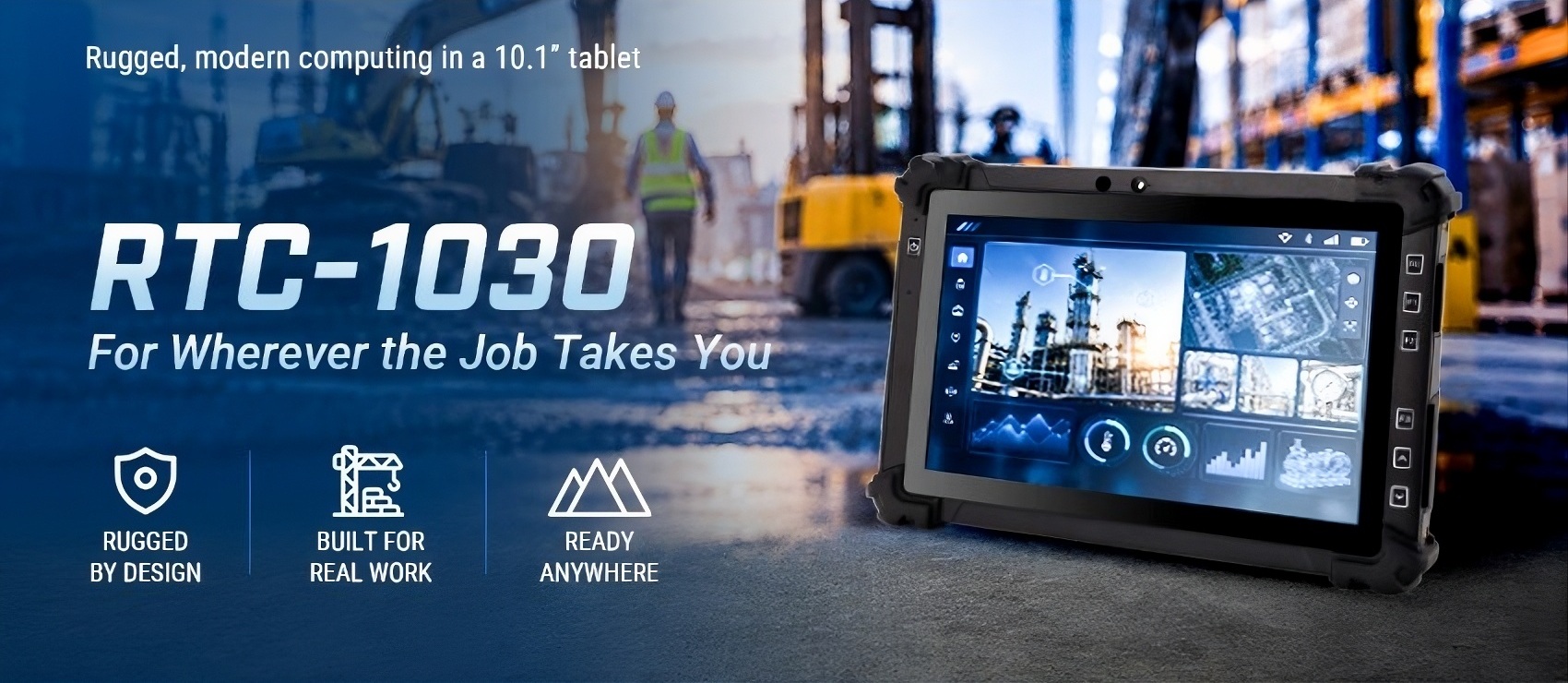
Taipei, Taiwan – Oct 06: Leading embedded computing company AAEON (Stock Code: 6579) today announced the release of the RTC-1030, a 10.1″ rugged mobile tablet designed for use in challenging environments such as field inspection, warehouse management, logistics, and manufacturing. The tablet is the latest addition to AAEON’s Rugged Tablet Computer collection, and the first in the series to feature an Intel® Processor N-series CPU and LPDDR5 system memory.
Given the environments it is designed to operate in, the RTC-1030 is built to be robust, with IP65-rated environmental sealing and a 10.1”, 425-nit projected capacitive multi-touch screen. In addition to this, the tablet lists MIL-STD-810H-tested drop, shock, and vibration resistance and an operating temperature range of -20°C to 50°C.
For continuous in-field use, the tablet supports two 32.7W hot-swappable batteries and offers an 8-hour battery life, with both DC jack and optional USB Type-C charging options available.
Beyond its rugged design, the RTC-1030 provides a number of technical enhancements over previous models from AAEON’s RTC collection, including a 5MP front camera and a 13MP rear camera with flash. Highlights from its I/O include three USB Type-A ports (one USB 3.2 Gen 1, two USB 2.0) and one USB Type-C port with display port functionality, as well as Gigabit Ethernet and a COM port supporting RS-232/422/485.
For wireless connectivity, the RTC-1030 provides Wi-Fi 802.11 a/b/g/n/ac and Bluetooth 5.3, with optional LTE supported through an M.2 slot. Additional connectivity and storage options include SIM card and Micro SD card slots. The tablet supports GPS, GLONASS, Galileo, BeiDou, and QZSS, with GPS and GLONASS provided by default, while storage comes in the form of an M.2 SSD, with 128GB by default, but capacities up to 1TB available upon request.
The RTC-1030 runs on Windows® 11 IoT Enterprise GAC, bringing familiar Windows applications into rugged field environments.
2, Oct 2026
FPT Lands At The Genoa International Boat Show With As Labruna, Bimotor, And Naval Motor Botti
Oct 02: FPT, the Iveco Group company dedicated to the design, production, and sale of powertrains and solutions for on- and off-road vehicles, as well as marine and power generation applications, will be exhibiting at the 66th edition of the Genoa International Boat Show, scheduled for October 1 to 6, 2026, one of the world’s premier yachting events and a true showcase for Italian excellence.
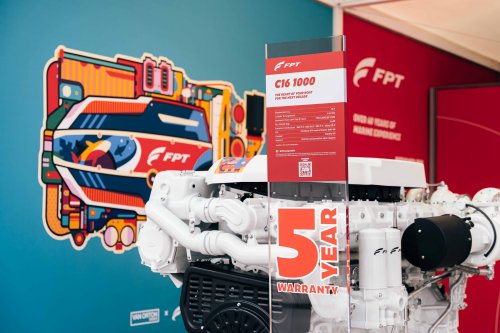
To highlight the importance that this event and the recreational segment of marine engines hold for the Brand, FPT will be participating alongside all its Italian distributors for the segment: AS Labruna, Bimotor, and Naval Motor Botti.
FPT’s growth strategy in the recreational segment is built on six decades of experience and a well-established reputation in the commercial marine sector. Today, the Brand engines power a wide range of vessels: patrol boats, passenger ferries, workboats, and charter boats, serving customers all around the world. The Brand is also a trusted partner of institutional operators responsible for safety and security at sea, including coast guards, customs and law enforcement authorities, and fire and rescue services. The demanding requirements of these specific applications have contributed to shaping the core strengths that distinguish the marine offering: proven reliability, long-lasting durability, high performance, and operational efficiency.
Building on this solid foundation, FPT is further strengthening its presence in the recreational market, bringing the same engineering excellence and proven technologies that have earned the trust of commercial operators and leading shipyards worldwide.
This commitment is also reflected in FPT’s recent entry into Confindustria Nautica, the Italian Marine Industry Association, and in its growing focus on collaborations with new shipyards, as part of a broader strategy aimed at fostering long-term partnerships across the marine industry and supporting the continued growth of the recreational boating segment.
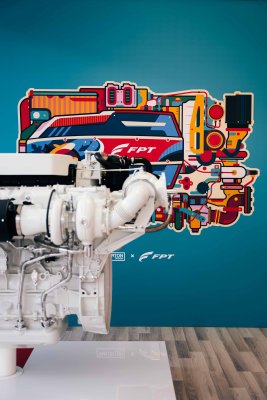
Visitors to the stand YP65 will be greeted by a remarkable innovation: the C16 1000 presented for the first time with the exclusive top cover by Van Orton, the renowned Italian creative duo whose vibrant, impactful pop style is globally recognized. Launched at Agritechnica 2025, the partnership between FPT and Van Orton is thus now expanding to marine engines as well.
Operating in the marine propulsion sector since 1965, FPT offers a comprehensive range of best-in-class engines spanning 3 to 15.9 liters in displacement, with power outputs from 85 to 1,000 hp. Built to power 25-to-80 ft vessels, FPT’s marine portfolio caters to a wide range of applications, from pleasure craft to light-, medium-, and heavy-duty commercial boats.
Every day in Italy, two new boats powered by FPT marine engines are launched. FPT supports its customers worldwide through a network of 375 marine service points, more than 200 of which are located in the Mediterranean region and over 80 in North America, with the remaining sites covering key marine markets across the rest of the world. This extensive service footprint ensures prompt response times, minimizes downtime and provides customers with continuous, reliable support wherever they operate.
Last but not least, starting from the Genoa International Boat Show 2026, FPT makes available a free-of-charge five-year warranty for its marine engines dedicated to pure recreational applications. The warranty extension is a great example of the trust that the Brand places in its engines and the respect it has for its customers. The warranty is available for customers across the EMEA region and provides global coverage.
CURSOR 16 1000 – The record-breaking engine delivering top reliability and durability
Winner of the world water speed record for a diesel-powered vessel, a record that remains unbeaten to this day, the CURSOR 16 continues its strong momentum across global markets. Marine professionals rely on this engine for its straightforward maintenance and exceptional efficiency, which translate into highly competitive operating costs. Delivering power outputs from 815 to 1,000 hp, it guarantees smooth installation, outstanding performance, quiet operation, and best-in-class, long-term reliability. These qualities have made the CURSOR 16 the ideal choice to power planing motor yachts and sport-fishing vessels up to 70 feet for almost 10 years.
C16 1000 – Van Orton cover limited edition
The new fruit of FPT’s collaboration with Van Orton is a striking engine cover, made by employing their peculiar, kaleidoscopic perspective to create a unique visual narrative, inspired by the groundbreaking Pop Art movement of artists such as Andy Warhol and Roy Lichtenstein. The result masterfully blends precision engineering with artistic vision, giving the usually “undercover” FPT engines one more reason to be admired.
CURSOR 16 1000 – Technical Specifications
Cylinder layout: 6L
Turbocharger: TCA
Displacement [liters]: 15.9
Injection system: Common Rail
Max power [hp @ rpm]: 1000 @ 2300
Dry weight [kg]: 1640
Full specifications are available on the FPT website.
N67 570 EVO – Best-in-class performance
With its 6.7-liter displacement, the N67 570 EVO marine engine generates up to 570 hp, delivering maximum torque at low RPMs and rapid load response to lead performance benchmarks in its category. Purpose-built for marine applications, its architecture features engine and turbocharging cooling systems tailored specifically for maritime operations. To simplify installation, key components – including the oil cooler, oil pump, water pump, and blow-by system – are fully integrated into the engine design. Maintenance is made straightforward via advanced diagnostics, while extended oil and filter service intervals of up to 300 hours significantly reduce downtime.
N67 570 EVO – Technical Specifications
Cylinder layout: 6L
Turbocharger: TCA
Displacement [liters]: 6.7
Injection system: Common Rail
Max power [hp @ rpm]: 570 @ 3000
Dry weight [kg]: 721
2, Oct 2026
Use.ai reaches 1 million monthly active users less than a year after launch
The all-in-one AI workspace gives consumers access to more than 10 major AI models, including GPT, Claude, Gemini, Grok and DeepSeek, through a single subscription and interface.
San Francisco, CA – Oct 02; Every new AI model creates another reason to switch. For users who have already built up months or years of conversations, preferences, files and personal context inside one platform, moving to a better model can also mean starting again.
Use.ai was built around the idea that people should be able to switch between the intelligence they use without changing the interface or losing their context. Less than a year after launch, the all-in-one AI workspace has reached one million monthly active users, giving consumers access to more than 10 leading AI models, including GPT, Claude, Gemini, Grok and DeepSeek, all within a single conversation.
The origin
Use.ai grew out of Co-Founder Ihor Herasymov’s own frustration with jumping between AI platforms. A former M&A and tech investment banker, Herasymov went on to launch seven businesses before building a tech company to 100+ employees and $3 million in annual revenue within two years. After ChatGPT was released, AI quickly became central to how he researched, analyzed and made decisions. He began testing models obsessively and quickly found that each built up context he didn’t want to lose.
“I pay around $1,000 a month for premium subscriptions because those accounts hold years of my history. My preferences, my work, my life. I don’t want to lose that context whenever a better model appears,” said Ihor Herasymov, Co-Founder of Use.ai. “That’s where Use.ai began: one account, leading AI models, and context that stays with you.”
The core offering
Use.ai turns a fragmented AI landscape into one workspace. Instead of juggling separate subscriptions, users can access all of them in a single consumer workspace and switch between them mid-conversation. Research, writing, planning and creation all happen in the same thread, with users able to pull in different models as the task evolves.
At the heart of Use.ai’s offering is its free Answer Engine, built on open-weights models that the company configures and optimizes. More advanced frontier models are available under a paid subscription when a task calls for deeper reasoning or more advanced capabilities.
The bigger ambition is to make choosing a model disappear entirely. Use.ai is building automatic orchestration that can route each task to the most suitable intelligence, alongside tools that allow the platform to understand more of a user’s world over time. Instead of asking people to follow model launches, study benchmarks or decide which AI belongs to which task, Use.ai wants them to focus on one thing: what they want to get done.
“We build for consumers, not developers”, said Herasymov. “Our users shouldn’t need to follow model releases, compare benchmarks or decide which model is best for every task. That’s our job.”
Why model choice matters
As people use AI more, the context trapped inside each platform becomes more valuable and harder to leave behind. Use.ai’s research suggests users already want the freedom to move between models: in a survey of more than 5,000 users, 42% said they switch for better quality or deeper reasoning, while 36.5% switch depending on the task. One user even compared the same investment question across four models, using where they agreed and disagreed to decide what needed more research.
Use.ai is betting that the biggest opportunity is still ahead. In a separate survey of more than 30,000 users, 54% said they were either using AI for the first time or had only tried it a few times. With the company estimating that roughly four billion more people could become regular AI users over the next decade, its aim is to become the place where those users build their AI context from day one.
Looking ahead
Use.ai’s next phase is about moving from answers to action. The goal is a personal assistant that understands a user’s preferences, routines, schedule and context, then coordinates models and connected apps to get things done.
That could be as simple as saying, “Book me a haircut next week.” With permission to access the user’s calendar, the assistant could know their usual salon, check available appointments against their schedule, make the booking, add it to the calendar and set a reminder.
The same approach could apply to shopping. A user looking for new running shoes could ask Use.ai to research suitable models based on their preferences and training habits, compare prices and availability across retailers and, eventually, complete the purchase once the user confirms.
Over time, that could mean finding and booking appointments, researching products, comparing prices and availability, and completing purchases with confirmation. The underlying idea is that users should be able to describe an objective while Use.ai handles more of the research, coordination and model selection required to complete it.
“Our goal is to minimize the effort between ‘I need something done’ and ‘it’s done,’” said Herasymov. “We want Use.ai to be where your AI relationship begins and where it stays, regardless of which model wins next.”
1, Oct 2026
Cyolo’s AI Alerts for Risky Activity Set New Standard for Real-time Oversight of Remote Sessions in OT
New AI-powered capability helps OT defenders keep pace with AI-driven threats by monitoring active remote sessions, identifying security and operational risk in context, and alerting teams in real time so they can intervene before incidents escalate or disrupt operations.
Miramar, FL, Oct 01 — Cyolo, the leading provider of secure connectivity for critical infrastructure and operational technology (OT), today announced Live Risk Detection, a first-of-its-kind AI capability that sets a new standard for remote session supervision.
Live Risk Detection brings real-time, context-aware detection and response to active OT sessions by identifying cyber threats, operational risks, and unexpected behavior as they occur. When potential risk is detected, Live Risk Detection alerts teams within seconds, enabling them to investigate and respond while the session is still active and before operations are impacted.
As remote connectivity continues to expand, employees, vendors, and OEMs are performing more critical OT work remotely. At the same time, AI-enabled threats are increasing the speed and effectiveness of malicious activity. But 1:1 monitoring of every session is not practical at scale, meaning potentially risky sessions may go unsupervised. Live Risk Detection removes this bottleneck by adding AI supervision to every session and directing human attention to activity that may require intervention.
In contrast to approaches that evaluate individual actions against predefined allow or block criteria, Live Risk Detection uses context-aware AI to assess activity across the full session. It identifies activity that is inherently malicious or unsafe, as well as mistakes that could lead to downtime or other operational disruptions. It can also recognize when a sequence of individually legitimate actions may indicate that an attack is underway or, conversely, when activity that may appear risky in isolation is benign in the context of the session.
Crucially, Live Risk Detection never acts autonomously. It flags potential risk and alerts relevant teams, always keeping a human in the loop to decide whether to observe, join, or terminate the session. This human-controlled approach is essential in OT and critical infrastructure environments, where digital actions can have physical consequences.
“Zero Trust doesn’t end at login,” said Almog Apirion, CEO and co-founder of Cyolo. “Getting the right person connected to the right system is key, but that’s just the beginning of the story. Risk can emerge even after a session is underway. Live Risk Detection gives teams another set of eyes, helping them spot risk while there’s still time to intervene—and without taking control away from the people who know the environment best.”
Live Risk Detection helps security and operations teams:
· Identify cyber and operational risk: Detect malicious activity as well as mistakes, unsafe actions, or configuration changes that could disrupt equipment, processes, or production, including during third-party vendor sessions.
· Understand risk in context: Assess activity across the broader session, including user intent, to identify when otherwise legitimate actions combine to create risk and help contain AI-enabled threats faster.
· Respond while the session is active: Alert the right security and operations stakeholders in real time so they can assess the situation and, if necessary, intervene or terminate the session before risk escalates.
· Scale session oversight: Reduce the bottleneck of 1:1 manual monitoring by directing attention to the sessions and activities most likely to require review.
· Keep humans in control: Use AI to flag potential risk and provide context without taking autonomous action, leaving response decisions to human experts.
Agentless by design, Live Risk Detection requires no software downloads or changes on the remote user’s device and works seamlessly across RDP, VNC, and more. Teams can adjust risk sensitivity and set notification thresholds by severity level, with alerts providing the risk level, activity details, and user identity needed for investigation. Alerts and activity logs can also feed into existing security workflows, including SIEM platforms.
This launch builds on Cyolo’s wider effort to help OT defenders scale visibility and respond faster to both AI-enabled and conventional cyber threats. Live Risk Detection complements Session Intelligence, introduced earlier this year to turn session recordings into searchable operational insights, by bringing AI-powered intelligence into the active session itself.
Live Risk Detection is available as a capability for the Cyolo PRO (Privileged Remote Operations) remote access solution and is part of Cyolo’s full-stack Secure Connectivity Platform for OT and critical infrastructure.
1, Oct 2026
Home Appliance Prices Set to Rise as Festive Shopping Season Begins
Oct 1: Consumers planning to purchase air-conditioners, televisions, refrigerators and washing machines during the festive season may face higher prices as manufacturers respond to rising raw-material and production costs.
According to a recent report, several consumer durable and appliance makers are raising prices from October as higher costs of key inputs such as copper, aluminium and steel, along with freight and currency-related pressures, weigh on manufacturers.
Air-conditioners are expected to see some of the most significant price increases, with industry reports indicating hikes of around 5–8 per cent in some cases. Prices of televisions, refrigerators and washing machines are also being revised by some manufacturers.
The timing of the price increases comes as India’s biggest festive shopping period gets underway. Consumers traditionally step up purchases of home appliances around Dussehra and Diwali, encouraged by discounts, exchange offers, festive promotions and easy financing options.
Higher Input Costs Behind the Move
According to the report, rising commodity prices are a major reason behind the latest revisions. Copper has emerged as a particular cost concern for air-conditioner manufacturers, while higher prices of steel, aluminium, plastics and other inputs are also adding to production expenses.
The latest increase is also being described as another round of price adjustments for the consumer durables industry this year, highlighting the continued pressure manufacturers are facing on production costs.
Festive Offers Could Cushion the Impact
Despite higher prices, consumers may still find attractive festive deals in the market. Industry executives have indicated that retailers and distributors continue to hold inventory purchased before the latest price revisions.
This means some products may continue to be available at earlier prices for a limited period, depending on the brand, model and retailer.
For manufacturers, the festive season will be an important period to balance higher costs with consumer demand. For shoppers, comparing prices, checking existing inventory and looking at festive discounts could help them make more informed purchasing decisions.
As India’s festive shopping season gathers momentum, the home-appliance market is therefore entering a period where rising input costs and strong consumer demand will have to move together.


