


24, Feb 2025
Pratyush Pandey, CEO, Upflex India steps Down from Anarock After Eight Years

Pratyush Pandey, CEO, of Upflex India steps Down from Anarock After Eight Years.
Pratyush Pandey, CEO of Upflex India, has announced his departure from Anarock after an eight-year tenure in various leadership roles. A founding member of the firm since its inception in 2017, Pratyush played a pivotal role in establishing and scaling three key business verticals—HVS, Warehousing & Industrial, and most recently, Upflex India.
His efforts in launching Upflex India, a joint venture with the world’s largest U.S.-based flexible workspace platform, proved highly successful. Within just two years, he led the venture to profitability, securing investment from WeWork India and achieving a valuation of ₹125 crore.
Pratyush began his real estate career in 2000 with Chesterton Meghraj which became later became Trammell Crow Meghraj, and was subsequently acquired by JLL India. He remained with JLL until 2017 before joining Anarock, where he played a key role in its expansion into new business domains.
While confirming his planned exit by mid-April 2025, Pratyush has remained tight-lipped about his next move.
- 0
- By Sujata Achary

24, Feb 2025
C4IR Telangana & WEF to Lead BioAsia 2025 Dialogues on Bio-economy & Digital Health

Hyderabad, 24 February 2025 – The Centre for the Fourth Industrial Revolution Telangana (C4IR Telangana), in collaboration with the World Economic Forum (WEF), will convene global thought leaders, industry experts, and policymakers at BioAsia 2025 to explore the future of the bio-economy, accelerate digital health adoption, and advance workforce well-being. Scheduled for February 25-26, 2025, these high-impact discussions will reinforce Telangana’s position as a global leader in healthcare innovation and policy.

C4IR Telangana, in partnership with the World Economic Forum, will co-host two high-impact panel discussions focusing on critical themes in healthcare innovation:
· Strengthening the Global Bio-economy & Transforming Human Health through Generative Biology – Scheduled for February 25, 2025, and moderated by Brynne Stanton, Thematic Lead – Bio-economy, World Economic Forum, this session will explore how generative biology can reshape global health outcomes, overcome regulatory and technological barriers, and foster global collaborations.
· Holistic Health and Well-Being Guidance for Employers – Taking place on February 26, 2025, this discussion, moderated by Sasikanth Dola, Partner – McKinsey Health Institute, will highlight the importance of employer-driven health programs, innovative approaches to holistic health, and collaborative frameworks aimed at enhancing well-being across the life sciences industry.
In addition to these panels, C4IR Telangana and the World Economic Forum will host three private workshops to bring together key stakeholders for in-depth discussions:
- India Digital Health Activator Workshop – Aimed at accelerating digital health adoption in Telangana, this workshop will focus on overcoming barriers to health data exchange, developing impactful use cases for the Family Health ID, and proposing actionable recommendations to drive digital transformation. Attendees will include government leaders, healthcare providers, pharmaceutical companies, tech innovators, and civil society representatives.
- Global Workshop on Accelerating the Tech-Driven Bio-economy – This session will emphasize India’s leadership in the bio-economy, exploring opportunities to scale solutions, enhance regulatory frameworks, and drive technology-led innovations. Policymakers, industry leaders, and researchers will collaborate on shaping India’s contribution to the World Economic Forum’s 2025 Bio-economy Framework.
- Thriving Together: Advancing Workforce Well-Being Across the Life Sciences Industry – Focused on collaborative pathways to enhance workforce well-being in the life sciences sector, this session will provide key insights to help shape a potential regional Healthy Workforces Program, led by C4IR Telangana, aimed at improving holistic health across the industry.
Jayesh Ranjan, Special Chief Secretary, Industries & Commerce and IT, Government of Telangana, stated, “Telangana continues to drive innovation in healthcare and life sciences, and our collaboration with the World Economic Forum through C4IR Telangana is a testament to our leadership in shaping the future of the bio-economy and digital health. BioAsia 2025 will serve as a vital platform to foster global partnerships, catalyze transformative discussions, and drive actionable outcomes.”
Shyam Bishen, Head, of the Centre for Health and Healthcare and member of the Executive Committee, the World Economic Forum, commented, “Scaling digital health solutions is no longer optional—it’s essential. Through initiatives like the India Digital Health Activator, we are committed to breaking down barriers, enhancing data interoperability, and integrating AI-driven tools to empower both patients and providers.”
Shakthi Nagappan, CEO of BioAsia and Telangana Life Sciences, Government of Telangana, added, “Telangana has always been at the forefront of healthcare innovation. Our collaboration with WEF and C4IR Telangana will drive groundbreaking discussions and collaborations at BioAsia 2025, solidifying Telangana’s position as a global hub for life sciences and digital health.”
With C4IR Telangana and the World Economic Forum leading these transformative discussions, BioAsia 2025 promises to be a landmark event shaping the future of healthcare, digital health, and workforce well-being through innovation, policy leadership, and global partnerships.
24, Feb 2025
Leander Paes: Tennis in India Needs National Strategy Like BCCI for Growth
Mumbai, 24 February 2025: “I am concerned about tennis. Our association is being reviewed by the Supreme Court. We should learn from the BCCI’s approach to cricket by adopting its system of establishing numerous cricket clubs in every region of India. We should also acknowledge Khelo India, as ₹1500 crores were allocated to it. That’s not just a sports budget; that’s a Khelo India budget.”, said Leader Paes, Indian Olympic Medalist, Grand Slam Winner, International Tennis Hall of Fame member, and Entrepreneur, Founder of Flying Man Ventures
Speaking about his childhood journey to become a tennis player, Leander Paes, Indian Olympic Medalist, Grand Slam Winner, International Tennis Hall of Fame member, and Entrepreneur, Founder of Flying Man Ventures, said, “Being born to a Bengali mother and a Goan father, football was my first passion. I received an opportunity to join Barcelona at the age of 11, but I was asked to give up my Indian passport to continue playing football. My father laughed at me for six minutes because I chose tennis instead. I said, ‘Give me 52 weeks in a tennis academy.”
Giving a peek into his personal life, Leander said, “I realized in the first year of my parent’s separation that Tennis is the only vehicle I had to become a man, which was written as the first and the last paragraph of the 100-page letter he had written for me.”
Sharing his concern on the state of Tennis, Leader Paes said, “I am concerned about tennis. Our association is currently facing the Supreme Court. We should learn from what the BCCI has done for cricket and follow its model of establishing hundreds of cricket clubs in every region of India. We should also commend Khelo India, as ₹1500 crores have been allocated for it. That’s not just a sports budget; that’s specifically a Khelo India budget.”
Sharing his perspective on how to develop sports in India, Leader Paes said, “I believe India has tremendous potential in sports, which can transform it into a powerhouse that enhances the quality of life, as well as the mental and emotional health of its people. We start scouting for talent quite late. As a nation, if we embrace sports science and incorporate DNA testing to assess young athletes whose abilities align with geographical genetics, I believe we can truly make a difference.”
Prakash Padukone, All England Open Badminton Champion, Padma Shri and Arjuna Awardee, said, “In 1962, shuttle badminton was not very popular in the southern part of India. There were only five badminton courts in the entirety of Bangalore. At that time, I had no idea whether I would play professionally; I was just fond of the sport. I learnt watching other people play. I started playing at the age of 7, and by the time I was 15 or 16, I won the national championship. That’s when I began to take the sport seriously.”
Talking about Olympics, Prakash Padukone, said, “We have abundant talent in the country, but many previously lacked opportunities. Over the last 15 years, this has changed significantly. The sports federations must be professionalized. Talent is not the issue, nor is funding a problem now. The government is doing its part, and people are receiving support, but it is crucial that sports federations become more involved. These federations need to operate like corporations. Federations control the sports. It is their responsibility to encourage and promote sports.”
Talking about how he started playing chess, Viswanathan Anand, 5-time World Chess Champion, Padma Vibhushan, Padma Bhushan, Padma Shri and Arjuna Awardee, said, “When I was 6 years old, I saw my siblings playing chess and asked my mother to teach me how to play. Near my sister’s college, there was a chess club, so I joined it. Although it was a small club, it was an excellent one, frequented by international players. A family member also knew how to play chess, which was helpful during a time when it was difficult to find books on chess. Later, my father received an assignment in the Philippines, and we moved there. Chess was booming in the Philippines, so it was a fortunate coincidence. Both of my parents were very supportive, especially my mother. In 1983, I participated in a tournament at the chess club in Bangalore, competed in a team championship, and started winning several of them. I was the first Asian to win the Grand Junior Championship and eventually became a Grand Master. I decided to become a chess player at the age of 6.
Talking about Olympics, Viswanathan Anand, said, “In India, I work to identify talent and provide them with all the resources they need. Winning medals will inspire more people to take up sports as a career option. When sports become a mass movement in our country, that’s when true transformation will happen. Currently, we are competitive in sports but often miss out narrowly. We shouldn’t be satisfied with these close misses; that’s how we will grow as a sporting nation. In India, federations should be reformed to become more accommodating and spontaneous. Many chess players have started their own academies.”
Sharing his journey of falling in love with billiards, Geet Sethi, 6-Time World Champion of Billiards/Snooker and Founder of Olympic Gold Quest, said, “I started in the 1970s. I used to play all types of sports. Then I got a chance to play billiards. At that time, you couldn’t play billiards if you were younger than 18 years because it was always located near the bar. A government circular reducing the age limit to 12 years opened my chance to play billiards. I was like a fish being drawn to water. Within a year, I stopped playing any other sports, and I won the first ever junior championship. To continue playing, I was asked to score a first division, and I would set the game aside for two months before Board Exams and barely get over 60%. I graduated with an Economics Honours degree and even did an MBA. I won my first major title in 1982 when I defeated Michael Ferreira.”
Speaking about how India can do better at Olympics, Geet Sethi said, “The reason why we are not producing Olympic level sportspersons is that sports in India don’t have the money for the talent to be nurtured. Socioeconomics, genetics, and subconscious self-belief are the three things which will drive India to sporting excellence. Today, each member of the Olympic contingent is more confident which was not the case before.”
Sharing his experience, Geet added, “We did a study and identified boxing, badminton, wrestling, archery, shooting as the sports that should be prioritised in India. We have no chance in athletics and aquatics.”
ABP Network’s Ideas of India 2025, centred on the theme ‘Humanity’s Next Frontier,’ will bring together thought leaders and innovators to explore the challenges and opportunities in India’s ascendance in a rapidly changing world. In the face of climate change, geopolitical conflicts, and technological advancements such as AI, the summit delved into India’s role as both an ancient civilisation and a demographic powerhouse in shaping the future. The two-day summit brought together a confluence of ideas from global thought leaders, intellectuals, and change-makers, covering transformative possibilities in science, medicine, social contracts, and global leadership, with experts from diverse fields offering bold visions of a better, more sustainable world for all.
24, Feb 2025
Fastrack announces launch of BARE collection

Bengaluru, February 24, 2025 – Fastrack, India’s leading youth fashion accessories brand has introduced its latest unisex collection BARE, an innovative transparent watch that celebrates raw authenticity and unfiltered self-expression. The collection has already garnered recognition as one of the Top 50 Designs in the Product Design Category at the prestigious 24th CII India Design Summit 2024.
The BARE collection showcases a striking skeletal dial complemented by bold aluminum bezel rings in 6 vibrant colors, offering a fresh perspective on contemporary watch design. The collection makes bold fashion accessible to style-conscious youth across India.
With the tagline of “Too Bare To Care”, the campaign highlights the unique design of the watch while celebrating those who are not afraid to show who they are.
Speaking at the launch, Danny Jacob, Head of Marketing at Fastrack, said, “Today’s youth navigate a digital world brimming with hyper-curated, picture-perfect content. But what often gets hidden are the raw, unfiltered realities—flaws, slip-ups, bloopers—that make us beautifully human. It takes boldness and authenticity to show up as your true self in a world that favors perfection. We want to celebrate those fearless enough to embrace the messy, imperfect, and wonderfully real moments of being unapologetically human!”
24, Feb 2025
FICCI Leadership Program’s Third Batch Begins at Manipal Academy

Manipal, Karnataka, February 24, 2025 – The Federation of Indian Chambers of Commerce and Industry (FICCI), in collaboration with Manipal Academy of Higher Education (MAHE), initiated the third batch of the Leadership Development Program (LDP) today. This exclusive three-day residential program is hosted at the MAHE campus in Manipal and features a series of nine meticulously designed training modules aimed at enhancing the leadership capabilities of academic leaders.
The FICCI LDP has brought together a diverse group of academic leaders including Directors, Deans, Registrars, Senior Professors, etc from various Higher Education Institutions (HEIs). The program is developed to orient professionals with advanced knowledge and leadership skills essential for managing the complexities of modern academia and shaping them to become ‘future-ready’.

Lt. Gen. (Dr.) M D Venkatesh, VSM (Retd), Co-Chair, FICCI Higher Education Committee and Vice-Chancellor, Manipal Academy of Higher Education, in his keynote address, highlighted the fundamentals of leadership, discussing its various layers and significance in personal, organizational, and societal contexts. Emphasizing the need for a structured approach to identifying and nurturing potential academic leaders, Lt. Gen. Venkatesh also addressed the challenges faced by stakeholders within the education ecosystem. These include stakeholder consciousness, managing expectations, budgeting and financing, industry partnerships, and regulatory compliance. He further highlighted the essential attributes expected of an academic leader in today’s rapidly evolving and transformative times. He emphasized the growing significance of developing a comprehensive sense in research, operational and strategic management, team-building skills, and proficiency in accreditation and ranking. He further underscored the critical importance of succession planning in Higher Education Institutions (HEIs) to ensure robust governance, innovation, and effective talent risk management, thereby ensuring readiness for future leadership transitions.
Prof. (Dr.) Rajan Saxena, Advisor, FICCI Higher Education Committee and Former Vice Chancellor, NMIMS, articulated the urgent need for developing readiness to embrace change. He stressed the importance of anticipating and preparing for future challenges to avert potential disasters, overcome stagnancy, and address systemic issues, which could otherwise lead to low enrollment and demoralization within the academic community. Prof. Saxena observed that the success of students and the relevance of HEIs hinge on recognizing the shifting dynamics of the job market. He pointed out the cyclical challenges that may at times persist until institutions adapt to these changes. He advocated for a continuous focus on adding value to students, industry, and society at large. He highlighted that the transformation in education begins with leadership at the top and permeates throughout the faculty and administrative levels.
Dr. Rajesh Pankaj, Director & Head – Education & Skills, FICCI, in his welcome remarks, highlighted the significant complementary efforts and benchmark standards set by private higher education institutions in India. These institutions, he noted, play a crucial role in equipping a global workforce with competent and relevant skills. Dr. Pankaj emphasized that the vision of the FICCI LDP is centered around capacity building within HEIs. He elaborated on how FICCI as an association is uniquely positioned to, integrate fresh insights from both industry and academia to forge structured leadership that meets critical benchmarks and significantly impacts HEIs.
The modules cover critical aspects of academic leadership including change management, talent management, research and innovation, technology integration, fostering a learning culture, financial sustainability, internationalization, and industry partnerships. These sessions are designed not only to enrich and upgrade the participants’ skill sets but also to immerse them in an environment that promotes substantial growth and networking opportunities. Participants will engage in real-time case studies, interactive sessions, and collaborative learning experiences that mirror the complexities and nuances of modern higher education.
This program masterfully blends theoretical foundations with practical insights to stimulate thoughtful discussion and inspire decisive action. Facilitated by esteemed leaders who are pioneers of change in their respective fields, its primary goal is to reimagine the role of academia in a transformative world. By focusing on critical areas such as technology integration, research innovation, and sustainable practices, the program is meticulously designed to equip leaders with the necessary tools to effectively shape the future of education.
The FICCI Leadership Development Program is a significant step toward empowering academic leaders to effectively lead and implement progressive policies, ensuring their institutions remain at the forefront of educational innovation and excellence.
Established in 1927, FICCI is India’s oldest and largest apex business organization, playing a pivotal role in propelling India’s economic growth and industrialization. As a non-government, not-for-profit organization, FICCI serves as the voice of India’s business and industry, facilitating dialogue, influencing policy, and building bridges across sectors.
Manipal Academy of Higher Education, an Institution of Eminence Deemed to be a University, is renowned for its academic excellence and comprehensive educational offerings. By hosting the LDP, MAHE underscores its commitment to fostering educational leadership that can drive significant impacts in the realms of higher education and beyond.
24, Feb 2025
Rotary Club Bangalore Presents ‘Kala for Vidya’ – Painting a Brighter Future
 Bangalore February 2025: The Rotary Club of Bangalore, Lavelle Road, is proud to Announce The Inauguration of “Kala for Vidya,” an annual art exhibition cum sale. This esteemed event, initiated in 2005, aims to support the education of underprivileged children at Rotary Bangalore Vidyalaya (RBV).
The news me of this year’s Exhibition is “Ephemeral Permanence, Stories of Nature.” it promises to be a spectacular showcase of art, featuring renowned artists from across India, alongside emerging talent. The event will present a diverse range of art forms, from traditional to contemporary.
Through their works, the artists will delve into the fleeting moments of beauty, the delicate balance of life, and the enduring power of nature.
The Rotary Club of Bangalore has been dedicated to providing quality education, free uniforms, food, and books to 540 children from underprivileged backgrounds at RBV. “Kala for Vidya” is a testament to the club’s commitment to Empowering these deserving children through education.
We invite art enthusiasts and supporters of education to join us in this noble endeavor. Together, let us paint a brighter future for these children.
EventDetails:
Date: March 1st and 2nd 2025 Time: 10.00 AM to 6.00 PM
Venue: ITC Windsor Manor Bengaluru
24, Feb 2025
Season 11 of MCHI Premier League Goes Global with a Grand Launch by CREDAI-MCHI
Mumbai, 24th February 2025 – The much-anticipated MCHI Premier League (MPL) Season 11, hosted by CREDAI-MCHI, was unveiled in a spectacular launch event, setting the stage for another thrilling edition of corporate cricket. Building on a decade-long legacy, this year’s tournament expands to international grounds, with Sri Lanka hosting the grand finale, reaffirming MPL’s stature as a premier cricketing and CSR-driven initiative.
The high-energy launch was graced by Miss Shreya Poonja, runner-up of Femina Miss India 2023, and Guest of Honor Mr. Gopal Kabraji, Managing Director of RR KABEL, adding to the celebratory atmosphere. Over the years, MPL has evolved beyond being just a sporting event—it has become a platform for camaraderie, team bonding, and a testament to the power of collective impact. The league not only fosters a competitive spirit but also strengthens workplace relationships, ultimately contributing to a more dynamic and productive corporate environment.

As part of CREDAI-MCHI’s ongoing CSR commitment, this year, the organization is extending its support to young Indian cricketing talents, Darsh Murkute and Trisha Parmar. Darsh, a left-hand batsman and left-arm spinner, has represented Mumbai U16 and currently plays A Division cricket for MIG Cricket Club and Parel Sporting Cricket Club. Trisha, an equally promising cricketer, played for Mumbai Under-15 in 2022 and has since represented Mumbai Under-19 in both T20 and One Day matches in 2024. Through MPL, CREDAI-MCHI is investing in the future of Indian cricket, providing these rising stars with mentorship, training, and opportunities to propel their careers forward.
Domnic Romell, President of CREDAI-MCHI, emphasized the significance of this initiative, stating, “MCHI Premier League Season 11 is not just about cricket; it symbolizes the ability of the real estate fraternity to come together for a larger purpose. Over the years, this league has grown beyond the field, creating a meaningful impact through our CSR initiatives. This year, we are proud to support young cricketing talents like Darsh and Trisha, who represent the future of Indian cricket.”
Adding to this, Shailesh Sanghvi, MPL Convener, shared, “With the tournament moving to Sri Lanka for the grand finale, MPL 11 is reaching new heights. While we celebrate the thrill of the game, we are also committed to giving back to the community by nurturing the next generation of cricketers. It is inspiring to witness how this league continues to evolve, not only as a competition but as a force for positive change.”
The league matches will commence in Mumbai from 21st to 23rd February, featuring a fierce contest among some of the top developers in the industry. The tournament will see participation from Raghav Royals, MICL Nova, Raymond Royals, Ajmera Tigers, S3 Big B, Mighty Rustomites, Lalani Warriors, and Hubtown Smashers, all vying for the prestigious MPL trophy.
24, Feb 2025
Tata Motors Celebrates 27 Years of Tata Safari
Mumbai, February 24, 2025: Tata Motors, India’s leading SUV manufacturer, proudly celebrates 27 iconic years of the Tata Safari with the launch of the exclusive, limited STEALTH Edition—a bold and sophisticated embodiment of luxury, power, and exclusivity. Limited to just 2,700 units, this premium edition will be available in both the Harrier and Safari redefining exclusivity and finest SUV aesthetics. With sleek, monotone finishes leading the charge, this STEALTH lineup sparks a fresh wave of desirability showcasing the evolving customer preferences of owning a vehicle which is one its kind. With just few units on sale, the bookings for the STEALTH edition opens starting today, both online and at our dealerships across the country.

The STEALTH Edition amplifies the looks with an all-new STEALTH Matte Black finish, exuding an undeniable road presence that is not just seen but felt. More than a mere design statement, this edition is a testament to dominance and exclusivity, offering an enigmatic aura that sets it apart on the road. The matte car paint delivers a unique, stylish finish, enhancing the SUV’s distinctive appeal. Its non-reflective surface lends the vehicle a sophisticated, elegant look, accentuating the SUV’s body lines and contours, making it appear exceptionally premium. The subtle sheen reduces glare under harsh sunlight, ensuring the vehicle’s bold stance remains uninterrupted in any lighting condition. Priced at ₹25.09 lakh, Ex-showroom Delhi for the Harrier STEALTH and at a starting price of ₹25.74 lakh, Ex-showroom Delhi for the Safari STEALTH (available in both 6 and 7 seater), these limited edition SUVs seamlessly blend prestige, performance, and cutting-edge technology, making an unmissable statement of excellence.
Launching this exciting new rendition of the Harrier and Safari, Mr. Vivek Srivatsa, Chief Commercial Officer, Tata Passenger Electric Mobility Ltd., said, ‘’Tata Motors has long been at the forefront of the SUV segment in India, with innovation deeply embedded in its DNA. The Tata Safari, which introduced the concept of a lifestyle SUV to the Indian market, stands as a testament to this spirit of pioneering excellence. With 27 years of unbeatable legacy, the Tata Safari has continually evolved, and the launch of the STEALTH Edition is a salute to the same. This special edition is a premium, exclusive release, with only 2,700 units of the enigmatic STEALTH Matte Black finish being made available. The STEALTH Edition is more than just an SUV—it’s a statement of prestige, adventure, and capability, elevating it to an aspirational collector’s car that will be coveted by enthusiasts and connoisseurs alike. Owning a STEALTH Edition isn’t just about possessing an exceptional car; it’s about securing a piece of automotive history that everyone will aspire to have in their garage’’.
24, Feb 2025
Coyu Brings ‘Joy of the Find’ to Gurugram with Grand Flagship Store Launch at Ireo
Gurugram, India, February 24th, 2025 – Coyu, a premium multi-brand fashion and lifestyle platform catering to the modern Indian woman, is set to unveil its flagship store at the IREO complex in Gurugram. To celebrate the launch, Coyu will host an exclusive event on February 22, 2025, inviting customers to experience the store’s distinctive offerings. The spacious 6,000 sq. ft. store is designed to deliver a personalized shopping experience, centered around Coyu’s core philosophy of ‘Joy of the Find,’ where discovering new styles and creating a personal wardrobe is both exciting and fulfilling.
Launched in October 2024 by industry leader Mohit Gupta, co-founder of Zomato and former COO of MakeMyTrip, with help of Mukesh Bansal, founder of Myntra and Cult.fit (co-founder and Strategic Advisor), Coyu was created to meet the diverse occasion wear needs of women. The name “Coyu” is derived from ‘Collated for You, in Collaboration with You,’ underscoring the brand’s commitment to offering a carefully curated collection of premium fashion and enabling the modern woman to shape and express her own unique style.
The new store features over 50 handpicked brands, offering a diverse range of Western, Modern Ethnic, and Indo-Western wear. Showcasing renowned international labels like Karen Millen, Salsa Jeans, DKNY, Sister Jane, Pinko, and Nobody’s Child, alongside celebrated Indian brands such as Saksha Kinni, Our Love, Dash & Dot, Basanti Kapde & Coffee, Linen Bloom, Ganga Fashions, and Soup by Sougat Paul, Coyu is a one-stop destination for every occasion. With prices starting from INR 3,000 and going up to INR 30,000, the store caters to everything—from casual outings and business meetings to festive celebrations.
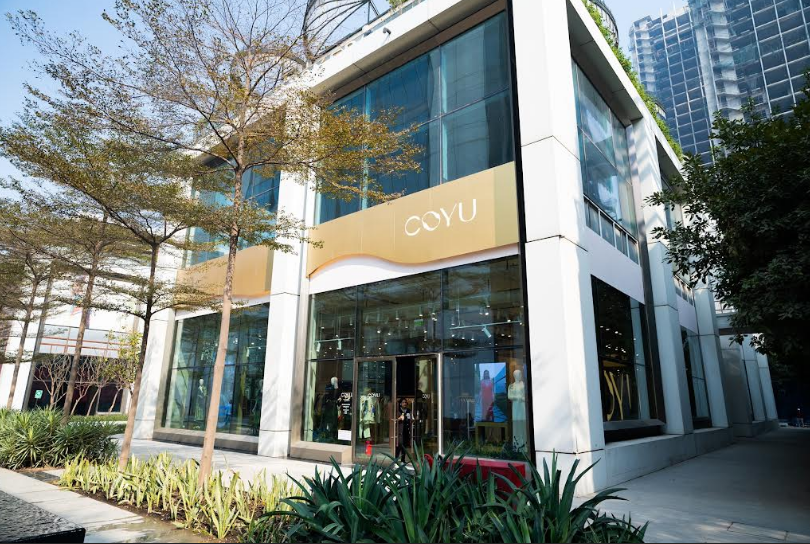
Coyu’s Shopping Experience
Coyu’s flagship store is designed to provide an exceptional shopping journey, offering an atmosphere that is both welcoming and exclusive. The store includes six spacious trial rooms, a dedicated lounge area, and a coffee station, creating a relaxed environment for customers. Exclusive styling sessions with expert stylists are available to help shoppers find their perfect look, and in-house alterations ensure a flawless fit for every customer.
Digital Services and Convenience
Coyu has already introduced its Try-at-Home service and 90-minute delivery with the opening of its first store at Ambience Vasant Kunj in October 2024. These services, which are currently being refined, provide convenience and flexibility for customers shopping from home. Coyu also operates a pop-up store at DLF Avenue Saket, bringing its curated selection of fashion to even more locations.
Key Features of the Coyu Flagship Store
Personal shopper lounge: For a more personalized shopping experience, customers can shop in a private lounge setting with our expert stylists picking the perfect pieces for your needs whether it’s a trousseau or a trip to the tropics.
Stylist Tips & Customization: Expert stylists provide personalized guidance, and in-house alterations guarantee a perfect fit.
Try-at-Home & 90-Minute Delivery: Convenient online shopping with delivery in just 90 minutes.
Artisanal coffee cart with gourmet bites: Enjoy the expansive curation of fabulous fashion finds from 50+ brands or relax with a coffee in the lounge area.
Mohit Gupta, Founder & CEO of Coyu, shared, “At Coyu, we believe the future of premium fashion retail lies in creating immersive, omnichannel experiences. We are thrilled to unveil our flagship store in Gurugram, designed to offer modern Indian women a truly unique and personalized shopping journey. Our focus is on curating premium fashion that caters to diverse occasion wear needs, while seamlessly integrating online and offline services. With this launch, we aim to make an elevated lifestyle more accessible, personal, and inspiring.Coyu offers a platform for multiple homegrown fashion brands, providing a wide variety of high-quality apparel for every occasion. Through flagship stores, boutique outlets, and its online platform, Coyu provides a service-first shopping experience, from expert styling to express delivery and Try-at-Home services. At Coyu, every discovery is unique, and every purchase celebrates individuality.”
24, Feb 2025
ABP Network’s Ideas of India 2025 Sparks Visionary Talks on Humanity’s Next Frontier
Chandigarh, 24 February 2025: The inaugural day of the ABP Network’s Ideas of India 2025 commenced with resounding grandeur, centred on the compelling theme, ‘Humanity’s Next Frontier.’ The summit witnessed an overwhelming response, solidifying its position as a premier platform for intellectual discourse and visionary thinking. This landmark event brought together luminaries from diverse fields to deliberate on India’s pivotal role in addressing global challenges such as climate change, geopolitical tensions, and the transformative impact of emerging technologies like artificial intelligence. Positioned at the intersection of India’s rich cultural heritage and its ascent as a global demographic and economic powerhouse, the summit served as a dynamic forum for thought leaders, policymakers, and innovators.
In the much anticipated opening session, ‘The Earth Flame Searching for Inner Peace’, celebrated Indian author, journalist, and travel writer, Pico Iyer, recounted his life in a catholic hermitage after a fire incident burned down his family home in California. “The very night I lost everything when my house burned down, I realized I still had the most important things. I also realized I don’t need 90% of things I accumulated; I can live more minimally. Humanity’s last frontier is really humanity’s first frontier which is what kind of invisible clarity and calm can we find to make our peace with AI and the other accelerating technologies.”
“India is not a poor country anymore, and we must take bold steps in developing our foundational AI models.”, said Dr. Manish Gupta, Senior Director at Google DeepMind, who leads AI research teams across India and Japan. Speaking on the topic ‘Transforming India with AI: Why We Need More Data’, he said, “Some assume that building foundational AI models requires hundreds of millions of dollars, but we must have the courage to take on challenges that have never been attempted before. AI is an old discipline, almost as old as computing itself. The reason ChatGPT and similar models took off is the innovation of transformer architecture, which has been key to foundational AI models.”
In the session, “The Frontiers of Science: Knowing the Unknown”, Dr. Pratima Murthy, Director, NIMHANS, said, “One in ten people suffer from a diagnosable mental disorder.” Dr. Shubha Tole, Neuroscientist and Professor at the Tata Institute of Fundamental Research, talked about the importance of research, saying, “Research opens minds. It’s the art of asking questions, and through this process, we uncover profound insights. Who better to solve a problem than a mind trained in research?” Dr. Jahnavi Phalkey, Founding Director of Science Gallery, Bangalore, talked about the state of research funding in our country. “Our funding system is skewed and laced with bureaucratic hurdles. The funding landscape is poorly developed and needs to be strengthened. We also need to rethink the direction of research.”
In the session titled ‘The Next Generation: Making Business Better’, Shashwat Goenka expressed how his organization identified the potential of makhana early, stating, “We discovered the market value of makhana before people even adopted it. Healthy snacking was an untapped space, and we saw the opportunity before it became mainstream.”
Speaking in the session, ‘Wah Ustads: Magic at Their Fingertips’, Taufiq Qureshi said, “During our childhood, we were given honest feedback and guidance from gurus at home. “In my house, we had already covered A to Z of percussions, A for Alla Rakha and Z for Zakir Hussain. I didn’t feel any pressure growing up. I feel fortunate that I was born in a family which has such rich musical legacy. So, very early in my career, I tried to create my own identity and music and succeeded.”
“With legacy comes responsibility, which can be overwhelming but you gradually find your voice”, said Bickram Ghosh. “I performed my first concert at the age of 9, and I was immensely praised. But when I returned home, I was debarred from performing for next 10 years so that I don’t get used to attention. In one of my early performances, I was told by someone in live audience that I didn’t perform as well as my father. My father advised that I have to create my own sound instead of following him.”
At ABP Network’s Ideas of India 2025, Geetanjali Vikram Kirloskar, Chairperson & MD, Kirloskar Systems Pvt. Ltd. shared a powerful narrative of resilience, leadership and legacy. Speaking in the session titled ‘Transformative Leadership — Adapting to Change,’ she reflected on her journey of steering Kirloskar Systems through adversity while upholding its vision and values. Geetanjali said, “Success comes with an enabling environment. When we brought Toyota to India, I joined my husband in that journey, supporting him in two joint ventures. After his passing, I remained committed to Kirloskar, doing everything I could for the company.”
In a session, Conscious Development – Making Governance Ecologically Sensitive, Hon’ble Chief Minister of Goa Dr. Pramod Sawant, said, “There should be no VIP culture at the Kumbh Mela. Safety and amenities should be available for everyone, and they are already in place at the Kumbh.” Speaking about rumours that tourism in Goa has declined, he said, “This is not accurate. Certain influencers are attempting to shift perceptions away from Goa as a premier tourism destination. This is not the appropriate platform to discuss which influencer is responsible, but we are conducting an investigation. Goa remains a safe and clean destination, attracting visitors who come to enjoy the sun, sand, and sea. Additionally, people now visit Goa to see its temples, although previously, the main attractions were its beaches and churches. We are expanding and developing our airports and ports to accommodate both domestic and international tourists. Regarding sustainable development goals, we currently hold the fourth position and aim to reach the top by 2030.”
In the session ‘Adventures in Space – Our Place in the Universe,’ Dr. Goutam Chattopadhyay, Senior Scientist at NASA’s Jet Propulsion Laboratory and Visiting Professor at Caltech, said, “There is no conspiracy theory here. NASA is not keeping Sunita Williams in space. Sunita Williams’ return was delayed due to a technical glitch, but on March 19, they will be safely back home. In fact, we are using this opportunity to explore space further.”
In the session ‘50 years on – Art, Activism, and Acting,’ acclaimed veteran theatre artist and actor Amol Palekar remarked, “Actors have more social responsibility because people look up to them. There was a trend that movie only meant for entertainment. But art or movies cannot be mindless entertainment. If you see on any channel, 90% of topics covered by media is political news, as if there’s nothing else in our lives. We are stuck in a maze of who said what. Media should take responsibility to cover other aspects of our lives which can help us to become better human beings.”
Spotlighting the need for sustainable urbanization and development, Mayank Agrawal, CEO of Gallant Group of Industries, highlighted the role of technology in reshaping infrastructure. Sharing his insights in the session “Building Sustainably – Cities of the Future,” Mayank Agrawal stated, “India’s growing population and rising demand for housing require smarter solutions. AI is already playing a significant role in construction by predicting future equipment needs based on past data. Given that construction is labour-intensive, technology can drive cost-effectiveness and improve efficiency.”
Celebrated Bollywood actress Taapsee Pannu inspired the audience with her views in the session ‘Fearless and Feisty – Telling Powerful Stories’. Taapsee remarked on the popularity of social media, stating “Don’t judge talent by their social media following. Cast actors in films because of their craft, talent, and ideology; not just because they have a huge follower count. I spend more time nurturing my talent than staying on social media. Trolling doesn’t affect me much.”
In the session titled ‘Diving into the Deep – A Decade in the Spotlight’ celebrated actress and climate change warrior Bhumi Pednekar opened up on several facets to her life. Bhumi said, “The way I look at the characters I have played is that they are women in their entirety. They are different shades of women a modern day Indian girl is. The common thing of all my characters is that they have agency. Something I really miss growing up was seeing women who didn’t fit into the bracket of conventional beauty standards are. I am genuinely fortunate and proud that my first movie was Dum Laga Ke Haisha. Usually women are defined by the rules that society expects them to be. But you don’t really have to. Women should make their own rules. I gained about 40 kilos for Dum Laga Ke Haisha but people around never judged me. So, I played the character with that confidence. Dum Laga Ke Haisha changed my life. I won’t ever want any other movie to debut.”
Celebrity Chef Ranveer Brar, said, “Coming from a small city like Lucknow has been a significant advantage for me. In such an environment, the need to prove oneself becomes second nature. Additionally, hailing from a city renowned for its rich culinary heritage has had a positive impact on me.” He was speaking in the session themed ‘What We Eat Is Who We Are: The Palate on a Plate’.
Celebrated singer and composer Papon captivated audiences during the session “Rhythm Divine: Growing Up with Music for the Soul.” He reflected on his musical journey, stating, “I was fortunate to be born into a family where music was a way of life. It was always like a mehfil at home. Delhi taught me a lot – the language, the nuances and the depth of music.”
Leading expert in foreign and national security policy, Ambassador Kurt Volker, Former U.S. Special Representative for Ukraine Negotiations, and President & Founder of Alliance Strategic Advisors, LLC, shed light on ‘The New World Order – View from America’.
Discussing the developments in United States since Donald Trump assumed office, he said, “There’s a feeling of disenfranchisement that Donald Trump has capitalized on to try and bring order back to people who are feeling dislocated.” He further commented on the developing geopolitics in Asia, stating, “China is a rising power which comes across as a direct adversary for United States; but India is a rising power that comes across a friendly state with shared values. President Trump personally likes Prime Minister Narendra Modi but that doesn’t stop his transnationalism.”