


8, Aug 2024
CII MP Hosts Interaction with Madhya Pradesh MPs in New Delhi
New Delhi, 8th August 2024: CII Madhya Pradesh organized an interaction with the Hon’ble Members of Parliament from Madhya Pradesh in New Delhi. The interaction sought to provide a platform to discuss the avenues of collaboration between industries and Government.
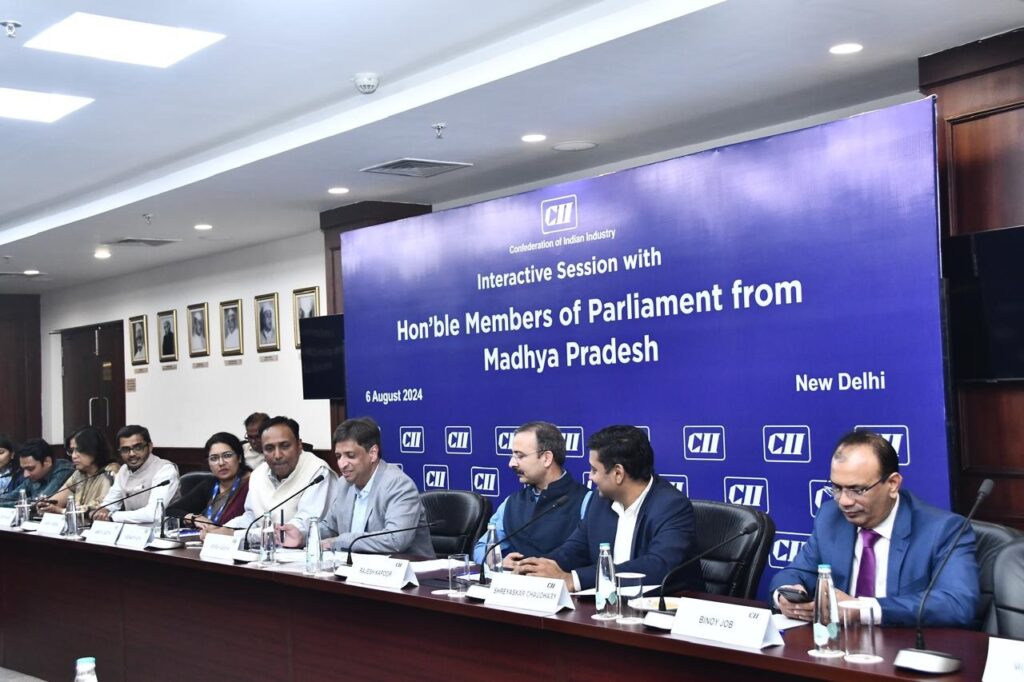
The meeting was attended by the following members of Parliament
1. Mr Ganesh Singh, Satna,
2. Mr Shankar Lalwani, Indore,
3. Mr Ashish Dubey, Jabalpur
4. Mr Sudhir Gupta, Mandsaur
5. Mr Bharat Singh Kushwaha, Gwalior
6. Smt Sandhya Rai, Bhind
7. Dr Rajesh Mishra, Sidhi
8. Smt Bharti Pardhi, Balaghat
9. Mr Shivmangal Singh Tomar, Morena
10. Mr Vivek Bunty Sahu, Chhindwara
11. Smt Maya Narolia, Rajysa Sabha
12. Smt Lata Wankhede, Sagar
The meeting entailed a detailed discussion on the present scenario of Madhya Pradesh and provided an opportunity to discuss the interventions required at central and state level to ensure the all-around development of the State. Members from CII Madhya Pradesh and members of Parliament discussed the key initiatives that can help in facilitating skill development of youth, generating employment opportunities, improving healthcare facilities & delivery, harnessing the sectoral strength of Madhya Pradesh. The meeting was moderated by Mr Ashish Vaishya, Chairman, CII Madhya Pradesh State Council.
Key Takeaways of the Meeting:
The meeting involved a detailed and in-depth discussion on the current situation of Madhya Pradesh, providing a crucial opportunity to identify the necessary interventions at the central and state levels to ensure the overall development of the state. The main topics discussed included the following aspects:
1. Youth Skill Development:
The discussion focused on initiating new and advanced training programs in collaboration with industries. Emphasis was also placed on establishing and facilitating the operation of skill development centers in both rural and urban areas.
2. Employment Opportunities:
The meeting identified new employment opportunities in various sectors. Additionally, plans to create jobs in partnership with local industries were considered. Special employment programs for women and the differently-abled were also key focus areas.
3. Healthcare Facilities and Delivery:
Improving the availability and quality of healthcare services in rural and remote areas was a major point of discussion. Expanding the reach of healthcare services through telemedicine and mobile clinics was highlighted. The use of digital technologies in healthcare was also emphasized.
4. Leveraging the Regional Strengths of Madhya Pradesh:
The discussion highlighted leveraging the state’s unique strengths in agriculture, tourism, and industries. Special plans for promoting organic farming and tourism were considered. Efforts to gain national and international recognition for local crafts and arts were also discussed.
5. Enhancing the Agri, Food Processing & Dairy Sectors of MP:
The discussions focused on harnessing the potential of the agriculture sector of Madhya Pradesh and build upon the same to boost the processing of agri & dairy produce.
6. Empowering FPOs & Self-Help Groups:
The empowerment of Self-Help Groups (SHGs) and Farmer Producer Organizations (FPOs) will catalyze the growth of the cottage industry, ensuring sustainable development and economic resilience. And hence the discussions revolved around necessary interventions.
Quotes:
The meeting with members of the Parliament will help us plan and execute the tangible action plans to foster a sustained and continuous growth of Madhya Pradesh. – Mr Ashish Vaishya, Chairman, CII MP
The interaction provided us with fresh perspective and has opened new avenues of collaboration to make Madhya Pradesh a “Shreshtha” Pradesh. – Mr Siddharth Sethi, Vice Chairman, CII MP
The discussions held today will pave a way for more focused and strategic partnerships to ensure inclusive and sustainable growth of Madhya Pradesh – Mr Akshat Chordia, Chairman, CII Malwa zone
- 0
- By Rabindra

8, Aug 2024
RBI MPC Holds Rates Steady Amid Economic Uncertainties
In its latest meeting, the Reserve Bank of India’s Monetary Policy Committee (MPC) opted to maintain the status quo on key policy rates. The repo rate, at which the RBI lends to commercial banks, remains unchanged, as does the reverse repo rate, which stands as the rate at which banks park excess funds with the central bank. This decision comes amid a backdrop of carefully balanced considerations around inflationary pressures, global economic conditions, and domestic growth dynamics. The MPC acknowledged the complex interplay of factors affecting inflation, including elevated global commodity prices and domestic supply-side constraints.
Looking forward, the MPC reaffirmed its commitment to supporting economic recovery while ensuring price stability. The monetary policy stance remains accommodative, signaling a willingness to sustain adequate liquidity and conducive financial conditions. The committee’s assessment underscored the importance of maintaining financial stability amidst ongoing uncertainties, emphasizing vigilance and proactive measures to mitigate risks. As India navigates through evolving economic challenges, the decisions taken by the MPC aim to foster resilience and facilitate a sustainable path to recovery.
Comments By Industry Experts:
Mr. Samir Jasuja, Founder & CEO of data analytics firm PropEquity
“The Reserve Bank’s decision should be seen in the context of inflation-growth dynamics and the ongoing geopolitical crisis.
Any rate hike would have halted the real estate sales momentum which in the past few years have been on an upwards trajectory.
Going forward, a reduction in the benchmark interest rate will go a long way in providing a further boost to the real estate sector, a major segment of the economy“.
Mr. Aman Sarin, Director & Chief Executive Officer, Anant Raj Limited
We welcome the Reserve Bank of India’s (RBI) decision to keep the policy rate unchanged to maintain economic growth and keep inflation under control. This decision fosters a stable economic environment, which is crucial for sustained development.
We believe that stable interest rates are particularly beneficial for the real estate sector. When interest rates remain steady, home buyers can plan their purchases without the uncertainty of potential rate hikes. The cost of borrowings too remains stable, thus, the cost of construction.
In the forthcoming RBI Monetary Policy, we hope the positive trend continues and expect favorable news for homebuyers specially in the Affordable and middle class housing.
Mr. Mohit Jain, Managing Director, Krisumi Corporation
“While a rate cut would have been an ideal scenario to propel economic growth across industries including real estate, maintaining the status quo will help prevent borrowing cost from rising, enable affordability, propel the residential demand and boost the overall economy. The RBI’s endeavour to maintain a stable policy environment will benefit not just homebuyers but also real estate developers who have the opportunity to innovate and cash in on the buoyancy.”
Siddharth Karnawat, Co-Founder, Blue Sky Capital
RBI keeps rate unchanged at 6.5% for 9 consecutive policies and that was expected on the sidelines of global uncertainty we are into. With FY25 GDP growth rate estimated at 7.2% and CPI inflation estimate at 4.5% maintained for FY25 but to be noted that concern over stubborn food inflation still exists which seems clearly the focus of RBI. Already big banks results showing deposits side pressure and concern over retail loans and RBI was yet again upfront on clearly highlighting that. RBI too indicated money going into markets due to attractive returns and hence banks are facing funding issues.It would be needless to say that currently RBI feels financial market is robust but is proactive to call out as these issues should not become a concern in future. As the focus of RBI always Digital lending RBI proposes to create a public depository of digital lending apps. What is also a good move on ease of doing business is Cheque clearance now will be in hours rather than a couple of days.
To sum up broadly in line with the street’s expectations but with a clear focus on food inflation and not in hurry to change rates.
Siddharth Maurya, Founder & Managing Director, Vibhavangal Anukulakara private limited
The retention of the status quo in the repo rate at 6.5% by the RBI for the ninth consecutive time sends an unequivocal signal about India’s resilient economy and a central bank committed to sustainable growth. That continuity automatically impacts personal financial planning. If one has variable rate loans, this stable interest rate environment provides the opportunity for accelerated repayment strategies. Consider this—an additional payment of even 5% of the EMI towards the principal of a ₹50 lakh home loan at 8.5% interest can cut the tenure by almost 2 years, saving more than ₹5 lakhs in interest.
On the investment front, even though interest rates for FDs might remain flat, this is the time to consider a systematic investment plan in equity mutual funds. With Sensex and Nifty touching all-time highs and the RBI forecasting robust GDP growth, disciplined investments in equities may deliver significant returns in the long run.
So, as depicted in the past records data of SIPs, the return on diversified equity funds on average resulting from SIP investments is approximately ranging within 12-15 % in a 10-year period. Another positive aspect realized by a stable interest rate is that this is a good time to seek an insurance review especially on term life insurance where rates are expected to remain fairly priced for the future.
Manoj Goyal, Director, Forteasia realty pvt ltd.
The move by the RBI to retain the repo rate at 6.5% for the ninth time in a row brings stability to the milieu of real estate financing, helping homebuyers in a manner that keeps interest rates on home loans steady at an average of 8.5%-9.5% for most banks at the moment. For a regular house loan of ₹50 lakhs for 20 years, this will come to an EMI of about ₹44,000 to ₹47,000, depending on the precise interest rate. With the unchanged repo rate and a GDP growth estimate at 7.2%, things have augured well for FY25 in terms of real estate investment, according to the RBI. History suggests that any period where interest rates are stable would normally comprise constant growth in property values. For instance, during the last protracted period of rate stability from 2015 to 2018, the House Price Index showed an average annual growth of 5.8%. This opens up prospects for prospective homebuyers to take balanced decisions without worrying about fluctuating EMIs.
LC Mittal, Director, Motia Group
The hold of the repo rate at 6.5% for the ninth time in a row bodes well with huge implications for the affordable housing sector. With home loan rates steady, the affordability index remains positive for first-time homebuyers. The share of the average home loan payment to income has improved from a high of 61% in FY14 to 43% in FY23, largely due to interest rate stability and rising incomes. This obviously would continue with the present rate stability. While the government’s affordable housing push and a supportive stance by the RBI would have given a fillip surely to this segment, it is quite probably because of price hikes that volumes have not grown so much. Affordable housing—units priced below ₹40 lakhs—accounted for 30% of new launches in the top seven cities in 2023. A status-quo repo rate, along with various government incentives like PMAY, will infuse continuous growth into the affordable housing sector and drive expansion in the overall real estate sector in step with the RBI’s projected 7.2% GDP growth for FY25.
Anurag Goel, Director at Goel Ganga Developments
The nuanced impact of the decision by the Reserve Bank of India to retain the repo rate at 6.5% for the ninth consecutive time is this: while residential real estate benefits directly from stable home loan rates, commercial real estate benefits on account of the overall economic stability that this decision signals. With the RBI retaining its GDP growth estimate at 7.2% for FY25, we can look forward to sustained demand for office spaces, especially in IT hubs and emerging business districts. Office space leasing in the top 8 cities increased by 15% YoY in 2023 to 38.2 mn sq ft. A stable rate environment is likely to trigger more long-term leases and property acquisitions by businesses. What is more, catalysed by the pandemic, for e-commerce the boom goes uninterrupted; hence, demand continues to surge for warehousing and logistics spaces, having grown by 47 percent YoY in 2023 to 51.1 mn sq ft. This trend will be accelerated further as both financing costs and attitude of optimism toward the economy continue unabated.
Aman Gupta, Director of RPS Group
The RBI has retained the repo rate at 6.5 percent for the ninth consecutive time, which impinges in a huge way on real estate developers and investors. On the upside, stability in interest rates, along with the RBI’s now forecasted 4.5 percent inflation, gives an ideal platform for the planning and execution of long-term projects. It now enables developers to plan new projects confidently as financing costs are more predictable. Supply of new housing in Top 7 cities surged by 23 percent year-on-year in 2023, touching 3.65 lakh units. Subsequent supply would maintain this upward trajectory with stable interest rates and positive economic projections. In times of continuity concerning repo rates revised and sustained at the level taken, an unchanged status of interest rate will retain the lucrativeness of rental yield, already averaging 3-4 percent in major Indian cities on residential properties, and 7-9 percent with regard to commercial properties. With an RBI GDP growth projection of 7.2 percent for FY25, we may further witness sustained appreciation in property values—especially in fast-growth urban centers and their emerging satellite towns.
Gurmit Singh Arora, National President, Indian Plumbing Association
The RBI’s decision has a cascading effect on the whole realty ecosystem and allied industries, as it/storage kept the repo rate unchanged at 6.5% for the ninth time in a row. Construction contributes to about 6-8% of India’s GDP, he said; this stability gives predictability to funding costs for projects. On track to reach $1.4 trillion by 2025 in India, stable interest rates take an important seat in this race to growth for the construction sector. Also, the home improvement and interior design sectors get positively impacted with an unchanged repo rate. Stable EMIs will prompt more people to invest in renovations and upgrades. Furniture and Home decor market in India was valued at $32 billion in 2023 and is further likely to bloom under such stable economic conditions. In all, the proptech sector saw over $3.4 billion investments from 2009 through 2022 alone. More innovation in property technology and digital real estate services shall follow under the proptech umbrella due to predictable real estate market conditions.
Mr. Pradeep Aggarwal, Founder & Chairman, Signature Global (India) Ltd.
“The RBI’s decision to keep rates unchanged is on expected lines with an intention to keep inflation under check. While the RBI is focused on reining in inflation within its target limit, the expectation of good monsoon may prompt the apex bank to lower interest rates in the subsequent months thereby further propelling real estate sales momentum and also providing an opportunity to perspective homebuyers to enter in the market. While portraying a robust forecast for economic growth, the RBI’s all-round efforts will positively impact homebuyers sentiments and industry as well”
8, Aug 2024
Government’s Revised LTCG Policy on Real Estate: Implications and Industry Response
8th August, 2024: The government’s recent revision of the long-term capital gains (LTCG) tax policy on real estate has sparked significant interest and debate within the industry. The updated policy aims to streamline taxation rules for property transactions, potentially impacting both investors and homeowners. This revision is seen as a move towards enhancing transparency and efficiency in the real estate sector while aligning with broader economic objectives. Stakeholders, including real estate developers, investors, and tax experts, are closely monitoring the implications of these changes on market dynamics and investment decisions. As the new rules take effect, their impact on property prices, transaction volumes, and overall market sentiment remains a topic of keen observation and analysis.
The government’s decision to give the option to taxpayers to choose between 12.5 per cent LTCG and 20 per cent LTCG with indexation benefit for properties purchased before July 23, 2024 is a positive development for the real estate sector,” commented Mr. Samir Jasuja, Founder and CEO of PropEquity. “It addresses the apprehensions among property owners that they will have to shell more taxes in the absence of indexation benefit. Real estate has always been an important asset class for investment and if we have to make real estate a trillion-dollar industry than lesser taxes should be introduced.”
“The decision provides flexibility to property owners, allowing them to carefully evaluate their financial situation and select the tax option whenever they plan to sell,” said Mr. Sanjoo Bhadana, Founder & MD, 4S Developers. “It has removed the apprehensions among property owners that the new LTCG would have led to higher tax outgo. Now, depending on individual circumstances, one option might offer significant tax savings compared to the other. The amendments in the Finance Bill certainly add a layer of positivity for the real estate market.”
“The amendment in LTCG has given home owners the option to make an informed choice by opting for a method that involves a lesser tax outgo,” noted Mr. Vijay Harsh Jha, founder and CEO of VS Realtors (I) Pvt Ltd, a Gurugram-based property brokerage firm. “The real estate sector is quite enthused with this change in policy and we hope that real estate transactions are not impacted.”
These quotes highlight the varied perspectives within the real estate industry regarding the revised LTCG policy and underscore the potential implications for property owners and investors alike. As the sector adjusts to these changes, stakeholders will continue to monitor how these reforms shape the future landscape of real estate transactions and investment decisions.
8, Aug 2024
Government Revises Long-Term Capital Gains Tax Policy: Implications and Reactions
8th August, 2024: In a recent move, the government has announced significant changes regarding the long-term capital gains (LTCG) tax, aiming to redefine the taxation framework for investors. This decision comes amidst a backdrop of economic considerations and aims to balance revenue generation with investor sentiments.
The new policy includes revisions to the LTCG tax structure, which has garnered attention and mixed reactions from various sectors. It aims to provide clarity and predictability while addressing concerns about equity and fairness in the tax regime.
Key stakeholders, including investors, financial experts, and industry leaders, are closely monitoring the implications of this decision. They are evaluating how it could impact investment patterns, market dynamics, and overall economic growth.
Furthermore, the government’s rationale behind this decision emphasizes its commitment to fostering a conducive environment for sustainable economic development. This move is expected to play a crucial role in shaping the investment landscape in the coming months and beyond.
As discussions unfold and stakeholders adapt to the new tax regime, the broader implications of this decision will undoubtedly unfold, influencing economic policies and investor strategies in the foreseeable future.
Comments by Mr. Mohit Jain, Managing Director, Krisumi Corporation
The amendment moved by the Finance Minister offers flexibility in computing long-term capital gains (LTCG) tax, allowing taxpayers to choose between a lower rate of 12.5% without indexation or a higher 20% rate with indexation for properties acquired before July 23, 2024. This enables property owners to strategically plan their sales, paying the lower of the two tax rates. This change provides much-needed relief for property owners and, consequently, the real estate industry, a significant employment generator in the economy. It also allows for more stability in the real estate market.
8, Aug 2024
Social Beat Achieves Numerous Esteemed Industry Awards

Chennai, 08, August 2024: Social Beat, a leading digital marketing agency, capped a successful six months winning multiple awards across several prestigious platforms. These accolades highlight Social Beat’s excellence in creativity for digital campaigns, performance marketing and influencer collaborations.
At the Maddys Awards, Social Beat secured three silver awards in the Digital Campaigns category:
- Brand Campaign for Samsonite
- Social Media Campaign for Royal Sundaram
- Influencer Marketing Campaign for Samsonite
In the Social Samosa Awards, Social Beat earned:
- Gold for Best Use of Performance Marketing for Sundaram Mutual Fund
- Silver for Best Use of Creators/Influencers for Indian Terrain’s #WearThePants campaign
Social Beat also triumphed at the Front Benchers Awards with three gold awards:
- Gold in the Video category for Samsonite
- Gold in the Rural Marketing category for Fortune (Adani Wilmar)
- Gold in Social Media Best Use of Creator Collaboration
Mr. Vikas Chawla, Co-Founder of Social Beat, said, “These wins are a testament to the strategic thinking and creative ability of our teams across products, services and markets. We are really thrilled to be recognized across multiple categories and platforms reflecting our width and depth of capability. This also motivates us to continue delivering innovative and impactful campaigns that drive business growth for our clients.”
About Social Beat:
Founded in 2012, Social Beat is a digital growth partner, enabling brands to rise to the impossible. They drive business outcomes with a 300+ strong team of digital experts across Bengaluru, Mumbai, NCR, and Chennai. They are India’s fastest-growing independent digital marketing solutions company and manage 4% of digital media investment in India. Social Beat is a Google Premier Partner, and Meta Business Partner and works closely with ecosystem partners like Amazon, Hotstar, Salesforce & LinkedIn. D2Scale is their center of excellence for commerce & omni channels brands to drive growth via D2C & Marketplaces. Influencer.in is their creator economy product driving discovery and real-time reporting of impactful influencer marketing campaigns. They work as extended growth teams with leading brands like Bharat Matrimony, Adani Wilmar, Jaquar, Indian Terrain, Samsonite, Mankind Pharma, Kalpataru Group, Go Colors, Mahindra Finance, JK Cement, Sundaram Mutual, Khazana Jewellery and with hyperscaling startups including boAt, Niyo, Gamezy, A23 Games, EaseMyTrip, Kapiva, Drools and Sukoon Health on driving business outcomes through a combination of creativity and performance.
8, Aug 2024
TeamLease EdTech and Kerala Government Partner to Boost Employabilit
Mumbai: 8th August 2024: TeamLease EdTech is proud to announce a new collaborative partnership with the Kerala Government to address the skill requirements, skill gap, and employability challenges in Kerala. This strategic alliance is set to design and implement impactful skill development through the Work Linked Degree Programs along with Credit Linked Diploma and Certificate, tailored to meet the specific needs of Kerala’s economy.
By combining their respective expertise, resources, and networks, TeamLease EdTech and the Government of Kerala are poised to equip Kerala’s workforce with industry-relevant skills through Work-Linked Degree Programs, internships, and apprenticeships. This initiative fosters increased demand from the state and facilitates a mutual exchange of knowledge, best practices, and industry insights between the two parties. The focus on continuous learning and practical experience aims to enhance the employability of individuals across Kerala, ultimately contributing to the state’s socio-economic development.
Shantanu Rooj, Founder, and CEO of TeamLease EdTech, stated, “This partnership represents a significant step towards bridging the skill gap and enhancing employability in Kerala. By integrating work-experience with academic learning, we aim to create a robust talent supply chain that meets the evolving demands of today’s job market. Our collaborative efforts with K-DISC will empower students with the necessary skills and knowledge to thrive in their careers and contribute effectively to the state’s economic growth.”
Dr P V Unnikrishnan, Member Secretary of KDISC, remarked, “The collaboration with TeamLease EdTech is a landmark initiative in our efforts to boost the employability and skill levels of our youth. By providing industry-oriented education and training, we are ensuring that our educated youth are well-equipped to meet the challenges and opportunities of the future. This MoU will significantly enhance the employment prospects of our students, thereby fostering sustainable economic development in Kerala.”
This Memorandum of Understanding (MoU) between TeamLease EdTech and KDISC underscores a shared commitment to socio-economic development. The initiative will provide gainful employment opportunities through industry-oriented Work Linked Degree Programs, Credit Linked Diplomas, and Certificates, making high-quality education and practical training accessible to all.
8, Aug 2024
Indian Full Moon Ghee has many takers globally: An Expert
Hyderabad, August 08, 2024……A Seminar on Food Processing & Packaging and Global Trends with increasing demand for Indian F & B products was held at FTCCI in Red Hills on Wednesday. It was organised by the Trade Promotion Council of India (TPCI), New Delhi and India Exposition Mart Limited (IEML), Greater Noida. And was supported by the Telangana Food Processing Society (TGFPS); the Federation of Telangana Chambers of Commerce and Industry (FTCCI) and the Dalit Indian Chamber of Commerce and Industry (DICCI)

Mr. Akhil Gawar, Director Telangana Food Processing Society (TGFPS) was the chief guest. Speaking on the occasion he said the focus area of the Government of Telangana was Food Processing, everyone knows how to produce, but, they find it difficult to scale it up. So, our focus is on helping companies to scale up their operations. We will help them in building technology, building a business model, Branding, Marketing, Distribution, Cold Chain Development and many other areas
We also focus on helping farmers to improve their incomes and women’s empowerment. MSME is another focus area. Food Processing is the biggest sub-segment of the MSME. Consumer health, and safety are our other areas of focus, he added.
Mr. Suresh Kumar Singhal who graced as a special guest said the Indian food processing industry stands at a pivotal juncture. The government’s recent budget announcements have underscored its commitment to supporting the growth and development of this vital sector.
Mr Devansh Trivedi, Director Shanti Boilers & Pressure Vessels Pvt. Ltd spoke on Sustainability in Food Processing & Packaging. Mr Trivedi discussed the critical role of sustainability in food production, shared best practices, and highlighted innovative approaches to ensure long-term food security
The Keynote Address was delivered by Mr Rupesh Patel, Co-founder- Healthy Honest Foods Pvt. Ltd. He spoke on Global Demand Trends and increasing Demand for Indian F&B Products
Mr. Patel provided insights into the growing global demand for Indian food products, explored market trends, and identified opportunities for Indian businesses in the international arena.
Frozen Samosas, Frozen Vegetarian Biryani, and Frozen Indian curries are a few food products hugely popular in other countries where India’s diaspora lives. A lot of Indian companies that are exporting ready-to-eat food are exporting in frozen form. This trend is witnessing a huge demand in sales abroad, he added. Not just Indians, but many foreigners are looking forward to this kind of food and has huge demand, he shared.
Indian Samosa has been turned into a billion-dollar global snack, he added. Indian curries in the frozen form are also in huge demand wherever Indians and students are living. After the pandemic Indian food is more accessible globally, he said.
Full moon ghee is also gaining a lot of demand abroad. Making ghee during the Full Moon is considered auspicious due to this powerful forward-moving energy of the Moon added Tamal Chatterjee, Chief Growth Officer SID’s Farm. The practice of making bilona ghee under the Purnima moon dates to Vedic times. Full moon ghee is prized as a potent ojas-building and healing elixir. It is used as a medicinal ghee to promote balance in the body and soul, he added.
The Seminar was organised as part of the roadshow in the backdrop of the “Indus Food Manufacturing” exhibition to be held from 09 to 11 January 2025 in Yashobhoomi, IICC New Delhi. This event is poised to showcase cutting-edge innovations, technologies, and trends in the food and beverage industry.
Core Objectives of the road show, seminar and Indus Food Manufacturing expo were to promote Sustainable Food Production and Raise awareness about the importance of sustainability in food production. And showcase best practices and innovative solutions for sustainable food production.
The second objective was to highlight the Global Demand for Indian F&B Products discuss the increasing global demand for Indian food products and Identify opportunities for Indian F&B businesses in the international market. Another objective was Networking and Collaboration among industry professionals and technology providers and encourage collaboration and partnerships to drive innovation and growth.
The delegation also showcased the upcoming shows “Indusfood 2025” and “Indusfood Manufacturing 2025”:
The Hyderabad roadshow on “Sustainable Food Production and Global Demand for Indian F&B Products” brought together industry leaders, technology providers, and sustainability advocates, the event aims to foster discussions, promote best practices, and identify new opportunities for growth and collaboration.
7, Aug 2024
Karma Primary Healthcare Secures Series A Funding from UBS Optimus Foundation
New Delhi, 07th August 2024: Digital healthcare startup Karma Primary Healthcare has secured funding from UBS Optimus Foundation as part of its Series A funding round. This investment brings the total Series A funding to ₹11 crore (about $1.3 million). The round also saw participation from 1Crowd and other investors.
The capital will be strategically deployed to enhance Karma’s technological capabilities; extend value-added services; and expand the team as it builds-out a patient-centric care model for rural patients in India. Karma aims to reach 100 locations serving over 150,000 patients annually by 2027.
Dhun Davar, Head of Social Finance, UBS Optimus Foundation and Head of Social Impact & Philanthropy, India and Middle East, UBS, said: ”UBS Optimus Foundation aims to scale quality primary healthcare for vulnerable communities around the world and make it more accessible. Our partner Karma Primary Healthcare has assisted hundreds of thousands of patients in rural India since our partnership began and our continued funding will help them expand their network of medical facilities and further strengthen their digital platform.”
The funding will enable Karma to transition from a transaction-based care model to a value-based care model, including the development of value-added services and referral networks. It will also support the enhancement of predictive analytics capabilities, allowing for improved patient data management and personalized healthcare solutions.
“We are delighted by the profound impact Karma has created by revolutionizing the primary healthcare space in India. Their unwavering commitment to bridging the healthcare gap by providing medical care solutions including phygital[1] consultations, advanced diagnostics, quality medicines, and health education in underserved geographies has truly been inspiring. Having supported Karma since their early days, we’re proud of the progress Jagdeep and his team are making in setting new standards in healthcare delivery. We remain committed to Karma’s transformative journey towards providing a continuum of care to people across the country.“ said, Natasha Kothari, Co-Founder, 1Crowd.
Jagdeep Gambhir, CEO & Founder, Karma Primary Healthcare stated, “UBS Optimus Foundation’s support aligns perfectly with our mission to revolutionize quality healthcare access for low-middle-income communities in rural India. This long-term commitment from UBS-OF supports our vision for sustainable growth.”
Founded in 2014, Karma enables access to quality primary healthcare across 8 states in India through its assisted telemedicine model. The company has witnessed a threefold increase in its patient base over the last three years impacting more than 350,000 lives with validated positive health outcomes, with 55% of them being women. Karma has been able to achieve this growth on the back of a robust technology platform that addresses both awareness gaps and service delivery gaps which has enabled it to accumulate a comprehensive dataset of patients in rural India.
7, Aug 2024
International SOS Foundation Recognises Organisations for Their Exceptional Duty of Care Initiatives
India, Aug 7, 2024 – The International SOS Foundation has revealed its 2024 Duty of Care Awards shortlist today. Entries from 29 different countries were received amongst others from leading technology firms and financial institutions to top-tier education and aerospace organisations.
Honouring organisations worldwide for their dedication to protecting their global workforce’s health, safety, security and wellbeing, the Awards are now in its seventh edition. The Awards’ theme, Leading Change for a Re-Imagined Future, is befitting in this continuously changing risk landscape.
This year’s Head of Judges, Deborah de Cerff, Founder of The Employee Mobility Institute (TEMI), said, “On behalf of our esteemed panel of judges, I extend our sincerest congratulations to this year’s exceptional finalists. The calibre of entries was truly inspiring, demonstrating an unwavering commitment to safeguarding employee health, safety, security, and wellbeing. These organisations and individuals have set a remarkable standard for Duty of Care. Their achievements serve as a beacon for others, illuminating a path towards a safer and more secure future for workforces globally.”
Kai Boschmann, Executive Director of the International SOS Foundation, said: “The escalating intersection of global threats requires innovative risk management strategies to protect people. We will honour the pioneering solutions at the forefront of Duty of Care, for a more resilient future.”
The International SOS Foundation is proud to present Chubb, the world’s largest publicly traded property and casualty insurance company, as the Platinum sponsor of the 2024 Duty of Care Awards & Summit. The Awards & Summit will also have supporting sponsorship from Workplace Options (WPO), Munich Re and Koa Health.
The winners across our six categories will be announced live at our Duty of Care Awards & Summit, which will take place on 31 October 2024 at the Fullerton Hotel in Sydney, Australia.
7, Aug 2024
Pacific D21 Mall Dwarka Celebrates Teej Mahotsav 2024
New Delhi, 7th August 2024: Pacific D21 Mall, Dwarka organised Dwarka Teej Mahotsav 2024 celebrating the vibrant and rich culture. The festival is dedicated to the celebration of love, devotion, and marital bliss holding immense significance in Indian culture. The event witnessed a remarkable turnout creating a lively atmosphere that showcased the traditional essence of Teej in all its glory.

The event saw a variety of engaging activities for the attendees throughout the day enjoying intricate mehendi designs, lively games, and enthralling dance performances by 25 talented artists. The competitions included a vibrant fashion show and a spirited game of musical chairs, with winners receiving beautiful gifts from the gifting partner, Senco Gold that made the event even more memorable.
Mr. Abhishek Bansal, Executive Director of Pacific Group, expressed his delight over the event’s success. He remarked, “The Dwarka Teej Mahotsav 2024 at Pacific D21 Mall has truly been a celebration of culture, tradition, and community spirit. We are thrilled to see such a wonderful turnout and the joy it has brought to everyone involved. Our heartfelt thanks to all the artists and participants who made this event memorable.”
The Dwarka Teej Mahotsav 2024 showcased the rich cultural heritage and strong community spirit, leaving everyone with cherished memories.


