


30, Jun 2026
Sensex, Nifty End Lower as IT Stocks Weigh; Markets Track US–Iran Talks
Mumbai, June 30: Indian equity benchmarks ended lower on Monday, weighed down by selling pressure in information technology stocks, while investors closely monitored developments around upcoming US–Iran talks.
Market sentiment remained cautious throughout the session as weak performance in key IT counters dragged the broader indices. Analysts noted that profit booking and global uncertainty contributed to the decline.
Investors also tracked geopolitical developments, particularly the scheduled US–Iran discussions, which are expected to influence global crude oil prices and broader risk sentiment in the coming days.
Despite the downturn, selective buying was seen in some defensive and sector-specific stocks, helping limit deeper losses in the broader market.
Market experts said volatility is likely to persist as global cues, currency movements, and geopolitical factors continue to shape investor sentiment.
- 0
- By Neel Achary

30, Jun 2026
Coal India Plans INR 1,900 Crore Investment in Research & Development by 2030
New Delhi, June 30: State-owned Coal India Limited (CIL) has announced plans to invest around ₹1,900 crore in research and development (R&D) by FY30, aiming to strengthen innovation and modernise its operations.
The investment is expected to focus on improving mining efficiency, adopting cleaner technologies, enhancing safety standards, and supporting sustainable coal production practices.
The move comes as Coal India looks to align with long-term energy transition goals while maintaining its role as a key supplier of coal to the power sector.
Officials said the R&D push will help the company integrate advanced technologies and improve productivity across its mining operations over the coming years.
30, Jun 2026
India Shielded Consumers from Gulf Crisis: Ex-Petroleum Official
New Delhi, June 30: India successfully shielded its consumers from the impact of the ongoing Gulf crisis through timely and well-planned energy management measures, a former senior petroleum official said.
According to the official, proactive steps taken by the government, including diversification of crude oil sourcing, strategic petroleum reserves management, and efficient supply chain coordination, helped maintain stability in fuel availability and prices.
The official noted that India’s energy security framework played a key role in minimizing disruptions despite global uncertainties arising from the Gulf situation. Coordinated efforts between policymakers, refiners, and distribution agencies ensured continuity in supply across the country.
Experts added that India’s approach to energy management highlights the importance of long-term planning, international partnerships, and flexible procurement strategies in safeguarding consumers during global supply shocks.
The remarks underline India’s growing resilience in managing external energy risks and maintaining stability in the domestic market.
30, Jun 2026
Ravi Agrawal Reappointed CBDT Chairman for Six Months
New Delhi, June 30: The Government of India has reappointed Ravi Agrawal as the Chairman of the Central Board of Direct Taxes (CBDT) for a period of six months, according to official sources.
The extension of tenure is aimed at ensuring continuity in leadership and maintaining stability in the functioning of the direct tax administration. The CBDT plays a key role in framing policy for direct taxes and overseeing the Income Tax Department.
Officials said the decision reflects the government’s focus on sustained implementation of ongoing tax reforms, improved compliance mechanisms, and efficient tax administration.
During his continued tenure, the CBDT Chairman is expected to oversee key initiatives related to revenue collection, digital tax systems, and taxpayer services.
Further administrative details will be issued by the concerned authorities in due course.
30, Jun 2026
Odisha Plans Rapid Transport Corridor Linking Bargarh, Sambalpur and Veer Surendra Sai Airport
Bhubaneswar (UDN): The Odisha government is planning to develop a Rapid Transport Corridor (RTC) connecting Bargarh, Sambalpur and Veer Surendra Sai (VSS) Airport at Jharsuguda to strengthen regional connectivity and support economic growth in western Odisha.

Representational image
The proposed corridor aims to provide faster, safer and more efficient transportation between the key urban centres and the airport, significantly reducing travel time for commuters, tourists and businesses. The project is expected to improve access to the region’s commercial, industrial and educational hubs while enhancing last-mile connectivity to the airport.
Official sources said the initiative is part of the state’s broader strategy to develop modern transport infrastructure and facilitate balanced regional development. Once implemented, the corridor is expected to boost trade, tourism, investment and employment opportunities across western Odisha.
The proposed transport network is also expected to benefit passengers travelling to and from Veer Surendra Sai Airport by providing seamless connectivity with major towns in the region. Authorities are examining various options for the corridor, including route alignment, mode of transport and implementation strategy.
The government is expected to undertake detailed feasibility studies and prepare a comprehensive project report before the project is taken up for execution. Officials said the initiative reflects the state’s commitment to expanding world-class transport infrastructure and improving mobility for the people of western Odisha.
30, Jun 2026
transcosmos completes registration as a Financial Services Intermediary
Tokyo, Japan, June 30: transcosmos announced that it has completed registration as a Financial Services Intermediary with the Kanto Local Finance Bureau (Registration No. 27). The Financial Services Intermediary business involves operations that directly handle customers’ assets and transactions, and therefore requires a highly robust operational foundation, including adequate financial capacity, guarantee arrangements, and rigorous compliance and internal control systems.
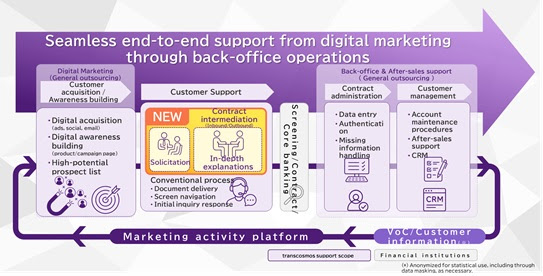
Under these requirements, transcosmos has completed its registration and will commence support for licensed operations across deposit, lending, and securities areas. Through these services, transcosmos will contribute to expanding the customer base of financial institutions while providing integrated support from the design of digital customer touchpoints to back-office operations.
Background
In recent years, amid changes in the interest rate environment, competition in financial products and services has intensified, while customer needs have become increasingly diverse and sophisticated. Against this backdrop, there is a growing need to expand opportunities for customer proposals, deliver seamless and efficient operations in contract-related support and procedures, enhance customer experience (CX) through digital channels, and drive continuous improvement by leveraging Voice of the Customer (VoC).
Overview of registered business and services
[Intermediation Services for Deposits and Loans]
– Acceptance and processing of new applications for housing loans and deposit accounts
– Document verification, data entry, and handling incomplete or missing information
– Provision of product information and implementation of initiatives to promote applications
[Securities Intermediation Services]
– Administrative procedures and customer support related to the opening of securities accounts
– Inquiry handling and order intermediation via telephone
– Support for applications and promotion of investment trusts and NISA (Nippon Individual Savings Account) accounts
transcosmos’s strengths
- Extensive track record in financial operations
Leveraging expertise gained through supporting the operations of financial institutions, transcosmos provides efficient and stable operational frameworks - Integration of digital (Web/CX) and operations
transcosmos delivers end-to-end services—from the design of customer touchpoints to back-office operations—enhancing CX and advancing operational capabilities - One of the largest contact center infrastructures in Japan
transcosmos provides high-quality, large-scale customer support and multichannel operations, including chat support, voice bots, and social media engagement
Next steps
Going beyond traditional outsourcing, transcosmos will work closely with financial institutions to address both management and operational challenges, while promoting the development of sustainable operational models. With this registration, transcosmos will expand its support in the CX domain to include licensed operations and establish an operating model that integrates digital and back-office functions. Through these initiatives, transcosmos will create an environment that enables financial institutions to concentrate on their core businesses, while contributing to the delivery of financial services that are clear, accessible, and reliable for consumers.
* transcosmos is a trademark or registered trademark of transcosmos inc. in Japan and other countries.
* Other company names and product or service names used here are trademarks or registered trademarks of respective companies.
30, Jun 2026
BlaBlaCar Announces Global Expansion Into 20 New Countries
June 30: BlaBlaCar announces expansion into 20 new countries as carpooling emerges as a mainstream solution to persistent economic and environmental pressures on consumers. This deployment marks the company’s first major wave of new market entries in a decade, driven by artificial intelligence to accelerate localization and operational scaling, and brings global presence to 41 countries.

The expansion builds on mature regional operations where the platform has successfully established localized networks. By broadening its geographic reach, BlaBlaCar aims to address structural transport challenges in high-growth areas while completing its network coverage across Europe.
It comes at a critical time when carpooling is emerging as an affordable and efficient solution for intercity travel amid the current context of rising fuel prices for the foreseeable future. Carpooling is a collaborative mobility alternative in which several individuals share a vehicle to complete the same journey and split the travel expenses. The average distance of BlaBlaCar journeys is around 150–250 kilometers. Through its technology, the platform optimizes and facilitates the connection between passengers and drivers who list their empty seats for trips they were already planning to make with other users who need to travel to the same destination in a more direct or economical way than other forms of travel can offer.
Since March 2026, BlaBlaCar registered more than 875,000 new drivers globally, demonstrating the impact of the platform in offsetting travel costs by sharing them.
“Our model works because it solves an economic reality for the consumer,” said Nicolas Brusson, CEO of BlaBlaCar. “Last year alone, our drivers saved over €568 million in travel expenses. As we scale into 20 new markets, we are unlocking massive, untapped economic relief for millions of travelers and commuters.”
The international rollout scales across four major geographical regions:
Latin America: The expansion follows a decade of operations in Brazil, where more than 25 million passengers used the platform in 2025. Brazil has become the second-largest global market for the group’s carpooling and bus offerings and this regional rollout introduces BlaBlaCar’s shared mobility infrastructure to neighboring countries, including Argentina, Bolivia, Chile, Colombia, Ecuador, Paraguay, Peru, and Uruguay.
Southeast Asia: the company is launching services in several new countries. New market entries include Indonesia, Malaysia, the Philippines, Thailand, and Vietnam. Structural transit gaps, particularly between big and mid-size cities, present high demand for shared travel solutions and carpooling offers an untapped opportunity in the region.
Europe: BlaBlaCar is expanding into several additional markets to complete its regional footprint across historical market, Europe. New entries include Albania, Bosnia, Bulgaria, Greece, Macedonia, and Moldova.
North Africa: The company is launching operations for the first time in Africa, starting with Morocco. The expansion leverages geographical proximity and existing similar travel patterns in the French and Spanish markets.
“Our mission is to optimize every empty seat on the road,” says Nicolas Brusson. “The growth we’ve seen in the last months demonstrates that consumers find the cost-sharing model more relevant than ever. And we are excited to see new communities form across new countries around the same concept.”
India, BlaBlaCar’s Largest Carpooling Market Globally
India has experienced 47% year-on-year growth in 2025 surpassing all European markets with 19 million passengers in 2025, thereby emerging as BlaBlaCar’s largest carpooling market globally.
In 2026, this momentum has only accelerated the platform now serves over 2 million passengers per month, with 315,000 new drivers joining since March alone. Remarkably, this growth has been driven entirely by word of mouth, reflecting the depth of demand for affordable intercity travel across the country. BlaBlaCar’s reach in India now extends well beyond metros, with shared mobility becoming a mainstream solution for travelers connecting cities like Pune, Jaipur, Kolhapur, Aurangabad, Chittoor, Meerut, Anantpur, amongst others.
30, Jun 2026
IRDAI to Introduce New Guidelines to Curb Insurance Mis-selling by Banks
New Delhi, June 30: The Insurance Regulatory and Development Authority of India (IRDAI) is set to issue fresh guidelines for banks to curb the mis-selling of insurance products, IRDAI Chairperson has said.
The proposed guidelines aim to strengthen transparency and ensure that insurance products are sold based on customers’ financial needs and informed consent. The regulator is expected to introduce measures that promote ethical sales practices and enhance accountability among banks distributing insurance products.
According to the Chairperson, the initiative is intended to safeguard policyholders’ interests and improve consumer confidence in the insurance sector. The guidelines are also expected to reinforce compliance standards and encourage fair business practices across the bancassurance channel.
Industry experts believe the move will help reduce complaints related to mis-selling and improve the quality of customer service by ensuring greater disclosure and suitability of insurance products.
The detailed guidelines are expected to be released by IRDAI in the coming weeks.
30, Jun 2026
India’s Water Sector Poised for INR 20 Lakh Crore Investment by 2030
New Delhi, June 30: India’s growing water deficit is expected to create an investment opportunity of nearly ₹20 lakh crore by 2030, according to a recent report.
The report highlights that increasing water demand, rapid urbanisation, industrial expansion, and climate-related challenges are driving the need for significant investment in water infrastructure, conservation, treatment, and efficient resource management.
Experts said investments will be required across key areas such as water supply systems, wastewater treatment, irrigation, desalination, recycling, and smart water management technologies to address the country’s long-term water security needs.
The report noted that the expanding investment landscape presents opportunities for both public and private sector participation while supporting sustainable development and improving access to clean water.
Analysts believe that timely investments and policy support will be crucial in strengthening India’s water infrastructure and ensuring efficient management of water resources over the coming years.
30, Jun 2026
NITI Aayog Highlights GCC Ecosystem as a Key Driver of India’s Innovation-Led Growth
June 30: NITI Aayog has stated that India’s rapidly expanding Global Capability Centre (GCC) ecosystem is well-positioned to power the country’s next phase of innovation-led economic growth.
According to the policy think tank, GCCs have evolved into strategic hubs for research, product development, digital innovation, artificial intelligence, and advanced technology services, playing an increasingly significant role in global business operations.
The report attributes India’s growing prominence in the GCC landscape to its large pool of skilled professionals, expanding digital infrastructure, and a supportive business environment. It also emphasises the importance of continued investment in talent development, innovation, and collaboration between industry, academia, and government.
NITI Aayog noted that strengthening the GCC ecosystem will not only enhance India’s competitiveness in the global knowledge economy but also create high-value employment opportunities and accelerate technology-driven growth.
The report calls for sustained policy support and a future-ready ecosystem to enable India to emerge as a leading global hub for innovation and enterprise services.


