


25, Jun 2026
Amazon CEO Announces Massive Dollar 48 Billion India Expansion Plan
New Delhi, June 25: Amazon CEO has met Prime Minister Narendra Modi and announced plans to invest $48 billion in India by 2030, marking one of the company’s largest long-term commitments in the country.
The investment is expected to be directed towards expanding Amazon’s e-commerce infrastructure, strengthening cloud computing capabilities, enhancing logistics networks, and supporting digital innovation across India.
According to officials, the announcement reflects growing confidence in India’s digital economy and its rapidly expanding consumer and enterprise markets. The planned investment is also expected to create new opportunities in technology, supply chain management, and employment generation over the coming years.
During the meeting, discussions focused on India’s digital transformation, ease of doing business, and the role of technology in driving inclusive economic growth. The government highlighted its continued focus on building a strong digital ecosystem to support global and domestic companies.
Amazon’s commitment is expected to further deepen its presence in India, where it already operates across multiple sectors including e-commerce, cloud services through Amazon Web Services (AWS), and digital payment solutions.
Industry experts say the investment underscores India’s position as a key global growth market for technology and retail expansion. It also aligns with broader trends of increasing foreign direct investment in India’s digital and infrastructure sectors.
The company stated that the long-term investment will support innovation, expand small business participation on its platform, and improve customer experience across the country.
The announcement is seen as a significant boost to India’s digital economy and reinforces global investor confidence in the country’s growth trajectory.
- 0
- By Neel Achary

25, Jun 2026
Two Premier Erling Haaland Cards From Logan Paul’s Personal Collection Headline Goldin Weekly Auction
June 25: Goldin, an internationally recognized leader in high-end collectibles and memorabilia, opened its 2026 Weekly Auction running from June 23 through July 2. The sale spans sports and pop culture, with standout collectibles across soccer, including this year’s FIFA World Cup participants.
Two of this week’s most significant lots are consigned from the personal collection of influencer, entrepreneur, and professional wrestler Logan Paul, featuring Norway’s Erling Haaland. Following an incredible performance against Senegal in the FIFA World Cup 2026, this week’s auction opens with a 2019-20 Topps Chrome Bundesliga SuperFractor #72 Erling Haaland Rookie Card (#1/1) – BGS GEM MINT 9.5 – True Gem+. The indomitable Manchester City and Norway striker Erling Haaland shines on this wholly unique Topps Chrome Bundesliga SuperFractor, one of the “Holy Grails” of the modern soccer collecting hobby. This singular card is a fantastic, ultra-prestigious Haaland showpiece that would instantly become the centerpiece of any high-end modern soccer card collection. Not to be missed as well is a 2019-20 Topps Chrome Bundesliga Red Refractor #72 Erling Haaland Rookie Card (#04/10) – PSA GEM MT 10 – Pop 4, one of four examples of this piece recorded at its unimprovable tier in PSA’s census reporting.
Building off the momentum of Harry Kane’s brace for England in the World Cup match last week, fans and collectors will find a 2023-24 Panini Donruss FIFA Kaboom! Gold #9 Harry Kane (#02/10). With a grading of PSA MINT 9, only one copy of this piece recorded in PSA’s census reporting has achieved a higher grading tier.
Beyond the remarkable soccer collectibles, Goldin’s Weekly Auction also includes a 2025 Topps Marvel Studios Chrome The Fantastic Four: First Steps SuperFractor #6 Silver Surfer (#1/1) – PSA MINT 9. The Silver Surfer—one of the primary antagonists in The Fantastic Four: First Steps— appears on this singular Topps Marvel Studios Chrome The Fantastic Four: First Steps SuperFractor collectible.
The 2026 Weekly Auction will close on July 2, with extended bidding beginning at 10:00 p.m. ET.
Additional ongoing auctions include the Airrack Youtuber Exclusive Auction open through June 24; the Spring Goldin 100 Auction, open through June 28, the USA 250th Anniversary Historical Auction, open through July 8, the June Elite Auction, open through July 11, and the Global Football Auction Part 2, which will open on June 26 and close July 25.
25, Jun 2026
Global Scrum Alliance Community Surpasses 2 Million Credentials Earned
The historic milestone belongs to a global ecosystem of trainers, partners, and practitioners, proving that agile capabilities are foundational to surviving and thriving in the age of AI and other disruptive forces
DENVER, CO, June 25: In a definitive sign that agility has become the foundational skill for the modern workforce, the Scrum Alliance® community has officially surpassed 2 million professional credentials earned from the organization. This historic milestone belongs entirely to the global community that built, shaped, and sustained this movement from the ground up.
This ecosystem is anchored by the training partners who scale workplace agility through hands-on education, and the members who sustain it through everyday practice. This milestone is a collective victory for every layer of the community: the early practitioners who first legitimized agility globally, the volunteers who shape professional standards, the local chapters and User Groups creating grassroots community, the enterprises adopting it at scale, and the dedicated members driving it forward every day.
From foundational certifications to emerging microcredentials, these credentials reflect a global movement of professionals applying agile principles beyond software and technology into business operations, healthcare, education, marketing, product development, leadership, and organizational transformation.
As organizations face unprecedented complexity driven by the rapid rise of AI and other disruptive forces, agile capabilities have become more important than ever. Agile principles and behaviors serve as the essential foundation for navigating these dynamics, allowing professionals across every sector to take charge of their career longevity and build adaptable, future-proof skill sets.
“Reaching two million credentials serves as a definitive index for a broader shift in the global talent market—one where agility is a core requirement for organizational resilience,” said Tristan Boutros, CEO of Scrum Alliance. “Modern enterprises increasingly rely on multi-faceted employees who can enable strategy, navigate AI-driven disruption, lead organizational change, and solve complex business problems. This milestone belongs to our extraordinary community. From the early practitioners who legitimized agility globally to the trainers and partners who scale it today, this celebrates the people who drive meaningful results in an unpredictable world.”
25, Jun 2026
Investment Migration enters the Sustainable Finance Mainstream, Global Citizen Solutions Research finds
London, June 25: Global Citizen Solutions (“GCS”), a leading residency and citizenship planning advisory firm, today publishes new research examining investment migration through the lens of sustainable finance. The briefing, Sustainable Citizenship: Investment Migration as an Impact-Investing Asset Class, traces how 22 citizenship and residency programs have evolved from capital-based fiscal instruments into purpose-driven mechanisms aligned with the United Nations Sustainable Development Goals and the EU sustainable finance taxonomy.
Of the 22 programs examined, approximately half carry some form of sustainability framing. The analysis identifies Small Island Developing States (SIDS) as the most advanced globally, with Caribbean programs including Dominica, St. Kitts and Nevis, Grenada, and Antigua and Barbuda representing the strongest regional concentration of sustainability-framed investment migration. For many of these economies, citizenship-by-investment revenue covers climate adaptation needs that multilateral finance has consistently failed to meet. Climate adaptation costs for SIDS reach USD 5.1 billion per year, while actual multilateral adaptation finance covers less than a third of that figure. CBI revenue has become a parallel channel for the same developmental outcomes the SDG framework was built to deliver.
Dominica records CBI inflows at 33% of GDP in 2022 and 26.9% in 2023, directly supporting public investment in disaster reconstruction, climate-resilient infrastructure, and a geothermal energy transition. St. Kitts and Nevis shows the fiscal deficit widening to -11% of GDP following a decline in CBI revenue, illustrating the same relationship from the opposite direction. For small-island economies, investment migration is a fiscal capacity necessity, not discretionary income.
The research also identifies an alignment between the Caribbean and Europe, despite operating through entirely different mechanisms. Caribbean programs work through sovereign statute: St. Kitts and Nevis has legislated seven sustainability pillars directly into its contribution mechanism. As Joe Rice, Head of Citizenship Programs at Global Citizen Solutions, observes: “The framing is shifting from we want your capital to we want your contribution. The next generation of programs will be purpose-driven, with measurable outcomes attached to the contribution itself.” In Europe, programs work through EU-wide financial regulation. For example, Portugal’s fund route operates within the EU Sustainable Finance Disclosure Regulation (SFDR) perimeter, bringing investment migration into direct contact with the regulatory architecture governing sustainable finance. Vera Avidano, product specialist at Global Citizen Solutions, notes: “Even though the fund investment route remains the most popular choice, we are seeing a growing interest in the cultural donation route as well.”
Investor demand is accelerating this structural shift. Morgan Stanley’s 2025 Sustainable Signals survey found that 99% of Gen Z and 97% of Millennial investors expressed interest in sustainable investing. A Standard Chartered Private Bank survey of HNW and affluent investors across Hong Kong, Singapore, the UAE, and the UK found that 84% were open to shifting funds from philanthropy to sustainable investing. In the United States, the US SIF Foundation’s 2025/2026 Trends Report placed total US sustainable investment assets at $6.6 trillion, with 46% of surveyed institutions expecting to increase their impact investing activities over the next three years. As investment migration programs continue to evolve their fund-based routes, this demand profile strengthens the commercial rationale for sustainability-framed qualification structures.
Impact investing has emerged as a significant segment of global finance, enabling investors to generate positive social and environmental outcomes alongside financial returns. According to the Global Impact Investing Network (GIIN), more than 3,900 organizations managed an estimated US$1.57 trillion in impact investing assets worldwide in 2024, reflecting a 21% compound annual growth rate since 2019 (GIIN, 2024). The sector is driven by increasing investor interest in addressing challenges such as climate change, affordable housing, healthcare, education, and sustainable infrastructure while achieving competitive financial performance.
The briefing situates sustainability framing within a longer history. Panama’s Reforestation Visa, operating under Law 24 of 1992, has required capital to be deployed in government-approved tropical reforestation projects for over thirty years, predating the ESG label entirely. At the other end of the timeline, Nauru’s Economic and Climate Resilience Citizenship Act, launched at COP29 in November 2024, was the first citizenship program designed and marketed from inception as a climate-finance instrument. São Tomé and Príncipe’s National Transformation Fund, launched in August 2025, is the newest entrant to the sustainability-framed cluster. New Zealand extends this pattern to the Anglosphere through administrative pre-approval of climate-impact funds.
The transition, however, remains uneven. Gulf, North American, and most MENA programs carry no sustainability framing. The United States Gold Card, designed explicitly as a revenue tool for the federal government rather than as an investment in any specific national priority, it has no requirement that the money go toward a defined project or outcome — and no mechanism to verify that it does. Structured as a purely economic and deficit-reduction instrument, it falls at the opposite end of the spectrum from fund-based, sustainability-framed programs: it carries no sustainability framing, no traceable developmental mandate, and no alignment with recognized impact-investing frameworks.
“The programs we analyzed fall into two almost equal groups: those structured around sustainability and measurable development outcomes, and those designed purely as fiscal instruments. That divide is the defining feature of the sector right now,” said Liana Simonyan, Researcher at GCS’ research arm, the Global Intelligence Unit.
25, Jun 2026
FPSB Releases New Practice Guidance Note on the Use of AI in Financial Planning
DENVER, COLO – 24 June 2026 – Financial Planning Standards Board Ltd. (FPSB), the nonprofit, standards-setting body for the global financial planning profession and owner of the international CERTIFIED FINANCIAL PLANNER certification program, is pleased to announce the release of its new Practice Guidance Note: Use of Artificial Intelligence in Financial Planning, designed to help financial planning professionals use artificial intelligence (AI) responsibly while meeting their ethical and professional obligations.

As AI adoption accelerates across the financial planning profession, the guidance provides practical direction on how financial planners can use AI to support efficiency, insight and client service while reinforcing the importance of professional judgment, human oversight, transparency and confidentiality.
The guidance note comes as FPSB’s 2025 global research on the Impact of AI on Financial Planning found that two in three financial planners report their firms are using AI or planning to do so in the next 12 months. The research, based on responses from more than 6,200 financial planners across 24 territories, also found that 78% believe AI will help them better serve clients, while 60% say it will enhance the quality of financial advice.
“AI is reshaping the practice of financial planning, but trust, professional judgment and accountability remain essential,” said FPSB CEO Dante De Gori, CFP. “This new practice guidance note is designed to help financial planners embrace the benefits of AI while reinforcing that they remain responsible for the advice and recommendations they provide to clients.”
The guidance note was developed to help financial planning practitioners better understand their professional and ethical obligations, as set out in FPSB’s Global Financial Planning Standards, when using AI across the financial planning process, including in client communication, data gathering, and research. It also highlights key areas requiring special care, such as privacy, cybersecurity, and the accuracy and reliability of outputs. FPSB’s guidance stresses that AI should support — not replace — professional expertise and critical thinking.
“As technology evolves, FPSB’s global standards continue to guide the level of practice expected of financial planning professionals,” said FPSB Chief Professionalism Officer Paul Grimes, CFP. “This guidance note helps financial planners understand how their professional and ethical obligations evolve as AI becomes part of professional practice.”
According to FPSB’s research on AI, financial planners are already using AI in practical ways, including client communications (41%), client data collection (33%) and client risk profiling (30%), as well as operational functions such as marketing (35%) and client onboarding (34%). At the same time, planners identified data privacy and cybersecurity (47%) and the accuracy and reliability of AI outputs (42%) among their top concerns.
The development of the practice guidance note was led by FPSB’s Professional Standards Committee in consultation with FPSB’s network of organizations, representing more than 236,000 CFP professionals across the world.
“AI can enhance how financial planners serve clients, but it must be used with care, transparency and professional oversight,” said FPSB Professional Standards Committee Chairperson Darren McShane. “FPSB’s new guidance note helps financial planners understand how to use AI responsibly while keeping professional judgment and client interests at the center.”
25, Jun 2026
AI-Embedded Cellular Module Adoption Loses Momentum in Q1 2026 as Surging Memory Prices Impact the Market
Buenos Aires, Seoul, Beijing, Berlin, Fort Collins, Hong Kong, London, New Delhi, Taipei, Tokyo, June 25: The cellular IoT module market is starting to look a little different. For years, most of the module innovation came from connectivity upgrades from 2G to 4G, then to NB-IoT to Cat 1 bis, and now 5G and RedCap. But that is beginning to change. Today, intelligence is becoming just as important as connectivity, but the path is proving less linear than many expected.
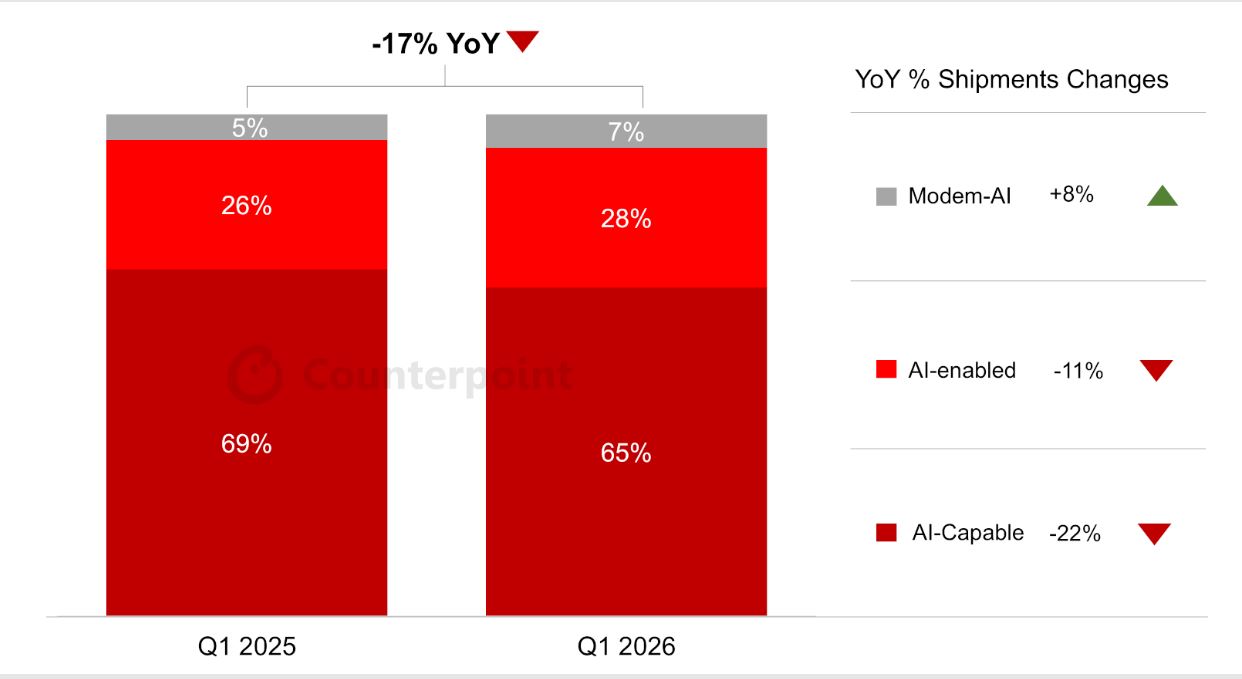
According to Counterpoint Research’s latest Cellular IoT AI Module & Chipset Tracker, AI-embedded cellular IoT modules contributed 6% of total cellular IoT module shipments in Q1 2026. While AI remains one of the most discussed topics across the IoT ecosystem, adoption lost momentum during the quarter for cellular AI modules. After growing 19% YoY in 2025, AI-embedded module shipments declined nearly 17% YoY in Q1 2026.
The slowdown was mainly due to rising memory prices, which have increased the bill of materials for many AI-enabled products. Unlike basic connectivity modules, AI-capable and AI-enabled modules typically require larger memory configurations to support local AI processing and computing workloads. As memory costs increased throughout the supply chain, several enterprise deployments were delayed, particularly in cost-sensitive segments.
AI-embedded Cellular Module Shipments Share by AI Capability, Q1 2026
Source: Counterpoint AI Module & Chipset Tracker & Forecast, Q1 2026
Commenting on the market scenario, Senior Analyst Tina Lu said “We are starting to see two different AI adoption paths in modules. One is the Modem AI modules where intelligence is directly embedded into modems (for example Qualcomm X72, X75, X80, X85 or Mediatek T830, T930) to handle tasks like optimization of connectivity, network selection and power efficiency, the second is application-centric AI where modules integrate CPUs, GPUs and dedicated NPUs to run AI processing locally.”
Lu added, “The different cost structure and component dependencies affected the growth and adoption of these two approaches. Modem AI, which is not dependent on memory and does not perform application processing, registered a growth of 8% YoY, whereas AI-capable and AI-enabled modules which mainly perform on-device edge AI and are dependent on higher memory configuration required to do processing tasks, declined 22% YoY and 11% YoY respectively, due to rising memory costs.”
Commenting on the drivers & outlook, Director of IoT Practice Mohit Agrawal said “Smart retail, rugged handhelds and industrial are the major adopters of AI-enabled modules whereas for AI-capable modules POS is driving the contribution. Modem AI growth is being single-handedly driven by router-CPE application as operators look to optimize network performance, improve power efficiency and deliver a better user experience in enterprise deployments and 5G FWA.”
Agrawal added, “Due to these memory price increases, AI-embedded cellular modules witnessed double-digit ASP growth as module players were forced to raise prices, eventually affecting demand across applications due to hardware costs. The recent slowdown does not change the direction of the market. AI adoption is still at an early stage across IoT applications. With ongoing traction in smart cameras, surveillance, retail, automotive, and industrial robotics, we expect AI penetration in cellular modules to reach 25% by 2030. Over time, AI will move beyond a few niche applications and become a standard feature, helping connected devices become smarter rather than simply remain connected.”
AI Category Definitions:
AI-Capable Modules: Modules integrating CPUs and GPUs that can support basic AI processing and lightweight inference, but without a dedicated AI accelerator. An example is the Fibocom SC226 module, which is powered by an ARM Cortex A53 quad-core processor, and includes a built-in Adreno 702 GPU.
AI-Enabled Modules: Modules integrating dedicated AI hardware such as NPUs, TPUs or AI engines to support advanced AI workloads and local inference. For example, the Meig SLM925 module, based on the QCM6125 SoC.
Modem AI Modules: Modules based on modem platforms with embedded AI capabilities focused on connectivity optimization, including network performance, power efficiency, positioning and signal management, rather than application-level AI processing.
25, Jun 2026
IPO bound Steamhouse secures INR 50 crore pre-IPO investment from Madhusudhan Kela and Niveshaay Sambhav Fund
Madhusudhan Kela-backed Singularity Large Value Fund III and Singularity Equity Fund I along with Niveshaay Sambhav Fund, have invested an aggregate Rs 49.99 crore in Steamhouse India Limited through a pre-IPO placement at an issue price of Rs 73 per equity share.
As part of the transaction, Steamhouse India allotted 68,49,315 equity shares to the investors through a private placement. Singularity Large Value Fund III received 47,94,520 equity shares aggregating Rs 34.99 crore, while Singularity Equity Fund I was allotted 6,84,932 equity shares worth Rs 5 crore. Niveshaay Sambhav Fund received 13,69,863 equity shares aggregating Rs 9.99 crore.
Following the allotment, the three investors collectively hold approximately 2.94% of Steamhouse India’s pre-offer equity share capital. As per SEBI regulations, the proposed fresh issue size under the IPO will be reduced to the extent of the amount raised through the pre-IPO placement.
The Surat-headquartered company, which pioneered the concept of centralized steam supply for industrial customers in India, has already filed its Updated Draft Red Herring Prospectus (UDRHP) with the Securities and Exchange Board of India (SEBI).
Founded in 2014 and backed by the industrial legacy of the Sanjoo Group, Steamhouse India operates one of the country’s largest industrial steam distribution networks. The company serves more than 167 industrial clients across sectors such as chemicals, textiles, pharmaceuticals, food processing, paper and manufacturing through a centralized utility model that supplies steam directly to factories through dedicated pipeline infrastructure.
Steamhouse introduced the concept of community boilers, a centralized alternative to captive boilers, enabling industrial customers to reduce operational costs, improve efficiency and lower emissions. The company leverages IoT and AI technologies across procurement, generation and distribution to deliver steam at approximately 190 degrees Celsius to customers.
The company has built over 45 kilometres of pipeline infrastructure across major industrial hubs including Sachin, Vapi, Ankleshwar, Sarigam, Panoli and Nandesari. Its operating model creates high entry barriers and establishes a dominant position in the industrial clusters where it operates.
It is expanding capacity across key industrial locations including Ahmedabad, Dahej, Vapi, Ankleshwar, Panoli, Jhagadia and Nandesari, while also evaluating opportunities across Andhra Pradesh, Telangana, Maharashtra, Himachal Pradesh, Madhya Pradesh, Rajasthan, Uttar Pradesh and Haryana.
In line with its sustainability focus, Steamhouse has commissioned a waste-to-steam boiler at Vapi that converts non-recyclable plastic waste from paper mills into industrial steam. The company also secured a 5 MW Waste-to-Steam project from Ahmedabad Municipal Corporation under the public-private partnership (PPP) model.
Beyond steam distribution, the company is expanding into adjacent businesses including nitrogen compression and distribution, waste-to-energy solutions and aviation logistics.
25, Jun 2026
India’s Housing Market Outlook: Decoding Sales and Supply Trends Across 9 Cities in Q2 2026
India’s housing market continues to demonstrate strong growth despite the Middle East conflict. The sharp increase in supply has expanded choices for homebuyers, while strong absorption levels indicate that underlying demand remains healthy across major markets. The reworking of supply pipelines by developers especially in Southern and Western India to suit the affordability of homebuyers have helped sales growth. Additionally, India’s stable economic outlook, improving infrastructure and growing investor confidence have enabled the housing market to maintain its growth trajectory reaffirming real estate as a preferred asset class for both end-users and investors.
25, Jun 2026
Gold, Silver Trade Volatile as Fed Rate Uncertainty Weighs on Sentiment
New Delhi, June 25: Gold and silver prices witnessed volatile trading in global and domestic markets amid growing uncertainty over the U.S. Federal Reserve’s interest rate outlook, according to market analysts.
Precious metals experienced fluctuations as investors reacted to mixed signals from the U.S. economy and evolving expectations around future rate cuts. Strength in the U.S. dollar at times weighed on bullion prices, while safe-haven demand provided intermittent support.
Analysts said that gold and silver continue to respond sharply to macroeconomic cues, particularly inflation trends, bond yields, and central bank commentary. Expectations of prolonged higher interest rates have limited upside momentum in bullion markets.
In the domestic market, traders reported range-bound movement with heightened volatility as global cues influenced sentiment. Investors remained cautious, awaiting clearer signals from the Federal Reserve regarding its monetary policy trajectory.
Despite short-term fluctuations, experts believe that gold retains its appeal as a safe-haven asset amid global economic uncertainty, while silver continues to see demand driven by both industrial usage and investment interest.
Market participants are expected to closely monitor upcoming U.S. economic data and central bank statements for further direction in precious metal prices.
The outlook for bullion remains sensitive to interest rate expectations, inflation trends, and broader global financial stability.
25, Jun 2026
India’s Real Estate Sector Sees Strong Dollar 4.3 Billion Institutional Inflows in H1 2026
New Delhi, June 25: India’s real estate market has attracted institutional investments worth $4.3 billion in the first half (H1) of 2026, reflecting strong investor confidence and sustained growth momentum in the sector.
According to industry data, the inflows were driven by robust demand across key segments, including commercial office spaces, residential developments, warehousing, and logistics infrastructure. The trend highlights India’s continued position as a preferred destination for global and domestic institutional investors.
Experts noted that stable economic fundamentals, improved regulatory frameworks, and growing urbanisation have contributed to increased investor participation in the real estate sector. The rise in demand for quality office spaces and expansion of e-commerce-driven logistics networks have also supported investment activity.
Analysts said the strong inflows indicate long-term confidence in India’s growth story, with both foreign and domestic investors actively participating in large-scale projects and development platforms.
The residential segment also witnessed steady interest, supported by improving affordability conditions and rising demand in major metropolitan regions. Meanwhile, the warehousing and industrial segments continued to benefit from supply chain expansion and infrastructure development initiatives.
Market observers believe that sustained institutional investments will further strengthen India’s real estate ecosystem, improve project execution, and enhance overall market stability in the coming years.
With $4.3 billion already invested in H1 2026, the sector is expected to maintain its growth trajectory, supported by policy stability and increasing demand across asset classes.


