


24, Jun 2026
Chef Lekhpal Singh Rawat Honored with Global Culinary Excellence Award at National Prestige Awards 2.0
Chef Lekhpal Singh Rawat, currently serving as Master Chef at Saffron Indian Cuisine Restaurant, North Carolina, USA, has been honored with the prestigious Global Culinary Excellence Award at the National Prestige Awards 2.0, held at the renowned Radisson Blu Hotel, Dwarka, New Delhi.
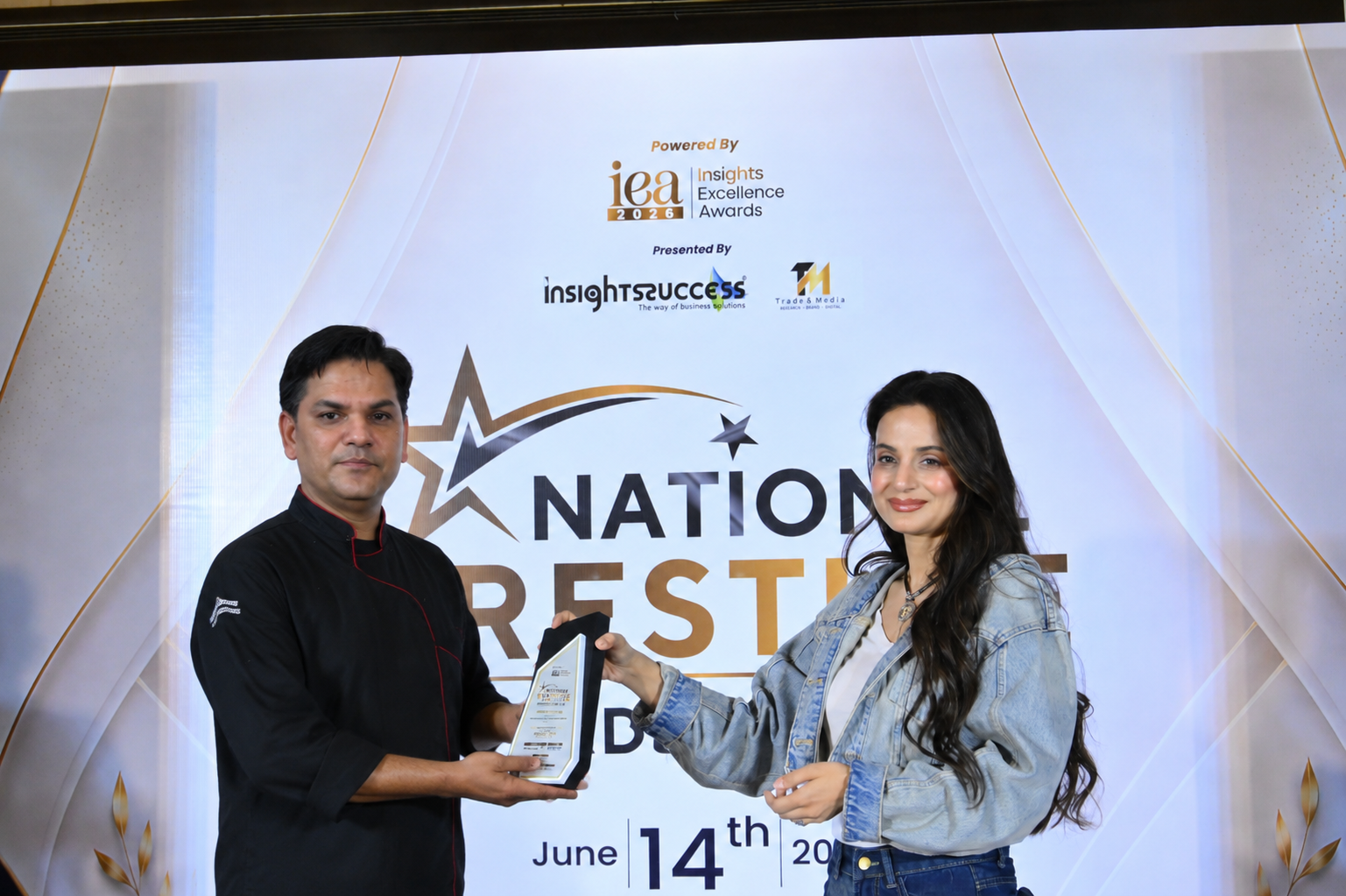
The award recognizes Chef Rawat’s exceptional contribution to the global culinary landscape, his dedication to preserving authentic Indian flavors, and his commitment to elevating Indian cuisine on the international stage. The recognition was presented during a grand ceremony attended by industry leaders, entrepreneurs, professionals, and distinguished guests from across the country.
Over the years, Chef Lekhpal Singh Rawat has earned a reputation for culinary innovation, operational excellence, and his ability to blend traditional Indian cooking techniques with contemporary presentation. At Saffron Indian Cuisine Restaurant in North Carolina, he has played a key role in delivering authentic dining experiences while promoting the richness and diversity of Indian gastronomy to international audiences.
Receiving the award, Chef Rawat expressed his gratitude and said,
“This recognition is a reflection of my passion for Indian cuisine and the unwavering support of my team, mentors, and family. It inspires me to continue showcasing the richness of Indian culinary traditions across the world.”
The National Prestige Awards 2.0, powered by the Insights Excellence Awards (IEA) 2026, celebrates outstanding professionals and organizations that have demonstrated excellence, innovation, and leadership in their respective fields. The event serves as a platform to recognize individuals who are making a significant impact within their industries and communities.
Chef Rawat’s achievement highlights the growing global appreciation of Indian cuisine and underscores the important role culinary professionals play in promoting India’s rich cultural heritage worldwide. His dedication to excellence, innovation, and authenticity continues to inspire aspiring chefs and hospitality professionals across the globe.
This prestigious recognition further strengthens Chef Lekhpal Singh Rawat’s position as one of the leading ambassadors of Indian cuisine internationally and marks another significant milestone in his distinguished culinary career.
- 0
- By Neel Achary

24, Jun 2026
AD Ports Group Increases Ownership in Global Feeder Shipping to 81% by Acquiring an Additional 30% Stake
Abu Dhabi, UAE – 24 June 2026: AD Ports Group (ADPORTS:ADX), a leading global enabler of integrated trade, industry and logistics solutions, today announced that it has acquired an additional 30% equity stake valued at AED 1.1 billion (USD 300 million) in one of its most strategic assets, Global Feeder Shipping (GFS), raising its holding to 81%.
In February 2024, AD Ports Group acquired a 51% stake in Dubai-based GFS, the world’s fourth-largest container feeder shipping line by capacity, with a call option to increase its ownership by December 2026. The Group has now exercised this call option at the same total Enterprise Value of AED 3.67 billion (USD 1 billion) set in 2024. The acquisition will be funded through a mix of debt and asset monetisation transactions.

AD Ports Group’s container feeder shipping business, which involves the transport of goods using small and medium-sized vessels between major transit hubs and smaller ports, has grown rapidly since its initial launch in 2020. GFS is among the Group’s most strategically significant assets. Through a sustained period of maritime disruption, GFS has maintained and expanded trade connectivity where other operators withdrew, ensuring the uninterrupted flow of cargo for customers across the GCC region, whilst serving the Indian Subcontinent, Red Sea, Far East, Mediterranean, and Africa regions — reinforcing AD Ports Group’s role as a reliable enabler of trade through volatility. In doing so, it has extended the Group’s geographic reach, broadened its customer base, and connected its terminals to a wider set of economies, with increased depth across the Red Sea and the Arabian Gulf.
The increase in ownership to 81% reinforces AD Ports Group’s cash flow generation and provides greater strategic and operational control over this core asset, enabling deeper integration with the Group’s ports, economic cities and logistics operations. This will further strengthen the end-to-end trade and logistics solutions AD Ports Group offers to customers worldwide.
Captain Mohamed Juma Al Shamisi, Managing Director & Group CEO of AD Ports Group, said: “Through the acquisition of an additional 30% stake in Global Feeder Shipping, AD Ports Group is reaffirming its commitment to investing in one of the most important and high-performing assets within our integrated business portfolio. GFS has expanded our reach into new markets and brought us closer to our customers, connecting our ports to more economies across the Red Sea and the Gulf at a time when reliable trade connectivity matters most. Our increased ownership in GFS allows us to deepen its integration within the Group’s portfolio and enables further growth across our shipping business. We will now be in a stronger position to accelerate our journey to enable trade for our stakeholders, in line with the vision of our wise leadership.”
Amir Maghami, CEO of Global Feeder Shipping, said: “Today marks an important step for GFS as we become more closely integrated into AD Ports Group, reinforcing the strength of our partnership. While the shipping industry continues to adapt to volatile market conditions, AD Ports Group’s support has enabled us to steadily expand our services and grow our fleet. Staying flexible and keeping customers at the centre of what we do has always been our priority, and I am excited to build on this momentum as we broaden our network and deliver even greater value in the months and years ahead.”
In 2025, GFS transported 2.8 million TEUs (Twenty-Foot Equivalent Units) and made more than 700 voyages covering 89 ports in 54 countries. Since the acquisition of its initial 51% stake in February 2024, GFS generated total cumulative EBITDA of over AED 1.8 billion (USD 500 million).
Alongside SAFEEN Feeders and Transmar, GFS forms the core of the Group’s container feeder shipping business, providing essential services for the movement of goods in and out of the UAE. In 2025, overall container feeder shipping revenue rose 17% year-on-year from 2024. The business also expanded the Group’s global footprint, playing an integral role in its trade ecosystem spanning Ports, Economic Cities & Free Zones, Maritime & Shipping, Logistics, and Digital services business clusters.
In 2025, the total revenue of the Maritime & Shipping Cluster grew 33% to AED 10.7 billion while the Cluster EBITDA rose 25% year-on-year to AED 2.5 billion. Overall, the Maritime & Shipping Cluster generated 51% of AD Ports Group’s revenue, and 45% of the Group’s EBITDA.
24, Jun 2026
Bitget Rewards Cross-Market Trading With New VIP Miracle Badge Program

Global, June 24: Bitget, the world’s largest Universal Exchange (UEX), has launched the VIP Miracle Badge Program, a new initiative designed to recognize active traders across crypto, stocks, and CFD markets while expanding access to premium services and exclusive rewards. The program introduces a series of achievement badges tied to trading activity across multiple asset classes and forms part of Bitget‘s broader effort to build a comprehensive VIP ecosystem for multi-asset traders.
As trading increasingly moves beyond a single asset class, users are building strategies across crypto, equities, commodities, foreign exchange products, and derivatives. The VIP Miracle Badge Program was created to recognize that evolution, rewarding traders who actively participate across the broader Universal Exchange ecosystem rather than within a single market segment.
“Most traders today rarely stay within one market,” said Gracy Chen, CEO of Bitget. “As users diversify their portfolios and move across markets, expectations around service, execution, and access continue to evolve. The VIP Miracle Badge Program builds on our VIP offering by recognizing trading achievements while giving users access to services and experiences designed for a multi-asset environment.”
The VIP Miracle Badge Program introduces four achievement categories based on trading participation and performance across different markets. The UEX Trading Master badge recognizes users active across multiple asset classes. The Futures Trading Master badge is designed for derivatives traders, while the Stock Trading Master and CFD Trading Master badges recognize participation across tokenized equities, commodities, foreign exchange products, and global indices.
The launch follows a series of initiatives aimed at expanding access to Bitget‘s VIP services. Recent programs include the VIP Fast Track Program, which allows eligible traders to access VIP benefits more efficiently, and the VIP Airdrop Season, which provides exclusive opportunities across products and asset categories. Together, these initiatives support Bitget‘s Universal Exchange strategy by creating a more connected experience for users participating across crypto and traditional financial markets.
As Bitget continues to expand access to tokenized stocks, commodities, foreign exchange products, and digital assets through a single platform, the VIP Miracle Badge Program adds a new layer of recognition and rewards for traders operating across global markets. The initiative reflects the growing role of multi-asset participation within the Universal Exchange ecosystem and the increasing demand for services built around the needs of active traders.
24, Jun 2026
Organic Tattva Introduces ‘Shuddhasana’: Because Wellness Begins Long Before You Step on the Yoga Mat
New Delhi, June 24: While Yoga Day often celebrates physical postures and mindfulness practices, Organic Tattva is shifting the conversation to what truly fuels holistic wellness: purity on the plate.
With the launch of its new sprouts campaign featuring Kareena Kapoor Khan, Organic Tattva introduces the philosophy of Shuddhasana the practice of embracing purity in everyday food choices. The brand believes that wellness doesn’t begin when you step onto a yoga mat; it begins with the food you consume every day.
The message comes at a critical time when food transparency is under the spotlight, and regulators are cracking down on misleading health and organic claims. As consumers navigate a growing number of wellness labels, Organic Tattva is encouraging them to look beyond surface-level claims and ask deeper questions about quality, safety and authenticity.
In the pulses category, terms such as “unpolished” have become common, but it’s not sufficient. However, Organic Tattva believes true purity demands far more than a single processing claim. The brand’s organic dals and pulses are backed by:
-
Non-fumigated processing practices
-
Testing for over 250 pesticide residues
-
Certified organic sourcing
-
End-to-end traceability and quality assurance
-
No artificial preservation methods
For Organic Tattva, Shuddhasana is not merely a campaign , it is a commitment to helping consumers make informed choices rooted in purity and trust.
Kriti Mehrotra, Co-Founder, Organic Tattva, said:“Yoga is not limited to an hour on the mat. The choices we make every day from what we eat to what we feed our families are equally important. Through Shddhasana, we want to inspire consumers to embrace purity as a way of life. In food, purity goes far beyond labels like ‘unpolished.’ Consumers deserve to know whether their dals are non-fumigated, whether they have been tested for pesticide residues and whether every stage of sourcing and processing meets the highest standards. At Organic Tattva, our promise is simple: complete transparency, uncompromising quality and food that families can trust.”
The company’s Yoga Day initiative highlights sprouts as one of nature’s most wholesome foods while reinforcing a larger message: wellness starts with purity. In an increasingly crowded health-food landscape, Organic Tattva believes consumers should expect evidence not just claims.
Because true wellness is not just about Asanas. It is about Shuddhasana.
24, Jun 2026
Netwrix Unveils New AI Governance Capabilities for Hybrid Microsoft Environments
Netwrix 1Secure™ SaaS platform now offers Agentic AI to secure data, identities and Copilot rollouts – providing insights within an hour
FRISCO, Texas – June 24, 2026 – Netwrix, a recognized leader in identity and data solutions, today announced new innovations within its 1Secure™ SaaS platform to accelerate securing and governing data, identities, and AI across hybrid Microsoft environments. 1Secure helps organizations address their most urgent security priority first, with a clear path to expand coverage over time.
“Organizations where AI expanded the identity footprint saw four times the breach rate of those where it didn’t — 43% versus 11%,” said Grady Summers, CEO of Netwrix. “The problem is speed. AI adds identities and accesses data at a much faster pace than human reviews can keep up, and attackers move in seconds. Netwrix 1Secure uses AI to help IT and security teams monitor changes across their environments, identify and fix issues faster, and prove compliance to auditors.”
AI tools like Microsoft Copilot inherit whatever access already exists, and that access is rarely fully audited. Organizations don’t know where sensitive data lives, which identities are overprivileged, or where they’re most exposed, and those gaps often aren’t discovered until AI surfaces them, or an attacker does.
“AI is creating real urgency around identity and data exposure that many of our customers didn’t realize they had,” said Rory Cooksey, VP of Brand & Business Development at WheelHouse IT, a managed services provider and Netwrix partner serving midsize organizations. “They need answers quickly and a path to reduce risk without taking on another complex project. With 1Secure, we can continuously manage who and what has access to sensitive data, monitor changes over time, and deliver that as a repeatable service, not a one-time engagement.”
This latest version of 1Secure extends recent innovations like Copilot activity monitoring and risk assessments with additional capabilities focused on visibility and speed:
- Netwrix Neo™ – a conversational AI assistant that gives security teams alerts in a plain-language briefing, so they know what happened and where to focus first.
- Sensitive Data Posture dashboard – a centralized visual overview of data risk across cloud and on-prem, including heatmaps, trend analysis, and behavioral insights in one place
- 200+ PingCastle-powered checks – across Active Directory and data sources that surface exposure gaps and close them faster with AI-powered guidance
- Group Policy (GPO) auditing – insights to detect risky configuration changes before they weaken security posture
- Windows Server activity reporting – near real-time alerts and activity records for system changes, services, DNS, DHCP, and more
Netwrix 1Secure now offers visibility, continuous monitoring, and control across hybrid Microsoft environments, extending native offerings with identity risk assessment and data classification visibility. Supported environments include:
- Identity systems: Active Directory and Entra ID
- Data sources: SharePoint Online, Exchange Online, Windows File Servers and SQL Server
Netwrix 1Secure deploys and delivers an initial risk assessment within an hour. Pricing starts at $22 per identity per year.
Netwrix 1Secure is available now. Organizations can start a free trial or request a demo at https://netwrix.com/en/lp/
24, Jun 2026
Three Odias Honoured with Padma Shri, Bringing Glory to the State
Bhubaneswar, June 24 (UDN): Odisha has once again earned national acclaim as three eminent personalities from the state were conferred with the prestigious Padma Shri award by President Droupadi Murmu at a special investiture ceremony held at Rashtrapati Bhavan in New Delhi on Tuesday.

The awardees—Santali litterateur and educationist Charan Hembram, veteran Prahallad Natak exponent Simanchal Patra, and master Bandha weaver Sarat Kumar Patra—have been recognised for their extraordinary contributions in the fields of literature, education, folk arts and traditional craftsmanship.
Charan Hembram, hailing from Mayurbhanj district, has dedicated over three decades to the preservation and promotion of the Santali language, literature and culture. A passionate advocate of indigenous knowledge systems, Hembram has played a pivotal role in strengthening Ol Chiki education and establishing institutions devoted to the advancement of Santali language and heritage. His efforts have significantly contributed to safeguarding tribal traditions and empowering future generations.
Ninety-eight-year-old Simanchal Patra of Ganjam district, fondly regarded as the “Vishma Pitamaha” of Prahallad Natak, was honoured for his lifelong commitment to Odisha’s traditional folk theatre. Through his relentless efforts, the centuries-old art form, known for its rich musical traditions encompassing 35 ragas and nearly 300 compositions, continues to thrive. His unparalleled dedication to preserving the cultural legacy of Prahallad Natak has earned him admiration across the country.
Master craftsman Sarat Kumar Patra from Tigiria in Cuttack district received the Padma Shri for his exceptional contribution to the traditional Bandha weaving tradition. Widely acclaimed for weaving verses from the sacred Geeta Govinda onto handwoven textiles, Patra achieved a remarkable milestone by creating a 52-metre-long Bandha saree inscribed with the revered text. The intricate masterpiece, completed after nearly seven years of painstaking effort, stands as a testament to Odisha’s rich handloom heritage.
The conferment of the Padma Shri on these distinguished personalities is a matter of immense pride for Odisha. Their lifelong dedication and outstanding achievements have not only preserved the state’s rich cultural and literary traditions but have also elevated Odisha’s stature on the national stage.
Their recognition serves as an inspiration for future generations to uphold and promote the state’s diverse and vibrant heritage.
23, Jun 2026
Prodoscore Launches MCP Connector, Bringing Workforce Intelligence Into Enterprise AI Workflows
New Offering Allows Enterprise AI Assistants to Analyze Workforce Intelligence Alongside CRM, Project, Financial and Operational Data
LOS ANGELES– As organizations of all sizes increasingly adopt AI assistants to handle routine tasks, workforce intelligence remains one of the last major data sources isolated from business decision-making. Today, Prodoscore, a leading provider of employee productivity and data intelligence software, announced the launch of the Prodoscore MCP server, enabling enterprise AI assistants to query workforce intelligence alongside data from any connected business tool and surface answers that no single platform could provide on its own.
Prodoscore’s MCP Connector is built on Model Context Protocol, an open standard for AI-to-tool connectivity, supported by Anthropic, OpenAI, Google, and Microsoft. Once connected, AI assistants including Claude, ChatGPT, Gemini and Copilot can draw on Prodoscore’s workforce data alongside tools like Salesforce, Jira, Asana, HubSpot and Slack.
Use cases span every major business function. A sales leader can ask which reps show declining activity and cross-reference their pipeline results. An HR leader can identify which teams show decreased engagement alongside open roles. A finance leader can flag expensive software licenses with low employee usage.
“Organizations aren’t lacking data – they’re lacking a way to connect it all together to see the full picture of a company and its workforce,” said Sam Naficy, Prodoscore CEO. “With the MCP Connector, one question to an AI assistant returns an answer that spans a company’s entire tech stack. That’s how true business intelligence should work, and Prodoscore is the first workforce analytics provider to introduce an MCP server. Companies simply cannot have an educated AI transformation without Prodoscore’s MCP, as it provides data, facts and granularity in a visible, engaging and thoughtful way.”
Additionally, for distributed and hybrid workforces, the MCP Connector transforms workforce intelligence from standalone dashboards into a core layer of enterprise decision-making. The Connector is read-only, applies existing role-based permissions automatically and does not use customer data to train external AI models.
23, Jun 2026
Lightrun Launches First-Ever Pull Request (PR) Review Tool That Simulates Proposed Changes Against a Live Production Environment
Runtime Aware PR Verifier Catches Code Change Failures That Are Missed
By Tests, Static Analysis and AI Reviewers
NEW YORK, June 23, 2026 — Lightrun, the leader in software reliability, today announced the Runtime Aware PR Verifier, the first-ever solution to confirm how a new pull request (PR) will impact live production, before deployment.
Unlike tools that estimate risk based on how production code previously behaved, Lightrun collects live runtime data from the exact code paths the PR touches. It then simulates how the new code would behave in place of the old, before a single line is merged. Each PR receives a risk score from risky to safe, based on how the change behaves against live execution paths, dependency interactions, and real traffic. This catches failures that static analysis, test environments, and other AI reviewers miss.
The Runtime Aware PR Verifier goes beyond catching regressions. It reviews the original ticket and evaluates how the proposed change will impact the live runtime activity. That means every edge case, use case, and piece of requested functionality is confirmed in the implementation. Because the verification runs against real production behavior, it reduces both missed issues and false positives, ensuring that all requirements are met in the first deployment iteration, not the third.
“AI coding agents have removed the bottleneck on writing code; a backend engineer using Copilot or Claude Code can produce 10 times more PRs than they could two years ago,” said Or Golan, R&D Lead of Lightrun’s AI Labs. “However, with AI comes bugs, and the most dangerous bugs are those that pass code review, clear every test, and then quietly break existing functionality after deployment. Our Runtime Aware PR Verifier identifies these hidden issues by testing how the pull requests would actually behave in production, even when traditional testing shows no problems.”
The solution provides business benefits, including:
– Fewer production incidents post-merge
– Reduced MTTR (mean time to repair)
– Lower cost of review and QA
– Improved deployment frequency
– Reduced cloud and data costs
The Lightrun Runtime Aware PR Verifier delivers its findings natively in GitHub, GitLab, and Bitbucket. This means that there is no need for developers to switch between platforms, and the entire team stays in context. For more information, visit https://lightrun.com/runtime-
23, Jun 2026
Scality unveils reimagined channel program built around partner success
New ‘Authorized’ tier, improved margins, and expanded deal protection give partners a clearer path to grow with Scality across cyber resilience, sovereignty, and AI.
SAN FRANCISCO, June 23, 2026 – Scality, a global leader in data infrastructure software for AI-era storage at scale, today announced a reimagined Scality Partner Program designed to deliver greater value, stronger economics, and a clearer growth path to its global community of resellers and distributors.
This is not only a significant update; it’s a change of program model. Where most channel programs reward transaction volume, Scality’s new program rewards expertise, pipeline creation, and the ability to address three simultaneously fast-growing markets: cyber-resilience, digital sovereignty, and AI infrastructure.
The channel opportunity has expanded
The market for enterprise data infrastructure is being reshaped by three forces that are creating new addressable opportunities for channel partners: the rapid build-out of AI infrastructure, the urgent enterprise need for cyber resilience, and the rising importance of sovereign control over data.
Each of these forces creates customer demand that partners are uniquely positioned to meet, but only if their economics, enablement, and program structure align to the kind of consultative, expertise-driven selling these opportunities require. Scality is doubling down on the channel as its route to market, and this new program is structured so that partners share fully in the opportunity ahead.
Built around what truly drives long-term success
The new Scality Partner Program is intentionally designed around the behaviors that build durable, mutual success and not just closed deals. It pairs competitive margins with deeper investment in enablement, growth and long-term value for partners.
Through Scality University, partners get on-demand sales and technical training. Clear certification tracks help them build proven expertise in Scality ARTESCA, RING, and ADI, from selling the solution to deploying it. And with the new ARTESCA Test Drive, partners can launch a live demo environment in minutes and show the product to customers with no setup. Together with marketing campaign kits, co-funded campaigns, and qualified leads for top tiers, these tools help partners grow stronger, expertise-led businesses with Scality.
23, Jun 2026
Parallels RAS Expands Virtual Desktop Flexibility with New Hypervisor-Agnostic Custom Provider Framework
Latest Parallels RAS release delivers expanded Nutanix, Azure, and Azure Virtual Desktop capabilities, greater infrastructure flexibility, and improved browser-based user experiences
AUSTIN, Texas — June 23, 2026 — Parallels, a leading global provider in virtualization and end-user computing (EUC) solutions, today announced a significant update to Parallels RAS (Remote Application Server), introducing a new Custom Provider Framework that enables organizations to integrate their hypervisor or cloud platform of choice into their Parallels RAS environments. The release also expands Nutanix, Microsoft Azure, and Azure Virtual Desktop support, strengthens hybrid and multi-cloud deployment options, and enhances browser-based experiences for secure application and desktop delivery.
“Organizations today operate across increasingly diverse virtualization and cloud environments, yet many virtual desktop solutions remain limited to a narrow set of supported hypervisors,” said Elena Koryakina, Chief Product and Technology Officer at Parallels. “With the introduction of the Custom Provider Framework, Parallels RAS delivers a truly flexible, hypervisor-agnostic approach that empowers customers and partners to integrate a wide range of infrastructure platforms while maintaining centralized management, automation, and secure application delivery.”
The new Custom Provider Framework extends Parallels RAS’s hypervisor-agnostic approach beyond application and desktop delivery into automated provisioning, VM lifecycle management, and infrastructure orchestration. This enables organizations to support hybrid, multi-cloud, edge, and private cloud deployments through a consistent management experience. The framework provides integration capabilities for a broad range of virtualization and cloud environments, including platforms such as KVM, Xen-based environments, edge deployments, and custom cloud APIs. These capabilities complement existing native integrations and extend Parallels RAS support into emerging and specialized infrastructure environments.
“Organizations are increasingly looking for digital workspace platforms that can adapt to diverse infrastructure strategies without adding operational rigidity,” said Filippo Vanara, Research Manager, Worldwide Enterprise Client Computing Platforms at IDC. “As IT teams balance hybrid, on-premises, cloud, and regional infrastructure requirements alongside evolving compliance, sovereignty, and operational resiliency priorities, infrastructure flexibility is becoming an increasingly important consideration.”
A hypervisor-agnostic approach to modern application and desktop delivery
At the core of the framework is a scripting language-agnostic connector model that acts as a bridge between Parallels RAS and the target infrastructure platform. Organizations and partners can create lightweight integrations using PowerShell, Python, or similar scripting languages that communicate with Parallels RAS through a standardized JSON protocol.
The framework also extends Parallels RAS provisioning capabilities to third-party platforms through template-based provisioning, automated cloning, VM lifecycle management, and extensible orchestration workflows. By reducing reliance on native hypervisor integrations, the Custom Provider Framework allows organizations to evolve their infrastructure strategy without sacrificing automation, scalability, or operational consistency. The framework helps customers integrate Parallels RAS into existing technology stacks with minimal operational overhead, accelerating time-to-value across diverse environments while enabling new deployment opportunities for managed service providers, sovereign cloud environments, regional hypervisors, and edge computing deployments.
In addition to the Custom Provider Framework, the latest version of Parallels RAS introduces expanded platform integrations, enhanced security controls, and user experience improvements designed that simplify administration and strengthen secure access to applications and desktops. New capabilities in the latest release include:
- Support for Nutanix Prism Central using native template integration to improve single-console administration for multi-cluster and hybrid cloud management
- Trusted Launch support for Microsoft Azure and Azure Virtual Desktop providers, including Secure Boot and virtual TPM capabilities for enhanced workload protection
- Azure Availability Zone support for improved workload placement and deployment flexibility
- Local file access and simultaneous multi-file transfer support for the RAS Web Client to improve browser-based productivity and Chromebook experiences
- Extended Parallels Client capabilities across multiple platforms, including cross-platform Web + Credentials authentication (macOS, Linux, Android, iOS), expanded clipboard redirection with image support for macOS, and extended USB filtering support for Linux and IGEL OS clients, alongside single sign-on capabilities for IGEL OS 12.
- Enhanced Gateway access control, restricting specific logon methods, API usage control, and client auto-logout capabilities for stronger security in shared and kiosk-style environments
The latest release of Parallels RAS version 21.2 is available immediately. Customers can upgrade from previous versions or explore Parallels RAS through a free trial at www.parallels.com/ras/remote-
For a full overview of what’s new in Parallels RAS 21.2, please visit www.parallels.com/products/


