


23, Jun 2026
Agriculture, Technology Emerge as Pillars of India’s Growth Story
June 23: India’s future economic growth will be significantly driven by the combined strength of agriculture and technology, according to industry leaders and policymakers speaking at the Summer Davos forum.
Experts highlighted that India’s large agricultural base, coupled with rapid advancements in digital technologies, artificial intelligence, innovation, and infrastructure, is creating new opportunities for sustainable and inclusive growth. They noted that technology is increasingly transforming the agricultural sector through improved productivity, better market access, data-driven decision-making, and enhanced supply chain efficiency.
Speakers emphasized that India is well-positioned to emerge as a global growth engine due to its young workforce, expanding digital ecosystem, and ongoing economic reforms. The integration of technology across sectors, particularly in agriculture, is expected to boost rural incomes, strengthen food security, and support long-term economic development.
The discussions also underscored the importance of continued investment in innovation, digital infrastructure, skill development, and sustainable agricultural practices to unlock India’s full growth potential.
Experts at the forum expressed confidence that the synergy between agriculture and technology will play a pivotal role in shaping India’s economic future and reinforcing its position as one of the world’s fastest-growing major economies.
- 0
- By Neel Achary

23, Jun 2026
IBM CEO Arvind Krishna Welcomes Growing US Focus on Quantum Computing
New York, June 23: IBM Chairman and CEO Arvind Krishna has welcomed the United States’ increasing focus on advancing quantum computing, highlighting the technology’s potential to drive innovation, strengthen economic competitiveness, and address complex challenges across industries.
Krishna noted that continued investment in quantum research, infrastructure, and talent development is essential for maintaining technological leadership in a rapidly evolving global landscape. He emphasized that collaboration between government, industry, and academic institutions will play a key role in accelerating the development and practical application of quantum technologies.
Quantum computing is widely regarded as the next frontier in computing, with the potential to solve problems that are beyond the capabilities of traditional computers. Experts believe the technology could transform sectors such as healthcare, finance, cybersecurity, materials science, and energy.
Krishna’s remarks come amid growing global competition in advanced technologies, with governments and technology companies increasing investments in quantum research and innovation. Industry leaders view sustained policy support and strategic funding as critical to advancing the commercialization of quantum computing solutions.
The comments underscore the growing importance of quantum technology as nations seek to strengthen their technological capabilities and secure long-term economic growth through innovation.
23, Jun 2026
Sensex, Nifty Open Muted as Easing West Asia Tensions Support Market Sentiment
Mumbai, June 23: Indian benchmark equity indices, Sensex and Nifty, opened on a subdued note on Tuesday as investors adopted a cautious approach despite signs of easing geopolitical tensions in West Asia.
The easing of tensions in the region has helped improve global market sentiment and reduced concerns over potential disruptions to crude oil supplies. This development provided some support to investor confidence, although market participants remained focused on broader economic and corporate factors.
Analysts noted that lower geopolitical risks could help stabilize energy prices and support equity markets. However, uncertainty surrounding global economic growth, interest rate outlooks, and upcoming economic data continued to keep investors cautious.
In early trade, sectoral movements remained mixed as investors assessed domestic and international developments. Market participants are also closely monitoring corporate announcements, foreign fund flows, and global market trends for further direction.
Experts believe that while easing tensions in West Asia have brought some relief to financial markets, volatility may persist in the near term as investors navigate evolving global and domestic factors.
Overall, Indian markets began the day on a steady footing, balancing positive geopolitical developments with caution over broader economic uncertainties.
23, Jun 2026
Wood Mackenzie cuts Brent forecast to Dollar 78/bbl for 2027 as US-Iran MoU targets staged Strait of Hormuz reopening
LONDON/HOUSTON/SINGAPORE, June 23: The oil price bubble has burst. Wood Mackenzie forecasts Brent averaging $78 a barrel in 2027 and potentially easing to $70/bbl by Q4 2027, following a US-Iran Memorandum of Understanding that has shifted market sentiment away from a prolonged Strait of Hormuz closure.
The pressure to reach an agreement was acute. On 15 June, President Donald Trump acknowledged that US reserves would run out “in about four weeks.” Inventories at the Cushing hub had fallen close to the operational floor. Those fundamentals, as much as diplomacy, brought both sides to the table.
The Memorandum of Understanding, signed last week, gives both parties 60 days to negotiate a comprehensive agreement. Both have accepted in principle that the Strait should be reopened. But the gap between acceptance and execution remains wide. Israel’s apparent rejection of restrictions on its ongoing military action in Lebanon adds further uncertainty. Negotiations may need to be extended. They could fail.
Brent averaged $92/bbl over the first half of 2026, buoyed by the elevated prices of March through May. Investor sentiment moved faster than the oil itself. In the four weeks to 16 June, positioning for higher Brent prices fell by around 80% from a five-year high. Wood Mackenzie’s vessel tracking data shows ships of all categories transiting the Strait reached a peak of 35 on 18 June, up from the low teens per day — but still well short of pre-war levels.
The revised forecasts of $78/bbl in 2027, and a potential $70/bbl by Q4 2027, assume Strait transit flows normalise during August. Alternating periods of elevated and depressed prices are likely as demand recovery, inventory rebuilding, and production ramp-up remain out of sync. Recovery will take months. The supply shock removed more than 11 million barrels per day of crude from global markets. Wood Mackenzie projects 70% of shut-in volumes could return within three months of the Strait reopening, and 90% within six months. The final one million barrels per day will take considerably longer.
Refining margins tell the same story: better but not recovered. Jet crack spreads remain at almost double pre-war levels despite easing progressively over the past two months.
“A prolonged closure would have pushed Brent well above $150 a barrel,” adds Alan Gelder, Senior Vice President, Macro Oils, Wood Mackenzie. “The MoU changed that trajectory. But the full value chain, from wellhead through to Gulf Cooperation Council ports, will take the better part of a year to fully recover. Jet crack spreads running at almost double pre-war levels are the clearest signal that this market has not yet normalised. Getting the barrels back is a different challenge from reaching a deal.”
23, Jun 2026
BPL Medical Hosts Symbiosis 2026, Bringing Strategic Partners Under One Roof
India, June 23: BPL Medical Technologies, India’s leading medical equipment brand with a rich 50-year legacy under the BPL Group, hosted Symbiosis 2026 at its 2-acre manufacturing facility in Bengaluru, established in 2024, bringing together key strategic partners and suppliers. The annual platform was designed to strengthen industry engagement, encourage dialogue and foster closer alignment across the healthcare manufacturing value chain.
The event brought together stakeholders from manufacturing, sourcing, engineering, quality and supply chain functions to discuss industry trends, operational priorities and opportunities emerging within India’s healthcare technology sector. Conversations throughout the day focused on the growing need for agility, reliability and innovation as manufacturers work to meet the changing requirements of healthcare providers and patients.
Speaking about the same, Dr. Shravan Subramanyam, Managing Director of BPL Medical Technologies, said, “Healthcare manufacturing today demands greater agility, consistency and collaboration than ever before. The strength of any organisation lies not just in its capabilities, but also in the partners who support its journey. Symbiosis is an opportunity to exchange ideas, strengthen relationships and recognise those who have contributed meaningfully to our growth.”
Commenting on the importance of industry collaboration, Mr. Guruswamy Krishnamoorthy, CEO, BPL Medical Technologies, said, “As manufacturing requirements continue to evolve, close coordination across the value chain becomes increasingly important. Our partners play a vital role in helping us maintain quality standards, improve responsiveness and support the delivery of healthcare technologies that healthcare providers rely on every day.”
A key highlight of the event was the Pinnacle Awards 2026, which recognised organisations that have made notable contributions to BPL Medical‘s operations through consistent performance, responsiveness and long-term support.
The award recipients were:
● Emerging Partner Award – Anand Industrial Enterprises
● Excellent Partner Award – Kaynes Technology India Limited
● All Weather Partner Award – Surya Power Packs
● Strategic Partner Award – Triwall Pak Private Limited
Anand Industrial Enterprises was recognised for its strong performance and growing contribution to BPL Medical‘s operations, while Kaynes Technology India Limited received the Excellent Partner Award for maintaining high standards across quality, delivery and execution. Surya Power Packs was honoured for its dependable support across varying business requirements, and Triwall Pak Private Limited was recognised for its strategic alignment with the company’s long-term objectives.
Beyond the awards, the summit served as a forum for exchanging perspectives on manufacturing efficiency, supply continuity and the evolving expectations of the healthcare sector. Participants also explored ways to strengthen coordination across the value chain and build capabilities that can support future industry requirements.
Hosting the summit at its Bengaluru facility underscored BPL Medical Technologies’ continued focus on innovation-led growth. The site serves as a centre for research, product development and manufacturing, producing patient monitors, ECGs, defibrillators, ultrasound equipment, Diagnostic X-Ray’s, Digital Radiography and other critical care technologies that support healthcare systems across India and beyond. As the healthcare technology landscape continues to evolve, BPL Medical Technologies remains focused on advancing innovation, expanding manufacturing capabilities and delivering solutions that address the emerging needs of healthcare providers.
23, Jun 2026
Dr L H Hiranandani Hospital, Powai Celebrates International Yoga Day 2026
Mumbai, June 23 : Dr L H Hiranandani Hospital, Powai celebrated International Yoga Day 2026, themed “Yoga for Healthy Ageing,” with a series of wellness initiatives, including a special yoga session at the hospital and a community yoga programme at Ghatkopar Metro Station. The celebrations commenced on June 20 with a special yoga session at the hospital involving Mumbai Traffic Police personnel, promoting physical and mental well-being among frontline workers. On June 21, the hospital extended the celebrations to the community through a large-scale yoga programme at Ghatkopar Metro Station, bringing together people across age groups to embrace yoga as a way of achieving better health, flexibility, mindfulness and overall well-being.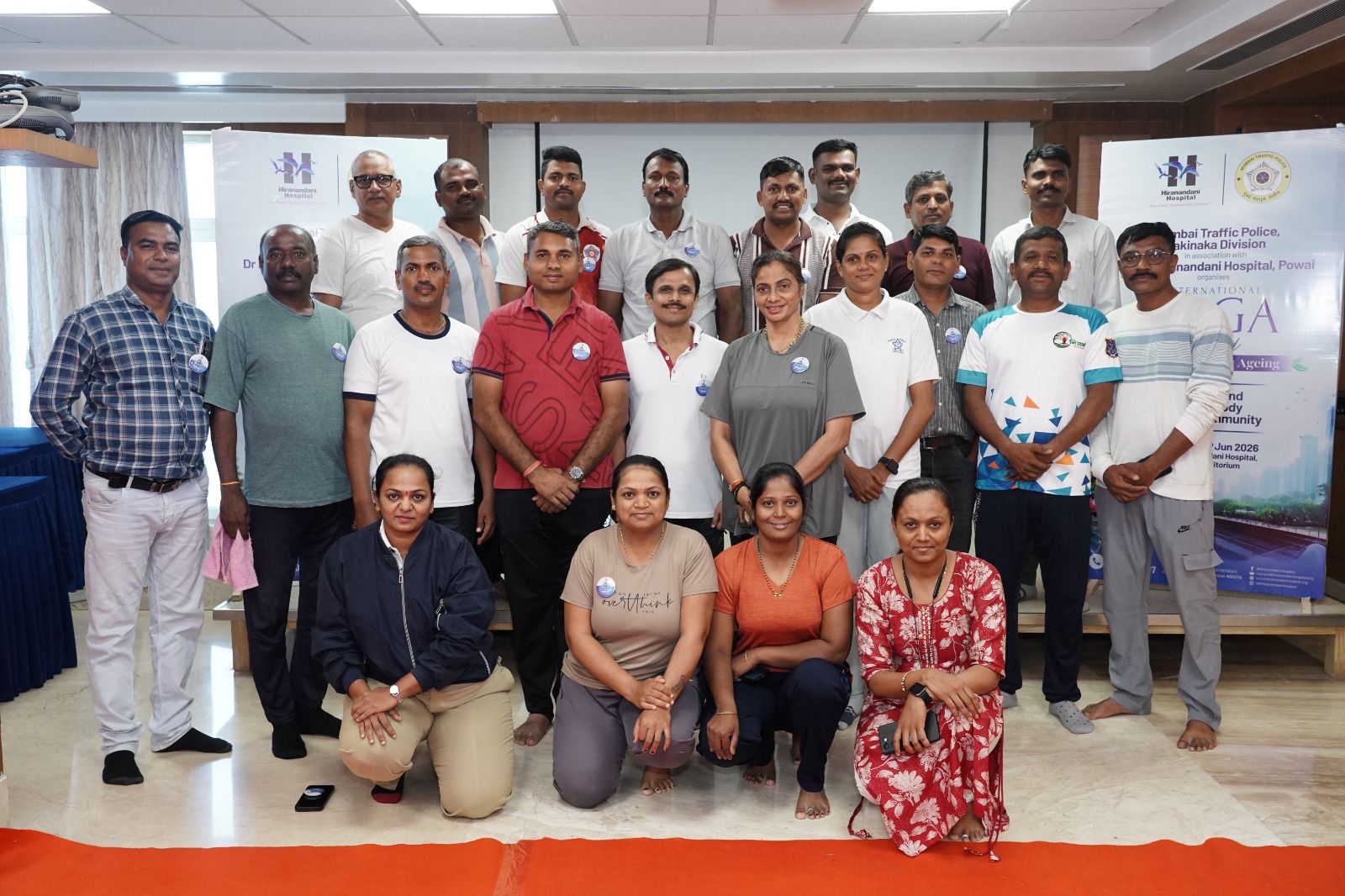
Certified male and female yoga instructors conducted guided sessions focusing on balance, strength, breathing techniques and mental wellness. The initiative witnessed enthusiastic participation from commuters and residents alike, creating a vibrant atmosphere dedicated to healthy living. The yoga sessions at the metro station complemented the hospital’s employee and Traffic Police engagement held a day earlier, underscoring the importance of incorporating wellness practices into everyday life and making yoga accessible to all sections of society.
India is home to one of the world’s largest working populations, and increasingly sedentary lifestyles, long working hours, stress and lack of physical activity have contributed to a growing burden of lifestyle disorders such as obesity, diabetes, hypertension and cardiovascular diseases. As preventive healthcare gains importance, yoga has emerged as a simple yet powerful practice that promotes physical fitness, improves flexibility, reduces stress and supports mental well-being. Incorporating yoga into daily life is essential not only for healthy ageing but also for preventing chronic diseases and fostering a healthier and more productive society.
Speaking on the occasion, Dr Sameer Kulkarni, CEO, Dr L H Hiranandani Hospital, Powai, said,
“Healthy ageing is not only about adding years to life, but adding life to years. Yoga is one of the most powerful and accessible ways to maintain physical fitness, mental clarity and emotional balance at every stage of life. Through these International Yoga Day initiatives, we aim to encourage people across generations to embrace yoga as a part of their daily routine and adopt a preventive approach towards long-term health and wellness.”
The celebrations reflected the hospital’s continued commitment to community well-being through awareness-led initiatives that encourage active lifestyles, disease prevention and overall wellness. By taking yoga beyond conventional spaces and into the community, Dr L H Hiranandani Hospital seeks to inspire individuals to make healthy and mindful living an integral part of their everyday lives.
23, Jun 2026
Alila Diwa Goa Appoints Takshila Chheda as Area Director – Digital Marketing
June 23: Alila Diwa Goa has appointed Takshila Chheda as Area Director – Digital Marketing. Prior to this, Takshila used to lead digital marketing for North, East and West India at Hyatt Hotels.
In this new role at Hyatt Hotels, Takshila’s scope will include leading digital marketing for the Goa & Pune markets, in addition to West and Central India.

Takshila will be responsible for shaping and executing robust digital and performance marketing strategies, driving strong growth and enhanced online visibility across Hyatt’s portfolio. Her expertise spans brand management, digital, social media, and public relations, underpinned by a consistent track record of delivering measurable business impact and revenue growth.
Takshila brings a rich and diverse professional background to this role. Prior to Hyatt, she served as a Digital Marketing Strategist at Jio World Centre, Reliance Industries, where she played a key role in the successful launch and digital amplification of the Nita Mukesh Ambani Cultural Centre. She also held the position of Senior Manager – Digital Marketing at Tata Motors, contributing to the brand’s strong digital presence and engagement across multiple platforms and campaigns. Earlier in her career, she built extensive expertise across leading communications agencies and the hospitality sector, working with a wide portfolio of renowned brands.
Takshila holds a Master of Science (MSc) in Corporate Communications & Reputation Management from Manchester Business School, UK, and a Bachelor’s degree in Mass Media (Advertising) from Mumbai University, providing a strong academic foundation to her strategic and creative approach.
23, Jun 2026
Child Care Aware of Missouri Appoints Director to Lead New Initiative
Angela Franks to head launch of Child Care WAGE$ Missouri Pilot in St. Louis County.

(St. Louis, Mo., June 23, 2026) Child Care Aware of Missouri (CCAMO) has named Angela Franks as Director of its Child Care WAGE$ Missouri project. In this role, she will lead the launch and ongoing management of the organization’s new initiative designed to improve retention among early childhood educators in St. Louis County through education-based compensation. Franks will oversee directing and daily operations while cultivating strong partnerships with child care professionals and county stakeholders.
Franks brings more than 20 years of experience as an educator and ecosystem builder. Prior to joining CCAMO, she served as Principal for ARK Consulting Services, where she developed and delivered training programs for adults and youth focused on personal development, career readiness, and small business growth. Her professional background also includes roles with multiple school districts and the St. Louis County Library. She holds a Master of Arts in Education, Curriculum and Instruction from Fontbonne University and a Bachelor of Arts in Psychology from Webster University.
Developed by the TEACH Early Childhood National Center in North Carolina, the Child Care WAGE$ program is a salary supplement initiative that invests in early childhood educators to strengthen workforce stability and improve quality of care. With more than 30 years of proven success in five states, this pilot marks the first implementation of the program in Missouri. The initiative is made possible through CCAMO’s long-standing affiliation with the national TEACH Early Childhood Scholarship program.
Funded by a $5.6 million award administered by the St. Louis County Children’s Services Fund, Child Care WAGE$ Missouri recently began offering its services. Through the Missouri pilot, eligible educators working in licensed or license-exempt child care programs in St. Louis County will receive salary supplements based on their education level and continued employment with their program.
“Angela brings the vision and deep workforce expertise needed to successfully launch this pilot,” said Beth Ann Lang, Deputy CEO of Child Care Aware of Missouri. “Her experience will be instrumental in strengthening retention and ensuring early childhood educators in St. Louis County receive meaningful financial recognition for their education and commitment.”
Founded in 1999, CCAMO is a statewide nonprofit that focuses on a comprehensive early childhood education experience through impactful programs and partnerships. The organization’s services include workforce development, child care business supports, advocacy and policy work, and Child Care Keeps Missouri Working, a regional campaign offering concierge solutions to businesses undergoing employee recruitment and retention challenges due to the overwhelming shortage of quality child care options. For more information, call (314) 535-1458 or visit www.mochildcareaware.org
22, Jun 2026
fäm Properties closes AED124 million office sale at Vision Tower, Business Bay
Approximately 40,000 square feet of Grade A office space changes hands, underlining sustained demand for prime business district assets in Dubai
Dubai, UAE, 22nd June 2026: fäm Properties has facilitated the sale of approximately 40,000 square feet of office space at Vision Tower in Business Bay for AED124 million, the biggest commercial real estate deal of its kind ever recorded in Dubai.
The asset, a contiguous block of Grade A office space across multiple floors in one of Business Bay’s landmark towers, was acquired by a UAE-based company as part of its business expansion plans.

“The transaction reflects continued confidence among local businesses in Dubai’s commercial real estate market, with investors and occupiers maintaining their focus on established business- districts and institutional-quality assets,” said Firas Al Msaddi, CEO of fäm Properties.
“Demand for well-located, institutional-grade office space in Dubai has stayed consistent. Buyers active at this level are precise about location, building quality and tenant profile. Assets that meet that standard continue to move.”
Daniel McCullagh, Commercial Sales Manager at fäm Properties, said transactions of this size typically involve extended due diligence, multiple stakeholders and detailed commercial structuring.
Led by McCullagh, fäm’s commercial team advised on both pricing context and execution, drawing on transaction data recorded with the Dubai Land Department to benchmark value and demand across the district.
The deal adds to the commercial division’s activity in large-format office mandates, advising occupiers, investors and landlords across Dubai’s principal office markets.
22, Jun 2026
Buzz Builds Around Mukul Phate’s Upcoming Music Video; Industry Awaits Big Release
Mumbai: Rising actor Mukul Phate is creating significant buzz in the Marathi entertainment industry with his upcoming music video, which has quickly become a topic of discussion across media platforms and social circles. With anticipation growing steadily, fans and industry insiders alike are eagerly waiting for the official release.
Directed by noted filmmaker and choreographer Suniel Waghmare (Smasterji), the project is already drawing attention for its promising creative team and energetic concept. Sharing his thoughts on the excitement surrounding the release, Waghmare said, “The response we’ve received even before launch has been incredible. The team has put in tremendous effort, and we’re confident audiences will enjoy what we’ve created. It will be worth the wait.”
Supporting the project as assistant director is Rajnish Singh, a recognised model known for his achievement in Teen India 2018. His contribution has added fresh creative energy and discipline to the production.
The music video also features accomplished dance performers Apeksha Londhe and Pratiksha Londhe, both of whom have impressed audiences through popular reality platforms including Maharashtra Best Dancer (Top 6), YDQ, India’s Best Dancer Season 3, and Dance Plus 6. Their presence is expected to bring strong visual appeal and powerful choreography to the screen.
The musical aspect of the project is equally exciting, with talented singer Harshavardhan Wavare lending his voice and Sarvesh Sable composing the music. Together, they promise a vibrant soundtrack that complements the scale and energy of the video.
With a talented cast, strong creative direction, and growing excitement among fans, Mukul Phate’s upcoming music video is shaping up to be one of the most talked-about releases in Marathi entertainment. Industry watchers believe the project has all the ingredients to make a strong impact upon release.


