


13, Feb 2024
The emotive and sensory connection between the brain and art discussed
Gandhinagar: Have you ever thought how any form of art influences the human brain or how our cognition aids in the development and interpretation of art in its various forms? These may seem two separate entities of science and arts, but in fact, they enrich and shape one another and, in turn, enrich us intellectually and emotionally.
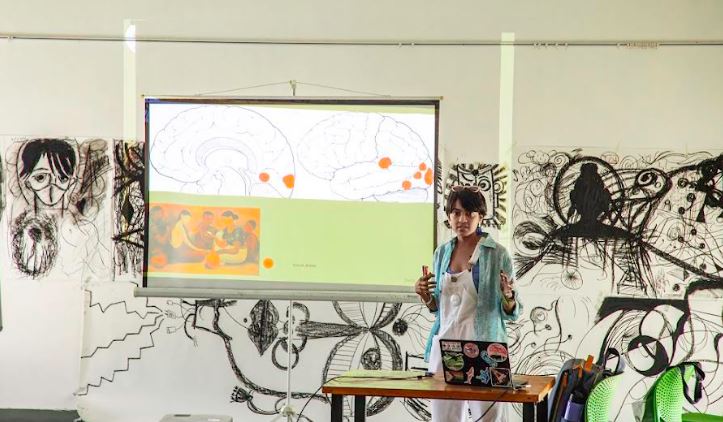
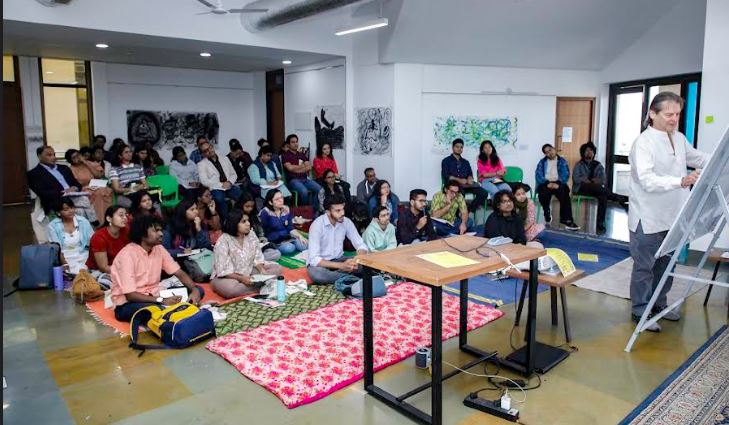
To explore and understand the intricacies of this intertwined relationship and its creative and cognitive processes, the Curiosity Lab at the Indian Institute of Technology Gandhinagar (IITGN), in collaboration with the Cognitive Science Society, Art@IITGN, and the departments of Cognitive and Brain Sciences and Humanities and Social Sciences at IITGN, organised the ‘Art and Cognition Confluence 2024’ on February 10 and 11, 2024.
The two-day residency brought together a unique blend of artists and neuroscientists/researchers from India and abroad for a series of immersive expert talks on the themes of: Art, Minds, and Brains; Music & Mental Health; Neuroaesthetics: The Science of Art; Dance & Emotion; Visual Thinking; What does Drawing Do?; Cajal’s Legacy: Art, Perception and Persona; Art & Cognition through Comics; and AI & Art.
On the first day, Kohinoor Darda, a cognitive neuroscientist, professional Indian classical dancer, and founder and director of the Advancement and Research in the Sciences and Arts (ARISA) Foundation, delivered a talk on ‘Neuroaesthetics: Exploring the Science of Art’. She explained how neuroaesthetics involves applying the science of the brain to the study of art and discussed how important aspects like culture, context, and emotions influence people’s perception of art.
Prof Frederick Coolidge, adjunct faculty at IITGN and a professor of Psychology at the University of Colorado, USA, talked about ‘Cerebellum & Creativity’ and explained how the cerebellum, an important portion of the human brain, tweaks ideas, images, thoughts, and motor movements that influence our creativity. Cognitive scientist, photographer, filmmaker, and writer Dyutiman Mukhopadhyay conducted a workshop on ‘The Image in Context: Exploring Narrative, Color, and Context through Photography’ that focused on understanding, using, and creating photographs and how context affects meaning-making and emotions experienced by a person. The session on ‘What Does Drawing Do?’ by Andrea Kantrowitz, an artist, educator, and director of the Art Education Program at the State University of New York, discussed using drawing to extend and reflect on one’s thought processes. She said, “Some purposes of drawing include observing, visualising, remembering, and reflecting. It makes our thoughts visible. Using drawing to think and learn can be really valuable.”
Shantala Hegde, a neuropsychologist at the National Institute of Mental Health and Neuro Sciences and a musician, through her talk on ‘Music & Mental Health’, looked at music from a neuroscience perspective and said, “Music, one of the higher-order neurocognitive functions of the brain, can be used as a tool to understand the functioning of mind and behaviours. Actively engaging with music corresponds to positive mental health, including intellectual, emotional, social, environmental, physical, and spiritual health.”
The second day of the residency witnessed more fascinating talks and workshops. Roshan Sahi, a visual artist at Srishti Manipal Institute of Art, Design and Technology, spoke about ‘Visual Thinking: Rang – Rasa – Raga’ and through various sketching, drawing, colouring, and painting tasks given to the participants, he explained how the experience of an aesthetic form emerges through the interaction between colour (Rang), emotions (Rasa), and melodic expression (Raga). Prof Vinod Goel, a professor of cognitive neuroscience at York University in Toronto, Canada, delivered a talk on ‘Art, Minds and Brains’ and explained what art is in terms of the structure of symbol systems. According to Prof Goel, “The structure of symbol systems matters. What we imagine as a depiction based on a particular description would differ for different people.”
A cancer researcher turned comics artist, Prof Argha Manna, Artist-in-Resident at IITGN, conducted a session on ‘Drawing Thoughts in Sequence: Exploring the Relationship between Art and Cognition through Comics’. This workshop explored critical thinking, visualising scientific concepts, and cognition through comics. One of its tasks involved encouraging participants to think abstractly, view the world from new angles, and translate it into short comics. Prof Argha said, “The beauty of comics is that the process is abstract, but the output is often concrete. Comics are the shape of your thoughts as text and images in a rhizomatic relationship. Include comics as a part of your learning process. Apart from prose, if you can also draw the science behind why the sky is blue, you really know the process!”
Prof Dawn Hunter, a renowned visual artist, associate professor, and a distinguished faculty member at the University of South Carolina’s School of Visual Arts and Design, delivered a talk on ‘The Fusion of Artistry, Perception, and Persona in Cajal’s Legacy’, to discuss the work of Santiago Ramon y Cajal, a Spanish neuroscientist and Nobel Prize winner in 1900, who is also known as the father of modern neuroscience. Gayatri Nerpagar, a Sabarmati Bridge Research Fellow at IITGN’s Department of Cognitive and Brain Sciences and a trained Bharatnatyam dancer, talked about ‘Navarasa: Exploring the Embodiment and Perception of Emotions’. She used various activities during the session to explain how Navarasa fits into certain cognitive science theories.
Prof Jaison Manjaly, Coordinator of the Confluence and the Jasubhai Memorial Chair Professor of Philosophy and Cognitive Science at IITGN, conducted the final session on ‘AI & Art’ and explored the subject by discussing various questions such as: What is a machine?, What is the difference between humans and machines?, Are humans machines?, and so on.
All the sessions of the Art and Cognition Confluence 2024 involved lively Q&A and discussion segments among the participants and experts, which further offered critical insights into various facets of art and cognition, which enable us to make sense of the world around us and respond to it. The confluence of art and cognition is an intersection where creativity and aesthetics come together to shape our perceptions, emotions, and intellectual abilities.
- 0
- By Rabindra

15, Dec 2023
“Paul’s Impressions” – A Journey Through Art by Paul Koli
“Paul’s Impressions” an exhibition by Paul Koli, is being presented at the Nine Fish Art Gallery and Dot Line Space Art Foundation, Byculla, Mumbai. The exhibition runs from December 9th to January 4th, 2024, welcoming visitors between 10:30 a.m. to 7:30 p.m.

Curated by Gourmoni Das, the exhibition offers a unique glimpse into the artist’s studio, revealing the fascinating interplay between space and inspiration. Das, as a curator, finds particular intrigue in exploring the studios of artists and understanding how these spaces shape the creation of their works.

Paul Koli’s studio is a captivating space, particularly for those fascinated by printmaking. The exhibition reveals the intricate layers of the printmaking process, encompassing linocuts to etchings, offering a sensory experience enriched with the smells, sounds, and colours of the artist’s workspace. The arduous journey of printmaking, involving techniques like linocuts, etchings, and the use of chemicals, becomes a fusion of sensory elements—sounds of the press, the rolling pin, wet paper—penetrating the artist’s senses and infusing the works with life. This connection between the artist and the studio forms a microcosmic world of creativity and aesthetics.
Koli’s deep passion for poetry and language adds an extra dimension to his works, showcasing a delicate journey from the world of poetry to visual arts. Professor V. M. Sholapurkar, an early critic, sheds light on Koli’s initiation into the art world at The J.J. School of Art, describing it as a ‘subtle’ and ‘hesitant quasi-curricular expedition into the possibility of print-making.’
Immersing himself in materials and deeply attuned to world history and politics, Koli’s works are textured with layered understandings, enriched by his love for the logos. In a recent conversation, Koli shared his perspective on art, describing it as “the madness of knowledge,” a reflection of his unending desire for learning and the complex emotions embedded in his creations.
Dr. Anurag Kanoria, Director, Nine Fish Art Gallery, said, “We are thrilled to host ‘Paul’s Impression’ at the Nine Fish Art Gallery, where Paul Koli’s exploration of printmaking transcends traditional boundaries. The exhibition beautifully intertwines the artist’s studio journey, poetic inspiration, and a deep connection to history. Paul’s mastery and Gourmoni Das’s curation promise a unique and enriching experience for art enthusiasts.”
“Impress” not only explores the art of printmaking but also unveils a nuanced awareness of the larger world, providing viewers with a unique journey through creativity and aesthetics.