


14, Nov 2026
Welfare is the responsibility of the State, but financial sustainability cannot be ignored, says Symposium Chairman
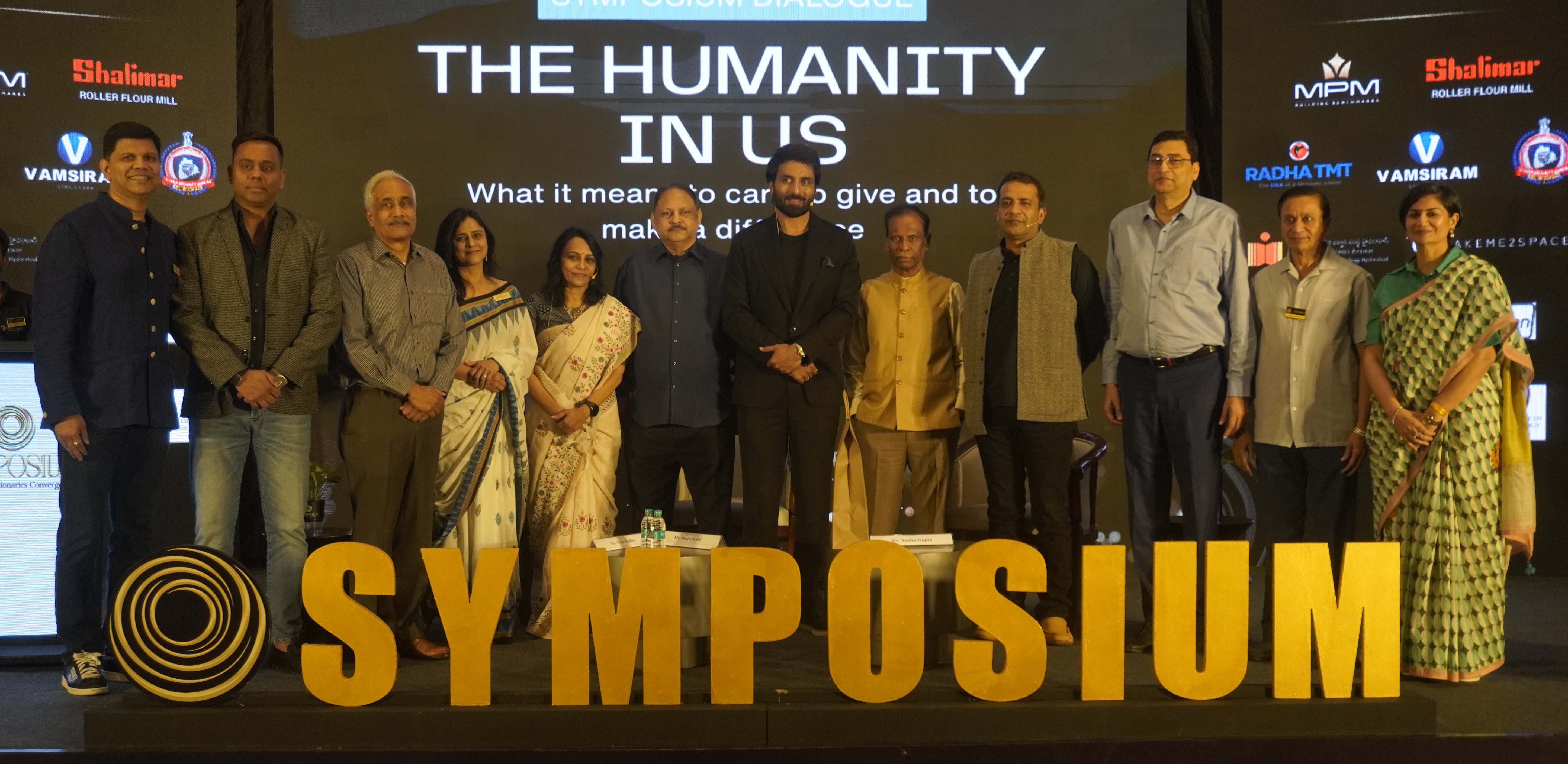
Hyderabad, Nov 14: How can governments ensure that welfare programmes reach those who need them most while maintaining a balance between social priorities and long-term financial sustainability? How can essential welfare initiatives be distinguished from other forms of public spending? And how can compassion and responsible resource management work together to support inclusive development?
These important questions formed part of the discussion at The Humanity in Us, the seventh edition of Symposium, Hyderabad’s premier knowledge forum. The event brought together humanitarian and actor Sonu Sood and Ramon Magsaysay Award-winning social entrepreneur Anshu Gupta, Founder of Goonj, for an engaging conversation on humanity, compassion and the transformative power of giving.
The event was organised on Friday evening at The Debut, HITEX, Hyderabad, in the presence of over 200 participants.
Sharing his thoughts on the relationship between welfare and financial responsibility, Mr. Girish Mallpani, Chairman of Symposium, observed that supporting the well-being of citizens remains an important responsibility of the State. At the same time, he noted that thoughtful planning and financial sustainability can help ensure that welfare initiatives continue to benefit communities over the long term.
He highlighted the importance of a balanced approach to public spending, taking into consideration each State’s revenue capacity, financial commitments and development priorities. He also emphasised the need to give due importance to essential welfare measures such as healthcare, education, nutrition and social security, while ensuring that adequate resources remain available for infrastructure, employment generation and other long-term development initiatives.
The larger consideration, he suggested, was how governments could continue addressing immediate social needs while creating opportunities that benefit future generations.
The discussion was moderated by independent journalist and former Executive Editor (South) of NDTV, Ms. Uma Sudhir.
Opening the conversation, she remarked that just as people dial 108 for an ambulance, 100 for police assistance and 101 for fire and rescue services, people in distress often turn to Sonu Sood for help.
Reflecting on his humanitarian journey, Ms. Uma Sudhir observed that Sonu Sood’s career had largely been about lights, action and camera, but the COVID-19 pandemic brought a new dimension to his life. Action came first, speed followed and focus came later, she remarked.
Recalling his experiences during the pandemic, Sonu Sood said that seeing migrant workers walking along highways with their children deeply moved him. He decided to continue helping them until the last person had reached their destination.
He attributed his humanitarian values to his upbringing. His mother helped students irrespective of their financial circumstances, while his father regularly organised community kitchens. These early influences shaped his belief in helping people in need.
Sharing his philosophy on charity, Sonu Sood said, “Charity should begin by addressing immediate suffering. When someone is hungry, give them food first. But don’t stop there; help them find opportunities to become self-reliant and build a better future.”
Anshu Gupta spoke about how his journey into social development began with a realisation that one of the most basic human needs — clothing — was largely missing from mainstream poverty alleviation and development programmes.
An earthquake in Uttarkashi in 1991 proved to be a turning point in his life. Recalling one of his experiences, he said he met a man wearing a jacket made from a jute gunny bag, desperately seeking basic woollen clothing to survive the cold.
Another incident in Delhi deeply affected him. He came across Habib Bhai, who collected unclaimed dead bodies in exchange for old clothes. These experiences exposed the overlooked struggles of people who lacked even basic clothing and the dignity that comes with it.
Anshu Gupta observed that while urban India was discarding huge quantities of surplus clothing and household articles, millions of people in rural and disaster-affected areas were struggling with acute shortages.
This realisation prompted him to focus on dignity rather than conventional charity. Instead of treating disadvantaged communities as passive recipients of donations, he developed a model that connected urban surplus with rural needs through community participation and dignity-driven exchange.
“I didn’t even know what an NGO was before I founded Goonj,” he recalled, explaining how sustained and thoughtful giving could restore human dignity.
Emphasising his approach to charity, Anshu Gupta said, “Charity should not create dependency. It should address the real needs of people, preserve their dignity and empower communities to find sustainable solutions for themselves.”
The discussion also explored the familiar philosophy, “Give a person a fish and you feed them for a day; teach them to fish and you feed them for a lifetime.”
Responding to how this principle should shape philanthropy, Sonu Sood stressed that immediate relief must not be overlooked, even as efforts are made to create opportunities for long-term self-reliance. Anshu Gupta emphasised that charity must go beyond distributing surplus resources and should address genuine needs while respecting the dignity and capabilities of communities.
Both speakers underlined that the purpose of charity is not merely to help people survive, but to empower them to live independently and with dignity. They also encouraged people to personally experience the process of giving, observing that simply writing a cheque may not provide the deeper understanding and satisfaction that comes from engaging directly with people in need.
Uma Sudhir highlighted the role of the Social Stock Exchange in creating transparent and institutionalised channels for directing investments towards social causes. She observed that non-profit organisations must also demonstrate accountability and transparency to earn public trust.
Referring to the recent ringing of the NSE bell by Hyderabad-based Grace Cancer Foundation, marking a milestone in social impact financing, Ms. Shruti Mallpani, Managing Trustee of Symposium and Executive Director of MPM Group, said the initiative demonstrated how social organisations could access structured financing through the Social Stock Exchange.
Grace Cancer Foundation raised ₹1 crore through its Social Stock Exchange listing to support early detection initiatives and 10,000 cancer screenings for underserved communities across North Telangana.
“This proves that there is a channel for good intentions. At the same time, it is equally important to preserve human dignity. People receiving assistance should never have to compromise their self-respect,” she observed.
Earlier, in her opening remarks, Wing Commander Asha Vashist, CEO of Symposium, explained the philosophy behind establishing the knowledge forum.
“I believe thoughtful conversations matter. In a world overflowing with opinions, we need spaces to listen, to question and to understand one another. That belief is the foundation of Symposium,” she said.
The discussion also touched upon the importance of ensuring that welfare expenditure remains aligned with the evolving needs of communities, while allowing sufficient room for long-term economic and social development.
Participants highlighted the value of a balanced approach that supports essential welfare programmes, encourages responsible resource allocation and creates opportunities for individuals and communities to become more self-reliant.
The larger message emerging from the dialogue was that compassion and financial prudence can complement each other. Welfare initiatives can make an even greater difference when they address immediate needs while also creating opportunities, strengthening livelihoods and helping people build independent and dignified lives.
On the occasion, a White Paper prepared based on the previous edition of Symposium was presented to Mr. S.P. Singh, IAS.
Over the last one year, Symposium has hosted six editions focusing on diverse subjects, including sports, the environment, spirituality, space technology and cyber security. With support from leading academic institutions, it has also published White Papers emerging from these deliberations.
The seventh edition, The Humanity in Us, continued this endeavour of bringing together thought leaders and practitioners to deliberate on issues of wider social relevance.
- 0
- By Neel Achary



