


25, Jun 2026
AI-Embedded Cellular Module Adoption Loses Momentum in Q1 2026 as Surging Memory Prices Impact the Market
Buenos Aires, Seoul, Beijing, Berlin, Fort Collins, Hong Kong, London, New Delhi, Taipei, Tokyo, June 25: The cellular IoT module market is starting to look a little different. For years, most of the module innovation came from connectivity upgrades from 2G to 4G, then to NB-IoT to Cat 1 bis, and now 5G and RedCap. But that is beginning to change. Today, intelligence is becoming just as important as connectivity, but the path is proving less linear than many expected.
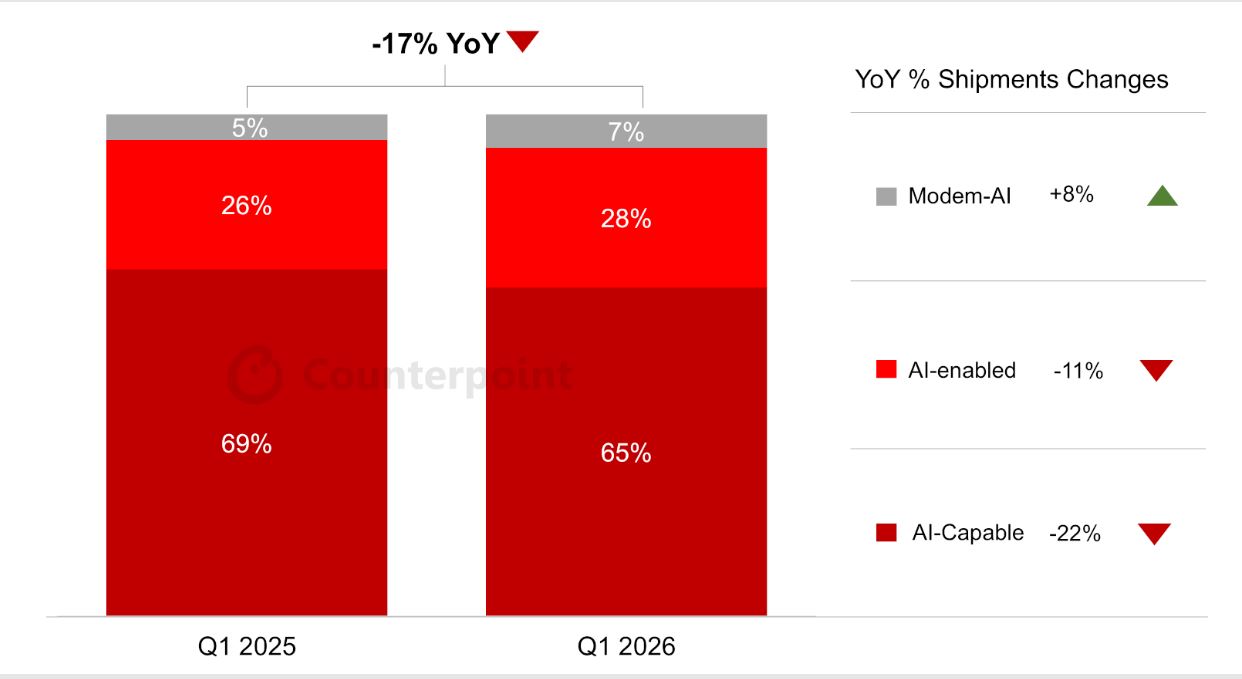
According to Counterpoint Research’s latest Cellular IoT AI Module & Chipset Tracker, AI-embedded cellular IoT modules contributed 6% of total cellular IoT module shipments in Q1 2026. While AI remains one of the most discussed topics across the IoT ecosystem, adoption lost momentum during the quarter for cellular AI modules. After growing 19% YoY in 2025, AI-embedded module shipments declined nearly 17% YoY in Q1 2026.
The slowdown was mainly due to rising memory prices, which have increased the bill of materials for many AI-enabled products. Unlike basic connectivity modules, AI-capable and AI-enabled modules typically require larger memory configurations to support local AI processing and computing workloads. As memory costs increased throughout the supply chain, several enterprise deployments were delayed, particularly in cost-sensitive segments.
AI-embedded Cellular Module Shipments Share by AI Capability, Q1 2026
Source: Counterpoint AI Module & Chipset Tracker & Forecast, Q1 2026
Commenting on the market scenario, Senior Analyst Tina Lu said “We are starting to see two different AI adoption paths in modules. One is the Modem AI modules where intelligence is directly embedded into modems (for example Qualcomm X72, X75, X80, X85 or Mediatek T830, T930) to handle tasks like optimization of connectivity, network selection and power efficiency, the second is application-centric AI where modules integrate CPUs, GPUs and dedicated NPUs to run AI processing locally.”
Lu added, “The different cost structure and component dependencies affected the growth and adoption of these two approaches. Modem AI, which is not dependent on memory and does not perform application processing, registered a growth of 8% YoY, whereas AI-capable and AI-enabled modules which mainly perform on-device edge AI and are dependent on higher memory configuration required to do processing tasks, declined 22% YoY and 11% YoY respectively, due to rising memory costs.”
Commenting on the drivers & outlook, Director of IoT Practice Mohit Agrawal said “Smart retail, rugged handhelds and industrial are the major adopters of AI-enabled modules whereas for AI-capable modules POS is driving the contribution. Modem AI growth is being single-handedly driven by router-CPE application as operators look to optimize network performance, improve power efficiency and deliver a better user experience in enterprise deployments and 5G FWA.”
Agrawal added, “Due to these memory price increases, AI-embedded cellular modules witnessed double-digit ASP growth as module players were forced to raise prices, eventually affecting demand across applications due to hardware costs. The recent slowdown does not change the direction of the market. AI adoption is still at an early stage across IoT applications. With ongoing traction in smart cameras, surveillance, retail, automotive, and industrial robotics, we expect AI penetration in cellular modules to reach 25% by 2030. Over time, AI will move beyond a few niche applications and become a standard feature, helping connected devices become smarter rather than simply remain connected.”
AI Category Definitions:
AI-Capable Modules: Modules integrating CPUs and GPUs that can support basic AI processing and lightweight inference, but without a dedicated AI accelerator. An example is the Fibocom SC226 module, which is powered by an ARM Cortex A53 quad-core processor, and includes a built-in Adreno 702 GPU.
AI-Enabled Modules: Modules integrating dedicated AI hardware such as NPUs, TPUs or AI engines to support advanced AI workloads and local inference. For example, the Meig SLM925 module, based on the QCM6125 SoC.
Modem AI Modules: Modules based on modem platforms with embedded AI capabilities focused on connectivity optimization, including network performance, power efficiency, positioning and signal management, rather than application-level AI processing.
- 0
- By Neel Achary

25, Jun 2026
IPO bound Steamhouse secures INR 50 crore pre-IPO investment from Madhusudhan Kela and Niveshaay Sambhav Fund
Madhusudhan Kela-backed Singularity Large Value Fund III and Singularity Equity Fund I along with Niveshaay Sambhav Fund, have invested an aggregate Rs 49.99 crore in Steamhouse India Limited through a pre-IPO placement at an issue price of Rs 73 per equity share.
As part of the transaction, Steamhouse India allotted 68,49,315 equity shares to the investors through a private placement. Singularity Large Value Fund III received 47,94,520 equity shares aggregating Rs 34.99 crore, while Singularity Equity Fund I was allotted 6,84,932 equity shares worth Rs 5 crore. Niveshaay Sambhav Fund received 13,69,863 equity shares aggregating Rs 9.99 crore.
Following the allotment, the three investors collectively hold approximately 2.94% of Steamhouse India’s pre-offer equity share capital. As per SEBI regulations, the proposed fresh issue size under the IPO will be reduced to the extent of the amount raised through the pre-IPO placement.
The Surat-headquartered company, which pioneered the concept of centralized steam supply for industrial customers in India, has already filed its Updated Draft Red Herring Prospectus (UDRHP) with the Securities and Exchange Board of India (SEBI).
Founded in 2014 and backed by the industrial legacy of the Sanjoo Group, Steamhouse India operates one of the country’s largest industrial steam distribution networks. The company serves more than 167 industrial clients across sectors such as chemicals, textiles, pharmaceuticals, food processing, paper and manufacturing through a centralized utility model that supplies steam directly to factories through dedicated pipeline infrastructure.
Steamhouse introduced the concept of community boilers, a centralized alternative to captive boilers, enabling industrial customers to reduce operational costs, improve efficiency and lower emissions. The company leverages IoT and AI technologies across procurement, generation and distribution to deliver steam at approximately 190 degrees Celsius to customers.
The company has built over 45 kilometres of pipeline infrastructure across major industrial hubs including Sachin, Vapi, Ankleshwar, Sarigam, Panoli and Nandesari. Its operating model creates high entry barriers and establishes a dominant position in the industrial clusters where it operates.
It is expanding capacity across key industrial locations including Ahmedabad, Dahej, Vapi, Ankleshwar, Panoli, Jhagadia and Nandesari, while also evaluating opportunities across Andhra Pradesh, Telangana, Maharashtra, Himachal Pradesh, Madhya Pradesh, Rajasthan, Uttar Pradesh and Haryana.
In line with its sustainability focus, Steamhouse has commissioned a waste-to-steam boiler at Vapi that converts non-recyclable plastic waste from paper mills into industrial steam. The company also secured a 5 MW Waste-to-Steam project from Ahmedabad Municipal Corporation under the public-private partnership (PPP) model.
Beyond steam distribution, the company is expanding into adjacent businesses including nitrogen compression and distribution, waste-to-energy solutions and aviation logistics.
25, Jun 2026
India’s Housing Market Outlook: Decoding Sales and Supply Trends Across 9 Cities in Q2 2026
India’s housing market continues to demonstrate strong growth despite the Middle East conflict. The sharp increase in supply has expanded choices for homebuyers, while strong absorption levels indicate that underlying demand remains healthy across major markets. The reworking of supply pipelines by developers especially in Southern and Western India to suit the affordability of homebuyers have helped sales growth. Additionally, India’s stable economic outlook, improving infrastructure and growing investor confidence have enabled the housing market to maintain its growth trajectory reaffirming real estate as a preferred asset class for both end-users and investors.
25, Jun 2026
Gold, Silver Trade Volatile as Fed Rate Uncertainty Weighs on Sentiment
New Delhi, June 25: Gold and silver prices witnessed volatile trading in global and domestic markets amid growing uncertainty over the U.S. Federal Reserve’s interest rate outlook, according to market analysts.
Precious metals experienced fluctuations as investors reacted to mixed signals from the U.S. economy and evolving expectations around future rate cuts. Strength in the U.S. dollar at times weighed on bullion prices, while safe-haven demand provided intermittent support.
Analysts said that gold and silver continue to respond sharply to macroeconomic cues, particularly inflation trends, bond yields, and central bank commentary. Expectations of prolonged higher interest rates have limited upside momentum in bullion markets.
In the domestic market, traders reported range-bound movement with heightened volatility as global cues influenced sentiment. Investors remained cautious, awaiting clearer signals from the Federal Reserve regarding its monetary policy trajectory.
Despite short-term fluctuations, experts believe that gold retains its appeal as a safe-haven asset amid global economic uncertainty, while silver continues to see demand driven by both industrial usage and investment interest.
Market participants are expected to closely monitor upcoming U.S. economic data and central bank statements for further direction in precious metal prices.
The outlook for bullion remains sensitive to interest rate expectations, inflation trends, and broader global financial stability.
25, Jun 2026
India’s Real Estate Sector Sees Strong Dollar 4.3 Billion Institutional Inflows in H1 2026
New Delhi, June 25: India’s real estate market has attracted institutional investments worth $4.3 billion in the first half (H1) of 2026, reflecting strong investor confidence and sustained growth momentum in the sector.
According to industry data, the inflows were driven by robust demand across key segments, including commercial office spaces, residential developments, warehousing, and logistics infrastructure. The trend highlights India’s continued position as a preferred destination for global and domestic institutional investors.
Experts noted that stable economic fundamentals, improved regulatory frameworks, and growing urbanisation have contributed to increased investor participation in the real estate sector. The rise in demand for quality office spaces and expansion of e-commerce-driven logistics networks have also supported investment activity.
Analysts said the strong inflows indicate long-term confidence in India’s growth story, with both foreign and domestic investors actively participating in large-scale projects and development platforms.
The residential segment also witnessed steady interest, supported by improving affordability conditions and rising demand in major metropolitan regions. Meanwhile, the warehousing and industrial segments continued to benefit from supply chain expansion and infrastructure development initiatives.
Market observers believe that sustained institutional investments will further strengthen India’s real estate ecosystem, improve project execution, and enhance overall market stability in the coming years.
With $4.3 billion already invested in H1 2026, the sector is expected to maintain its growth trajectory, supported by policy stability and increasing demand across asset classes.
25, Jun 2026
EAM Jaishankar Calls for Cooperative Global Order at South Korea Forum
June 25: External Affairs Minister Dr. S. Jaishankar has called for enhanced global cooperation to address shared challenges and promote a more balanced and inclusive international order, while invoking India’s ancient philosophy of “Vasudhaiva Kutumbakam” (the world is one family) at the Jeju Forum in South Korea.
Speaking at the forum, the External Affairs Minister emphasised the importance of collaboration among nations in addressing pressing global issues such as economic uncertainty, geopolitical tensions, climate change, and technological transformation. He highlighted that no country can effectively tackle these challenges in isolation.
Dr. Jaishankar underscored India’s consistent advocacy for a rules-based, multipolar world order that reflects contemporary global realities and ensures equitable opportunities for all nations. He noted that dialogue, cooperation, and mutual respect remain essential pillars for global stability and progress.
Invoking the principle of Vasudhaiva Kutumbakam, he reiterated India’s belief in shared responsibility and collective action in addressing global concerns, stressing that the world must move towards greater unity and understanding in an increasingly interconnected environment.
He also highlighted India’s growing role in global affairs and its commitment to working with partner countries to strengthen multilateral institutions and promote sustainable development.
The address was well received by participants at the forum, which brought together policymakers, diplomats, and experts to discuss key global challenges and opportunities for cooperation.
Officials said India’s engagement at the Jeju Forum reflects its continued efforts to contribute constructively to global dialogue and reinforce partnerships in the Indo-Pacific and beyond.
25, Jun 2026
Nitin Gadkari Reviews Highway Safety, Orders Urgent Monsoon Action Plan
New Delhi, June 25: Union Minister for Road Transport and Highways Nitin Gadkari has directed officials to strengthen monsoon preparedness measures across the National Highway network to ensure smooth traffic movement and minimise weather-related disruptions.
During a review meeting, the Minister instructed highway authorities and implementing agencies to take proactive steps to address issues such as waterlogging, landslides, damaged road stretches, and weak drainage systems, which typically worsen during the monsoon season.
Officials have been asked to conduct urgent inspections of vulnerable highway stretches and identify accident-prone or flood-prone areas for immediate corrective action. Emphasis was also placed on ensuring proper maintenance of drainage systems to prevent accumulation of rainwater on roads.
The Minister directed that repair work on damaged sections should be completed on priority and that emergency response teams be kept on standby to deal with unforeseen situations during heavy rainfall.
He also stressed the importance of coordination between National Highways Authority of India (NHAI), state agencies, and local administration to ensure quick resolution of road blockages and restore connectivity at the earliest in case of disruptions.
Gadkari further instructed officials to deploy adequate machinery and manpower in sensitive zones and ensure real-time monitoring of traffic conditions through control rooms.
The Ministry stated that these measures are aimed at improving commuter safety, reducing travel delays, and maintaining uninterrupted connectivity across key highway corridors during the monsoon period.
Officials said that continuous monitoring and timely intervention will be crucial to managing weather-related challenges effectively in the coming weeks.
25, Jun 2026
India Launches AIR SUVIDHA 2.0 for Travellers from Ebola-Affected Countries
New Delhi, June 25: The Government of India has launched AIR SUVIDHA 2.0, a digital health declaration system for passengers arriving from Ebola-affected countries, to strengthen public health screening and border preparedness.
The upgraded platform will require travellers from identified high-risk countries to submit health and travel details online before arrival in India. This will help authorities assess risk in advance and streamline screening at airports.
Officials said the system is designed to improve early detection of potential health risks, support faster response measures, and enhance contact tracing if required. It is part of India’s broader efforts to strengthen surveillance against infectious diseases.
AIR SUVIDHA 2.0 is an upgraded version of the earlier system used during the COVID-19 pandemic and includes improved data tracking and integration features for better monitoring of international arrivals.
Passengers from Ebola-affected countries will need to complete the mandatory online form before travel. Airport health teams will conduct additional screening based on risk assessment protocols.
Health authorities said the initiative aims to balance public safety with smooth passenger movement while ensuring strict monitoring of arrivals from affected regions.
The government stated that the platform reflects its continued focus on preparedness, early warning systems, and safeguarding public health at international entry points.
25, Jun 2026
New Peer-Reviewed Study Published Ahead of World Vitiligo Day Demonstrates Improved Outcomes When GliSODin® Is Combined With Targeted Phototherapy
Research Published in Photodermatology, Photoimmunology & Photomedicine Shows Significant Improvements in Repigmentation and Quality of Life for Patients With Localized Vitiligo
PARIS, France, June 25: New clinical research published in the peer-reviewed journal Photodermatology, Photoimmunology & Photomedicine demonstrates that combining oral gliadin-protected superoxide dismutase (GP-SOD), the patented antioxidant technology behind GliSODin®, with targeted phototherapy significantly improves outcomes for patients with localized vitiligo compared to phototherapy alone.
The study, Combination of Oral Gliadin-Protected Superoxide Dismutase With Targeted Phototherapy in Vitiligo: A Prospective, Comparative, Randomized, Single-Blinded Study, was conducted by an international team of researchers led by Pr. Giovanni Leone of the Photodermatology and Vitiligo Treatment Center at Israelite Hospital in Rome, Italy, in collaboration with researchers from Nice University Hospital and Université Côte d’Azur in France, including renowned vitiligo expert Pr. Thierry Passeron.
Vitiligo is a chronic autoimmune condition that causes the loss of skin pigment, affecting millions of people worldwide. Increasingly, researchers have identified oxidative stress as an important factor in the disease process, prompting interest in therapies that support the body’s natural antioxidant defenses.
The six-month randomized study evaluated 40 adults with localized non-segmental vitiligo. All participants received targeted excimer lamp phototherapy, while half also received oral GP-SOD. Researchers found that patients receiving the combination treatment experienced significantly greater repigmentation compared to those receiving phototherapy alone. In addition, patients receiving GP-SOD reported significantly greater improvements in quality of life. The treatment was also well tolerated, with no serious adverse events reported.
“These findings reinforce the growing body of evidence supporting the role of oxidative stress in vitiligo and suggest that addressing this pathway may help improve patient outcomes when combined with established treatment approaches, in particular the combination with phototherapy has been shown to be one of the best approaches to stabilize vitiligo and increase the pigmentation response,” said Pr. Giovanni Leone.
These findings add to a growing body of clinical research supporting the role of GP-SOD as an adjunct to phototherapy in vitiligo treatment. Previous research published in the Journal of the European Academy of Dermatology and Venereology demonstrated improved repigmentation outcomes when oral GP-SOD was combined with NB-UVB phototherapy. This latest study is among the first to specifically evaluate its use alongside targeted phototherapy for localized vitiligo. Researchers concluded that combining GP-SOD with UVB phototherapy resulted in significant improvements in repigmentation, quality of life, and overall treatment outcomes while maintaining a favorable safety profile.
“At GliSODin, our mission has always been to support the body’s natural ability to defend itself against oxidative stress,” said François Vix, CEO of GliSODin. “We are encouraged to see continued independent clinical research exploring the role of GP-SOD in conditions where oxidative stress is believed to play a key role.”
The publication arrives just ahead of World Vitiligo Day on June 25, an annual global initiative dedicated to raising awareness, advancing research, and supporting individuals living with vitiligo.
25, Jun 2026
Arunachal Flash Floods: Four Missing, Assam on Alert Over Downstream Impact
Guwahati/Itanagar, June 25: At least four people are missing after flash floods triggered by heavy rainfall in Arunachal Pradesh, officials said.
Search and rescue operations are currently underway to trace the missing persons. Several areas have also reported damage due to rising water levels and sudden flooding.
In neighbouring Assam, authorities have issued a high alert as a precautionary measure due to the possible downstream impact of the floods. Disaster response teams have been placed on standby in vulnerable districts.
Officials said river water levels are being closely monitored, and people in low-lying and flood-prone areas have been advised to remain cautious and follow safety instructions.
Local administrations in both states are coordinating closely to manage the evolving situation and ensure timely response if conditions worsen.
The situation remains under continuous watch as rainfall continues in parts of the region.


