



23, Feb 2026
APSEZ, NMDC and Vale Brazil Sign MoU on Iron Ore

Hyderabad, Feb 23: Adani Ports and Special Economic Zone Ltd (APSEZ), the world’s fastest-growing integrated transport utility, through its subsidiary Adani Gangavaram Port Limited (AGPL), has signed a strategic Memorandum of Understanding (MoU) with NMDC Limited (A Government of India Enterprise) and Vale S.A. (Brazil) at the India–Brazil Business Forum Summit held in New Delhi.
The MoU was signed during the official visit of H.E. Luiz Inácio Lula da Silva, President of Federative Republic of Brazil to India, and in presence of Shri Piyush Goyal, Minister of Commerce and Industry of India, underscoring the deepening India–Brazil strategic partnership.
The agreement establishes a strategic framework for the development of an iron ore blending facility and a dedicated Special Economic Zone (SEZ) at Gangavaram Port. Under this collaboration, the parties will jointly develop, operationalize, and manage an integrated SEZ‑based ecosystem for the blending, value addition, and commercialisation of iron ore. This initiative is designed to strengthen the iron ore export value chain on India’s East Coast while enhancing efficiency, scale, and global competitiveness in mineral processing and trade. With this development, the capacity of Gangavaram Port will increase up to 75 MMT, and it will become a hub for iron ore exports for India and the region.
“This collaboration reflects a shared commitment to building resilient, future-ready infrastructure that strengthens India’s position in global supply chains,” said Mr. Ashwani Gupta, Whole-time Director & CEO, APSEZ. “By integrating high-quality mineral logistics with advanced port capabilities, we are supporting industry requirements while contributing to the country’s broader economic growth. Our partnership with NMDC and Vale will help establish a modern, efficient, and sustainable ecosystem for the iron ore sector on the East Coast. Gangavaram Port is poised to become the first port in India capable of handling Valemax vessels — the world’s largest Very Large Ore Carriers (VLOCs).”
The collaboration will involve:
· Development of an integrated iron ore blending and value-addition ecosystem within a dedicated SEZ at Gangavaram Port.
· Establishment of fully mechanised berthing and cargo‑handling facilities capable of accommodating Valemax vessels with a carrying capacity of up to 400,000 MMT.
· End-to-end yard management, blending operations, and vessel discharge and loading to enhance supply chain efficiency.
· Strengthening Gangavaram’s position as a consolidated export hub for iron ore and port-led industrial growth.
Together, this partnership positions Gangavaram Port as a strategic gateway for global iron ore trade and reinforces India’s emergence as a competitive, future-ready maritime hub.
- 0
- By Neel Achary

23, Feb 2026
AAEON’s UP Squared Series Gains Full Mainline Linux Support for 40-pin GPIO Header
Driver redesign led by Bootlin sees GPIO forwarder library and pinctrl driver merged into Linux 6.18 release.
(Eindhoven, The Netherlands – Feb 23) AAEON’s UP brand, a leading provider of professional developer boards, is excited to announce that full Linux kernel support for its UP Squared series’ 40-pin I/O header has been officially merged into the Linux 6.18 release.
Following the brand’s 10-year anniversary last May, UP outlined its intention to complete the upstreaming of its DKMS drivers to the Linux mainline kernel. This objective was part of a broader set of initiatives aimed at providing users with a more streamlined route from concept to project deployment.
Upstream support is a goal that AAEON had been working towards for a number of years. However, coordinating the FPGA and Intel® SoCs on UP hardware has made mainline Linux support for the 40-pin header a challenge.
To resolve this issue and assist in pushing the project to completion, AAEON approached Bootlin, a leading embedded Linux and open-source development company. Bootlin’s embedded Linux development expertise was instrumental in resolving the pain points encountered during previous attempts to upstream support for its 40-pin header. By rewriting the pinctrl driver to remove Intel-specific code, adding a GPIO forwarder library, and extending the gpio-aggregator driver to create a reusable library, full upstream support was achieved. As a result, the UP Squared series’ 40-pin header now supports GPIO, I²C, UART, and SPI out-of-the-box on mainline Linux 6.18.
“This achievement is the result of a multi-year effort and close collaboration with Bootlin, and one that will provide a huge benefit to the entire UP community,” said Victor Lai, Managing Director of UP and AAEON Europe. “With upstream integration for our UP Squared series now established, we are already working hard to expand this support across our product family and help even more users transform their ideas into real-world successes.”
23, Feb 2026
Accelerating Deep-Tech Entrepreneurship: NXP India in collaboration with Industry, Govt and Academia kickoffs the 6th Season of NXP India Tech Startup Challenge
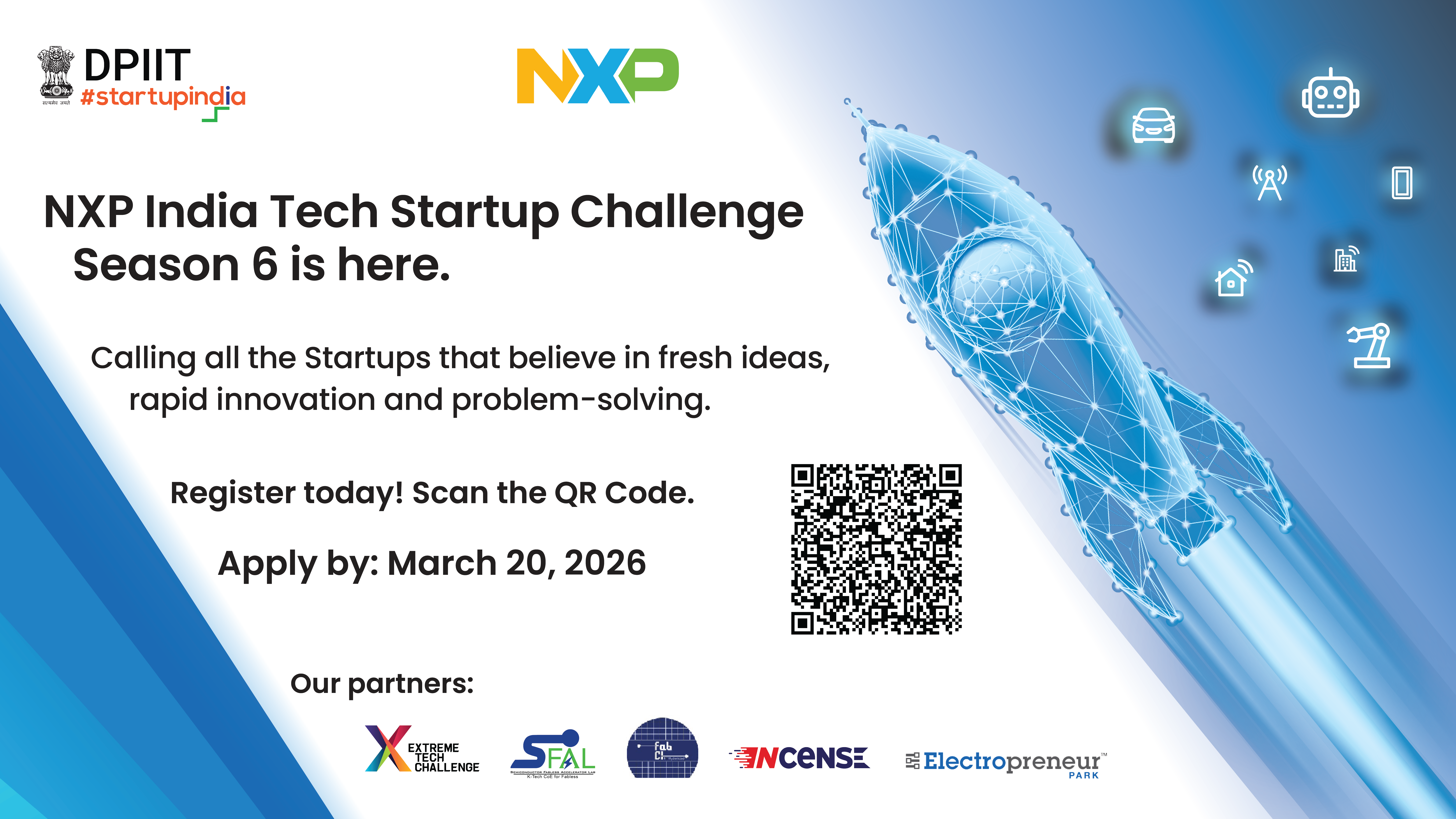
New Delhi, Feb 23: NXP India, one of the largest R&D centers for NXP Semiconductors and a leader in secure connectivity and embedded processing solutions, announced the launch of Season 6 of the NXP India Tech Startup Challenge, continuing its mission to drive innovation and entrepreneurship.
Organized in collaboration with Startup India Hub, this initiative aligns with the Government of India’s vision to strengthen and scale the country’s startup ecosystem through the Startup India initiative, driving innovation, entrepreneurship, and global competitiveness. The program aims to enhance global visibility and network scalability for tech startups, while providing access to incubation, mentorship, and international exposure.
Electropreneur Park (ESDM Incubator), SFAL (Semiconductor Fabless Acceleration Lab), FabCi at IIT Hyderabad and INCeNSE at IISc Bengaluru will extend equity-free incubation, access to advanced labs, and expert mentorship to the Top 10 selected startups, helping them accelerate product development, refine business strategies, and scale their innovations.
Additionally, Extreme Tech Challenge (XTC), a US based non-profit organization, will give a special award for “Excellence in Applied AI” recognizing innovative use of “applied intelligence” for a better world. The winner of the “Applied AI” award will be invited to showcase their startup at XTC’s flagship annual AI conference in California, USA in November 2026.
“Since 2021, the NXP India Tech Startup Challenge has been one of our key engines for fuelling India?s fast-growing deep-tech and semiconductor ecosystem,” said Lars Reger, Executive Vice President and Chief Technology Officer at NXP Semiconductors. “As we kick-off Season 6, our mission stays the same: empower bright minds with the right mix of mentorship, industry connections, and access to global platforms-so they don?t just innovate locally, but compete and collaborate on a truly international scale.”
The challenge is dedicated to supporting startups working on IP development, processors, semiconductor fabless ASIC design, and embedded product development across key domains, including Automotive, Industrial & IoT, Smart Cities, Smart Homes, Healthcare, and Energy Management.
“Our vision is to build an ecosystem where sustainable development and technology with social purpose are integral to how startups innovate and grow. Through Season 6 of the NXP India Tech Startup Challenge, we are excited to connect Indian entrepreneurs with global networks, technical expertise, and opportunities that can help transform breakthrough ideas into impactful, scalable solutions.” said Hitesh Garg, Vice President and India Managing Director, NXP Semiconductors.
Key Program Benefits:
Top 3 winning startups will receive:
- INR 10 Lakhs in prize money, equally distributed among the winners (inclusive of applicable taxes)
- Exclusive mentorship – three interactive sessions per month for three months with NXP India’s technical leadership experts
Top 10 selected startups will benefit from:
- Industry visibility and networking opportunities with NXP and ecosystem partners
- Up to 3-month equity-free pre-incubation at Electropreneur Park (ESDM Incubator), including access to state-of-the-art ESDM lab equipment, business and technical mentorship, supplier connections, and reimbursement of prototyping expenses up to INR 50,000
- Up to 4-month equity-free cohort program at SFAL, with access to high-value In-Kind Partner (IKP) assets, FPGA Innovation Lab@SFAL, specialized tools, business guidance, and investment mentorship
- Up to 3-month equity-free pre-incubation at INCeNSE, IISc Bengaluru, including in-kind partner support worth INR 50,000 per startup, access to nanofabrication and characterization facilities, faculty mentorship, and participation in industry events
- Selected Top 10 start ups will be aided to incubate at i-TIC, the deep tech incubator of IIT Hyderabad. They will be provided access to the state of the art characterization facilities for chip and system testing. Further, they will be mentored by expert faculty in semiconductor design domain for a period of six months.
Winner of the XTC Excellence in Applied AI Award will benefit from:
- Inclusion in Extreme Tech Challenge’s global ecosystem of investors and corporate innovation teams
- Publicity through XTC’s media channels
- Invitation to attend XTC’s flagship annual AI conference in California, USA in November, 2026.
Program Timeline:
- Application Open Date: February 17, 2026
- Application Closure Date: March 20, 2026
- Internal Evaluation Completion: April 30, 2026
- Grand Finale Event: May 28, 2026 (Virtual)
Eligible applicants must be startups incorporated in India as Private Limited Companies with at least 51% Indian ownership. The challenge seeks the most innovative technology startups working in AI, ML, IoT, 5G, Edge Computing, Functional Safety, Ultra-Wideband, Wi-Fi 6, and beyond.
Season 5 winners, including Bharat Pi, Deepfacts, Lapa Electric, and Adaslabs Technologies, along with past winners such as Muse Diagnostics, Reflex Drive (Sunmint Energy), and Glovatrix, have gained significant industry traction and global visibility. Past winners have also been featured on platforms like Shark Tank India, showcasing the impact of this initiative.
23, Feb 2026
Ambuja Cements Empowers Self–Help Group Member in Ropar through Sustainable Livelihood Support
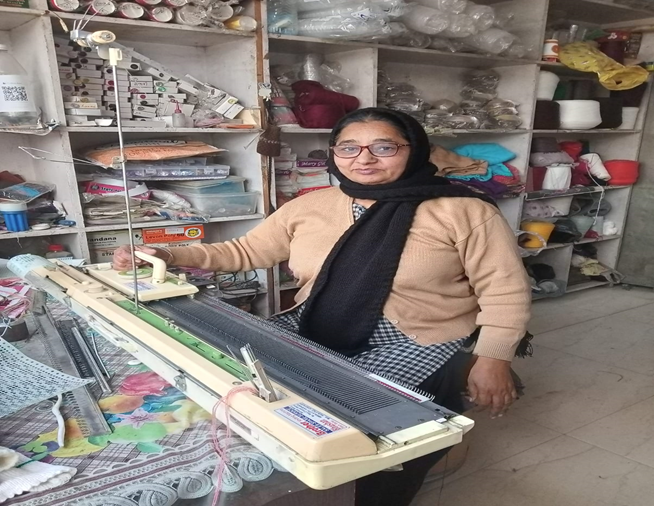
Punjab, 23 Feb: Ambuja Cements, the 9th largest building materials solutions provider globally and part of the diversified Adani Portfolio as part of its CSR initiatives, has transformed the life of Kuldeep Kaur, a member of Guru Teg Bahadur Self-Help Group (SHG) from Ghanaouli village in Ropar district, through its sustained livelihood support initiatives.
Kuldeep, who belonged to a financially vulnerable family, faced severe hardships after marriage. With her husband earning ₹7,000 per month as a labourer and her son suffering from serious health issues, the family struggled to meet basic needs. In 2005, she joined the SHG and in 2008 began knitting training with support from Ambuja Cements, marking a turning point in her journey.
Despite personal challenges, she steadily developed her skills and established her own income-generating activity in knitting. Her earnings enabled her to secure proper medical treatment for her son, build her own house and support her daughter’s education in the medical stream.
Recognising her dedication, Ambuja Cements encouraged her to become a knitting trainer. Since then, she has trained women across 20 villages, opened a wool shop and distributes knitting orders among SHG members. During peak season, she earns up to ₹80,000 per month. Her journey stands as a testament to the impact of women empowerment and sustainable livelihood initiatives supported by Ambuja Cements.
23, Feb 2026
Sunidhi Chauhan’s Concert
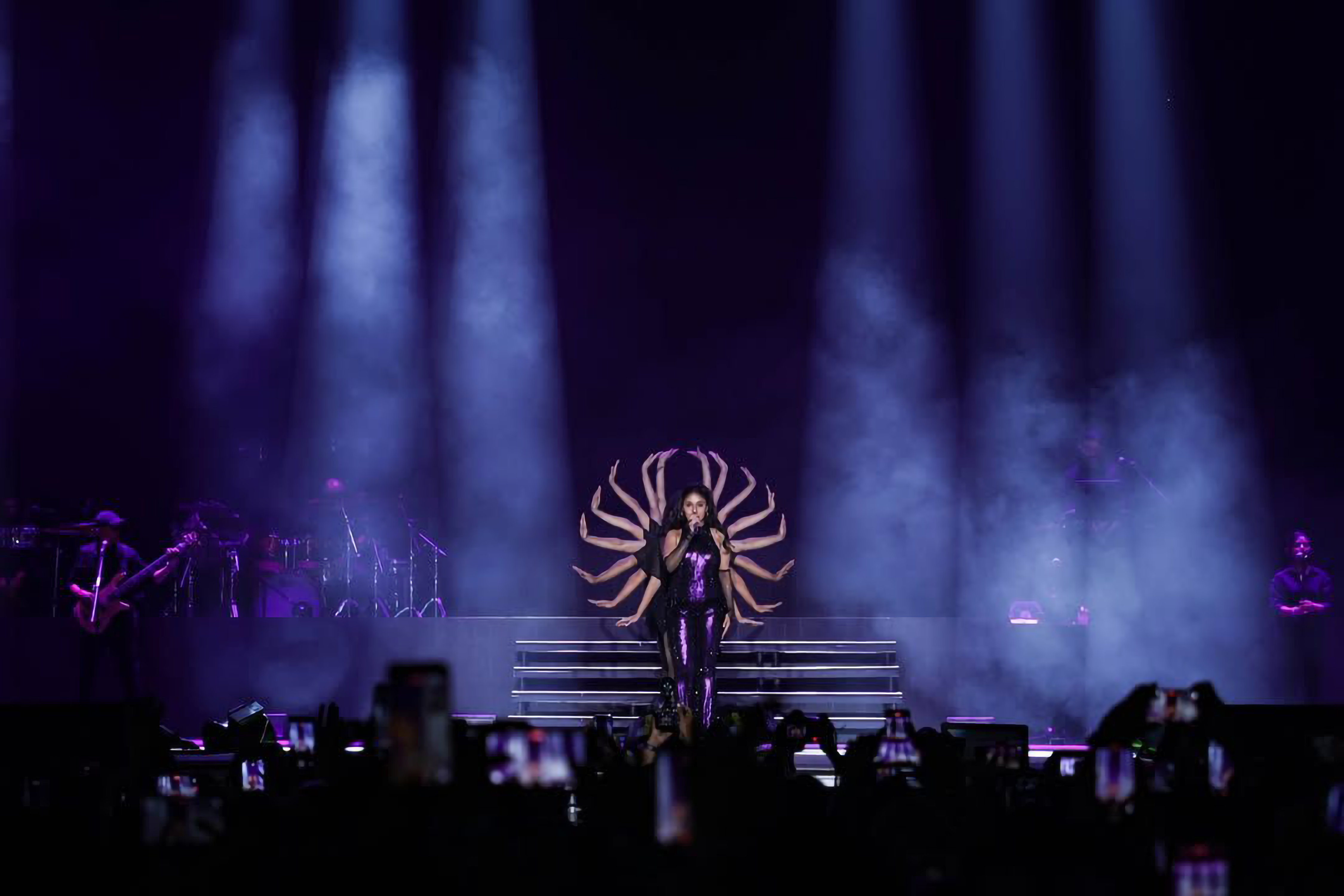
Chandigarh, Feb 23: Omaxe New Chandigarh witnessed a landmark live entertainment evening as more than 10,000 fans gathered for the high-energy ‘I AM HOME INDIA TOUR’ headlined by acclaimed playback sensation Sunidhi Chauhan. The grand spectacle further reinforced the city’s growing stature on the regional cultural and entertainment map.
Delivering a power-packed performance, Sunidhi Chauhan enthralled audiences with a dynamic lineup of her chart-topping hits. Her electrifying stage presence and powerful vocals transformed the venue into a vibrant celebration of music, energy, and community spirit.
As the Official Venue Partner, Omaxe Group curated a seamless and immersive concert experience. The event featured state-of-the-art stage production, advanced lighting systems, expansive LED displays, and high-quality sound engineering. Meticulous crowd management, streamlined entry and exit planning, robust security arrangements, and a thoughtfully designed food and beverage zone elevated the concert into a comprehensive lifestyle experience.
The scale, precision, and execution of the event underscore Omaxe’s broader vision of developing integrated destinations that foster community engagement and cultural vibrancy. With infrastructure designed to accommodate mega gatherings, Omaxe New Chandigarh is rapidly emerging as a preferred destination for marquee events across North India.
Speaking on the occasion, Jatin Goel, Executive Director, Omaxe Group, said:
“The turnout of over 10,000 attendees highlights the region’s strong appetite for premium live entertainment. Hosting Sunidhi Chauhan’s ‘I AM HOME INDIA TOUR’ at Omaxe New Chandigarh is a proud milestone, and we look forward to curating many more landmark experiences for the city.”
The evening concluded on an exhilarating note, setting a new benchmark for large-scale live entertainment events in the region and further solidifying Omaxe New Chandigarh’s position as a premier cultural and lifestyle hub.
23, Feb 2026
Three Years, Stronger Every Year: How Sharada Mundada Built a Thriving Insurance Career with PBPartners

Bengaluru, Feb 23: Policybazaar’s PoSP arm, PBPartners, is enabling individuals across India to turn ambition into sustainable insurance careers. One such inspiring journey is that of Sharada Mundada from Bengaluru, a testament to three years of consistent growth, resilience, and determination.
She began her insurance journey with PBPartners, eventually evolving from a new advisor into a high-performing partner while building a solid presence in the industry.
Business Growth, Learning, and Recognition
Over the period of three years, Sharada has grown her business, supported by PBPartners’ integrated digital platform that streamlines product access, servicing, and renewals. She also participated in specialised training programs to strengthen her product understanding and business clarity. Her journey has been recognised through the PBP One loyalty program, where she redeemed multiple rewards and earned international travel opportunities to Dubai, Vietnam, and Thailand.
Building a Diverse and Trusted Insurance Portfolio
Sharada began her journey with a focus on health insurance and gradually expanded into multiple insurance segments. With access to a wide pool of insurers through PBPartners, she was able to offer tailored solutions to customers across categories, helping her strengthen client relationships while expanding her business reach. This flexibility enabled her to build credibility and position herself as a reliable insurance advisor.
Support and Future Outlook
Sharada describes her journey with PBPartners as both independent and well-supported. She shared, “The PBPartners team and my Relationship Manager have always provided dependable support while allowing me the independence to grow my business in my own way.”
With a strong foundation in place, she now looks forward to expanding her reach further and exploring new opportunities with PBPartners.
23, Feb 2026
India’s Power Transition Creates Clear Utility Divide
ARE report finds JSW Energy and Tata Power best positioned for firm-power era; NTPC’s execution critical as coal economics tighten
SINGAPORE / NEW DELHI, INDIA, Feb 23 - India’s power sector is entering a decisive new phase as electricity demand surges, peak loads hit record highs, and the country moves toward its 500GW non-fossil capacity target by 2030 post a record 52GW capacity added in FY26But the next chapter of the transition will not be defined by installed capacity alone.
A new report by Asia Research & Engagement (ARE), Powering Net Zero: Pathways to Clean Energy for India’s Utility Companies, finds that the market is shifting toward firm, dispatchable and availability-linked power — creating clear divergence among India’s largest listed utilities.
The analysis identifies:
- JSW Energy and Tata Power as best placed to monetise the transition, combining contracted renewable growth, storage depth and improving cashflow quality.
- Adani Green Energy remains the fastest capacity scaler with strong long-term visibility, though storage integration remains at an early stage.
- NTPC, India’s largest generator, retains unmatched scale and sovereign-backed financing, but its transition outcomes hinge on execution speed and managing coal’s declining role.
- Adani Power remains predominantly thermal, with limited exposure to the structural upside from renewables and storage.
The report also highlights tightening coal economics. While new ultra-supercritical coal plants clear bids at INR5. 5–6 per kWh, effective delivered costs rise materially once utilisation, fuel volatility and compliance costs are factored in. By comparison, round-the-clock and storage-backed renewable projects are clearing between INR2.7–5.1 per kWh with availability guarantees embedded in contracts.
“The debate is no longer coal versus renewables,” said Arun Kumar, Strategic Advisor for Power Markets & Technology Innovation at ARE and lead author of the report. “As procurement shifts toward round-the-clock supply, reliability and execution — not just megawatts — will determine competitive advantage.”
“While this ARE study highlights significant momentum across the sector, it also identifies areas where sharper strategic clarity, improved contracting frameworks, and stronger delivery capabilities will be essential to meeting India’s long-term decarbonisation goals.”
23, Feb 2026
Climate Jobs Fair Connects Climate Startups with Young Talent at DCIW 2026
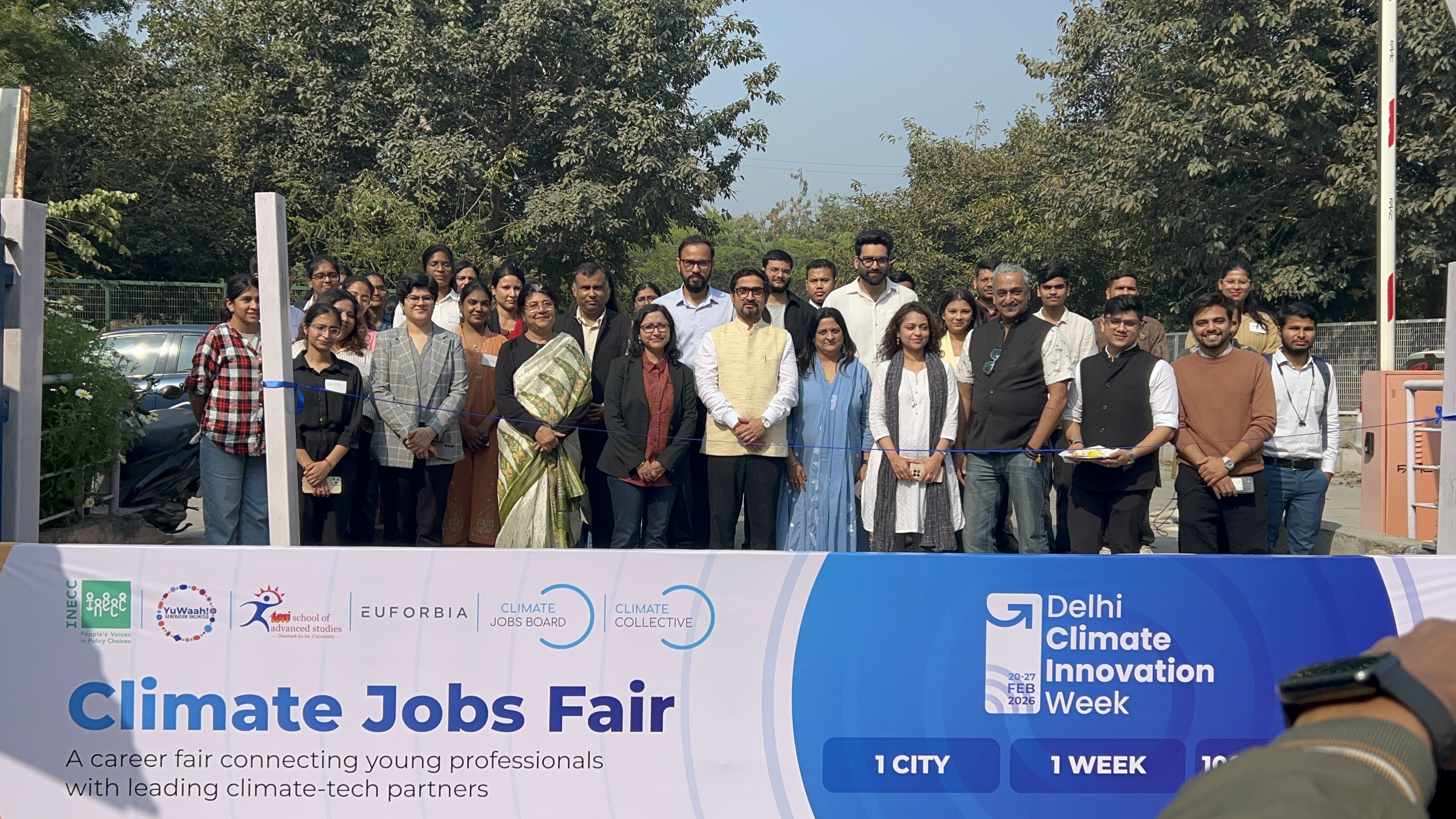
New Delhi, Feb 23: Day Two of Delhi Climate Innovation Week (DCIW) 2026 witnessed 19 events across Delhi NCR, as part of the week-long platform featuring 110+ climate-focused events over seven days.
A major highlight of the day was the Climate Jobs Fair 2026, hosted at TERI School of Advanced Studies (TERI SAS) in collaboration with Climate Collective Foundation (CCF). The fair brought together climate technology-focused startups, students, researchers, and young professionals for a day dedicated to green careers and workforce readiness.
Participating startups represented sectors including clean energy, energy efficiency, mobility, AI, grid intelligence, circular economy, and waste management. Startups engaging with talent at the fair included KHEONI, Valency Energy, TRILLECTRIC, and 3R Zerowaste Pvt Ltd, among others. About 100+ job seekers engaged with the startups and spot interviews were conducted across the day.
Beyond recruitment interactions, the Climate Jobs Fair featured sustainability games, a climate quiz, resume-building sessions, and direct founder–student networking. The event positioned itself not merely as a hiring drive but as a structured career exploration platform, connecting young people to the expanding climate innovation ecosystem.
India’s climate innovation landscape has expanded significantly in recent years, with nearly 4,000 clean tech startups now active across the country — a sharp rise from just a few dozen a decade ago. Yet, a gap persists between emerging opportunities and awareness among youth. The Climate Jobs Fair aimed to address this mismatch by creating direct pathways between climate enterprises and aspiring professionals.
Prof. Suman Kumar Dhar, Vice Chancellor, TERI School of Advanced Studies, said: “At TERI School of Advanced Studies (TERI SAS), we are committed to nurturing the next generation of ‘sustainability natives.’ The Climate Jobs Fair 2026 is a vital bridge between academic excellence and real-world impact. The future of work is undeniably green. As a pioneer in sustainability education and research, TERI SAS recognizes that solving the climate challenge requires a highly specialized and dedicated workforce. This jobs fair serves as a catalyst for innovation, connecting talented minds with organizations that are at the forefront of climate action. TERI SAS in collaboration with Climate Collective Foundation (CCF) is proud to provide a platform where education meets opportunity, driving the systemic change needed for a sustainable and equitable planet.”
Jui Joshi, Partner, Climate Collective Foundation, added: “Less than a decade ago, climate careers were seen as niche. Today, they are central to India’s growth story. With India’s green economy booming and projected to create 48 million full time jobs by 2047, a large portion of this will be led by fast-growing startups transforming climate goals into a massive employment reality. The climate transition is creating real businesses and real jobs across sectors. The Climate Jobs Fair aims to support startups in building the right talent pipeline during their crucial phase of growth. It makes these opportunities visible and accessible — showing young people that climate is not just impact work, it is a serious and rewarding career path.”
The event also saw participation from school students exploring future academic streams, as well as Masters and PhD scholars seeking internships and placements. Faculty leaders from TERI SAS emphasised the importance of building early exposure at school level while strengthening forward linkages into industry — reinforcing academia–industry collaboration.
Also on Day Two of DCIW, an event titled “Building Climate-Ready Talent: Data and AI Pathways for Climate Action” was hosted by data.org, spotlighting the growing importance of data science and artificial intelligence in climate action. The session explored how data-driven tools are strengthening heat risk and vulnerability mapping, supporting climate finance and Loss & Damage evidence, and enabling informed local climate planning. Through an interactive engagement format, participants explored learning pathways in data-driven climate careers, further reinforcing the central theme emerging from the day: India’s climate transition requires not only technology and capital, but skilled, interdisciplinary talent.
23, Feb 2026
Surya Brasil Accelerates India Expansion after 30% growth in the US; Launches New Hair Care Range

New Delhi: Feb 23:Surya Brasil, the Brazilian clean beauty brand known globally for its natural henna-based hair colour solutions, has announced the expansion of its product portfolio in India. The company aims to further reinforce and amplify its flagship Henna Cream while introducing a wider range of hair care and treatment products tailored for the Indian market.
With a presence in over 40 countries, Surya Brasil is strengthening its focus on key growth markets including India, supported by increased investments in marketing and trade engagement to deepen reach and visibility.
The expansion builds on Surya Brasil’s strong growth momentum in the United States, where the brand recorded 30% growth last year and outpaced the hair colour category by 16 percentage points, according to NielsenIQ data. This performance reflects rising consumer preference for natural and clean beauty alternatives.
The timing aligns with the rapid growth of the global natural cosmetics industry, which is projected to reach USD 74 billion by 2028. Increasing consumer awareness around ingredient transparency and sustainability is reshaping buying behaviour in India, particularly in the hair care segment. Surya Brasil’s expanded range aims to serve both professional salons and conscious consumers looking for effective, plant-based alternatives.
“At Surya Brasil, we have always believed that what you apply to your hair and skin matters,” said Clelia Angelon, Founder and CEO of Surya Brasil. “India has been an inspiration to us through Ayurveda, and expanding our portfolio here feels both strategic and meaningful.”
As part of its expansion, Surya Brasil is introducing a broader portfolio of complementary hair care and treatment products designed to create a complete clean beauty routine. The new additions include The Color Fixation line, The Hair Therapy range, The Balanced Cleansing Shampoo, The Nourishment & Protection conditioner, Brazilian Vegetable Keratin, The Force line and The Bio Finishers range. Henna Clean and Henna Force further extend the brand’s offering with treatment-focused solutions aimed at improving scalp health and strengthening hair from root to tip.
The flagship product Henna Cream remains at the centre of Surya Brasil’s India strategy. Formulated with up to 98% natural ingredients, the product offers full grey coverage while nourishing and strengthening the hair. Free from harsh chemicals such as ammonia and its by-products, including ethanolamine and triethanolamine, as well as PPD, Surya Brasil is aiming for a considerable market penetration in the natural hair care category with this flagship product.
With manufacturing headquartered in São Paulo and operations in Houston and Milan, Surya Brasil brings international quality standards and long-standing clean beauty credentials to the Indian market. The company says it remains committed to ethical formulations, responsible sourcing, and long-term investment in the region.
22, Feb 2026
Dr. Bhargav Mallappa’s Reappointment as National Deputy Chairman Underscores Social Mission
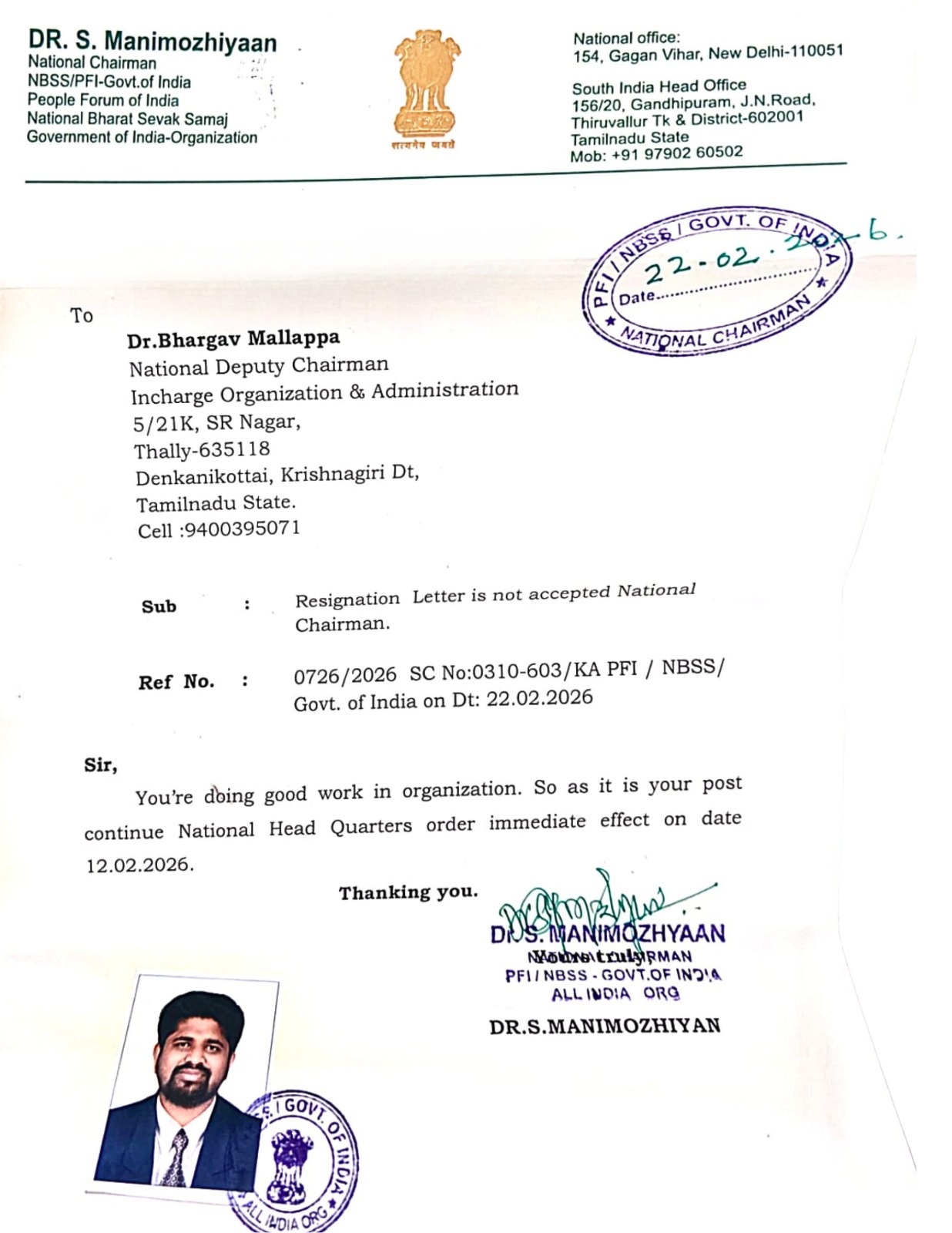
Delhi, Feb 22: Dr. Bhargav Mallappa will continue serving as the National Deputy Chairman of the People Forum of India after the National Chairman Dr. S. Manimozhyaan, formally declined to accept his resignation and urged him to remain in office in view of the organisation’s ongoing social responsibilities and long-term mission.
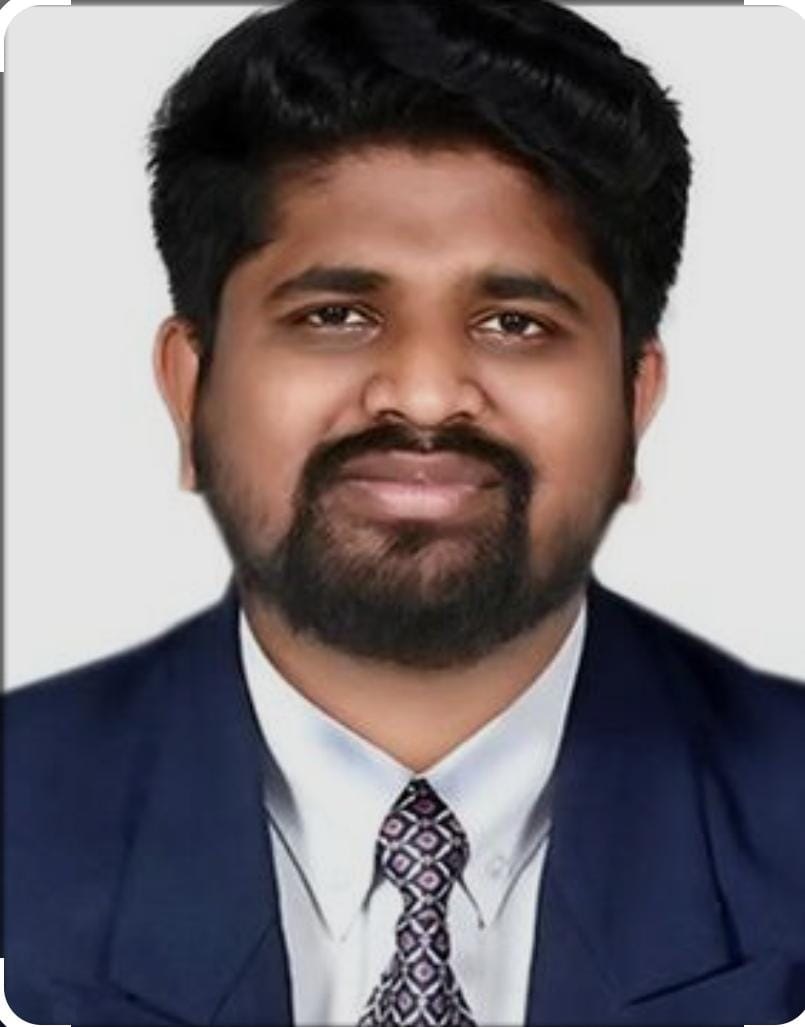
In an official communication issued on Sunday, the National Chairman acknowledged Dr. Mallappa’s sustained contributions to the organisation’s administrative strengthening and grassroots social initiatives, expressing confidence in his leadership and requesting him to continue his responsibilities in the larger interest of the mission.
Responding to the development, Dr. Bhargav Mallappa said the decision to step back from his resignation was guided not by position, but by purpose. He said, “Public service is not about titles; it is about responsibility. The trust shown by the organisation carries moral weight. After thoughtful reflection, I felt it was important to prioritise continuity and collective vision over personal considerations. Our shared objective remains the upliftment of society, and that commitment must remain uninterrupted.”
Dr. Mallappa further said that moments of introspection often strengthen institutions rather than weaken them. “This phase has brought clarity. It has reinforced why we began this journey — to build structured, accountable, and impactful social initiatives. With renewed focus and stronger coordination, we will move forward with greater discipline and deeper engagement at the grassroots level.”
He expressed optimism that the organisation will now work with sharper alignment and enhanced energy, ensuring that its social outreach efforts expand in both scale and substance.
Dr. Mallappa will continue to serve as National Deputy Chairman with immediate effect, reaffirming his dedication to strengthening institutional processes and advancing meaningful social change.


