


17, Jun 2026
Cinchy Appoints Cybersecurity Industry Veteran J.Paul Haynes as Chief Executive Officer

Former eSentire Executive Joins Cinchy to Accelerate the Company’s Next Chapter of Trusted AI Adoption
TORONTO, ON — June 17: Cinchy today announced the appointment of J.Paul Haynes as Chief Executive Officer, bringing decades of cybersecurity leadership experience to the company as organizations increasingly seek trusted approaches to AI adoption.
Haynes joins Cinchy following a distinguished career helping build and scale some of cybersecurity’s most recognized organizations, including playing a leadership role in the growth of eSentire from an emerging startup into one of the industry’s leading Managed Detection and Response (MDR) providers.
His appointment comes at a pivotal moment as enterprises struggle to safely move beyond AI experimentation and begin integrating generative AI, copilots and autonomous agents into critical business workflows.
While AI promises significant gains in productivity and acts to unlock innovation, many organizations are discovering that existing governance and security models were not designed for systems capable of independently accessing data, interacting with enterprise applications and influencing business decisions increasingly in autonomous fashions.
Under Haynes’ leadership, Cinchy will focus on helping organizations accelerate AI adoption while maintaining the governance, security and operational oversight required to do so responsibly.
“Organizations are under tremendous pressure to move faster with AI, but they are learning they cannot sacrifice trust, security or accountability in the process,” said Haynes. “The opportunity in front of us is to help enterprises confidently embrace AI while ensuring it operates within the guardrails of their business, compliance obligations and security requirements. I believe Cinchy is uniquely positioned to solve that challenge.”
Founded on a vision of helping organizations govern access to enterprise data, Cinchy has spent years helping customers establish trusted access, visibility and control across complex environments. Today, the company is extending that governance foundation to address a new challenge: enabling trusted AI adoption at enterprise scale.
“J.Paul’s experience helping organizations navigate transformational shifts in cybersecurity makes him an ideal leader for Cinchy’s next chapter,” said Leo Casusol, Managing Director at Forgepoint, a leading U.S. cybersecurity investment firm and Cinchy investor. “His track record of scaling innovative companies, building high-performing teams and understanding the evolving security landscape will be invaluable as enterprises seek new ways to govern and secure AI.”
The appointment reflects Cinchy’s belief that trusted AI adoption is becoming the defining technology challenge of this decade.
As AI continues to take on a more active role across business workflows, Cinchy remains focused on building the governance foundation organizations need to safely scale AI adoption across enterprise systems, data and processes, while maintaining visibility, accountability and trust.
- 0
- By Neel Achary

17, Jun 2026
Airtel Extends Connectivity for Indian Army in Arunachal Pradesh
Guwahati, June 17: Bharti Airtel (“Airtel”), one of India’s leading telecommunications service providers, today announced the successful completion of the first phase of a strategic initiative in partnership with 4 Corps of Indian Army headquartered at Tezpur to strengthen mobile connectivity across remote regions in Arunachal Pradesh.
With this milestone deployment, Airtel has become the first and only service provider to deliver reliable mobile connectivity in the mountainous, high-altitude, and difficult-to-access region. This will enable both military and civil personnel residing in these remote locations to stay seamlessly connected with their families.
As part of the initiative, Airtel deployed network infrastructure across 30 Army stations located in challenging mountainous terrain. The deployment significantly enhances voice and data connectivity in areas where access has historically remained limited due to geographical and infrastructure constraints.
This achievement was made possible through the strong collaboration between Airtel and the Indian Army. The Army extended extensive logistical support throughout the project, including assistance for fiber deployment and power infrastructure. In several locations where road access was not possible, the Indian Army provided the necessary assistance and logistics support to move Airtel Technical teams and telecommunication equipment deep into the mountains.
The successful completion of Phase 1 has now paved the way for the next chapter. Encouraged by the impact of the project, the Indian Army and Airtel have agreed to undertake Phase 2, under which network sites will be built across 15 additional locations in Arunachal Pradesh
“This initiative reflects Airtel’s continued commitment to extending connectivity to some of the country’s most difficult terrains. The rollout required extensive coordination between Airtel teams and local support units to overcome immense terrain and weather-related challenges,” said Balaji R, CEO – North East and Assam, Bharti Airtel. “Our teams operated under demanding high-altitude conditions and adverse weather to ensure timely and secure network activation. We are deeply grateful to the Indian Army for their unparalleled logistical support, which made it possible to bring digital connectivity to these frontier regions.”
Airtel’s continued expansion into such challenging environments reflects its commitment to bridging the digital divide and powering India’s digital transformation.
17, Jun 2026
Omdia: XR headwear market set for growth from 2027, as industry attention shifts from headsets to glasses
LONDON, June 17: Global shipments of XR headwear will decline by 12% to 6.2 million units in 2026, according to the latest forecast from Omdia. However, the market is expected to return to growth in 2027, reaching 6.5 million units, an increase of 4.8%. This recovery will be driven by the rapid expansion of XR glasses, offsetting declines in headset shipments, as both consumers and manufacturers increasingly favor lighter form factors over bulkier devices.
The tethered XR glasses segment, led by Chinese vendors like RayNeo and Xreal, is projected to reach 900,000 units in 2026 – a 19% increase – and maintain double-digit growth to reach 3.8 million units by 2030. Meanwhile, standalone XR glasses remain a relatively small segment, largely confined to enterprise and developer use, with shipments forecast to reach just 93,000 units in 2026. However, the category is expected to grow rapidly over the next five years as hardware matures and spatial computing capabilities improve.
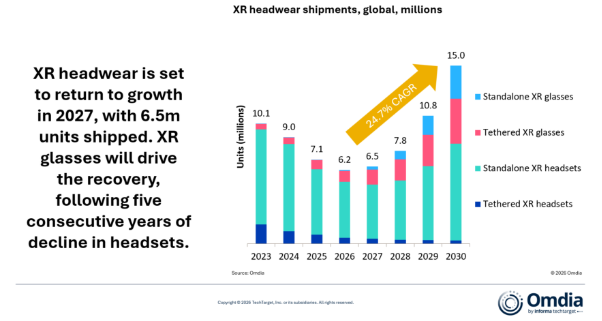
XR headwear is part of the wider intelligent headwear market as defined by Omdia, which also includes AI glasses. “Following three years of rapid growth, AI glasses have begun normalizing face-worn computing for daily use,” said George Jijiashvili, Senior Principal Analyst at Omdia. “This growing consumer familiarity is directly fueling the XR glasses segment, laying groundwork for an industry-wide evolution toward slimmer glasses form factors.”
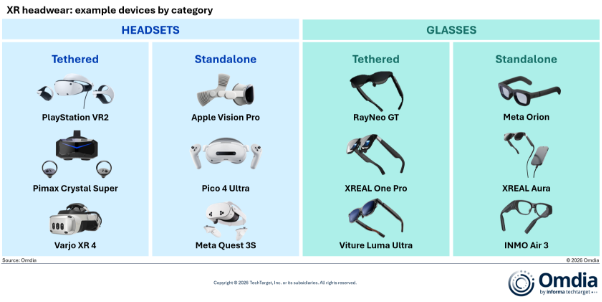
The standalone XR headset category, which includes the Meta Quest 3 and Apple Vision Pro, is projected to decline 15% in 2026 to 4.7 million shipments, with contractions continuing into 2027, marking a fifth consecutive year of decline for the category since its pandemic-induced peak in 2021/22. A return to growth is predicted in 2028, with shipments forecast to rise to 5 million units.
This recovery relies on Apple introducing a more accessible Vision Pro around 2028, acting as the catalyst for players like Samsung and Vivo to make a more competitive push. Without these developments, growth prospects for the segment remain uncertain. Meanwhile, tethered headsets continue their steep decline, dropping 34% in 2026 to 500,000 units as standalone alternatives displace them.
“Despite maturing technology, bulky XR headsets struggle to demonstrate everyday utility for mainstream consumers,” noted Qiran Ju, Senior Analyst at Omdia. “Meta has prioritized AI glasses, while Google signaled a similar direction through emphasis on XR glasses at I/O 2026. Lighter form factors are better positioned to gain widespread consumer acceptance and steer the future of XR development.”
17, Jun 2026
Nickel Digital Redefines The Pod Shop For The Digital Asset Age
June 17: Nickel Digital Asset Management (“Nickel”), Europe’s leading digital assets hedge fund manager, founded by alumni of Bankers Trust, Goldman Sachs and JPMorgan, has outlined its vision of best practice for pod shops in the digital asset space.
Its model is focused on reducing fixed-cost drag and strengthening alignment and trust with pods anchored in higher performance fees, but with a holdback to absorb some degree of potential future drawdowns. This First Loss Deferred (FLD) capital creates a tangible alignment of incentives and avoids the asymmetric manager payout structure.
Many of the managers come out of top-tier trading environments, ranging from established TradFi hedge funds and proprietary trading firms, to highly specialised crypto-native desks, combined with strong academic pedigrees in disciplines such as mathematics, physics, engineering and computer science. The blend of rigorous analytical training and real-world trading experience is fundamental to Nickel’s systematic, research-driven approach.
Traditional pod shop models have often been criticised for fixed-cost drag – the burden of high management fees and sign-on bonuses that dilute returns. Nickel’s model deliberately strips away these elements, replacing them with a system built on institutional-grade rigour and genuine performance-led growth.
In a fragmented and volatile digital asset market, Nickel believes that the hero trader model is no longer sufficient. To capture alpha across global venues, the firm exclusively funds fully systematic strategies where every stage from signal generation to execution is driven by code.
A cornerstone of Nickel’s best practice approach is its commitment to manager autonomy and intellectual property (IP) protection. Unlike many platforms that seek to internalise signals or harvest successful strategies, Nickel’s pods remain independent by design.
Nickel’s operational excellence is underpinned by RiskZeus, its proprietary system capturing over 100 million tick-by-tick data points every 24 hours across roughly 10,000 open positions. This technology was proven during the October 10th Flash Crash last year which saw the largest liquidation event in digital asset history, with $20 billion wiped out. While many faced collapse, Nickel’s fund protected capital and delivered one of its strongest daily returns, maintaining annualised volatility below 7%.
Counterparty and custody risk management remain central to the platform with 94% of exposure managed via Off-Exchange Settlement (OES) solutions as of February 2026. This ensures investor assets remain secure with specialised crypto custodians like Copper and regulated banks like Sygnum acting as the custody providers.
As of early 2026, Nickel’s trading bench includes 80 pods across 35 cities and six continents, with aggregate trading volumes exceeding $100 billion in 2025.
Anatoly Crachilov, CEO and Founding Partner at Nickel Digital, explains that the platform’s success is rooted in its ability to act as a bridge between exceptional global talent and institutional capital. “The next generation of multi-manager investing in digital assets will not be built around in-house star traders and balance-sheet-heavy platforms.” says Crachilov. “It will be built around institutional access to globally-located scarce systematic trading talent, protected intellectual property, and a powerful risk control infrastructure running on 24/7 basis.
Alek Kloda, Co-CIO and Founding Partner at Nickel Digital, believes that the shift toward tokenisation demands a new level of technological agility. “As digital assets mature, the velocity of market opportunities requires a 24/7, code-driven approach to both execution and risk management,” notes Kloda. “Our model empowers independent pods to act swiftly while ensuring that global risk controls are uniformly applied, bridging the gap between low-latency crypto trading and institutional safety,” he commented.
Michael Hall, Co-CIO and Founding Partner at Nickel Digital, notes that the strength of Nickel Digital’s platform lies in its marriage of flexibility for the trader and discipline for the investor. “By ensuring our trading partners retain ownership of their IP, we attract the best talent, while our centralized risk architecture ensures that this creative freedom operates within strict, pre-defined parameters. This balance is crucial for achieving high Sharpe ratio strategies in a volatile market environment,” he adds.
“We are defining the next generation of asset management, where institutional rigour meets digital agility,” concludes Crachilov. “Our commitment is to continue providing superior risk-adjusted returns for our investors, regardless of market direction.”
17, Jun 2026
Algorand Foundation Launches Global x402 Challenge with Dollar 100k USD + 500k ALGO Prize Pool
Competition opens on the heels of a successful Berlin hackathon as developer momentum behind x402 payments accelerates
DOVER, DELAWARE, June 17: The Algorand Foundation today launched the Global x402 Challenge, a five-month competition for developers building x402-powered, pay-per-request API services on Algorand mainnet.
The announcement follows the Algorand Builders Berlin: Agentic Commerce x402 Hackathon on June 6-7, where more than 100 builders gathered in Berlin for a 36-hour build sprint. Winning builds ranged from an agentic trust layer for regulated finance to a peer-to-peer energy market where an EV agent settles solar power purchases in real time, with no checkout step required.
x402 is an open protocol that embeds payment logic directly into HTTP requests. Originally developed by Coinbase, it enables AI agents and services to transact per call without API keys or billing infrastructure. Algorand’s instant finality and low transaction fees make it particularly well-suited as the settlement layer for high-frequency agent payments at scale.
To enter the Global x402 Challenge, developers must deploy a paid x402 endpoint on Algorand Mainnet. Usage is tracked automatically via the GoPlausible facilitator on a public leaderboard. The top 50 qualify for 10 finalist spots, who will present live (in-person or virtually) at Devcon 8 India. The top five finalists share $100,000 USD, with an additional 500,000 ALGO split across the top 20 endpoints on the leaderboard. Full eligibility requirements, prize terms, and conditions are set out in the Official Rules; the Challenge is void where prohibited and is not open to residents of sanctioned or otherwise restricted jurisdictions.
17, Jun 2026
AMD and Rackspace Technology Sign Definitive Agreement for Phased Deployment of 30 MW of AMD AI Compute
SANTA CLARA, Calif. and SAN ANTONIO, June 17: (GLOBE NEWSWIRE) — AMD (NASDAQ: AMD) and Rackspace Technology® (NASDAQ: RXT), a global enterprise AI infrastructure and solutions provider, today announced the signing of a definitive agreement for the phased deployment of an initial 30 MW footprint dedicated to AMD-based compute deployments across Rackspace’s global data centers beginning in late 2026 through 2028. The agreement operationalizes the Memorandum of Understanding announced May 7, 2026, and establishes AMD as a strategic technology partner at the silicon layer of Rackspace’s governed AI stack.
At full deployment, 30 MW of dedicated AMD compute across Rackspace’s footprint will represent meaningful capacity to serve regulated enterprise workloads, including healthcare providers who have expressed early interest in accelerated compute for clinical AI and inference at scale. This collaboration incorporates both AMD Instinct™ GPUs (including MI355X, MI350P, and future successor solutions) and AMD EPYC™ CPUs inside an integrated Enterprise AI Cloud architecture, enabling Rackspace to route each workload to the right compute with full accountability for performance and outcomes end to end.
“Enterprises in regulated industries need AI infrastructure that is governed from the ground up, with one operator accountable for business outcomes, not a collection of vendors each owning a piece,” said Gajen Kandiah, CEO, Rackspace Technology. “This collaboration combines the right compute with the right operating model and delivers something the market hasn’t offered before: a governed AI stack with one accountable partner from silicon to outcomes.”
“As enterprise AI evolves, customers need infrastructure that can deliver the right mix of accelerated and general-purpose compute for each workload,” said Dan McNamara, senior vice president and general manager, Compute and Enterprise AI, AMD. “By bringing together leadership AMD AI compute solutions and Rackspace’s governed cloud operating model, we are helping regulated enterprises deploy high-performance AI infrastructure with the openness, scalability and accountability needed to run AI at enterprise scale.”
Both companies expect to dedicate sales and marketing resources to identify and engage enterprise customers for AMD compute-powered infrastructure, with each company committing personnel to jointly develop and pursue customer opportunities across regulated industries.
This agreement will accelerate delivery of the four integrated capabilities announced with the MOU: Enterprise AI Cloud, Enterprise Inference Engine, Inference as a Service, and Bare Metal AMD Instinct, offering a complete, governed stack from bare metal compute through fully operated inference. Together, the companies aim to establish a new category of managed enterprise AI infrastructure that offers enterprises an alternative to the bare metal model. The shift from AI experiments to agentic workflows running inside core enterprise systems is accelerating demand for exactly the kind of governed, accountable infrastructure this collaboration is built to deliver.
17, Jun 2026
Avio Smart Market Stack Appoints Sandeep Pandya to Drive Global Expansion of its Diagnostics & Healthcare Business
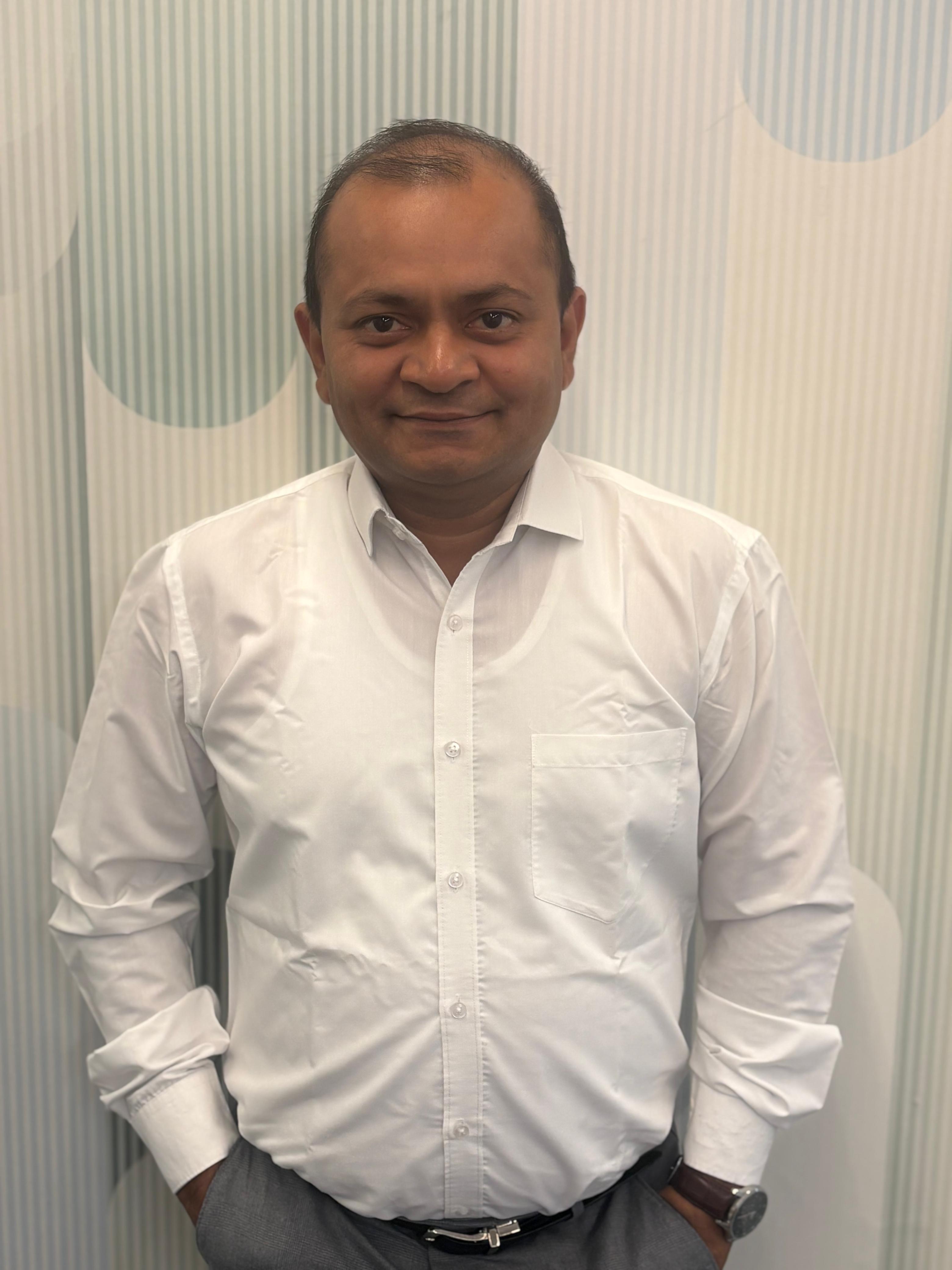
June 17: Avio Smart Market Stack Limited (formerly Bartronics India Limited) has appointed healthcare industry veteran Sandeep Pandya as Head – International Sales, Diagnostics & Healthcare Division, as the company accelerates its global expansion strategy in diagnostics and healthcare technologies.
With over two decades of experience across diagnostics, medical devices, pharmaceuticals, and healthcare technologies, Pandya has built and scaled international businesses across Asia, Africa, Europe, and emerging markets. He has previously held leadership roles at Meril Life Sciences, Beacon Diagnostics, CTX Life Sciences, and Span Diagnostics, where he led international market development, distributor networks, regulatory initiatives, and commercialisation programs.
In his new role, Pandya will spearhead Avio Stack’ international business development efforts, focusing on market expansion, strategic partnerships, distribution network development, and commercialisation of the company’s healthcare portfolio across global markets.
A key priority will be expanding the international footprint of Huwel Lifesciences’ molecular diagnostics portfolio, a cornerstone of Avio Stack’s healthcare strategy. The portfolio includes advanced molecular diagnostic solutions for tuberculosis (TB), drug-resistant TB, sepsis, HPV, hepatitis, antimicrobial resistance (AMR), respiratory illnesses, and other infectious diseases.
Commenting on the appointment, Vidya Sagar Reddy, Managing Director, Avio Smart Market Stack Limited, said: “Healthcare and diagnostics represent a strategic growth pillar for Avio Stack. As we continue building a globally relevant healthcare platform, strengthening our international presence becomes increasingly important. Sandeep brings deep expertise in diagnostics and healthcare commercialisation across multiple geographies, and his leadership will help us accelerate market access, forge meaningful partnerships, and create sustainable growth opportunities worldwide.”
Speaking on his new role, Sandeep Pandya, Head – International Sales, Diagnostics & Healthcare Division, Avio Smart Market Stack Limited said: “The global healthcare landscape is evolving rapidly, creating significant opportunities for innovative and accessible diagnostic solutions. Avio Stack has laid a strong foundation through its healthcare initiatives, and I look forward to working with the team to expand our international reach, strengthen strategic collaborations, and deliver impactful healthcare solutions across diverse markets.”
The appointment underscores Avio Stack’s long-term vision of building a globally scalable diagnostics and healthcare business through indigenous healthcare technologies, strategic collaborations, and expanded international market access. The company aims to strengthen its presence across both emerging and developed healthcare markets while improving access to affordable, high-quality diagnostic solutions.
17, Jun 2026
EbixCash expands phygital network as assisted digital transactions surge in non-metro India
New Delhi | June 17: EbixCash World Money, a flagship subsidiary of Eraaya Lifespaces Limited, today announced the expansion of its payments, remittance and forex network to 2,250 Indian cities/town/villages, up from 2,143 a year ago. The expansion adds over 573 new retail touchpoints, with 89% of new merchant additions coming from Tier 2 and Tier 3 towns.
The newly added network spans key regional clusters including Punjab and Kerala, where remittance-led transactions continue to anchor demand, as well as Gurgaon and Pune, which are seeing increased activity across SME payments and outbound forex usage. Southern markets such as Chennai, Bengaluru, and Coimbatore are witnessing stronger adoption of hybrid payment models that combine digital interfaces with assisted service delivery.
Neighbourhood retail points are emerging as critical financial access hubs. Kirana stores and local outlets are enabling use cases ranging from assisted remittances for migrant workers to everyday payment acceptance for small businesses, while also supporting first-time users as they enter formal digital financial systems. Unlike metros, where usage is largely app-driven, these markets continue to rely on assisted journeys, particularly for higher-value or more complex transactions.
Commenting on the development, Mr. T. C. Guruprasad, CEO & Managing Director – Payments Solutions, EbixCash, said, “The next phase of digital transaction growth is being led by non-metro India, but the path to adoption here is structurally different. Assisted models are playing a critical role in building trust and enabling usage, especially for more complex financial needs like remittances and forex. Our network is designed to leverage local retail infrastructure as the interface for digital services, allowing us to scale access while staying relevant to how these markets transact.”
Vikas Garg, Chairman, Ebix Group, added, “In a market as diverse as India, distribution will continue to be a key differentiator in financial services. Digital alone cannot address the last mile at scale, particularly in emerging markets. The ability to integrate physical infrastructure with digital capabilities will define how effectively companies can build trust, drive usage, and scale sustainably across the next phase of growth.”
Looking ahead, the company plans to further expand its presence across emerging markets, with a continued focus on strengthening merchant access, scaling cross-border payment capabilities, and deepening its forex and transaction-led service offerings across India’s regional economies.
17, Jun 2026
Switzerland extends its lead in the technologies reshaping the global economy
ZURICH / PARIS, June 17. The technologies now driving the global economy, from advanced computing to artificial intelligence and robotics, are built patiently, over decades of sustained investment and deep scientific groundwork. Increasingly that work traces back to a country a fraction of the size of the giants it competes with.
Switzerland now directs a greater share of its venture capital to deep tech than any other nation, and commits more per head than any country in Europe, placing it among the top three worldwide. The finding anchors the Swiss Deep Tech Report 2026, published today by Deep Tech Nation Switzerland, Founderful, Kickfund, Startupticker.ch, and Dealroom.co, and launched at VivaTech in Paris.
The report sets out where the next decade of frontier technology will be engineered. The world’s most valuable companies are built on data centers, artificial intelligence and robotic automation, and Switzerland is among the few countries worldwide where that work is researched and commercialized at the frontier. What has changed is that its companies now stay to scale, and the world has taken notice. “For the first time, the companies spinning out of ETH and EPFL are staying, scaling and attracting serious capital,” says Jean-Philippe Fricker, Co-Founder and Chief System Architect of Cerebras Systems. The country’s international standing now matches the strength of its ecosystem.
Five findings that put Switzerland at the forefront of deep tech innovation
The pipeline is shifting toward the sectors that dominate global capital. AI and machine learning now account for one in four newly founded Swiss deep tech companies, more than double their previous share. Beyond startup creation, Switzerland has the highest density of AI researchers globally, twice that of the UK and the US. Robotics is moving even faster relative to peers: Switzerland has created 3.5 times more venture-backed robotics startups per capita since 2020 than the United States, and 5 times more than the UK. In Future of Compute, 2026 is already a record funding year, and Switzerland boasts 7 times more patents per capita than the European average, driven by its world-leading microelectronics and high-precision sensor industries.
The world’s most deep-tech-focused venture market. 63% of all Swiss venture capital flows to deep tech, the highest share of any country, ahead of China and the United States and nearly double the share of Germany and the UK, and well ahead of France.
First in Europe on intensity, top three globally. At $1,470 invested per capita, Switzerland commits more to deep tech per head than any country in Europe. Worldwide, that places it among the top three nations alongside Israel and the United States.
Funding is accelerating. Swiss deep tech funding has grown roughly fivefold since 2015 to reach a record $2.6B in 2025.
The strongest growth is still ahead. ETH Zurich and EPFL Lausanne are Europe’s leading universities for new deep tech spinouts. Building on a leading position, the two have extended their lead since 2023, and that cohort is only now reaching the seed-to-Series-A window, the stage at which company value and capital raised compound most sharply.
Momentum on the ground
Some of the clearest signals do not yet appear in the funding data. Among the report’s co-authors are several of the country’s most active deep tech investors, who describe a change in the character of the ecosystem over the past year. The world’s top funds no longer need persuading to look at Switzerland; they are arriving on their own initiative. “The energy and talent dynamism reminded me of what we saw in Israel and the UK in the early 2000s,” says Saul Klein, Founding Partner of LocalGlobe.
Global technology leaders are expanding their computing, robotics and AI research presence in the country. The pipeline feeding that activity runs straight from the universities. “At EPFL we see it every day: the discoveries made in our laboratories become the deep tech companies of tomorrow,” says Anna Fontcuberta i Morral, President of EPFL. And as deal flow deepens, founders are growing more selective about the investors they choose to work with.
“Since we launched in 2019, we’ve never seen such a high density of ambitious entrepreneurs tackling globally relevant tech challenges as right now. The pace at which these founders execute reminds me of what people speak about when they refer to SF. In the coming decade Zurich will become home to at least a dozen global category leaders, I’m sure of that.”
— Alex Stöckl, Partner at Founderful and Swiss Deep Tech Report co-author
Where the opportunity sits
Foreign investors supply 88% of Swiss deep tech funding at rounds of $100M and above, against 75% across Europe, while domestic capital falls to just 12% at late stage. In a top-ranked ecosystem, late-stage capital remains underweight relative to the quality of the companies being built, leaving clear room for new investors to enter early.
“We built one of the world’s most deep tech-focused economies without a franc of public venture capital. In Germany, France and the UK, much of the late-stage money is state-backed through Bpifrance, British Patient Capital or the German Future Fund. In Switzerland that barely exists, and yet the world’s best investors now come here on their own initiative, with some setting up shop. No public money had to write the cheque to make this real.”
— Wanja Humanes, Partner at Kickfund and Swiss Deep Tech Report co-author
What happens next
The seed-to-Series-A cohort now moving through the ecosystem is the largest Switzerland has produced, and it is only now reaching the stage where company value and capital raised compound most sharply. Deep tech funding has already grown roughly fivefold since 2015 to a record $2.6B. The companies are staying, and the funds are arriving on their own. The report sets out, sector by sector, the leaders and the startups most worth watching, and invites the investors who would rather arrive early than late.
17, Jun 2026
Plaud Scales From dollar 1M to 100M ARR Within Two Years, Bringing AI Beyond the Screen for Professionals
Among the fastest-known AI companies, Plaud stands out as a rare hardware-enabled AI company in a cohort dominated by software-only players
SAN FRANCISCO, June 17: Plaud, the company building real-world AI interface for professionals, today announced it has scaled from $1M to $100M in ARR within two years, placing it among the fastest AI companies globally to reach the milestone. Plaud is the only hardware-enabled AI company in a cohort otherwise dominated by software-only players, and now serves more than 2 million professionals across 170+ countries.
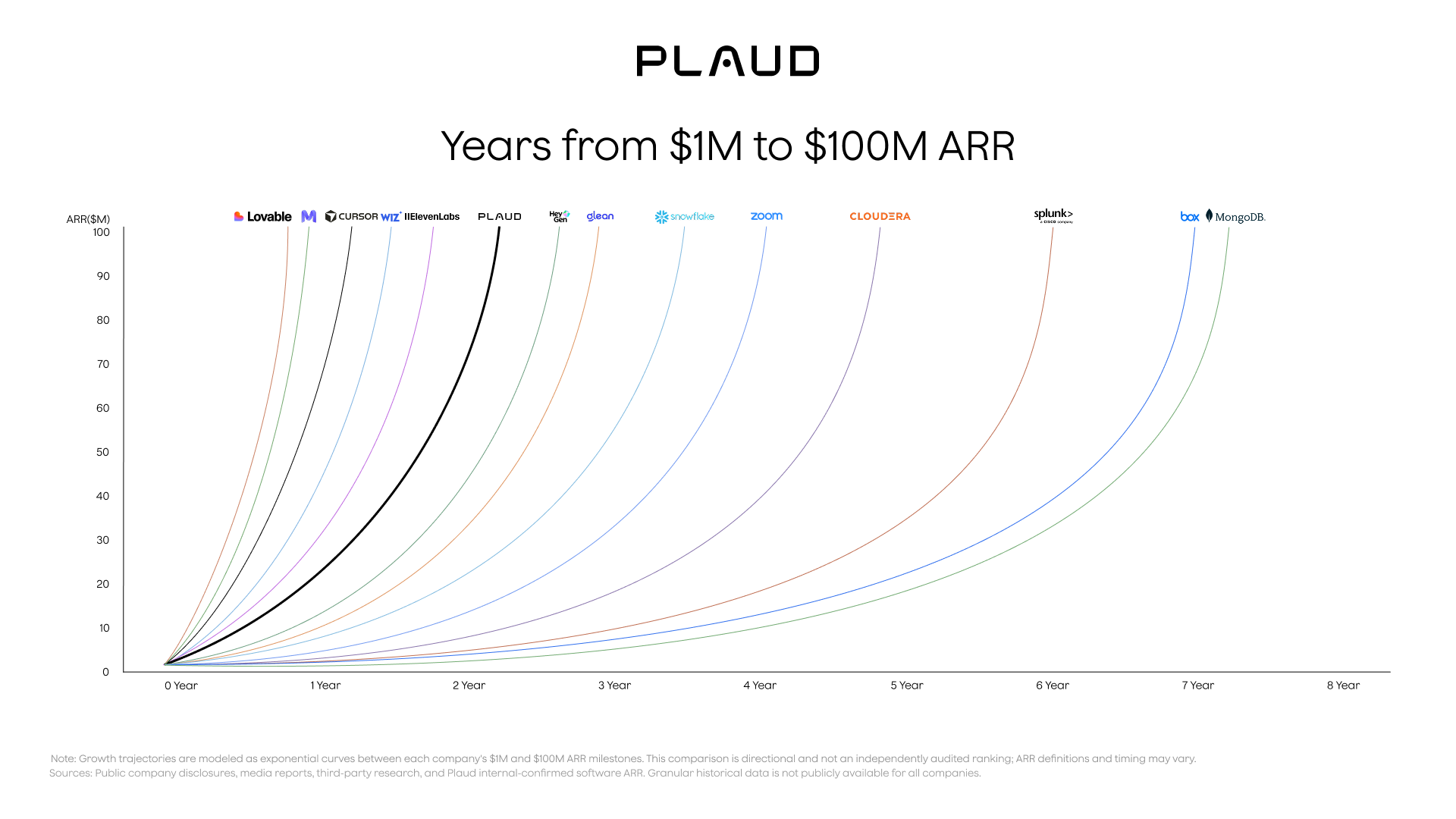
The fastest AI growth stories have, until now, belonged almost entirely to software-native companies: AI coding tools, enterprise workflow agents, and other SaaS products scaling behind screens and keyboards. Plaud’s growth represents a different model — recurring AI software scaled through a real-world physical interface, with devices (Plaud Note, Plaud Note Pro, Plaud NotePin S) acting as the entry point into human conversations, capturing the upstream, lossless, source-of-truth context.
Most AI today operates after the fact, on summaries, documents, prompts typed from memory. The intelligence that actually drives decisions comes from real-world conversations, before any prompt is written, before any keyboard is touched. When conversation fades, that intelligence decays. Not just information — intent, nuance, the reasoning behind decisions. Plaud is the post-screen, post-smartphone interface built to capture it at the rawest form.
“Most AI companies have scaled through software behind a screen. We took a different path.” said Nathan Xu, co-founder and CEO of Plaud. “The conversations that actually move things forward don’t happen on a keyboard. We built the interface for the post-screen world. And the market validated it.”
As AI moves from screen-based tools toward interfaces and agents that need trusted context to act reliably, real-world conversations are becoming a critical data layer. Plaud is also expanding beyond individual note-taking into team and developer workflows. Plaud Team brings conversation intelligence into collaborative work, while MCP and workflow integrations allow Plaud to connect with the broader agent ecosystem — turning meetings, calls, and in-person conversations into follow-ups, shared knowledge, and actions across the tools professionals already use.


