


8, Oct 2026
Suriname Ambassador Visits KIIT & KISS, Highlights Power of Education and India-Suriname Ties
Bhubaneswar,Oct 8 (UDN): KIIT and KISS had the honour of welcoming Her Excellency Ms Hanisha Jairam, Ambassador of Suriname to India, who visited the institutions and interacted with students, faculty and members of the KIIT and KISS communities.

Very happy to welcome Her Excellency Ms Hanisha Jairam, Ambassador of Suriname to India, to KIIT & KISS. She went around our KIIT campuses, saw the facilities at KISS and spent time with my lovable KISSians. We also spoke about the long ties of history and culture between India and Suriname. She appreciated the confidence and smiles of my KISSians, encouraged them to dream big whatever their circumstances, and spoke about how educating a girl can help her whole family. My sincere thanks to her for spending time with our children and for her kind words.
— Achyuta Samanta (@achyuta_samanta) October 7, 2026
During her visit, the Ambassador toured the KIIT campuses and visited various facilities at the Kalinga Institute of Social Sciences (KISS), gaining an insight into its distinctive model of education, empowerment and social transformation. She also spent valuable time with the students of KISS, fondly known as the KISSians, and appreciated their confidence, enthusiasm and cheerful spirit.
Interacting with the students, Her Excellency encouraged them to dream big and pursue their aspirations irrespective of their circumstances. She particularly emphasised the transformative power of educating girls, noting that when a girl receives quality education, the benefits extend beyond her to her entire family and community.
The visit also provided an opportunity to discuss the longstanding historical and cultural connections between India and Suriname. The shared bonds between the two countries, shaped by history, people-to-people ties and cultural exchanges, were highlighted during the interaction.
Reflecting on the visit, Dr Achyuta Samanta, Founder of KIIT and KISS, expressed his sincere gratitude to Her Excellency for spending time with the students and for her encouraging words.
“We are deeply honoured to welcome Her Excellency Ms Hanisha Jairam to KIIT and KISS. Her interaction with our students was especially meaningful. Her message to our KISSians—to dream without limitations and to believe in the power of education—will remain an inspiration to them. We are also grateful for her appreciation of our students’ confidence and spirit. The enduring bonds between India and Suriname make this interaction particularly special,” said Dr Samanta.
Her Excellency’s visit reaffirmed the shared commitment to education, empowerment, cultural understanding and stronger people-to-people relations between India and Suriname. For the students of KISS, her interaction was a memorable and inspiring experience, leaving them with a renewed sense of confidence to dream bigger and strive for a brighter future.
- 0
- By Neel Achary

7, Oct 2026
BIOAGRI 2026 Explores Innovation and Sustainability in India’s Agriculture Sector
Hyderabad, October 7, 2026: The 6th Annual BioAgri Industry Summit – BIOAGRI 2026, India’s leading conference on Sustainable Biological Agriculture, kicked off today at Ramoji Film City, Hyderabad, bringing together industry leaders, scientists, researchers, startups, innovators, policymakers, regulators and other stakeholders from across the country.
400 registered delegates participated. Dr. J.P. Singh, former Plant Protection Advisor of the Government of India, inaugurated and gave a keynote address for the conference.
“Biological agriculture is no longer a niche segment; it is emerging as an important pillar of sustainable agriculture. The future of Indian farming will depend on how effectively we integrate biological solutions, scientific research and smart technologies with the needs of farmers. Platforms such as BIOAGRI provide an important opportunity for industry, researchers, startups and policymakers to come together, exchange knowledge and accelerate the responsible adoption of biological solutions. We must move towards an agriculture system that is productive, environmentally responsible and resilient for the generations ahead said Dr. J.P. Singh, Former Plant Protection Advisor, Government of India in his keynote address
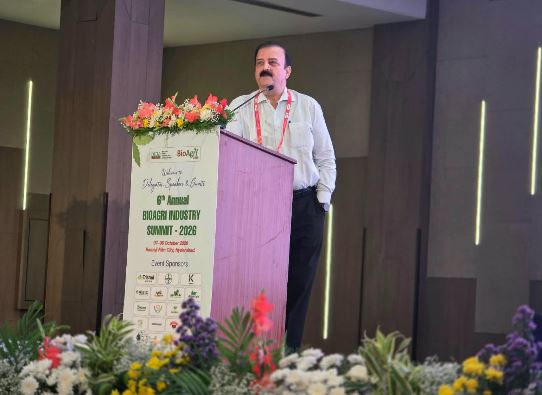
Dr. J.P. Singh, former Plant Protection Advisor of the Government of India
Organised by the BioAgri Input Producers Association (BIPA), the two-day summit, being held on October 7 and 8, is themed “Biological Intelligence & Smart Agriculture” and focuses on the emerging intersection of biological sciences, technology and agriculture.
The summit witnessed participation from manufacturers of biopesticides, biofertilizers, biostimulants, pheromones and other biological agricultural inputs, along with digital technology platforms, equipment suppliers and technology companies. The accompanying exhibition provided an opportunity for companies to showcase their products, technologies and solutions, with more than 60 exhibitors participating across around 35 exhibition stalls.
The inaugural session set the tone for two days of discussions on the changing landscape of biological agriculture and the opportunities emerging from the convergence of science, technology and sustainable farming practices. BIOAGRI, which has grown over the years into a significant national platform for the biological agriculture industry, is bringing together stakeholders from across the agricultural value chain to exchange knowledge, showcase innovations and explore opportunities for collaboration.
The first day featured a series of high-level technical sessions examining emerging opportunities and challenges shaping India’s biological agriculture ecosystem. Technical Session 1 on “Investment & Business Opportunities” focused on global business opportunities in agri-biologicals, climate-action finance and carbon credits, the evolving biological market and regenerative transition, and the use of microbes for extracting precious metals.
This was followed by a CEO Panel that examined commercial scaling, quality assurance, microbial stability, regulatory pathways, R&D partnerships, policy incentives and preparedness for global export markets. A dedicated session on “Soil Health” explored the transition from soil fertility to “soil intelligence”, soil nutrition, mycorrhizal applications, biomass, biochar and carbon credits, besides examining the shift from conventional agricultural inputs towards biological solutions.
The afternoon programme focused on “Technology Opportunities for the BioAg Industry”, bringing together startups, academia, industry and researchers to discuss emerging technologies and innovations in food, agriculture and biotechnology. Discussions covered the need for stronger connections between academia and industry, phytosanitary research, startup technologies, biological products and innovations, market outreach and scientific contributions to the sector.
The first day concluded with an Award Ceremony recognising achievements across industry, academia and the startup ecosystem, besides providing an opportunity for networking and celebrating innovation in the biological agriculture sector.
The summit is witnessing participation from 1,000+ delegates, 60+ exhibitors and participants from more than 20 states, along with experts, industry leaders and researchers representing different segments of the biological agriculture ecosystem. The summit also has more than 100 partnerships and collaborations, reflecting the growing interest in biological solutions and the expanding ecosystem around sustainable agriculture.
With Indian agriculture increasingly seeking sustainable, efficient and science-driven solutions, BIOAGRI 2026 is exploring how biological intelligence, biological inputs and smart technologies can contribute to the next phase of agricultural transformation. The summit provides a platform for stakeholders to discuss the potential of biological solutions to address challenges relating to agricultural productivity, sustainability, soil and crop health, climate resilience and the changing needs of farmers.
The summit is also strengthening interaction between established industry players and the emerging startup ecosystem, with innovation, entrepreneurship and research playing an increasingly important role in shaping the future of biological agriculture.
A major new attraction of BIOAGRI 2026 is the BIPA Startup Challenge 2026, an exclusive competition for early-stage companies developing innovative solutions in biological agriculture. Selected startups are getting an opportunity to pitch their solutions before a panel of industry leaders, investors and researchers, providing them with a platform for visibility, recognition and potential industry connections. The Startup Challenge is designed to highlight the growing role of entrepreneurship and innovation in addressing some of the most pressing challenges facing modern agriculture.
Building on the success of the BIOAGRI summits held between 2021 and 2025, BIOAGRI 2026 seeks to further strengthen the national ecosystem for biological agriculture through knowledge sharing, industry collaboration, research, innovation and constructive engagement with policymakers and regulators.
BIPA, one of India’s oldest registered associations dedicated to biological agriculture, represents more than 100 industry members and works towards promoting innovation, regulatory excellence, industry collaboration and wider adoption of sustainable biological solutions.
The two-day summit at Ramoji Film City features expert sessions, industry interactions, exhibitions, networking and discussions aimed at building stronger connections among researchers, businesses, startups, regulators and other stakeholders.
With participation from across India, BIOAGRI 2026 further reinforces Hyderabad’s growing profile as a destination for knowledge-driven industry conferences, innovation and agricultural technology.
7, Oct 2026
Kore.ai Launches Autoloop, the Optimization Engine That Keeps AI Agents Performing at Production Scale
SAN MATEO, Calif.—October 7, 2026 – Kore.ai, the global leader in enterprise AI platform and agentic applications, today announced general availability of AutoloopTM, the optimization engine of the Kore.ai Agent Platform, Artemis edition. Enterprises set the goals. Autoloop builds the agents, measures them against those goals, and keeps optimizing them automatically, from first draft through production. The launch marks a shift in how enterprise AI is run: from agents tuned by hand to those that self-improve against the goals set by the business.
Today, most enterprises maintain agents through a cycle of fixing individual failures, and a fix for one problem often creates another. The cost of that approach is now measurable: the 2026 Kore.ai Agent Productivity Index found that 79% of enterprises have reversed an action taken by an AI agent, and 70% have faced a failure their teams could not trace. However, the industry is shifting, and Gartner predicts that by 2030, autonomous learning techniques will be present in a majority of AI agents, up from less than 5% in 2026.
“Every enterprise knows what it wants from its agents: finish the job, follow the rules, stay safe, and do it at a sensible cost,” said Raj Koneru, Founder and CEO of Kore.ai. “With Autoloop, your agents keep improving against the goals you set. The companies that scale AI will be the ones using AI to build, govern, and optimize AI.”
Autoloop starts from goals, not prompts. Teams define what success looks like across the dimensions that matter to the business, and Autoloop optimizes against all of them at once:
- Task completion: the agent finishes what the user came to do, handing off to a human only when it should.
- Accuracy and grounding: every answer is correct and backed by the enterprise’s own data, with no fabricated facts.
- Business-rule adherence: complies with policies, eligibility checks, and limits on every interaction.
- Guardrails and safety: no data exposure, off-policy actions, or unsafe responses.
- Consistency: consistent behavior across phrasings, languages, channels, and edge cases.
- End-user experience: fewer turns, less repetition, and lower latency across chat and voice.
- Cost efficiency: the same outcome with fewer, faster, and more affordable model calls and tokens.
Against these goals, Autoloop runs one continuous loop spanning: build, evaluate, diagnose, optimize, and re-verify. Before launch, it builds the agent and its test coverage from the enterprise’s own operating procedures and iterates until the agent meets every goal. In production, real interactions start new optimization cycles. Every change is scored against all goals at once, so a gain on one, such as lower token spend, cannot quietly hinder another, such as task completion or safety.
Automatic optimization requires complete visibility into agent activity and control over how they change. Two Kore.ai innovations give Autoloop these capabilities:
- StateTrace delivers the visibility, evaluating agents against their full production execution context. It traces every handoff, delegation, state, tool call, and piece of context across the agent network, so Autoloop knows where and why a goal was missed. A patent-pending five-layer validation architecture makes most checks deterministic, which keeps continuous optimization affordable at enterprise scale.
- Agent Blueprint Language (ABL) delivers the control by compiling supervision, routing, handoffs, delegation, tools, business rules, and guardrails into an executable state machine. Every step in a trace maps back to the blueprint, so Autoloop changes exactly the part that caused the miss, and nothing else.
Kore.ai runs the same discipline on its own engineering, where AI agents now produce roughly 6,500 commits a month on a production codebase of 2.6 million lines, governed by 68 always-on guardrails.
“You can’t optimize what you can’t see, or fix precisely what you can’t express precisely,” said Prasanna Arikala, Chief Technology Officer and Chief Product Officer at Kore.ai. “StateTrace lets Autoloop see exactly what agents did, and ABL allows it to change anything that needs changing. These are the technologies that make automatic optimization a reality.”
Today’s launch extends the ground Kore.ai has staked out in the market. Much of the industry sells tools that create agents, or control layers added after the fact. Kore.ai builds the harness: a single layer that builds, deploys, manages, and optimizes enterprise AI agents, with governance defined from the first line. Autoloop completes it, because only an agent built and governed in one layer can be optimized in that same layer, automatically and with evidence.
7, Oct 2026
CRUT to Install ADAS, Driver Monitoring Systems in 270 Electric Buses Across Bhubaneswar, Cuttack, Puri
Bhubaneswar, Oct 7 (UDN): The Comprehensive Region Urban Transport (CRUT) has decided to introduce advanced safety technology in 270 electric buses operating across Bhubaneswar, Cuttack and Puri, as part of efforts to reduce road accidents and enhance passenger safety.

Representational Image
The initiative will initially see the installation of Advanced Driver Assistance Systems (ADAS) and Driver Fatigue and Monitoring Systems (DFMS) in the electric bus fleet, officials said.
ADAS to Assist Drivers
The ADAS technology will provide drivers with alerts about potential road hazards, including possible collisions, vehicles in blind spots and unintended lane changes.
The system will also assist with functions such as emergency braking, reverse parking and maintaining a safe distance from vehicles ahead.
The technology is expected to give drivers additional warnings in critical situations, allowing them to respond more quickly to potential hazards.
DFMS to Monitor Driver Alertness
Alongside ADAS, CRUT will introduce the Driver Fatigue and Monitoring System, designed to track driver alertness while buses are in operation.
The system will monitor indicators of drowsiness, fatigue and distraction and issue alerts when it detects that a driver may not be sufficiently attentive.
Move Follows Bus Accident
The decision comes in the wake of a fatal accident involving an Ama Bus near Rupali Square in Bhubaneswar in January.
The bus reportedly rammed into a stationary autorickshaw from behind, resulting in the death of the autorickshaw driver and injuries to a passenger.
CRUT officials said the new safety systems are intended to strengthen preventive measures and help drivers identify and respond to potential dangers more effectively.
The deployment of ADAS and DFMS across the 270 electric buses is expected to improve road safety and provide a safer commuting experience for passengers using public transport in the Bhubaneswar-Cuttack-Puri region.
7, Oct 2026
Welcomhotel by ITC Hotels, Bengaluru Presents A Celebration to Savour – Bengali Food Festival at WelcomCafe Jacaranda

Welcomhotel Bengaluru invites guests to embark on a culinary journey through the rich and vibrant flavours of Bengal with “A Celebration to Savour,” a specially curated Bengali Food Festival at WelcomCafe Jacaranda, from 9th to 21st October 2026.
Celebrating the culinary traditions of Bengal, the festival brings together an exquisite selection of cherished regional classics and festive favourites, thoughtfully prepared using authentic flavours and time-honoured recipes. From comforting preparations to indulgent delicacies, the spread captures the warmth, nostalgia and celebratory spirit associated with Bengali cuisine.
Guests can savour the specially curated spread as part of the dinner buffet, offering an opportunity to discover the diverse flavours of Bengal in an inviting and contemporary setting.
Festival Details
What: A Celebration to Savour – Bengali Food Festival
Where: WelcomCafé Jacaranda, WelcomHotel Bengaluru
When: 9th – 21st October 2026
Takeaway Box for Two:
With its evocative flavours, cherished recipes and festive culinary traditions, “A Celebration to Savour” promises guests an opportunity to experience the essence of Bengal, one plate at a time.
7, Oct 2026
Sumsub Launches Reusable KYC Gateway, Cutting Repeat Verification for MiniPay’s Network
The first integrator to go live with Reusable KYC Gateway, enabling 20 million wallet users verify their identity once and reuse it across MiniPay’s partner ecosystem

SINGAPORE, Oct 07 — Sumsub, the AI-powered trust infrastructure for compliance operations at scale, today launched Reusable KYC Gateway at Token2049 Singapore. MiniPay, one of the fastest growing stablecoin wallets, is the first live integrator, giving its users a shared verification experience across MiniPay’s partner network.
MiniPay users can verify their identity once and reuse it at every regulated partner in that network, without MiniPay needing to store, handle or control sensitive personal data like identity documents. Gateway is the newest addition to Sumsub’s Reusable KYC product line, which also includes Reusable KYC Share.
Solving repeat verification at scale
MiniPay operates across more than 70 countries with over 20 million wallets opened to date. As a self-custodial wallet, MiniPay does not need to verify users itself. Each of its partners, including on and off ramps, card issuers and payment providers, has traditionally run its own separate KYC process. That means the same user re-uploads documents and resubmits a selfie every time they interact with a new partner, even though they are verifying the same identity inside the same ecosystem. Each repeat check is a fresh drop off point, costing partners conversion and costing users time.
One verification, every partner
Reusable KYC Gateway removes that repetition. Users verify once with Sumsub, then unlock each new regulated partner service in MiniPay’s network with a single tap. When a MiniPay user is prompted to verify, they either draw on one of the 15 million pre-existing Sumsub IDs or complete a new check with an ID document and a selfie. The user explicitly consents to connect that verified identity to their MiniPay account, keeping control over what is shared and with whom.
From there, when the user first interacts with a regulated partner in MiniPay’s network, they consent once to share their identity with that partner, and the partner receives the verified identity directly from Sumsub ID. The partner can then complete verification without any extra user screens while still running its own compliance checks against its policies, with additional checks required for higher-risk transactions.
As the verified identity is passed directly from Sumsub to the partner, MiniPay does not collect, store or handle sensitive identity documents or biometric data itself.
Results for MiniPay’s partner network
Since adopting the approach, MiniPay partners have seen verification conversion rise from approximately 70% to 95%, and KYC completion time fall by up to 50%. Eight of MiniPay’s partners already use Sumsub for verification.
“Repeated KYC checks across the same ecosystem are inconvenient for everyone, and one in three applicants we see have already verified with us before,” said Andrew Novoselsky, Chief Product Officer at Sumsub. “Reusable KYC Gateway puts that reuse to work for MiniPay’s users, giving them a single verified identity that works throughout its entire partner network, with full control over what they share and with whom.”
“Self-custody has always been central to MiniPay. Users hold their own funds, and now they also control their own verified identity,“ said Murray Spark, Senior Director of Business Development at Opera. “They decide what to share and with whom, and that matters more and more as our partner network expands across new markets.”
Available now
Reusable KYC Gateway is now available to any non-regulated business connecting users to a network of regulated partners, from non-custodial wallets to decentralized trading platforms, that wants to cut onboarding friction without taking on the data liability of storing identity documents themselves. Sumsub is showcasing the product at its Token2049 Singapore booth on 7–8 October.
7, Oct 2026
Odisha Govt Releases Rs 99.26 Crore Interest Subsidy for 1.79 Lakh SHGs, Total Hits Rs 247 Crore
Bhubaneswar, Oct 7 (UDN): The Odisha government has released Rs 99.26 crore in interest subsidy for 1,79,809 self-help groups (SHGs) across the State, taking the total interest subvention disbursed during the current financial year to Rs 247.03 crore.

Representational Image
Deputy Chief Minister Pravati Parida released the latest financial assistance at a programme organised by the Mission Shakti Department in Bhubaneswar.
Rs 575 Crore Earmarked for SHG Interest Subsidy
The State government has allocated Rs 575 crore for interest subvention to SHGs during the 2026-27 financial year as part of its efforts to strengthen access to institutional credit and support women-led livelihood activities.
The latest release follows an earlier disbursement of Rs 147.77 crore in interest subsidy to 2,88,198 SHGs on June 24.
With the latest tranche, the cumulative interest subsidy released so far this financial year has reached Rs 247.03 crore.
Rs 20,000 Crore Credit Linkage Target
The Odisha government has set a target of facilitating Rs 20,000 crore in bank credit linkage for SHGs during 2026-27.
Interest subvention and community-level financial support are expected to complement bank financing and help SHGs expand livelihood activities and women-led enterprises.
The financial assistance is aimed at reducing the cost of institutional borrowing for SHGs while strengthening their access to formal credit.
Additional Rs 151.28 Crore Released
Apart from the interest subsidy, the Mission Shakti Department has also released Rs 151.28 crore under three community-based financial support programmes.
The latest measures are intended to provide SHGs with a broader financial support system covering interest relief, bank-linked credit and community-based funding.
The government said the initiatives would strengthen the financial foundation of self-help groups and support livelihood generation and women’s economic participation across Odisha.
7, Oct 2026
Private Equity Fund Managers Focus on Evergreen and Hybrid Launches
Oct 07: Private equity fund managers are increasingly focusing on hybrid and evergreen structured funds for new launches as they target new distribution channels, new research* from Ocorian, a leading U.S. and global asset services provider, shows.
The study, carried out across the U.S. and Europe with private equity fund managers managing $3.511 trillion, found that 63% expect to see hybrid or perpetual structures with gates dominate new launches over the next two years, while 56% expect to see the most new launches in evergreen or open-ended funds.
Semi-liquid funds are likely to be less popular, with just 40% expecting to see the most new launches, while 25% point to bespoke mandates and just 10% to closed-ended drawdown vehicles.
The key reason driving changes to fund structures is access to new distribution channels, such as wealth managers, with nearly half (47%) citing that motivation, ahead of 41% pointing to regulatory or tax considerations, the research across all key U.S. markets and in the UK, Switzerland, Germany, Italy, Spain, Poland, Sweden and Bulgaria found.
All (100%) of the private equity fund managers surveyed said they are evolving fee structures across their product range. Over a third (37%) are now placing greater reliance on performance-based fee structures, and a similar number (35%) are charging tiered fees by commitment size. Around a quarter (24%) have evolved their fee structures to offer a more bespoke arrangement per investor. Just 4% cite that they’re lowering their headline management fees.
Around six out of 10 (58%) expect to increase capital raised from wealth managers and private banks over the next two years, while 63% expect a rise in capital raising from family offices.
However, the biggest source of new capital is likely to be pension funds, with 86% expecting an increase in capital raised from the sector, while 80% expect an increase from insurance companies and 84% from sovereign wealth funds.
Around 50% of private equity fund managers questioned reported that average investor commitments had increased in the past two years, with the rest saying commitments had remained broadly stable.
Almost all (92%) said the liquidity profile of their newer products had increased, albeit modestly, with just 4% saying products were significantly more liquid than five years ago. Increasing interest in tokenization of funds may have some influence with 70% of managers saying they were exploring the concept or actively pursuing it.
Eamon Burns, Global Head of Fund Accounting at Ocorian, said: “Private equity fund managers are adapting and evolving their product ranges in response to changes in demand as they seek to widen their distribution channels.
“There is increasing demand for, and interest in more liquidity, as well as a rise in average investor commitments. At the same time, fund managers are adapting fund structures to attract new investors, with the wealth management sector a key target. However, the main sources of investment remain institutional.
“Fund managers increasingly require support that can help them to quickly and efficiently adapt to changes across the market, while concentrating on their core business.”
7, Oct 2026
Bengaluru to Host One of India’s Largest Climate-Data Gatherings as Bangalore Climate Data Week 2026 Brings 30+ Events Together
Bengaluru, October 07, 2026: The first edition of Bangalore Climate Data Week (BLR-CDW) 2026 will be a city-wide platform focused on accelerating the implementation of data and AI to help solve real-world climate challenges. The week-long convening will be held from the 12th to the 16th of October 2026 with 30+ partner-led events hosted across Bengaluru. This is an initiative by the Climate Collective Foundation (CCF), convened in association with Google as Anchor Partner and Karnataka Digital Economy Mission (KDEM), Karnataka Innovation and Technology Society (KITS), and Startup Karnataka as State Innovation Partners.
BLR-CDW is expected to bring together over 2,000 attendees, including researchers, climate tech founders, investors, policymakers, corporates, technologists, and practitioners. The programme is organised as a city-wide series of events, with ecosystem organisations hosting their own summits, workshops, working sessions, networking sessions, startup pitches, and climate career fairs. This is an opportunity for organisations working at the intersection of climate, data, and AI to form collaborations.
“India has very strong communities in climate technology and data but they often operate in silos,” says Nalin Agarwal, Co-Founder, CCF. He adds, “BLR-CDW as an initiative intends to encourage collaborations between stakeholders across climate and data. Our intent is to create more intersections – from applying AI for industrial decarbonisation and anticipating climate risks efficiently to deploying more solutions at scale and building a strong climate workforce. We want to bring together people from different backgrounds, and we expect the conversations to continue well beyond the Week.”
Google’s involvement during the Week will reinforce the AI, data, and climate technology convergence. Google is also the Anchor Partner for the AI for Climate Tech Summit 2026, the flagship event of BLR-CDW, in addition to co-hosting the AI for Resilience Tech Summit 2026 along with CCF.
Jaya Dhindaw, Executive Program Director – Sustainable Cities – WRI India said: “We are at a critical inflection point when it comes to data. On one hand, we have unprecedented volumes of information, on the other, we are navigating a sea of misinformation and fragmented datasets that often obscure rather than guide decision-making. The value of such data is even greater in the contentious space of climate action where credible, transparent evidence can serve as an anchor for building consensus, driving accountability, and guiding investment. At WRI India, we help cut through the noise by turning complex data into actionable analysis and tools. Our hope is to share this knowledge with others, so we can work together to achieve positive ecosystem shifts.”
BLR-CDW 2026 is joined by Climate Change AI, the Coalition for Disaster Resilient Infrastructure (CDRI), and the U.S.-India Business Council (USIBC) as Strategic Partners. Additionally, the Centre for Study of Science, Technology and Policy (CSTEP), Data.org, Net-zero Energy Transition Association (NETRA), UC Davis Global South Center for Clean Transportation Institute of Transportation, Vasudha Foundation, and WRI India are the Knowledge Partners. MathWorks and Salesforce are also supporting this edition of BLR-CDW as Technology Partners. With different stakeholders coming together, the convening will cover themes across climate risk modelling and decision-support tools, clean technologies in buildings and data centres, circular economy; resilience; and clean mobility.
Speaking about BLR-CDW 2026, Dr Indu K Murthy, Sector Head, Climate, Environment and Sustainability, CSTEP, said, “India’s climate risks are hyperlocal—a drought in one district, a flood in another, and a heat wave that hits differently depending on who you are and where you live. Generic global models cannot capture this granularity, which is why building India-specific, decision-ready climate data and intelligence is not optional but foundational to resilience. Robust climate data and intelligence are integral to credible, actionable policy, and the Bangalore Climate Data Week is a timely platform to strengthen that foundation together.”
Programme highlights
● AI for Climate Tech Summit 2026: The Week’s flagship event, convening founders, investors, policymakers, scientists, corporates and ecosystem leaders to discuss how AI can help develop climate solutions.
● AI for Resilience Tech Summit: An event, co-hosted by Google and CCF, exploring how AI can support better risk assessment, preparedness, and decision-making across high-risk sectors.
● Industry Net Zero Innovation Summit – AI Edition: A convening on AI and climate innovation for industrial decarbonisation.
● She Wins Climate – South Asia: Startup Showcase 2026: A pitch platform for women-led climate startups, alongside a networking session for women working in data and climate.
● The Climate Table: A conversation among CXOs, investors, philanthropists, and ecosystem leaders on how finance can scale climate solutions.
● Climate Jobs Fair: A curated career fair for students and professionals to connect with climate tech startups for internships, jobs, and career opportunities.
Bangalore Climate Data Week 2026 will take place across Bengaluru from 12 to 16 October 2026.
7, Oct 2026
PM Modi Marks 25 Years in Public Life, Thanks People for Trust and Support
New Delhi, Oct 7: Prime Minister Narendra Modi on Wednesday marked 25 years of continuous service as the head of a government, expressing gratitude to the people of India and saying their trust has placed the greatest responsibility on his shoulders.
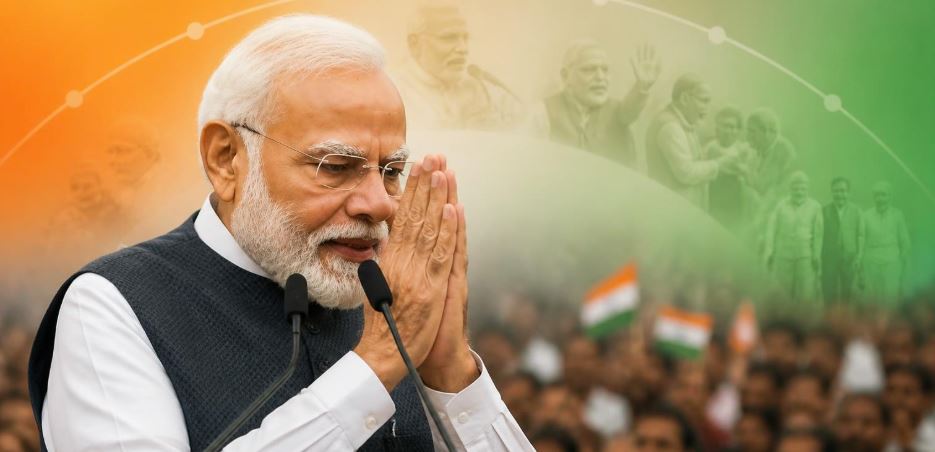
Addressing a large gathering at the ‘Viksit Bharat Sankalp Sabha’, Modi recalled his journey from becoming Gujarat Chief Minister on October 7, 2001, to serving three consecutive terms as Prime Minister.
“I bow my head and pay my respects to the people of the country. Be it the Assembly or the Lok Sabha elections, people have chosen me for their service for 25 years,” Modi said, while also paying tribute to India’s democratic institutions and the Constitution.
‘People Are Also a Form of God’
Modi said he had never imagined, when he took oath as Gujarat Chief Minister in 2001, that he would reach the milestone of completing 25 years as head of a government.
He credited the continued support of citizens, the Bharatiya Janata Party (BJP), the NDA and his political colleagues for the journey.
“For me, the people are also a form of God. The trust of lakhs and crores of countrymen and the hard work of lakhs of workers have always been my greatest strength,” he said.
The Prime Minister added that the country had given him immense responsibility and that every citizen had a right over him.
“The country has given me so much. Therefore, my responsibility towards the country is also the greatest,” he said.
Modi Recalls 2001 Gujarat Beginning
Modi began his tenure as head of a government on October 7, 2001, when he was appointed Gujarat Chief Minister, succeeding Keshubhai Patel.
He assumed office at a challenging period for Gujarat, which was recovering from the devastating Bhuj earthquake and facing political and administrative difficulties.
Modi remained Gujarat Chief Minister until 2014, when he moved to national politics after leading the BJP to victory in the Lok Sabha elections.
He subsequently became Prime Minister and has since completed three terms in office.
Welcomed With Slogans, Flowers
As Modi arrived at the event, supporters welcomed him with flowers and BJP flags while raising slogans including ‘Bharat Mata ki Jai’ and welcoming the Prime Minister.
Several people were also seen recording his arrival on their mobile phones.
Earlier in the day, Modi visited the Shri Vinayak Mandir in Delhi’s Sarojini Nagar, where he offered prayers and sought blessings on the completion of 25 years in public office.
He said he prayed for the happiness, prosperity and good health of people across the country, whom he described as members of his extended family.
Modi also expressed his gratitude to participants of the Seva Jyoti Yatra.
Over the past 25 years, his political journey has also coincided with a more prominent international profile for India, with the government placing greater emphasis on diplomatic engagement, relations with major global powers and India’s role in the Global South.


