


19, May 2026
The Death of the Five-Year Plan in Legal Firms: New Research from The Positive Group Reveals AI has Ended Stable Planning Cycles in Big Law Firms
The traditional multi-year strategic roadmap, long a staple of the legal industry’s C-suite, is rapidly losing its relevance. This is one of the key findings from new research released today by leadership consultancy The Positive Group, which reveals that the rapid adoption of AI has dismantled stable planning cycles, forcing the world’s leading law firms into a state of “perpetual pivot.”
The study, titled The AI Leadership Challenge in Law, which was conducted in collaboration with researchers from Harvard Business School, RSGI, and Hubel Labs, is based on in-depth insights from 16 of the most influential figures in the global legal market. Participants included Managing Partners, Chief AI and Innovation Officers, and firm-wide decision-makers responsible for strategy, risk, and professional standards at firms including Orrick, Herbert Smith Freehills, Bird & Bird, Baker McKenzie, A&O Shearman, White & Case, Gilbert + Tobin, and Kramer Levin.
The Acceleration Trap
The findings paint a picture of a sector struggling to sync human cognition with technological velocity. For decades, law firms operated on predictable three-to-five-year cycles. Today, the research suggests that AI is not a discrete “transformation programme” with a finish line, but an atmospheric shift. One study contributor noted a staggering contraction in strategic timelines: “Our long-term plans were happening within about four months.”
This acceleration is reshaping how the world’s largest law firms make decisions. Multi-year roadmaps are being discarded in favour of “rolling reassessments”. What was considered cutting-edge 18 months ago—or even last quarter—is already being revised as standard practice.
However, employees are struggling to keep pace with this change – as one study participant leader reflected, “the propensity of tech change is almost unlimited… the propensity of humans to change is very limited.”
Will Marien, Director at The Positive Group, said: “The legal sector is facing a cognitive gap that technology alone cannot bridge. We are seeing a fundamental misalignment between the ‘unlimited’ propensity of tech change and the very real, biological limits of human adaptation. For leaders at law firms, the challenge isn’t just selecting employees with the right LLM; it’s managing a workforce that is being asked to adapt to rapid change every few months, while meeting client demand and working within a billable hours system.”
Rising risk of ‘automation bias’
Crucially, the research highlights a dangerous trend: Accumulation. While technology moves at light speed, organisational structures are lagging. In most instances, AI is being bolted onto existing workflows rather than triggering a fundamental redesign of how work is organised.
Lawyers are currently expected to master complex new tools and respond to shifting client expectations without any reduction in their existing caseloads. In an environment already defined by “peak workload” and billable-hour pressure, AI is frequently becoming an additional layer of complexity rather than a time-saving solution.
The result is a looming behavioural risk. The Positive Group warns that when time is constrained and cognitive load is exceeded, professionals are more likely to accept AI-generated outputs without the necessary interrogation – an “automation bias” that could have significant implications for professional standards and risk management.
The Perfection Paradox
The study also identifies a growing cultural tension within law firms. The legal profession is built on a foundation of 100% precision and total reliability. However, AI operates on a probabilistic “80/20” basis. This creates a friction point where “imperfect” tools are often rejected by cynical associates rather than being improved through iterative use.
As one study participant bluntly put it: “If we wait for perfection, we’re toast. Yet, moving too fast risks the very reputation for accuracy that these global brands are built upon.”
Will Marien added: “Leadership in the age of AI requires a shift from ‘command and control’ to ‘psychological agility.’ Without clear leadership framing, this tension between the need for speed and the requirement for precision leads to total disengagement. If firms don’t address the human element of this transition, they will find themselves with incredibly sophisticated tools that no one actually trusts or uses effectively. The end of stable planning cycles means leaders must now prioritise building resilient, adaptive cultures over rigid strategic milestones.”
The research concludes that the law firms which thrive in this new era will be those that move beyond seeing AI as an IT project and instead treat it as a fundamental challenge to human performance and organisational design.
- 0
- By Neel Achary

19, May 2026
UPSC Introduces Historic Reform, Early Answer Keys for Civil Services Prelims 2026
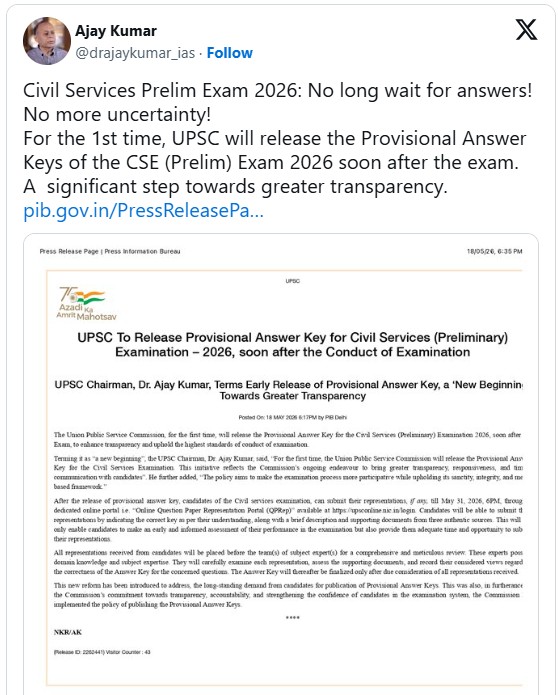
New Delhi, May 19 (BNP): In a significant reform aimed at improving transparency and candidate engagement, the Union Public Service Commission (UPSC) has announced that it will release the provisional answer key for the Civil Services (Preliminary) Examination 2026 shortly after the examination scheduled on May 24, marking a major departure from its long-standing practice.

Representational image
Describing the move as “a new beginning,” Dr. Ajay Kumar said the initiative is intended to institutionalise greater transparency, responsiveness and structured participation within India’s premier civil services recruitment process.
Traditionally, UPSC released official answer keys only after completion of the entire examination cycle, including the Preliminary Examination, Main Examination and Personality Test, often leaving aspirants dependent on unofficial answer keys to assess performance and determine their preparation strategy for subsequent stages.
Under the newly introduced system, candidates will gain early access to a provisional answer key soon after the Preliminary Examination, enabling them to evaluate their performance with greater clarity and confidence. The Commission has also opened a formal mechanism for aspirants to raise objections through the Online Question Paper Representation Portal (QPRep) available on the UPSC online platform.
According to the revised process, candidates will be allowed to submit objections and representations until May 31, 2026, at 6:00 PM, if they identify discrepancies in the provisional answer key. To ensure credibility and academic rigour, objections must be supported with documentary evidence and reasoned explanations using recognised academic references, with candidates permitted to cite up to three authentic sources.
The Commission stated that all objections will undergo detailed scrutiny by expert panels comprising subject specialists before the final answer key is prepared. Only valid and evidence-backed representations will be considered for incorporation into the final version.
While the reform allows quicker clarity on answer accuracy, UPSC clarified that official Preliminary Examination marks will continue to be released only after the conclusion of the complete recruitment cycle, maintaining the confidentiality and integrity of the examination process.
Education experts and aspirants have welcomed the development, noting that timely access to answer keys could significantly reduce uncertainty and help qualifying candidates transition more efficiently into preparation for the highly competitive Main Examination. The move is being seen as a landmark procedural reform that could redefine transparency standards in India’s competitive examination ecosystem.
19, May 2026
Fire Breaks Out in Bhubaneswar

Bhubaneswar, May 19: A fire incident was reported in VSS Nagar, Bhubaneswar, today amid ongoing intense heatwave conditions in the region. The exact cause of the fire is currently unknown.
At this stage, no confirmed cause has been established, and authorities are examining all possible factors. The fire was brought under control after prompt response measures by emergency services.
Officials are continuing on-ground assessment to determine the extent of damage and other details related to the incident.
Residents have been advised to remain cautious due to the prevailing high temperatures and to follow safety guidelines issued by local authorities.
19, May 2026
Digitide posts record INR 800 crore quarterly revenue in Q4FY26
Bengaluru, May 19 : Digitide Solutions Limited an AI-first digital transformation partner for global enterprises, today announced its audited financial results for the fourth quarter and full fiscal year ended March 31, 2026.
Key Financial & Operational Highlights
Q4 FY26 Performance (Sequential QoQ Progress)
- Revenue Expansion: Consolidated revenue reached an all-time high of ₹800 Cr, growing 2.5% sequentially and 9.2% year-on-year, marking five consecutive quarters of forward momentum.
- High-Margin Tech & Digital Growth: Climbed 5.8% sequentially (and 27.2% YoY) to ₹249 Cr, expanding its share to 31.1% of the total business mix.
- International Acceleration: Expanded 4.3% sequentially (and 16.4% YoY) to ₹304 Cr, with international business scaling to 38.1% of revenue.
- EBITDA & Operating Leverage: EBITDA stood at ₹88 Cr, broadly stable sequentially, with an EBITDA margin of 11.0% after absorbing the impact of the new wage code (~₹4 Cr).
- Robust Balance Sheet & Cash Conversion: Delivered an exceptional operating cash flow of ₹145 Cr, representing 165% of EBITDA. Working capital cycles optimized sharply with Days Sales Outstanding (DSO) reducing to 75 days. Net cash stood at ₹182 Cr, up 46% sequentially from ₹125 Cr in Q3, ensuring an unencumbered runway for growth.
- Commercial Booking Momentum: Total Contract Value (TCV) bookings reached ₹620 Cr, marking the second consecutive quarter of 600Cr+ TCV. The company added 29 key logos during the quarter, including 8 international logos.
Full Year FY26 Performance
- Revenue: Stood at ₹3,080 Cr, up 7.1% year-on-year.
- Tech & Digital Shift: Tech & Digital revenue grew to ₹910 Cr, representing 29.6% of the overall business mix.
- EBITDA: Reached ₹343 Cr with a full-year EBITDA margin of 11.1%.
- Adjusted Profitability: Adjusted PAT (excluding non-recurring transitional items) stood at ₹11 Cr for Q4FY26 and ₹70 Cr for the full year.
Highlights for the Fourth Quarter and Fiscal Year Ended March 31, 2026
Financial Performance
|
In ₹ Cr |
Q3 FY26 |
Q4 FY26 |
QoQ |
YoY |
FY25 |
FY26 |
YoY |
|
Revenue |
780 |
800 |
2.5% |
9.2% |
2,875 |
3,080 |
7.1% |
|
EBITDA |
88 |
88 |
0.4% |
6.9% |
401 |
343 |
-14.4% |
|
EBITDA % |
11.2% |
11.0% |
-23 bps |
-24 bps |
13.9% |
11.1% |
-280bps |
|
Adj PAT |
24 |
11 |
-53.1% |
-60.8% |
133 |
70 |
-47.1% |
|
Adj PAT % |
3.0% |
1.4% |
-165bps |
-249bps |
4.6% |
2.3% |
-235bps |
|
PAT |
-2 |
-5 |
|
|
108 |
6 |
|
|
PAT % |
-0.3% |
-0.6% |
|
|
3.8% |
0.2% |
|
Adjusted PAT excludes exceptional / one-time items.
Q4 FY26 exceptional items stood at ~₹16 Cr, mainly including wage code-related impact. For FY26, exceptional items totalled ~₹65 Cr, primarily comprising wage code impact of ~₹41 Cr, demerger-related costs of ~₹23 Cr
FY25 exceptional items were demerger-related and amounted to ~₹25 Cr.
Segment Performance
|
|
Q3 FY26 ₹ Cr |
Q3 Mix |
Q4 FY26 ₹ Cr |
Q4 Mix |
QoQ |
YoY |
FY26 ₹ Cr |
FY26 Mix |
|
BPM |
545 |
69.8% |
551 |
68.9% |
1.1% |
2.6% |
2,170 |
70.4% |
|
Tech & Digital |
236 |
30.2% |
249 |
31.1% |
5.8% |
27.2% |
910 |
29.6% |
|
Total |
780 |
100.0% |
800 |
100% |
2.5% |
9.2% |
3,080 |
100% |
|
|
Q3 FY26 ₹ Cr |
Q3 Mix |
Q4 FY26 ₹ Cr |
Q4 Mix |
QoQ |
YoY |
FY26 ₹ Cr |
FY26 Mix |
|
Domestic |
488 |
62.6% |
496 |
61.9% |
1.5% |
5.2% |
1,931 |
62.7% |
|
International |
292 |
37.4% |
304 |
38.1% |
4.3% |
16.4% |
1,149 |
37.3% |
|
Total |
780 |
100.0% |
800 |
100.0% |
2.5% |
9.2% |
3,080 |
100.0% |
Geographical Highlights
High-Value Commercial AI Execution & Strategic Moats
Digitide continues to aggressively monetize its AI capabilities, shifting from pilots to large-scale, production-ready enterprise engagements.
- Landmark Global AI Win & Tier-2/3 Strategy: Digitide has secured multiple milestone enterprise AI engagements, headlined by winning a mandate to establish a dedicated AI Center of Excellence (CoE) for a Global P&C Insurance major across Bengaluru and Coimbatore. The selection of Coimbatore underscores Digitide’s early, deliberate bet on Tier-2 and Tier-3 cities, which has now crystallized into a structural competitive advantage. By building deep engineering roots in these hubs, Digitide bypasses the severe talent attrition and escalating cost pressures of primary metros. This provides clients with a highly stable, elite, and cost-optimized delivery model for complex automation workloads.
- Proprietary AI IP: This multi-location CoE leverages Digitide’s proprietary Pulse.Nerve, an advanced agentic framework powered by Model Context Protocol (MCP). In production environments, Pulse.Nerve is already delivering over 40% productivity gains and up to 3x faster deployment cycles.
- Hyperscaler Alliances: Growth was further fortified by deep, formalized co-sell pipelines across AWS, Microsoft Azure, and Google Cloud, specifically targeting cloud transformation and advanced Data & Analytics architectures.
- Industry-Leading Talent Retention: Providing a steady framework for this execution is Digitide’s world-class workplace environment. The company was officially Ranked 3rd among India’s Best Workplaces™ in Health & Wellness 2026: Companies that Care by Great Place to Work India, alongside celebrating its seventh consecutive year of Great Place to Work certification.
Gurmeet Chahal, Chief Executive Officer of Digitide Solutions Limited, stated:
“We have closed our first year as an independent listed entity on a strong note, demonstrating our ability to execute with intense operational discipline in a complex global environment. Our fifth consecutive quarter of sequential revenue growth to ₹800 Cr, paired with a massive 27.2% YoY surge in Tech & Digital, validates our rapid repositioning into an AI-first digital leader. Our commercial booking momentum remains stellar, with ₹620 Cr in Q4 TCV and the acquisition of 29 high-caliber logos.
Our milestone enterprise AI CoE win for a Global P&C Insurance giant validates our deep domain verticalization and our early localization strategy in Tier-2 and Tier-3 hubs like Coimbatore. As we pivot into FY27, our priorities are absolute: scale high-value services, deepen our alliance pipelines with hyperscalers, expand our international footprint, and rigorously cultivate our talent ecosystem to sustain high-velocity revenue growth and compound long-term shareholder value.”
Suraj Prasad, Chief Financial Officer of Digitide Solutions Limited, added:
“Our performance this quarter underscores a structurally improving business mix and continued operating discipline, with EBITDA at ₹88 Cr and EBITDA margin at 11.0%. Our focus on aggressive working capital optimization yielded an extraordinary operating cash flow of ₹145 Cr, converting a stellar 165% of our EBITDA, while successfully lowering our DSO to 75 days.
With our net cash climbing 46% quarter-on-quarter to ₹182 Cr, our balance sheet is rock-solid. Having fully absorbed our one-off transitional and wage restructuring items in FY26, we enter FY27 with a clean financial architecture and robust liquidity, giving us total flexibility to fund disciplined, high-return growth initiatives.”
Way Forward: Strategic Growth Vectors for FY27
As Digitide enters FY27, the organization is pivoting from a year of intense foundation-building to a phase of disciplined, non-linear acceleration. Capitalizing on the structural momentum built through FY26, the company’s execution roadmap is anchored to four high-impact strategic vectors:
- Monetizing Enterprise AI at Scale via Hybrid Delivery Hubs: Digitide will aggressively scale its AI-first positioning by duplicating the milestone multi-location Center of Excellence (CoE) framework established in Q4. By expanding complex workloads into established Tier-2 and Tier-3 talent hubs like Coimbatore, the company will optimize its delivery cost architecture while shielding clients from metro-centric attrition pressures. Production delivery will continue to be accelerated through proprietary IP, including the Pulse.Nerve agentic framework, to lock in structural speed and productivity advantages.
- Driving High-Value, Partnership-Led International Growth: The company will leverage its healthy sales pipeline and formalized alliances across all three major hyperscalers — AWS, Microsoft Azure, and Google Cloud — to accelerate double-digit revenue growth, led by North America and priority international markets. GTM efforts will be reinforced by sharper verticalization across primary industries like Property & Casualty (P&C) Insurance and Healthcare.
- Amplifying Operational Leverage & Margin Expansion: To hit the targeted 100 basis point margin expansion by FY27 exit, Digitide is institutionalizing rigorous sales governance, tighter delivery discipline, and an organizational culture focused on speed and accountability. This operational focus is designed to protect project yields, maintain low DSO cycles, and maximize operating cash flows to ensure consistent quarter-on-quarter profitability gains.
- Nurturing Talent Excellence as an Execution Moat: Recognizing that specialized engineering talent is the critical dependency for digital transformation, Digitide will continue deep capability investments through its advanced upskilling academies. By maintaining its status as one of India’s Top 10 Best Workplaces™ in Health & Wellness, the company ensures high execution predictability and an elite retention profile to capture expanding enterprise market share.
Backed by a highly differentiated solutions portfolio, robust balance sheet liquidity, and exceptional customer trust, Digitide is strongly positioned to drive compounding, sustainable growth and maximize long-term stakeholder value in the year ahead.
19, May 2026
Pharmacy Shops to Remain Open Despite AIOCD Nationwide Strike Call Against E-Pharmacies
New Delhi, May 19 (BNP): Major pharmacy chains, hospital-attached medical stores, Jan Aushadhi Kendras and AMRIT Pharmacy outlets across the country will continue operations on May 20, despite a nationwide shutdown call issued by the All India Organisation of Chemists and Druggists (AIOCD) against the functioning of e-pharmacies and online medicine platforms.

Representational image
The decision comes following discussions between representatives of the AIOCD and national drug regulatory authorities, during which concerns regarding online medicine sales, regulatory oversight and market practices were raised. According to sources, the association was assured that the concerns are under active review and that the existing regulatory framework governing the sector is being examined to address issues affecting retail pharmacy stakeholders.
Several pharmacy associations and retail medicine networks have reportedly chosen not to participate in the proposed shutdown, citing the importance of uninterrupted healthcare services and the potential hardship that medicine shortages could create for patients dependent on essential and life-saving drugs.
Sources indicated that retail pharmacy associations from multiple states and Union Territories, including West Bengal, Kerala, Punjab, Maharashtra, Karnataka, Haryana, Uttar Pradesh, Gujarat, Chhattisgarh, Sikkim, Uttarakhand and Ladakh, have provided written assurances confirming that pharmacies under their jurisdiction will continue to function normally.
The AIOCD, which represents more than 1.24 million chemists and drug distributors nationwide, had earlier announced a one-day strike on May 20 to protest what it termed the unregulated expansion of e-pharmacy operations and alleged predatory pricing practices. The organisation has raised concerns over the sale of medicines without adequate prescription verification and warned against the misuse of digital systems that could potentially enable unauthorised access to antibiotics and habit-forming medicines.
The trade body has also expressed apprehension over deep discounting practices by large corporate-backed online medicine platforms, arguing that such pricing structures threaten the sustainability of small and independent pharmacies, particularly in rural and semi-urban areas where access to physical chemist shops remains critical.
At the same time, stakeholders opposing the shutdown stressed that closure of pharmacy outlets could adversely affect patients requiring continuous medication and emergency healthcare support. Consumer welfare and uninterrupted access to medicines, they said, remain a priority while regulatory concerns are addressed through consultation and policy review.
The issue of e-pharmacy regulation continues to remain under scrutiny, with industry bodies seeking stricter safeguards, clearer compliance mechanisms and a balanced policy framework to ensure fair competition while protecting public health interests.
19, May 2026
Findability Sciences Launches Rapid AI Readiness Assessment for Dairy Plants
India, May 19: Findability Sciences today launched the LactaAI™ Discovery and Readiness Assessment, a self-serve diagnostic built for dairy plant leaders who want a clear picture of where AI can deliver measurable value, without the months-long discovery cycle that typically precedes enterprise AI projects.
The assessment runs in minutes, not months, and gives operations leaders, plant heads and CXOs three answers: where value is leaking across yield, energy, downtime, quality and reporting; whether existing systems (PLCs, SCADA, MES, ERP, LIMS) are ready to support AI; and where to start for the fastest, clearest return.
“Most plant heads can name three places they’re losing money. What they cannot do is prove it fast enough to act,” said Anand Mahurkar, Founder and CEO, Findability Sciences. “This assessment closes that gap in minutes, not months. A plant leader walks out of it knowing exactly where AI can make a dent first, and what their systems will actually support.”
The timing matters. Dairy processors globally are under pressure from tightening margins, rising energy costs and increasingly complex supply chains. The global dairy processing equipment market is projected to grow from USD 12.73 billion in 2025 to USD 17.36 billion by 2031 (Source: Mordor Intelligence), as operators accelerate the push toward smarter, higher-yield production.
LactaAI is built around what Findability Sciences calls the data-to-decision gap: the lag between data existing inside a system and that data actually changing an operational call. The platform integrates plant-floor and enterprise data to surface not just what is happening, but why, and what needs to change. Deployments in comparable industrial environments have delivered 0.4 to 0.6 percent yield improvement, 8 to 15 percent energy recovery in utilities, and time-to-value in 6 to 10 weeks. Findability Sciences estimates large dairy operations can unlock between USD 1 million and USD 4 million in annual value per plant, depending on scale and product mix.
About LactaAI LactaAI is Findability Sciences‘ industrial intelligence platform for dairy and whey processing. It covers milk, cheese, whey protein, lactose, drying, packaging, utilities, quality and enterprise operations, spanning both the plant floor (Lacta Insight) and the business layer (Lacta BPC).
19, May 2026
Keto Motors Debuts on Bombay Stock Exchange

Hyderabad, May 19: Keto Motors, a Hyderabad-based commercial electric vehicle manufacturer focused on sustainable mobility solutions, has debuted on the Bombay Stock Exchange (BSE) following the successful completion of its reverse merger with Taaza International Limited. The listing strengthens the company’s access to public capital markets as it expands manufacturing capabilities, electric bus development and commercial EV operations across India.
The reverse merger, approved by the National Company Law Tribunal (NCLT), Hyderabad Bench in June 2025, enabled the transition of Taaza International Limited into Keto Motors Limited, subject to applicable regulatory and exchange compliances.
The listing comes as Keto Motors continues to scale its electric commercial mobility business through key initiatives including its INR 300 crore electric bus manufacturing project in Telangana and the upcoming commercial rollout of its Urbanova KE9 9-metre electric bus platform.
Keto Motors continues to strengthen its technology and manufacturing capabilities through its strategic association with TRON Energy Technology, a Taiwan-based EV technology provider with expertise in electric mobility and sustainable transportation systems. Through this collaboration, the company gains access to advanced battery systems, powertrain solutions and chassis engineering technologies for commercial EV platforms.
Commenting on the listing, Mr. Venkatesh Challa, Director, Keto Motors, said: “Our BSE debut marks an important milestone in Keto Motors’ journey as we continue building a scalable electric commercial mobility business in India. This development strengthens our ability to expand manufacturing capabilities, accelerate product innovation, and support the growing adoption of sustainable transportation solutions across the country. We believe India’s commercial EV sector is entering a transformative phase, and Keto Motors is well-positioned to contribute meaningfully to this transition.”
He further added, “To all our shareholders, I would like to convey that this journey is not only about business growth, but also about contributing to India’s progress. We remain committed to building cutting-edge technology, world-class manufacturing capabilities, generating employment, and advancing sustainable mobility solutions that can play a meaningful role in the country’s growth story.”
The company is focused on addressing growing demand from State Transport Undertakings (STUs), institutional fleet operators, employee transportation providers, and urban mobility networks transitioning toward zero-emission transportation systems.
Keto Motors recently secured CMVR Type Approval certification for its Urbanova KE9 electric bus and is preparing for commercial deployments across multiple mobility applications. Manufacturing operations are being developed at the company’s integrated facility in Jadcherla, Telangana, which is expected to support advanced electric bus production and future scale expansion.
With India’s commercial EV transition accelerating, Keto Motors aims to strengthen its position across electric bus manufacturing, fleet mobility solutions and sustainable transportation infrastructure.
19, May 2026
Ministry of Ayush Issues Public Health Advisory on Heatwave, Urges Preventive Measures
New Delhi, May 19 (BNP): The Ministry of Ayush has issued a public health advisory in response to rising temperatures and heatwave conditions across several parts of the country, urging citizens to take necessary precautions to prevent heat-related illnesses.
The advisory outlines key preventive measures such as maintaining adequate hydration, avoiding direct exposure to sunlight during peak hours, and limiting strenuous outdoor activities. Citizens have been advised to wear light, breathable clothing, consume sufficient fluids, and adopt simple lifestyle adjustments to reduce the risk of heat exhaustion and heatstroke.

Emphasising India’s traditional systems of wellness, the Ministry has also recommended incorporating Ayurvedic practices, seasonal dietary habits, and cooling foods into daily routines to help the body adapt to extreme heat conditions. The advisory encourages the use of natural cooling methods along with balanced nutrition to maintain overall health and immunity during the summer season.
In addition to preventive guidance, the Ministry has highlighted basic emergency response steps for heat-related illnesses, including immediate cooling of the body, rehydration, and seeking timely medical assistance in severe cases.
The advisory is aimed at increasing public awareness and strengthening preparedness as several regions continue to face intense heatwave conditions, with special focus on protecting vulnerable groups such as children, elderly persons, and outdoor workers.
19, May 2026
Shiny Doshi Talks About Picking Up South Indian Nuances For Ishk Dum Aur Idli Rasam

Balaji Studios is turning up the heat in the digital entertainment space with its latest YouTube Original, Ishk Dum Aur Idli Rasam, a soulful blend of food, family, tradition, and romance that’s already creating major buzz online. Set against the backdrop of a heritage South Indian restaurant, the show promises a refreshing mix of emotions, culture, and culinary nostalgia.
At the centre is Meera Nair, played by Shiny Doshi, a warm and instinctive head chef who carries her late father’s philosophy that food is service, not spectacle. Deeply rooted yet quietly resilient, her life takes an unexpected turn when Arjun Thakur, portrayed by Abhishek Kumar, enters her kitchen as a global chef-investor determined to revive the family restaurant. What follows is a clash of ideologies that slowly evolves into an emotional and heartfelt love story.
What makes Shiny’s portrayal stand out is the subtle authenticity she has brought to Meera’s character. Since playing a South Indian role was something she had never attempted before, the actress focused on understanding the character’s tonality, cultural nuances, and natural way of speaking rather than making it overly stylised.
Talking about the experience, Shiny shared, “Ishk Dum Aur Idli Rasa felt special to me from the very beginning because it’s not your typical kitchen drama. Every once in a while, a character arrives that changes the way you approach your craft, and Meera was that for me. Playing a chef on screen was also something I had never explored before, which instantly made me curious about the project. During our workshops and readings, the entire team at Balaji Studios was very clear that authenticity was extremely important. I picked up a few nuances and a slight South Indian twang in the way Meera speaks, because the character needed to feel believable and organic. Even a small pronunciation mistake can stand out to the audience. But honestly, it wasn’t about trying to master a language, but about making sure the emotions felt real in every scene. It wasn’t easy at all, but I genuinely enjoyed the process because it helped me get closer to Meera as a person.”
Interestingly, the makers also wanted Meera to sound relatable and organic “like a normal Bangalore girl speaking Hindi” giving the character a natural urban flavour instead of making it overly stylised.
Produced under the banner of Balaji Studios, the digital series is already being hailed as a refreshing departure from typical daily dramas. From mastering kitchen sequences to understanding the rooted emotional world of the story, Shiny seems to have poured her heart into becoming Meera. Interestingly, the actress is also known among friends and family for her love of cooking, with many often dropping by specially to enjoy her food.
A story layered with flavour, emotion, and rooted charm, Ishk Dum Aur Idli Rasam stands out as one of the most refreshing digital drops of the year. New episodes release every Monday, Wednesday, and Friday at 6 PM on the Balaji Telefilms YouTube Channel
19, May 2026
Dust raises USD40M to make AI multiplayer inside the enterprise
Series B round with Abstract and Sequoia to scale its multiplayer AI platform for human-agent collaboration. The company now serves more than 3,000 organizations, with 51,000 monthly active users, zero churn in 2025, and 300,000 agents deployed across the platform.
San Francisco, CA – May 19; Most companies have adopted AI, but they haven’t become meaningfully more intelligent as organizations. One person prompts an assistant, gets an answer, and the context disappears into a private chat window. The result is real productivity at the individual level, with very little compounding across teams. Dust, the multiplayer agentic AI system, was built to change that by making AI collaborative, shared, and operational across an entire company.
The company today announced a $40 million Series B with Abstract and Sequoia, with participation from Snowflake Ventures and Datadog. With this round, Dust has raised over $60 million in total funding.
Why this matters now
Most organizations are stuck in what Dust calls single-player AI. Every employee has their own assistant with its own context and its own outputs. A sales rep researches an account, then the solutions engineer starts from scratch the next day. Marketing drafts a one-pager, then enablement recreates a battlecard with different inputs. The effort repeats, knowledge fragments, and gains don’t compound.
Dust argues that most AI tools used by enterprises reinforce this pattern. Foundation model workspaces and copilots are powerful, but they’re primarily designed around one individual’s workflows and context. Enterprise search tools retrieve information, but don’t take action. The outcome is more activity and more AI usage at the individual user-level, but not an intentionally designed system that compounds AI into shared leverage.
“This is a century-defining transformation, and we’re only in year three,” said Gabriel Hubert, Co-Founder and CEO of Dust. “What will transform the way we work isn’t the next best model or assistant. It’s going to be a completely new type of system that gives humans and agents shared, governed access to the same information and capabilities so that they become true collaborators, working with the same context, notifications, artifacts, and goals to compound organizational impact. This is what we call multiplayer AI, and this is what we’re building at Dust.”
What Dust is building
Dust is the multiplayer AI system for human-agent collaboration. It gives business teams a platform to build, deploy, and manage AI agents that collaborate across an organization, connected to company knowledge, integrated with the tools teams already use, and governed with enterprise-grade controls.
At the center of Dust is a collaborative surface where people and agents work together across shared context, tools, conversations, tasks, and goals. Agents can analyze, transform, and generate files — including documents, spreadsheets, presentations, and interactive data visualizations — and take action across connected systems through Dust’s context layer, which combines semantic search across company knowledge with integrations to more than 100 data sources and business tools. Built-in memory and feedback loops help agents improve over time by learning from team preferences, usage patterns, and feedback, while proactively recommending improvements.
Dust is designed for enterprise deployment, with granular permissions, cost and usage monitoring, audit trails, and agent analytics. The platform is SOC 2 Type II certified, GDPR compliant, supports EU and US data residency, and does not train models on customer data, as contractually guaranteed by major model providers.
Dust runs primarily on its own product and is defining an emerging identity inside high-growth companies: AI Operators. These are the people closest to the work, inside functions like Ops, Support, Marketing, and Sales, who build and run AI systems for their teams, rewiring how work gets done from inside the business.
Traction and customer outcomes
Dust is used by more than 3,000 organizations globally, from high-growth AI-native companies to established enterprises. Monthly active adoption is consistently above 90%, with weekly active usage above 70% across customers, signaling that Dust has become embedded in how teams work. More than 300,000 agents have been deployed across the platform. In 2025, Dust saw significant customer expansion and acquisition, reaching 240% NRR with zero churn.
“Dust quickly became the platform our team runs on,” said Stevie Case, CRO at Vanta. “900 people across sales, customer success, and revenue operations save thousands of hours a week on tasks like business review prep, outbound prospecting, and forecasting. They saved this time not because it was mandated, but because the agents were built by the people closest to the work. Dust enabled the whole team to collaborate in building agents that deliver measurable value, realizing the compounding effect I’ve been waiting for AI to achieve.”
At Clay, Dust serves as foundational knowledge infrastructure for the rapidly growing GTM team, enabling the team to grow 4x without a proportional increase in enablement headcount. Profound uses Dust as the source of truth for customer intelligence and post-sales, compressing new hire ramp time from months to days. At Persona, teams across 11 departments have deployed over 300 Dust agents to condense cross-functional workflows like sales RFPs from days to minutes. Doctolib has made Dust central to its company-wide AI strategy, giving 3,000 employees smoother access to corporate information and enabling the decommissioning of legacy intranet tools.
The origin
Dust was founded by Gabriel Hubert and Stanislas Polu, who have been building together since meeting at Stanford in 2007. They previously co-founded TOTEMS, a data analytics company acquired by Stripe in 2014, and spent five years at Stripe scaling products and teams. Polu later joined OpenAI as a research engineer on Greg Brockman’s team, co-authoring papers on AI reasoning with Ilya Sutskever. Hubert became Chief Product Officer at Alan.
In September 2022, Polu left OpenAI with a conviction that became Dust’s founding thesis: the models were already powerful enough to be economically transformative, but were under-deployed because the product layer was missing. Dust incorporated in February 2023 to build that horizontal layer on top of frontier models and company knowledge, with a model-agnostic approach that avoids vendor lock-in.
“We’re in the early innings of a massive shift in how organizations use AI,” said Konstantine Buhler, Partner at Sequoia. “Most enterprise AI today is single-player: one person, one prompt, no compounding. Dust is building the multiplayer system, where agents and humans share context and work together across the entire company. Zero churn and 70% weekly active usage tell you this isn’t experimental anymore. This is how enterprises will actually operate.”
“Most AI platforms are stuck in single-player mode: one person, one chatbot, one task,” said Ramtin Naimi, General Partner at Abstract. “Dust is multiplayer. AI Operators inside companies like Datadog and 1Password don’t just use Dust; they build agents that collaborate across teams, learn from every interaction, and rewire how the entire company works. That’s a new operating model and category. That’s why we participated in this round.”
What’s next
Dust plans to use this round to push three frontiers at once: agents that learn and improve automatically as they’re used, collaboration primitives that make humans and agents equal co-contributors with bidirectional access to shared projects, tools, and context, and infrastructure that makes governance and orchestration predictable at enterprise scale. The bet is that the next phase of enterprise AI won’t be won by who has the best single assistant. It’ll be won by who turns AI into shared, compounding capability across the entire org.


