


15, May 2026
Group 108 highlights ONE FNG and Grandthum at PRC 2026
Mumbai, May 15 : At a time when retail is steadily moving beyond the predictable, Group 108 marked a commanding presence at the Phygital Retail Convention 2026, held on May 13–14 at the Jio Convention Center, Mumbai. The participation emerged as a layered reflection of the group’s larger retail philosophy, anchored through its flagship developments – ONE FNG and Grandthum.
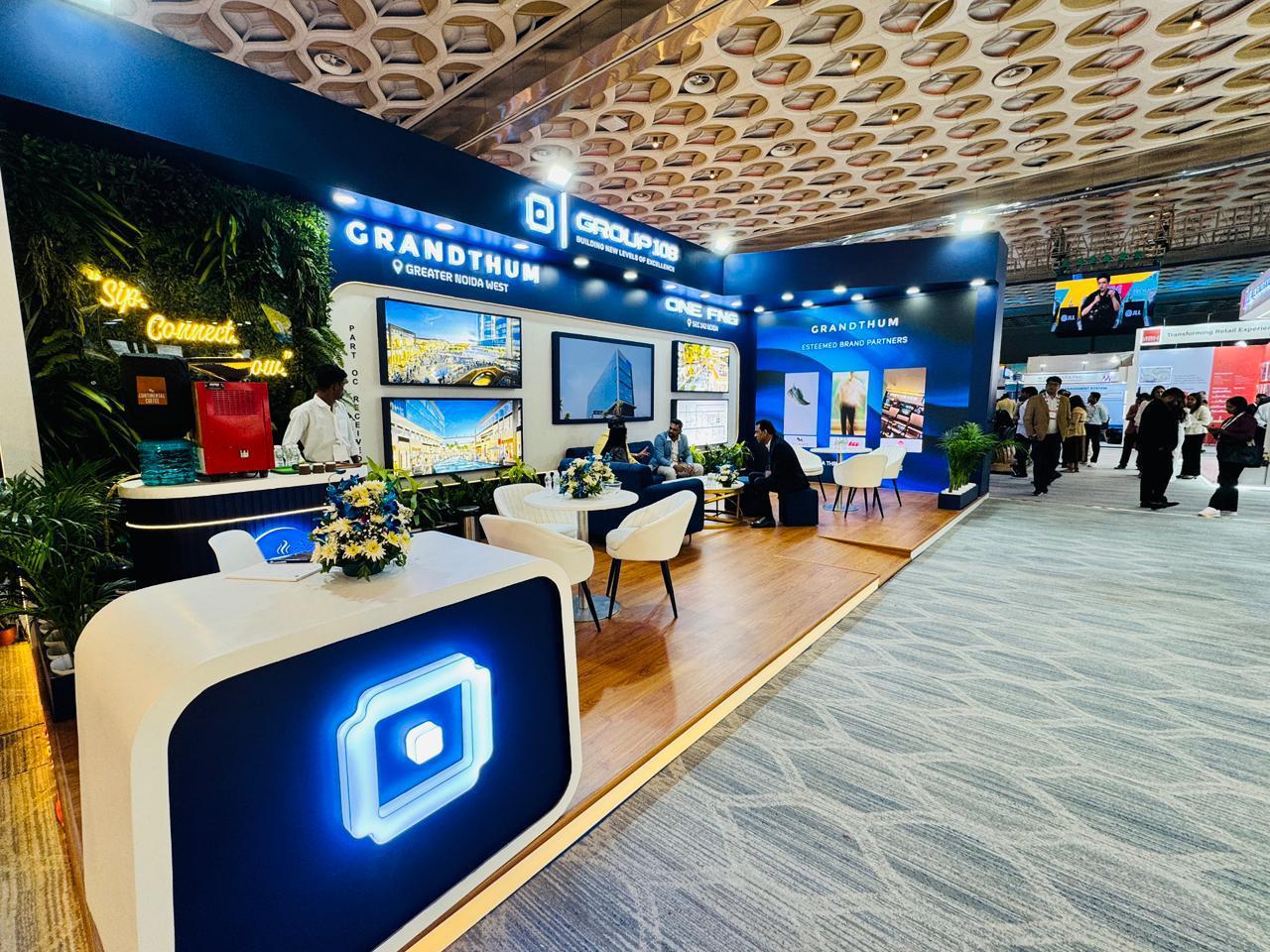
As one of the country’s most influential retail platforms, PRC served as a convergence point for prominent retailers, franchise networks, developers, and consumer brands engaging in conversations around the future trajectory of physical and phygital commerce. The two-day convention brought together more than 3,000 attendees representing over 1,000 brands, alongside celebrated retail leaders, global brands, technology innovators, and industry experts. With over 30 conference sessions and an expansive exhibition extending across 100,000+ sq. ft., the event highlighted advancements across retail technology, retail design, commercial real estate, and customer experience solutions. Against this backdrop, Group 108’s showcase aligned strongly with the convention’s larger discourse around experience-led retail environments and evolving consumer engagement.
Rather than positioning retail as a static proposition, Group 108 presented a more progressive perspective where spatial planning, movement dynamics, and consumer behaviour converge to create enduring engagement. The discussions emerging during the convention reflected this transition, shifting distinctly beyond transactional thinking toward environments that actively influence how brands are perceived and experienced.
At the center of attention stood Grandthum, envisioned as a high-energy commercial destination rather than a conventional retail address. Its expansive high-street format, uninterrupted frontages, and fluid pedestrian movement were highlighted as defining elements capable of transforming footfall into meaningful consumer interaction.
Alongside this, ONE FNG introduced a distinct yet equally compelling narrative. The development showcased a retail ecosystem shaped around sustained engagement, premium audiences, and continuous consumer circulation, strengthening both visibility and long-term brand value.
Across the two-day engagement, Group 108’s presence evolved into a focal point for strategic industry conversations, attracting retailers, franchise operators, and expansion leaders evaluating the next evolution of physical retail.
Sharing his perspective, Sanchit Bhutani, Managing Director, Group 108, said,
“Retail is no longer defined by location alone; it is shaped by the experience it delivers. What we are building at Grandthum and ONE FNG is not just retail space, but environments that encourage engagement, strengthen brand presence, and create long-term value. PRC has been an important platform to engage with brands that share this forward-looking outlook.”
Group 108’s participation at PRC 2026 underscores a clear direction toward creating immersive retail environments aligned with evolving consumer and brand expectations.
- 0
- By Neel Achary

15, May 2026
ITR Filing Season Begins as Income Tax Department Launches ITR-1, ITR-4 Utilities
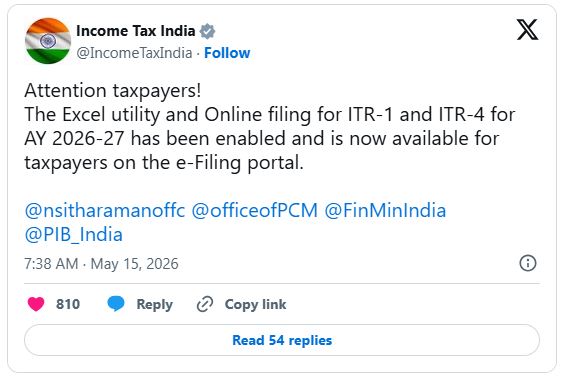
May 15 (BNP): The Income Tax Department has officially started the Income Tax Return (ITR) filing process for Assessment Year 2026-27 with the release of Excel-based offline utilities for ITR-1 and ITR-4 forms on the e-filing portal.

The move enables eligible taxpayers to begin filing returns for income earned during the Financial Year 2025-26. Taxpayers can now download the utilities, fill in income and tax details offline, calculate tax liabilities, generate JSON files, and upload them to the official portal for submission and verification.
The launch marks the beginning of the annual tax filing season and is expected to benefit salaried employees, pensioners, small business owners, and professionals covered under presumptive taxation schemes by allowing them to complete the process well before the deadline.
ITR-1 is applicable for resident individuals with annual income up to ₹50 lakh earned through salary, pension, up to two house properties, and other sources such as bank interest. The form also covers agricultural income up to ₹5,000 and long-term capital gains under Section 112A up to ₹1.25 lakh.
Meanwhile, ITR-4 is designed for resident individuals, Hindu Undivided Families (HUFs), and firms excluding LLPs with income up to ₹50 lakh opting for presumptive taxation schemes under Sections 44AD, 44ADA, and 44AE.
Officials have advised taxpayers to verify PAN, Aadhaar linkage, bank account details, Form 16, and other financial information before filing returns. The department has also encouraged early filing to avoid last-minute technical issues and penalties.
Income Tax Returns are mandatory documents through which taxpayers declare their income, deductions, and tax liabilities to the Income Tax Department. The last date for filing returns without penalty is expected to remain July 31, unless extended by the government.
15, May 2026
NEET UG 2026 Rescheduled for June 21 After Paper Leak Forces Cancellation of Exam
New Delhi, May 15 (BNP): The National Testing Agency (NTA) has officially announced that the re-examination for NEET-UG 2026 will be conducted on June 21, following the cancellation of the earlier exam amid allegations of a paper leak.
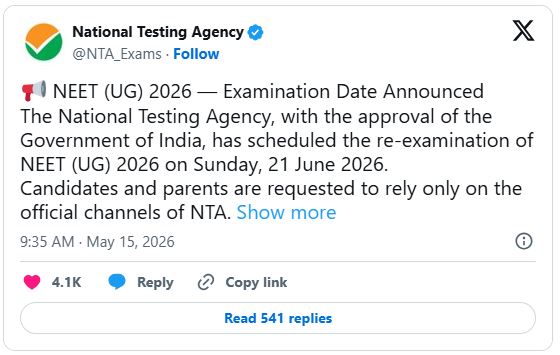
The revised examination date was confirmed on Friday through the agency’s official communication channels, ending days of uncertainty for more than 22 lakh medical aspirants across the country.
The original NEET-UG 2026 examination, held on May 3, was cancelled after reports of an alleged question paper leak surfaced from multiple regions. The Government of India approved the decision to conduct a fresh examination to ensure transparency and maintain the integrity of the country’s premier medical entrance test.
In its statement, the NTA said the re-examination would be held nationwide on Sunday, June 21, under enhanced security and monitoring arrangements. The agency also urged students and parents to depend only on official notifications for updates regarding admit cards, examination centres, and the admission process.
The cancellation announcement made on May 12 had triggered anxiety among lakhs of candidates awaiting clarity on the future course of the examination. With the fresh schedule now released, preparations for the re-exam process are expected to begin immediately.
NEET-UG serves as the gateway for admission to undergraduate medical courses across India, including MBBS, BDS, AYUSH, and other allied medical programmes.
15, May 2026
Attracting young women to careers in construction
By Lara Pacillo
As Australia’s construction industry faces a critical skills shortage, new research from Adelaide University shows how the industry can better support women and therefore strengthen the future workforce.
In Australia, labour shortages are exacerbated by the underrepresentation of young women across various roles, particularly in blue-collar and trade sectors.
Women currently make up just 13 per cent of the construction workforce in Australia, with only around 3 per cent working in trades. At the same time, demand for infrastructure and housing continues to surge, with recent estimates pointing to a 61 per cent skills shortage across the sector.
An Australia-wide study, published in Construction Management and Economics, found that many young women are interested in careers in construction but feel the industry must adapt to better meet their needs.
Current support programs often address women as a single group, despite significant differences in motivations, priorities, and career goals.
“Our research suggests that young women would be willing to enter construction if workplace conditions improved,” explained Professor Nancy Arthur, Dean of Research at Adelaide University’s College of Business & Law, who was joined on the research team by Adelaide University’s Dr Lynette Washington, Dr Ali Ardeshiri and Professor Akshay Vij.
“We also found that salary alone is not enough. Workplace culture, flexibility, and career pathways often matter more.”
Many participants expressed interest in roles that emphasise collaboration, problem-solving, and career progression, challenging how construction jobs are traditionally designed and communicated.
Professor Arthur says the research points to several clear priorities for industry reform:
- Make workplaces safer and more inclusive
- Offer flexible work arrangements
- Create clear and visible career pathways
- Increase the visibility of female role models
- Tailor strategies to different groups, not a one-size-fits-all approach
“The issue is not motivation. It is mismatch,” said Dr Washington.
“Across all groups, there was a clear pattern in what women are after. More than a gender issue, it is a workforce, productivity, and economic sustainability issue.
“If the industry cannot attract and retain more women, it simply will not have the workforce needed to meet future demand.”
While the research supports prior studies identifying safety concerns, workplace culture, and gender bias as major barriers, the new study shows how much these factors matter and how they influence women’s career choices.
“We show that young women are not all the same. Some prioritise flexibility, others value career progression, others respond to financial incentives,” said Dr Ardeshiri.
“This helps explain why many past initiatives have struggled. They treated women as a single group.”
“Fixing construction industry barriers for women will fix construction for everyone,” Professor Arthur says.
“This is about equity, but also about unlocking a workforce the industry cannot afford to ignore.”
15, May 2026
HCLTech collaborates with Red Hat to deliver enterprise-grade AI infrastructure solutions
Collaboration additive to HCLTech’s AI Factory ecosystem
NEW YORK and NOIDA, India, May 15 — HCLTech, a leading global technology company, announced a strategic collaboration with Red Hat to deliver enterprise-grade AI infrastructure for organizations accelerating their AI adoption journeys. This collaboration strengthens HCLTech’s AI Factory solution ecosystem, which brings together global technology leaders to provide best-in-class AI Infrastructure solutions to its clients.
The HCLTech AI Factory with Red Hat, built on Red Hat AI Enterprise, provides an integrated foundation for running AI workloads consistently across on-premises, cloud and edge environments. The solutions are designed to improve infrastructure efficiency and reduce inference costs through model optimization, distributed serving and unified operations, while offering an enterprise-grade data foundation with governance and lineage to support reliable AI operations at scale.
“Enterprises are moving beyond experimentation to operationalizing AI across their core businesses,” said Rampal Singh, Senior Vice President and Global Business Head – Hybrid Cloud Business Unit at HCLTech. “The HCLTech AI Factory with Red Hat is designed to help organizations industrialize AI, bringing together the right foundational building blocks to translate AI investments into measurable business outcomes.”
“The launch of HCLTech AI Factory, powered by Red Hat AI Enterprise, is a significant milestone in bringing enterprise-grade AI to our customers,” said Ryan King, Vice President, AI and Infrastructure Partners at Red Hat. “By building on the trusted foundation of Red Hat AI Enterprise and our full portfolio of enterprise-grade, AI-optimized open source software, HCLTech is providing organizations with a unified, scalable platform to deploy and manage their critical AI workloads consistently, from the core data center to the edge. This collaboration helps enterprises industrialize AI, translating their investments into real business value.”
15, May 2026
Azra and RevealDx Announce Partnership
Seattle, WA – May 15, 2026 – Azra AI, the leading end-to-end enterprise platform for incidental findings and oncology workflow automation, and RevealDx, the leader in AI tools for the characterization of lung nodules, today announced a new partnership.
This partnership builds upon Azra AI’s recent acquisition of Thynk health, which provides cancer screening and incidental findings management. Customers can now use one integrated solution to identify high-risk nodules, manage these nodules through diagnosis, and seamlessly connect to oncology workflow automation.
Recently cleared by the FDA, the RevealDx technology, marketed as RevealAI-Lung, characterizes incidental lung nodules by producing a score called the Malignancy Similarity Index (mSI™). mSI is intended to help radiologists make more informed follow-up recommendations to assist in cancer diagnosis. The company has validated the software on over 1,500 patients from a variety of cohorts, and RevealAI-Lung is now reimbursable by Medicare using codes 0721T and 0722T.
“This partnership strengthens our enterprise-wide intelligence platform,” said John Marshall, CEO of Azra AI. “The integration of the mSI score into the clinical workflow empowers providers to diagnose patients earlier while increasing clinical efficiency. We are excited to deliver this new technology to our customers because not only are we detecting lung cancer earlier with RevealDX, but once identified Azra’s oncology platform will then coordinate the patient’s care all the way through survivorship.”
“When vendors partner, patients and providers can benefit, and that is certainly the case here,” said Chris Wood, CEO of RevealDx. “We are proud of the fact that Azra AI chose to integrate mSI into their clinical workflows, and introduce RevealAI-Lung to their installed base. Just producing a malignancy risk score is not sufficient. It needs to be integrated into platforms built for the full continuum, which is exactly what Azra AI provides.”
14, May 2026
ITS America Conference & Expo 2026 Unveils Plenary Speaker Lineup
DETROIT, Mich. (May 14, 2026) — The ITS America Conference & Expo 2026, organized in partnership by RX Global and ITS America (ITSA), unveils its highly anticipated plenary speaker lineup. Taking place June 9-12 at Huntington Place in Detroit, Michigan, the event will feature two plenary sessions as the conference’s centerpieces, bringing together national transportation leaders to celebrate 35 years of ITS America and chart the course for the next generation of mobility.
“Each plenary session is thoughtfully designed to spark dialogue and inspire action,” said Laura Chace, President and CEO of the Intelligent Transportation Society of America. “Attendees will gain a rich perspective on the technologies that have transformed transportation over the past 35 years and the bold, forward-looking strategies needed to empower innovation and build a safer, smarter, and more connected future.”
The plenary sessions will provide critical insights from national transportation leaders on the key issues shaping the future of mobility:
Wednesday, June 10: Transforming Transportation: 35 Years of ITS – Connecting the Past and Future (8:30 a.m. to 10 a.m., Ballroom A): This milestone session marks 35 years of progress in intelligent transportation, bringing together public and private sector leaders to reflect on the industry’s evolution and spotlight the technologies driving the next chapter of safe, connected mobility. Speakers will examine how communities across the country have benefited from sustained investment in proven and emerging ITS technologies — and what it will take to scale those solutions even further.
Featured Keynote Speakers:
-
Sean McMaster, Administrator, FHWA, USDOT
-
Seval Oz, Sr. Advisor, Office of the Asst. Secretary for Research & Technology, USDOT
Session will include the following speakers:
-
Nathaniel Ford, CEO, Jacksonville Transportation Authority
-
Justine Johnson, Chief Mobility Officer, Michigan Economic Development Corporation
-
Peter Montgomery-Torrellas, President, Cubic Transportation Systems
-
Brad Wieferich, Director, Michigan Department of Transportation
-
Marc Williams, Executive Director, Texas Department of Transportation
-
Mike Witzman, Senior Director, Solutions Engineering, CISCO
Thursday, June 11: From Vision to Reality: Enabling the Next Generation of Transportation (8:30 a.m. to 10 a.m., Ballroom A): As the transportation sector faces mounting pressure to meet rising consumer expectations and secure long-term funding, this session, sponsored by Miovision, will equip attendees with actionable strategies for embracing digital transformation and building the partnerships essential to delivering tomorrow’s mobility solutions. Speakers will explore how transportation leaders can move from concept to implementation, turning bold ideas into measurable outcomes.
Session will feature the following speakers:
-
Laura Chace, President and CEO, ITS America
-
Tim Haile, Executive Director, Contra Costa Transportation Authority
-
Tracy Larkin-Thomason, Director, Nevada Department of Transportation
-
Kurtis McBride, CEO and Co-founder, Miovision
-
Mina Sartipi, Director, Center for Urban Informatics and Progress (CUIP), University of Tennessee at Chattanooga
-
Ron Thaniel, Senior Director of Policy and Regulatory Affairs, Zoox
-
Erik Varney, Senior Director, IoT Solutions & Ecosystem Partners, Verizon Business
“These plenary sessions sit at the center of our industry,” said Jaime McAuley, Event Vice President, ITS America Events, RX Global. “Attendees will leave Detroit with a stronger understanding of the foundations that shaped the sector, along with the practical tools and connections needed to drive the next generation of transportation innovation.”
The ITS America Conference & Expo 2026, themed “Empowering Innovation,” is a premier event for decision-makers and innovators advancing mobility solutions. This year’s conference will bring together hundreds of speakers and over 170 exhibitors sharing the latest transportation innovations, giving attendees the opportunity to engage with industry leaders, explore cutting-edge technologies, and experience the future of intelligent transportation firsthand in Detroit, Michigan.
For more information or to register, please visit ITSAmericaEvents.com.
14, May 2026
5 Digital Lending Apps That Let You Borrow For Education With Flexible Repayment Options
With the rising cost of higher education, professional certifications, and career-focused upskilling continues to rise. Students and young professionals across India are increasingly seeking faster and more flexible financing solutions, while traditional education loans involve lengthy paperwork and repayment structures, digital lending platforms are emerging as a more accessible and convenient alternative for modern learners. Powered by fintech innovation, a new wave of lending apps is simplifying education financing through seamless digital applications, quicker approvals, minimal documentation, and flexible repayment options customized to evolving financial needs. These platforms are helping bridge financial gaps with greater ease, speed, and convenience.
Digital lenders like RupeeRedee, MoneyTap, Kredit-Bee, Navi, and Kissht are emerging as preferred lending platforms for students and young professionals by offering faster access to credit, simplified loan journeys, KYC Process and flexible repayment solutions.
RupeeRedee: Incepted in 2018, RupeeRedee is a tech-driven digital lending platform that provides personal loans within minutes. Leveraging technology and data sciences, it serves India’s underserved customers with smooth KYC processes and robust data protection. Customers can get small-ticket loans up to ₹25,000. With more than 1Cr installs on Google Play Store and 400K average website traffic, RupeeRedee operates through its captive NBFC, FincFriends Private Limited, offering short-term loans with diverse underwriting methods. Following the Fair Practice Code, it ensures a hassle-free consumer experience.
MoneyTap: Incepted in 2015, MoneyTap is one of India’s early pioneers in app-based consumer credit, offering instant personal credit lines via fully digital and paperless process. Built to simplify short-term borrowing, the platform enables users to access funds up to ₹5 lakh with flexible repayment tenures and a unique “borrow-as-you-need” model.Backed by advanced data analytics and technology-led underwriting, MoneyTap partners with RBI-regulated banks and NBFCs to deliver quick approvals, seamless KYC, and accessible credit solutions for salaried professionals and emerging borrowers across India. With its customer-first approach and flexible credit ecosystem, the platform has emerged as a key player in India’s fast-growing digital lending space.
Kredit-Bee: KreditBee is a platform that facilitates loan transactions between borrowers and personal loan providers such as NBFCs/Banks. All loan applications are approved and sanctioned by the NBFCs/Banks registered with the RBI. KreditBee takes pride in being inclusive as an Instant Loan provider, where users can apply for Personal Loans up to ₹ 4 lakhs as per the requirement. The documentation needed is minimal and the entire process starting from registration to disbursement takes an average of 10 minutes. The application process is completely online and on approval, the funds are immediately transferred to the bank account of the applicant. There are a number of unique Loan Offers available with simple repayment plans.
Navi: Incepted in 2018, Navi Finserv has rapidly emerged as a technology-first financial services platform simplifying access to credit through a completely digital ecosystem. Focused on speed, convenience, and accessibility, this platform offers instant personal loans with minimal paperwork, seamless KYC verification, and flexible repayment options tailored for modern borrowers. Backed by data-driven underwriting and a user-friendly mobile experience, Navi enables customers to access loans of up to ₹20 lakh with quick disbursals and transparent processes. With its strong digital infrastructure and customer-centric approach, the platform continues to strengthen financial inclusion by making formal credit more accessible to India’s evolving consumer base.
Kissht: Listed on the BSE and NSE, Kissht, operated by OnEMI Technology Solutions, offers quick and accessible credit solutions through a completely digital process. The company has also strengthened its brand presence with cricket icon Sachin Tendulkar as its brand ambassador. Known for its tech-driven underwriting and fast disbursal capabilities, Kissht provides instant personal loans of up to ₹5 lakh in as little as 5 minutes with minimal documentation and flexible repayment options. The platform also supports education-related financial needs through personal loans, while offering a wide range of other credit products across consumer and secured lending segments. Over the years, Kissht has built a strong customer base of 63+ million users by focusing on convenience, accessibility, and responsible lending practices. As digital borrowing continues to grow in India, platforms like Kissht are helping bridge the credit gap for consumers looking for faster and more seamless financial solutions.
Disclaimer: The information provided in this article is for general informational purposes only and does not constitute financial advice, endorsement, or recommendation of any digital lending platform. Loan approval, interest rates, repayment terms, and eligibility criteria may vary based on the lender’s policies and the borrower’s credit profile. Readers are advised to verify whether the lending app is registered with a Reserve Bank of India (RBI)-regulated entity and carefully review all terms, charges, and repayment obligations before applying for a loan.
14, May 2026
NSE Launches Electronic Gold Receipts (EGR) to deepen India’s gold ecosystem
Bengaluru, May 14th 2026: The National Stock Exchange of India Limited (NSE) announces the launch of Electronic Gold Receipts (EGRs) as a new segment. A transformative initiative designed to bring transparency, efficiency, and formalization to India’s massive, deeply tradition-rooted gold market. The milestone launch on May 04, 2026, is expected to bridge the age-old gap between physical gold and the financial markets by offering a regulated, secure, and technologically advanced platform for trading in the precious commodity.
EGRs are dematerialized securities that represent ownership of physical gold, which is securely stored in SEBI-accredited vaults and held electronically through depositories. Each EGR is fully backed by physical gold and is tradable on the exchange, seamlessly integrating gold into the formal financial system.
With this launch, NSE aims to create a robust and transparent ecosystem for gold trading, enabling efficient price discovery, improved market participation, and enhanced trust across stakeholders including jewellers, refiners, traders, and institutional investors.
NSE also witnessed the successful dematerialization of a gold bar (1000 grams) into an Electronic Gold Receipt, symbolising the seamless conversion of physical gold into a secure, tradable electronic instrument within the regulated ecosystem. This milestone underscores the operational readiness of the NSE EGR framework and its ability to facilitate efficient, transparent, and delivery-backed trading in gold.
Shri Sriram Krishnan, Chief Business Development Officer (CBDO), NSE, said:
“The introduction of Electronic Gold Receipts at NSE marks a pivotal evolution in how India interacts with its most cherished asset. By leveraging NSE’s robust technology and liquidity framework, we are democratizing access to gold, enabling investors across the nation to trade with unprecedented transparency and confidence. We believe that by creating a seamless, secure, and digital pathway for gold investment, we are positioning gold as a modern, integrated asset class within our capital markets, ultimately reducing dependence on fragmented benchmarks and fostering deeper financial inclusion.”
By facilitating electronic holding, assured quality, and seamless convertibility between physical and digital formats, EGRs empower investors to participate in the gold market even in smaller denominations, providing improved liquidity and flexibility comparable to other financial instruments held in demat form.
14, May 2026
Kia India Brings ‘Kia Vibe Studio’ to Pune, Creating a Unique Experience for Young Creators at HYBE INDIA Pop-Up Park
Pune, India, 14 May 2026: Kia India, one of the country’s leading mass-premium automakers, is set to bring an immersive cultural experience to Pune as part of its ongoing partnership with HYBE INDIA. Designed to celebrate creativity, self-expression, and youth culture, the initiative will come alive through the ‘Kia Vibe Studio’ at the Kia Engagement Zone at the HYBE INDIA Pop-Up Park.
The HYBE INDIA Pop-Up Park will take place on 16th – 17th May at Phoenix Marketcity, Liberty Square, Pune transforming the location into a vibrant hub of music, fandom, and interactive experiences. With entries starting 04:00 pm onwards, visitors will have the opportunity to engage with a range of interactive formats, including live experiences, participative activities, and curated engagements designed to bring together entertainment and innovation in a high-energy environment.

At the heart of this experience is the Kia Vibe Studio stationed at the Kia Engagement Zone, uniquely housed inside the 2026 Kia Syros. This in-car content creation setup enables visitors to record and instantly create high-quality, shareable performance videos, turning the vehicle into a space for creativity and self-expression. The 2026 Kia Syros strengthens its value-led, mass-premium positioning with a more distinctive SUV appeal with sporty and rugged design enhancements, wider variant choice, and improved accessibility to automatic transmissions, including diesel AT options. Reflecting Kia India’s youthful and progressive ethos, it builds on its core strengths of spacious interiors, five-star BNCAP safety, and enhanced feature distribution—blending everyday practicality with connected technology and comfort.
Following the Pop-Up Park, HYBE INDIA will conduct on-ground auditions on 17th May 2026 at Novotel Pune Nagar Road, Pune offering aspiring participants an opportunity to showcase their talent as part of its initiative to discover and launch India’s next global girl group. More information is available on HYBE INDIA [https://india.hybeaudition.com/en] website.
The Pune leg, following successful showcases in Guwahati and Mumbai, is part of a larger 10-city journey across India, creating a platform for emerging talent to step onto the world stage. Through such initiatives, Kia India continues to strengthen its connect with young audiences by going beyond mobility to engage with culture, creativity, and new-age aspirations.
With this activation, Kia India reinforces its position as a youthful and progressive brand, building meaningful cultural connections and engaging with a new generation driven by passion and ambition.