


23, Apr 2026
FIA President H.E Mohammed Ben Sulayem meets with Montenegrin Prime Minister Milojko Spajić
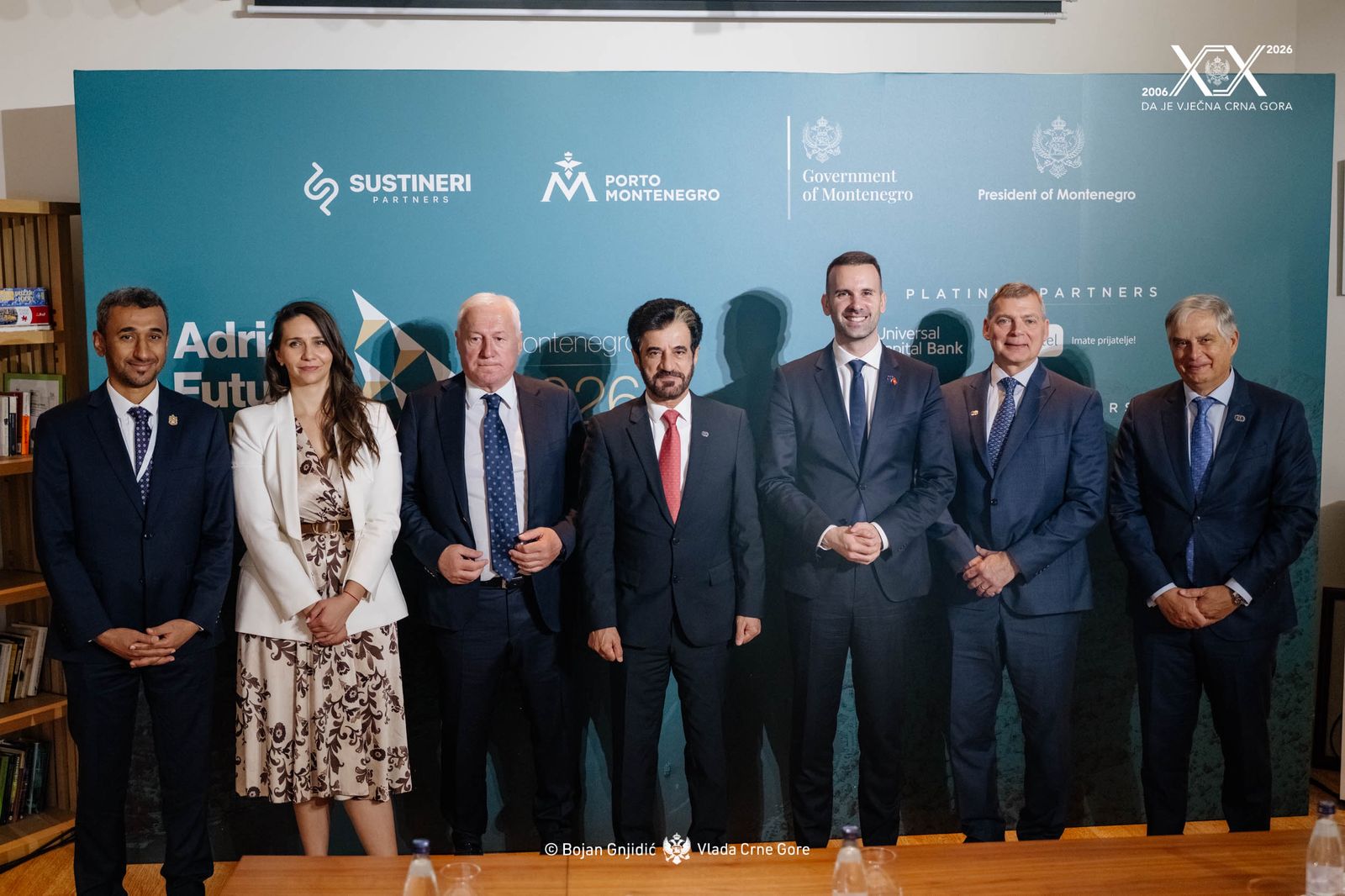
Discussions touched on how continued growth of Montenegro’s motorsport can help boost the economy
Dubai, UAE, Apr 23: FIA President H.E Mohammed Ben Sulayem has met with Montenegrin Prime Minister Milojko Spajić to strengthen cooperation between the Fédération Internationale de l’Automobile (FIA) and Montenegro.
The meeting in Tivat yesterday provided an opportunity to discuss the FIA’s leadership across both motorsport and mobility, and to explore areas of collaboration aligned with Montenegro’s national priorities.
Motorsport and tourism were key topics of the meeting. The discussion touched on how the continued growth of Montenegro’s motorsport can help boost the economy, bring more visitors to Montenegro, and raise the country’s international profile, while ensuring events are run safely and sustainably.
Another key focus was Montenegro’s ambition to become a regional leader in road safety. President Mohammed Ben Sulayem shared how the FIA helps countries use data to better understand accidents, improve roads, and make driving safer.
This includes global tools like the FIA Road Safety Index (RSI), which helps track and measure progress using cutting-edge AI. Both leaders agreed that using data and new technology is essential to making real improvements for everyday road users.
The Prime Minister and President also spoke about the importance of keeping people safe online through the FIA’s United Against Online Abuse (UAOA) campaign. They highlighted the need to promote respect and protect users, especially young people and those involved in sport, from online abuse.
H.E. Mohammed Ben Sulayem, FIA President, said: “Montenegro is a country with clear ambition to lead in road safety. We are delighted to work with them to help bring that ambition to life by combining innovation, data, and collaboration.
“Together with the Auto-moto Association of Montenegro, we will work to deliver safer roads, more efficient mobility systems, and continued growth in motorsport, helping to build a future that is safer, more sustainable, and more connected for all.”
The FIA President has been in Montenegro to attend the FIA Region I Spring Meeting hosted in Budva by the Auto-moto Association of Montenegro.
Reaching its conclusion later today, the meeting brought together 102 FIA Member Clubs across Europe, the Middle East and Africa for three days of collaboration, innovation and knowledge sharing to advance safe and sustainable mobility for motorsport fans and road users.

- 0
- By Neel Achary

23, Apr 2026
Hitachi Vantara Releases FY2025 Sustainability Report, Highlighting Leadership in Energy-Efficient Infrastructure for AI-Driven Workloads
April 23: Hitachi Vantara, the data storage, infrastructure and hybrid cloud management subsidiary of Hitachi Ltd. (TSE: 6501), today announced the release of its FY2025 Sustainability Report, detailing measurable advancements across its environmental, social and governance priorities. The report highlights advancements in energy-efficient infrastructure, including innovations across Hitachi Vantara’s Virtual Storage Platform One (VSP One) data platform, expanded lifecycle sustainability initiatives and strengthened governance practices to support customers navigating the growing demands of AI and data-intensive workloads.

As organizations accelerate digital transformation and AI adoption, the energy and efficiency demands of data infrastructure are rising sharply, creating new operational and sustainability challenges. According to the International Energy Agency (IEA), global data center electricity consumption could reach more than 1,000 terawatt-hours by 2026, roughly equivalent to the annual electricity consumption of a major industrialized nation, driven in part by AI workloads. At the same time, organizations are under pressure to reduce costs, making it more difficult to balance performance with environmental impact. As electricity demand increases, so do the power and cooling requirements needed to support data infrastructure, making efficiency a critical factor in both cost and sustainability. Hitachi Vantara is addressing this challenge by embedding sustainability into its infrastructure, helping customers reduce energy consumption, optimize operations and improve return on investment.
“Sustainability is increasingly tied to operational performance and business outcomes,” said Akinobu Shimada, CEO of Hitachi Vantara. “In FY2025, we focused on helping customers manage the growth of AI and data while improving efficiency and reducing environmental impact. Our investments in infrastructure innovation, lifecycle design and governance are enabling customers to achieve powerful results.”
Key highlights from the report include:
- Infrastructure efficiency and performance: Hitachi Vantara introduced VSP One Block High End, designed to deliver scalable infrastructure that improves efficiency while maintaining high reliability and reducing power and cooling requirements for enterprise and AI-driven workloads, supported by integrated tools for energy monitoring, carbon reduction and sustainability reporting.
- Lifecycle sustainability advancements: The company expanded lifecycle assessment initiatives across its VSP One Block, File and Object portfolios, enabling more accurate measurement of environmental impact and improved Scope 3 emissions visibility. These efforts are complemented by tools such as the Clear Sight dashboard, which provides customers with visibility into energy consumption and carbon usage, along with actionable insights to optimize system efficiency and environmental impact.
- Circularity and materials sustainability: Hitachi Vantara increased the use of post-consumer recycled plastics across its storage systems, with up to 50% recycled content in key components. The company also reported that less than 0.3% of materials were sent to landfill, with the vast majority reused or recycled through optimized recovery and circularity programs.
- Governance and data quality improvements: Hitachi Vantara enhanced cross-functional governance and emissions tracking processes, strengthening audit readiness and improving data accuracy across Scope 1, Scope 2 and key Scope 3 categories, aligning with science-based emissions reduction targets and evolving ESG reporting standards.
Hitachi Vantara’s commitment to sustainability extends beyond its own operations, focusing on helping customers achieve measurable improvements in efficiency, performance and environmental impact. Through its infrastructure and data platforms, the company enables organizations to reduce energy consumption, optimize resource utilization and support more sustainable operations at scale. Recent examples include:
- Aquiris (Belgium): Upgraded its storage platform with VSP One Block to improve operational efficiency, resilience and reliability for critical water treatment operations, processing more than 110 million cubic meters of wastewater annually and collecting over one million data points per day, while helping reduce power usage and lower its carbon footprint through more efficient data management and infrastructure.
- DestekBank (Turkey): Deployed VSP One Block to support rapid retail banking expansion, achieving a 25% reduction in data center energy consumption, a 35% increase in application performance and a 20% reduction in total cost of ownership.
- Malayala Manorama (India): Modernized its data infrastructure with Hitachi Vantara to support 24/7 media operations, achieving a 66% reduction in data center rack space and 70% savings in power and cooling costs, while improving availability and operational efficiency across its print, broadcast and digital platforms.
“Hitachi Vantara is helping us fulfill our goal of creating a sustainable process for safeguarding supplies of clean water and supporting the growth and development of Brussels,” said Juan Ochoa, managing plant director, Aquiris. “The performance gains with VSP One Block will be significant. We are constantly collecting data, tracking KPIs and monitoring our purification processes. The improvement in storage capabilities will help us respond quickly to issues and optimize our plant operations.”
While the FY2025 Sustainability Report reflects progress across the past year, it also reflects a broader shift in how Hitachi Vantara is approaching sustainability, embedding efficiency, transparency and lifecycle thinking directly into its infrastructure and operations. This approach helps organizations operationalize sustainability at scale, particularly as AI-driven workloads continue to increase infrastructure demands.
23, Apr 2026
AAEON Releases the BOXER-6407-TWL, an Ultra-Slim PC Designed for Legacy System Modernization
35% slimmer than its predecessor and offering both VGA and HDMI display outputs, the BOXER-6407-TWL is positioned as a reliable, cost-efficient platform for retrofitting and upgrading existing setups.

(Taipei, Taiwan – April 23, 2026) Leading provider of industrial PC solutions AAEON (Stock Code: 6579) today announced the BOXER-6407-TWL, an ultra-slim compact embedded PC available with either the Intel Processor N250 or N150 CPU SKU from the Intel Processor N-series (formerly Twin Lake).
Central to the product’s value proposition is its compact 153mm x 101mm x 30mm size, with its height being particularly notable, given it is 35% slimmer than previous models from AAEON’s Ultra-slim Box PC portfolio. AAEON has said this design decision was made to satisfy market demand for more advanced, fanless platforms that can be integrated into existing systems with minimal space, such as semiconductor manufacturing equipment and digital signage installations.
Highlighting its suitability for retrofitting and modernizing industrial setups, the BOXER-6407-TWL offers both VGA and HDMI display outputs to ensure compatibility with existing display panels. Meanwhile, the PC features a robust industrial I/O comprised of three USB ports (USB 3.2 Gen 2 x 1, USB 2.0 x 3), dual Gigabit Ethernet LAN, and two DB-9 ports for RS-232/422/485. This positioning of the product as one for industrial environments is consistent with the its mechanical specifications, which boast a fanless, ventless chassis with a single-mold top cover, allowing it to operate in temperatures as high as 60°C while preventing dust ingress.
For storage, the system sacrifices the SATA support seen in earlier models for an M.2 2280 M-Key slot, with additional expansion coming in the form of an M.2 2230 E-Key, an M.2 3052 B-Key, and a SIM card slot.
The system’s operating system support includes Windows 11 Pro, Windows 11 IoT, and Linux Ubuntu 24.04 and later.
23, Apr 2026
Travel Planning and Booking Now Takes Minutes, Not Your Entire Weekend, with Yatra’s DIYA AI
Apr 23: You know the feeling. You’ve been dreaming about a Southeast Asia trip for months – maybe Vietnam, then a quick hop to Singapore, and back home. You open a tab to research on the best itinerary. Then a tab to search for flights. Then another for hotels. Three hours later, you’re overwhelmed, nothing’s booked, and you’ve closed all 23 tabs in frustration.
It doesn’t have to be this way.
Yatra Online Limited, one of India’s leading online travel companies today announced a powerful new upgrade to DIYA, its AI-powered assistant giving travellers the ability to research, plan, customize, and book their entire journey – even those spanning across multiple cities & countries, all within a single chat conversation. No juggling platforms & tabs. No losing context.
The Real Problem With Travel Planning
It was never really about finding flights or hotels. Those exist everywhere. The problem is that travel planning is a process – one that involves research, decisions, trade-offs, and constant back-and-forth, and no single tool has ever held that process together from start to finish. Until now.
One Conversation. Your Entire Trip. Powered with AI
With DIYA AI, travellers can now simply describe what they have in mind, and DIYA takes it from there. Ask it to suggest an itinerary. Tweak the number of days. Discover recommended activities. Pick a hotel from the options it surfaces. Swap a flight. And when everything feels right, you proceed with the bookings. Every step happens inside the same conversation, with DIYA holding the full context throughout.
Imagine typing: “Plan a 7-day trip covering Bali & Singapore for 2 people. I’ll start from Delhi on July 17.”
Within moments, DIYA maps out a complete, bookable day-wise itinerary – flights, hotels for each stop, curated local experiences, creating ready-to-book packages, all tailored to your trip.
It’s less like using a booking engine and more like having a well-travelled expert who recommends options in real time.
Including the Trips That Were Always Too Complicated to Plan
This flexibility extends to even the most complex journeys. Multi-city itineraries- the kind that used to require a weekend of research and a spreadsheet to coordinate are now just another chat conversation. Whether it’s a one-way journey across cities, a round-trip, or a full multi-country loop, DIYA is the world’s first AI assistant capable of end-to-end multi-city travel planning and booking within a single, continuous conversation.
Your Yatra, Your Way
This builds on DIYA’s existing capabilities as a generative AI-powered travel assistant that offers end-to-end travel planning, booking, and post-booking support across chat and voice in over 100 languages. Powered by advanced AI models including Google’s Gemini, DIYA leverages natural language processing, real-time integrations, and retrieval-augmented generation to deliver personalized, context-aware travel experiences.
Commenting on the development, Siddhartha Gupta, Chief Executive Officer, Yatra Online, said “The gap in online travel has never really been about access to options. There are plenty of those. The real problem has always been the effort it takes to turn those options into an actual trip. Travellers were left to do all the hard work themselves – coordinating across platforms, second-guessing their choices, and spending weekends on planning instead of looking forward to the journey. With DIYA, we are taking a major step forward in closing that gap. From the first message to the final booking, DIYA holds the entire experience together- intelligently, conversationally, and in real time. That, for us, is what making travel truly intelligent looks like.”
“DIYA leverages the semantic intelligence of Large Language Models to deeply understand traveler intent and sentiment. It then applies advanced reasoning to craft highly personalized itineraries and dynamic travel packages-seamlessly identifying the best flights and hotels in real time. Users can continue to refine the package until it’s perfectly aligned with their needs,” adds Shakti Goel, Chief Architect and Data Scientist, Yatra Online
Since DIYA’s launch in August 2025, Yatra continues to expand its capabilities as a consumer-first AI travel assistant, moving closer to fully autonomous, end-to-end travel planning. By combining conversational intelligence with real-time execution across flights, hotels, and experiences, DIYA is redefining how travellers discover, plan, and book increasingly complex journeys in a faster, more intuitive way.
Your next adventure is waiting. Now, planning it takes minutes – not a weekend.
DIYA AI is available on Yatra’s consumer travel platforms across Web & App (Android & iOS).
23, Apr 2026
India–Nepal Travel Tightens: New Vehicle Permits & Customs Duties for Indian Visitors !
Nepal / India,Apr23(BNP): Travelling from India to Nepal has become more regulated following the introduction of new rules affecting Indian visitors, particularly those crossing the border by road or carrying goods.
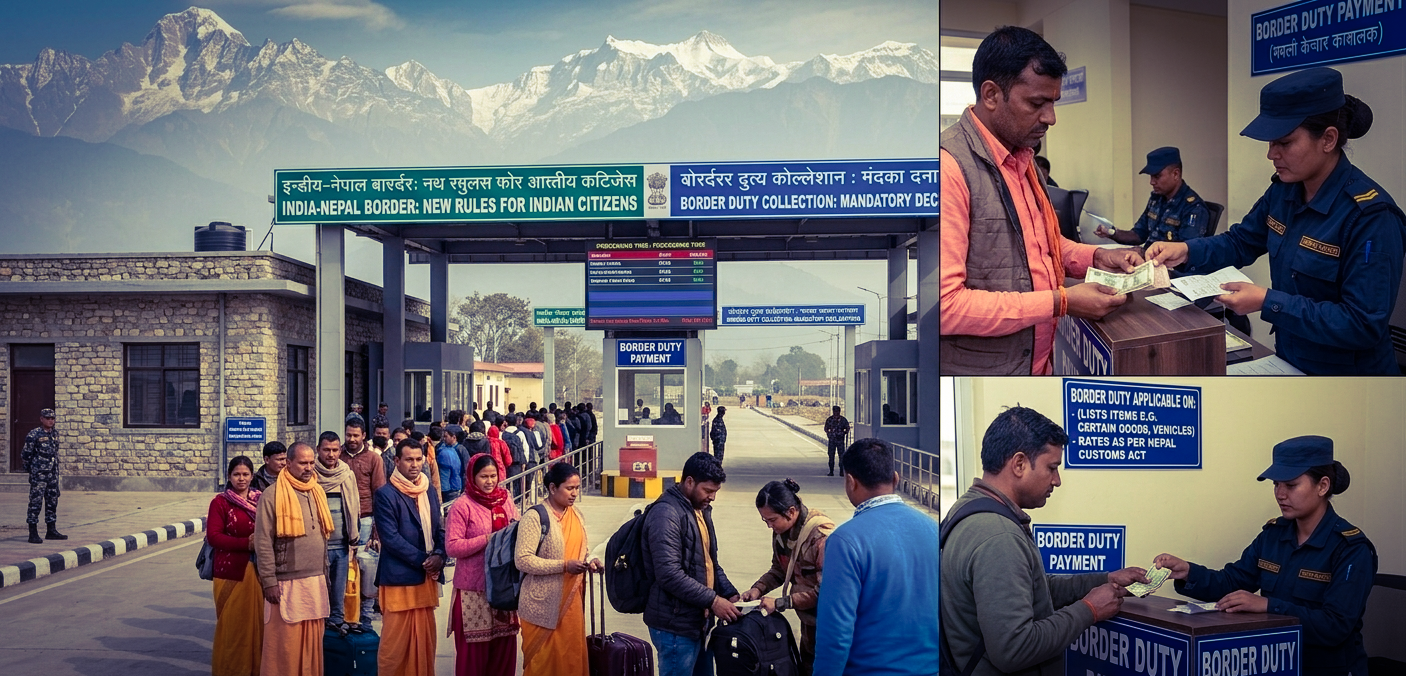
Under the revised guidelines, Indian vehicles entering Nepal must now be officially registered at the border and carry valid permits at all times during their stay. Authorities have made it mandatory to comply with these procedures to ensure proper monitoring and regulation of cross-border vehicular movement.
In addition, goods purchased from India and taken into Nepal will now attract applicable customs duties beyond prescribed limits. This marks a shift from the earlier, more relaxed system and is aimed at curbing informal trade and strengthening customs enforcement.
Officials stated that the new measures are designed to bring greater transparency and accountability in cross-border travel and trade. However, the changes are expected to impact frequent travellers and those accustomed to informal shopping trips across the open border.
Travellers have been advised to stay updated on the latest regulations and ensure all required documentation and declarations are in place to avoid penalties or additional costs.
Despite the tighter norms, movement between India and Nepal continues under long-standing bilateral arrangements, with authorities emphasizing smoother implementation while minimizing inconvenience to genuine visitors.
23, Apr 2026
Kedarnath Dham Reopens Amid Grand Ceremony; Over 12,000 Devotees Attend Opening Day !
Kedarnath Temple, Rudraprayag district, Uttarakhand, Apr 23 (BNP): The sacred portals of Kedarnath Dham were ceremonially opened to devotees at 8:00 AM on April 22, 2026, amid Vedic chants and traditional rituals, marking the beginning of this year’s pilgrimage season.

The Himalayan shrine witnessed an overwhelming turnout, with over 12,000 devotees present to witness the grand opening ceremony. The temple premises were beautifully decorated with nearly 15 quintals of flowers, while the atmosphere echoed with chants of “Har Har Mahadev,” reflecting deep spiritual devotion.
Pushkar Singh Dhami, Chief Minister of Uttarakhand, attended the ceremony, performed the first puja, and reviewed arrangements for the ongoing pilgrimage. Emphasizing efficient management, he stated that the queue system has been streamlined to ensure smooth and timely darshan for all pilgrims, with early visitors completing their prayers within minutes.
The Chief Minister also appealed to devotees to support a “Green Yatra” initiative by maintaining cleanliness and keeping the shrine area plastic-free.
The reopening of Kedarnath marks a key phase of the annual Char Dham Yatra. Meanwhile, the portals of Badrinath Temple opened on April 23 at 6:15 AM, while Yamunotri Temple and Gangotri Temple had already opened on April 19.
Authorities have put in place extensive arrangements to ensure the safety, facilities, and smooth movement of pilgrims, with a significant surge in footfall expected in the coming days.
23, Apr 2026
EkoStay Crosses INR 40 Crore in Revenue, Scales to 150 plus Villas Across 12 plus Cities, Built Entirely Without External Funding
Mumbai, April 23: At a time when growth in hospitality startups is often equated with capital raised, EkoStay is charting a fundamentally different trajectory, one anchored in profitability, operational discipline, and consistent guest demand.
The Mumbai-based alternative accommodation brand has reported ₹40 crore in revenue for FY 2025–26, marking a 43% year-on-year growth, while continuing to remain EBITDA-positive with ~10% margins.
But beyond revenue, the scale of the business tells a deeper story.
From its inception in 2018, EkoStay has grown into a network of 150+ professionally managed villas across 12+ leisure destinations, translating into hundreds of operational rooms and guest units serving travellers across India’s most in-demand holiday markets. The brand currently operates at an average occupancy of 56%, with a strong and growing base of repeat customers.
Looking ahead, the company is targeting ₹52+ crore in revenue in FY27, alongside a 30%+ growth trajectory and plans to scale its footprint to 220+ properties nationwide.
A Bootstrapped Model That Prioritised Fundamentals Over Funding
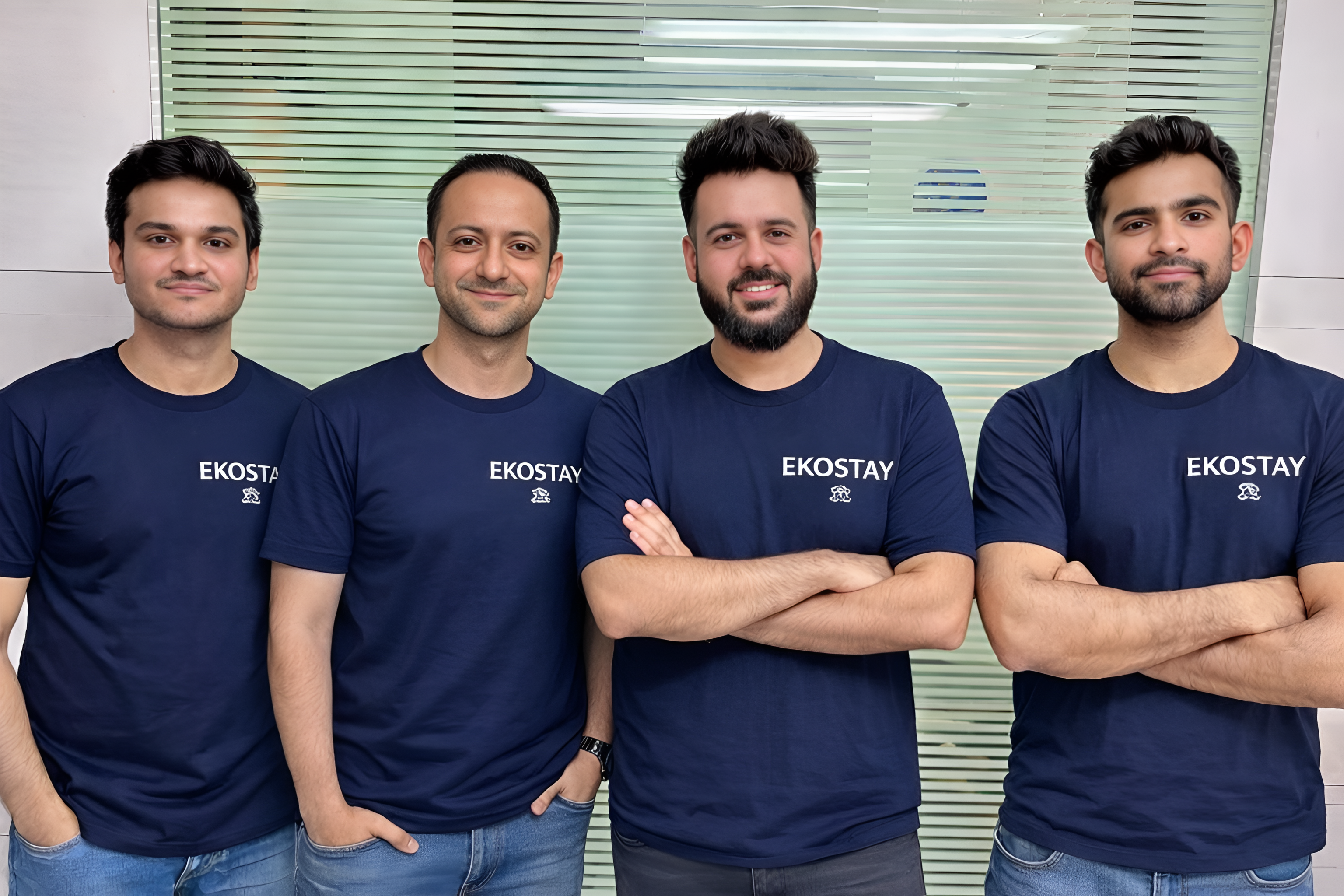
Founded by Husain Khatumdi, Sohail Mirchandani, Varun Arora, and Zishan Khan, EkoStay has been built without raising external capital, relying instead on internal accruals, measured expansion, and sharp operational control.
“Being bootstrapped meant every decision had to be efficient and accountable. That discipline is what continues to define how we scale today,” said Varun Arora, CEO & Co-Founder, EkoStay.
This approach has enabled the company to grow sustainably, while maintaining profitability in a segment often characterised by high burn and fragmented supply.
Repeat Behaviour, Not Discounts, Driving Growth
A defining lever of EkoStay’s growth has been repeat bookings and organic referrals, significantly reducing dependence on paid acquisition channels.
“Consistency in guest experience has been critical in building trust. A large part of our growth today comes from guests who choose to stay with us again or recommend us within their network,” added Sohail Mirchandani, COO & Co-Founder.
This repeat-driven model has allowed the brand to strengthen unit economics while scaling demand in a capital-efficient manner.
Scaling Supply Where Demand Already Exists
EkoStay’s expansion strategy has remained sharply demand-led, focusing on high-traction leisure micro-markets rather than aggressive, undifferentiated inventory addition.
The brand has seen particularly strong growth across South India, including the Nilgiris region, where demand for private villa stays continues to rise alongside evolving travel preferences.
“Our focus has always been on identifying destinations where demand is structurally strong and aligning our supply accordingly,” said Zishan Khan, Chief Acquisition Officer & Co-Founder.
A Standardised Yet Personalised Hospitality Model
Operating at the intersection of hospitality and vacation rentals, EkoStay combines the reliability of branded hospitality with the privacy and comfort of homestays.
Its model also enables homeowners to unlock value from their properties through professional management, without the operational complexities of hosting, creating a parallel supply pipeline that supports scalable growth.
What ₹40 Crore Represents
For EkoStay, this milestone is not just about topline growth.
It reflects a business built with zero external funding, zero dilution, and no reliance on debt, driven entirely by customer demand and internal reinvestment.
“₹40 crore is not just a revenue milestone, it validates a model that has been built sustainably, with long-term value creation at its core,” said Husain Khatumdi, Managing Director & Co-Founder.
Positioned for the Next Phase of Category Growth
India’s alternative accommodation segment is witnessing a structural shift, driven by rising domestic travel and increasing preference for private, curated, and experience-led stays.
With a strong foundation of profitability, repeat demand, and a growing supply base, EkoStay is well-positioned to capitalise on this momentum.
As the company scales towards 220+ properties and ₹52+ crore in revenue, its focus remains clear: disciplined growth, stronger operations, and delivering consistently high-quality guest experiences at scale.
23, Apr 2026
Navi UPI’s latest ‘Hurrypur’ film turns an auto breakdown into a high-speed pit stop
April , 23: Navi Limited one of India’s fastest-growing financial services companies, has released a new film under its ‘Hurrypur’ campaign, continuing its focus on speed and simplicity in everyday transactions.

The film, synced to US based musical act Baalti’s track “123”, opens with an autorickshaw breaking down mid-ride. Within seconds, the situation shifts. The repair unfolds like a Formula 1 pit stop. The tyre is replaced instantly, the vehicle is back on the road, and even the conversation that follows moves at the same pace. A ride is agreed upon in seconds, and the journey resumes.
The idea is simple. In a world where everything moves fast, systems around it have to keep up.
The film builds on the larger Hurrypur narrative, a fictional setting where time is treated as the most valuable resource. Each story translates this into everyday situations, using humour and exaggeration to reflect how people increasingly expect services to respond.
Rajiv Naresh, MD & CEO, Navi Limited (formerly Navi Technologies Limited) said,
“In Hurrypur, whether you’re on a racetrack or on a regular commute, we understand that time is of the essence and the importance of moving fast. This world we’re creating is designed to creatively underscore our obsession with delivering a fast and seamless experience, where every second counts and everything keeps moving seamlessly.”
Mr. Abhijit Avasthi, Founder of Sideways, added,
“When Hurrypur connected the way it did, we knew we had something worth building on. Pitstop doesn’t just continue the story – it takes it somewhere unexpected, and in the most entertaining way possible, brings out Navi’s attribute of speed. Honestly, it’s the kind of film you’re really happy to be a part of.”
Director Ayappa KM, said,
“What was a really fun script, proved surprisingly difficult to conceive. We took inspiration from Balti’s track “1, 2, 3,” using its rhythm and spirit as the backbone of the film’s pacing and vibrant colour palette, landing on something exuberant and unmistakably Indian.”
The campaign continues Navi UPI’s approach of using storytelling over feature-led messaging, focusing on relatable moments rather than product demonstrations.
23, Apr 2026
West Bengal & Tamil Nadu Polls 2026: High-Stakes Voting Begins Amid Intense Political Contest !
West Bengal / Tamil Nadu,Apr23(BNP): Voting for the 2026 Assembly Elections commenced today in two politically significant states—West Bengal and Tamil Nadu—marking a crucial phase in India’s electoral landscape.
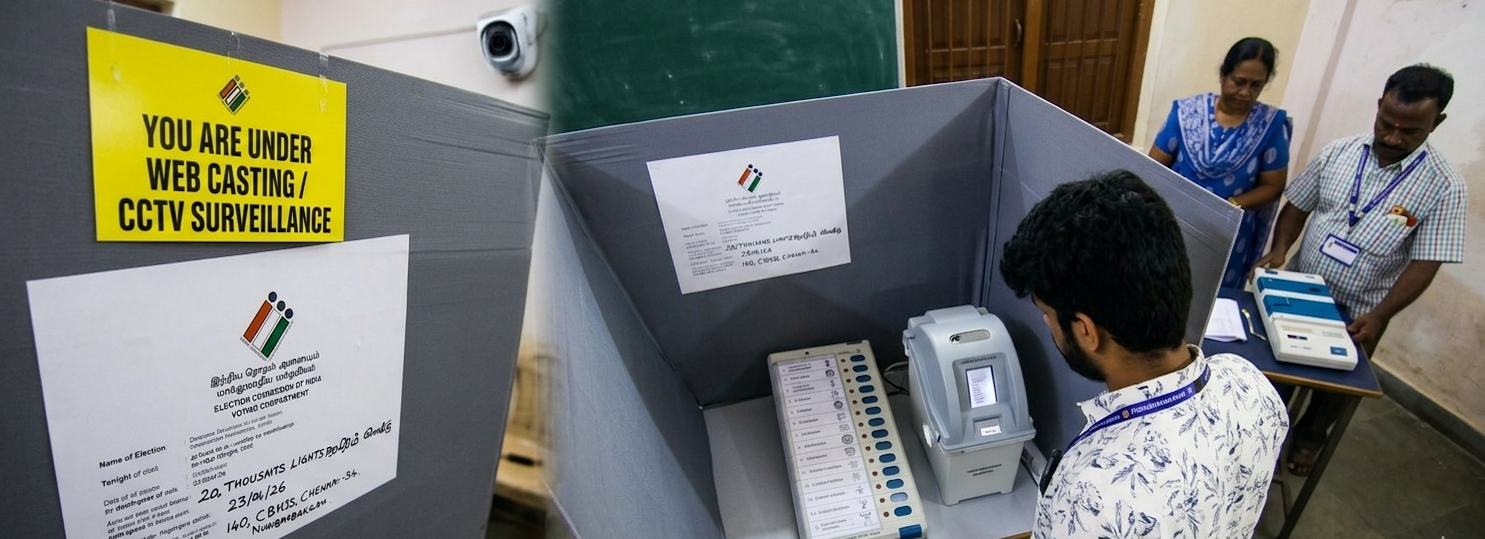
In West Bengal, polling is underway in 152 of the state’s 294 constituencies spread across 16 districts, including key regions such as Nandigram, Darjeeling, Siliguri, Jalpaiguri, and Cooch Behar. Approximately 3.6 crore voters are eligible to cast their votes in this phase. The second phase of polling is scheduled for April 29.
The electoral contest in the state is primarily between the ruling Trinamool Congress and the Bharatiya Janata Party, amid heightened political tensions over voter list revisions and campaign narratives.
Meanwhile, in Tamil Nadu, polling is being held across all constituencies, witnessing a multi-cornered contest. The Dravida Munnetra Kazhagam-led Secular Progressive Alliance is facing competition from the All India Anna Dravida Munnetra Kazhagam alliance with the BJP, alongside the political entry of actor Vijay, adding a new dimension to the electoral dynamics.
The DMK has focused its campaign on the “Dravidian Model” of governance and welfare initiatives, while the AIADMK-BJP alliance has campaigned on promises of corruption-free administration and an end to what they describe as “one-family rule.”
The Election Commission of India has put in place extensive security and logistical arrangements to ensure smooth, free, and fair polling across both states. Voter turnout is being closely monitored, with authorities encouraging maximum participation in the democratic process.
Polling will continue until the designated hours, with counting scheduled as per the official election timeline.
23, Apr 2026
AD Ports Group and NYU Abu Dhabi to Build and Pilot a High-Fidelity Intelligence Engine for Smarter Port Operations
Research-focused initiative to leverage stochastic AI models and spatial analytics for integrated vessel arrival prediction, berth allocation, and emissions insights
Abu Dhabi, UAE – 23 April 2026: Powering ahead in its adoption of next-generation digital capabilities, AD Ports Group (ADX: ADPORTS), a leading global enabler of trade, industry and logistics solutions, today announced a strategic partnership and research collaboration agreement with NYU Abu Dhabi.
This multi-year partnership aims to build and pilot a high-fidelity intelligence engine based on stochastic models and spatial intelligence. The engine is designed to serve as a sophisticated decision-support layer for human operators, bringing together vessel arrival time predictions, berth allocation optimisation suggestions, and environmental impact considerations with high precision.
In an industry where global berth waiting times often stretch into multiple days at anchorage, the opportunity to improve planning precision is noteworthy. This high-fidelity intelligence engine aims to further de-risk port call uncertainty and continue port operations fluidity enhancement, resulting in smarter port calls that unlock more capacity without physical expansion.
Furthermore, depending on the vessel type, aligning arrival times with berth allocation can reduce idle time and save fuel burn considerably, minimising environmental harm and facilitating greener port calls.
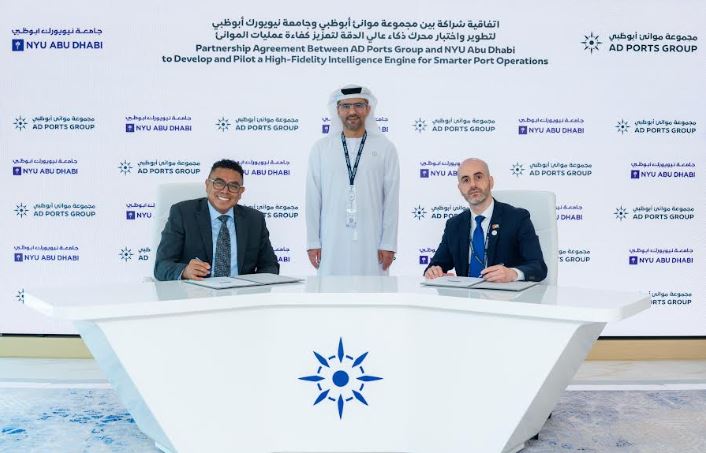
Mohamed Jamal-Eddine, Group Chief Digital & Information Officer – AD Ports Group, said: “As we continue to reimagine logistics ecosystems to advance the frontiers of global trade, pioneering research and strategic partnerships remain key pillars of our digitally-led approach. By integrating our deep expertise in port operations and trade facilitation with advanced predictive arrival intelligence and resilient operational modelling, we are accelerating the pace towards a future of autonomous decision-support. Through strategic partnerships such as this with NYU Abu Dhabi, we are ensuring that our move to predictive precision is both robust and ethically sound, giving our global partners the certainty they need to navigate an increasingly complex trade landscape.”
This jointly-developed initiative aims to turn variability into reliability and significantly advance terminal-focused decarbonisation transparency, serving as an integrated operational and environmental digital decision layer. As part of a long-term commitment to technological evolution, plans are in place to pilot the initiative at select terminals and trade lanes, with the objective of scaling successful outcomes across the Group’s global network.
Arlie Peters, Provost – NYU Abu Dhabi, said: “At NYU Abu Dhabi, we focus on research that addresses real-world challenges. Our collaboration with AD Ports Group brings together academic expertise and practical insight to strengthen the efficiency, resilience, and sustainability of modern logistics. This partnership reflects Abu Dhabi’s broader ambitions and the UAE’s leadership in trade and infrastructure. By connecting research with application, we aim to support the UAE’s continued role as a global hub for logistics. Led by Professor Ali Diabat from Civil and Urban Engineering, this work develops data-driven approaches to support better decision-making and improve long-term performance across port and logistics operations.”
This partnership represents a powerful synergy of specialised expertise and operational reach. NYU Abu Dhabi brings world-class analytical capabilities and advanced research, providing the scientific rigor needed for high-fidelity modelling. In line with internal data governance controls, AD Ports Group will support the initiative by providing secure access to relevant operational information and by facilitating controlled, real-world pilot deployments across selected terminals and trade lanes, helping translate the high-fidelity engine into an executable, field-tested solution.