



1, Nov 2025
Toyota Kirloskar Motor Sends 100 Skilled Youth for Global Training to Japan
Mumbai, 1st November, 2025: Toyota Kirloskar Motor (TKM) today announced that 100 members will travel to Japan to participate in the Global Skill-Up Training (GST) program at Toyota Motor Corporation. The initiative reflects TKM’s deep commitment to nurturing globally competitive talent and aligns with the Government of India’s Skill India Mission and the Technical Intern Training Program (TITP) a collaborative framework between the Governments of India and Japan for international skill development and talent exchange.
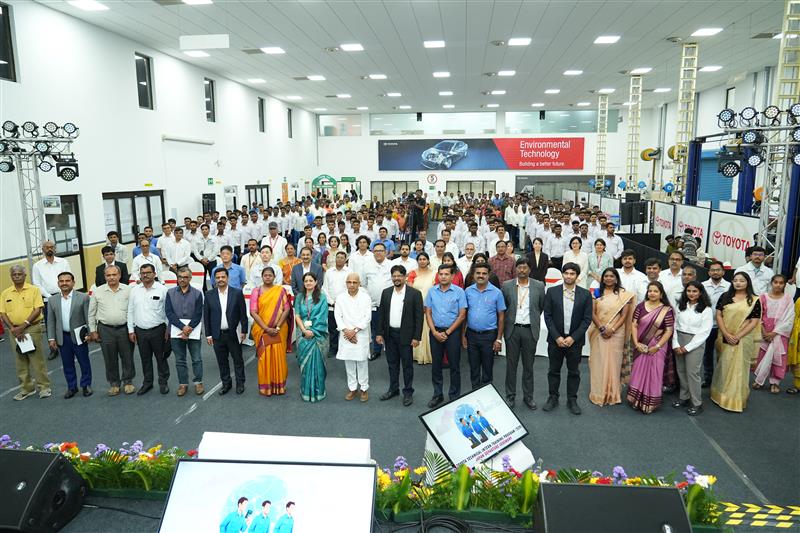
The Global Skill-Up Training Program at Toyota Motor Corporation, Japan, spans 11 months, combining classroom sessions with intensive on-the-job training. It emphasizes Toyota’s core principles while nurturing teamwork, adaptability, and cross-cultural understanding. Trainees are also oriented towards Japanese language, culture, and civic responsibility to prepare for global integration.
The event was graced by the presence of Hon’ble Minister Dr. Sharanaprakash Rudrappa Patil, Minister for Skill Development, Government of Karnataka and Ms. Sonal Mishra, Additional Secretary, Ministry of Skill Development & Entrepreneurship (MSDE), Government of India along-with Toyota Kirloskar India Team.
Speaking on the initiative, Mr. G. Shankara, Executive Vice President, Finance and Administration, Toyota Kirloskar Motor said, “We at Toyota Kirloskar Motor are deeply committed to nurturing globally competitive talent from India. The Global Skill Up Training Program is more than just a learning opportunity; it is a journey to experience excellence, discipline, innovation, and respect on a global stage. Through this initiative, we aim to empower our youth with world class technical expertise and the values that define Toyota’s culture, while contributing to the Government of India’s Skill India vision. Together, we aspire to make India a global hub for people, solutions, and automobiles, and together we will make that vision a reality.”
Appreciating TKM’s training program, Dr. Sharanaprakash Rudrappa Patil, Hon’ble Minister for Skill Development, Government of Karnataka, “We are proud to see our youth getting access to this global opportunity with Toyota. This program aligns strongly with our vision to position Karnataka as a hub for advanced skills while empowering rural talent to access world-class career opportunities.”
Ms. Sonal Mishra, Additional Secretary, Ministry of Skill Development & Entrepreneurship (MSDE), Government of India, “The collaboration between MSDE and Toyota under the TITP framework represents India’s growing role as a trusted global source of highly skilled professionals. This international apprenticeship opportunity will accelerate India’s contribution to global value chains and enable our youth to build future-ready careers.”
As an National Skill Development Corporation (NSDC)-approved Sending Organization, Toyota Kirloskar Motor has facilitated the overseas training of over 1000 youth in countries including Japan, Jordan, Qatar, and Slovakia, reinforcing its commitment to advancing global mobility and cross-cultural learning. The TITP framework provides Indian youth with an opportunity to acquire international technical experience, contribute to Japan’s workforce, and return as globally skilled professionals ready to support India’s industrial growth.
Guided by the vision “Grow India and Grow with India” and the mission “Producing Happiness for All,” TKM believes that industrial progress and social progress must advance together. Since its establishment in 1997, the company has focused on developing people and creating shared value for the community through holistic learning and skilling initiatives.
Toyota’s Skilling Initiatives
Under the Toyota India Center of Excellence, TKM has built an integrated framework for human resource development that operates at three levels. At the elementary level, it instils discipline, responsibility, and good citizenship among school students through value-based education. At the technician level, it develops world-class technicians through the renowned Toyota Technical Training Institute (TTTI) model, combining classroom and on-the-job learning. At the advanced level, it focuses on leadership and new-age skill development, preparing Auto-IT technicians and engineers in partnership with universities to meet emerging industry demands.
Through this multi-tier skilling initiatives, over 1,40,000 youth across India, many from Karnataka, have been trained and empowered. TKM also supports over 100 Industrial Training Institutes (ITIs) across Karnataka through faculty development, infrastructure support, and culture-building. In collaboration with Samagra Shikshana Karnataka, TKM is further enhancing vocational education for 800 students across seven districts, fostering employability and social progress.
Through initiatives such as Toyota Technical Training Institute (TTTI), Toyota Kaushalya, and leadership programs under the Toyota India Center of Excellence, TKM continues to champion the “Rural to Global” transformation — building human capability that drives both national development and international collaboration.
- 0
- By Neel Achary

1, Nov 2025
Underweight and Unbalanced: Gut Microbial Diversity in Underweight Japanese Women
Researchers link BMI and differences in gut microbiota in young, underweight Japanese women
November 1, 2025: Low body weight in young women has been associated with various health concerns. Rising trends in the proportion of underweight women between the ages of 20 and 39 have been seen in Japan, raising concerns. In a first-of-its-kind study, Dr. Katsumi Iizuka and Dr. Hiroaki Masuyama from Japan have found that underweight Japanese women had a lower gut microbiota diversity and more inflammation-linked microbes. These findings suggest gut health is critical in weight control.
Low body weight in young women has been linked to a range of health concerns, including disrupted menstrual cycles, infertility, weakened immune function, and a long-term decline in bone density. Japan has seen a rising trend in the proportion of underweight women between the ages of 20 and 39, with little to no change over the past two decades. The persistence of this trend raises concerns over the long-term health implications, especially as lean body weight has been correlated with changing dietary habits, diseases like anorexia nervosa, and even imbalances in gut microbiota. While previous research has reported lower alpha gut microbiota diversity in the underweight and overweight categories compared to those with normal weight, the differences in gut microbiota diversity in young, underweight Japanese women remain unclear.
To explore this further, a team of researchers from Japan, led by Dr. Katsumi Iizuka, a Professor at the Department of Clinical Nutrition, Fujita Health University, Japan, and Dr. Hiroaki Masuyama, Symbiosis Solutions Inc., set out to investigate the link between body type, dietary patterns and gut microbiota diversity in young, underweight Japanese women. They focused on understanding whether the gut microbiota diversity differed significantly between women who were underweight and those with normal body mass index (BMI). Their research was published in Volume 17, Issue 20 of the journal Nutrients on October 17, 2025. Prof. Iizuka says, “The differences in the diversity of the gut microbiota of young Japanese women by body weight have not been investigated. If differences in the gut microbiota between thin young women and women of normal weight become clear, I believe that improving eating habits could lead to improvements in the gut microbiota and consequently, body weight.”
The study observed and compared 40 underweight women with 40 age-matched women, between 20 and 39. The underweight group included women who were referred to the Nutrition Clinic at Fujita Health University with a BMI less than 17.5 at their first consultation, while the control group was composed of women with normal BMI (18.5 ≤ BMI < 25) and were selected from a database by Symbiosis Solutions Co., Ltd. (Tokyo, Japan). Stool samples were collected using standardized kits, while food frequency questionnaires were used to assess dietary patterns.
Interestingly, the researchers found no significant differences in dietary patterns between the two groups. However, an analysis of the gut microbiota showed that underweight women had a significantly lower microbiota diversity and an increased presence of species, such as Bacteroides, Bifidobacterium, and Erysipelatoclostridium, which are linked to inflammation. On the other hand, the normal-weight group had a healthier abundance of bacteria like Prevotella and Dorea. Prof. Iizuka mentions, “Among Japanese women aged 20–39, those in the underweight group showed a greater decrease in gut microbiota diversity compared to the normal-weight group, rather than differences in dietary patterns.” He adds, “Underweight women demonstrated reduced gut microbiota diversity and enrichment of taxa associated with inflammatory tendencies.”
These findings suggest that gut health is as important as caloric intake when it comes to addressing low body weight. Prof. Iizuka explains, “Not only the amount of energy or the ratio of protein, fat, carbohydrate, but actively consuming dietary fiber and fermented foods may lead to weight improvement in underweight individuals by causing changes in the gut microbiota.”
When asked about the long-term implications of the study, he said, “By combining the dietary survey data with gut microbiota analysis, it may become possible to evaluate not only the nutrients and energy contained in food, but also the quality of digestion and metabolism within the intestines after eating.”
With gut health gaining global attention, the findings of this study offer new insights into how the gut microbiota could aid in more personalized nutritional care for underweight Japanese women.
31, Oct 2025
Nayara Energy unveils ‘The Gir Inheritance’
Mumbai, 31th October, 2025: Nayara Energy, an integrated downstream company of international scale, has unveiled The Gir Inheritance, a coffee table book that celebrates the rich heritage and enduring conservation legacy of Gir. Published by Sanctuary, the book was presented to select recipients as a measure of support for the majestic lions of Gir.
The book is a tribute to nature’s resilience and the relentless efforts to protect it for generations to come. Moreover, it offers an immersive experience, artfully blending compelling narratives and evocative imagery to chronicle the legacy of Gir’s unique biodiversity and the efforts to safeguard it. By showcasing the vital role of conservation in sustaining both biodiversity and local livelihoods, the book highlights how protecting wildlife also safeguards ecosystems that nurture communities, inspiring innovative approaches and collective investment in a sustainable future.
“At Nayara Energy, we are committed to protecting and preserving India’s natural heritage. We are proud to have brought this important work to life. The Gir Inheritance is a tribute to the ongoing dedication of all those who have tirelessly worked to protect Gir and its ecosystems ensuring that future generations inherit this invaluable living legacy. Nayara Energy is honoured to play a part in this vital mission, reaffirming our pledge to environmental stewardship and sustainable development” said Teymur Abasguliyev, Chief Executive Officer, Nayara Energy.
Speaking on the release of the coffee table book, Bittu Sahgal, Editor, Sanctuary Asia said “The Gir Inheritance Coffee Table Book captures the rich heritage of Gir, home to the last sanctuary of the endangered Asiatic lion. The ‘Pride of Gujarat owes its resurgence to the tireless efforts of scientists, local communities, and conservationists. It is heartening to see Nayara Energy supporting these critical conservation efforts, ensuring that this vital legacy continues for generations to come.”
This initiative highlights Nayara Energy’s unwavering commitment to environmental sustainability and community engagement. It underlines the importance of preserving our natural heritage and the vital role we all share in sustaining the environment for future generations. Through this initiative, the Company seeks to raise awareness and inspire continued support for conservation efforts.
31, Oct 2025
Bollywood Nights Under the Stars at Infiniti Mall, Malad
Mumbai, 31st October, 2025: Infiniti Mall, Mumbai’s premium destination for luxury shopping, dining, and entertainment is back with another month of open-air movie screenings at its Malad location. This time bringing audiences a lineup of beloved Bollywood favourites through November 2025.
Get ready to relive the charm, music, and emotions of these timeless hits under the stars:
|
INFINITI MALL, MALAD |
||
|
DATE |
MOVIE |
TIME |
|
2nd November |
Kuch Kuch Hota Hai |
7 pm |
|
8th November |
Rockstar |
7 pm |
|
15th November |
Queen |
7 pm |
|
23rd November |
Zindagi Na Milegi Dobara |
7 pm |
From college romance and musical passion to self-discovery and friendship, November’s screenings promise pure nostalgia and feel-good cinema for every mood.
Grab your popcorn, settle in, and let the movies do the magic, only at Infiniti Mall, Malad.
31, Oct 2025
India’s REIT Market to Touch INR 19.7 Trillion by 2030: Knight Frank
REITs market projected to reach INR 19.7 tn by 2030, powered by office, retail and warehousing sectors: Knight Frank India
New Delhi, 31th October, 2025: Knight Frank India, in collaboration with the Confederation of Indian Industry (CII), today unveiled its latest report, Commercial Real Estate: Potential is Built, Opportunity is Now, at the CII Conference on Evolving Landscape of Indian Real Estate – CRE: Unlocking Investments, Opportunities & Economic Growth. The report positions India’s commercial real estate (CRE) sector at a defining juncture, where its built potential is set to translate into tangible growth. Among its key highlights, India’s REIT market is projected to reach INR 19.7 tn by 2030 (from INR 10.4 tn in 2025), driven by high occupancy, favourable taxation, and broader sectoral inclusion.
Private equity participation, rising from USD 500 mn in 2011 to multi-billion-dollar highs by 2019, has enhanced transparency, deepened institutional confidence, and paved the way for REIT expansion across India’s thriving CRE landscape. As urbanisation, technology, and progressive policy reforms continue to reshape the sector, India’s CRE stands poised to unlock the next wave of opportunity across asset classes.
Retail consumption across the organised formats is estimated at a value of INR 8.8 Tn for FY 2025. Led by shopping centres (INR 4.9 tn), high streets (INR 3.8 tn), and other new-age formats such as airport and transit retail. This expansion reflects a clear shift toward experience-driven, consumer-centric destinations where shopping intersects with lifestyle and leisure.
Shishir Baijal, Chairman and Managing Director, Knight Frank India, said, “India’s CRE transformation is being led by businesses that are more global, technology-driven and experience-focused than ever before. Consolidation in office demand, resilient retail growth and the rapid expansion of digital infrastructure have fundamentally reshaped occupier behaviour. Today, companies want efficient, green, future-ready spaces, and capital markets are rewarding that shift. As India heads toward a USD 7 tn economy, CRE will play an essential role in powering productivity, attracting investment and building next-generation urban centres.”
India’s REITs have a potential to diversify beyond traditional asset classes like office, retail, and warehousing, to industrial parks, data centres, and hospitality. Listed REITs have delivered stable average annual dividend yield of about 5.5%, making them attractive income-generating vehicles. By 2030, India’s REIT market (including office, retail and warehousing sectors) is projected to reach INR 19.7 tn. India currently has five listed REITs covering about 177 mn sq ft of commercial and retail space spanning operational, under-construction, and upcoming assets worth approximately INR 2.3 tn with over 290,000 unitholders.
Office REITs
India’s office REITs account for just 15.3% of the total office stock across the top eight cities, signalling strong potential for institutional growth. Demand from Global Capability Centres (GCCs) and India-facing businesses continues to strengthen, supported by a steady leasing pipeline and occupier preference for premium, sustainable workspaces. The value of REIT-able office assets is expected to rise from INR 8.2 tn in 2025 to INR 16.0 tn by 2030, nearly doubling in five years. With substantial prime office assets yet to enter REIT structures, broader participation from developers and investors will define the next growth phase for India’s office REIT market.
Retail REITs
Retail REITs are emerging as a new frontier for India’s real estate market amid a strong revival in organized retail. With only 7.3 mn sq ft of Grade A stock currently under REITs, out of a total of 66 mn sq ft of Grade A stock, there is significant headroom for institutional expansion. The value of REIT-able retail assets is projected to grow from INR 1.5 tn in 2025 to INR 2.4 tn by 2030, driven by rising consumer demand and the shift toward formal retail formats. As malls, lifestyle hubs, and mixed-use developments proliferate, retail REITs offer a structured, transparent way for investors to participate in India’s consumption-led growth story.
Warehousing and Industrial REITs
Warehousing has emerged as one of the most promising future avenues for REITs in India. Fuelled by e-commerce and third-party logistics (3PL) growth, leasing activity reached 32.1 mn sq ft in H1 2025. The top eight warehousing markets collectively hold 220.9 mn sq ft of Grade A stock, offering vast institutional potential. As technology-enabled, high-quality logistics facilities gain traction among occupiers, industrial and warehousing REITs or InvITs are expected to be launched in the next few years. Value of REIT/InvIT can potentially grow from INR 0.7 tn to INR 1.3 tn by 2030.
Neel Raheja, Chair, CII National Committee on Real Estate & Housing, and Group President, K Raheja Corp, said, “The partnership between CII and Knight Frank underscores a shared commitment to advancing India’s built environment. As commercial real estate matures, it will play a pivotal role in shaping investment flows, employment, and urban transformation. The sector’s progress mirrors India’s broader economic journey—where potential is abundant, and the time to seize opportunity is now.”
India is world’s fourth largest office market (valued at INR 16.4 tn (USD 186 bn) and now it has crossed the 1 bn sq ft milestone in 2025. Over two decades, office stock expanded at a CAGR of 8.6%, underscoring structural resilience and sustained investor appetite.
Between 2008 and 2024, gross leasing activity grew 5% CAGR, while new completions rose just 1%, tightening the supply-to-demand ratio from 1.40 in 2008 to 0.49 in 2025. The report notes that several top developers have shifted focus to residential projects for higher margins and quicker returns, deepening supply constraints.
Trend in Office Completions and Absorption and Trend in End Use Classification
To achieve the next milestone of 2 bn sq ft, India’s office sector must blend expansion with optimisation through policy incentives, public-private partnerships/JVs and institutional capital. Integrating green certifications early in the planning process is increasingly seen as best practice, enhancing ESG alignment and unlocking additional FSI. Notably, 31% of existing office stock offers retrofitting potential, while 12% of SEZ assets can be adaptively reused, creating scope for sustainable growth.
Across organised formats, retail consumption is estimated at a value of INR 8.8 tn for FY 2025, driven by the expansion of shopping centres, high streets, and emerging formats such as airport and transit retail. Since 90% of the market is unorganised, this presents a huge opportunity to the sector to tap on the consumption boom. This growth underscores a significant transition toward experience-led, consumer-centric retailing, where shopping is increasingly intertwined with lifestyle, leisure, and entertainment.
Shopping Centres continue to dominate the organized retail landscape, accounting for INR 4.9 tn, followed by high streets at INR 3.8 tn and airports contributing INR 0.1 tn. This tiered structure illustrates the evolution of retail into a multi-format ecosystem catering to distinct consumption behaviours. While shopping centres are hubs for curated experiences and brand visibility, high streets retain strong local loyalty and sustained footfall. Despite having a smaller share, airport retail delivers the highest revenue per square feet.
Across all formats, Apparel and Food & Beverages remain the dominant categories, contributing 50–60% of total revenues in shopping centres and high streets, and over 75% in airport retail. These segments anchor consumption patterns and continue to attract new entrants, reflecting the sector’s alignment with aspirational, lifestyle-led spending.
The report highlights that Tier 2 and Tier 3 cities are emerging as the next growth frontiers, fuelled by increasing disposable incomes, expanding urbanization, and the proliferation of national and regional brands. Developers are responding with smaller, agile shopping centres formats and mixed-use retail destinations designed to optimize footfall and experience.
After two cautious investment years, private equity inflows into retail real estate have touched USD 500 mn year-to-date in 2025, signalling renewed investor confidence. The resurgence is driven by consumption growth, improving rental yields, and the formalization of retail operations.
In parallel, sustainability and technology integration are shaping the sector’s next phase. Smart shopping centre management systems, energy-efficient operations, and digital engagement tools are being adopted to enhance tenant and customer experience. The report notes that the retail sector’s ability to blend technology with human experience will be key to maintaining its growth momentum.
India’s retail story is no longer just about expansion, it is about evolution and resilience. As consumers seek more immersive, meaningful, and value-driven experiences, the sector is redefining how space, experience, and community come together to create long-term value for investors, brands, and consumers alike.
Data centres are now India’s fastest-growing commercial real estate asset class, with total capacity crossing 10 GW (1.4 GW operational and an additional 8.8 GW in the pipeline). Fuelled by 5G, AI, cloud adoption, and data localisation, the sector could see a sevenfold rise in live capacity.
The report identifies key priorities to sustain growth: addressing power availability and reliability, mapping future energy demand, and incentivizing renewable sourcing. It also calls for developing training ecosystems and a harmonized national regulatory framework to align with global best practices. India’s opportunity lies in leapfrogging conventional growth by adopting renewable energy strategies, grid-readiness models, and innovation partnerships seen in mature markets.
Viral Desai, Senior Executive Director Occupier Strategy & Solutions, Industrial & Logistics, Capital Markets and Retail Agency, Knight Frank India, said, “India’s commercial real estate has moved from promise to performance. With office stock crossing 1 bn sq ft and retail consumption as estimated to be INR 8.8 tn for FY 2025, we are witnessing a maturing cycle supported by strong governance, foreign capital and a confident domestic economy. As REITs scale from INR 10.4 tn to a projected INR 19.7 tn by 2030, the focus must shift to quality supply, sustainability and global-standard asset management. The real opportunity lies in converting this built momentum into long-term, inclusive economic value.”
India’s commercial real estate stands at an inflection point, its potential firmly built, and its opportunity unfolding now. As each asset class matures and new capital pathways emerge, the sector is set to play a deeper role in shaping the country’s economic narrative. With structural reforms, sustainability imperatives, and technology-led transformation aligning in its favour, India’s CRE is evolving from a growth story into a story of enduring strength, institutional depth, and global relevance.
31, Oct 2025
Edge by Titan Celebrates Time as Art in its New Ultraslim campaign

At just 3.3 mm, Titan Edge’s slimmest watch yet takes center stage in a campaign that spotlights precision, patience, and the art of owning time without chasing it.
Campaign Link- https://www.instagram.com/p/
Mumbai, October 31, 2025: Edge by Titan has unveiled a compelling new campaign for the Edge Ultraslim — its slimmest watch ever at just 3.3 mm — rooted in the belief that true mastery is never rushed. More than a campaign, it is art in motion, celebrating creation unbound by time.
The film follows a master immersed in his craft — every gesture deliberate, every detail shaped with patience. Here, time is no longer a measure of urgency but a quiet companion, reminding us that greatness is born not in haste, but in devotion and vision. The result is a masterpiece — the Edge Ultraslim, a triumph of precision engineering and sculptural design that reimagines how time is experienced, savoured and felt rather than chased down to the last second.
Powered by the 1.15 mm Calibre Edge T9081, one of the world’s thinnest quartz movements, and defined by its single-hand floating disc, the Edge Ultraslim moves in ten-minute intervals, inviting wearers to embrace time as moments to be lived rather than seconds to be chased.
“The Edge Ultraslim is more than a watch, it is a meditation on time,” said Ms Kalpana Rangamani, CSMO, Premium & Luxury Watches. “This campaign captures its spirit perfectly — showing that mastery is achieved not by racing against the clock, but by rising above it because time obeys the maker’s will.”

For the unveiling of Titan Edge Ultraslim, guests were invited into a world that blurred the lines between design, philosophy, and art. The experience drew from the four elements — Wind, Water, Earth, and Sky — each space conceived as a sensory meditation on time unfolding around them.
As they entered, visitors were enveloped by concentric zones, each unfolding with light, sound, and form designed to reflect one element’s rhythm. Wind whispered through kinetic sculptures that moved with unseen precision. Water shimmered in fluid reflections that rippled across mirrored planes, distorting and revealing time in passing moments. Earth grounded the experience with texture, weight, and material — a reminder of the craft and human touch that anchor every Edge creation. Finally, Sky opened into light, air, and kinetic moments that showcased the watch— the purest expression of freedom, where time seemed to expand and slow in equal measure.
The journey culminated in a seamless reveal — the Edge Ultraslim emerging from darkness into light, its impossibly thin 3.3 mm form gleaming with quiet authority. On the wrist, it felt almost weightless, yet carried a sense of permanence and poise that few objects achieve
Through this carefully orchestrated movement, guests didn’t just witness time — they felt its stillness and flow. The installation embodied the Edge Ultraslim’s philosophy: that time is not pressure, but possibility.
31, Oct 2025
Amla Navami and Radha Pada Darshan: A Divine Glimpse of Devotion and Nature in Odisha
The sacred month of Kartik holds immense significance in Odisha’s spiritual calendar. Among its many divine observances, Amla Navami, also known as Radha Pada Darshan, stands out as a festival that beautifully blends devotion, mythology, and reverence for nature. Celebrated on the ninth day (Navami) of the bright fortnight (Shukla Paksha) of Kartik month, the day is believed to bring endless prosperity, purity, and blessings to devotees.
The Sacred Tree of Immortality
On this auspicious day, devotees worship the Amla (Indian Gooseberry) tree, considered a sacred embodiment of Lord Vishnu. It is believed that any act of charity or devotion performed under an Amla tree on this day yields Akshaya Punya—merit that never diminishes. This belief gives the festival another revered name, Akshaya Navami.
In traditional Odia households, especially among Habisyalis (women observing Kartik vows), special rituals are performed under the shade of the Amla tree. Devotees bathe the image of Lord Vishnu with holy water beneath the tree, cook simple sanctified food (Habisya Anna), and partake in it as prasada. Circumambulating the tree is believed to grant longevity, good health, and divine blessings. The day is thus not only a religious observance but also a celebration of nature’s generosity — expressing gratitude to the life-giving environment.
The Legend of Radha Pada Darshan
Beyond its ecological symbolism, Amla Navami holds a deeply spiritual connection in Odisha, particularly at the Sakhigopal Temple, near Puri. Here, the festival coincides with the Radha Pada Darshan Yatra, a day when devotees are granted a rare glimpse of Maa Radha’s sacred feet — a vision believed to absolve one of countless sins and bless the devotee with eternal bliss.
According to the temple legend, Lord Krishna once appeared in the form of Sakhigopal (Witness Gopal) to defend the honor of a humble devotee. Over centuries, the divine idol journeyed from Vrindavan to Kanchi, and eventually to Odisha, where King Purushottama Deva enshrined Him near Puri. But when the Lord took residence there, His beloved Radha remained in Vrindavan, leading to their separation. To fulfill this divine longing, Radha was later reborn in human form as Lakshmi, the daughter of the temple priest Beleswar Mahapatra of Satyabadi. Each night, the Lord would secretly visit her — their reunion celebrated in the sacred groves known as Bakula Ban, often described as “Gupta Vrindavan” or the hidden Vrindavan of Odisha.
When the king mistakenly accused the priest of wrongdoing, Lord Sakhigopal appeared in the king’s dream, revealing the divine truth and commanding that a golden idol of Radha be created and installed beside Him. The day this idol was consecrated, Lakshmi left her mortal body, and her tomb was later transformed into a Mahavir Temple, which still stands near the shrine.
The Divine Vision and the Odia Attire
The story further tells that, in memory of Radha’s human incarnation, her idol remained draped year-round in long garments — concealing her divine feet. But once a year, on Amla Navami, she appears in her Odia attire (Odiani Besha), and devotees are blessed with the rare opportunity of Radha Pada Darshan — the sacred sight of her lotus feet.
On this day, both deities are dressed in resplendent attire. Lord Gopal is adorned in the Natabara Besha (the charming dancer form), wearing a golden crown and holding a golden flute, while Maa Radha is decorated with traditional Odia ornaments — paunji (anklets), kundala (earrings), chandrika, nose ring, and the sacred Amla mala (necklace made of gooseberries). The temple resonates with devotional songs, rituals, and the fragrance of flowers and incense, as thousands gather for a glimpse of the divine pair.
Outside the temple, devotees tie red threads smeared with vermilion around Amla trees, praying for the fulfillment of their wishes, marital happiness, and the well-being of their children.
A Celebration of Nature, Faith, and Eternal Love
While the legends and rituals give the day its deep spiritual essence, Amla Navami also stands as a reminder of India’s ancient tradition of living in harmony with nature. Worshipping the Amla tree signifies gratitude to the environment that sustains life. Sitting beneath its shade or partaking of food there is believed to heal the body and calm the mind.
The spiritual significance of the day — the union of Radha and Krishna, nature and divinity, devotion and gratitude — makes Amla Navami a celebration of love and balance. Whether one believes in the myths or cherishes the symbolism, the festival’s essence remains universal: to honour the divine in nature, to find purity in devotion, and to live in harmony with all that sustains us.
Conclusion
Amla Navami and Radha Pada Darshan together remind us that faith is not separate from nature — it flows through the trees, rivers, and traditions that define our culture.
31, Oct 2025
Obesity and Yoga: Reconnecting Mind, Body, and Metabolism
India, 31st October 2025: Obesity has emerged as one of the most pressing health concerns of modern times, affecting not only physical appearance but also emotional balance and metabolic health. It often stems from unhealthy eating habits, stress, hormonal imbalances, and a lack of mindful movement. Yoga offers a holistic and restorative solution to this growing lifestyle challenge helping rejuvenate the body’s natural rhythm, boost metabolism, and promote emotional harmony.

Yoga fosters a deep connection between awareness and action. Through regular practice, individuals learn to listen to their bodies, restore digestive strength, and regulate energy flow. This state of balance supports sustainable weight management, emotional stability, and the inner vitality necessary for long-term well-being.
Among the many asanas that help manage obesity, Utkatasana (Chair Pose) strengthens the thighs, hips, and spine while improving endurance. By engaging large muscle groups, it enhances metabolism and promotes calorie burning. Naukasana (Boat Pose) activates the core, improves digestion, and supports metabolic function all vital to maintaining a healthy weight. These asanas also cultivate focus and discipline, key ingredients for any lasting wellness journey.
Additionally, Surya Namaskar (Sun Salutation) serves as a complete body workout that synchronizes movement with breath. Practicing several rounds in the morning invigorates metabolism, stimulates the cardiovascular system, and enhances flexibility. Its rhythmic flow unites mind and body, bringing both mental clarity and physical strength.
Pranayama techniques such as Kapalabhati and Anulom Vilom further enhance the benefits of yoga. Kapalabhati, or “skull-shining breath,” energizes the body and purifies internal systems, while Anulom Vilom balances the nervous system, alleviates stress, and stabilizes metabolism.
Beyond physical postures, yoga nurtures mindfulness a transformative element that reshapes our relationship with food and daily habits. It teaches mindful eating: savoring each bite, recognizing true hunger, and avoiding emotional overeating. This union of mindful awareness and consistent practice becomes a powerful ally in rebuilding confidence, discipline, and balance.
Sustained commitment to a yogic routine combining asanas, pranayama, and short meditation sessions gradually strengthens the body, enhances digestion, and lightens the mind. Over time, practitioners experience an inner transformation that inspires regularity, self-care, and empowerment.
When approached through a yogic lens, obesity transcends being a mere physical issue it becomes a journey of self-renewal. Yoga realigns the mind, body, and metabolism through awareness, discipline, and breath, guiding individuals toward holistic healing and reminding each of us that true wellness begins within.
31, Oct 2025
Exchange Identifies Root Cause of October 28 Incident; Assures Robust Systems and Future Readiness
Mumbai, 31th October, 2025: Further to our earlier communication regarding the incident on 28th October2025, this is to update that the primary root cause has been identified as predefined parameter limit relating to reference data like Unique Client Code (UCC) configured within the systems. This led to constraints beyond the threshold. We have taken steps to address the constraints to prevent similar issues in the future. Notably, trading systems have not had issues. Exchange systems are well positioned to support market volumes and growth. We remain committed to strengthening our operational robustness and will continue investing in cutting-edge technology to enhance performance, reliability, and scalability, ensuring that we meet the evolving needs of our members, participants and stakeholders .We sincerely thank our members, participants and all stakeholders for their continued support, cooperation, understanding and valuable assistance during the incident, and we deeply appreciate your ongoing trust and partnership.
31, Oct 2025
Say Goodbye to Winter Dullness with Max Factor Miracle Pure Cream Blush
Max Factor Miracle Pure Creamy Blush
Infuse your cheeks with colour and care. The Max Factor Miracle Pure Cream Blush is more than just a blush it combines skin‑loving ingredients and a buildable, luminous finish for a radiant glow that feels as good as it looks. Enriched with hyaluronic acid & squalane, this blush formula helps moisturize and plump the skin, giving a fresh, dewy appearance all day.

Availability : Nykaa, Myntra, Amazon, Tata Cliq, Health & Glow, Dabur NewU and Shoppers Stop


