


28, Sep 2026
India’s Battery Storage Market Enters a New Growth Phase as Renewable Energy Expands
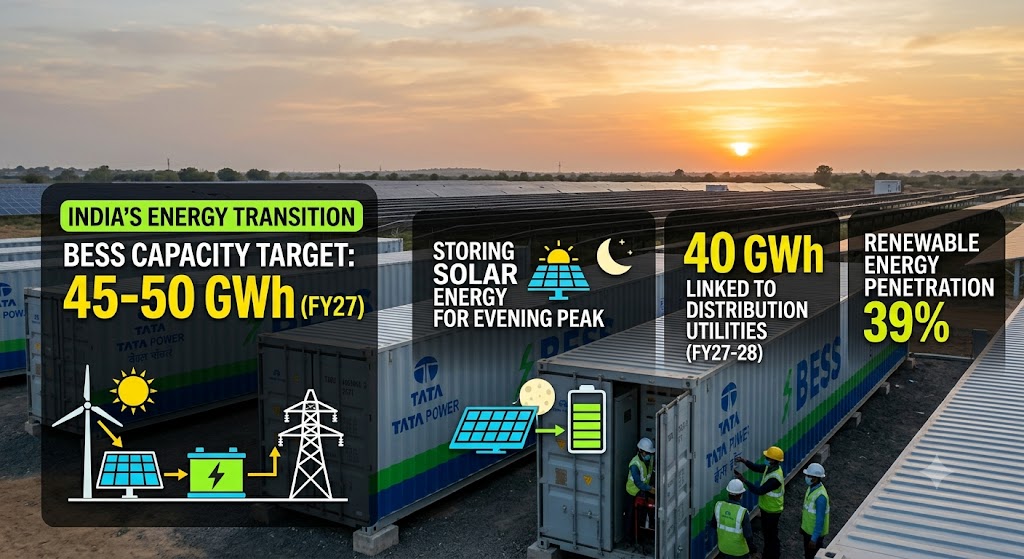
India’s energy transition is creating a new business opportunity in battery storage, as the rapid expansion of solar and wind power increases the need for electricity that can be stored and supplied when demand is high.
Battery Energy Storage System (BESS) capacity in India is expected to reach around 45-50 GWh over the current and next financial years, a sharp increase from the roughly 1 GWh installed by the end of the previous financial year, according to a recent industry assessment.
The growth reflects a simple change taking place in India’s power sector. Solar panels can generate large amounts of electricity during the day, but power demand often rises in the evening when solar generation falls. Batteries can store surplus electricity when generation is high and release it later when consumers and businesses need more power.
This makes battery storage increasingly important as India adds more renewable energy to its electricity system. Renewable energy accounted for about 39 per cent of the country’s installed power capacity and 15 per cent of electricity generation in FY26, increasing the need for flexible power resources.
Battery storage creates a new business ecosystem
The expansion of BESS is not only about installing large battery banks. It is creating opportunities across the wider energy and manufacturing ecosystem, including battery manufacturing, power electronics, battery-management systems, energy-management software, engineering and construction, operations, maintenance and battery recycling.
Government auctions are already reflecting this shift. BESS-linked projects accounted for nearly 40 per cent of renewable capacity auctioned in FY26, compared with around 5 per cent in FY24 and FY25. Around 50-55 GWh of BESS capacity is scheduled for commissioning in FY27 and FY28, with roughly 40 GWh linked to distribution utilities and another 10-15 GWh expected to serve commercial and industrial users or the merchant power market.
For businesses, this means batteries are gradually moving from being a supporting technology to becoming an important part of the power infrastructure itself.
How batteries can change the power market
A battery storage system can charge when electricity is available or cheaper and discharge when demand is higher. This can help reduce pressure on the grid during peak hours and make renewable electricity more useful throughout the day.
For industries and large commercial users, storage can also provide greater control over electricity consumption and help manage fluctuations in power supply. For distribution companies, batteries can support peak-hour supply and improve grid flexibility.
The government is also supporting the development of storage through measures such as viability-gap funding, transmission-charge waivers for eligible projects and policies aimed at increasing energy-storage deployment. The National Electricity Plan projects BESS requirements could rise to 236 GWh by 2031-32, indicating the scale of the potential market.
Manufacturing could become a major opportunity
As demand increases, India has an opportunity to develop a larger domestic battery-storage ecosystem instead of relying heavily on imported batteries and critical components.
The opportunity extends beyond cells to battery packs, power-conversion equipment, thermal management, control systems, software and recycling. A larger domestic ecosystem could support new manufacturing capacity, engineering services and skilled jobs while strengthening the supply chain for renewable energy.
However, the industry also faces challenges. Higher battery costs, dependence on overseas suppliers for some critical components and limited execution experience among some developers could affect project returns and commissioning timelines. Around 8-9 GWh of awarded capacity is considered more exposed to delays.
Despite these challenges, the direction of the market is becoming clearer. As India adds more solar and wind capacity, the value of electricity will increasingly depend not only on how much power is generated, but also on when that power is available.
Battery storage is emerging as the link between renewable generation and reliable electricity demand, opening a growing market for energy companies, manufacturers, technology providers and infrastructure investors.
- 0
- By Neel Achary



