


31, Aug 2026
GIGABYTE Highlights What Drew Gamers at Gamescom 2026 with AORUS INFINITY and Immersive Gaming Experiences
TAIPEI, Aug. 31, 2026 /PRNewswire/ — GIGABYTE, the world’s leading computer brand, concluded Gamescom 2026 with strong gamer engagement at its AORUS INFINITY showcase, where flagship gaming hardware, intelligent technologies, and distinctive PC design came together through hands-on experiences. From high-performance desktop builds and AI gaming laptops to OLED gaming monitors and peripherals, gamers experienced the performance, responsiveness, and visual immersion of the latest AORUS lineup.

At the center of the showcase, the AORUS INFINITY Series brought GIGABYTE’s engineering expertise into a unified gaming ecosystem. The X870E AORUS INFINITY NEXT motherboard combines aerospace-inspired engineering with advanced power and thermal design, including 3D metal-printing technology. Paired with AORUS GeForce RTX™ 50 Series INFINITY graphics cards featuring the WINDFORCE HYPERBURST cooling system, the platform sustains performance during demanding gameplay. The AORUS C510 GLASS INFINITY chassis completes the setup with an integrated 16-inch display and flexible placement options, turning the PC itself into part of the gaming experience.
The AORUS MASTER 16 GEN 2 AI gaming laptop and AORUS RTX™ 5060 Ti AI BOX gave visitors a hands-on look at how AI can enhance gaming setups. With GIGABYTE’s exclusive GiMATE AI agent, players experienced intuitive system control and real-time performance optimization, while GPU Selector demonstrated how GPU resources can be intelligently deployed between the laptop and external GPU. The AORUS MASTER 16 GEN 2 was also named a CHIP Highlight at Gamescom 2026, recognizing its gaming performance, intelligent optimization, and advanced thermal design.
AORUS OLED gaming monitors were another crowd favorite, allowing players to experience OLED responsiveness and visual clarity in fast-paced gameplay. The FO27Q28G and FO27Q24G combine QHD WOLED panels, refresh rates of up to 280Hz, and 0.03ms response times, while GIGABYTE Tactical Features support competitive play. Deep contrast, smooth motion, and quick response created a more immersive experience across the gaming area.
Beyond performance, visitors also explored STEALTH cableless builds and the WOOD Series, highlighting how gaming PCs can combine clean layouts with distinctive personal style. As GIGABYTE continues its 40th anniversary celebrations, AORUS INFINITY at Gamescom 2026 marks another chapter in the brand’s four-decade journey of gaming innovation. Bringing together performance, intelligent technologies, and distinctive design, the showcase reflects GIGABYTE’s engineering legacy while shaping the future of gaming experiences worldwide. For more details, please visit the official website.
 View original content to download multimedia:https://www.prnewswire.co.uk/news-releases/gigabyte-highlights-what-drew-gamers-at-gamescom-2026-with-aorus-infinity-and-immersive-gaming-experiences-302865052.html

- 0
- By Sai Krishna

31, Aug 2026
Relativity Brings Powerful Legal Data Intelligence to Microsoft Copilot, Expanding AI Assistant Support for Legal Teams
News Summary
- RelativityOne now integrates with Microsoft Copilot through the Model Context Protocol (MCP).
- This integration enables legal teams to automate RelativityOne administrative workflows in Copilot through natural language.
- The company’s continued efforts in expanding MCP integrations serve to extend Relativity solutions into the surfaces where legal professionals already do their work.
CHICAGO, Aug. 31, 2026 /PRNewswire/ — Relativity, a legal data intelligence company, today announced that RelativityOne, its extensible AI platform for legal work, now integrates with Microsoft Copilot through the Model Context Protocol (MCP). With this integration, legal teams can now use natural language in Copilot to execute administrative reporting capabilities directly within the RelativityOne environment without switching contexts or platforms.

“Copilot is now one more place our users can take action in RelativityOne in plain language without leaving Microsoft 365,” said Chris Brown, President, Relativity. “This accelerates administration, while aiR continues to transform the high-stakes legal work that demands deep context, and tight governance stays in RelativityOne.”
According to the International Legal Technology Association’s 2025 Legal Technology Survey of global law firms, Microsoft Copilot is the most widely used generative AI tool in the industry. It reports that Copilot is used by 68% of firms and 84% of the largest firms. Integrating RelativityOne with Copilot serves to enable legal professionals to work more seamlessly across the two surfaces.
“As legal teams embrace AI to transform how work gets done, the ability to securely connect enterprise knowledge, workflows, and data systems becomes increasingly important,” said Mala Anand, Executive Vice President & Chief Customer Officer at Microsoft. “By bringing RelativityOne into Microsoft 365 Copilot through MCP, we are enabling legal professionals to use natural language to orchestrate complex workflows, accelerate time to insight, and unlock the value of their data within a trusted AI-powered experience.”
By streamlining the work required to understand data structures, and manage users, teams can move faster from trigger event to analysis, while decisions still drive impact. The integration also delivers insights into data and usage patterns to reinforce best practices, strengthen governance, and support more informed decisions across matters, clients, and practice groups.
RelativityOne has long been a platform designed to be extended through APIs and a partner ecosystem. This Copilot integration further empowers Relativity’s user community to manage and tailor their RelativityOne environments to meet their unique needs, simplify operational tasks and ultimately focus more time on the consequential work that drives successful outcomes.
Relativity’s integration with Microsoft Copilot currently enables orchestration and reporting capabilities in Copilot Cowork, including standing up workspaces, organizing case data and managing legal operations through natural language. Reporting capabilities—such as analyzing workspace access and generating administrative reports—are enabled in Copilot Chat. Support for orchestration capabilities is planned to be added to Copilot Chat later this year.
Following the company’s recent moves to launch Relativity claiR in advanced access, plans to integrate Gavel‘s Word capabilities into RelativityOne, recent MCP expansions, this Copilot integration is the latest advancement in Relativity’s strategy of expanding RelativityOne to meet legal teams where and how they work.
Learn more about enabling the Copilot connector in RelativityOne.
About Relativity
Relativity is a leading legal data intelligence company that builds technology to help users organize data, discover the truth, and act on it. Its extensible cloud platform, RelativityOne, transforms complex data into actionable insights at massive scale for litigation, investigations, regulatory inquiries, data breach responses, and other legal use cases. The world’s largest law firms and corporations, government agencies, and a robust network of channel partners rely on Relativity’s legal AI software to securely surface and manage the most relevant and impactful information in their matters. The company also expands access to technology by providing its platform at no cost to academic institutions through its Relativity Academic program and to organizations supporting pro bono legal work through its Justice for Change initiative.
 View original content to download multimedia:https://www.prnewswire.co.uk/news-releases/relativity-brings-powerful-legal-data-intelligence-to-microsoft-copilot-expanding-ai-assistant-support-for-legal-teams-302864550.html

31, Aug 2026
Vanguard 500 Index Fund Turns 50: NYSE Content Update
NYSE issues a pre-market daily advisory direct from the trading floor.
NEW YORK, Aug. 31, 2026 /PRNewswire/ — The New York Stock Exchange (NYSE) provides a daily pre-market update directly from the NYSE Trading Floor. Access today’s NYSE Pre-market update for market insights before trading begins.
Ashley Mastronardi delivers the pre-market update on August 31st
- Today marks the 50th anniversary of the launch of the Vanguard 500 Index Fund.
- Considered the industry’s first index fund for individual investors.
- The fund holds approximately $1.7 trillion in assets across all its share classes.
- Vanguard’s Kathy Kellert will join NYSE Live to explain what makes the fund revolutionary.
- The Annual Gabelli Aerospace & Defense Symposium kicks off September 10th.
- The event is designed to connect aerospace and defense companies with shareholders, investors, fund managers, and analysts.
- Participants will discuss key trends shaping the industry, including accelerating global defense spending and technological modernization.
- Gabelli Funds Portfolio Manager Tony Bancroft will join NYSE Live to discuss how the event connects companies with investors.
- Investors renew their focus on the Middle East following new developments.
- The U.S. struck Iranian rocket launchers on Sunday, marking the first military action against Iran in more than a month.
- The Dow Jones industrial Average will look to clinch its fifth consecutive willing month during today’s session.
Opening Bell
Vanguard celebrates the 50th anniversary of the Vanguard 500 Index Fund
Closing Bell
Ronald McDonald House NY marks the start of Childhood Cancer Awareness Month on September 1st
For market insights, IPO activity, and today’s opening bell, download the NYSE TV App and check out the NYSE YouTube: TV.NYSE.com and YouTube.com/@NYSEofficial

 View original content to download multimedia:https://www.prnewswire.co.uk/news-releases/vanguard-500-index-fund-turns-50-nyse-content-update-302864960.html

31, Aug 2026
Altimetrik Achieves the AWS Generative AI Specialization
BENGALURU, India, Aug. 31, 2026 /PRNewswire/ — Altimetrik, an AI-first digital engineering company, has achieved the Amazon Web Services (AWS) Generative AI Specialization, a new category launched within the AWS AI Competency. This specialization recognizes Altimetrik as an AWS Partner that helps customers leverage foundation models and related technologies to implement use cases across industries.

The AWS AI Competency Generative AI Specialization distinguishes Altimetrik as an AWS Partner with demonstrated technical expertise and customer success in building and deploying enterprise-grade generative AI solutions on AWS. Altimetrik has a proven track record of using Amazon Bedrock AgentCore, Amazon Bedrock, Amazon SageMaker, and other AWS AI services to help customers move beyond experimentation and deploy generative AI at scale.
“Achieving the AWS Generative AI Competency reflects the depth of our engineering expertise in designing and delivering enterprise AI capabilities on AWS,” said Farid Roshan, Global Head of AI Infused Digital at Altimetrik. “From responsible AI and governance to scalable architectures and emerging agentic patterns, this designation gives our clients added confidence that we’re applying proven engineering practices to turn AI into meaningful business outcomes.”
“Generative AI delivers the most value when it’s grounded in deep domain understanding,” said Gautam Samanta, Chief Revenue Officer at Altimetrik. “Across our clients, we’re combining decades of industry knowledge with the right technology capabilities on AWS to help them build AI solutions that scale with their business and stay aligned to their specific industry priorities.”
Altimetrik’s generative AI work is built on ALTi AIOS™, a structured framework spanning 45 engineering disciplines that covers the design, deployment, and governance of enterprise AI solutions. On AWS, the company uses Amazon Bedrock and SageMaker to build GenAI-powered platforms that automate tasks, improve enterprise search, and create a single source of truth from fragmented data. Built-in guardrails for security, compliance, and cost tracking give organizations the confidence to scale generative AI across the business.
“Generative AI is forcing enterprises to confront whether their data, processes and governance are actually ready for enterprise-scale adoption,” said Phil Fersht, CEO and Chief Analyst, HFS Research. “The technology is moving faster than most operating environments can absorb it, which makes engineering discipline, governed workflows and clear human accountability critical. AWS’s validation of Altimetrik’s generative AI capabilities is significant because it demonstrates the company is building for production environments where AI solutions have to work securely, reliably and at scale, not simply perform well in another pilot.”
Altimetrik has already put these capabilities to work, helping a leading global financial intelligence and analytics provider build a GenAI-native Internal Developer Platform on AWS that streamlined how engineering teams work. The platform uses Amazon Bedrock and Titan embeddings to power an AI-driven coding companion and intelligent search across more than 70 code repositories, enabling developers to find and reuse existing work rather than start from scratch. The platform helped the provider accelerate delivery while maintaining compliance and cost control.
This Specialization ensures customers can confidently select partners who demonstrate validated expertise in building and implementing enterprise-grade AI agents. These specialized partners help organizations deploy autonomous AI systems that can handle end-to-end business processes across diverse use cases, including enterprise knowledge operations, intelligent process automation, autonomous customer operations, financial operations automation, and supply chain optimization.
“Generative AI is moving beyond experimentation, but scaling it requires more than capable models,” said Jimit Arora, CEO, Everest Group. “Enterprises need trusted data, embedded governance, observability, clear accountability, and the ability to integrate AI safely across real business workflows. Altimetrik’s AWS Generative AI recognition reflects the market’s shift toward production-grade generative AI and measurable business outcomes.”
Learn more about Altimetrik’s work with AWS.
About Altimetrik
Altimetrik is an AI-native engineering company helping some of the most revered and iconic enterprises modernize systems, data, and processes at the heart of their business, so they can move faster, operate more efficiently, and innovate continuously. Through ALTi AIOS™, its AI-native operating system, Altimetrik combines the latest AI capabilities with deep engineering expertise to help clients solve complex challenges, accelerate modernization, and deliver measurable outcomes at scale.
Altimetrik’s clients get access to the latest AI innovations while maintaining flexibility to choose the right technologies for their business, through trusted relationships with OpenAI, Google Gemini, Anthropic, Databricks, and major hyperscalers.
A member of the World Economic Forum’s Centre for AI Excellence, the Forum’s global hub for shaping responsible AI, Altimetrik is also recognized in the 2025 Constellation Research ShortList™ for Global AI Services and named a Major Contender in multiple Everest Group PEAK Matrix® assessments, including Software Product Engineering Services (2026), Enterprise Quality Engineering Services (2025), and Digital Engineering Services for BFSI and Life Sciences. Learn more at altimetrik.com.
 View original content to download multimedia:https://www.prnewswire.com/in/news-releases/altimetrik-achieves-the-aws-generative-ai-specialization-302864948.html

31, Aug 2026
Bitmine Immersion Technologies (BMNR) Announces ETH Holdings Reach 5.90 Million Tokens, and Total Crypto and Total Cash Holdings of $15.6 Billion
Bitmine owns 4.9% of the total ETH coin supply of 120.7 million
Bitmine is 98% of the way to the ‘Alchemy of 5%’ in just 15 months
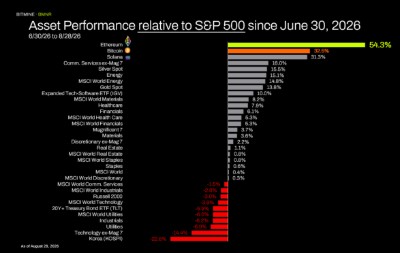
ETH is the best performing macro asset in 3Q26 so far, outperforming the S&P 500 by 5,430bp
Bitmine was added to the Russell 1000 Large-cap index on June 26, 2026
Bitmine’s Series A Preferred Stock is trading on the NYSE under the symbol BMNP
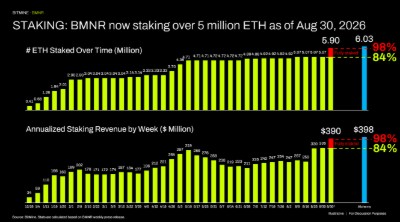
Bitmine has 5,067,309 staked ETH, representing $12.7 billion at $2,511 per ETH. MAVAN (Made in America VAlidator Network) is a premier Ethereum staking destination for BMNR and institutional investors
Bitmine owns $81 million of Eightco (NASDAQ: ORBS), now one of the only publicly listed equities in the world to provide investors indirect exposure to OpenAI
Bitmine Crypto + Total Cash Holdings & Marketable Securities + “Moonshots” total $15.6 billion, including 5.90 million ETH tokens, total cash & marketable securities of $541 million, and other crypto holdings
Bitmine remains supported by a premier group of institutional investors including ARK’s Cathie Wood, MOZAYYX, Founders Fund, Bill Miller III, Pantera, Kraken, DCG, Galaxy Digital and personal investor Thomas “Tom” Lee to support Bitmine’s goal of acquiring 5% of ETH
NORWALK, Conn., Aug. 31, 2026 /PRNewswire/ — (NYSE: BMNR) Bitmine Immersion Technologies, Inc. (“Bitmine” or the “Company”) a Bitcoin and Ethereum Network company with a focus on the accumulation of crypto for long term investment, today announced Bitmine crypto + total cash & marketable securities + “moonshots” holdings totaling $15.6 billion.
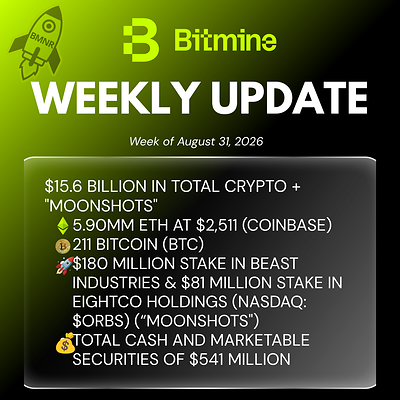
As of August 30, 2026 at 3:00pm ET, the Company’s crypto holdings are comprised of 5,901,112 ETH at $2,511 per ETH (per Coinbase NASDAQ: COIN), 211 Bitcoin (BTC), $180 million stake in Beast Industries, $81 million stake in Eightco Holdings (NASDAQ: ORBS) (“moonshots”) and total cash & marketable securities of $541 million. Bitmine’s ETH holdings are 4.9% of the ETH supply (of 120.7 million ETH).
“As we enter the final month of 3Q26, ETH is the best performing macro asset, outperforming the S&P 500 by 5,430bp through last Friday. In fact, the top 3 performing assets since June 30th are ETH, BTC and SOL,” stated Thomas “Tom” Lee, Chairman of Bitmine. “We believe this sets the stage for institutions to add to their crypto holdings given the substantial outperformance of crypto versus other macro assets in 3Q so far.”
“We believe there are multiple positive catalysts as we head into the final months of 2026,” stated Lee. “These include the upcoming CLARITY Act vote scheduled in mid-Sept. Additionally, Korean investors have again started buying crypto and rotating away from AI stocks. The 4-year cycle is bottoming within the next few weeks in our view. And this sets the stage for what we expect to be sizable institutional participation in buying crypto in the final months of 2026, especially given the tailwinds of tokenization and Agentic-AI.”
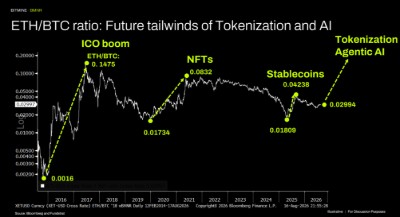
“This ETH/BTC ratio has moved up during crypto bull cycles, driven by increasing use of Ethereum relative to bitcoin. These prior cycles were fueled by ICOs (2017-2018), NFTs (2020-2021), and stablecoins (2025). In this upcoming crypto cycle, we see the ETH/BTC ratio rising, driven by Wall Street tokenizing on the blockchain and by agentic-AI using blockchains,” continued Lee.
“Over the past week, we acquired 53,501 ETH. Bitmine has bought ETH for each of the past 65 weeks (every week since the inception of the ETH Treasury Strategy on June 30, 2025),” stated Lee.
On July 16, 2026, Bitmine released the latest Chairman’s Message (link here) for July 2026. The title of the Message is “ETH is the cure for the Uncanny Valley of Wealth.”
Earlier in 2026, Bitmine launched MAVAN (the Made in America VAlidator Network), the institutional-grade staking platform. While MAVAN was originally developed to support Bitmine’s own Ethereum treasury, MAVAN intends to expand to serve institutional investors, custodians, and ecosystem partners seeking best-in-class staking infrastructure. A portion of Bitmine’s ETH is already staked on the MAVAN platform.
As of August 30, 2026, Bitmine total staked ETH stands at 5,067,309 ($12.7 billion at $2,511 per ETH). “Bitmine has staked more ETH than other entities in the world. At scale (when Bitmine’s ETH is fully staked by MAVAN and its staking partners), the projected ETH staking reward is $390 million on an annualized basis (using 2.63% 7-day BMNR yield),” stated Lee.
“Annualized staking revenues are now projected at $335 million. And this 5.1 million ETH is 86% of the 5.90 million ETH held by Bitmine. Bitmine’s own staking operations generated a 7-day yield of 2.63% (annualized),” continued Lee.
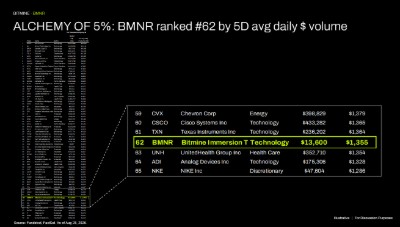
Bitmine is one of the most widely traded stocks in the US. According to data from Fundstrat, the stock has traded average daily dollar volume of $1.36 billion (5-day average, as of August 29, 2026), ranking #62 in the US, behind Texas Instruments (rank #61) and ahead of UnitedHealth Group (rank #63) among 5,704 US-listed stocks (statista.com and Fundstrat research).
Bitmine’s crypto holdings reign as the #1 Ethereum treasury and #2 global treasury, behind Strategy Inc. (NASDAQ: MSTR), which reportedly owns 840,447 BTC valued at approximately $66 billion. Bitmine remains the largest ETH treasury in the world.
Bitmine management believes the GENIUS Act and the Securities and Exchange Commission’s (SEC) Project Crypto are as transformational to financial services in 2026 as the US action on August 15, 1971, which ended the Bretton Woods system and took the U.S. dollar off the gold standard 55 years ago. This 1971 event was the catalyst for the modernization of Wall Street, creating the iconic Wall Street titans and financial and payment rails of today. These proved to be better investments than gold.
The Chairman’s message can be found here:
https://www.Bitminetech.io/chairmans-message
The Fiscal Full Year 2025 Earnings presentation and corporate presentation can be found here: https://Bitminetech.io/investor-relations/
To stay informed, please sign up at: https://Bitminetech.io/contact-us/
About Bitmine
Bitmine Immersion Technologies, Inc. (NYSE: BMNR), together with its subsidiaries (“Bitmine” or the “Company”), is a blockchain technology infrastructure company operating across institutional digital asset staking and validation services, bitcoin mining, and strategic digital asset management. As the world’s leading Ethereum Treasury company, it implements an innovative digital asset strategy for institutional investors and public market participants. The Company provides institutional-grade staking and validation infrastructure—through which it earns staking rewards and validation income—alongside bitcoin mining activities. Bitmine holds digital assets strategically, generating yield on those holdings to support liquidity and capital formation. Since 2025, the Company has expanded its blockchain infrastructure capabilities, including developing and deploying MAVAN, its institutional staking and validation platform. The Company’s activities further include investments in early-stage blockchain opportunities (“moonshot” investments) and ancillary mining, hosting, and consulting services.
For additional details, follow on X:
Forward Looking Statements
This press release contains statements that constitute “forward-looking statements” within the meaning of the Private Securities Litigation Reform Act of 1995, as amended. Forward-looking statements include all statements that are not purely historical and can generally be identified by terms such as “expects,” “projects,” “intends,” “plans,” “believes,” “anticipates,” “estimates,” “forecasts,” “targets,” “goals,” “may,” “will,” “would,” “could,” “should,” “view,” “see,” or similar expressions, or the negative of such terms, or other comparable terminology. This press release specifically contains forward-looking statements regarding, among other things: (i) the Company’s goal of acquiring 5% of the total ETH supply (the “Alchemy of 5%” initiative) and statements regarding its progress toward this goal; (ii) the Company’s digital asset accumulation and treasury strategy, including statements regarding continued weekly ETH acquisitions and the Company’s status as the largest ETH treasury in the world; (iii) the Company’s staking operations, including projected annualized ETH staking rewards of approximately $396 million at scale (assuming Bitmine’s ETH is fully staked by MAVAN and its staking partners), currently projected annualized staking revenues of approximately $340 million, and the 7-day yield of 2.67% (annualized); (iv) MAVAN’s intended expansion to serve institutional investors, custodians, and ecosystem partners seeking best-in-class staking infrastructure, and its intended position as a premier Ethereum staking destination for BMNR and institutional investors; (v) expectations regarding future ETH and other digital asset price performance, including statements regarding ETH’s performance relative to the S&P 500 and other macro assets in 3Q26 and the expectation that institutions will add to their crypto holdings; (vi) management’s belief that multiple positive catalysts exist heading into the final months of 2026, including the CLARITY Act vote scheduled for mid-September 2026, renewed buying by Korean investors and rotation away from AI stocks, the view that the four-year crypto cycle is bottoming within the next few weeks, and the expectation of sizable institutional participation in buying crypto in the final months of 2026, including the anticipated tailwinds of tokenization and agentic-AI; (vii) statements and expectations regarding the ETH/BTC ratio, including that the ratio will rise in the upcoming crypto cycle driven by Wall Street tokenizing on the blockchain and by agentic-AI using blockchains; (viii) management’s belief that the GENIUS Act and SEC Project Crypto are “as transformational to financial services” as the end of the Bretton Woods system in 1971, and that the resulting investments will prove better than gold; (ix) statements regarding the Company’s investment in Eightco Holdings (NASDAQ: ORBS) as providing indirect exposure to OpenAI, and its investment in Beast Industries; (x) statements regarding the value of the Company’s crypto, cash, marketable securities, and “moonshot” holdings, including aggregate holdings of $15.6 billion and ETH holdings representing 4.9% of the total ETH supply; and (xi) the future growth, advancement, and strategic direction of the Company’s Ethereum treasury strategy, blockchain infrastructure capabilities, bitcoin mining operations, and MAVAN staking platform.
These forward-looking statements involve substantial risks and uncertainties that could cause actual results to differ materially from those expressed or implied. Factors that could cause or contribute to such differences include, but are not limited to: the extreme volatility and unpredictability of digital asset prices, including ETH and Bitcoin, and the speculative nature of digital asset investments; the risk that historical ETH price movements and relative performance versus other macro assets will not recur or are not indicative of future performance; the Company’s reliance on third-party pricing sources and reported market values in calculating the value of its crypto, cash, marketable securities, and “moonshot” holdings, and the risk that such values fluctuate materially after the date and time referenced in this release; changes in market conditions affecting the trading price and trading volume of the Company’s common stock and Series A Preferred Stock, and the risk that the Company’s inclusion in the Russell 1000 index does not produce anticipated benefits; the Company’s ability to successfully execute its digital asset acquisition strategy and achieve its ETH accumulation targets, including the “Alchemy of 5%” goal; the Company’s ability to finance its business operations, Ethereum treasury operations, and MAVAN expansion; operational, security, and technological risks associated with the Company’s staking and validation operations, including network failures, slashing events, cybersecurity breaches, and protocol changes; the risk that actual staking participation, yields, rewards, and revenues differ materially from the projected amounts described in this release, which are based on a 7-day yield and assume ETH is fully staked at scale; competition in the digital asset treasury, staking, and mining industries; the Company’s dependence on key personnel, including executive leadership; regulatory developments affecting digital assets, blockchain technology, and staking activities in the United States and globally, including the timing and outcome of the scheduled CLARITY Act vote and the ultimate enactment, implementation, and interpretation of the GENIUS Act and other pending legislation and regulatory initiatives; actions by the SEC, CFTC, and other regulatory bodies affecting digital assets and related businesses; risks related to the Company’s investments in early-stage blockchain opportunities (“moonshot” investments), including the investments in Eightco Holdings and Beast Industries and any indirect exposure to OpenAI; macroeconomic factors, including inflation, interest rates, Federal Reserve monetary policy, labor market conditions, investor flows in international markets, and general economic conditions affecting investor sentiment toward digital assets; the accuracy of management’s expectations regarding the ETH/BTC ratio and the impact of tokenization and agentic-AI applications on Ethereum; the unpredictability of cryptocurrency market cycles and the accuracy of expectations regarding future crypto cycles, including whether the four-year cycle bottoms as anticipated and whether institutional participation materializes; changes to the Ethereum protocol, including staking mechanics, validator requirements, and reward structures; risks related to AI systems and their potential impact on cryptocurrency markets and blockchain technology; the performance of third-party service providers, exchanges, custodians, and staking partners; risks related to the concentration of the Company’s assets in digital currencies, particularly Ethereum; and the other risk factors described in the Company’s filings with the SEC.
The forward-looking statements contained in this press release are based on information available to management as of the date of this release and reflect management’s current expectations, estimates, forecasts, projections, views, and beliefs concerning future events and circumstances. Actual results may vary materially from those expressed or implied by forward-looking statements based on a number of factors, including those described above and in the Risk Factors section of the Company’s Annual Report on Form 10-K for the fiscal year ended September 30, 2025 filed with the SEC on November 21, 2025, the Company’s Quarterly Reports on Form 10-Q, and the Company’s other filings with the SEC, as amended or updated from time to time. Copies of these filings are available on the SEC’s website at www.sec.gov and on the Company’s website at https://Bitminetech.io/investor-relations/. The Company cautions readers not to place undue reliance on any forward-looking statements, which speak only as of the date on which they are made. Bitmine expressly disclaims any obligation or undertaking to update, revise, or supplement any forward-looking statements to reflect any change in its expectations or any change in events, conditions, or circumstances on which any such statements are based, except as required by applicable law or regulation.
 View original content to download multimedia:https://www.prnewswire.co.uk/news-releases/bitmine-immersion-technologies-bmnr-announces-eth-holdings-reach-5-90-million-tokens-and-total-crypto-and-total-cash-holdings-of-15-6-billion-302864602.html

31, Aug 2026
Rockwell Automation Integrates Plex QMS with FactoryTalk Analytics VisionAI to Advance AI-Driven Quality, Continues AI Expansion
Integration brings AI-powered visual inspection into QMS workflows to help improve quality, traceability and defect detection
MILWAUKEE, Aug. 31, 2026 /PRNewswire/ — Rockwell Automation, Inc. (NYSE:ROK), the world’s largest company dedicated to industrial automation and digital transformation, on Aug. 11, 2026 announced an API-enabled integration between Plex Quality Management System (QMS) and FactoryTalk® Analytics™ VisionAI™. The integration, available from Aug. 11, expands AI-driven quality management and reflects Rockwell’s continued investment in artificial intelligence and elastic MES solutions.

Rockwell continues to advance AI/ML across its offerings, including cloud-based MES platforms, edge AI and digital twins. According to Rockwell’s “Scaling MES Across the Enterprise” report, 42% of manufacturing processes are expected to become AI-supported within the next year. The Plex QMS and FactoryTalk Analytics VisionAI integration offers manufacturers opportunities for strategic, automated quality intelligence.
“AI plays a critical role in Rockwell’s industrial autonomy strategy,” states Devin Burke, group product manager, Rockwell Automation. “With predictive intelligence, manufacturers can shift from scripted automation to adaptable autonomy as systems learn, adjust and collaborate across software, hardware and workers.”
The integration builds on the API-first architecture of Plex QMS, enabling interoperability. When connected to FactoryTalk Analytics VisionAI, Plex QMS delivers AI-driven workflows to new and existing camera systems. These workflows help detect anomalies and reduce defects. Traditional visual inspection is only 80% effective and often fails to store inspection history. The Plex QMS and FactoryTalk Analytics VisionAI integration delivers exceptional visual inspection, as results recorded in the Plex system provide traceability, product serialization and an accurate record of inspection history.
In addition to the new integration, Plex Connected Worker recently introduced AI-powered authoring agent within the Digital Work Instructions suite, which transforms CAD files and technical assets into structured, step-by-step instructions for frontline employees. Similarly, Plex includes an AI agent embedded within its Reporting and Analytics capabilities, delivering out‑of‑the‑box dashboards that turn operational data into real-time, actionable insights. Users can engage these agents in natural language to proactively surface risks, predict issues, and drive faster, smarter decisions—moving from operational foresight to action with a single click.
“At Rockwell Automation, we’ve built a context-rich industrial data foundation shaped by years of manufacturing expertise,” shares Manu Ravichandran, senior product manager, Rockwell Automation. “This foundation gives manufacturers the structure, context, and scalability needed to operationalize advanced analytics and AI across complex operations.”
You can learn more about Plex QMS here and FactoryTalk Analytics VisionAI here
About Rockwell Automation
Rockwell Automation, Inc. (NYSE: ROK), is a global leader in industrial automation and digital transformation. We connect the imaginations of people with the potential of technology to expand what is humanly possible, making the world more productive and more sustainable. Headquartered in Milwaukee, Wisconsin, Rockwell Automation employs approximately 26,000 problem solvers dedicated to our customers in more than 100 countries as of fiscal year end 2025. To learn more about how we are bringing Connected Enterprise to life across industrial enterprises, visit www.rockwellautomation.com
 View original content to download multimedia:https://www.prnewswire.com/in/news-releases/rockwell-automation-integrates-plex-qms-with-factorytalk-analytics-visionai-to-advance-ai-driven-quality-continues-ai-expansion-302864883.html

31, Aug 2026
Happy Cultures Adds a Dubai Kunafa Twist to the Protein Category with Its Latest Launch
Aug, 31: Indian health and wellness company Happy Cultures has launched Dubai Kunafa Yeast Protein, bringing the popular Dubai Kunafa flavour profile to the growing protein category. Priced at an MRP of INR 2,199, the new product combines Happy Cultures’ yeast protein with real pistachios, offering a more indulgent take on everyday protein consumption.

Each serving delivers 24g of complete yeast protein with a PDCAAS score of 1, indicating a high-quality protein source with a complete amino acid profile. Made with 100% yeast protein isolate, the formulation contains no added sugar or artificial sweeteners, is naturally sweetened with monk fruit, and is free from lactose, dairy, gluten and soy. The addition of probiotics further supports its positioning as a convenient, gut-friendly protein option for consumers seeking a balance of nutrition, taste and indulgence.
The launch comes as protein consumption in India moves beyond traditional fitness audiences, with consumers increasingly looking for products that combine nutritional value with taste, convenience and variety. According to IMARC group, the protein supplement market in India is anticipated to reach Rs. 13,186 crore (US$ 1.52 billion) by 2033.
The product has also undergone independent testing by Eurofins Analytical Services India, with each batch evaluated across key parameters including nutritional composition, amino acid profile, melamine and heavy metal contaminants. It is available through Happy Cultures’ website, Swiggy, Zepto, Big Basket, Amazon and Flipkart.
Speaking about the launch, Mr. Amit Monteiro, CEO, Happy Cultures, said,
“Protein is becoming a crowded category, and we believe the next phase of innovation will be about making the experience more exciting for consumers. Dubai Kunafa is a flavour people already recognise and enjoy, so bringing it into yeast protein felt like a natural way to make the category more interesting.”
“We want consumers to look at yeast protein differently,” added Monteiro. “Innovation in protein does not have to stop at the usual vanilla, chocolate or coffee flavours. There is an opportunity to build products around flavours that are culturally relevant, familiar and genuinely enjoyable.”
A key differentiator of the product is the inclusion of real pistachios, which Happy Cultures says is intended to bring greater authenticity to the Dubai Kunafa-inspired flavour rather than relying only on flavouring. The product is positioned within the company’s premium protein portfolio, with flavour innovation forming an important part of its approach to product development.
The launch also reflects the growing influence of social media-led food trends on mainstream consumption. Dubai chocolate and Kunafa-inspired flavours have gained significant consumer interest, creating opportunities for food and wellness brands to translate emerging preferences into new product formats.
For Happy Cultures, yeast protein is a growing part of its broader protein innovation strategy. The company sees an opportunity to move the category beyond conventional flavours and create products that appeal to consumers through a combination of nutrition, taste, ingredients and experience.
The Dubai Kunafa Yeast Protein joins Happy Cultures’ broader portfolio spanning proteins, nutritional supplements and Gut First Solutions, as the company continues to develop products around emerging consumer preferences and evolving wellness needs.
31, Aug 2026
KuCoin Launches KuLeague With 400,000 USDT Reward Pool and Dynamic Team Rematching
PROVIDENCIALES, Turks and Caicos Islands, Aug. 31, 2026 /PRNewswire/ — KuCoin, a global crypto platform built on trust, today launched KuLeague, its new flagship futures trading competition series. The inaugural season is now live with KuCoin Futures’ reward pool of 400,000 USDT, a new Dynamic Team Matching mechanism designed to keep more participants competitive, and a 35% direct referral commission integrated into the team experience.
At the core of KuLeague is an adaptive team structure for a smooth trading competition experience. Eligible participants form squads of five or more and compete based on their combined eligible futures trading volume for a share of the 100,000 USDT team prize pool. Through Dynamic Team Matching*, participants whose teams do not meet the minimum member threshold may be reassigned on September 14, 2026, to teams that satisfy the relevant requirements. This allows eligible participants to continue competing for team rewards as part of their new team.
Beyond the team competition, KuLeague now provides multiple ways for eligible participants to compete for rewards*, including:
- 240,000 USDT allocated to daily draw rewards
- 50,000 USDT allocated to solo P&L race
- 35% direct referral commission on qualifying referral activity
- Multi-tier rewards supporting broader participation
This multi-path structure accommodates different experience levels and trading styles. Integrating referral incentives directly into the competition also connects team collaboration with community growth.
Together, these refinements create a more inclusive and resilient format — one that limits the impact of inactive squads, recognizes different forms of participation and keeps more traders in contention. Fall Season 2026 marks the beginning of a recurring KuLeague series that will evolve across future seasonal cycles.
The campaign runs from August 31 to September 21, 2026. Visit the KuLeague campaign page for full details*.
About KuCoin
Founded in 2017, KuCoin is a leading global crypto platform built on trust and security, serving over 45 million users across 200+ countries and regions. Known for its reliability and user-first approach, the platform combines advanced technology, deep liquidity, and strong security safeguards to deliver a seamless trading experience. KuCoin provides access to 1,500+ digital assets through a broad product suite and remains committed to building transparent, compliant, and user-centric digital asset infrastructure for the future of finance, backed by SOC 2 Type II, ISO/IEC 27001:2022, ISO/IEC 27701:2019, ISO 22301:2019 and ISO/IEC 42001:2023 certifications. In recent years, we have built a strong global compliance foundation, marked by key milestones including AUSTRAC registration in Australia, a MiCA license in Europe, and regulatory progress in other markets.
Learn more at www.kucoin.com.
Disclaimer
*Terms and Conditions apply. Participation, certain products, services, campaign features and rewards may not be available in all jurisdictions.
The information is for corporate PR purposes only and does not constitute endorsement or investment advice.
Futures trading involves substantial risk and may result in significant financial losses. Read our Risk Disclosure.

 View original content to download multimedia:https://www.prnewswire.co.uk/news-releases/kucoin-launches-kuleague-with-400-000-usdt-reward-pool-and-dynamic-team-rematching-302861629.html

31, Aug 2026
Aon to acquire USI to establish the premier U.S. middle-market platform
- Builds on the successful acquisition of NFP to advance leading platform in the large and growing U.S. middle market
- Extends Aon’s differentiated capabilities to provide better choice, superior solutions and greater value for clients
- Expands Aon’s access to the Excess & Surplus (E&S) segment, among the fastest-growing areas in U.S. commercial insurance
- Enhances Aon’s industry-leading data platform, deepening its context advantage
- Following the close of the transaction, USI Chairman and CEO Mike Sicard will serve as President of Aon plc and global CEO of Middle Market for the firm
- Purchase price of $17.0 billion; transaction expected to deliver $395 million in annual run-rate net adjusted EBITDA impact from revenue and cost synergies across the combined middle-market platform and to be accretive to adjusted EPS in 2028
- Aon to host conference call to discuss transaction on August 31, 2026, at 8:00 AM ET
DUBLIN, Aug. 31, 2026 /PRNewswire/ — Aon plc (NYSE: AON), a leading global professional services firm, today announced the signing of a definitive agreement to acquire USI from KKR and other shareholders for a total purchase price of $17.0 billion. The transaction establishes the premier platform in the large and growing U.S. middle-market segment, building on the success of Aon’s acquisition of NFP in 2024.
USI, a leading provider of property & casualty, employee benefit, personal risk and retirement solutions for the middle market, is the tenth largest U.S. insurance broker with approximately $3 billion in annual revenue and more than 10,500 team members across nearly 200 U.S. offices. Powered by its proprietary USI ONE® platform for analytics, networked resources and strategic planning to inform and advise clients, USI is highly complementary with Aon’s one-firm, Aon United strategy and global Aon Business Services operating and technology engine.
“In a time of rising complexity and volatility, creating better outcomes for clients across their risk and people challenges requires a combination of capabilities and expertise supported by proprietary data, analytics and technology,” said Greg Case, President and CEO of Aon. “Through the successful execution of our 3×3 Plan to accelerate our Aon United strategy, we have significantly strengthened our firm to build the industry’s most differentiated model: what we call our context advantage.”
Case added: “Combining with USI will establish the premier U.S. middle-market platform, deepen our context advantage and position Aon to accelerate organic growth. Building on the success of our acquisition of NFP, USI will substantially enhance our middle-market footprint and expand access for our firm in the E&S segment to deliver content, capabilities and expertise to a broader client base, while enabling client leaders to expand relationships and win new business. Our combined data platform will generate richer insight, advance the development of innovative, AI-driven solutions and expand the universe of insurable risk, while further reinforcing the context advantage that differentiates Aon. For nearly two decades, Mike Sicard has built and led a high-performing and integrated team, and I am excited about the opportunities we will create together for our clients, colleagues and shareholders.”
Following the close of the transaction, USI Chairman and CEO Mike Sicard will serve as President of Aon plc and global CEO of Middle Market, reporting to Case, and join the Aon Executive Committee.
“Joining Aon represents a truly energizing next chapter for our firm and an opportunity to accelerate our momentum as part of the Aon United platform,” said Sicard. “Our firms share strong, one-firm cultures with a deep commitment to working together to bring the best of our capabilities to clients. I look forward to leading Aon’s middle-market platform and uniting the strengths of USI, NFP and Aon to deliver a new standard of content, capabilities and service to our clients.”
Compelling Strategic and Financial Rationale
- Establishes the leading platform in the large and growing U.S. middle-market segment. The addition of USI substantially enhances Aon’s presence in the more than $40 billion U.S. middle-market segment. The middle-market segment represents more than one third of U.S. commercial P&C direct written premium. The acquisition will also extend Aon’s capabilities across health, talent and Human Capital advisory offerings to provide better choice, superior solutions and greater value for clients.
- Expands Aon’s direct access to the E&S segment, distributed through Managing General Agents, Managing General Underwriters and Wholesalers. USI’s emerging wholesale capabilities will strengthen Aon’s ability to meet a wider range of client needs and meaningfully participate in the E&S segment, among the fastest-growing areas in U.S. commercial insurance, representing 26% of U.S. commercial P&C premiums.
- Enhances Aon’s industry-leading data platform, deepening its context advantage. The transaction will expand Aon’s data ecosystem and augment the firm’s proprietary data flow, fidelity and analytics to generate richer insights and deliver differentiated, AI-enabled solutions and drive better client outcomes.
- Unites organizations with shared one-firm mindsets and proven leadership teams, facilitating a faster, more seamless integration and greater value capture. Powered by its proprietary USI ONE® platform for analytics, USI is highly complementary with Aon’s one-firm, Aon United strategy and global Aon Business Services operating and technology engine. With experienced leadership across USI, NFP and Aon, the combined firm will be well positioned to capture the unique value of its middle-market platform.
- Creates compelling long-term shareholder value with significant synergies, enhanced growth opportunities and larger addressable markets. The combination is expected to accelerate organic growth across Aon’s middle-market platform by enhancing client access to value-added capabilities. Building on the firm’s demonstrated success in integrating NFP, Aon has a clear path to deliver approximately $395 million in annual run-rate net adjusted EBITDA impact from identified revenue and cost synergies across the combined middle-market platform. Aon expects the acquisition to be accretive to adjusted EPS in 2028 and thereafter.
Transaction Details
The purchase price for USI is $17.0 billion, or $16.7 billion on a net basis, which reflects approximately $278 million of certain tax attributes. The net purchase price represents approximately 14.5x on a synergized trailing twelve-month adjusted EBITDA basis.
Aon expects to fund the transaction, as well as related transaction expenses and other costs, with new debt raised across a range of maturities, subject to market conditions.
The firm expects to maintain its current rating of Baa2 with Moody’s and A- with S&P. Aon will continue to execute its disciplined capital allocation strategy, prioritizing de-leveraging, funding a stable and growing dividend and balancing investments for growth with return of excess capital. Consistent with this strategy, the firm does not expect to repurchase shares in the near-term as it prioritizes debt repayment.
The transaction has been unanimously approved by the Board of Directors of Aon and the Board of Directors of USI. Closing of the transaction is subject to customary conditions, including regulatory approvals, and is expected to occur in the fourth quarter of 2026. Aon and USI will continue to operate independently until the closing date.
Conference Call, Presentation Slides and Webcast Details
The firm will host a conference call on August 31, 2026, from 8:00-8:45 AM ET. Interested parties can listen to the conference call via a live audio webcast and view the presentation slides at ir.aon.com.
Advisors
BofA Securities and Citi served as financial advisors to Aon on the transaction. Cravath, Swaine & Moore LLP acted as legal counsel to Aon, McDermott Will & Schulte LLP acted as legal advisor to Aon with respect to regulatory matters and Skadden, Arps, Slate, Meagher & Flom is acting as financing counsel to Aon.
About USI Insurance Services
USI is one of the largest insurance brokerage and consulting firms in the United States, delivering property and casualty, employee benefits, personal risk, program and retirement solutions to its clients nationwide. Headquartered in Valhalla, New York, USI connects more than 10,500 industry-leading professionals from nearly 200 offices to serve clients’ needs. USI has become a premier insurance brokerage and consulting firm by leveraging the USI ONE Advantage®, an interactive platform that integrates proprietary and innovative client solutions, networked local resources and enterprise-wide collaboration to deliver customized results with positive, bottom-line impact. For more information about USI, please visit www.usi.com.
About Aon
Aon plc (NYSE: AON) exists to shape decisions for the better — to protect and enrich the lives of people around the world. Through actionable analytic insight, globally integrated Risk Capital and Human Capital expertise, and locally relevant solutions, our colleagues provide clients in over 120 countries with the clarity and confidence to make better risk and people decisions that protect and grow their businesses.
Follow Aon on LinkedIn, X, Facebook and Instagram. Stay up-to-date by visiting Aon’s newsroom and sign up for news alerts here.
Media Contacts
Aon
mediainquiries@aon.com
Toll-free (U.S., Canada and Puerto Rico): +1 833 751 8114
International: +1 312 381 3024
USI
Nate Forsberg
USI Insurance Services
610-619-5669
Nate.Forsberg@usi.com
Investor Relations Contact
investor.relations@aon.com
Safe Harbor Statement
This communication contains certain statements related to future results, or states Aon’s intentions, beliefs and expectations or predictions for the future, all of which are forward-looking statements as that term is defined in the Private Securities Litigation Reform Act of 1995. These forward-looking statements are subject to certain risks and uncertainties that could cause actual results to differ materially from either historical or anticipated results depending on a variety of factors. These forward-looking statements include information about possible or assumed future results of Aon’s operations. All statements, other than statements of historical facts, that address activities, events or developments that Aon expects or anticipates may occur in the future, including, without limitation, statements about Aon’s outlook, expected market and industry conditions, including competitive and pricing trends, the development and performance of Aon’s services and products, the expected timing and closing requirements for completing the proposed acquisition, the expected benefits of the proposed acquisition, including advances in the middle-market segment and access to the Excess & Surplus segment, business generation, revenue and cost synergies, increased profitability, the timing of value capture and costs and other anticipated financial impacts of the proposed acquisition, including with respect to credit ratings, expected governance and stakeholder value impacts as a result of the proposed acquisition, Aon’s expected cost structure and the outcome of cost-saving or restructuring initiatives, including the impacts of the Accelerating Aon United Program and the integration of USI, Aon’s, USI’s and the combined firm’s plans, objectives, expectations and intentions, actual or anticipated legal settlement expenses, future capital expenditures, growth in commissions and fees, changes to the composition or level of our revenues, cash flow and liquidity, expected tax rates, expected foreign currency translation impacts, business strategies, competitive strengths, goals, the benefits of new initiatives, growth of Aon’s business and operations, plans and references to future successes are forward-looking statements. Also, when Aon uses words such as “anticipate”, “believe”, “continue”, “confidence”, “conviction”, “could”, “estimate”, “expect”, “forecast”, “intend”, “looking forward”, “may”, “might”, “plan”, “potential”, “opportunity”, “commit”, “probably”, “project”, “positioned”, “should”, “will”, “would” or similar expressions, it is making forward-looking statements.
The following factors, among others, could cause actual results to differ materially from those set forth in or anticipated by the forward-looking statements: the possibility that the proposed acquisition will not be consummated, uncertainties relating to the timing of consummation of the proposed acquisition, failure to obtain necessary regulatory approvals or to satisfy any of the other conditions to the proposed acquisition, adverse effects on the market price of Aon’s securities and on Aon’s operating results for any reason, including, without limitation, because of the failure to consummate the proposed acquisition, the failure to realize the expected benefits of the proposed acquisition (including anticipated revenue and cost synergies), the failure to effectively integrate the combined companies following consummation of the proposed acquisition, the diversion of management time on transaction-related issues, negative effects of an announcement of the proposed acquisition, changes in global, political, economic, business, competitive, market and regulatory forces, future exchange and interest rates, changes in tax laws, regulations, rates and policies, future business acquisitions or disposals, or any announcement relating to the consummation of or failure to consummate the proposed acquisition on the market price of Aon’s securities, significant transaction and integration costs or difficulties in connection with the proposed acquisition and/or unknown or inestimable liabilities, potential litigation associated with the proposed acquisition, the potential impact of the announcement or consummation of the proposed acquisition on relationships, including with suppliers, customers, employees and regulators, and general economic, business and political conditions (including any epidemic, pandemic or disease outbreak) that affect the combined companies following the consummation of the proposed acquisition.
Any or all of Aon’s forward-looking statements may turn out to be inaccurate, and there are no guarantees about Aon’s performance. The factors identified above are not exhaustive. Aon and its subsidiaries operate in a dynamic business environment in which new risks may emerge frequently. Accordingly, you should not place undue reliance on forward-looking statements, which speak only as of the dates on which they are made.
In addition, results for prior periods are not necessarily indicative of results that may be expected for any future period. Further information concerning Aon and its businesses, including factors that could materially affect Aon’s financial results, is contained in Aon’s filings with the SEC. See Aon’s Annual Report on Form 10-K for the year ended December 31, 2025 and subsequent Quarterly Reports on Form 10-Q for further discussion of these and other risks and uncertainties applicable to Aon and its businesses. These factors may be revised or supplemented in subsequent reports filed with the SEC. Aon is not under, and expressly disclaims, any obligation to update or alter any forward-looking statement that it may make from time to time, whether as a result of new information, future events or otherwise.
No Offer or Solicitation
This communication is for information purposes only and is not intended to and does not constitute, or form part of, an offer, invitation or the solicitation of an offer or invitation to purchase, otherwise acquire, subscribe for, sell or otherwise dispose of any securities, nor shall there be any sale, issuance or transfer of securities in any jurisdiction in contravention of applicable law. No offer of securities shall be made in the United States absent registration under the U.S. Securities Act of 1933, as amended, or pursuant to an exemption from, or in a transaction not subject to, the registration requirements thereof.
Explanation of Non-GAAP Measures
This communication includes supplemental information not calculated in accordance with generally accepted accounting principles in the United States (“U.S. GAAP”), including Aon’s organic revenue growth, USI’s EBITDA, USI’s adjusted EBITDA, synergized adjusted EBITDA, Aon’s adjusted diluted net income per share (“adjusted EPS”) and certain other noteworthy items that affected results for the comparable periods. Organic revenue growth includes the impact of intercompany activity and excludes foreign exchange rate changes, acquisitions (provided that organic revenue growth includes organic growth of an acquired business as calculated assuming that the acquired business was part of the combined company for the same proportion of the relevant prior year period), divestitures (including held for sale disposal groups, which are adjusted from organic revenue growth upon classification as held for sale, if any), transfers between revenue lines, fiduciary investment income and gains or losses on derivatives accounted for as hedges. Reconciliations to the closest U.S. GAAP measure for each non-GAAP measure presented in this communication are provided in the attached appendices. Supplemental organic revenue growth information and additional measures that exclude the effects of certain items noted above do not affect net income or any other U.S. GAAP reported amounts. EBITDA is net income minus the impact of interest, taxes, depreciation and amortization. Adjusted EBITDA is EBITDA minus the impact of earnout adjustments and accretion of discount, certain acquisition related tax obligations, certain restructuring costs and management fees. Synergized adjusted EBITDA, presented including the full benefit of estimated run-rate cost and net revenue synergies expected to be substantially realized in the period between the anticipated closing date and 2029, is based on management’s estimates, assumptions and projections and has not been prepared in conformance with the applicable requirements of Regulation S-X relating to pro forma financial information, and the required pro forma adjustments have not been applied and are not reflected therein. This information should not be considered in isolation from, or as a substitute for, the historical financial statements of USI. This information does not reflect what USI’s financial condition or results of operations would have been had the proposed transaction occurred on or prior to the dates indicated. Various factors could cause actual future results to differ materially from those currently estimated by management, including, but not limited to, the risks described above and in Aon’s filings with the SEC. Management believes that these measures are important to make meaningful period-to-period comparisons and that this supplemental information is helpful to investors. Management also uses these measures to assess operating performance and performance for compensation. Non-GAAP measures should be viewed in addition to, not in lieu of, Aon’s Condensed Consolidated Financial Statements. Industry peers provide similar supplemental information regarding their performance, although they may not make identical adjustments. Aon does not provide a reconciliation of forward-looking non-GAAP measures, such as EBITDA, adjusted EBITDA and synergized adjusted EBITDA, where Aon believes such a reconciliation would imply a degree of precision and certainty that could be misleading and is unable to reasonably predict certain items contained in the corresponding GAAP measures without unreasonable efforts. This is due to the inherent difficulty of forecasting the timing or amount of various items that have not yet occurred and are out of Aon’s control or cannot be reasonably predicted. These items are uncertain, depend on various factors and could have a material impact on U.S. GAAP reported results. For these reasons, Aon is also unable to address the probable significance of the unavailable information.
 View original content to download multimedia:https://www.prnewswire.co.uk/news-releases/aon-to-acquire-usi-to-establish-the-premier-us-middle-market-platform-302864639.html

31, Aug 2026
Manipal Hospitals Joins Hands with Sarla Aviation and Aeromed to Transform Emergency Medical Transport in India
BENGALURU, India, Aug. 31, 2026 /PRNewswire/ — In a significant step towards transforming emergency medical transportation in India, Manipal Hospital Old Airport Road has signed a tripartite Memorandum of Understanding (MoU) with Sarla Aviation and Aeromed International Rescue Services to explore the development of next-generation air ambulance services using electric vertical take-off and landing (eVTOL) aircraft.

The partnership brings together Sarla Aviation’s eVTOL technology, Manipal Hospitals’ network of hospitals and clinical expertise, and Aeromed’s experience in air ambulance and medical evacuation services. The aim is to develop a seamless system that can transport patients directly between their location and the appropriate hospital, helping reduce delays caused by road traffic and long-distance travel.
The MoU, signed on August 7, 2026, will focus on developing the aircraft’s medical cabin, establishing patient transfer procedures and identifying medical routes where faster transportation could make a critical difference. The partners will also work on emergency transfers for trauma, heart attacks, strokes, newborns requiring specialised care and organ transplantation.
As part of the collaboration, the teams will jointly work on designing the medical bay and integrating essential equipment into Sarla Aviation’s Shunya eVTOL aircraft, while keeping patient safety and comfort at the centre. They will also develop standard procedures for transferring patients between ground ambulances, the aircraft and hospitals, including protocols for situations where patients require urgent escalation of care. Training programmes, insurance and safety frameworks, as well as research into patient outcomes, will also form part of the collaboration.
Speaking about the potential of such technologies, Shri. Kinjarapu Ram Mohan Naidu, Minister of Civil Aviation of India, said, “What we have to now provide is seamless connectivity from the airport to the doorstep. That is where this will be very, very instrumental. With the kind of urbanisation and increase in population that we are seeing, we have to bring in new technologies to cater to that.”
For patients and families, the potential impact is significant. In medical emergencies, every minute can matter. A dedicated air ambulance service that can avoid congested roads and connect patients more quickly to specialised medical care could help make emergency and inter-hospital transfers faster and more efficient.
Dr. H. Sudarshan Ballal, Chairman, Manipal Hospitals, said, “Healthcare is constantly evolving, and our responsibility is to embrace innovations that can make care more accessible, timely and effective. The integration of advanced aviation technology with our healthcare expertise has the potential to significantly transform emergency and inter-hospital patient transfers. Through this collaboration, we hope to help shape a safe, clinically robust and scalable model for next-generation air ambulance services in India, with the patient firmly at the centre.”
For more information, please visit: https://www.manipalhospitals.com/
 View original content to download multimedia:https://www.prnewswire.com/in/news-releases/manipal-hospitals-joins-hands-with-sarla-aviation-and-aeromed-to-transform-emergency-medical-transport-in-india-302864825.html