


13, Aug 2026
Initial Portfolio, Retail Offer and Capital Access Window
This announcement contains inside information for the purposes of Article 7 of the UK version of Regulation (EU) No 596/2014 which is part of UK law by virtue of the European Union (Withdrawal) Act 2018, as amended. Upon the publication of this announcement via a Regulatory Information Service, this inside information is now considered to be in the public domain.
Shaires Holdings Ltd
(“Shaires Holdings” or the “Company“)
LONDON, Aug. 13, 2026 /PRNewswire/ — Shaires Holdings Ltd (AIM: SHR), the publicly quoted London investment company providing investors with exposure to leading private mid-and late-stage global technology and AI companies, is pleased to announce several new initiatives today. Highlights include:
- Initial portfolio established: binding agreements in place, subject to customary closing conditions, providing exposure to Anthropic, Stripe, ByteDance, Moonshot AI, Figure AI, SandboxAQ and Colossal Biosciences, with an aggregate value of up to US$86.7 million.
- Retail offer for UK investors only, managed by Marex Financial (“Marex”), launching today at US$20.00 per share, alongside the recently announced US$28.5 million institutional placement, which was also priced at US$20.00 per share, with details set out in a separately issued press release.
- A Capital Access Window will be initiated. This is a voluntary pause to the trading of a Company’s shares to make it easier for companies to reach a broader range of investors, including retail investors, during a fundraise. It will remain in place until completion of the Retail Offer.
- Additional investment and contribution opportunities of up to US$500 million are under advanced negotiation, including further investments into leading private technology and AI names, and will be announced upon reaching definitive agreements.
- Targeting a total raise of US$100 million across the first and second institutional tranches and the retail offer as well as initial in-kind contributions.
- An overview video of the Company by CEO Vivek Seth is available on-demand at: https://shaires-holdings.com/?preview=cav81dllxremeq.
Initial Portfolio
In order to establish its initial investment portfolio, the Company has entered into binding option agreements to purchase up to US$40 million of interests in special purpose vehicles (“SPVs”) managed by Rizvi Traverse (a company connected to Suhail Rizvi, Executive Chairman of Shaires and a related party to the Company), that provide exposure to some of the world’s most significant private technology companies:
- Anthropic, the frontier AI company behind the Claude family of models
- Stripe, a leading financial infrastructure company for businesses
- Figure AI, the first-of-its kind AI robotics company working on general purpose humanoids
In addition, the Company has entered into a subscription agreement with a third-party SPV providing exposure to ByteDance (US$15.0 million), the leading global technology group behind TikTok, Douyin and Doubao. The Company has also entered into a subscription agreement to acquire an interest in Moonshot AI (US$5.0 million), the leading Chinese AI lab behind the Kimi series of open-source models. Furthermore, as part of its in-kind, share-for-share contribution programme, the Company has entered into contribution agreements with certain counterparties that are contributing US$14.8 million of interests in SPVs providing exposure to SandboxAQ, a leading AI and quantum computing company as well as U$12.0 million of shares in Colossal Biosciences, an advanced genetics and biosciences company working on “de-extinction”. The aggregate total maximum value of all the initial commitments amounts to US$86.7 million.
|
Portfolio Company |
Investment Type |
Investment Amount¹ |
|
Anthropic |
Binding option agreement |
Up to $16.2m |
|
Bytedance |
Cash investment |
$15.0m |
|
SandboxAQ |
In-kind contribution |
$14.8m |
|
Figure AI |
Binding option agreement |
Up to $14.5m |
|
Colossal Biosciences |
In-kind contribution |
$12.0m |
|
Stripe |
Binding option agreement |
Up to $9.2m |
|
Moonshot AI |
Cash investment |
$5.0m |
|
Total |
Up to $86.7m |
|
|
1 For more details, refer to the Company’s separate transaction announcements; subject to completion. |
||
The Company is in advanced discussions regarding further investments into leading private technology and AI companies and will provide regular updates when definitive agreements are signed, in keeping with the Company’s intention to build a portfolio in excess of US$500 million in the near-term. These opportunities are at varying stages of negotiation and documentation and there is no certainty that any will be completed.
The initial portfolio will be funded, in part, by the Company’s institutional raise, conducted through direct subscriptions for new ordinary shares at US$20.00 per share, under which a first tranche of US$28.5 million has been completed through the subscription of 1,424,000 new ordinary shares as announced on 30 July 2026. The investments in SandboxAQ and Colossal Biosciences as part of the in-kind programme are funded by the issuance of 1,341,821 new ordinary shares (“Contribution Shares”). Under the in-kind programme, the Company will issue new ordinary shares at $20.00 per share.
Retail Offer
As announced in a separate release a retail offer (“WRAP Retail Offer”), managed by Marex, is being launched today at a price of $20.00 per share, the same price as the initial institutional raise.
The Company’s capital raising programme is ongoing: a second institutional tranche is in progress alongside the retail offer. Across the two institutional tranches, in-kind programme and the retail offer, the Company is targeting a total raise of US$100 million. Further updates on the fundraise will be provided in due course.
Capital Access Window
Following the updates to the AIM Rules for Companies announced earlier this month, the Company has decided to utilise a Capital Access Window. This is a voluntary pause to the trading of a Company’s shares to make it easier for companies to reach a broader range of investors, including retail investors, during a fundraise. From 07:30am today, the Company’s shares will enter a Capital Access Window until a further announcement is made detailing the close of the WRAP Retail Offer.
New Shares Admission and Total Voting Rights
Due to adjustments for fractions in the share consolidation that took place on 9 June 2026 being accounted for in error, the number of the Company’s number of shares outstanding incorrectly included 15 shares. The actual number of shares outstanding as of today is 2,499,989 and not 2,500,004 as previously stated.
Furthermore, an application will be made for the 741,821 Consideration Shares related to the investment in SandboxAQ and the 600,000 Consideration Shares related to the investment in Colossal Biosciences (together 1,341,821 Consideration Shares) to be admitted to trading on AIM (“Admission”), with admission expected on or around 21 August 2026.
In accordance with the provisions of the Disclosure Guidance and Transparency Rules of the Financial Conduct Authority, the Company confirms that, following Admission, the Company will have 3,841,810 ordinary shares in issue and no ordinary shares held in treasury. The above figure may be used by shareholders as the denominator for the calculations to determine if they are required to notify their interests in, or change to their interest in, the Company. All the ordinary shares have equal voting rights.
Board and Management Comments
Suhail Rizvi, Executive Chairman of Shaires, said:
“This is the point in the AI cycle we have been waiting for. The pioneering phase of AI, when investors were funding an idea and a team, has largely passed. In front of us now is a set of companies that have crossed from promise into performance. These businesses have products, customers and revenue, and in our judgement most of their adoption is still ahead of them.
“What is scarce at this stage is an orderly route to liquidity for the people who built these companies. Employees and early shareholders hold stock they cannot easily sell. Their alternatives are a fragmented secondary market or several more years of waiting for an event that may never arrive.
“Shaires can be the single long-term holder on the other side of that, with no obligation to sell to a timetable. That is what earns us access, and what we intend to keep building on.”
Vivek Seth, CEO of Shaires, said:
“This team has been investing in private technology companies together for close to thirty years, and we have kept coming back to the same conversation. The defining companies of this cycle are being built and repriced entirely in private, and by the time they reach public markets much of the value creation has already happened.
“Shaires is our answer to that: a permanent vehicle listed in London, where an institution, a retail investor buying through a platform and a founder contributing their own stock all end up owning exactly the same thing, at the same price, at the same time.
“Look at what sits in it: Anthropic, Stripe, ByteDance, Figure AI, SandboxAQ, Moonshot AI, Colossal Biosciences. Elsewhere in public markets, these names might appear as a fraction of a fund or a line item in somebody else’s portfolio. Here, they are the whole point of the company.
“We chose London deliberately. Being quoted on AIM allowed us to build Shaires as an internally managed company rather than an externally managed fund. That structure puts management, public shareholders and in-kind contributors on the same terms. We would rather be invited in than be one more name in a crowded market. London is at an inflection point of its own, and we are pleased to be arriving as that renewal begins.”
Further announcements regarding the Company’s investment portfolio, additional capital raising activities and strategic developments will be made as and when appropriate.
Investor Meet Company Webinar
CEO Vivek Seth will provide a company presentation via Investor Meet Company on Friday 14 August 2026 at 14:00 BST.
The presentation is open to all existing and potential shareholders. Questions can be submitted pre-event via your Investor Meet Company dashboard up until 09:00 BST on Friday 14 August 2026, or at any time during the presentation.
Investors can sign up to Investor Meet Company for free and add to meet SHAIRES HOLDINGS LTD via: https://www.investormeetcompany.com/shaires-holdings-ltd-1/register-investor.
Investors who already follow SHAIRES HOLDINGS LTD on the Investor Meet Company platform will automatically be invited.
Enquiries
|
Shaires Holdings Ltd Via Tavistock |
|
|
Zeus – Nominated Adviser & Broker James Joyce, Andrew de Andrade |
+44 (0) 20 3829 5000 |
|
Tavistock – Financial PR Jos Simson, Kuba Stawiski, Henry Kirby |
shaires@tavistock.co.uk +44 (0) 20 7920 3150 |
About Shaires Holdings Ltd
Shaires Holdings Limited (AIM: SHR) is a publicly quoted London investment company that provides public market investors with concentrated exposure to leading private mid- and late-stage technology companies, with a particular focus on artificial intelligence. The Company is internally managed and charges no management or performance fees.
In addition to cash investments, the Company may acquire positions through in-kind (in specie) contributions, whereby employees and early shareholders of private technology companies may exchange eligible holdings for new ordinary shares in the Company, therefore providing them liquidity and diversification. Through this mechanism, public-market investors gain access to an asset class historically closed to them.
With an emerging megatrend of large frontier AI companies vertically integrating their business throughout the value chain from modelling through to chips and services, the Shaires board and management believe that they have the right methodology and strategy to provide capital to the best next-generation businesses.
Further information is available at www.shaires-holdings.com.
Forward-looking statements are subject to risks and uncertainties, and actual results may differ materially. Anthropic, Stripe, ByteDance, Moonshot AI, Figure AI, SandboxAQ and Colossal Biosciences figures are unaudited estimates or management reported. Nothing in this announcement is investment advice or a recommendation. The value of investments can go down as well as up.
 View original content:https://www.prnewswire.co.uk/news-releases/initial-portfolio-retail-offer-and-capital-access-window-302850531.html

- 0
- By Sai Krishna

13, Aug 2026
Artmarket.com: Q2 2026 Upward Trend, from Progressive Transition to Artprice’s “AI-FIRST” Metamorphosis
PARIS, Aug. 13, 2026 /PRNewswire/ — Thierry EHRMANN, Founder of Artprice and CEO of Artmarket.com, and his family have full confidence in the future of Artmarket.com and in the growth of its activities, driven notably by substantial investments dedicated to the development of Artmarket.com’s vertical AI. The expression of support from the Ehrmann family and Groupe Serveur (majority shareholder) for the expansion of Artmarket.com’s business will materialize very shortly through an increase in their shareholding in Artmarket.com via the acquisition of additional Artmarket.com shares. Naturally, all required disclosures will be made to the AMF (French Financial Markets Authority) and online within legal deadlines during authorized trading windows.

News and Outlook
From Progressive Transition to the “AI-FIRST” Metamorphosis of the Artprice Meta-Database
Following an in-depth strategic review approved by the Board of Directors, Artprice—the global leader in art market information for nearly three decades—is executing a major doctrinal shift in the integration of its proprietary artificial intelligence architectures, notably “Intuitive Art Market®” and “Blind Spot®”.
- From Incremental Deployment to the “AI-First” Architectural Shift
The initial strategy called for a slow, educational rollout of our AI building blocks within our historical databases. While cautious, this approach fragmented the market’s perception of the ongoing technological revolution. AI is no longer an optional component: it has become the core matrix of the global economy.
Gradually injecting AI modules into an infrastructure proven over 25 to 30 years of use is equivalent to attempting to convert an internal combustion engine vehicle with analog controls into a digital electric vehicle piece by piece while driving. Clients struggle to gauge the quantum leap between the old world and the new, risking operational inconsistencies. Today, we choose clarity and high standards: abandoning piecemeal deployments to deliver a global, seamless, and fully realized mutation. - Financial Strength and Adjusted Schedule
This choice of rigor entails a minor adjustment to our public deployment schedule, with no impact on our financial trajectory. In a complex global economic environment marked by heightened geopolitical tensions and sharp volatility in energy costs, Artprice by Artmarket’s revenue continues to maintain steady growth. This remarkable economic foundation grants us the independence and composure necessary to prioritize operational perfection over haste—a stark contrast to many listed companies incorporating AI into their business models while constantly seeking equity capital. - Act I: The Intra-Community Revolution
The restructuring centers around Artprice’s unique asset: nearly 180 interconnected proprietary databases forming an unprecedented global meta-database, alongside its world-renowned collection of Manuscripts and sales catalogs from 1700 to the present day, considered unique worldwide by researchers and experts.
The first phase of this mutation is occurring internally. All Group employees, departments, and production units are being directly equipped with dedicated AI hardware and edge units. Before exposing these tools to our subscribers, we are completing a total overhaul of our internal workflows. Data collection, standardization, and enrichment pipelines are being completely rewritten according to Deep Learning standards and proprietary algorithms. - Act II: Delivery of a Natively Transformed Database Platform
Only once the internal value chain is fully calibrated will the platform be released to our subscribers. The database platform will not appear as a stack of incremental modules, but as a complete “AI-First” environment built upon our core pillars: certified massive data (standardized Big Data), deep learning (Data Learning), and algorithmic security.
By choosing this comprehensive and structured metamorphosis, Artprice reaffirms its position as a pioneer: transforming 30 years of global art market information leadership into a sovereign engine of decision intelligence for the entire global art market.
In an era where the open internet is sinking into entropy and dilution caused by the surge of synthetic data (70% uncontrollable synthetic data as of June 30, 2026, according to Gartner Group and the Europol Innovation Lab), companies that own their entire data value chain constitute true citadels of cognitive sovereignty.
Mastering the process from raw capture (standardized big data) to data mining, through to training deep learning models on tens of millions of unique records protected by patented algorithmic architectures, is no longer mere digital asset management: it establishes a monopoly on ground truth in a given market—in this case, the Art Market.
The evolution of Artprice’s ultra-proprietary databases into vertical AI versions (Intuitive Art Market® and Blind Spot®) represents not a simple technical update, but an ontological mutation structured around key strategic axes:
Ontological Mutation Defined: According to Thierry Ehrmann, Founder of Artprice and CEO of Artmarket: An ontological mutation designates a radical transformation not of the form, performance, or functions of an entity (what it does), but of its fundamental nature, essence, and mode of existence (what it is). Where a traditional evolution refines an existing system, an ontological mutation changes the category of reality to which that system belongs.
Applied to Artprice and the full mastery of its vertical AI (Intuitive Art Market® and Blind Spot®) and industrial process pipelines, this mutation manifests across three levels:
- From Information Container to Cognitive Organism: Artprice no longer defines itself as an expert aggregator or a historical database. By embedding vertical AI at the core of its sovereign infrastructure, the entity evolves from a knowledge base into an autonomous cognitive architecture.
- The Metamorphosis of Data: Art market data changes its ontological status. From a static, descriptive archival trace, it becomes a dynamic, predictive, and living semantic matrix capable of contextualizing and analyzing the market in real time.
- Ontological Sovereignty of the Process: Owning the entire industrial chain (from proprietary raw data to the vertical language model, without third-party application dependencies) guarantees systemic self-sufficiency. AI is not a tool grafted onto the model: it becomes the very substance of Artprice’s operation.
Five Strategic Axes of the AI Mutation
- From Information Container to Deterministic Oracle: Historically, the value of these databases rested on indexing depth and search engine precision. Integrating a proprietary vertical AI transforms passive yet incorruptible data into active decision intelligence. While generic large language models (LLMs) suffer from hallucinations due to the porosity of their training corpora, vertical AI backed by a sovereign data pipeline operates in an ultra-secure closed loop. The system does not generate plausibility; it produces explainable certainty backed by pinpoint traceability.
- The Emergence of High-Value Sovereign Agency: User interaction evolves from the traditional query-response model to complex agentic automation. Artprice subscribers no longer search for a single occurrence or historical statistic; they mandate an autonomous Artprice agent trained exclusively on this data asset to perform arbitrage, simulate forward-looking scenarios, or model risks with extreme precision. Vertical AI becomes an augmented collaborator that unlocks the underlying value of millions of data pairs accumulated over decades by Artprice by Artmarket.
- Valuing Scarcity Amid the Synthetic Flood: As the marginal cost of creating generic content plunges toward zero, the relative value of historical, certified, and non-replicable databases grows exponentially (Financial Times). Companies controlling this sealed pipeline hold the only unpolluted “raw oil wells” of the digital world. Their subscription model no longer sells access to information, but the privilege of accessing critical information asymmetry for strategic, financial, or operational decision-making, via an annual subscription at a very reasonable cost of $1,600 to $2,500/year (€1,600–$2,500).
- Algorithmic Interfacing and Restricted Hybridization: These citadels will not isolate themselves completely, but will evolve their access models. The future lies in deploying predictive APIs and inference sub-systems capable of integrating directly into institutional clients’ workflows. Rather than delivering raw data, Artprice will distribute embedded intelligence modules, making its algorithmic ecosystem indispensable and intrinsically linked to its subscribers’ vital processes.
- Continuous Capture and Closed Feedback Loop: Every query and analysis conducted by privileged Artprice users within this vertical AI feeds back into and enriches the underlying data structure (continuous fine-tuning, metadata enrichment). This feedback mechanism creates an unassailable technological flywheel: the more Artprice databases are queried by experts via AI, the more the AI refines its semantic and predictive understanding of the market, indefinitely widening the gap with any emerging competitor.
In short, these ultra-proprietary databases will cease to be viewed as digital libraries and become sovereign inference engines. By controlling both the fuel (tens of millions of certified data points) and the engine (vertical AI and proprietary algorithms), these players do not merely evolve—they redefine the very nature of paid strategic intelligence, elevating data exclusivity into the supreme standard of the algorithmic era.
Strategic Summary: Perfect Encapsulation and Absolute Rigor for the High-End Offer
Armed with a massive head start guaranteed by our two proprietary artificial intelligences, Intuitive Art Market and Blind Spot, we took the necessary step back to make a minor adjustment to our launch calendar. This strategic timing reflects a fundamental requirement: finalizing a high-end subscription where technological power is entirely seamless behind absolute ease of use.
The top priority lies in complete encapsulation of algorithmic complexity between our data production pipelines and the client operational stage. Subscribers should no longer have to manipulate complex filters or settings; interaction must occur naturally and fluidly between our members and our sovereign AIs.
In the specialized ecosystem of the Art Market, this fluidity demands extreme rigor: the AI must master domain terminology and operate in over forty languages while strictly respecting the golden rule of art history, which formally prohibits any translation of artwork titles. Preserving original nomenclature and adhering to our historical protocols remain non-negotiable.
To perfect the user experience, the interface incorporates high-precision predictive guidance: from the very first natural language prompt, the system spontaneously suggests the most relevant follow-up questions to guide collectors, institutions, and professionals. However, unlike generic search engines that tolerate approximation, there is zero margin for error for a proprietary AI powered by our fully standardized and certified databases.
Currently undergoing rigorous and demanding beta testing to push their limits, our AIs are being calibrated to deliver flawless ergonomics. This stress-testing phase ensures intuitive and rewarding adoption across all user generations, proving that absolute mastery of internal corpora is the prerequisite for exceptional artificial intelligence.
From Valuation Algorithm to Systemic Paradigm: The “BLIND SPOT©” Dynamics
Initially conceived as a microeconomic modeling tool within Artprice, the Blind Spot© system was designed to solve the price discontinuity equation between two public auction sales. By relying on an artist’s global index history and formal traceability of auction sales—such as a Jackson Pollock masterpiece auctioned for $4 million in 1998 reaching $58 million in 2026—Blind Spot calculated with surgical accuracy the reconstruction of value during intervals of market opacity.
However, the rise of vertical AI architectures and the formalization of our theoretical corpus revealed a deeper truth: the blind spot is not merely a statistical gap; it is the underlying structure of data and the fundamental lever to access market truth.
Re-conceptualized by its creator Thierry Ehrmann, Blind Spot has become a 360-degree investigation engine capable of detecting and illuminating what escapes traditional modeling across key dimensions:
- Biographical & Corpus Consistency: Applied to artistic career trajectories, Blind Spot analyzes abnormal proliferation of works that do not align with an artist’s documented biography. An artist’s biography is not just a historical narrative; it sets the physical boundaries of production, identifies creative shifts, and isolates peak periods—the key phases sought after by collectors. By cross-referencing market volume indices with real biographical pacing, the AI immediately detects flow anomalies and authenticates scarcity.
- Macroeconomic & Geopolitical: On a global market scale, Blind Spot isolates exogenous factors explaining sudden drops in market activity for a financial center or country. Where traditional analyses suffer variations without grasping causes, the system cross-checks weak signals (regulatory, tax, sociopolitical) to explain trend disruptions and anticipate geographical shifts in capital.
- Aesthetic & Cross-Recommendation: At the behavioral level, collectors often remain confined within rigid classifications of official artistic movements. Blind Spot breaks these conceptual silos by identifying formal, material, or conceptual correspondences between artists from seemingly disparate movements. By revealing these elective affinities invisible to the human eye, the system recommends works outside collectors’ usual scope that resonate perfectly with the deep sensibility of their collections.
- Operational & Calendar Alignment: In processing massive global data flows, certain delays or acquisition pauses previously remained unexplained. By integrating all cultural, civil, national, and religious calendars into the heart of the model, the AI illuminated the temporal gaps responsible for these lulls. This granular understanding of societal cycles allows pre- and post-capture adjustments, permanently closing algorithmic gaps.
- Cross-Functional Innovation Among Our Teams: Extended to internal organization, the Blind Spot concept transformed human capital management. In complex organizations, groundbreaking ideas rarely prevail when proposed by employees outside the relevant department. By identifying these organizational blind spots, the company unlocks cross-functional capabilities, encouraging employees to voice vision beyond their scope, enriching collective intelligence and driving unprecedented qualitative leaps.
Today, Blind Spot no longer merely bridges gaps between two market valuations of the same work: it has become the guiding principle of a global vision, converting every shadow zone of the market, data, and organization into a high-value strategic asset.
Deployment of Deterministic and Probabilistic AI Agents for Global and US Market Conquest
The Group’s technological infrastructure achieves a decisive milestone in its strategy to acquire and maximize high-value information by deploying two complementary agentic architectures: deterministic AI for structured data collection and probabilistic AI for strategic commercial expansion.
- Deterministic Agentic Agents: Sovereign Collection & Data Exclusivity
Evolving from our initial web scraping and crawler systems, we have already deployed a generation of deterministic agentic agents. Engineered to operate without drift or interpretation, these agents interact exclusively under contractual agreements and formal partnerships with our global network of 7,200 auction house partners. Their mission is to extract, index, and structure an unprecedentedly rich data corpus, incorporating significant confidential information completely absent from the open Web. By deliberately excluding any probabilistic approach at this capture stage, we guarantee our databases scientific rigor and absolute certainty. - Probabilistic Agentic Agents: High-Precision Targeting in the US Market
To drive our expansion ambitions in the US market—the world’s primary art market offering immense revenue potential—we are concurrently deploying a fleet of probabilistic agentic agents with high success probability algorithms. Tailored to adapt to local, linguistic, and cultural specificities across US states, these agents model behavior to pinpoint major collectors, professionals, and institutions operating outside traditional sales channels with surgical precision. - Media Synergy: The Impact of Artprice News
This acquisition framework is amplified through synergy with Artprice News, our global art market news agency. Publishing real-time dispatches nearly every hour with a strong emphasis on the North American ecosystem, the agency and its editorial team continuously engage decision-makers. The combination of our data’s deterministic depth and our agents’ probabilistic market penetration establishes an unparalleled customer acquisition engine.
Copyright 1987-2026 thierry Ehrmann www.artprice.com – www.artmarket.com
For information purposes, Thierry Ehrmann has finalized the writing of an 1,800-page philosophical and scientific essay dedicated to Artificial Intelligence from 1987 to the present day. The central chapters of this work trace Artprice’s little-known human epic, leading to the global construction of a universal memory of the art market, shaped through landmark encounters with pioneers in art market sociology and historical market figures. This multilingual work will be released globally in digital and print formats, with the English version benefiting from a preliminary release prior to the launch of the French edition.
Artprice’s econometrics department can answer all your questions relating to personalized statistics and analyses: econometrics@artprice.com
Find out more about our services with the artist in a free demonstration: https://artprice.com/demo
Our services: https://artprice.com/subscription
About Artmarket.com:
Artmarket.com is listed on Eurolist by Euronext Paris. The latest TPI analysis includes more than 18,000 individual shareholders excluding foreign shareholders, companies, banks, FCPs, UCITS: Euroclear: 7478 – Bloomberg: PRC – Reuters: ARTF.
Watch a video about Artmarket.com and its Artprice department: https://artprice.com/video
Artmarket and its Artprice department were founded in 1997 by thierry Ehrmann, the company’s CEO. They are controlled by Groupe Serveur (created in 1987). cf. the certified biography from Who’s Who In France©:
Artmarket is a global player in the Art Market with, among other structures, its Artprice department, world leader in the accumulation, management and exploitation of historical and current art market information (the original documentary archives, codex manuscripts, annotated books and auction catalogs acquired over the years) in databanks containing over 30 million indices and auction results, covering more than 915,300 artists.
Artprice Images® allows unlimited access to the largest art market image bank in the world with no less than 181 million digital images of photographs or engraved reproductions of artworks from 1700 to the present day, commented by our art historians.
Artmarket, with its Artprice department, constantly enriches its databases from 7,200 auction houses and continuously publishes art market trends for the main agencies and press titles in the world in 121 countries and 11 languages.
Artmarket.com makes available to its 9.3 million members (members log in) the advertisements posted by its Members, who now constitute the first global Standardized Marketplace® for buying and selling artworks at fixed prices.
There is now a future for the Art Market with Artprice’s Intuitive Artmarket® AI.
Artmarket, with its Artprice department, has twice been awarded the State label “Innovative Company” by the French Public Investment Bank (BPI), which has supported the company in its project to consolidate its position as a global player in the art market.
Artprice by Artmarket publishes its 2025 Global Art Market Annual Report, published in March 2026:
https://www.artprice.com/artprice-reports/the-art-market-in-2025
Artprice by Artmarket publishes its 2025 Contemporary Art Market Report:
https://www.artprice.com/artprice-reports/the-contemporary-art-market-report-2025
Summary of Artmarket press releases with its Artprice department: https://serveur.serveur.com/artmarket/press-release/en/
Follow all the Art Market news in real-time with Artmarket and its Artprice department on Facebook and Twitter:
www.facebook.com/artpricedotcom/ (more than 6.4 million subscribers)
x.com/artmarketdotcom
x.com/artpricedotcom
Discover the alchemy and the universe of Artmarket and its Artprice department: https://www.artprice.com/video
whose head office is the famous Museum of Contemporary Art Abode of Chaos dixit The New York Times / La Demeure of Chaos:
https://issuu.com/demeureduchaos/docs/demeureduchaos-abodeofchaos-opus-ix-1999-2013
Madame Rachida Dati, French Minister of Culture, has granted official recognition to thierry Ehrmann’s Abode of Chaos as a ‘total work of art’, the global headquarters of Artprice by Artmarket.
La Demeure du Chaos/Abode of Chaos – Total Work of Art and Singular Architecture.
Confidential bilingual work, now made public: https://ftp1.serveur.com/abodeofchaos_singular_architecture.pdf
- L’Obs – The Museum of the Future: https://youtu.be/29LXBPJrs-o
- https://www.facebook.com/la.demeure.du.chaos.theabodeofchaos999 (more than 4.1 million subscribers)
- https://vimeo.com/124643720
Contact : Artmarket.com and its Artprice department – Contact: ir@artmarket.com
 View original content to download multimedia:https://www.prnewswire.co.uk/news-releases/artmarketcom-q2-2026-upward-trend-from-progressive-transition-to-artprices-ai-first-metamorphosis-302850083.html

13, Aug 2026
Angelaligner Will Appeal Chinese Court Decision about Premolar Extraction Solution, Which Has No Impact on Customers
SHANGHAI, Aug. 13, 2026 /PRNewswire/ — Angelalign Technology Inc. (6699.HK) (“Angel”) http://www.angelaligner.com said today that it will appeal the August 10 first-instance judgment by the Jinan Intermediate People’s Court (Jinan City, China) that directed Angel’s Chinese subsidiaries to stop using the masterForce biomechanics simulation system and the ATreat digital diagnosis and design system to generate A7 and A7 Speed premolar extraction solutions.

The preliminary decision, which applies only in China, has not taken effect and, therefore, has not impacted the company’s customers or patients. The court’s ruling would take effect if Angel’s appeal is unsuccessful.
Angel is confident that the A7 Premolar Extraction Solution does not infringe any valid patent. The Company has won several patent disputes against the Plaintiff in various jurisdictions around the world and strongly advocates for fair competition in the aligner and scanner market.
“The court’s decision is limited to China. Even in China, there is no immediate impact on our customers,” said Fox Hu, CEO of Angel. “We feel very good about growth in orthodontist support for our professional solutions around the world. We feel confident about winning this appeal against our competitor, given we’ve won a series of similar cases.”
On May 12, 2026, the Local Division Düsseldorf (Germany) of the Unified Patent Court issued a preliminary ruling expressly rejecting the Plaintiff’s request for a preliminary injunction requiring Angel to cease using the A7 Premolar Extraction Solution. The Plaintiff did not appeal the ruling, which is now final. The European patent at issue and the Chinese patent at issue in the Jinan case belong to the same patent family.
On June 26, 2026, the Zhengzhou Intermediate People’s Court of China rendered two first-instance judgments in two disputes over patent infringement brought by the Plaintiff against Angel, dismissing all the Plaintiff’s claims. The Plaintiff has appealed the judgments.
Angel respects intellectual property and has a history of innovation in its 20-plus years in business. Some of the best orthodontists in the world, including even from competitors, consider Angel a leader in the treatment of complex orthodontic cases. Some competitors are even following in our footsteps, including our angelButton™ and A6 Mandibular Advancement System.
Angel has a market capitalization of $2 billion, strong profitability, a solid balance sheet, and a global team of caring professionals. This allows Angel to be a fortress of a long-term partner to orthodontists to create extraordinary clinical outcomes.
The Chinese case is part of an ongoing lawsuit brought by Align Technology Inc. (ALGN) (“Plaintiff”) against Angel that alleges patent infringement, which Angel denies. For additional information, please go to: https://www.angelaligner.com/legal-proceedings/
About Angelalign Technology Inc.
Founded in 2003 and celebrating over 2 million smiles worldwide, Angelalign Technology Inc. (HK:6699) (Angel Aligner) provides digital technology-driven clear aligner products and services to meet the needs of dental professionals and patients worldwide. The Company’s innovative portfolio — including the KiD aligner system, angelButton, A6 Mandibular Advancement, angelHook, and the iOrtho™ digital planning platform — reflects 23+ years of clinical innovation and a mission to deliver Complexity with Confidence for orthodontists and their patients. Listed on the Hong Kong Stock Exchange in 2021, Angelalign launched its global expansion strategy in 2023, with products and services now reaching over 60 countries and regions. Angel Aligner entered the North American market three years ago and is expanding rapidly, including with a new 52,000 sq. ft. U.S. manufacturing facility. Learn more at www.angelaligner.com
Media Contact:
Sue Kolb
sue.kolb@angelaligner.com
 View original content to download multimedia:https://www.prnewswire.co.uk/news-releases/angelaligner-will-appeal-chinese-court-decision-about-premolar-extraction-solution-which-has-no-impact-on-customers-302850421.html

13, Aug 2026
ArkBio Announces China IND Approval for its Antiviral Drug-Fc Conjugate (AFC) Candidate AK0406 for Influenza Prophylaxis
SHANGHAI, Aug. 13, 2026 /PRNewswire/ — Shanghai Ark Biopharmaceutical Co., Ltd. (“ArkBio”) today announced that the Investigational New Drug (IND) application for AK0406 injection, the company’s first long-acting antiviral drug‑Fc conjugate (AFC) candidate for influenza prophylaxis, has been approved by the National Medical Products Administration (NMPA) of China, making AK0406 the first influenza AFC drug to enter clinical development in China.
AK0406 is a new generation, long-acting antiviral agent discovered and developed by ArkBio. By precisely conjugating a highly potent antiviral small molecule with an antibody Fc fragment, AK0406 is designed to provide sustained pre‑ and post‑exposure prophylaxis and potential therapeutic benefits, addressing the high unmet needs for influenza prevention during peak seasons. Preclinical data show that AK0406 exerts broad-spectrum, high-potency activity against both influenza A and B viruses, maintains immune effector function, and provides prolonged exposure. Compared with other AFC molecules, AK0406 is engineered to offer an optimized profile for both prophylaxis and treatment of influenza infection.
On the global clinical development front, ArkBio received approval from the Australian Human Research Ethics Committee (HREC) in February 2026 to initiate a phase I clinical trial of AK0406. Enrollment and dosing of healthy adult volunteers in all cohorts have been completed in Australia, and the trial has now entered the follow-up phase.
Influenza remains a critical global public health challenge. Current flu preventive measures centered on seasonal vaccines face significant limitations, including the inability to effectively address antigenic drift, uncertainty in annual strain prediction and matching, and substantially reduced protective efficacy among elderly and immunocompromised populations, leaving significant unmet clinical needs.
ArkBio will maintain close interactions with the CDE to advance the clinical development of AK0406 in China, while continuing the follow-up work of the ongoing phase I study in Australia. By pursuing a parallel, dual‑track development pathway in China and globally, the company aims to accelerate the clinical program to deliver a safer, more effective, and convenient solution for influenza prevention worldwide.
About ArkBio
ArkBio is a commercial-stage biotechnology company focused on the discovery and development of innovative therapeutics for respiratory/lung and pediatric diseases. Founded in 2014, the company has established proprietary technology platforms and a differentiated R&D pipeline through internal innovation and strategic collaborations.
Key pipeline assets include: ziresovir (AK0529), the first direct-acting antiviral for RSV with positive pivotal phase 3 results; AK3280, a potentially best-in-class anti-fibrotic agent with positive phase 2 results in idiopathic pulmonary fibrosis, is currently in phase 3 registrational trials; AK0901, approved and commercialized in China for ADHD treatment. The company also has multiple first-in-class or best-in-class innovative candidates in clinical or preclinical development.
ArkBio has established strategic partnerships with multinational pharmaceutical companies including Roche and Genentech, leading academic institutions including The Scripps Research Institute and the Institute of Microbiology of the Chinese Academy of Sciences, Qilu Pharmaceutical, as well as other domestic and international biotech companies and CROs.
For more information, please visit: www.arkbiosciences.com
Investor Inquiries: IR@arkbiosciences.com
 View original content to download multimedia:https://www.prnewswire.co.uk/news-releases/arkbio-announces-china-ind-approval-for-its-antiviral-drug-fc-conjugate-afc-candidate-ak0406-for-influenza-prophylaxis-302849777.html

13, Aug 2026
Project Pigeon Consortium Launches APAC Working Group to Advance Governance Standards for Permissionless Blockchains
Joint initiative by Elliptic, Digital Asset Association (DAA), Responsible Fintech Institute (RFI) and Baker McKenzie Wong & Leow to establish an industry standard risk-management framework, supporting safe innovation and Group 1 crypto asset treatment.
SINGAPORE, Aug. 13, 2026 /PRNewswire/ — The Project Pigeon consortium, jointly convened by Elliptic, the Digital Asset Association (DAA), the Responsible Fintech Institute (RFI) and Baker McKenzie, today announced the formation of “Project Pigeon: A Working Group for Permissionless Blockchain Governance in APAC”. This regional initiative is dedicated to advancing safe, compliant innovation on public blockchain networks, providing financial institutions with the frameworks necessary to operate securely within rapidly evolving regulatory landscapes.

The initiative takes its name from carrier pigeons, reflecting the consortium’s goal of developing trusted governance frameworks that enable secure communication and value transfer across open, decentralized blockchain networks.
The launch of the working group follows the Monetary Authority of Singapore’s (MAS) April 2026 Consultation Paper regarding the prudential treatment of crypto assets on permissionless blockchains. A primary objective of Project Pigeon is to help banks and financial institutions assess and address regulatory considerations raised in the consultation through the development of a framework structured around four fundamental risk pillars, each spearheaded by a designated consortium co-convenor:
- Governance Risk (led by RFI): Addressing node concentration, maintaining governance transparency, and ensuring strict accountability within decentralized ecosystems.
- Technology Risk (led by DAA): Mitigating threats such as 51% attacks, protocol vulnerabilities, smart contract exploits, and broader infrastructure risks.
- Settlement Finality Risk (led by Baker McKenzie): Evaluating consensus mechanisms, reconciling probabilistic versus deterministic finality, and establishing the legal certainty of settlement.
- AML/CFT Risk (led by Elliptic): Tackling challenges related to pseudonymity, implementing effective sanctions screening, leveraging advanced on-chain analytics, ensuring Travel Rule compliance and managing the linkage to prudential risk.
The working group brings together a diverse coalition of banks, crypto-native firms, digital asset exchanges, and legacy financial institutions operating across the Asia-Pacific (APAC) region. Underscoring the systemic importance of this initiative, Project Pigeon has established observer and consulting roles for leading regulatory bodies.
Baker McKenzie serves as the official secretariat to the consortium, providing comprehensive editorial oversight, supporting engagement with regulators, and managing the consortium’s governance processes. This structured approach includes bi-weekly plenary sessions, focused meetings for the four workstream sub-groups, quarterly regulatory checkpoints, and monthly reviews conducted by the central Steering Committee comprising DAA, RFI, Elliptic, and Baker McKenzie.
The culmination of the consortium’s efforts will be an authoritative industry guide, “Pigeon Permissionless Blockchains”, which will set out a practical, end-to-end risk management lifecycle framework and executable guidelines for risk and compliance managers, referencing existing industry standards and regulatory guidance. This comprehensive publication will feature a detailed risk taxonomy, catalogues of risk events, preventive and detective controls, governance mechanisms, methodologies for controls testing, and protocols for issues management and reporting. Alongside the guide, the consortium will release a dedicated regulatory briefing paper tailored for supervisors across the APAC region. The target publication date for the industry guide is set for Q1 2027.
Underscoring the drive toward a unified framework, the consortium’s workstream leads commented:
“Robust governance is the missing link between decentralized ideals and institutional reality. Our focus is on creating transparent accountability mechanisms that satisfy regulatory expectations without stifling innovation.”
Chia Hock Lai, Chairman, Responsible Fintech Institute (RFI)
“The underlying technology of public chains is immensely powerful, yet undeniably complex. We are dedicated to producing actionable controls that shield financial institutions from protocol vulnerabilities and adversarial network actions.”
Jag Foo, ExCo Member & Chair of Digital Assets Security Subcommittee, Digital Assets Association (DAA)
“Legal certainty is fundamental to the functioning of financial markets. As the use of permissionless blockchain networks continues to evolve, there is a growing need for greater clarity around the legal and governance considerations among financial institutions. Project Pigeon provides a platform to examine these issues and contribute to the development of practical approaches for the industry.”
Stephanie Magnus, Principal, Financial Services Regulatory and FinTech, Baker McKenzie Wong & Leow
“As the adoption of permissionless chains accelerates, so too must our approach to financial crime compliance. By embedding advanced on-chain analytics and Travel Rule compliance directly into the operational lifecycle, we are ensuring that transparency and security go hand-in-hand.”
June Lau, APAC Head of Policy and Regulatory Affairs, Elliptic
Interested financial institutions, technology providers and regulatory bodies are invited to participate in the working groups or contribute to the public consultation phase. To express interest, contribute expertise or receive official updates, please contact the Project Pigeon secretariat.
ABOUT PROJECT PIGEON
Project Pigeon is a regional working group and industry consortium focused on establishing governance and risk management standards for the use of permissionless blockchains by financial institutions in the APAC region. Convened by Elliptic, DAA, RFI, and Baker McKenzie, the initiative bridges the gap between decentralised technology and institutional regulatory compliance.
ABOUT ELLIPTIC
Elliptic is the global leader in cryptoasset risk management for crypto businesses, governments and financial institutions worldwide. Recognized as a World Economic Forum Technology Pioneer, Elliptic protects the cryptoasset economy from financial crime with advanced on-chain analytics and AML/CFT compliance solutions.
ABOUT THE DIGITAL ASSET ASSOCIATION (DAA)
The Digital Asset Association (DAA) is an industry body dedicated to fostering a responsible, secure, and innovative digital asset ecosystem. The DAA collaborates with policymakers, technology developers, and financial institutions to promote best practices and mitigate technology risks in blockchain infrastructure.
ABOUT THE RESPONSIBLE FINTECH INSTITUTE (RFI)
The Responsible Fintech Institute (RFI) is a global nonprofit organization based in Singapore. Our goal is to create a safe, trustworthy, and reliable future for digital finance by building the digital utilities to support responsible innovation. Our work involves bringing together different public and private sector stakeholders to help build the necessary rules and technology for new digital financial tools, making the digital asset world sustainable and inclusive for everyone.
ABOUT BAKER MCKENZIE WONG & LEOW
Baker McKenzie empowers clients to compete in the global economy. The Firm provides comprehensive and practical legal advice that cuts through complexity with clear, actionable guidance. Its people represent diverse cultures and jurisdictions, combining local know-how with international expertise to help businesses thrive across borders.
Baker McKenzie’s global Fintech practice advises financial institutions, fintech innovators, digital asset businesses and technology companies on complex legal, regulatory and governance issues arising from emerging technologies and digital financial services. Drawing on experience across established and emerging markets, the team helps clients navigate evolving regulatory frameworks, assess legal and governance considerations, and support the responsible development and adoption of innovative financial services. Its work spans areas including digital assets, digital payments, tokenization, market infrastructure and other technology-enabled financial services.
Baker McKenzie Wong & Leow is the Singapore member firm of Baker McKenzie.
 View original content to download multimedia:https://www.prnewswire.co.uk/news-releases/project-pigeon-consortium-launches-apac-working-group-to-advance-governance-standards-for-permissionless-blockchains-302849849.html

13, Aug 2026
Pepperstone Appoints New CTO to Drive AI-Native Proprietary Tech Push
Former Xero engineering executive Nigel Fernandes will lead Pepperstone’s push to own more of its technology as the business expands into crypto and new markets.
MELBOURNE, Australia, Aug. 13, 2026 /PRNewswire/ — Melbourne-based Pepperstone, a global online trading and fintech provider serving clients in more than 160 countries, today announced the appointment of Nigel Fernandes as Chief Technology Officer (CTO), effective 1 October 2026. The appointment comes as Pepperstone accelerates its shift toward owning more of its own technology, building a broader fintech ecosystem spanning crypto, AI-native engineering and institutional-grade infrastructure.

Fernandes brings more than 20 years of technology leadership experience across financial services, retail, media and enterprise software. He will join from Xero, where he serves as SVP and Executive General Manager of Engineering leading a global organisation across cloud platforms, customer identity and data. Prior to Xero, he held senior leadership roles at Publicis Sapient, Coles Group, SEEK and Envato.
“I’m excited to be joining Pepperstone at such a pivotal time for the business,” said Fernandes. “My focus will be building on the quality global brand that traders have trusted for years, investing in the technology we own to scale an AI-native engineering foundation that gives clients faster, more reliable access to the tools they need.”
“The technology underpinning our client experience is core to everything we do. We’re expanding Pepperstone into a genuine fintech ecosystem that opens access to crypto and new markets, while investing in our own technology to give clients a more personalised experience,” said Tamas Szabo, Group CEO of Pepperstone. “Nigel’s track record building high-performing engineering teams at some of the world’s best technology companies makes him the right leader to help us build that.”
As CTO, Fernandes will lead engineering, architecture, security and data globally, reporting to Group CEO Tamas Szabo. He will be based at Pepperstone’s global headquarters in Melbourne.
About Pepperstone
Pepperstone is a global fintech and CFD broker serving traders in more than 160 countries. The company provides access to forex, indices, commodities, shares, ETFs and digital asset markets through industry-leading platforms, competitive pricing and a strong regulatory framework.
 View original content to download multimedia:https://www.prnewswire.co.uk/news-releases/pepperstone-appoints-new-cto-to-drive-ai-native-proprietary-tech-push-302849795.html

12, Aug 2026
Bank of America Enters into a Joint Venture Agreement with Jio Financial Services Limited to Acquire up to 49.9% in Jio Credit Limited
Key points
- Bank of America’s investment, including the equity shares and warrants (if fully subscribed), would be ₹18,268 crore (~$1.9 billion USD[1]).
- Jio Credit receives further capital to support its growth in India and expertise of a global financial services firm.
- The investment supports Bank of America’s commitment to its global franchise with a strong local partner in India.
MUMBAI, India and NEW YORK, Aug. 12, 2026 /PRNewswire/ — Jio Financial Services Limited (JFSL) and Bank of America Corporation (BofA) today announced that they have signed a definitive agreement whereby BofA will acquire up to a total of 49.9% interest as a joint venture partner in JFSL’s wholly-owned NBFC (non-bank financial company) lending subsidiary, Jio Credit Limited (JCL) through a preferential allotment of equity shares and warrants.

The venture will combine JFSL’s digital reach and knowledge of the Indian market with BofA’s global financial services expertise. Both companies share the common vision of improving clients’ financial lives through state-of-the-art digital access, innovation, access to credit and strong risk management.
JCL is among India’s fastest growing NBFCs, having built assets under management (AUM) of ₹30,667 crore (~$3.2 billion USD) as of June 30, 2026, within just two years of operations. The digital-first lender is focused on bridging the gap between traditional finance and modern accessibility through its diverse suite of lending products, with ambitions to responsibly continue its growth trajectory by providing borrowing opportunities across existing and new products within India.
The investment will allow BofA to expand its participation in the rapidly growing Indian market, the world’s fastest growing major economy at double the global growth rate, while doing so with a partner that has local expertise and differentiated capabilities.
As India’s financial sector expands alongside the nation’s robust economic growth, the partnership positions the venture to capitalize on emerging growth opportunities in the industry. Beyond securing long-term capital for sustainable loan growth, the collaboration provides the venture with access to BofA’s expertise related to financial services, governance, risk management, and technology.
The investment of up to ₹18,268 crore (~$1.9 billion USD), will be made through a preferential allotment of equity shares and warrants. The transaction initially gives Bank of America a 26.5% equity interest in JCL, which can go up to 49.9% upon exercise of the warrants. The transaction is subject to regulatory and statutory approvals.
Pursuant to the transaction, JCL’s Board of Directors will have equal representation from both JFSL and BofA. The existing management team of JCL will continue driving the strategy and operations at the NBFC and JCL will continue to be consolidated as a subsidiary in JFSL’s financial reporting.
Commenting on the proposed partnership, Mukesh D. Ambani said: “Our country’s progress toward becoming Viksit Bharat by 2047 demands a financial ecosystem built on scale, trust, and inclusivity. Central to this journey is the democratization of responsible credit — characterised by lower costs for the customer, absolute transparency, and expanding access to capital as our economy grows.
Jio Financial Services is committed to making finance more seamless and simpler for Indians than ever before, leveraging new technology and anchored in the highest standards of governance. Our strategic partnership with Bank of America is a pivotal milestone in this mission. By combining our digital reach with Bank of America’s global pedigree, we will eliminate friction in credit delivery for all Indians, empowering them to chart a prosperous and inclusive path forward for the entire nation.”
Brian Moynihan, Chair and Chief Executive Officer, Bank of America said: “India is one of the world’s most important growth markets, and this investment reflects our confidence in its future, a market we know well and have supported for decades. We are excited to become a partner with Jio Financial Services, which has achieved remarkable scale in a short period of time, growing to more than $3 billion in assets under management in just two years.
By combining Jio Financial Services’ scale, local expertise and customer base with Bank of America’s global reach, digital experience and close to 250 years of leadership in banking, we can help expand access to financial services and support India’s continued economic growth.”
About Jio Credit Limited
Jio Credit Limited (JCL, formerly known as Jio Finance Limited), a wholly owned subsidiary of Jio Financial Services Limited, is a digital-native NBFC redefining India’s lending landscape. JCL bridges the gap between traditional finance and modern accessibility through a full spectrum of secured credit — from Retail assets like Mortgages and Loans Against Securities to Commercial and Supply Chain Finance. By anchoring its diverse portfolio in advanced risk frameworks, JCL delivers resilient, high-quality growth for both individuals and enterprises.
About Jio Financial Services Limited
Jio Financial Services Limited (JFSL) is a Core Investment Company (CIC) registered with the Reserve Bank of India. As a new-age institution, JFSL operates a full-stack financial services ecosystem through customer-facing subsidiaries, including Jio Credit Limited, Jio Insurance Broking Limited, Jio Payment Solutions Limited, Jio Leasing Services Limited, Jio Finance Platform and Service Limited, and Jio Payments Bank Limited.
Through a 50:50 joint venture with BlackRock, JFSL offers Mutual Funds and SIFs in India through Jio BlackRock Asset Management Private Limited; and wealth management through Jio BlackRock Investment Advisers Private Limited. The JV with BlackRock also proposes to offer broking services through Jio BlackRock Broking Private Limited.
JFSL has entered into 50:50 joint ventures with the Allianz Group, establishing Allianz Jio Reinsurance Limited for reinsurance services and Jio Allianz General Insurance Limited for general and health insurance in India. Additionally, they have signed a non-binding agreement to explore future opportunities in life insurance.
With a digital-first model, JFSL is committed to enhancing the financial well-being of Indian citizens by enabling them to borrow, transact, save, and invest seamlessly. Through the JioFinance app, customers can access a wide range of solutions including loans, savings accounts, investment products and solutions, UPI, bill payments, recharges, digital insurance, financial tracking and management tools, and more.
For more updates, please visit www.jfs.in | Follow JFSL on Instagram: @OfficialJioFinance | X: @JioFinance1 | Facebook: @JioFinance | LinkedIn: @Jio Financial Services Limited | To download the JioFinance app, click here
Bank of America
Bank of America is one of the world’s leading financial institutions, serving individual consumers, small and middle-market businesses and large corporations with a full range of banking, investing, asset management and other financial and risk management products and services. The company provides unmatched convenience in the United States, serving more than 69 million clients with approximately 3,500 retail financial centers, approximately 15,000 ATMs (automated teller machines) and award-winning digital banking with approximately 60 million verified digital users. Bank of America is a global leader in wealth management, corporate and investment banking and trading across a broad range of asset classes, serving corporations, governments, institutions and individuals around the world. As the #1 small business lender in the United States (FDIC), Bank of America offers industry-leading support to approximately 4 million small business households through a suite of innovative, easy-to-use online products and services. The company serves clients through operations across the United States, its territories and more than 35 countries and/or jurisdictions. Bank of America Corporation stock (NYSE: BAC) is listed on the New York Stock Exchange.
For more Bank of America news, including dividend announcements and other important information, visit the Bank of America newsroom and register for news email alerts.
Forward-looking statements
Bank of America
Certain statements contained in this news release may constitute “forward-looking” statements within the meaning of the Private Securities Litigation Reform Act of 1995. These forward-looking statements represent the current expectations, plans or forecasts of Bank of America based on available information. Forward-looking statements can be identified by the fact that they do not relate strictly to historical or current facts. These statements often use words like “expects,” “anticipates,” “believes,” “estimates,” “targets,” “intends,” “plans,” “predicts,” “goal” and other similar expressions or future or conditional verbs such as “will,” “may,” “might,” “should,” “would” and “could.” Forward-looking statements speak only as of the date they are made, and Bank of America undertakes no obligation to update any forward-looking statement to reflect the impact of circumstances or events that arise after the date the forward-looking statement was made.
Forward-looking statements represent Bank of America’s current expectations, plans or forecasts of its future results, revenues, expenses, dividends, efficiency ratio, capital measures, and future business and economic conditions more generally, and other future matters. These statements are not guarantees of its future results or performance and involve certain known and unknown risks, uncertainties and assumptions that are difficult to predict and are often beyond Bank of America’s control. Actual outcomes and results may differ materially from those expressed in, or implied by, any forward-looking statements due to a variety of factors. You should not place undue reliance on any forward-looking statement and should consider all of the precautionary statements, uncertainties and risks discussed in Bank of America’s filings with the Securities and Exchange Commission (SEC), including under Item 1A. “Risk Factors” of Bank of America’s Annual Report on Form 10-K for the year ended December 31, 2025, and in any of Bank of America’s other subsequent SEC filings.
Jio Financial Services Limited
This presentation contains forward-looking statements which may be identified by their use of words like “plans,” “expects,” “will,” “anticipates,” “believes,” “intends,” “projects,” “estimates” or other words of similar meaning. All statements that address expectations or projections about the future, including, but not limited to, statements about the strategy for growth, product development, market position, expenditures, and financial results, are forward-looking statements. Forward-looking statements are based on certain assumptions and expectations of future events. The companies referred to in this presentation cannot guarantee that these assumptions and expectations are accurate or will be realised. The actual results, performance or achievements, could thus differ materially from those projected in any such forward-looking statements. These companies assume no responsibility to publicly amend, modify or revise any forward-looking statements, on the basis of any subsequent developments, information or events, or otherwise.
Reporters may contact
JFSL
Aveek Datta, Jio Financial Services Limited
aveek.datta@jfs.in
Shruti Singh, Jio Financial Services Limited
shruti.singh@jfs.in
Bank of America
Linus Chettiar, Bank of America
Phone: 91.98200.37765
linus.chettiar@bofa.com
Jocelyn Seidenfeld, Bank of America
Phone: 1.646.743.3356
jocelyn.seidenfeld@bofa.com
Footnotes
[1] Assuming FX conversion rate of US$1 = INR 96
 View original content to download multimedia:https://www.prnewswire.com/in/news-releases/bank-of-america-enters-into-a-joint-venture-agreement-with-jio-financial-services-limited-to-acquire-up-to-49-9-in-jio-credit-limited-302849857.html

12, Aug 2026
Relativity Launches claiR, Giving Lawyers Conversational Command of the Full Depth of Their Legal Data
News Summary
- With Relativity claiR, lawyers can ask questions on the complete RelativityOne matter record in plain language and get grounded, cited, auditable answers, turning the platform legal teams already trust into an organization-wide intelligence advantage.
- Lawyers gain new, streamlined access to the full power of Relativity’s AI platform, without complexity or a learning curve, empowering them to make sharper decisions, develop more effective strategies and strengthen their work product.
- Three of the world’s leading law firms, A&O Shearman, Foley & Lardner LLP and K&L Gates are the first to put claiR to work through Relativity’s Advanced Access program.
- This is the latest advancement in Relativity’s strategy of expanding RelativityOne to meet legal teams where and how they work, following its launches earlier this year of Relativity aiR for Case Strategy and aiR Assist, its planned move into Microsoft Word through the acquisition of Gavel, extending Model Context Protocol integrations, and investments in emerging legal tech innovators through its Rel Labs investment arm.
CHICAGO, Aug. 12, 2026 /PRNewswire/ — Relativity, a legal data intelligence company, today announced Relativity claiR, a conversational AI experience designed specifically for lawyers, providing a direct, intuitive and instant way to work with all the data at the center of their most critical matters without the complexity. claiR can empower lawyers and their teams to reach better-informed decisions sooner, where and how they work. And because the data stays in RelativityOne, it removes the time and increased risk that can come with moving sensitive data between systems.

“This isn’t lawyers learning their way around RelativityOne. It’s a fundamentally new way to get them straight to the answers in their most consequential legal data,” said Phil Saunders, CEO of Relativity. “Conversational AI is now how people everywhere expect to work, and with claiR, for the first time, the full richness of a matter’s data is directly in lawyers’ hands, rather than something they wait on technical legal data teams to surface. claiR draws on the full power of our industry-leading aiR suite and legal data intelligence platform, and on the record itself for high-stakes legal work that has to stand up in court, before boards and before regulators.”
Three of the world’s leading law firms, A&O Shearman, Foley & Lardner LLP and K&L Gates are among the first to participate in Advanced Access for claiR, a program that plays a key role in how Relativity shapes and refines solutions ahead of general availability planned for early 2027. Once generally available, claiR is expected to be included in RelativityOne integrated pricing at no additional cost.
Better-informed decisions, grounded in the full depth of data
Lawyers can now put the full power of RelativityOne to work in plain language, from the moment a matter opens. Relativity claiR reasons across the full scale of that matter: millions of documents, their metadata, and the connections between them. That foundation can empower lawyers to drive better outcomes, including earlier insight, sharper strategy and more confident decisions, whether the work is litigation, an investigation or a regulatory response.
“A&O Shearman’s commitment to innovation is longstanding—we brought RelativityOne in-house in 2017 and were one of the very earliest firm-wide adopters of generative AI in early 2023,” said Calum Burnett, Partner and Global Co-Head of Litigation & Investigations at A&O Shearman. “AI is now integral to how we work and we are excited to help shape Relativity’s new self-service solution for lawyers. It provides powerful, auditable AI analysis to help our lawyers in their day-to-day work, enhancing our ability to provide insightful and trusted strategic advice to our clients.”
“What’s most useful about claiR is that it lets our lawyers get to the facts faster and identify issues sooner so we can deliver more timely strategic counsel to our clients,” said David Simon, Foley & Lardner LLP litigation partner and member of the firm’s AI Steering Committee. “This tool allows us to work more efficiently. It’s a practical way to use conversational AI within our existing legal workflows to better serve clients and provide greater value.”
Defensible by design and decades of legal expertise
Built on each customer’s own matter data already stored and managed within RelativityOne, the experience grounds every answer and resulting associated work product in a complete, secure system of record shaped over decades of legal work. Most legal AI tools require organizations to move data into a separate environment before the AI can work on it. claiR brings the AI to the data instead. It reasons across everything, with the permissions, security and defensibility of RelativityOne intact.
“claiR doesn’t replace legal judgment, it gives lawyers more complete access to the facts and insights that judgment depends on,” said Chris Brown, President of Relativity. “When a lawyer asks a question in claiR, the answer draws on everything in the matter, at the scale at which legal work actually happens. Nothing is exported or sampled, the answer comes from the record itself, right where the data lives.”
Because the data never leaves RelativityOne, using claiR helps mitigate the exposure risk that can come with moving sensitive material into external tools, and every data point is transparent and auditable.
“This tool, when deployed to its full potential, will further revolutionize discovery for large, complex volumes of electronic data—leveraging a sophisticated framework of approved platforms, verified outputs and clear accountability,” said Julie Anne Halter, Seattle Office Managing Partner and Practice Group Coordinator for the firm’s e-Discovery Analysis & Technology practice at K&L Gates. “As an AI-forward firm, this type of innovation at scale supports our broader strategy to deploy advanced technology to our strategic clients’ advantage, pairing adoption with governance and finding efficiencies that accentuate our lawyers’ experience.”
By giving lawyers and the technical teams who support them one shared project and system of record, claiR can also strengthen the collaboration between them. Each side’s work can inform the other, and the whole team can reach decisions faster.
Part of a broader strategy to meet legal professionals where they work
claiR is the latest step in Relativity’s commitment to extending its platform to the surfaces where legal work already happens. Through Relativity’s previous launches this year of Relativity aiR for Case Strategy and aiR Assist, legal teams have compressed early case review from weeks to hours and can ask plain-language questions of their data and get back precise, cited answers in seconds. claiR builds on the foundation aiR Assist establishes and extends it, from indexed document sets to the full depth of a matter, in an experience designed specifically for lawyers.
With its acquisition of Gavel, the company plans to bring AI-native drafting and redlining into Microsoft Word, keeping more of a lawyer’s daily work connected to the data behind it and syncing edits back to RelativityOne to expand reusable knowledge. Through a growing set of integrations built on the Model Context Protocol, legal data and technology teams can handle administrative work, such as setting up matters, selecting workspace templates and managing access, from the AI assistants they already use, in plain language, while the substantive work runs in RelativityOne and the data stays governed.
And via Rel Labs, its innovation hub and investment arm, Relativity is backing legal technology innovators shaping what comes next. Recent investments include Courtroom, a platform that simulates real courtroom decision-makers, Patlytics, a purpose-built platform for intellectual property litigation teams, and Advocacy, an early-stage solution for litigators focused on case strategy, drafting and trial preparation.
Learn more about Relativity claiR and sign up to stay informed as development progresses here. Relativity will share additional announcements at RelFest Chicago taking place Sept. 29-Oct. 1.
About Relativity
Relativity is a leading legal data intelligence company that builds technology to help users organize data, discover the truth, and act on it. Its extensible, AI cloud platform, RelativityOne, transforms complex data into actionable insights at massive scale for litigation, investigations, regulatory inquiries, data breach responses, and other legal use cases. The world’s largest law firms and corporations, government agencies, and a robust network of channel partners rely on Relativity’s legal AI software to securely surface and manage the most relevant and impactful information in their matters. The company also expands access to technology by providing its platform at no cost to academic institutions through its Relativity Academic program and to organizations supporting pro bono legal work through its Justice for Change initiative.
CONTACT: PR@relativity.com
 View original content to download multimedia:https://www.prnewswire.co.uk/news-releases/relativity-launches-clair-giving-lawyers-conversational-command-of-the-full-depth-of-their-legal-data-302849082.html

12, Aug 2026
GLOBAL SUPPLY CHAIN PRESSURES EASE IN JULY, BUT SHORTAGES PERSIST AHEAD OF RENEWED STRAIT OF HORMUZ DISRUPTION: GEP GLOBAL SUPPLY CHAIN VOLATILITY INDEX
- Demand for intermediate goods and raw materials stagnates in July as manufacturers reduced safety-stock building
- Supply shortages remained elevated, leaving production vulnerable to fresh geopolitical shocks
- Asia and North America continued to lead global manufacturing demand, while Europe continues to lag
CLARK, N.J., Aug. 12, 2026 /PRNewswire/ — GEP Global Supply Chain Volatility Index — a leading indicator tracking demand conditions, shortages, transportation costs, inventories and backlogs, based on a monthly survey of 27,000 businesses — showed global supply chain pressures eased in July as manufacturers reduced precautionary stockpiling and transportation pressures moderated. However, supply shortages remained elevated and production backlogs continued to build, indicating supply chains had yet to fully recover before the renewed disruption in the Strait of Hormuz.
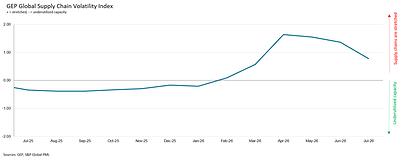
The survey was mostly conducted before the latest escalation in the Middle East and renewed disruption to shipping through the Strait of Hormuz, providing a snapshot of global supply chains immediately before energy prices and geopolitical uncertainty increased again.
Manufacturers scaled back safety-stock building in July following a three-and-a-half-year peak in the second quarter of 2026, suggesting businesses believed supply risks were beginning to ease. Transportation costs also moderated, helping drive the overall improvement in global supply chain conditions.
Despite the easing, reports of critical items in short supply remained elevated globally, while manufacturers continued reporting rising production backlogs caused by missing materials and components. This indicates supply bottlenecks remain unresolved and could worsen if geopolitical tensions persist.
Demand for raw materials and commodities remained strongest across Asia and North America, where manufacturers continued purchasing inputs at a significantly faster pace than other major regions. Europe, by contrast, remained comparatively subdued, reflecting weaker manufacturing order books and lower inventory building.
Interpreting the data:
Index > 0, supply chain capacity is being stretched. The further above 0, the more stretched supply chains are.
Index < 0, supply chain capacity is being underutilized. The further below 0, the more underutilized supply chains are.
JULY 2026 REGIONAL KEY FINDINGS
- ASIA: Index decreased to 1.37, from 1.95, its lowest reading since March. Asian factory purchasing activity slowed sharply in July, driven by China.
- NORTH AMERICA: Index fell to 0.76, from 1.17, pointing to a further easing of supply chain pressures faced by North American manufacturers.
- EUROPE: Index declines to 0.68, from 1.13, its lowest level since March. Demand for manufacturing inputs shrank further, indicating factory retrenchment across the continent.
- U.K.: Sharp reduction in the index to 0.30, from 1.05 as U.K. manufacturers rapidly reduced their procurement activity and ran down their stocks aggressively.
JULY 2026 KEY FINDINGS
- DEMAND: July data indicated a slowdown in factory purchasing volumes. The index’s demand component was its weakest in the year-to-date, driven principally by China and, to a lesser extent, the U.S. The data suggest that the stockpiling-driven boost to demand has faded at the start of the third quarter.
- INVENTORIES: Reports of global manufacturers stockpiling raw materials and intermediate products due to price or supply concerns fell for the first time since January, indicating that procurement leaders ran down the inventories they had built up since the Middle East war began.
- MATERIAL SHORTAGES: The items in short supply indicator fell only fractionally in July, indicating a limited improvement in the availability of critical manufacturing inputs. Overall, supply shortages remained high by historical standards.
- LABOR SHORTAGES: Manufacturers’ reports of backlogs rising due to staff shortages remained anchored, signaling that labor was not a hindrance to capacity utilization during July.
- TRANSPORTATION: The global transportation cost indicator fell again in July, reaching its lowest level since March. That said, data were principally collected prior to global oil prices surging towards the tail-end of the month.
For more information, visit www.gep.com/volatility.
Note: Full historical data dating back to January 2005 is available for subscription. Please contact economics@spglobal.com.
The next release of the GEP Global Supply Chain Volatility Index will be 8 a.m. ET, Sep. 11, 2026.
About the GEP Global Supply Chain Volatility Index
The GEP Global Supply Chain Volatility Index is produced by S&P Global and GEP. It is derived from S&P Global’s PMI® surveys, sent to companies in over 40 countries, totaling around 27,000 companies. The headline figure is a weighted sum of six sub-indices derived from PMI data, PMI Comments Trackers and PMI Commodity Price & Supply Indicators compiled by S&P Global.
- A value above 0 indicates that supply chain capacity is being stretched and supply chain volatility is increasing. The further above 0, the greater the extent to which capacity is being stretched.
- A value below 0 indicates that supply chain capacity is being underutilized, reducing supply chain volatility. The further below 0, the greater the extent to which capacity is being underutilized.
A Supply Chain Volatility Index is also published at a regional level for Europe, Asia, North America and the U.K. For more information about the methodology, click here.
Media Contacts
Derek Creevey
Director, Public Relations
GEP
Phone: +1 646-276-4579
Email: derek.creevey@gep.com
Joe Hayes
Senior Principal Economist
S&P Global Market Intelligence
Phone: +44-1344-328-099
Email: joe.hayes@spglobal.com
S&P Global Market Intelligence
Corporate Communications
Email: Press.mi@spglobal.com
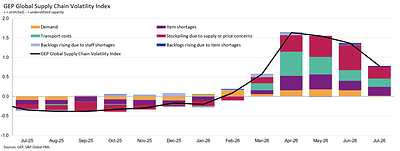
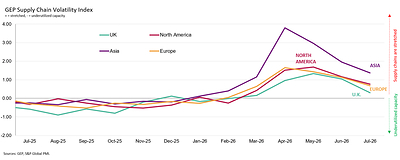

 View original content to download multimedia:https://www.prnewswire.co.uk/news-releases/global-supply-chain-pressures-ease-in-july-but-shortages-persist-ahead-of-renewed-strait-of-hormuz-disruption-gep-global-supply-chain-volatility-index-302849802.html

12, Aug 2026
Londian Wason Raises $94.3 Million Ahead of Trading Debut: NYSE Content Update
NYSE issues a pre-market daily advisory direct from the trading floor.
NEW YORK, Aug. 12, 2026 /PRNewswire/ — The New York Stock Exchange (NYSE) provides a daily pre-market update directly from the NYSE Trading Floor. Access today’s NYSE Pre-market update for market insights before trading begins.
Kristen Scholer delivers the pre-market update on August 12th
- Londian Wason prepares to begin trading on NYSE today.
- The Chinese-based electrolytic copper foil developer priced its American Depositary Shares at $22 apiece, the top end of its expected range.
- The deal gives Londian Wason (NYSE: FOIL) a valuation above $1.7 billion.
- SunScout will make its debut on NYSE American during today’s trading session.
- The solar-powered robotic mower developer priced 3.1 million shares at $5 each.
- SunScout’s (NYSE: SNSC) market capitalization reaches $115.5 million.
- Kickstarter CEO Everette Taylor will join NYSE Live.
- Taylor will discuss the company’s new $1 million culture fund.
- Supports independent creators working across art, fashion, and film.
- Investors digest the July Consumer Price Index ahead of market open.
- Economists expected to see the headline figure increase by 3.4% year-over-year, and anticipated Core CPI to rise by 2.5%.
- Monthly report tracks changes in prices paid by U.S. consumers.
Opening Bell
Londian Wason (NYSE: FOIL) celebrates its IPO
Closing Bell
Jefferies (NYSE: JEF) celebrates its annual Office of the CFO Summit
For market insights, IPO activity, and today’s opening bell, download the NYSE TV App and check out the NYSE YouTube: TV.NYSE.com and YouTube.com/@NYSEofficial


 View original content to download multimedia:https://www.prnewswire.co.uk/news-releases/londian-wason-raises-94-3-million-ahead-of-trading-debut-nyse-content-update-302849725.html



