


10, Aug 2026
STARTRADER Provides Update on Trustpilot Review Profiles
DUBAI, UAE, Aug. 10, 2026 /PRNewswire/ — STARTRADER is in ongoing discussions with Trustpilot about a proposed consolidation of its existing review profiles into a single listing. The matter remains under discussion, and no timeline for completion has been confirmed. STARTRADER confirms that the matter has no impact to date on its operations or client services.

As STARTRADER has expanded across multiple regions, separate Trustpilot profiles were established for different entities and markets over time. A single, consolidated profile would provide clients a clearer overarching view of STARTRADER’s customer feedback across regions.
Some clients may have noticed changes to STARTRADER’s Trustpilot presence, including to the displayed rating, review count, or review history. These changes are not related to the proposed consolidation exercise described above, or to STARTRADER’s trading platforms, products, or client support, all of which continue to operate as per normal.
STARTRADER will provide further updates as discussions with Trustpilot progress. Clients with questions in relation to this matter can reach out through STARTRADER’s client support channels.
About STARTRADER
STARTRADER is a global multi-asset broker empowering retail and institutional partners to access global markets through a range of platforms, including MetaTrader, STARTRADER APP, and STAR Copy. STARTRADER operates through entities licensed and regulated by authorities including CMA, ASIC, FSCA, FSA and FSC, combining strong governance with a client-first approach, serving both retail clients and partners with a commitment to transparency, reliability, and long-term growth.
 View original content to download multimedia:https://www.prnewswire.co.uk/news-releases/startrader-provides-update-on-trustpilot-review-profiles-302846832.html

- 0
- By Sai Krishna

10, Aug 2026
Landis+Gyr Expands Edge Applications Ecosystem with Two New Digital Innovators to Power Next-Generation Intelligent Grid
Future Grid and OTS join Landis+Gyr’s open Edge ecosystem to accelerate real-time distribution grid intelligence and innovation across Australia.
SYDNEY, Aug. 10, 2026 /PRNewswire/ — Landis+Gyr (SIX: LAND) today expanded its Edge Application (App) Ecosystem in Australia, adding Future Grid and Operational Technology Solutions (OTS) as new partners. The additions strengthen Landis+Gyr’s open global ecosystem, bringing new edge applications to market that enhance real-time intelligence and network reliability.

Landis+Gyr’s Edge App Ecosystem is an open, scalable platform that brings the simplicity and speed of an app-driven model to utilities, enabling real-time optimisation at the grid edge.
As distributed energy resources (DER) adoption accelerates, utilities face unprecedented grid complexity and require real-time visibility to make faster, more informed operational decisions while maintaining reliability.
Landis+Gyr’s platform addresses this challenge by providing a shared foundation for edge intelligence, enabling utilities to extend operational capabilities through best-of-breed applications and analytics.
The ecosystem enables developers to deliver advanced analytics, operational optimisation and customer engagement applications within a secure, utility-grade environment, supporting predictive, data-driven decision-making.
Applications developed within Landis+Gyr’s Edge App ecosystem can be deployed across utilities using the company’s industry-leading Revelo® grid sensing platform, accelerating innovation and expanding intelligent grid capabilities at scale.
Landis+Gyr, Senior Vice President David Maclean, APAC said, “This is intelligent energy, delivered, empowering utilities to unlock greater value from data and build more resilient, future-ready networks.
Innovation at the edge should be simple, scalable, and impactful. Today, our Edge Apps Ecosystem enables utilities to rapidly adopt new applications and unlock AI-driven insights.
We are excited to welcome Future Grid and OTS to our global ecosystem, bringing a growing portfolio of applications to utilities and enabling real-time intelligence and innovation at the edge.”
New Partners Unlocking Next Generation Intelligent Insights
Future Grid is the leading SaaS platform that enables LV distribution networks to be managed seamlessly in real time – powered by advanced grid intelligence technology and AI-optimized analytics that transform massive quantities of data into a clear risk matrix of actions, used across globally by grid operators and utilities from compliance, field crews, grid planning to control rooms.
Operational Technology Solutions (OTS) brings deep expertise in data analytics, edge sensors, and real-time systems, enabling utilities to harness large-scale data, automate insights, and accelerate digital transformation. The company works with leading utilities to deliver advanced analytics capabilities that support the next generation of intelligent grid operations.
Future Grid and OTS join Landis+Gyr’s global ecosystem of application partners, including Sense, Mitsubishi Electric and more, bringing a growing portfolio of proven applications to utilities, ready to deploy and scale at the edge.
As the energy transition accelerates, Landis+Gyr continues to expand its intelligent ecosystem by working closely with utilities and partners to co-create edge solutions that are open and deliver real impact.
David Maclean added “The future of energy is collaborative, built on shared innovation, open platforms, and a collective commitment to shaping a more intelligent, connected, and resilient grid.”
About Landis+Gyr
Landis+Gyr is a global energy technology leader delivering intelligent solutions that connect devices, data, and decisions across the grid. Our mission is to accelerate the energy evolution through purposeful innovation and trusted partnerships. Trusted by more than 2,000 utilities worldwide, we transform traditional infrastructure into intelligent, networked systems that provide real-time grid visibility and control. With these insights, electric, gas and water utilities can anticipate demand, optimize operations, and deliver energy that is more reliable, resilient, accessible, safe, and sustainable. For more information, please visit our website www.landisgyr.com
 View original content to download multimedia:https://www.prnewswire.co.uk/news-releases/landisgyr-expands-edge-applications-ecosystem-with-two-new-digital-innovators-to-power-next-generation-intelligent-grid-302846630.html

9, Aug 2026
CCTV+: Int’l Congress of Basic Science opens in Beijing
BEIJING, Aug. 9, 2026 /PRNewswire/ — The 2026 International Congress of Basic Science (ICBS) opened in Beijing on Sunday, drawing more than 1,000 participants, including scientists, researchers and young scholars from both China and abroad.
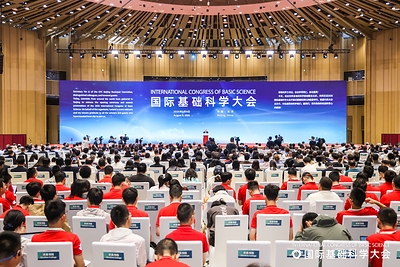
Under the theme “Advancing Basic Science for Humanity,” the two-week event will host over 500 academic sessions covering all branches and interdisciplinary directions of basic science, along with frontier topics such as generative large-model reasoning, computer vision, human-computer interaction and quantum information.
Top international scientists will deliver lectures on basic science and frontier science award reports to share the latest global breakthroughs and promote multidisciplinary collaborative innovation.
A diverse range of events will also be held during the congress, including high-level academic dialogues, youth engagement activities, and cultural and scientific exchange programs.
The high-level academic dialogues will feature “Mathematics Night,” “Physics Night,” and “Engineering Night,” bringing together Fields Medal and Turing Award recipients to discuss frontier trends.
The newly launched Women Scientists Forum will invite outstanding female researchers to share their career experiences and discuss opportunities and challenges in scientific research, aiming to inspire more female scholars to scale new heights in science.
The congress will also host a Basic Science and AI Forum for in-depth discussions on core bottlenecks and future breakthrough paths in AI theory, as well as industry trends.
In addition, the event will feature “Tsinghua Day,” which will invite world-leading mathematicians and physicists to Tsinghua University for dialogues with young students, encouraging them to engage in basic science and explore the unknown.
During the congress, an “Explore Huairou” tour will be held to invite global experts to visit Huairou Science City, the International Conference Resort, the Mutianyu Great Wall, the Great Wall International Animation Valley and Doctor’s Farm.
The tour will offer international scholars a firsthand look at the innovation vitality and research ecosystem of the comprehensive national science center, as well as the ecological charm and cultural heritage of Huairou.
It will also demonstrate how science and technology are empowering rural revitalization, showcasing Huairou’s achievements and high-quality development as a world-class strategic science and technology integration demonstration zone.
This year marks the fourth year of the ICBS being held in Beijing. It is co-hosted by the Beijing Municipal Government, the Ministry of Science and Technology, the China Association for Science and Technology, and the International Consortium of Chinese Mathematicians.
 View original content to download multimedia:https://www.prnewswire.co.uk/news-releases/cctv-intl-congress-of-basic-science-opens-in-beijing-302846625.html

8, Aug 2026
Chandigarh University Researchers Granted Patent for Attendance-Based Health Monitoring System to Monitor Three Vital Health Parameters
Students and Employees to benefit with regular monitoring of mental & physical health
CHANDIGARH, India, Aug. 8, 2026 /PRNewswire/ — A team of researchers at Chandigarh University has developed an attendance-based health monitoring system which integrates biometric attendance authentication with real-time physiological health monitoring. The system simultaneously measures multiple vital health parameters including body temperature, heart rate and blood pressure on a single device during biometric attendance.
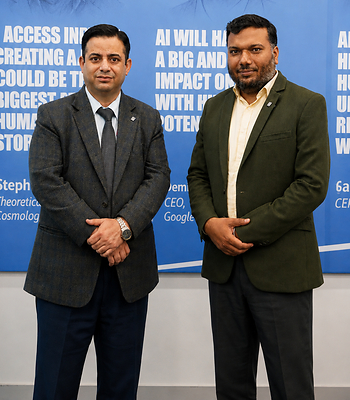
This innovative health monitoring system, developed by Chandigarh University Researchers, Dr Vikas Wasson, Professor CSE & Director (Engineering Foundations), Dr Sachin Kalsi, Associate Professor (Mechanical Engineering) and Head-Academic Operations (E-Governance) along with three CU students Rishabh Raj, Paras Gupta, Vikas Sharma has been granted a patent by the Indian Patent Office in 2026.
Prof Wasson said the invention addresses a growing societal concern where students and employees often work or study for long hours under intense academic and professional pressure, while neglecting their physical well-being. “In today’s highly competitive world, students and working professionals pursue their academic, career and organisational goals, many times at the cost of their health. But long working hours, stress, irregular routines and inadequate attention to well-being gradually affects an individual’s physical and emotional health. We live in an age surrounded by intelligent technology, yet most attendance systems do not pay attention to the well-being of the person. This invention is an attempt to bridge that gap by integrating health monitoring into an activity that people already perform every day. By monitoring vital health parameters, the system can support the early identification of unusual health trends, thereby contributing to healthier workplaces and educational institutions,” he said.
Prof Kalsi said the invention provides a practical solution for integrating daily attendance management with preventive healthcare monitoring. “Since attendance recording is a mandatory activity in most organizations and educational institutions, the system enables routine health assessment without requiring additional effort from users. It also supports digital health record management by maintaining authenticated historical health data, which can be useful for health trend analysis, occupational safety, and institutional health management,” he said.
“In addition, the system reduces the dependence on wearable monitoring devices by embedding health monitoring directly into the attendance process, making it cost-effective and scalable for large organizations. Overall, the invention contributes to the advancement of smart healthcare infrastructure by combining biometric authentication, real-time physiological monitoring, automated health assessment, and institutional alert mechanisms into a single integrated platform, thereby promoting proactive healthcare, improving safety, and supporting the development of intelligent workplaces and smart educational campuses,” he added.
Prof Wasson said, “Almost every day, millions of us walk up to a biometric machine — in schools, colleges, coaching centres, and offices. Rather than only recording who showed up, the enhanced biometric sensor also reads three vital signs — blood pressure, body temperature, and heart rate. In one effortless gesture that people already perform every single day, the machine begins to understand not just whether a person is present, but how they truly are on the inside,”.
Prof Kalsi said, “A single stressful morning — a frantic rush to reach office on time — can spike anyone’s heart rate and blood pressure. So the system never judges a person on one reading. Instead, it monitors each individual over a seven-day period to learn their personal, normal baseline. Only a genuine, sustained deviation from that baseline is treated as meaningful. Crucially, the readings are never displayed on the screen, because a person confronted with alarming numbers may panic and worsen their own condition. Instead, the weekly data will flow confidentially to the Human Resource team. If someone’s pattern shifts in a concerning way, the HR department can take timely action to provide required medical help,” he added.
Prof Wasson said sensors for blood pressure, temperature, and heart rate all exist today but as separate instruments and have not traditionally been integrated into a single attendance device that millions use at their workplace daily. “The true novelty here is integration: fusing quiet health monitoring into routine biometric attendance, so that emotional and physical distress can be detected early, within the natural rhythm of everyday life, without asking anyone to do a single extra thing. The mission is stated plainly, and it is deeply human: to save lives. By transforming a mundane daily habit into a compassionate early-warning system, this invention aims to build calmer classrooms, healthier workplaces, and — above all — a world where far fewer families are left to grieve the people they love most,” he added.
Congratulating Chandigarh University researchers for getting the patent for attendance based health monitoring system, Deepinder Singh Sandhu, Senior Managing Director, Chandigarh University said, “This achievement reflects the strong research and innovation eco-system at Chandigarh University to support research excellence and intellectual property generation for advancement of technology. Chandigarh University’s students and faculty members have filed more than 6,100 patents out of which 5800 patents have been published and 260 patents have been granted. Chandigarh University is ranked number one as a single institution in India for filing highest number of patents. CU’s 44 faculty members featured in Stanford University–Elsevier list of the world’s top 2% scientists. The range of research activities at Chandigarh University is wide-ranging and profound. University scholars conduct research in practically every domain, and pursue to develop human knowledge through investigation, invention, and understanding. Chandigarh University is recognized as Scientific and Industrial Research Organization (SIRO) by the Union Ministry of Science and Technology’s Department of Scientific and Industrial Research (DSIR) for promoting and advancing the research. To amplify research, Chandigarh University has dedicated an annual budget of Rs 15 Crore for research and has also 60 Research Centres and 15 Centres of Excellence. CU’s research initiatives are further strengthened by 67 projects funded by the corporate sector and government bodies with Rs 90 Crore,”.
About Chandigarh University
Chandigarh University is a NAAC A+ Grade University and QS World Ranked University. This autonomous educational institution is approved by UGC and is located near Chandigarh in the state of Punjab. It is the youngest university in India and the only private university in Punjab to be honoured with A+ Grade by NAAC (National Assessment and Accreditation Council). CU offers more than 109 UG and PG programs in the field of engineering, management, pharmacy, law, architecture, journalism, animation, hotel management, commerce, and others. It has been awarded as The University with Best Placements by WCRC.
Website: https://www.cuchd.in/
 View original content to download multimedia:https://www.prnewswire.com/in/news-releases/chandigarh-university-researchers-granted-patent-for-attendance-based-health-monitoring-system-to-monitor-three-vital-health-parameters-302846543.html

8, Aug 2026
12 Value-Added Courses at Chandigarh University Uttar Pradesh, AI, Business Analytics & More to Boost Student Skills
Artificial Intelligence, Business Analytics, Design Thinking and IoT to enhance employment opportunities for students
LUCKNOW, India, Aug. 8, 2026 /PRNewswire/ — Chandigarh University Uttar Pradesh has integrated 12 value-added courses into its academic curriculum. These credit-based courses aim to equip students with additional skills alongside their degree, addressing demands in both the current job market and higher education. Artificial Intelligence, Business Analytics, Design Thinking and IoT will now become part of regular curriculum for students.

These value-added courses are being conducted across various fields involving Applied Sciences, Business, Liberal Arts & Behavioral Sciences, and Computer Science Engineering. Incorporated as credit-based courses within the academic programme, they enable students to develop interdisciplinary knowledge and professional skills alongside their regular studies.
A key feature of these courses is that they focus not only on technical subjects but also give equal importance to business, society, environment, leadership and moral values. Chandigarh University Uttar Pradesh believes that today’s students need not only subject-specific knowledge but also multidimensional thinking and problem-solving capabilities.
The curriculum includes subjects such as AI in Biotechnology, Biotechnology Entrepreneurship, Spreadsheet Modeling & Business Analytics, Design Thinking & Creativity for Innovation, Foundation in Business Analytics, Public Governance & Systems Management, Introduction to Sustainable Development Goals, Managing Societal Concerns, Power & Politics in Organisations, Psychology & AI, Understanding Society Through a Sociological Lens, and Fundamentals of IoT. Through these courses, students get opportunities to better understand the relationship between technology and society.
According to Chandigarh University, the objective of these value-added courses is not merely to teach additional subjects, but also to develop capabilities in innovation, entrepreneurship, digital literacy, critical thinking, leadership, communication, problem-solving and social responsibility among students. The curriculum has been designed in alignment with National Education Policy 2020 principles, which emphasize multidisciplinary and experiential learning.
The duration of these courses ranges from 30 to 60 hours, with each course carrying 2 to 4 academic credits. Teaching is primarily conducted through offline classrooms. Additionally, students learn through interactive lectures, case studies, group discussions, practical demonstrations, project-based learning, seminars and expert talks. This ensures a focus not only on theoretical knowledge but also on practical application.
Chandigarh University Uttar Pradesh has made these value-added courses part of the academic curriculum. As per the programme, several courses are mandatory for students, ensuring every learner acquires additional professional and interdisciplinary skills alongside their main subject. This will strengthen students’ employability and prepare for future challenges.
These courses have been developed by experienced faculty members considering current industry trends and academic requirements. During the programme, guest lectures, seminars, projects and workshops by industry and academic experts are also included. This provides students with opportunities to understand emerging technologies, business practices, sustainability and social issues from a practical perspective.
The curriculum covers subjects like Artificial Intelligence, Internet of Things (IoT), Business Analytics, Spreadsheet Modeling, Design Thinking, Entrepreneurship, Sustainable Development Goals, Public Governance, Psychology, Sociology, Leadership and Ethical Decision Making. Special attention is also given to professional skills such as communication, collaboration, teamwork and social responsibility.
Students from the first batch at Chandigarh University Uttar Pradesh has successfully completed these courses, while the next batch is currently studying. Students enrolled in these programmes have participated in interdisciplinary projects, innovation challenges, research activities, internships, entrepreneurship and community engagement programmes. This has resulted in improvements in their analytical ability, creative thinking, leadership skills and confidence.
On this occasion, Prof. Dr. T.P. Singh, Pro Vice-Chancellor, Chandigarh University Uttar Pradesh, said, “In the coming times, we will expand the number and scope of value-added courses. New interdisciplinary courses will be crafted by keeping emerging technologies, evolving industry needs and global academic trends in mind. The curriculum will be reviewed periodically to ensure students continue to receive future-ready learning opportunities”.
Chandigarh University Uttar Pradesh is committed to providing quality higher education with a focus on innovation, research and industry collaboration. The university offers diverse undergraduate, postgraduate and doctoral programmes across multiple disciplines with emphasis on experiential learning and skill development.
About Chandigarh University Uttar Pradesh (Lucknow)
Envisioned to foster a culture of sustainability and empower future global leaders, Chandigarh University, Uttar Pradesh, immerses 21st-century learners in a personalised and experiential learning experience, integrating an AI-powered academic model and a multidimensional, futuristic perspective on education. Our Uttar Pradesh campus carries forward the venerable legacy of more than a decade of Chandigarh University, Punjab, which has established itself as India’s No. 1 Private University and a torchbearer of groundbreaking pedagogy and research-driven innovation. The AI-augmented new campus offers a broad spectrum of industry-driven futuristic academic programs encompassing data-driven insights, virtual reality experiences, real-world simulations, corporate mentorship, international perspective, interdisciplinary research, cultivation of entrepreneurial spirit, and professional competencies.
 View original content to download multimedia:https://www.prnewswire.com/in/news-releases/12-value-added-courses-at-chandigarh-university-uttar-pradesh-ai-business-analytics–more-to-boost-student-skills-302846545.html

8, Aug 2026
Mahamandleshwar Gita Manishi Swami Shri Gyananand Ji Maharaj Enlightens Chandigarh University Students with Timeless Teachings of Bhagavad Gita
Bhagavad Gita Can Help Gen Z Deal with Tension, Stress, Depression in Today’s Competitive World, says Mahamandleshwar Gita Manishi Swami Shri Gyananand Ji Maharaj at Chandigarh University
CHANDIGARH, India, Aug. 8, 2026 /PRNewswire/ — “Bhagavad Gita is not merely a religious text but a way of life. It’s a logical, practical, universal and scientific way of life. As Gita addresses every problem and offers solutions for them all, this epic scripture can help Gen Z in dealing with the tension, stress, and even depression in today’s competitive world,” said Mahamandleshwar Gita Manishi Swami Shri Gyananand Ji Maharaj, during a transformative dialogue with Gen Z students on ‘Gita clarity, purpose and courageous action for a changing world’ at Chandigarh University on August 7th.
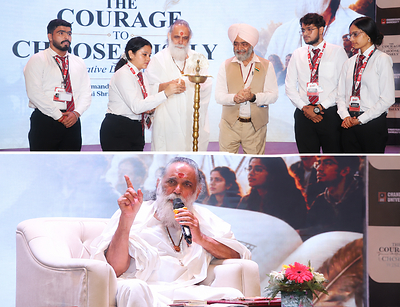
This interactive dialogue, organized the Department of Student Welfare’s ‘Centre of Student Wellbeing’, covered wide range of topics including ‘purpose in uncertain times’, ‘calm under pressure’, ‘ambition with inner balance’, ‘duty, freedom and ethical action’, and ‘meaningful living in the modern world’. This dialogue was attended by Swami Shri Gyananand Ji Maharaj as Chief Guest along with other dignitaries including Prof (Dr) RS Bawa, Advisor to the Chancellor of Chandigarh University.
In his spiritual address to students, Swami Shri Gyananand Ji Maharaj said that anxiety about the future overpowers the present and weakens our willpower. Giving example of shooter Manu Baker, who credited Bhagavad Gita’s teaching that one should focus on karma, not on the outcome of the karma for her success in winning two medals at the Paris Olympics, he said Gita can help students in dealing with the tension, stress, and even depression in today’s competitive world.
“That is why the Gita says ‘do not turn the future into a source of anxiety, focus on the present’. What happens next is not in your hands and you should concentrate only on present. Keeping the teachings of Bhagavad Gita in mind, nothing is impossible. Gen Z should set a good example in life and become a shining example for others yourself,” Swami Shri Gyananand Ji Maharaj said.
He said for concentration and confidence, youngsters should dedicate a few minutes each day to meditation. “Meditation isn’t solely about religious faith, think of it like charging your mobile phone. You plug it in daily to connect it to a power source, it charges up and then powers you through the entire day. This is particularly relevant for today’s students, as they inhabit a different world—one heavily influenced by social media—which often distances them from reality. With the rise of AI and social media these days, the primary need is the ‘courage to choose wisely’. You must make choices regarding social media with awareness—specifically, being aware of what is truly beneficial for you at this stage of life. Consider it like a ladder which can take you upward but if you do not tread carefully, your foot might slip, and it could cause you to fall,” Swami Shri Gyananand Ji Maharaj said.
On the question of how the Gen Z should strike a balance between their freedom and responsibility, Swami Shri Gyananand Ji Maharaj said that unrestricted freedom shouldn’t become a license to do whatever one whimsically desires.
“Freedom without responsibility or discipline, is harmful. It won’t earn you respect. Freedom is a good thing, but if freedom is leading a person towards pub culture, drug addiction or wrong circle of friends, then it is a bad thing. Therefore, embrace freedom, but keep your focus on responsibility,” he said.
Answering queries during the interactive session, Swami Shri Gyananand Ji Maharaj said, “One must learn from past mistakes without letting his or her mind become so disheartened that it closes off future paths. Life is incredibly precious; do not call your life into question just because of a single shortcoming. There is so much more to life—keep making good decision.”
Earlier in his welcome address, Prof (Dr) RS Bawa, Advisor to the Chancellor of Chandigarh University said, “Chandigarh University was established in 2012 with the resolve to become not merely a center of education, but a powerful medium for upholding Indian culture and moral values, and for nation-building. The University aims to mold young individuals who understand their responsibilities toward society and the nation. Much like Indian culture itself, values such as human dignity, empathy, humility, and generosity form the foundation of every activity at Chandigarh University. The University has set numerous new benchmarks in the fields of academic excellence, research, sports, cultural activities, and placements. The essence of life lies in having the courage to make wise choices; if you make the right choice, no challenge can stop you from moving forward.”
Chandigarh University
Chandigarh University is a NAAC A+ Grade University and QS World Ranked University. This autonomous educational institution is approved by UGC and is located near Chandigarh in the state of Punjab. It is the youngest university in India and the only private university in Punjab to be honoured with A+ Grade by NAAC (National Assessment and Accreditation Council). CU offers more than 109 UG and PG programs in the field of engineering, management, pharmacy, law, architecture, journalism, animation, hotel management, commerce, and others. It has been awarded as The University with Best Placements by WCRC.
Website address: https://www.cuchd.in/
 View original content to download multimedia:https://www.prnewswire.com/in/news-releases/mahamandleshwar-gita-manishi-swami-shri-gyananand-ji-maharaj-enlightens-chandigarh-university-students-with-timeless-teachings-of-bhagavad-gita-302846529.html

8, Aug 2026
Dr. Sharad Chandra Bhaiya Authors ‘Journey Into Black Holes’, Bringing the Mysteries of Black Holes Closer to Young Readers
A science-focused book seeks to develop curiosity about black holes, space science, astronomy and research among students
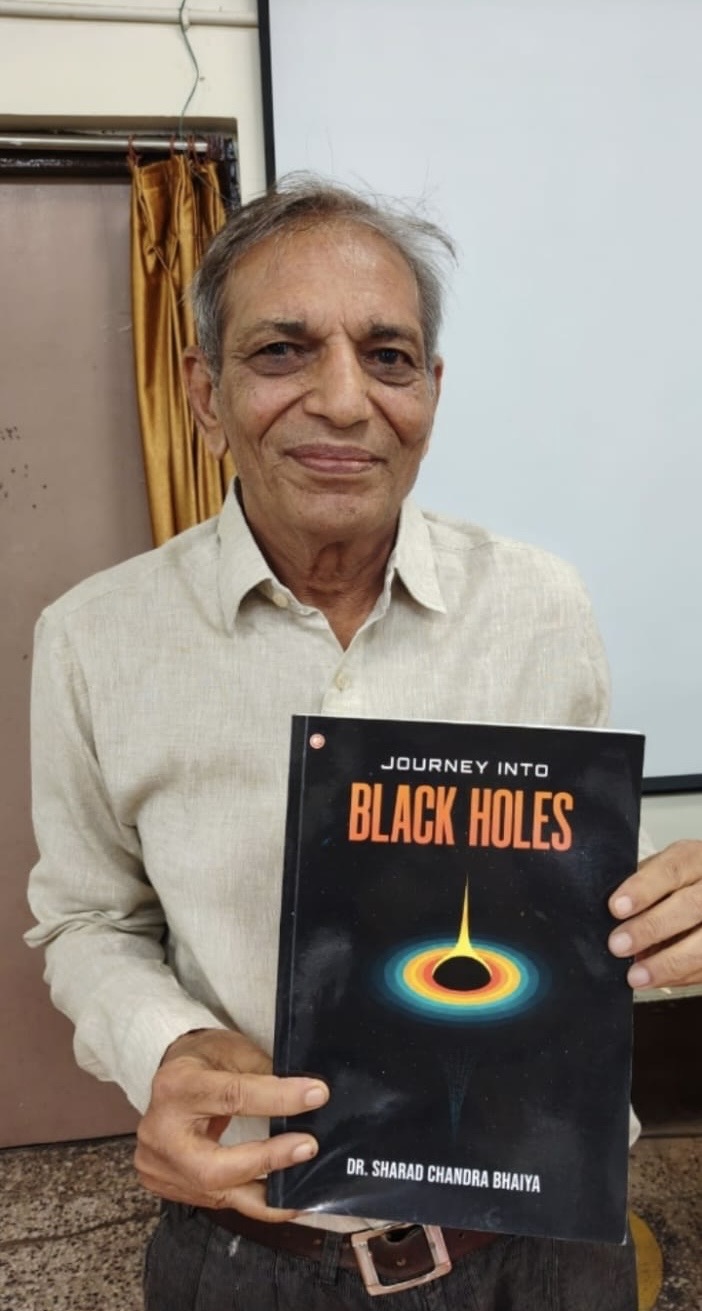
India, August 2026: A new book exploring one of the most intriguing subjects in the universe—black holes—has brought the mysteries of space science into sharper focus for young readers. Authored by Dr. Sharad Chandra Bhaiya, former Physics lecturer,
Journey Into Black Holes is an effort to present the subject of black holes in an accessible manner and encourage students to develop a deeper interest in space science, astronomy and scientific research.
The book was formally unveiled at BSP Senior Secondary School, Sector 10, Bhilai, in the presence of teachers and students. The occasion marked the presentation of a science-oriented work aimed at making a challenging and fascinating subject more approachable for learners and encouraging them to look beyond conventional classroom learning.
At the heart of Journey Into Black Holes is an attempt to build scientific curiosity. Black holes have long fascinated scientists and the wider public because of the questions they raise about the universe. Through his book, Dr. Bhaiya seeks to introduce students to this subject in a simple and understandable manner, enabling them to engage with scientific ideas without feeling overwhelmed by their complexity.
The book also reflects the author’s larger objective of encouraging an interest in scientific enquiry and research among young minds. By bringing the subject of black holes into a student-friendly format, the book aims to stimulate questions, encourage independent thinking and create greater enthusiasm for exploring the universe.
As part of the book’s unveiling, Dr. Sharad Chandra Bhaiya interacted with the students and explained aspects related to black holes in simple language. He also responded to questions from the students, creating an opportunity for them to engage directly with the subject and clarify their understanding of a phenomenon that remains one of the most fascinating areas of space science.
The publication of Journey Into Black Holes is therefore not merely an exploration of a scientific subject; it is also an attempt to bridge the gap between scientific knowledge and youthful curiosity. The book seeks to encourage students to develop a questioning mindset and take a greater interest in astronomy, space science and research.
With its focus on a subject that continues to capture global scientific imagination, Journey Into Black Holespositions itself as a contribution towards making conversations around black holes and space science more accessible to students and general readers. The book carries a simple but important message: curiosity about the universe can be the starting point for a deeper journey into science.
8, Aug 2026
Gujarat’s Divyang Bus Pass Goes Digital, Earns National Recognition for Inclusive Public Transport
Gandhinagar, Aug 8: Gujarat’s Divyang Bus Pass has earned national recognition after being integrated with DigiLocker, marking a significant step towards making public transport more accessible and convenient for persons with disabilities.
The digital facility allows eligible beneficiaries to access their bus pass through DigiLocker, reducing dependence on physical documents and making it easier to carry and present the pass while travelling.
For many persons with disabilities, access to affordable and reliable public transport is closely linked to their ability to work, study, access healthcare and participate independently in everyday life. The move to a digital pass is aimed at making that process simpler and less time-consuming.
The integration also reduces paperwork and can make verification more efficient for transport authorities, while giving beneficiaries a secure digital record that can be accessed when needed.
The initiative reflects a wider effort to use digital public infrastructure to improve the delivery of citizen services. Bringing the bus pass onto a widely used digital platform can also make the benefit easier to access without requiring beneficiaries to repeatedly handle or preserve physical documents.
The national recognition of Gujarat’s initiative highlights the growing role of technology in building more inclusive public services. A simple digital intervention such as a transport pass can have a meaningful impact on everyday mobility, particularly for citizens who rely on public transport.
The initiative is ultimately aimed at more than digitising a document — it seeks to make mobility easier, services more accessible and public transport more inclusive for persons with disabilities.
8, Aug 2026
EuroWeb: From Ancient Threads to Digital Platforms
Aug 8: Every piece of fabric has a story to tell. The colours, patterns and weaves of each piece reveal centuries of craft, trade and cultural exchange. Some of these stories are hidden in the mineralised textiles of Pompeii, while others lie in the ancient silk routes that once connected Asia and Europe, or in the wool and dyes that clothed everyone from kings to ordinary people.
The COST Action Europe Through Textiles: Network for an integrated and interdisciplinary Humanities connected people studying these stories. From archaeologists and conservators to fashion historians and textile artists, EuroWeb created a network where knowledge could travel as freely as fabrics once did.
Rediscovering Europe through textiles
Through conferences, workshops and training schools, the Action demonstrated that textiles had a significant impact on nearly all aspects of European history. Researchers gathered in Pompeii to learn how to handle and document fragile, mineralised textiles. They explored the influence of Asian textiles on European industry between 1200 and 1900. In their sessions on Textiles and the Dead, they investigated what burial cloths can reveal about ancient beliefs. The Sailing Textiles conference examined the role of textiles in navigation and trade, while a training school on knitting, knitwear and wool revisited these long-standing European traditions. Another training school, Dyeing with Natural Dyes, demonstrated how traditional techniques can inspire sustainable practices today.
EuroWeb was also showcased at the Festival of the New European Bauhaus in Brussels, where it organised a hands-on LAB event as part of the Fair section. This participation helped highlight the Action’s alignment with the New European Bauhaus values of sustainability, creativity and inclusivity.
Every event revealed new insights, showing how textiles can serve both as evidence of the past and as a source of inspiration for the future.
Did you know?
- Some of the oldest textiles still carry traces of Tyrian purple, a dye made from Mediterranean sea snails. In Roman times, it was so costly that only emperors could afford it
- In medieval Europe, the kermes insect gave wool a deep red shade prized by nobility
- Long before metal or pottery, textiles were Europe’s first great innovation, shaping clothing, trade, identity, and communication
How textile heritage is weaving the future
Led by Dr Agata Ulanowska from the University of Warsaw, the project developed open digital platforms that continue to evolve long after its conclusion.
“EuroWeb generated a substantial body of new knowledge and approaches, as evidenced by more than 50 peer-reviewed publications,” said Dr Ulanowska. “It also developed several open-access infrastructures that remain active and continue to grow.”
The Digital Atlas of European Textile Heritage, for example, is a unique repository that already documents thousands of textiles, tools, seals, workshops and archaeological sites. This interactive platform visualises the many layers of Europe’s textile heritage throughout history.
Another useful resource is the Textile and Clothing Terminology Online platform, which compiles rich vocabularies relating to fabrics and garments in ancient and modern languages. Through language, it highlights how much of Europe’s textile heritage is shared and rooted in centuries of cultural exchange. It is also a valuable research tool, facilitating understanding between scholars and craftspeople from different countries.
EuroWeb also ensured that this knowledge reached beyond academia. The Action’s website and YouTube channel host publications, lectures, and training materials, making this facet of European cultural heritage widely accessible and already used as an educational and outreach resource.
Watch the video: Textile workshop: EuroWeb Training School at Malia
“These resources are widely used and continue to attract interest from professionals and the general public,” said Agata Ulanowska proudly.
Heritage meets sustainability
Building on EuroWeb’s foundations, the COST Innovators Grant HERITEX-HUB, led by Dr Francisco B. Gomes of the University of Lisbon is transforming historical knowledge into a valuable resource for a more sustainable textile and fashion industry.
“The opportunities that COST provides for training, leadership, and collaboration are truly transformative.” Dr Francisco B. Gomes, Chair of HERITEX-HUB
According to Dr Gomes: “Making textile heritage visible can inspire innovation. By showcasing sustainable practices from the past, we give today’s makers tools to develop greener approaches in a competitive market.”
“EuroWeb acted as an incubator for projects that address sustainability and heritage preservation directly,” said Francisco Gomes. “HERITEX-HUB draws data, knowledge, and inspiration from textile heritage research for more sustainable textile and fashion futures, bridging academic insight with policy and industry needs.”
HERITEX-HUB has connected researchers, designers, entrepreneurs, and small businesses. It has offered practical resources such as factsheets on natural materials and traditional techniques, storyboards to inspire creative design, and the Digital Atlas of European Textile Heritage, mapping sustainable textile know-how across Europe.
“The network is also developing a matchmaking platform to connect local crafts and modern production chains, promoting sustainability from the ground up”, explained Francisco. “At a time when people are growing increasingly aware of the negative impact of how we consume textiles and fashion, historic and traditional examples can show that there are alternatives.”
Did you know that in 2020 textile consumption per person in the EU required on average:
- 400 m² of land
- 9 m3 of water
- 391 kg of raw materials
- Caused a carbon footprint of 270 kg
Empowering people through collaboration
For both Agata Ulanowska and Francisco Gomes, the impact of COST extended far beyond research outcomes.
“EuroWeb raised awareness of COST Actions at my university, showing how impactful they can be.” Dr Agata Ulanowska, Chair of EuroWeb“Participating in EuroWeb was a great, though occasionally exhausting, experience that has significantly advanced my career,” said Agata. “I gained international recognition and met fantastic colleagues with whom I now collaborate. EuroWeb also raised awareness of COST Actions at my university, showing how impactful they can be.”
“I joined EuroWeb as a young postdoctoral researcher and will leave HERITEX-HUB as a consolidated researcher with a permanent position,” added Francisco. “The opportunities that COST provides for training, leadership, and collaboration are truly transformative.”
A shared European fabric
Every fabric holds a story. Thanks to the COST Action EuroWeb and the COST Innovators Grant HERITEX-HUB, those stories continue to inspire new ideas, sustainable practices, and a shared sense of European identity.
From studying mineralised textiles in Pompeii to building digital platforms for future generations, these two COST projects have shown that Europe’s textile heritage is not a relic of the past but a living resource.
“The results from EuroWeb, and in part also from HERITEX-HUB, have been tremendously beneficial for textile heritage researchers and a much wider range of stakeholders,” concluded Dr Gomes. “We hope that making knowledge about textile heritage more accessible will empower people and offer them tools to make informed, sustainable choices.”
7, Aug 2026
Bybit Dual Asset Integrates Four New xStocks, Expanding Use Cases for Tokenized Equities on Bybit
DUBAI, UAE, Aug. 7, 2026 /PRNewswire/ — Bybit, the world’s second-largest cryptocurrency exchange by trading volume, announced the expansion of its xStocks Dual Asset offering with four newly supported tokenized stocks: METAx, TSLAx, HOODx, and CRCLx. The addition brings xStocks Dual Asset to a lineup of 10 tokenized stock pairs, following strong user demand
The expansion builds on Bybit’s earlier integration of xStocks into Dual Asset, which introduced tokenized shares in SpaceX, NVIDIA, Apple, Alphabet, Coinbase, and Amazon as underlying assets for the popular structured yield product. With the addition of METAXUSDT, TSLAXUSDT, HOODXUSDT, and CRCLXUSDT, xStocks Dual Asset now covers ten xStocks tokens encompassing the most sought-after assets on Wall Street.
The newly added assets span key sectors including artificial intelligence, electric vehicles, fintech, and stablecoins, further broadening the range of market themes users can build yield strategies around on Bybit.
Since launch, tokenized equities in NVIDIA has attracted the strongest user demand among supported xStocks, while SpaceX has consistently recorded the highest trading volume, underscoring sustained user interest in Bybit’s Dual Asset products tied to xStocks.
As tokenization of real-world assets continues to gain traction across the industry, Bybit’s expanded support for xStocks in Dual Asset reflects growing crypto-native interest in accessing traditional equities through familiar, on-chain mechanisms. Bybit was the first centralized exchange to offer xStocks as underlying assets for a structured yield product of this kind.
Dual Asset is a non-principal-protected investment product offering expected fixed returns upon successful subscription. Users select an asset pair, investment period, and target price based on their market view and risk appetite, with the final settlement asset determined by price movement against the target price at settlement.

xStocks Dual Asset follows the same eligibility requirements and regional restrictions as xStocks. Terms and conditions apply, and users should read the Risk Factors for this product before subscribing. For more details on eligibility and potential restrictions, users may visit: xStocks Dual Asset expands with four new assets
#Bybit / #NewFinancialPlatform
About Bybit
Bybit is The New Financial Platform.
We believe every person should have access to every financial opportunity on earth. That’s why we’re building the first intelligent platform that connects anyone, anywhere to the world’s finance.
Trusted by more than 80 million users worldwide, Bybit brings together investing, trading, payments, and wealth-building in a single secure and intelligent ecosystem. Through the combination of AI-powered technology, deep global liquidity, robust security, and transparent operations, Bybit makes global finance more accessible, efficient, and empowering for everyone.
Built for everyone. Powered by intelligence. Open to the world.
Learn more at Bybit.com
For more details about Bybit, please visit Bybit Press
For media inquiries, please contact: media@bybit.com
For updates, please follow: Bybit’s Communities and Social Media
Discord | Facebook | Instagram | LinkedIn | Reddit | Telegram | TikTok | X | Youtube

 View original content to download multimedia:https://www.prnewswire.co.uk/news-releases/bybit-dual-asset-integrates-four-new-xstocks-expanding-use-cases-for-tokenized-equities-on-bybit-302846213.html



