


7, Aug 2026
Lumina Datamatics Completes Acquisition of TNQTech, Creating a Global Leader in Scholarly Publishing Solutions
MUMBAI, India, Aug. 7, 2026 /PRNewswire/ — Lumina Datamatics, a global leader in content, retail support, and technology solutions, today announced the completion of its acquisition of TNQTech, a leading Chennai-based publishing technology company. This transaction marks a significant milestone in Lumina Datamatics’ organic and inorganic growth strategy and positions the combined organization among the world’s largest providers of scholarly publishing solutions.

The announcement follows the signing of a definitive agreement in December 2024 to acquire an 80% controlling stake in TNQTech. With the acquisition of the remaining 20%, the transaction has now been completed, making TNQTech a 100% wholly owned subsidiary of Lumina Datamatics.
The combined entity brings together Lumina Datamatics’ global scale, customer relationships, technology expertise, and service excellence with TNQTech’s proven leadership in scholarly publishing technology and AI-enabled solutions. In addition, this acquisition will accelerate innovation, enhance operational efficiency, and deliver greater speed, quality, and value to publishers worldwide.
Sameer Kanodia, Vice Chairman and CEO, Lumina Datamatics & TNQTech, said:
“The successful acquisition of TNQTech marks a defining milestone in our journey. Together, we have created a leading global partner for scholarly publishing solutions, combining deep domain expertise with next-generation AI technologies to help publishers transform their businesses.”
He further added, “Our focus is on driving the next wave of growth through innovation, AI-led transformation, and strategic investments in technology. Integrating exceptional talent, complementary capabilities, and a shared vision for the future, we are uniquely positioned to accelerate product innovation, expand our global footprint, and deliver greater value to customers worldwide. We believe this combination creates tremendous opportunities to redefine how scholarly content is created, managed, enriched, and delivered in the years ahead.”
Mariam Ram, Founder and Director, TNQTech, said:
“Becoming a part of Lumina Datamatics is the right step for TNQTech. Our technology and domain expertise align perfectly with their scale and reach in scholarly publishing. I am confident TNQTech’s people, products and customers are now in the hands of a reliable, trusted organization that will carry our vision forward while driving the next phase of innovation and growth.”
The combined organization is uniquely positioned to support publishers across the entire content lifecycle—from manuscript submission, peer review, and editorial workflows to production, digital publishing, accessibility, analytics, and AI-powered content enrichment. Customers will benefit from an expanded portfolio of intelligent publishing platforms, domain expertise, automation capabilities, and global scale.
As the publishing industry continues to evolve, Lumina Datamatics remains committed to driving innovation and delivering technology-enabled solutions that help publishers improve efficiency, accelerate growth, and unlock new opportunities in an increasingly digital and AI-driven landscape.
About Lumina Datamatics
Lumina Datamatics is a trusted partner providing digital content services, retail support services, and technology solutions to companies in the publishing and retail industries worldwide. With 7,500+ employees across the US, UK, Germany, the Philippines, and India, the company serves 8 of the top 10 academic publishers, and 3 of the top 5 retailers and marketplaces, delivering AI-powered, technology-driven solutions that help customers accelerate innovation, improve efficiency, and drive business growth.

 View original content to download multimedia:https://www.prnewswire.com/in/news-releases/lumina-datamatics-completes-acquisition-of-tnqtech-creating-a-global-leader-in-scholarly-publishing-solutions-302845892.html

- 0
- By Sai Krishna

7, Aug 2026
FAMILIARITÉ: A Poetic Convergence of Cinema and Literature
DJI and Cannes-honored Icon Isabelle Reunite Two Women’s Voices Across Centuries — Shot Entirely on the Osmo Pocket 4P
SHENZHEN, China, Aug. 7, 2026 /PRNewswire/ — DJI, the global leader in civilian drones and creative camera technology, unveiled FAMILIARITÉ, an original short video starring and creatively directed by Isabelle Huppert, and shot in its entirety on the DJI Osmo Pocket 4P. More than a technology showcase, the video is a meditation on literature, memory, and the quiet familiarity that connects women across time and culture — and a demonstration of how a camera that fits in the palm of a hand can now carry the full weight of cinematic storytelling.

When Two Uncompromising Visions Meet
It all began with Isabelle Huppert and DJI’s shared vision together: an uncompromising devotion to the image — to what can be seen, felt, and left unsaid on screen.
Across a career spanning more than 120 films, multiple Best Actress honors at Cannes and Venice, a Golden Globe, and an Academy Award nomination, Isabelle Huppert has become synonymous with what she conveys without words — the wordless gaze, the restrained micro-expression, emotion delivered through the subtlest of means. DJI has spent its history pursuing a parallel goal from the engineering side: to capture the finest nuance of light and motion in ever more capable, ever more unobtrusive tools.
In FAMILIARITÉ, those two pursuits came together. Stepping behind the camera, Isabelle Huppert shaped not only her performance but the video’s visual language — and chose the Osmo Pocket 4P as the instrument to realize it. Discreet and lightweight, the camera all but disappeared on set, letting her work in her most relaxed, unguarded state and giving the production a creative freedom that heavier, more imposing rigs rarely allow.
For Isabelle Huppert, encountering the camera for the first time was a discovery in itself. “It’s the first time I’ve discovered such a tiny camera — truly quite extraordinary,” she recalls. “It’s almost invisible, and yet it reproduces an image of extraordinary sharpness and precision. Above all, it conveys so well the emotion of a face, and what was happening between us, between my partner and me.” Far from feeling like an intimidating machine, she notes, it never altered her craft — it remained, simply, a camera. In FAMILIARITÉ, technology does not command the performance; it liberates it.
Two Voices, One Familiar Echo
FAMILIARITÉ takes its form not from plot, but from poetry. It is a conversation across time between two women who never met, yet each turned a life into the written word.
George Sand (1804–1876) claimed her voice in 19th-century France by writing under a man’s name — a defiance that Isabelle Huppert honors in the video by wearing a man’s tailored suit. Centuries earlier and a world away, the Song-dynasty poet Li Qingzhao (1084–c.1155) resisted the upheavals of her age through the enduring force of her verse. Both women transformed the pain of a life into language that outlived them.
FAMILIARITÉ draws these two souls together in light and shadow. George Sand’s “À Aurore” runs through the video like a thread, and the encounter culminates in a single, wordless exchange between Isabelle and a young Chinese girl — an echo of familiarity that crosses both time and culture. Shot amid the shifting sunlight, tree shadows, and water surfaces of a traditional Chinese garden, the video preserves a poetic, almost extraordinary atmosphere in perfect connection with George Sand’s verse. This is not merely a “meeting.” It is a visual narrative about women, expression, and freedom.
A Cinematic Language, Built Entirely in the Palm of a Hand
The video’s artistic ambition is realized through a deliberate cinematographic language made possible by the Osmo Pocket 4P — its dual lenses becoming the video’s own way of seeing. Again and again, the production found that scenes conceived on the page could be captured precisely because the camera was small enough to go where a full-size cinema rig could not.
A conversation on the water. One of the video’s most intimate exchanges unfolds between Isabelle and her co-star aboard a small rowboat drifting across the garden’s pond. Fitting a traditional cinema camera and its crew into so confined and unsteady a space would have been impossible without breaking the moment. The Osmo Pocket 4P, by contrast, sat naturally within the boat, keeping the two performers close and the frame alive with the gentle motion of the water.
Fluidity, carried by hand. Much of the video lives in continuous, moving shots — drifting past figures, tree shadows, bookshelves and door frames, so that every transition becomes a quiet, deliberate gesture. A large share of these were captured handheld by the DP. Thanks to the camera’s pocketable size and 3-axis mechanical stabilization, the operator could move freely and reset between setups in seconds, keeping takes smooth and lifting the pace of the shoot considerably.
Wide latitude for high-contrast light. The garden setting is full of extreme contrast — bright highlights beside deep, layered shadows, on both the scenery and the human face. With D-Log2 and 17 stops of dynamic range, the Osmo Pocket 4P preserved the full gradation of that light, giving the colorist ample latitude in post and making even the most demanding lighting worry-free.
A portrait lens for the face. To draw the eye toward Isabelle Huppert’s most delicate expressions, the production turned to the 60mm telephoto — a natural portrait focal length that renders skin cleanly and true, without the distortion of a wide lens, compressing space so that the faintest shift of expression reads with clarity. Wider perspectives (15mm / 20mm) place each character within her space, so that every movement becomes a shift in time and dimension.
Bound together by that stabilization and range of focal lengths, these perspectives flow as one unbroken motion — and in its remarkably discreet, pocketable form, the Osmo Pocket 4P let the production work closely and intimately with its lead, capturing performance-driven storytelling once reserved for large crews and heavy equipment.
It reaffirms DJI’s mission: to place uncompromising imaging power in the hands of every storyteller — and to prove that the size of a camera need never limit the scale of a story.
Bringing the Video to a Global Audience
FAMILIARITÉ has been released across DJI’s official channels accompanied by behind-the-scenes material and creator-focused content exploring both Isabelle Huppert’s artistry and the creative potential of the Osmo Pocket 4P. You can find the video here.
About DJI
Since 2006, DJI has led the world with civilian drone innovations that have empowered individuals to take flight for the first time, visionaries to turn their imagination into reality, and professionals to transform their work entirely. Today, DJI serves to build a better world by continuously promoting human advancement. With a solution-oriented mindset and genuine curiosity, DJI has expanded its ambitions into areas such as renewable energy, agriculture, public safety, surveying and mapping, and infrastructure inspection. In every application, DJI products deliver experiences that add value to lives around the world in more profound ways than ever before.
For more information, visit our:
Website: www.dji.com
Online Store: store.dji.com
Facebook: www.facebook.com/DJI
Instagram: www.instagram.com/DJIGlobal
X: www.x.com/DJIGlobal
LinkedIn: www.linkedin.com/company/dji
Subscribe to our YouTube Channel: www.youtube.com/DJI
 View original content to download multimedia:https://www.prnewswire.co.uk/news-releases/familiarite-a-poetic-convergence-of-cinema-and-literature-302845669.html

7, Aug 2026
FAMILIARITÉ: A Poetic Convergence of Cinema and Literature
DJI and Cannes-honored Icon Isabelle Reunite Two Women’s Voices Across Centuries — Shot Entirely on the Osmo Pocket 4P
SHENZHEN, China, Aug. 7, 2026 /PRNewswire/ — DJI, the global leader in civilian drones and creative camera technology, unveiled FAMILIARITÉ, an original short video starring and creatively directed by Isabelle Huppert, and shot in its entirety on the DJI Osmo Pocket 4P. More than a technology showcase, the video is a meditation on literature, memory, and the quiet familiarity that connects women across time and culture — and a demonstration of how a camera that fits in the palm of a hand can now carry the full weight of cinematic storytelling.
When Two Uncompromising Visions Meet
It all began with Isabelle Huppert and DJI’s shared vision together: an uncompromising devotion to the image — to what can be seen, felt, and left unsaid on screen.
Across a career spanning more than 120 films, multiple Best Actress honors at Cannes and Venice, a Golden Globe, and an Academy Award nomination, Isabelle Huppert has become synonymous with what she conveys without words — the wordless gaze, the restrained micro-expression, emotion delivered through the subtlest of means. DJI has spent its history pursuing a parallel goal from the engineering side: to capture the finest nuance of light and motion in ever more capable, ever more unobtrusive tools.
In FAMILIARITÉ, those two pursuits came together. Stepping behind the camera, Isabelle Huppert shaped not only her performance but the video’s visual language — and chose the Osmo Pocket 4P as the instrument to realize it. Discreet and lightweight, the camera all but disappeared on set, letting her work in her most relaxed, unguarded state and giving the production a creative freedom that heavier, more imposing rigs rarely allow.
For Isabelle Huppert, encountering the camera for the first time was a discovery in itself. “It’s the first time I’ve discovered such a tiny camera — truly quite extraordinary,” she recalls. “It’s almost invisible, and yet it reproduces an image of extraordinary sharpness and precision. Above all, it conveys so well the emotion of a face, and what was happening between us, between my partner and me.” Far from feeling like an intimidating machine, she notes, it never altered her craft — it remained, simply, a camera. In FAMILIARITÉ, technology does not command the performance; it liberates it.
Two Voices, One Familiar Echo
FAMILIARITÉ takes its form not from plot, but from poetry. It is a conversation across time between two women who never met, yet each turned a life into the written word.
George Sand (1804–1876) claimed her voice in 19th-century France by writing under a man’s name — a defiance that Isabelle Huppert honors in the video by wearing a man’s tailored suit. Centuries earlier and a world away, the Song-dynasty poet Li Qingzhao (1084–c.1155) resisted the upheavals of her age through the enduring force of her verse. Both women transformed the pain of a life into language that outlived them.
FAMILIARITÉ draws these two souls together in light and shadow. George Sand’s “À Aurore” runs through the video like a thread, and the encounter culminates in a single, wordless exchange between Isabelle and a young Chinese girl — an echo of familiarity that crosses both time and culture. Shot amid the shifting sunlight, tree shadows, and water surfaces of a traditional Chinese garden, the video preserves a poetic, almost extraordinary atmosphere in perfect connection with George Sand’s verse. This is not merely a “meeting.” It is a visual narrative about women, expression, and freedom.
A Cinematic Language, Built Entirely in the Palm of a Hand
The video’s artistic ambition is realized through a deliberate cinematographic language made possible by the Osmo Pocket 4P — its dual lenses becoming the video’s own way of seeing. Again and again, the production found that scenes conceived on the page could be captured precisely because the camera was small enough to go where a full-size cinema rig could not.
A conversation on the water. One of the video’s most intimate exchanges unfolds between Isabelle and her co-star aboard a small rowboat drifting across the garden’s pond. Fitting a traditional cinema camera and its crew into so confined and unsteady a space would have been impossible without breaking the moment. The Osmo Pocket 4P, by contrast, sat naturally within the boat, keeping the two performers close and the frame alive with the gentle motion of the water.
Fluidity, carried by hand. Much of the video lives in continuous, moving shots — drifting past figures, tree shadows, bookshelves and door frames, so that every transition becomes a quiet, deliberate gesture. A large share of these were captured handheld by the DP. Thanks to the camera’s pocketable size and 3-axis mechanical stabilization, the operator could move freely and reset between setups in seconds, keeping takes smooth and lifting the pace of the shoot considerably.
Wide latitude for high-contrast light. The garden setting is full of extreme contrast — bright highlights beside deep, layered shadows, on both the scenery and the human face. With D-Log2 and 17 stops of dynamic range, the Osmo Pocket 4P preserved the full gradation of that light, giving the colorist ample latitude in post and making even the most demanding lighting worry-free.
A portrait lens for the face. To draw the eye toward Isabelle Huppert’s most delicate expressions, the production turned to the 60mm telephoto — a natural portrait focal length that renders skin cleanly and true, without the distortion of a wide lens, compressing space so that the faintest shift of expression reads with clarity. Wider perspectives (15mm / 20mm) place each character within her space, so that every movement becomes a shift in time and dimension.
Bound together by that stabilization and range of focal lengths, these perspectives flow as one unbroken motion — and in its remarkably discreet, pocketable form, the Osmo Pocket 4P let the production work closely and intimately with its lead, capturing performance-driven storytelling once reserved for large crews and heavy equipment.
It reaffirms DJI’s mission: to place uncompromising imaging power in the hands of every storyteller — and to prove that the size of a camera need never limit the scale of a story.
Bringing the Video to a Global Audience
FAMILIARITÉ has been released across DJI’s official channels accompanied by behind-the-scenes material and creator-focused content exploring both Isabelle Huppert’s artistry and the creative potential of the Osmo Pocket 4P. You can find the video here.
About DJI
Since 2006, DJI has led the world with civilian drone innovations that have empowered individuals to take flight for the first time, visionaries to turn their imagination into reality, and professionals to transform their work entirely. Today, DJI serves to build a better world by continuously promoting human advancement. With a solution-oriented mindset and genuine curiosity, DJI has expanded its ambitions into areas such as renewable energy, agriculture, public safety, surveying and mapping, and infrastructure inspection. In every application, DJI products deliver experiences that add value to lives around the world in more profound ways than ever before.
For more information, visit our:
Website: www.dji.com
Online Store: store.dji.com
Facebook: www.facebook.com/DJI
Instagram: www.instagram.com/DJIGlobal
X: www.x.com/DJIGlobal
LinkedIn: www.linkedin.com/company/dji
Subscribe to our YouTube Channel: www.youtube.com/DJI
View original content to download multimedia:https://www.prnewswire.co.uk/news-releases/familiarite-a-poetic-convergence-of-cinema-and-literature-302845669.html
7, Aug 2026
FP Markets Analysis: Japanese Yen at a Crossroads as Markets Weigh Next Move
The yen has been here before — will history repeat itself, or is this time genuinely different?
LIMASSOL, Cyprus, Aug. 6, 2026 /PRNewswire/ — The Japanese yen remains a widely discussed currency following a coordinated, record-setting US-Japan intervention that began on 30 July. Before the intervention, USD/JPY was trading near ¥164 – a 40-year low for the yen.

The initial intervention weighed on USD/JPY, triggering losses of more than 400 pips (-2.4%) in a single day, with further intervention on 31 July prompting another 200-pip decline. Despite a tentative recovery from ¥155 to approximately ¥158 – the underside of the pair’s 200-day SMA – market participants are understandably on edge, as both US and Japanese officials have said they are prepared to intervene again if needed.
Japan has intervened on several occasions since 2022, but coordinated action with the US has been rare, most notably in the late 1990s and again in 2011. Both prior joint interventions marked turning points in the USD/JPY trend.
The question is why the US and Japan joined forces now. The US involvement was primarily to prevent a destabilising spike in domestic bond yields. As the largest foreign holder of US government debt, Japan typically finances interventions by selling Treasury holdings. To shield the bond market from a sell-off, the US Treasury financed its share by selling euros from reserves to buy yen.
FP Markets Chief Market Analyst Aaron Hill commented: ‘To prevent the yen from weakening further, intervention alone is unlikely to be sufficient. The BoJ would need to get involved, increasing the policy rate a few more times to send a serious signal to the market. But to keep the JPY structurally bid, it would also likely need an exogenous catalyst that incentivises repatriation back into the yen to put this capital to work on home soil. Without this, USD/JPY dip-buyers could emerge and target pre-intervention levels in the not-so-distant future’.
With volatility expected to remain elevated, access to reliable pricing, 24/7 customer support, fast execution, and an experienced customer support team is key. FP Markets offers competitive spreads, a wide range of FX currency pairs, including an extensive selection of JPY pairs, award-winning trading platforms, and timely market commentary to support traders in responding to fast-moving events such as currency interventions.
About FP Markets:
FP Markets is a global, multi-regulated, award-winning broker established in Sydney, Australia in 2005. The broker offers 10,000+ CFD instruments across seven asset classes, available on industry-leading platforms including MetaTrader 4, MetaTrader 5, TradingView, and cTrader.
FP Markets’ regulatory presence includes the Australian Securities and Investments Commission (ASIC), the Cyprus Securities and Exchange Commission (CySEC), the Financial Services Authority (FSA) in the Seychelles, the Financial Sector Conduct Authority (FSCA) of South Africa, and the Capital Markets Authority (CMA) of Kenya.
For more information, visit www.fpmarkets.com
 View original content to download multimedia:https://www.prnewswire.co.uk/news-releases/fp-markets-analysis-japanese-yen-at-a-crossroads-as-markets-weigh-next-move-302845390.html

7, Aug 2026
Seaspan Becomes First International Ship Owner and Operator to Access China’s Panda Bond Market
SINGAPORE, Aug. 6, 2026 /PRNewswire/ — Seaspan Corporation Pte. Ltd. (“Seaspan”), a leading independent maritime asset owner and operator, is pleased to announce the successful issuance of a RMB 1.5 billion Panda Bond in China’s domestic bond market.

The three-year private placement note was issued on July 15, 2026, with a coupon rate of 2.50% per annum. The offering was oversubscribed by Chinese onshore and international investors with a book coverage ratio of 2.3 times.
The transaction is a significant milestone for Seaspan as the first international ship owner and operator to successfully access the Panda Bond market.
Beyond establishing a new funding channel, the transaction supports Seaspan’s strategy to diversify its sources of capital and broaden its access to unsecured debt, strengthening the company’s ability to invest in its fleet, pursue growth opportunities, and create long-term value for customers and stakeholders.
“The issuance demonstrates the confidence that investors have in Seaspan’s credit quality, business model, strong financial profile, and sustainable growth strategy,” said Andreas Brauch, Chief Financial Officer. “Expanding our access to China’s domestic capital markets further diversifies our funding sources and improves our access to cost-efficient capital, enhancing our long-term growth objectives to support our customers with one of the world’s largest and most modern fleets.”
The Panda Bond issuance marks an important highpoint in Seaspan’s participation in Chinese capital markets, where the company has strategic partnerships across the maritime ecosystem, including chartering, shipbuilding, financing, and maritime services.
About Seaspan Corporation Pte. Ltd.
Seaspan is the world’s leading maritime asset-owner and operator focused on long-term, fixed-rate leases to the world’s most prominent shipping lines. As of June 30, 2026, Seaspan’s operating fleet consisted of 247 vessels, pro forma for undelivered newbuilds (including four Pure Car, Truck Carriers, five Very Large Ethane Carriers and four Open Hatch Gantry Crane vessels), with a total fleet capacity of approximately 2.5 million TEU on a fully delivered basis.
Media Contact: Cailey Murphy, Head of Corporate Communications, Seaspan Corporation Pte. Ltd., communications@seaspancorp.com
 View original content to download multimedia:https://www.prnewswire.co.uk/news-releases/seaspan-becomes-first-international-ship-owner-and-operator-to-access-chinas-panda-bond-market-302845399.html

7, Aug 2026
Solidion Technology Achieves Dramatic Balance Sheet Improvement, Increased Revenues
Private Placement Eliminates Balance Sheet Overhang and Alleviates Previously Disclosed Going Concern Doubt
DALLAS, Aug. 6, 2026 /PRNewswire/ — Solidion Technology Inc. (“Solidion” or the “Company”) (Nasdaq: STI), an advanced battery technology solutions provider, today has released Second Quarter 2026 Financial and Operating Results. The condensed consolidated financial statements of Solidion and additional information can be found in Solidion’s Form 10-Q, filed with the Securities and Exchange Commission, August 6, 2026 (the “Form 10-Q”). This earnings release should be read together with the information contained in the Form 10-Q.

Previously Announced Recent Business Highlights
Business Development
- Successful demonstration of a high-power 9.5Ah pouch cell designed for industrial and military drone applications. The prototype delivered exceptional power stability, retaining approximately 95% of its capacity at a 10C discharge rate, a significant improvement over typical market pouch cells, which average 78% retention at 5C. Solidion expects to make the pouch cell commercially available in Q2 2026. Solidion is working toward commercial availability of the pouch cell and will provide updates as development progresses.
- The Company unveiled its new PEAK Series, an advanced UPS battery system engineered specifically for AI data centers, leveraging the Company’s high-performance 5500 silicon-carbon anode cell. The system delivers up to 30% space savings, significantly lower total cost of ownership, and up to three times longer life than conventional backup solutions. Commercial availability is expected in 2026, with Solidion currently working with select data center partners on early integration and testing.
Technological Advancements, Business Development and Corporate Updates:
- $35 Million Private Placement (June 7, 2026): Solidion announced a securities purchase agreement with a new institutional investor for 750,000 shares of common stock and pre-funded warrants to purchase 1,583,000 shares in a private placement priced above market under Nasdaq rules, generating $35 million in gross proceeds and closing on June 9, 2026. Net proceeds are earmarked to accelerate commercialization of the Company’s patented Extreme-Climate Battery technology, fulfill customer demand, expand inventory, advance prototype development, and support general working capital needs, with Titan Partners, a division of American Capital Partners, serving as sole placement agent.
- Gen-ECB / Space Battery Technology (June 4, 2026): Solidion unveiled its patented Generation Extreme-Climate Battery (Gen-ECB) platform, engineered to power satellites, LEO-based AI data centers, crewed spacecraft, and future lunar infrastructure as commercial space activity accelerates. The technology leverages graphene’s thermal conductivity and radiation resistance to actively manage cell temperature, enabling reliable operation from −80°C to +60°C and demonstrating over 500 charge cycles at −40°C — a key durability benchmark for missions like NASA’s Artemis program. Paired with the Company’s silicon-rich solid-state, anode-less lithium metal, and lithium-sulfur chemistries (targeting 380+ Wh/kg), the platform positions Solidion — backed by its 385+ patent portfolio — to supply high-reliability, domestically sourced power storage for satellites, Starship operations, and lunar surface systems, diversifying its revenue opportunity alongside its existing EV and AI data center UPS markets.
- The Company previously announced that it has entered into a non-binding Memorandum of Understanding with an entity that manufactures and distributes energy storage systems.
- The Company has been awarded a grant to advance research and development of Electrochemical Manufacturing of High-Performance Graphite Based on Biomass-Derived Carbon. This award is one of the projects funded by ARPA-E, the Advanced Research Projects Agency, from their highly competitive OPEN program.
- The Company has been awarded a grant to scale up the synthesis of a carbon-nanosphere material that will be used as an anti-corrosive additive in molten-salts-based heat transfer fluids for advanced molten salt nuclear reactors from the U.S. Department of Energy (DOE).
- The Company has been awarded a grant to develop an advanced fiber-based electronic battery system built on a coaxial carbon nanotube (CNT) yarn architecture from the U.S. Department of War/Army STTR Program.
- Solidion Technology completed a major restructuring of its August 2024 equity financing, eliminating all Series C and D Pre-Funded Warrants, along with the corresponding derivative liability, significantly strengthening the balance sheet and reducing future dilution risk. Long-term investors Madison Bond LLC and Bayside Project LLC converted their entire warrant allocation into common stock, and agreed to lock-up restrictions on those shares, subject to certain exceptions, which supports shareholder alignment and Solidion’s long-term growth strategy.
CEO Statement:
“Solidion’s much improved balance sheet reflects the commitment of long term shareholders and reaffirms the strategy of building an organization that can compete revenue wise,” said Jaymes Winters, Chief Executive Officer of Solidion Technology.
Q2 2026 Financial Highlights
- $27.7 million in cash and cash equivalents at June 30, 2026, compared to $0.2 million at December 31, 2025. Following the completion of the private placement, the substantial doubt about the Company’s ability to continue as a going concern previously disclosed has been alleviated.
- $124,914 in revenue from government grants and delivery of Solidion’s proprietary silicon anode products.
- $1.4 million loss from continuing operations, reflecting decreased spending on professional services and other public company expenses.
- Net Loss of $2.9 million, or $0.35 per basic share, including a non-cash loss of $0.9 million related to change in fair value of derivatives.
See below for additional information on Solidion’s operational results:
Summary of Statements of Operations for the Three Months Ended June 30, 2026 and 2025
|
For the Three Months |
||||||||
|
2026 |
2025 |
|||||||
|
Net sales |
$ |
124,914 |
$ |
4,000 |
||||
|
Cost of goods sold |
– |
2,327 |
||||||
|
Operating expenses |
1,492,251 |
1,788,797 |
||||||
|
Total other expense |
(1,519,419) |
(326,735) |
||||||
|
Net loss |
$ |
(2,886,756) |
$ |
(2,113,859) |
||||
Net Sales
Net sales increased by $120,914 for the three months ended June 30, 2026, to $124,914, compared to $4,000 for the three months ended June 30, 2025. The increase was primarily attributable to government grant revenue recognized during the period.
Operating Expenses
Operating expenses decreased by $296,546 for the three months ended June 30, 2026. This decrease was primarily driven by lower general and administrative costs, including reduced personnel and professional services expenses. Additionally, there were decreased research and development costs, including personnel expenses associated with the commercialization of our battery cell products and third-party validation testing of our proprietary silicon anode.
Other Income (Expense)
Other expense increased by $1,192,684 for the three months ended June 30, 2026. This increase was largely driven by a loss of $917,780 due to a change in the fair value of derivative liabilities related to the Forward Purchase Agreement and warrants related to the March private placement financing, compared to a loss of $216,150 in the three months ended June 30, 2025. Other expense for the quarter also included a $549,915 non-cash write-off of deferred offering costs associated with a registration statement the Company withdrew in June 2026, and interest expense of $153,597 primarily related to the Company’s short-term notes.
About Solidion Technology, Inc.
Headquartered in Dallas, Texas with pilot production facilities in Dayton, Ohio, Solidion’s (NASDAQ: STI) core business includes manufacturing of battery materials and components, as well as development and production of next-generation batteries for energy storage systems, including UPS systems serving the artificial intelligence (AI) data center market and electric vehicles for ground, aerospace, and sea transportation. Solidion holds a portfolio of over 385 patents, covering innovations such as high-capacity, silane gas free and graphene-enabled silicon anodes, biomass-based graphite, advanced lithium-sulfur and lithium-metal technologies.
For more information, please visit www.solidiontech.com or contact Investor Relations.
Forward-Looking Statements
This press release contains forward-looking statements within the meaning of the Private Securities Litigation Reform Act of 1995. Solidion Technology Inc., (NASDAQ: STI) (the “Company,” “Solidion,” “we,” “our” or “us”) desires to take advantage of the safe harbor provisions of the Private Securities Litigation Reform Act of 1995 and is including this cautionary statement in connection with this safe harbor legislation. The words “forecasts” “believe,” “may,” “estimate,” “continue,” “anticipate,” “intend,” “should,” “plan,” “could,” “target,” “potential,” “is likely,” “expect” and similar expressions, as they relate to us, are intended to identify forward-looking statements. We undertake no obligation to publicly update any forward-looking statements, whether as a result of new information, future developments or otherwise, except as may be required by law.
 View original content to download multimedia:https://www.prnewswire.co.uk/news-releases/solidion-technology-achieves-dramatic-balance-sheet-improvement-increased-revenues-302845452.html

7, Aug 2026
Lumina Datamatics Completes Acquisition of TNQTech, Creating a Global Leader in Scholarly Publishing Solutions
MUMBAI, India, Aug. 7, 2026 /PRNewswire/ — Lumina Datamatics, a global leader in content, retail support, and technology solutions, today announced the completion of its acquisition of TNQTech, a leading Chennai-based publishing technology company. This transaction marks a significant milestone in Lumina Datamatics’ organic and inorganic growth strategy and positions the combined organization among the world’s largest providers of scholarly publishing solutions.
The announcement follows the signing of a definitive agreement in December 2024 to acquire an 80% controlling stake in TNQTech. With the acquisition of the remaining 20%, the transaction has now been completed, making TNQTech a 100% wholly owned subsidiary of Lumina Datamatics.
The combined entity brings together Lumina Datamatics’ global scale, customer relationships, technology expertise, and service excellence with TNQTech’s proven leadership in scholarly publishing technology and AI-enabled solutions. In addition, this acquisition will accelerate innovation, enhance operational efficiency, and deliver greater speed, quality, and value to publishers worldwide.
Sameer Kanodia, Vice Chairman and CEO, Lumina Datamatics & TNQTech, said:
“The successful acquisition of TNQTech marks a defining milestone in our journey. Together, we have created a leading global partner for scholarly publishing solutions, combining deep domain expertise with next-generation AI technologies to help publishers transform their businesses.”
He further added, “Our focus is on driving the next wave of growth through innovation, AI-led transformation, and strategic investments in technology. Integrating exceptional talent, complementary capabilities, and a shared vision for the future, we are uniquely positioned to accelerate product innovation, expand our global footprint, and deliver greater value to customers worldwide. We believe this combination creates tremendous opportunities to redefine how scholarly content is created, managed, enriched, and delivered in the years ahead.”
Mariam Ram, Founder and Director, TNQTech, said:
“Becoming a part of Lumina Datamatics is the right step for TNQTech. Our technology and domain expertise align perfectly with their scale and reach in scholarly publishing. I am confident TNQTech’s people, products and customers are now in the hands of a reliable, trusted organization that will carry our vision forward while driving the next phase of innovation and growth.”
The combined organization is uniquely positioned to support publishers across the entire content lifecycle—from manuscript submission, peer review, and editorial workflows to production, digital publishing, accessibility, analytics, and AI-powered content enrichment. Customers will benefit from an expanded portfolio of intelligent publishing platforms, domain expertise, automation capabilities, and global scale.
As the publishing industry continues to evolve, Lumina Datamatics remains committed to driving innovation and delivering technology-enabled solutions that help publishers improve efficiency, accelerate growth, and unlock new opportunities in an increasingly digital and AI-driven landscape.
About Lumina Datamatics
Lumina Datamatics is a trusted partner providing digital content services, retail support services, and technology solutions to companies in the publishing and retail industries worldwide. With 7,500+ employees across the US, UK, Germany, the Philippines, and India, the company serves 8 of the top 10 academic publishers, and 3 of the top 5 retailers and marketplaces, delivering AI-powered, technology-driven solutions that help customers accelerate innovation, improve efficiency, and drive business growth.
View original content to download multimedia:https://www.prnewswire.com/in/news-releases/lumina-datamatics-completes-acquisition-of-tnqtech-creating-a-global-leader-in-scholarly-publishing-solutions-302845892.html
7, Aug 2026
FAMILIARITÉ: A Poetic Convergence of Cinema and Literature
DJI and Cannes-honored Icon Isabelle Reunite Two Women’s Voices Across Centuries — Shot Entirely on the Osmo Pocket 4P
SHENZHEN, China, Aug. 7, 2026 /PRNewswire/ — DJI, the global leader in civilian drones and creative camera technology, unveiled FAMILIARITÉ, an original short video starring and creatively directed by Isabelle Huppert, and shot in its entirety on the DJI Osmo Pocket 4P. More than a technology showcase, the video is a meditation on literature, memory, and the quiet familiarity that connects women across time and culture — and a demonstration of how a camera that fits in the palm of a hand can now carry the full weight of cinematic storytelling.
When Two Uncompromising Visions Meet
It all began with Isabelle Huppert and DJI’s shared vision together: an uncompromising devotion to the image — to what can be seen, felt, and left unsaid on screen.
Across a career spanning more than 120 films, multiple Best Actress honors at Cannes and Venice, a Golden Globe, and an Academy Award nomination, Isabelle Huppert has become synonymous with what she conveys without words — the wordless gaze, the restrained micro-expression, emotion delivered through the subtlest of means. DJI has spent its history pursuing a parallel goal from the engineering side: to capture the finest nuance of light and motion in ever more capable, ever more unobtrusive tools.
In FAMILIARITÉ, those two pursuits came together. Stepping behind the camera, Isabelle Huppert shaped not only her performance but the video’s visual language — and chose the Osmo Pocket 4P as the instrument to realize it. Discreet and lightweight, the camera all but disappeared on set, letting her work in her most relaxed, unguarded state and giving the production a creative freedom that heavier, more imposing rigs rarely allow.
For Isabelle Huppert, encountering the camera for the first time was a discovery in itself. “It’s the first time I’ve discovered such a tiny camera — truly quite extraordinary,” she recalls. “It’s almost invisible, and yet it reproduces an image of extraordinary sharpness and precision. Above all, it conveys so well the emotion of a face, and what was happening between us, between my partner and me.” Far from feeling like an intimidating machine, she notes, it never altered her craft — it remained, simply, a camera. In FAMILIARITÉ, technology does not command the performance; it liberates it.
Two Voices, One Familiar Echo
FAMILIARITÉ takes its form not from plot, but from poetry. It is a conversation across time between two women who never met, yet each turned a life into the written word.
George Sand (1804–1876) claimed her voice in 19th-century France by writing under a man’s name — a defiance that Isabelle Huppert honors in the video by wearing a man’s tailored suit. Centuries earlier and a world away, the Song-dynasty poet Li Qingzhao (1084–c.1155) resisted the upheavals of her age through the enduring force of her verse. Both women transformed the pain of a life into language that outlived them.
FAMILIARITÉ draws these two souls together in light and shadow. George Sand’s “À Aurore” runs through the video like a thread, and the encounter culminates in a single, wordless exchange between Isabelle and a young Chinese girl — an echo of familiarity that crosses both time and culture. Shot amid the shifting sunlight, tree shadows, and water surfaces of a traditional Chinese garden, the video preserves a poetic, almost extraordinary atmosphere in perfect connection with George Sand’s verse. This is not merely a “meeting.” It is a visual narrative about women, expression, and freedom.
A Cinematic Language, Built Entirely in the Palm of a Hand
The video’s artistic ambition is realized through a deliberate cinematographic language made possible by the Osmo Pocket 4P — its dual lenses becoming the video’s own way of seeing. Again and again, the production found that scenes conceived on the page could be captured precisely because the camera was small enough to go where a full-size cinema rig could not.
A conversation on the water. One of the video’s most intimate exchanges unfolds between Isabelle and her co-star aboard a small rowboat drifting across the garden’s pond. Fitting a traditional cinema camera and its crew into so confined and unsteady a space would have been impossible without breaking the moment. The Osmo Pocket 4P, by contrast, sat naturally within the boat, keeping the two performers close and the frame alive with the gentle motion of the water.
Fluidity, carried by hand. Much of the video lives in continuous, moving shots — drifting past figures, tree shadows, bookshelves and door frames, so that every transition becomes a quiet, deliberate gesture. A large share of these were captured handheld by the DP. Thanks to the camera’s pocketable size and 3-axis mechanical stabilization, the operator could move freely and reset between setups in seconds, keeping takes smooth and lifting the pace of the shoot considerably.
Wide latitude for high-contrast light. The garden setting is full of extreme contrast — bright highlights beside deep, layered shadows, on both the scenery and the human face. With D-Log2 and 17 stops of dynamic range, the Osmo Pocket 4P preserved the full gradation of that light, giving the colorist ample latitude in post and making even the most demanding lighting worry-free.
A portrait lens for the face. To draw the eye toward Isabelle Huppert’s most delicate expressions, the production turned to the 60mm telephoto — a natural portrait focal length that renders skin cleanly and true, without the distortion of a wide lens, compressing space so that the faintest shift of expression reads with clarity. Wider perspectives (15mm / 20mm) place each character within her space, so that every movement becomes a shift in time and dimension.
Bound together by that stabilization and range of focal lengths, these perspectives flow as one unbroken motion — and in its remarkably discreet, pocketable form, the Osmo Pocket 4P let the production work closely and intimately with its lead, capturing performance-driven storytelling once reserved for large crews and heavy equipment.
It reaffirms DJI’s mission: to place uncompromising imaging power in the hands of every storyteller — and to prove that the size of a camera need never limit the scale of a story.
Bringing the Video to a Global Audience
FAMILIARITÉ has been released across DJI’s official channels accompanied by behind-the-scenes material and creator-focused content exploring both Isabelle Huppert’s artistry and the creative potential of the Osmo Pocket 4P. You can find the video here.
About DJI
Since 2006, DJI has led the world with civilian drone innovations that have empowered individuals to take flight for the first time, visionaries to turn their imagination into reality, and professionals to transform their work entirely. Today, DJI serves to build a better world by continuously promoting human advancement. With a solution-oriented mindset and genuine curiosity, DJI has expanded its ambitions into areas such as renewable energy, agriculture, public safety, surveying and mapping, and infrastructure inspection. In every application, DJI products deliver experiences that add value to lives around the world in more profound ways than ever before.
For more information, visit our:
Website: www.dji.com
Online Store: store.dji.com
Facebook: www.facebook.com/DJI
Instagram: www.instagram.com/DJIGlobal
X: www.x.com/DJIGlobal
LinkedIn: www.linkedin.com/company/dji
Subscribe to our YouTube Channel: www.youtube.com/DJI
View original content to download multimedia:https://www.prnewswire.co.uk/news-releases/familiarite-a-poetic-convergence-of-cinema-and-literature-302845669.html
7, Aug 2026
FAMILIARITÉ: A Poetic Convergence of Cinema and Literature
DJI and Cannes-honored Icon Isabelle Reunite Two Women’s Voices Across Centuries — Shot Entirely on the Osmo Pocket 4P
SHENZHEN, China, Aug. 7, 2026 /PRNewswire/ — DJI, the global leader in civilian drones and creative camera technology, unveiled FAMILIARITÉ, an original short video starring and creatively directed by Isabelle Huppert, and shot in its entirety on the DJI Osmo Pocket 4P. More than a technology showcase, the video is a meditation on literature, memory, and the quiet familiarity that connects women across time and culture — and a demonstration of how a camera that fits in the palm of a hand can now carry the full weight of cinematic storytelling.
When Two Uncompromising Visions Meet
It all began with Isabelle Huppert and DJI’s shared vision together: an uncompromising devotion to the image — to what can be seen, felt, and left unsaid on screen.
Across a career spanning more than 120 films, multiple Best Actress honors at Cannes and Venice, a Golden Globe, and an Academy Award nomination, Isabelle Huppert has become synonymous with what she conveys without words — the wordless gaze, the restrained micro-expression, emotion delivered through the subtlest of means. DJI has spent its history pursuing a parallel goal from the engineering side: to capture the finest nuance of light and motion in ever more capable, ever more unobtrusive tools.
In FAMILIARITÉ, those two pursuits came together. Stepping behind the camera, Isabelle Huppert shaped not only her performance but the video’s visual language — and chose the Osmo Pocket 4P as the instrument to realize it. Discreet and lightweight, the camera all but disappeared on set, letting her work in her most relaxed, unguarded state and giving the production a creative freedom that heavier, more imposing rigs rarely allow.
For Isabelle Huppert, encountering the camera for the first time was a discovery in itself. “It’s the first time I’ve discovered such a tiny camera — truly quite extraordinary,” she recalls. “It’s almost invisible, and yet it reproduces an image of extraordinary sharpness and precision. Above all, it conveys so well the emotion of a face, and what was happening between us, between my partner and me.” Far from feeling like an intimidating machine, she notes, it never altered her craft — it remained, simply, a camera. In FAMILIARITÉ, technology does not command the performance; it liberates it.
Two Voices, One Familiar Echo
FAMILIARITÉ takes its form not from plot, but from poetry. It is a conversation across time between two women who never met, yet each turned a life into the written word.
George Sand (1804–1876) claimed her voice in 19th-century France by writing under a man’s name — a defiance that Isabelle Huppert honors in the video by wearing a man’s tailored suit. Centuries earlier and a world away, the Song-dynasty poet Li Qingzhao (1084–c.1155) resisted the upheavals of her age through the enduring force of her verse. Both women transformed the pain of a life into language that outlived them.
FAMILIARITÉ draws these two souls together in light and shadow. George Sand’s “À Aurore” runs through the video like a thread, and the encounter culminates in a single, wordless exchange between Isabelle and a young Chinese girl — an echo of familiarity that crosses both time and culture. Shot amid the shifting sunlight, tree shadows, and water surfaces of a traditional Chinese garden, the video preserves a poetic, almost extraordinary atmosphere in perfect connection with George Sand’s verse. This is not merely a “meeting.” It is a visual narrative about women, expression, and freedom.
A Cinematic Language, Built Entirely in the Palm of a Hand
The video’s artistic ambition is realized through a deliberate cinematographic language made possible by the Osmo Pocket 4P — its dual lenses becoming the video’s own way of seeing. Again and again, the production found that scenes conceived on the page could be captured precisely because the camera was small enough to go where a full-size cinema rig could not.
A conversation on the water. One of the video’s most intimate exchanges unfolds between Isabelle and her co-star aboard a small rowboat drifting across the garden’s pond. Fitting a traditional cinema camera and its crew into so confined and unsteady a space would have been impossible without breaking the moment. The Osmo Pocket 4P, by contrast, sat naturally within the boat, keeping the two performers close and the frame alive with the gentle motion of the water.
Fluidity, carried by hand. Much of the video lives in continuous, moving shots — drifting past figures, tree shadows, bookshelves and door frames, so that every transition becomes a quiet, deliberate gesture. A large share of these were captured handheld by the DP. Thanks to the camera’s pocketable size and 3-axis mechanical stabilization, the operator could move freely and reset between setups in seconds, keeping takes smooth and lifting the pace of the shoot considerably.
Wide latitude for high-contrast light. The garden setting is full of extreme contrast — bright highlights beside deep, layered shadows, on both the scenery and the human face. With D-Log2 and 17 stops of dynamic range, the Osmo Pocket 4P preserved the full gradation of that light, giving the colorist ample latitude in post and making even the most demanding lighting worry-free.
A portrait lens for the face. To draw the eye toward Isabelle Huppert’s most delicate expressions, the production turned to the 60mm telephoto — a natural portrait focal length that renders skin cleanly and true, without the distortion of a wide lens, compressing space so that the faintest shift of expression reads with clarity. Wider perspectives (15mm / 20mm) place each character within her space, so that every movement becomes a shift in time and dimension.
Bound together by that stabilization and range of focal lengths, these perspectives flow as one unbroken motion — and in its remarkably discreet, pocketable form, the Osmo Pocket 4P let the production work closely and intimately with its lead, capturing performance-driven storytelling once reserved for large crews and heavy equipment.
It reaffirms DJI’s mission: to place uncompromising imaging power in the hands of every storyteller — and to prove that the size of a camera need never limit the scale of a story.
Bringing the Video to a Global Audience
FAMILIARITÉ has been released across DJI’s official channels accompanied by behind-the-scenes material and creator-focused content exploring both Isabelle Huppert’s artistry and the creative potential of the Osmo Pocket 4P. You can find the video here.
About DJI
Since 2006, DJI has led the world with civilian drone innovations that have empowered individuals to take flight for the first time, visionaries to turn their imagination into reality, and professionals to transform their work entirely. Today, DJI serves to build a better world by continuously promoting human advancement. With a solution-oriented mindset and genuine curiosity, DJI has expanded its ambitions into areas such as renewable energy, agriculture, public safety, surveying and mapping, and infrastructure inspection. In every application, DJI products deliver experiences that add value to lives around the world in more profound ways than ever before.
For more information, visit our:
Website: www.dji.com
Online Store: store.dji.com
Facebook: www.facebook.com/DJI
Instagram: www.instagram.com/DJIGlobal
X: www.x.com/DJIGlobal
LinkedIn: www.linkedin.com/company/dji
Subscribe to our YouTube Channel: www.youtube.com/DJI
View original content to download multimedia:https://www.prnewswire.co.uk/news-releases/familiarite-a-poetic-convergence-of-cinema-and-literature-302845669.html
7, Aug 2026
National Handloom Day: PM Modi Encourages Citizens to Embrace Traditional Indian Fabrics
New Delhi, Aug 7: Prime Minister Narendra Modi has urged citizens, especially the youth, to mark National Handloom Day by supporting India’s traditional weaving community and promoting locally made handloom products.
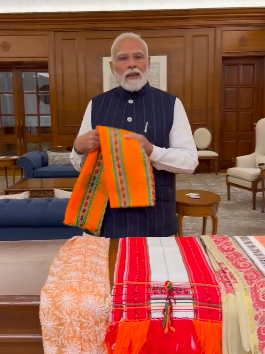
Hon’ble PM Shri @narendramodi Ji’s message on the eve of #NationalHandloomDay is a stirring tribute to the enduring spirit of Swadeshi and the exceptional craftsmanship of our master weavers.
From the iconic Sambalpuri, Bomkai, and Kotpad weaves of Odisha to the rich handloom… pic.twitter.com/sa6MiRul7H
— Mohan Charan Majhi (@MohanMOdisha) August 6, 2026
In a message shared on social media, the Prime Minister highlighted the historical importance of August 7, 1905, the day the Swadeshi Movement began during the freedom struggle against British rule. He said the occasion reflects the spirit of self-reliance and encourages people to support Indian artisans.
PM Modi appealed to young people to purchase handloom products and share their experiences through social media, including “Get Ready With Me” videos showcasing traditional handloom clothing.
He said celebrating National Handloom Day is a way of recognising the efforts of weavers and supporting families involved in preserving India’s rich textile heritage.
The Prime Minister also emphasised that handloom products represent the skill, dedication and cultural identity of artisans across the country. He said choosing handloom items supports the “Vocal for Local” initiative and contributes to the vision of an Aatmanirbhar Bharat.
National Handloom Day is observed every year on August 7 to commemorate the launch of the Swadeshi Movement and highlight the contribution of India’s handloom sector.