


26, Jun 2026
AVer Receives 2026 Unified Communications Product of the Year Award from TMCnet

Taipei, Taiwan – June 26: AVer Information Inc., an award-winning provider of AI audio-video solutions, announced today that TMC, a global, integrated media company helping clients build communities via in person and digital marketing campaigns has named the VB150 as a 2026 Unified Communications Product of the Year Award winner.
“We are honored to receive TMC’s 2026 Unified Communications Product of the Year Award for the VB150,” said Marc Happes, Sr. Product Manager at AVer Information Inc. “The VB150 was designed to simplify hybrid collaboration in smaller meeting rooms while delivering exceptional video and audio experiences for every participant. TMCnet’s recognition reflects our commitment to creating innovative solutions that help organizations communicate and collaborate more effectively in today’s dynamic workplace.”
AVer’s VB150 is a next-generation USB video bar designed to make hybrid collaboration effortless, accessible and highly impactful. Built specifically for huddle rooms and small meeting spaces, the VB150 combines powerful 4K video performance, intelligent AI features and simple plug-and-play connectivity to deliver seamless hybrid meeting experiences for BYOD and PC-based room solutions.
The VB150 features a high-performance 4K camera with a 120° wide-angle lens, ensuring every participant is clearly visible and included in the conversation. The VB150 also includes intelligent features such as AI Voice Tracking, which automatically follows the active speaker, while Smart Composition frames all meeting participants for a balanced, engaging view. Together, these capabilities create a natural and inclusive meeting experience without requiring manual camera adjustments.
The VB150’s advanced audio system ensures every voice is heard clearly. Equipped with five beamforming microphones and AI noise reduction, the system captures speech accurately while minimizing background distractions. An optional expansion microphone can further extend audio pickup range, making the VB150 adaptable to a variety of room layouts.
“It gives me great pleasure to honor AVer as a 2026 recipient of TMC’s Unified Communications Product of the Year Award for their innovative solution, VB150,” said Rich Tehrani, CEO, TMC. “Our judges were very impressed with the ingenuity and excellence displayed by AVer in their groundbreaking work on VB150.”
Winners of the 2026 Unified Communications Product of the Year Award will be announced online and highlighted in INTERNET TELEPHONY magazine online.
- 0
- By Neel Achary

26, Jun 2026
As AI Concerns Grow, 66% of Enterprise Event Professionals Now Say AI Translation Outperforms Human Interpreters
New study finds AI translation exceeds human interpretation on quality, access, and cost as multilingual demand surges
LOS ALTOS, CA – June 26 – For years, human interpreters have been considered the gold standard for multilingual communication. New research suggests the standard is changing.
The “2026 State of AI Translation and Captions” survey, conducted independently by Dimensional Research and commissioned by Wordly, finds that two-thirds (66%) of enterprise event planners now say AI translation and captions deliver better quality than human interpreters. That shift strengthens with AI usage. Among regular users, 79% say AI performs better, while just 12% prefer human interpreters.
“Much of the public conversation around AI still focuses on risk, uncertainty, and what the technology cannot do,” said Lakshman Rathnam, Wordly Founder & CEO. “But research shows that organizations that use AI translation are making decisions based on outcomes, not assumptions. They’re seeing measurable gains in quality, accessibility, and scale and that is reshaping what they expect from language technology.”
Key Findings from the 2026 State of AI Translation and Captions Survey:
●A New Quality Standard: 66% of enterprise event planners report that AI translation and captioning delivers higher quality than human interpreters (compared to 25% who still prefer traditional interpretation services).
●High Satisfaction Across the Board: 79% of regular users say AI translation performs better than traditional options (with just 12% preferring human interpreters), while 61% of occasional users report a superior experience.
●Rapid Technology Advances: 93% of respondents state that AI translation quality has noticeably improved over the past year.
●Economics Driving Adoption: 95% of enterprise organizations find AI translation more affordable and easier to deploy than human interpretation, allowing them to expand language access within budget constraints.
●Surging Multilingual Demand: 88% of respondents report an increase in non-English-speaking participants, up from 77% the previous year.
●A Universal Corporate Priority: 96% of surveyed organizations state that providing comprehensive language access is now an official priority.
What’s Next: The Future Strategy for Enterprise Language Access
Despite near-universal adoption of AI interpretation (88%) and captioning (91%), 97% of respondents want capabilities beyond live translation, including:
●58% are interested in adding full multilingual transcripts
●53% would like to add subtitle and voice dubbing files
●51% are interested in creating meeting notes with action items
●50% would like to add marketing-ready summaries
A complete copy of the 2026 State of AI Translation and Captions can be found online at https://www.wordly.ai/research/state-of-ai-translation-2026. An infographic highlighting the biggest trends of the survey is also available.
Survey Methodology: The 2026 State of AI Translation and Captioning survey was commissioned by Wordly and conducted by Dimensional Research. The study surveyed 205 qualified meeting and event stakeholders from the United States and United Kingdom between May 11 and May 21, 2026. Participants were responsible for external events and/or internal meetings involving multilingual audiences at organizations with more than 1,000 employees.
25, Jun 2026
Metals.io, Powered by Tezos, Launches Global First with Tokenized Cobalt and Nickel
The platform unlocks assets once out of reach for assets individual and professional investors, giving direct beneficial ownership of physical metals held in secure facilities
London, UK—25th June, 2026—Tezos based application, metals.io, today, in a global first, launched physically backed industrial metals tokens with the listing of two tokens: xCo (cobalt) and xNi (nickel) on the Tezos-based trading platform. In tokenizing cobalt and nickel, metals that are notable for their specific strategic value in industrial and manufacturing applications and use in the energy sector, and for being inaccessible to retail investors, the team behind metals.io is once more responding to market demand and unlocking access to assets that have long been out of reach for individual investors.
Despite their use in a range of applications, such as the manufacturing of rechargeable batteries, high-performance superalloys, and corrosion-resistant materials, a number of factors have prohibited retail investors from accessing cobalt and nickel before now. For cobalt, minimum lot sizes through OTC channels typically start at one tonne and scale up from there. At early 2026 prices a one-tonne minimum implies a USD 56,000 minimum ticket, before any consideration of warehouse storage costs, insurance, and the financing of working capital. The market is not designed for investors looking for sub-tonne fractional ownership, and settlement timelines, payment terms, and warrant transfer mechanics are all geared toward industrial buyers. Nickel is equally inaccessible for retail traders. While nickel does have a deep, transparent, exchange-traded reference market (the LME), the standard LME nickel contract size is 6 tonnes, and financing costs, insurance, and the operational requirements of taking physical delivery from an approved warehouse make this a market designed for industrial users and large traders rather than investors looking for direct exposure.
The tokenized assets, xCo (cobalt) and xNi (nickel), serve to broaden access to these commodities, giving investors direct beneficial ownership of the physical metals held in facilities. By combining a trust structure with Tezos-based smart contracts, metals.io makes it possible for investors to own, hold, and trade these assets without the financing, warehousing, and minimum lot-size frictions that have kept the cobalt and nickel markets largely closed to anyone smaller than an industrial buyer or a commodity trading house.
“The rapid growth of AI, an explosion of manufacturing capacity in emerging markets, and a host of other technological demands and developments have created demand for the metals and minerals that power industries as diverse as the automotive sector to the aerospace industry. However, systemic barriers have long prohibited mainstream access to these assets and, when it comes to how metals and commodities are traded today not much has changed in the transfer of metals since the launch of the London Metals Exchange, almost 150 years ago. Now, though, with the launch of metals.io and the dawn of tokenization, we’re able to streamline access to these essential commodities, making them available to a new profile of buyer and introducing new routes to market for suppliers”, said Ben Elvidge, Lead for metals.io, and Head of Alternative Assets at Trilitech.
Cobalt and nickel each have specific properties that make them especially valuable for energy, industrial and manufacturing applications. Cobalt is one of the defining critical minerals of the energy transition. It is essential to nickel manganese cobalt (NCM) and nickel cobalt aluminium (NCA) battery cathodes used in the majority of European and North American electric vehicles, as well as in consumer electronics, aerospace alloys, and a range of industrial catalysts. Nickel is one of the most strategically important industrial metals in the world. It is the backbone of stainless steel, which still accounts for around two-thirds of global nickel demand, and it has become a critical input into high-energy-density battery cathodes used in premium electric vehicles, aerospace, and grid-scale storage.
The launch of tokenized cobalt and nickel on metals.io further expands the platform’s offerings, opening access to new investors who would not previously have had the opportunity to own and trade them. In addition to the new assets launching today, visitors to the site can also access xU3O8 tokenized uranium; VNX Gold (VNXAU), digital proof of ownership of allocated gold which is physically held in a vault in Liechtenstein; and the RARE token from Noemon Tech, which provides transparent exposure to a diversified basket of five strategic metals selected for their critical industrial and technological value. For more information about all of these assets and tokenized commodities, visit: https://metals.io/
25, Jun 2026
IBM Pushes Semiconductor Limits with Sub-1 Nanometre Chip Innovation
June 25: IBM has announced a major breakthrough in semiconductor innovation with the development of a sub-1 nanometre chip architecture, marking a significant step forward in next-generation computing technology.
The new advancement is designed to deliver higher performance while using less energy, addressing the growing global demand for faster and more efficient computing systems. By pushing beyond traditional scaling limits, the technology represents a major milestone in chip design and engineering.
IBM stated that the breakthrough leverages advanced fabrication techniques aimed at improving transistor density and overall chip efficiency. This could help unlock new possibilities in areas such as artificial intelligence, cloud computing, data processing, and scientific research.
Experts believe this development may reshape the future of the semiconductor industry, as companies continue to seek more powerful and energy-efficient solutions to support increasingly complex digital workloads.
The innovation also highlights the rapid pace of progress in chip technology, where even small improvements in size and efficiency can lead to significant gains in computing power and performance.
IBM’s latest announcement reinforces its position as a key player in advanced semiconductor research and next-generation computing solutions.
25, Jun 2026
Nature-Based Solutions Key to India’s Water Security: Expert
New Delhi, June 25: India has the potential to emerge as a global leader in sustainable water management by adopting nature-based solutions and innovative approaches, an expert said on Tuesday.
Speaking on the importance of long-term water security, the expert highlighted that climate change, rapid urbanisation, and increasing demand are putting significant pressure on water resources across regions. In this context, nature-based solutions such as watershed restoration, wetland conservation, rainwater harvesting, and ecosystem-based water management were identified as key strategies.
The expert noted that integrating traditional knowledge systems with modern technology can help improve water conservation outcomes and ensure sustainable use of resources. Community participation and decentralised water governance were also emphasised as critical components for success.
India’s diverse geography and existing experience in large-scale water management programmes provide a strong foundation for scaling up such initiatives, the expert said. Strengthening local water bodies and improving groundwater recharge were highlighted as priority areas.
The need for collaborative efforts between government agencies, local bodies, and communities was also underlined to ensure effective implementation of sustainable water practices.
The expert further stated that investing in nature-based solutions not only supports water security but also contributes to climate resilience, biodiversity conservation, and rural livelihoods.
With growing global attention on environmental sustainability, India’s focus on innovative water management strategies could position the country as a model for other developing economies.
25, Jun 2026
AAEON’s Release of the EPIC-PTH9 Puts a Spotlight on Industrial AI
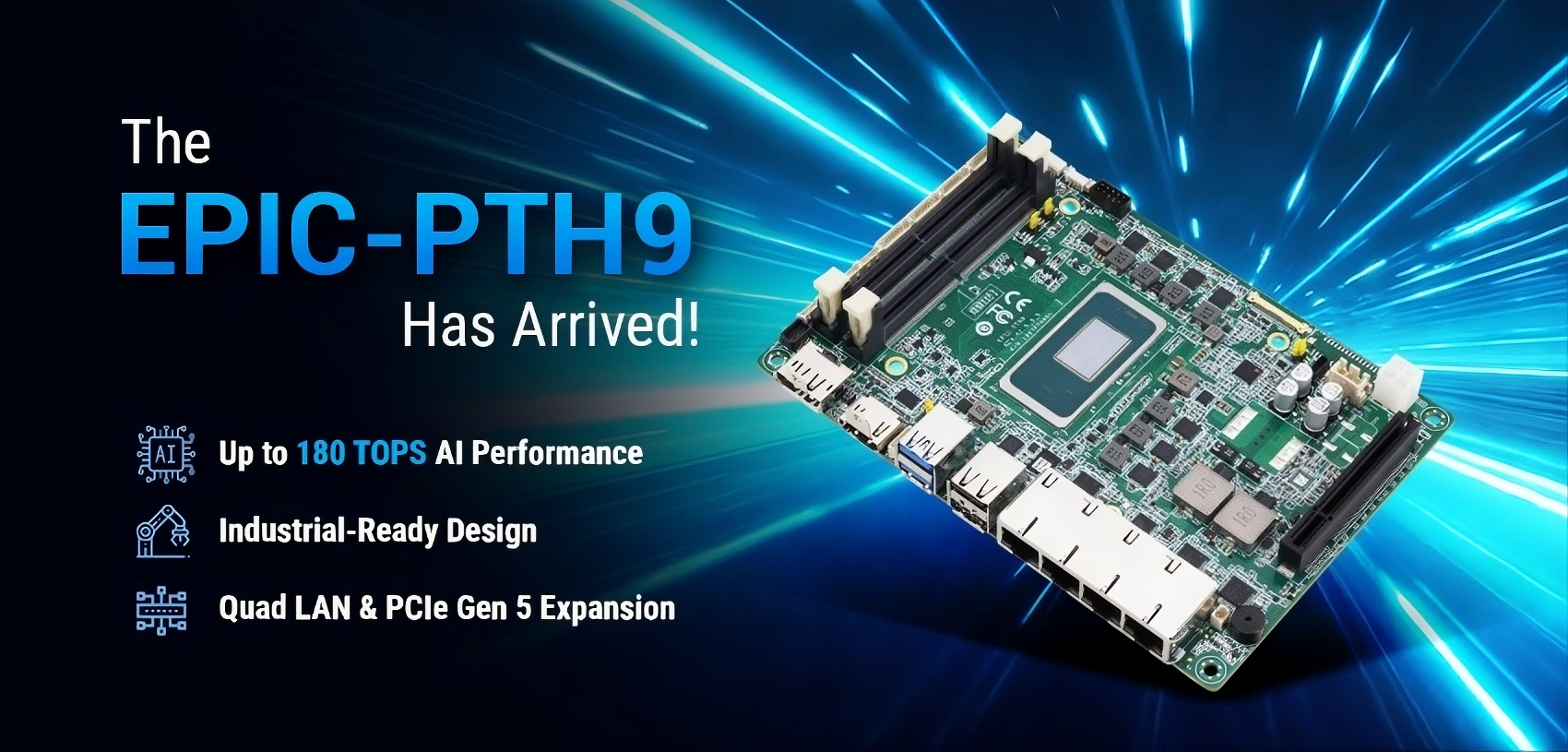
Blending Intel Core Ultra Series 3 processing with a reinforced, low-profile design, the EPIC-PTH9 sees AAEON target the industrial AI sphere.
Taipei, Taiwan – June 25: Industry-leading provider of embedded solutions AAEON (Stock Code: 6579) today announced the release of the EPIC-PTH9, a 4” industrial single-board computer with Intel Core Ultra Series 3 processors (formerly Panther Lake), PCIe Gen 5 x8 expansion, and a robust, low-profile design.
Offering standard models with a choice of either the Intel Core Ultra X7 Processor 358H or Intel Core Ultra 7 Processor 356H, the EPIC-PTH9 can deliver up to 180 TOPS of AI performance through the Intel platform’s integrated CPU, Intel Arc B390 GPU, and NPU.
Given the product’s positioning as a platform for industrial AI applications, its I/O is geared towards support for the need to support multiple cameras, sensors, or control devices such solutions require. For this, the EPIC-PTH9 comes with four LAN ports, three of which three running at 2.5GbE and one at 1GbE speed, with two of these four ports supporting PXE enablement.
Other notable I/Os come in the form of four USB ports (two USB 3.2 Gen 2 and two USB 2.0), as well as four internal serial port headers. The board also provides a GPIO 8-bit, and SMBus header, co-lay with I2C and timed GPIO functions, which can be changed by BOM.
Perhaps the biggest difference between the EPIC-PTH9 and its predecessors, outside of its processing foundation, is the presence of a PCIe 5.0 x8 slot, which can be used to host next-gen AI accelerators, frame grabbers, and other specialized industrial I/O cards. Other expansion options include a M.2 3052 B-Key, M.2 2230 E-Key, and M.2 2280 M-Key slots for 5G, Wi-Fi, and NVMe storage modules, respectively.
The EPIC-PTH9 also sees improvements in its environmental ruggedness, with a default temperature range of -20°C to 70°C and a 9V to 24V power input tolerance. These features are particularly notable given the board’s low-profile 1U I/O height.
With respect to OS compatibility, the EPIC-PTH9 lists support for both Windows 11 and Linux Ubuntu 26.04 (kernel 7.0.0-14).
25, Jun 2026
Amazon CEO Announces Massive Dollar 48 Billion India Expansion Plan
New Delhi, June 25: Amazon CEO has met Prime Minister Narendra Modi and announced plans to invest $48 billion in India by 2030, marking one of the company’s largest long-term commitments in the country.
The investment is expected to be directed towards expanding Amazon’s e-commerce infrastructure, strengthening cloud computing capabilities, enhancing logistics networks, and supporting digital innovation across India.
According to officials, the announcement reflects growing confidence in India’s digital economy and its rapidly expanding consumer and enterprise markets. The planned investment is also expected to create new opportunities in technology, supply chain management, and employment generation over the coming years.
During the meeting, discussions focused on India’s digital transformation, ease of doing business, and the role of technology in driving inclusive economic growth. The government highlighted its continued focus on building a strong digital ecosystem to support global and domestic companies.
Amazon’s commitment is expected to further deepen its presence in India, where it already operates across multiple sectors including e-commerce, cloud services through Amazon Web Services (AWS), and digital payment solutions.
Industry experts say the investment underscores India’s position as a key global growth market for technology and retail expansion. It also aligns with broader trends of increasing foreign direct investment in India’s digital and infrastructure sectors.
The company stated that the long-term investment will support innovation, expand small business participation on its platform, and improve customer experience across the country.
The announcement is seen as a significant boost to India’s digital economy and reinforces global investor confidence in the country’s growth trajectory.
25, Jun 2026
Global Scrum Alliance Community Surpasses 2 Million Credentials Earned
The historic milestone belongs to a global ecosystem of trainers, partners, and practitioners, proving that agile capabilities are foundational to surviving and thriving in the age of AI and other disruptive forces
DENVER, CO, June 25: In a definitive sign that agility has become the foundational skill for the modern workforce, the Scrum Alliance® community has officially surpassed 2 million professional credentials earned from the organization. This historic milestone belongs entirely to the global community that built, shaped, and sustained this movement from the ground up.
This ecosystem is anchored by the training partners who scale workplace agility through hands-on education, and the members who sustain it through everyday practice. This milestone is a collective victory for every layer of the community: the early practitioners who first legitimized agility globally, the volunteers who shape professional standards, the local chapters and User Groups creating grassroots community, the enterprises adopting it at scale, and the dedicated members driving it forward every day.
From foundational certifications to emerging microcredentials, these credentials reflect a global movement of professionals applying agile principles beyond software and technology into business operations, healthcare, education, marketing, product development, leadership, and organizational transformation.
As organizations face unprecedented complexity driven by the rapid rise of AI and other disruptive forces, agile capabilities have become more important than ever. Agile principles and behaviors serve as the essential foundation for navigating these dynamics, allowing professionals across every sector to take charge of their career longevity and build adaptable, future-proof skill sets.
“Reaching two million credentials serves as a definitive index for a broader shift in the global talent market—one where agility is a core requirement for organizational resilience,” said Tristan Boutros, CEO of Scrum Alliance. “Modern enterprises increasingly rely on multi-faceted employees who can enable strategy, navigate AI-driven disruption, lead organizational change, and solve complex business problems. This milestone belongs to our extraordinary community. From the early practitioners who legitimized agility globally to the trainers and partners who scale it today, this celebrates the people who drive meaningful results in an unpredictable world.”
25, Jun 2026
AI-Embedded Cellular Module Adoption Loses Momentum in Q1 2026 as Surging Memory Prices Impact the Market
Buenos Aires, Seoul, Beijing, Berlin, Fort Collins, Hong Kong, London, New Delhi, Taipei, Tokyo, June 25: The cellular IoT module market is starting to look a little different. For years, most of the module innovation came from connectivity upgrades from 2G to 4G, then to NB-IoT to Cat 1 bis, and now 5G and RedCap. But that is beginning to change. Today, intelligence is becoming just as important as connectivity, but the path is proving less linear than many expected.
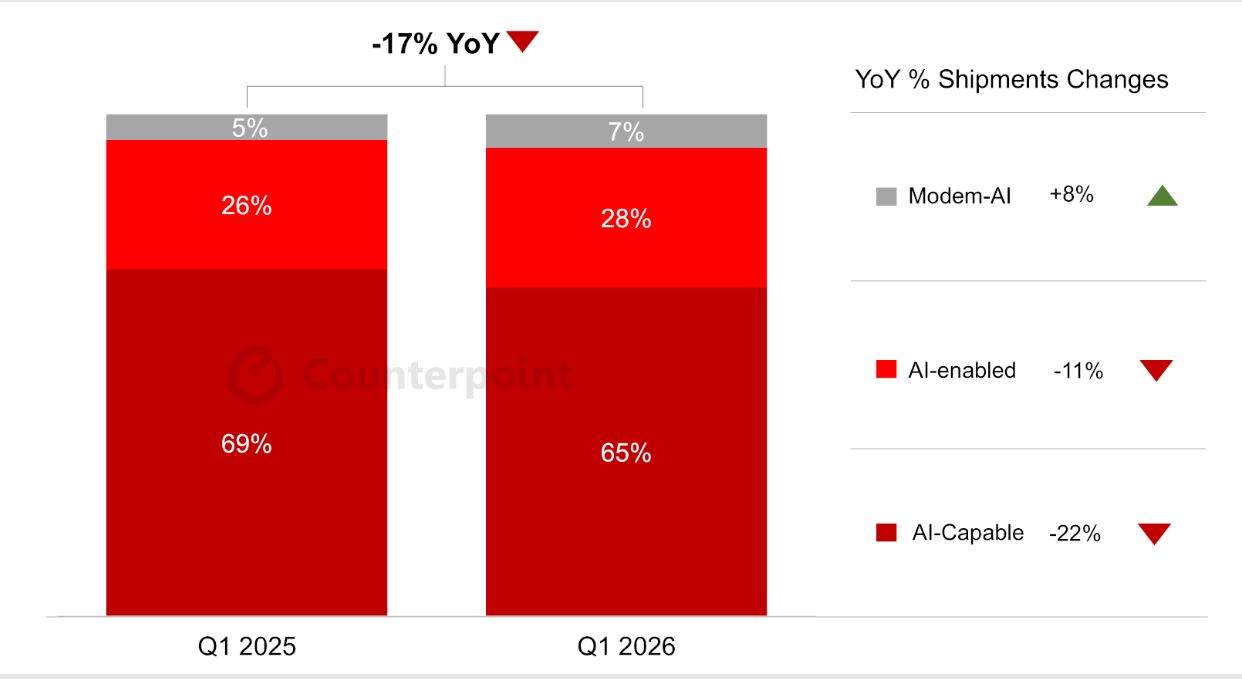
According to Counterpoint Research’s latest Cellular IoT AI Module & Chipset Tracker, AI-embedded cellular IoT modules contributed 6% of total cellular IoT module shipments in Q1 2026. While AI remains one of the most discussed topics across the IoT ecosystem, adoption lost momentum during the quarter for cellular AI modules. After growing 19% YoY in 2025, AI-embedded module shipments declined nearly 17% YoY in Q1 2026.
The slowdown was mainly due to rising memory prices, which have increased the bill of materials for many AI-enabled products. Unlike basic connectivity modules, AI-capable and AI-enabled modules typically require larger memory configurations to support local AI processing and computing workloads. As memory costs increased throughout the supply chain, several enterprise deployments were delayed, particularly in cost-sensitive segments.
AI-embedded Cellular Module Shipments Share by AI Capability, Q1 2026
Source: Counterpoint AI Module & Chipset Tracker & Forecast, Q1 2026
Commenting on the market scenario, Senior Analyst Tina Lu said “We are starting to see two different AI adoption paths in modules. One is the Modem AI modules where intelligence is directly embedded into modems (for example Qualcomm X72, X75, X80, X85 or Mediatek T830, T930) to handle tasks like optimization of connectivity, network selection and power efficiency, the second is application-centric AI where modules integrate CPUs, GPUs and dedicated NPUs to run AI processing locally.”
Lu added, “The different cost structure and component dependencies affected the growth and adoption of these two approaches. Modem AI, which is not dependent on memory and does not perform application processing, registered a growth of 8% YoY, whereas AI-capable and AI-enabled modules which mainly perform on-device edge AI and are dependent on higher memory configuration required to do processing tasks, declined 22% YoY and 11% YoY respectively, due to rising memory costs.”
Commenting on the drivers & outlook, Director of IoT Practice Mohit Agrawal said “Smart retail, rugged handhelds and industrial are the major adopters of AI-enabled modules whereas for AI-capable modules POS is driving the contribution. Modem AI growth is being single-handedly driven by router-CPE application as operators look to optimize network performance, improve power efficiency and deliver a better user experience in enterprise deployments and 5G FWA.”
Agrawal added, “Due to these memory price increases, AI-embedded cellular modules witnessed double-digit ASP growth as module players were forced to raise prices, eventually affecting demand across applications due to hardware costs. The recent slowdown does not change the direction of the market. AI adoption is still at an early stage across IoT applications. With ongoing traction in smart cameras, surveillance, retail, automotive, and industrial robotics, we expect AI penetration in cellular modules to reach 25% by 2030. Over time, AI will move beyond a few niche applications and become a standard feature, helping connected devices become smarter rather than simply remain connected.”
AI Category Definitions:
AI-Capable Modules: Modules integrating CPUs and GPUs that can support basic AI processing and lightweight inference, but without a dedicated AI accelerator. An example is the Fibocom SC226 module, which is powered by an ARM Cortex A53 quad-core processor, and includes a built-in Adreno 702 GPU.
AI-Enabled Modules: Modules integrating dedicated AI hardware such as NPUs, TPUs or AI engines to support advanced AI workloads and local inference. For example, the Meig SLM925 module, based on the QCM6125 SoC.
Modem AI Modules: Modules based on modem platforms with embedded AI capabilities focused on connectivity optimization, including network performance, power efficiency, positioning and signal management, rather than application-level AI processing.
25, Jun 2026
Wood Mackenzie acquires LandGate to deliver connected intelligence for the new era of US power markets
Acquisition of 150 million parcel-level land intelligence dataset strengthens Wood Mackenzie’s leading market position and will drive faster, higher-confidence capital allocation decisions for power, renewables, and data center developers
LONDON/HOUSTON/SINGAPORE, June 25: Wood Mackenzie, a global leader in data, analytics and insights for the energy and natural resources industry, today announced the acquisition of LandGate. The deal combines Wood Mackenzie’s power market forecasting and supply chain analytics with LandGate’s proprietary land and grid intelligence, as electricity demand grows at an unprecedented pace.
“Wood Mackenzie is committed to providing the data, analytics and insights our clients need to make critical decisions in an increasingly complex energy world,” said Jason Liu, CEO of Wood Mackenzie. “The system is becoming more interconnected and companies that rely on siloed approaches will be left behind. This acquisition advances our strategy by bringing LandGate’s granular land and infrastructure data into our platform, giving customers a uniquely connected view of where demand is growing, how the grid must respond, and where capital should flow.”
Power generation investment in the US is expected to reach $1.36 trillion through 2035. Data centers are at the forefront of this growth and Wood Mackenzie estimates they will account for roughly 68% of US load growth through 2030. That concentration of large-scale, location-specific load is shifting power markets from a supply-led model to one defined by demand and whether grid infrastructure can respond in time. Decisions made at the earliest stages of project development are more crucial than ever and require data connecting power market fundamentals to ground-level site conditions within a single workflow.
Founded in Denver, Colorado in 2016, LandGate offers a highly differentiated and proprietary data and analytics solution, leveraging insights on the US power transmission grid and more than 150 million land parcels in the US to support critically important capital allocation decisions for data centers, power and renewables projects, and other energy infrastructure assets.
“The energy industry is undergoing a fundamental transformation, and our customers are at the heart of it,” said Yoann Hispa CEO of LandGate. “By combining our proprietary data and insights with Wood Mackenzie, we are creating a unified ecosystem that will strengthen our offerings and accelerate the growth and innovation our clients rely on.”
“The future of power market analysis requires connecting demand, supply, networks and infrastructure in a single decision-making framework,” said Xizhou Zhou, Executive Vice President and Head of Power & Renewables at Wood Mackenzie. “LandGate adds a critical layer of high-resolution data across land, transmission and large-load demand that allows us to model and understand markets from the ground up and significantly enhances our ability to support clients through the full investment lifecycle, from screening and siting to development and financing.”
KippsDeSanto & Co., KPMG, and Brach Eichler LLC served respectively as financial, tax, and legal advisors to LandGate in connection with the transaction.


