


6, May 2026
Magna Systems Builds the Future Broadcast Stack at BroadcastAsia 2026
20-22 May at Singapore Expo on stand 5D1-1
SINGAPORE, May 06– Magna Systems will once again play a prominent role at this year’s BroadcastAsia show (part of Asia Tech x Singapore – ATXSG) as it demonstrates the very latest solutions from its technology partners involved in Building the Future Broadcast Stack.
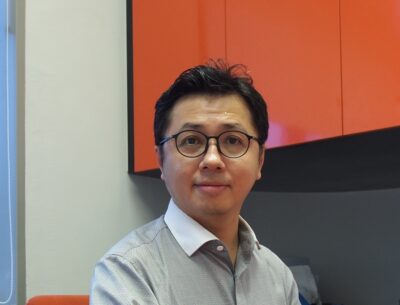
Magna Systems Director – Sales and Operations (Asia) Patrick So
Magna will have cutting edge demonstrations from some of its key Asia Pacific technology partners and principals.
These include Actus Digital (Realtime Media & Broadcast Monitoring Software), Arkona Technologies (IP core infrastructure solutions), Caton Technology (High Quality Live Video Over IP with Ultra-Low Latency) and Chyron (live broadcast production creation, playout and real-time data visualisation).
There will also be live demonstrations on the Magna stand from and of Dalet (agile media workflows), Enensys (efficient media delivery over multiple infrastructures), Kaltura (video solutions for superior webinars, events and hubs), NetOn.Live (innovative live media production solutions) and Providius (advanced real-time observability software purpose-built for mission-critical network infrastructures).
Then alongside these will be the latest solutions from RTS (intercom and talkback), TAG (software-based integrated IP probing, monitoring, visualisation and analytics), Synamedia (flexible, modular SaaS OTT video platform), Techex (live video, over IP and in the cloud) and TSL (interoperable, independent vendor-agnostic broadcast control, audio monitoring & intelligent power solutions).
Magna Systems Director – Sales and Operations (Asia) Patrick So said, “The Magna Systems stand at Broadcast Asia will serve as a gathering place for Asia’s broadcast, media and entertainment professionals and provide a platform where the industry’s key players can converge to understand how Magna are helping Build the Future Broadcast Stack. It’s an exciting time to be in the Asia Pacific industry.”
Join Magna Systems at BroadcastAsia 2026 on stand 5D1-1 to explore cutting-edge broadcast technologies and engage in insightful discussions that will drive the next wave of media transformation across Asia.
Picture credit
Magna Systems Director – Sales and Operations (Asia) Patrick So

- 0
- By Neel Achary

6, May 2026
Silver Trak Digital demonstrates next gen Media Room Suite solutions at Broadcast Asia 2026
20-22 May at Singapore Expo on IAMT Pavilion, stand 5C27
SINGAPORE, May 06 – Media asset management specialists Silver Trak Digital will be demonstrating its next gen Media Room Suite solutions at Broadcast Asia 2026 from 20-22 May at the Singapore Expo on the IAMT Pavilion, stand 5C27.
Silver Trak COO Christian Christiansen explained, “We will be demonstrating two products from our latest, cutting-edge Media Room suite – Media Room covering Media Asset Management, distribution and screeners (and more) and Media Room Connect which creates and manages a secure screening room on your company domain. We will also be discussing two new products under development including Media Room Screeners, a secure screener campaigns product with enhanced artwork capabilities and Media Room Transport, our SaaS large file, high speed transport solution.”
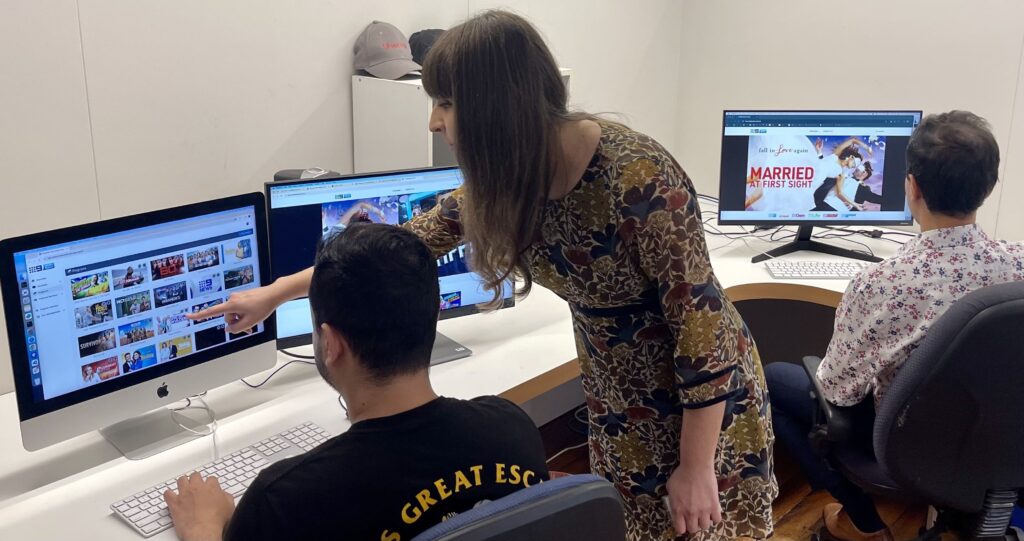
Media Room in action
Media Room is the affordable, secure, cloud-based media asset management and delivery platform that enables content owners to upload, manage, market and distribute content globally, faster, more efficiently and with complete control.
Due to its flexibility and affordability, media organisations can easily start small and scale with Media Room as their business grows.
Broadcast Asia is the central meeting point of Asia’s broadcast, MediaTech and entertainment community, bringing together the visionaries and innovators redefining how content is created, delivered and experienced.
As broadcast, digital and AV worlds converge, Broadcast Asia 2026 sparks new thinking and insightful conversations around innovative media transformation – not just showcasing technology but shaping strategy. It’s where leadership, innovation and industry direction meet to define the next era of MediaTech in Asia and beyond. Hence it being the ideal place for companies to experience Media Room and its applications.
At this year’s show Silver Trak will be a key partner on the IAMT Pavilion, which includes the IAMT Impact Awards, IAMT Member Interviews, a dynamic IAMT Conference Programme jam-packed with essential intelligence and expert perspectives and the IAMT Hub forming a space to connect, meet and engage throughout the show.
All of this on the IAMT Pavilion, stand 5C27.
Christiansen added, “Being on the IAMT Pavilion gives us, as IAMT Members, a ready-made, engaging and interactive space ideal for a trusted MediaTech organisation. It’s the perfect environment to demonstrate the very latest developments in our Media Room Suite of solutions.”
Christian Christiansen will be joined at Broadcast Asia by Karlz Varma, VP Business Development for Silver Trak Asia.
6, May 2026
Causal Dynamics Lab outperforms Anthropic & OpenAI in multiple coding tests
New research shows AI coding agents spend >80% of their time searching for files rather than editing them. Cielara Code changes this by using a clear map of production software. This approach helps find the right code to change faster, cheaper, and more accurately than typical coding agents.
San Francisco, CA – May 06: AI coding tools are now producing code faster than teams can check what it will do in real use. Causal Dynamics Lab (CDL) announced new research explaining why this happens, along with a new product called Cielara Code. This product achieved the highest accuracy in code localization among AI coding tools, outperforming both Claude Code (Opus-4.6) and OpenAI Codex (GPT-5.4) across three independent tests.
CDL studied how coding agents operate by tracking their actions across thousands of coding sessions. They found 56.8% of agents’ actions involved reading files, and 24.2% involved using grep. Less than 1% of their actions were actual code edits. The problem was not that agents couldn’t write code; they had difficulty finding the correct code to edit. The situation worsened with more complex tasks: when a correct fix involved more than six files, the agents’ ability to recall the necessary information dropped significantly, and the computing power used in failed attempts increased by a factor of 4 compared to successful ones.
“Every coding agent out there today uses grep, which is like a surgeon operating without imaging,” said Hasibul Haque, CEO at Causal Dynamics Lab. “We created Cielara Code to help agents see better: it provides a clear understanding of the working environment, making the reasons behind each change clear and verifiable.”
The 2025 DORA report showed the use of AI coding tools led to a 7.2% drop in deployment stability. AWS CTO Werner Vogels called this problem “dynamic verification debt.” A well-known issue with Claude Code (GitHub issue #42796) illustrates the same problem on a larger scale: current agents treat code as flat text without showing how files connect, how functions call each other, or how changes affect the overall system.
How Cielara Code works
Cielara Code uses a model to represent a customer’s production environment in a 6-layer causal graph. This graph includes information on what the code does, why it was created, who owns it, its limitations, where it runs, and what happens at runtime. If there is a failure, it can be linked back to the specific code change, the developer who approved it, and the reason for that change. Before an agent begins to explore, Cielara Code builds a Code Dependency Causal Graph. This graph tracks four types of relationships, allowing the agent to navigate the structure rather than just look through files one by one.
Benchmark results
Across three independent benchmarks, Cielara Code beat both Claude Code (Opus-4.6) and OpenAI Codex (GPT-5.4) at the hardest part of agent work: finding the right place to make a change. Overall localization accuracy hit 0.774, versus 0.738 for Claude Code and 0.707 for Codex. On MULocBench (1,033 issues across 46 repositories), Cielara reached 0.752 recall@5 versus 0.727 for Claude Code, and cut mean task time from 141.84 to 128.62 seconds. The result: fewer wrong-file edits, fewer failed runs, and 30 to 40 percent lower compute cost per task.
REASONARA: causal memory at enterprise scale
Cielara Code makes this practical through REASONARA, a graph-structured causal memory layer that stores 125M+ tokens of effective context but retrieves only what matters for each query. A typical lookup uses 1,000–2,500 tokens, compared with 23,000–115,000 for full-context approaches — a reduction of up to 98%. On independent benchmarks, REASONARA scores 94% on UltraDomain, 92% on LoCoMo, 73% on LoCoMo-plus, and 87.4% on LongMemEval, and runs 5–8× faster than Codex high-reasoning mode. The roadmap targets a one-billion-token context window.
Cielara Code is a safety layer for AI coding agents. It aims to enhance the safety of their output rather than replace them. Currently, 11 Fortune 100 and over 40 Fortune 500 companies use Cielara Code on their codebase.
“Board members and auditors expect more proactive risk management. Leaders now want proof that security can anticipate risks caused by fast-moving AI and automation, instead of just reacting after incidents,” said the CISO of one of the largest law firms in the United States, who is also a Cielara Code customer.
Phillip Miller, Vice President, Global Chief Information Security Officer, H&R Block added: “Enterprises need solutions to problems they cannot solve with people alone. Cielera’s technology is a generational leap towards the original promise of AI: tackling complexity 7×24 with acquired knowledge, deep reasoning, and unbeatable accuracy. For engineering teams, this means a single engine to discover faults in real-world deployments (including legacy, cloud) and provide clear resolution steps. When I wrote, Hacking Success, I described a world where AI needs strong, directive policy (not rules / guardrails) to be safe and effective. Information Security lags behind the innovation curve, as most options rely on legacy thinking including posture, gateways, and logging. Enterprises now have an option to leverage Cielera’s models to oversee deployments of AI agents, models, and their supporting infrastructure.”
The team
The team has strong skills based on the problem they are addressing. CEO Hasibul Haque led platform engineering at Uber during its rapid growth. CTO Ryan Turner was a Staff Engineer at Uber and helped maintain the SPIRE Project within the Cloud Native Computing Foundation (CNCF). R&D is led by Dr. Xuchao Zhang, who worked at Microsoft Research, and Dr. Liang Zhao from Emory University, who has 200+publications and is ranked among the top 2% of scientists by Stanford University. CDL has a formal research partnership with Emory’s AI Lab.
“AI has already changed how people find information. The next step is to change how people make decisions by exploring possibilities, comparing options, and understanding the outcomes before making a choice,” said Matt Fisher, former Co-Founder and CTO of Daydream and an Adjunct Professor at Brown University. “That shift towards exploring outcomes is what CDL is focusing on.”
What’s next
The Production World Model serves as a foundation. Cielara Code and REASONARA are the first products to use this foundation. In the future, Causal Dynamics Lab will fully simulate the effects of changes in code, infrastructure, policy, and operation. This will create a permanent reasoning layer in the enterprise system that any AI agent can access before making changes that affect production.
6, May 2026
MathCo Collaborates with Google Cloud to Help Enterprises Adopt Workflow-Native AI on Gemini Enterprise
6, May 2026
Synology® officially introduces AI Advisor for accurate, reliable information discovery
Taipei, Taiwan — May 6, 2026 Synology today officially introduces AI Advisor, an intelligent assistant designed to simplify information discovery. By delivering accurate, localized technical guidance directly on Synology’s website, the AI Advisor ensures reliable insights while significantly reducing resolution time for users worldwide.
“AI Advisor integrates over a decade of Synology’s AI expertise,” said Steven Liang, Manager of the Generative AI Application Group at Synology. “With an agent-as-tool design, dynamic knowledge injection, context optimization, and a continuous evaluation pipeline, AI Advisor delivers accurate, high-quality responses and continuously refines itself. These innovations will extend across Synology product lineup, advancing our vision of secure, intuitive solutions.
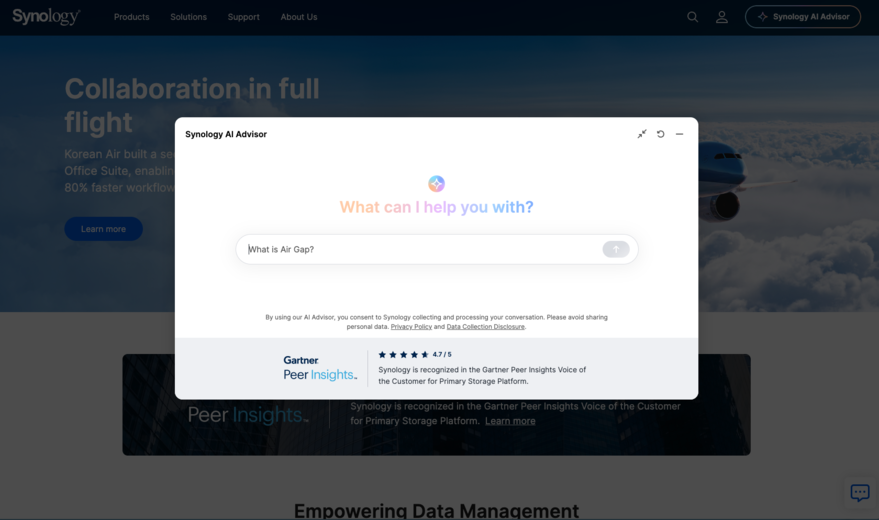
Self-hosted ecosystem to ensure AI sovereignty
Prioritizing customer privacy, the AI Advisor utilizes a self-hosted LLM that operates entirely independent of third-party AI providers, ensuring no context is shared externally. Moving toward complete data sovereignty, the service will transition to a dedicated Synology infrastructure later in 2026, guaranteeing 100% data residency and keeping all user interactions within a secure, sovereign ecosystem.
Streamlined navigation from inquiry to implementation
AI Advisor integrates with Synology’s NAS Selector and NVR Selector tools. Users are guided through preliminary sizing and product recommendation workflows tailored to their deployment needs, enabling faster and more informed early-stage purchasing decisions. By understanding the intent and context of each query, the Advisor further streamlines the journey by directing users to relevant support articles, downloads, or configuration guides to ensure a fast transition from question to solution.
Accessibility and Availability
Alongside the introduction of AI Advisor, this website update brings support for global web accessibility standards, ensuring an inclusive and user-friendly experience for audiences worldwide.
The Synology Website AI Advisor is available now on Synology’s official website. To learn more about Synology’s AI-driven services and experience the new Advisor, visit Synology’s official website. www.synology.com
5, May 2026
ITS America Conference & Expo 2026 Offers More Outdoor Demonstration Experiences Than Ever Before
DETROIT, Mich. (May 5, 2026) — ITS America Conference & Expo, organized in partnership by RX Global and ITS America, introduces an expanded demonstration program for the 2026 ITS America Conference & Expo, taking place June 9-11 in Detroit, Michigan. Attendees will see firsthand how the newest technologies installed along roadways and within vehicles are making transportation in Detroit safer and more efficient. The program marks a significant leap beyond traditional outdoor demonstrations, delivering hands-on, immersive experiences that connect attendees with the latest intelligent transportation technologies in real-world conditions.
The Michigan Department of Transportation (Michigan DOT) is spearheading the ITS America Conference & Expo’s outdoor demonstration experiences, sponsored by Integral Blue, under the theme “Everyday Interoperability,” showcasing how everyday people benefit from a seamless ecosystem of emerging technologies. The 2026 program features a record number of demonstration participants, a milestone that reflects growing industry momentum and commitment to advancing intelligent transportation solutions.
“Michigan Department of Transportation is proud to showcase the State of Michigan as a living laboratory for next‑generation transportation,” said Michele Mueller, Manager Connected, Automated, Electrification at the Michigan Department of Transportation. “By demonstrating emerging innovations in active corridors, we provide the ITS community with a rare opportunity to experience how integrated, data-driven mobility solutions are shaping a safer, smarter, and more efficient mobility ecosystem.”
What makes this year’s ITS America Conference & Expo’s demonstration program truly distinctive is that attendees will experience the technology in transit to see how it works in real time.
-
The I-94 Freeway Experience spans a 45-mile route between downtown Detroit and Ann Arbor, featuring work zone warnings, road hazard alerts, and emergency vehicle applications delivered through advanced roadside sensors, dedicated communication units, and vehicle-to-network (V2N) cellular connectivity.
-
The M-1 Intelligent Woodward Experience runs four miles along 31 vehicle-to-everything (V2X)-equipped intersections between Huntington Place and the Electreon Inductive Charging Tour at the Henry Ford Health Center, deploying autonomous vehicle (AV) shuttles to demonstrate intersection-based mobility and safety services.
-
The Everyday Downtown Experience extends V2N applications throughout downtown Detroit, connecting AV shuttles, pedestrians, and micromobility users through a dedicated smartphone app that functions as a personal on-board unit for collision avoidance and vulnerable road user alerts.
-
Anchoring the broader program is ITS America Conference & Expo’s Emergency Response Tech & Demo Day, scheduled for Thursday, June 11, from 10 a.m. to 6:30 p.m. in the Outdoor Demonstration Area. Brought to life by GFT Infrastructure Inc. and Michigan DOT, this immersive event spotlights infrastructure-based V2X communications for incident scene warnings, drone delivery integration for emergency operations, and an autonomous freight vehicle available for up-close technical exploration. Attendees will engage directly with practitioners and technology specialists throughout the day.
The Outdoor Demonstration Area, located directly outside Huntington Place’s Hall B entrance, features live product demonstrations from leading industry innovators including Brandmotion, showcasing its SmartHUD Digital Vehicle Alert System; Haas Alert, demonstrating networked V2X safety solutions; Integrity Security Services LLC; Miovision Technologies, presenting connected vehicle capabilities; PrePass Safety Alliance; and Ver-mac. Each company will give attendees direct access to hands-on evaluation of new solutions and one-on-one time with the experts driving these developments.
The expanded program includes curated small-group visits to Newlab, Detroit’s premier innovation center, where startups and emerging technologies are advancing the future of mobility. Attendees will also tour The Detroit Smart Parking Lab (DSPL), where live demonstrations from participating companies highlight EV charging, autonomous systems, robotics, and drone operations. An ADASTEC autonomous shuttle will transport attendees between event venues, the Smart Parking Lab, and Newlab. Tours run multiple times throughout the event and are limited to 15 participants per session. More information about demonstrations will be added to the website in the coming weeks.
“The demonstration experience program is what makes this event so distinct, and this year, we can truly say we are doing something new,” said Laura Chace, President and CEO of the Intelligent Transportation Society of America. “With a record number of demo participants and a reimagined experiential program, attendees will engage with technologies not just on the show floor, but out in the real world where they are making impact in our transportation systems.”
The demonstration program is sponsored by Integral Blue and powered by Michigan DOT. For more information on demonstrations and the full event experience, visit www.itsamericaevents.com/expo/
5, May 2026
Tech Startup Launches Tool Built to Catch AI Hallucinations in Legal Citations
CiteSentinel Helps Lawyers File Faster While Avoiding Sanctions and Embarrassment
LOS ANGELES, May 5, 2026 — Legal tech startup BrentWorks Inc. launched CiteSentinel, among the first dedicated platforms built specifically to detect and prevent AI hallucinations in legal citations. The tool scans legal documents and flags case law, statutes, and legal authorities that may be fabricated, misstated, or otherwise erroneous, before they reach a judge.
Courts across the country are increasingly sanctioning attorneys who submit briefs containing invented case citations, a well-documented byproduct of generative AI drafting tools that produce authoritative-sounding, but entirely fictional, legal authority. CiteSentinel was designed to close that verification gap, giving attorneys a fast and easy way to confirm that every citation in a filing corresponds to a real case, a real statute, and a real legal authority.
“The legal profession is learning, in very public ways, that AI doesn’t just make mistakes, it confidently lies to your face,” said BrentWorks co-founder Brent Britton. “CiteSentinel is about restoring trust. It lets lawyers move fast with the irresistible efficiencies of generative AI while still filing documents reciting authorities they can stand behind. It also enables them to scan opposing counsel’s documents, giving them a competitive edge in the courtroom.”
Many attorneys who do not personally use AI to draft documents are discovering they have a problem anyway. Opposing counsel may have used AI. Co-counsel may have. Contract attorneys and paralegals almost certainly have access to it and may be using it
without disclosing that fact. When a brief containing fabricated citations reaches the court, the question of who drafted it quickly becomes secondary to the question of whose name is on it.
CiteSentinel lets attorneys scan any document, their own, a colleague’s, or an adversary’s, for citation errors before those errors become their problem. Attorneys who review opposing counsel’s filings with CiteSentinel gain an additional advantage: the ability to identify and challenge citations to authorities that simply do not exist.
Today, a lawyer’s supervisory obligation includes a question that would have seemed absurd just a few short years ago: Are the cases cited in this brief real or imaginary?
Senior lawyers cannot personally verify every citation in every document produced by everyone under their supervision. CiteSentinel can. At a cost that is modest compared to a single sanctions proceeding or the reputational damage that comes with public embarrassment before a court, CiteSentinel is among the most cost-effective risk management tools available to any law firm, legal department, or solo practice today.
Unlike traditional research platforms that focus on finding more information, CiteSentinel focuses on confirming the law cited in a document is real. Attorneys can scan:
· Their own AI-assisted drafts, before filing
· Submissions from co-counsel, contract attorneys, and support staff
· Opposing counsel’s filings, for strategic advantage
· Any document where citation accuracy carries professional or ethical weight
Like a reality check for legal briefs, the tool flags citations that may be hallucinated, misstated, or inaccurately referenced, allowing lawyers to correct errors before courts, clients, or competitors discover them first.
Under mounting deadline pressure, many attorneys now rely on AI-generated research, but verification has not kept pace. CiteSentinel addresses that verification gap head-on, helping lawyers practice faster, more accurately, and with the confidence that their work reflects reality.
BrentWorks was founded by Brent Britton, a veteran technology attorney and MIT-trained engineer, and Brent Hunter, a longtime technologist and AI pioneer. CiteSentinel is the first in a series of products the company will be releasing to elevate the practice of law in the age of AI.
BRENT C.J. BRITTON/CEO
Brent Britton is what happens when law school meets the MIT Media Lab. A veteran engineer, technology attorney licensed in three states (California, New York and Florida), and entrepreneur who literally wrote the book on IP law, Britton has spent his career guiding creators and companies at the frontier of innovation, overseeing billions of dollars of aggregate deal flow in the process. The culmination of his life is re-engineering legal tools to think faster, decide better, and serve humanity at the speed of innovation.
BRENT N. HUNTER/PRESIDENT AND CIO
Brent N. Hunter is a technology pioneer who applied neural networks to finance in 1993. He has since led multimillion-dollar transformation programs for Fortune 500 giants, including GE, Wells Fargo, Disney, and Warner Bros. Discovery. An author, technologist, and systems thinker, he fuses psychology, technology, and leadership into a single mission: to build intelligent systems that serve humanity.
5, May 2026
GMEX Robotics Receives First Deployment Order for Bon Vivant 3.0 Cooking Robot Machines
GMEX Robotics Corporation (NASDAQ: GMEX) (“GMEX Robotics” or the “Company”), a developer of AI-powered robotic technologies, today announced it has received its first deployment order under its previously disclosed AU$4.2 million agreement with a leading Australian hospitality food and beverage group.
The initial purchase order includes multiple Bon Vivant 3.0 automated cooking systems, representing approximately AU$504,000 in value. Delivery of the systems is expected to be completed prior to June 30, 2026.
The order represents the first phase of execution under the purchase agreement announced on March 23, 2026, which provides for the planned deployment of at least 50 intelligent kitchen robotics systems, including Bon Vivant 3.0 and Max models, across the customer’s network of hospitality venues throughout Australia. The identity of the customer remains undisclosed; however, it is the same leading Australian food and beverage group referenced in the Company’s March 23, 2026 announcement.
“This initial deployment order marks an important milestone in the transition from commercial agreement to active deployment,” said Sam Lu, Chief Executive Officer of GMEX Robotics. “We are now executing on our first large-scale hospitality contract, bringing Bon Vivant 3.0 systems into real-world kitchen environments and demonstrating the operational value of our technology.”
GMEX Robotic’ Bon Vivant 3.0 platform integrates AI-driven control systems, advanced sensors, and programmable cooking workflows to support professional kitchen environments. The system is designed to reduce labor intensity, improve consistency, and enable scalable food preparation across multiple locations.
This deployment represents the first phase of execution under GMEX Robotics’ previously announced agreement and is expected to serve as a foundation for broader rollout activities across the customer’s network as GMEX Robotics advances the commercialization of its intelligent culinary robotics platform.
5, May 2026
Kore.ai Establishes Bay Area Strategic Headquarters to Lead the Next Wave of Enterprise AI
Triple-digit customer growth, deepening hyperscaler partnerships, and senior executive appointments accelerate the company’s push to scale the next generation of its AI-native agent platform
SAN MATEO, Calif. — May 5, 2026 — Kore.ai, a global leader in agentic AI platforms and applications, today announced the establishment of its strategic headquarters in the San Francisco Bay Area, positioning the company at the heart of the world’s leading AI innovation ecosystem. The move caps a year of accelerating customer growth, deepening strategic partnerships, and expanding industry leadership, and positions Kore.ai at the center of the ecosystem shaping the next wave of enterprise AI.
The establishment of a Bay Area hub strengthens Kore.ai’s leadership position within the AI community, brings it closer to its expanding local customer base, and highlights its continued investment in top enterprise AI talent. Kore.ai’s official headquarters remains in Orlando, where the company was founded, and the company continues to maintain a significant presence in New York and other major cities worldwide.
To support its next phase of growth, Kore.ai has appointed three senior executives in the Bay Area:
- Uma Sandilya has joined as Chief Growth Officer, bringing experience as a former McKinsey Partner and C3.ai executive, where he developed AI growth strategies
- Cathal McCarthy has been named as Chief Strategy Officer, drawing on more than 25 years’ experience at notable companies, including Apple and eBay, where he scaled global technology businesses and operationalized AI for Fortune 500 and private equity organizations
- Peter Mullen has joined as Chief Marketing Officer, with a strong track record of building and scaling category-defining brands for Fortune 25 companies and leading AI enterprises.
The appointments are accompanied by the relocation of key engineering, Forward Deployed Engineering (FDE), and go-to-market talent to the Bay Area office.
“The Bay Area represents the epicenter of AI innovation and enterprise technology transformation,” said Raj Koneru, Founder and CEO of Kore.ai. “Establishing our strategic headquarters here allows us to be closer to our customers, partners, and the broader ecosystem shaping the future of AI. It strengthens our ability to innovate faster, collaborate more deeply, and deliver cutting-edge, enterprise-grade AI solutions at a global scale.”
A Year of Accelerating Momentum
Kore.ai deepened strategic partnerships with Microsoft and AWS over the last fiscal year, serving as a launch partner for Microsoft Agent 365 and earning the AWS Advanced AI Competency designation, with joint co-build, co-market, and co-sell motions now in market. In addition, the company secured strategic growth capital from AllianceBernstein Private Credit Investors to accelerate product innovation and international expansion.
Additionally, the company recently strengthened its AI-native product portfolio with Agent Management Platform (AMP), a unified command center designed to govern, monitor, and manage AI agents and AI systems across the enterprise and it operates a thriving agent marketplace.
Kore.ai has added over 100 new enterprise customers globally in the last fiscal year, including a growing number in North America and the Bay Area, while continuing to expand within its existing customer base. The company has delivered some of the largest production-scale AI deployments across customer service and employee productivity use cases, enabling enterprises to move from AI pilots to measurable business outcomes.
This growth has been further validated by more than 12 industry leadership recognitions, including placements in the Gartner Magic Quadrant™ for Conversational AI Platforms, Forrester Wave™ for Cognitive Search Platforms, and Everest Group PEAK Matrix® for Agentic AI Products, among others.
With its strategic presence in the Bay Area, Kore.ai is well-positioned to lead the next wave of enterprise AI adoption—driven by innovation, scale, and real-world execution.
5, May 2026
WaveMaker’s Agentic AI Application Generation System Sees Strong Early Momentum Following Launch, Enterprise and Partner Trials Surging Across Industries
Also Read: Construction Bookkeeping: Managing Cash Flow and Compliance in a Complex Industry


