28, Apr 2026
Odisha Launches SITI ODISHA Think Tank for Data Driven Growth
Bhubaneswar, Apr 28 (BNP): Odisha has taken a significant step towards strengthening innovation-led governance with the launch of SITI-ODISHA, a new think tank aimed at improving policy formulation, research, and data-driven decision-making.
The initiative marks a new phase in the state’s development strategy focused on innovation, collaboration, and the use of technology to enhance governance outcomes.
SITI-ODISHA is expected to function as a key knowledge and research hub, supporting evidence-based policymaking across sectors. It will also help bridge the gap between research, implementation, and public policy by bringing together experts, institutions, and stakeholders.
Key Objectives
The think tank is designed to:
ଓଡ଼ିଶାରେ ନବଚିନ୍ତନ ଓ ନବସୃଜନ କ୍ଷେତ୍ରରେ ଏକ ନୂତନ ଅଧ୍ୟାୟର ଶୁଭାରମ୍ଭ ହୋଇଛି। SITI-ODISHA ଏକ ପ୍ରମୁଖ ‘ଥିଙ୍କ୍-ଟ୍ୟାଙ୍କ୍’ ଭାବେ ନୀତି ପ୍ରଣୟନ, ଗବେଷଣା ଏବଂ ତଥ୍ୟଭିତ୍ତିକ ନିଷ୍ପତ୍ତି ଗ୍ରହଣ ପ୍ରକ୍ରିୟାକୁ ସୁଦୃଢ଼ କରିବ । ‘ଭିଜନ ୨୦୩୬’ ଏବଂ ‘ବିକଶିତ ଭାରତ @୨୦୪୭’ର ଲକ୍ଷ୍ୟକୁ ସମନ୍ୱିତ କରି ସହଭାଗିତା ଓ ପ୍ରଯୁକ୍ତି ବିଦ୍ୟାର… pic.twitter.com/QPRslDhdEe
— Mohan Charan Majhi (@MohanMOdisha) April 27, 2026
- Strengthen data-driven decision-making in governance
- Promote research and policy innovation
- Encourage collaboration between government, academia, and industry
- Support long-term planning aligned with development goals
Officials said the initiative aligns with Vision 2036 and Viksit Bharat @2047, ensuring that Odisha’s growth strategy remains future-ready and globally competitive.
By integrating technology and participatory governance, SITI-ODISHA aims to accelerate the state’s development journey and improve the efficiency of policy outcomes across sectors such as education, health, industry, and infrastructure.
The launch reflects Odisha’s broader push to position itself as a hub for innovation, research, and sustainable development in the coming decades.

- 0
- By Neel Achary

28, Apr 2026
TriFetch comes out of stealth to automate the administrative work that slows specialty clinics
TriFetch is building an end-to-end automation layer for independent specialty clinics, covering patient calls and scheduling, referral processing, and prior authorizations. The company is running active pilots across California and aims to help clinics reduce administrative burden so staff can spend more time on care.
San Francisco, CA – Apr 28; In a specialty clinic, the phone rarely stops ringing. Referrals arrive in bursts, prior authorizations stall in payer portals and staff juggle paperwork while patients sit on hold. Independent clinics have been patching these problems with more headcount for decades, even as labor costs rise due to a shortage of highly specialised workers and burnout deepens. TriFetch was built to take that administrative weight off the clinic. By automating the three workflows that dominate clinic operating costs: patient calls, referral processing, and prior authorization, TriFetch helps clinics save on 50%+ of administrative costs while also increasing revenue. This can translate into 1m+ savings for a mid-size practice.
TriFetch announced a $1.9 million pre-seed round led by Nexus Venture Partners with participation from angels from Google, Hipprocratic, Mercor, MIT to scale its automation platform for the front, mid, and back office of specialty care.
The pressure TriFetch is targeting is structural. Independent clinics face the same administrative load as large health systems with a fraction of the staff. A single prior authorization can take 45 minutes and referral coordination often means hours on hold. Patient calls pile up while the front desk triages between the waiting room and the phone line and those left unanswered go to an inbox with hundreds of unread messages.
“Clinics are doing everything they can to keep up, but the administrative workload keeps expanding,” said Varuni Sarwal, CEO and co-founder of TriFetch. “We built TriFetch to plug into how clinics already run and take the tasks staff dread the most off their plate, calls, referrals, and prior auth, so teams can focus on the parts of care that require the human touch.”
TriFetch automates the three workflows that eat the most staff time. Its multilingual voice agent handles patient calls end to end – inbound inquiries, outbound scheduling, and follow-ups. Its referral engine routes and processes referrals, verifies eligibility, and books patients with humans in the loop. And its prior auth automation submits and tracks requests so paperwork delays never push costs onto patients. The platform plugs directly into how a clinic already runs, with no EHR migration or retraining required. “Clinics don’t need more software where every new tool adds another tab, another login, another thing to learn; they need less friction. TriFetch integrates as the connective tissue of a clinic’s existing operations, adapting to the clinic’s ecosystem and not the other way around,” says co-founder and COO Rosemary He, who is leading the product team.
Cofounders Varuni Sarwal and Rosemary He met at UCLA while completing their PhDs in Computer Science, where they worked at the intersection of AI and healthcare. Varuni’s research applied machine learning to tabular EHR to predict depression and sepsis while Rosemary built computer vision models to predict Alzheimer’s progression in longitudinal 3D medical images. After publishing in top venues like Nature and ICML, the contrast they saw from the inside was hard to ignore: while AI was compounding at the frontier, most specialty clinics still ran on fax, phone trees, and manual paperwork. They built TriFetch to bring that capability into specialty care, and have taken a forward-deployed approach, embedding alongside clinic teams until the system runs end-to-end.
TriFetch is currently running multiple active pilots with specialty clinics across California. In an ophthalmology clinic, the doctor and his staff are being overtaken by phone calls and prior authorizations while trying to deliver the highest quality of care to his patients. In a cardiology clinic, staff have been overwhelmed by patient inquiries and internal routing needs.
In a GI practice, two staff members work full-time processing up to 100 referrals a day and calling patients to schedule them. TriFetch handles that workflow end-to-end, freeing roughly 16 hours of staff time a day and returning more than $200,000 a year to the clinic. For a mid-size specialty practice, that range of recovered costs and captured revenue can run anywhere from $500,000 to $1.4 million a year.
Dr. Shashi Ganti, Ophthalmologist, Cal Retina MD added: “Clinics up and down the US are facing the same administrative headache. Working with TriFetch, we’ve been able to relieve our staff from managing patient calls and scheduling: freeing them up from hundreds of voicemails and phone calls to focus on the patients in front of them. AI can be incredibly powerful when adopted safely, and I can’t think of a better team to trust with that in my clinic.”
As AI adoption accelerates in healthcare, most tools either target large health systems, solve a single narrow workflow, or are EMR-specific. TriFetch is the first unified, EMR-agnostic automation layer purpose-built for independent clinics that can be customized across specialties and locations, deploying alongside existing systems (NextGen, eCW, Athena, and others) in weeks, not quarters, reducing the need for clinics to stitch together multiple vendors to keep their operations running.
Jishnu Bhattacharjee, Partner at Nexus, commented: “Varuni and Rose are deep domain experts in healthcare AI. Healthcare administrative workflows represent one of the largest untapped opportunities for AI, and the Trifetch team is uniquely positioned to unlock it. They combine deep AI capabilities with real-world clinical understanding to build what we believe can become a category-defining company in healthcare AI. We are excited to partner with Trifetch and support them on this journey”, said
Calls, referrals, and prior authorization for specialty clinics are the starting point. Over time, TriFetch plans to build the first AI-native operating layer for healthcare systems, expanding nationwide from independent specialty clinics into multi-specialty groups, primary care, and hospital-owned networks, deepening EHR integrations, and connecting the tools clinics already use to the workflows that keep care moving. The goal: less time on paperwork, more time with patients.
TriFetch is guided by a founding cohort of 10+ strategic advisors drawn from operators inside the country’s leading health systems, including former NextGen co-founder Tim Eggena, senior leaders from Sutter Health, Johns Hopkins, Mayo, UW Health, Revere Health, Springfield Clinic, and UChicago Medicine. The cohort reflects TriFetch’s operator-first approach: the people who have run the workflows TriFetch automates are the same people helping shape the product.
28, Apr 2026
SK Telecom Presents AI Reasoning Model at ICLR 2026 to Identify Customers’ True Preferences
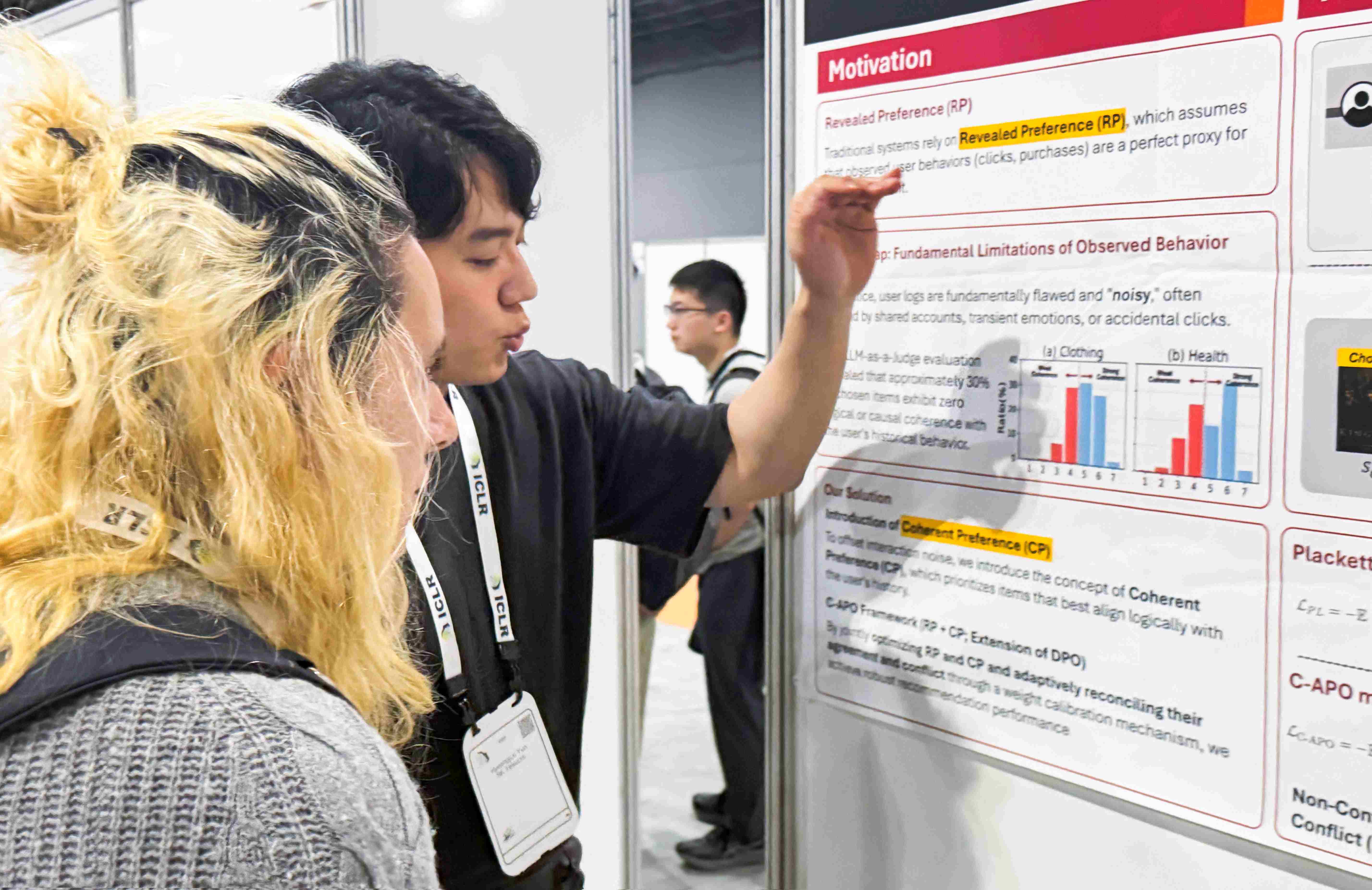
Seoul, Korea, Apr 28 – SK Telecom (NYSE:SKM, hereinafter referred to as “SKT”) announced today that its new AI recommendation model, which more accurately identifies customers’ true preferences, was presented at a leading AI conference, the International Conference on Learning Representations (ICLR) 2026.
ICLR, along with the Conference on Neural Information Processing Systems (NeurIPS) and the International Conference on Machine Learning (ICML), is regarded as one of the world’s top three AI conferences. Technologies presented at these events see industrial application within a few years or become benchmarks for academic research and product development, making them key indicators of the future direction of AI.
The research paper, titled “More Than What Was Chosen: LLM-Based Explainable Recommendation Beyond Noisy User Preferences,” centers on SKT’s proprietary Conflict-Aware Direct Preference Optimization (C-APO) technology. The technology filters out conflicting preference signals, enabling more accurate recommendations of products that customers genuinely desire.
To achieve this, SKT introduced the concept of “coherent preference” — reflecting recurring patterns and contextual coherence across a customer’s overall behavior. Through this approach, the model distinguishes coherent preferences from revealed preferences derived from single actions, such as accidental clicks or one-time, unintentional choices.
This approach increases the learning weight when the two preference signals align, reinforcing the recommendation. When the signals conflict, the model treats the discrepancy as noise and lowers the learning weight, enabling it to identify the most appropriate recommendations.
Conventional AI recommendation systems have struggled to interpret conflicting preference signals — for example, a customer who typically watches romance films may receive only action recommendations after watching even a single action movie based on a friend’s suggestion. SKT’s new recommendation model, however, filters out such inconsistencies to identify the customer’s true preferences.
SKT plans to apply this research to future agent-based customer recommendation systems that integrate AI for interpreting usage context, generating recommendation candidates, and refining results through an orchestration layer. The company aims to deliver more advanced and personalized recommendations tailored to each customer’s needs and behavior.
“The technology lays the foundation for delivering personalized recommendations by better understanding customers’ true preferences,” said Seok Ji-hwan, Head of AI/DT Data Office at SK Telecom. “The presentation at ICLR 2026 marks a milestone in SKT’s AI transformation to enhance customer experience, and we will continue to advance AI technologies that customers can benefit from.”
27, Apr 2026
Pixel Doors and Beyond The Pixels® Launch ‘Astro Burn’ into Early Access Following a Triumphant London Games Festival Showcase
Riding a massive surge in Steam wishlists, the hyper-vibrant retro cute-em-up brings its “awesomely bonkers” arcade chaos to PC and Mac today.
AMSTERDAM, NETHERLANDS & LONDON, UNITED KINGDOM, April 27, 2026: Indie publisher Pixel Doors and London-based developer Beyond The Pixels® have officially launched Astro Burn into Early Access on Steam today. The fast-paced sidescroller invites players back to the golden era of arcade cute-em-ups, fueled by a delightfully bizarre, internet-era aesthetic.
The launch follows an incredibly successful week for Beyond The Pixels® at the London Games Festival 2026. Selected as an Official Selection for the New Game Plus showcase, Astro Burn drew massive in-person crowds and glowing feedback. The event triggered a glorious surge in Steam wishlists, driven heavily by players who don’t traditionally play the bullet-hell genre, proving the game’s unique blend of chaotic action and approachability.
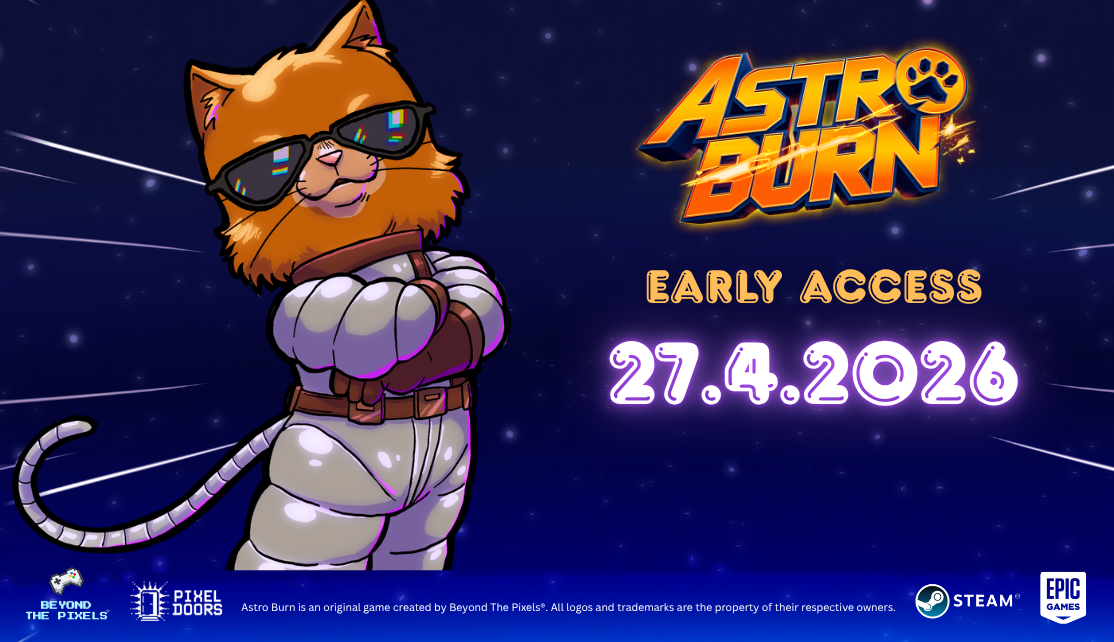
In Astro Burn, players control Astro, a sassy space cat armed to the teeth. Aided by her robot companion, Astro blasts through waves of cute enemies across 10 diverse levels, from deep space and mechanical worlds to underwater realms and sprawling cities. By unleashing over-the-top, stackable anime-style power-ups, players must annihilate screen-filling waves of adorable enemies in a chaotic bid to find her way home.
Developed by film, tv and games industry veteran HaZ Dulull, the retro-inspired title features both solo and local couch co-op modes, designed to be deeply satisfying for hardcore shmup fans while remaining highly accessible for newcomers.
HaZ Dulull, Founder and Game Director at Beyond The Pixels®, said: “We are coming off an absolutely unreal high from the London Games Festival. Hearing players call the game ‘awesomely bonkers’ and ‘insanely original’ was amazing, but my absolute favorite moments were the hesitant players who said they were terrible at shmups, only to give it a try and realize how accessible and fun it actually is. Launching into Early Access today means taking that incredible in-person energy and expanding it globally. We want the community right here in the heart of the game with us, helping shape, tune, and push Astro Burn to its final, most meowtastic form.”
Jacek Pudlik, Co-Founder of Pixel Doors, said: “What HaZ and the team experienced at the London Games Festival is exactly why we do this. They proved that Astro Burn has that rare, universal appeal! It captures the addictive chaos of classic arcade shooters but welcomes everyone to the party. We are thrilled to see that momentum translate into a massive surge of wishlists, and even more excited to officially open the doors to Early Access today so players everywhere can finally get their hands on it.”
Astro Burn is available NOW in Early Access for PC and Mac via Steam.
27, Apr 2026
TRAI Seeks Stakeholder Views to Expand Public Wi-Fi Access Across India
Apr 27 (BNP): The Telecom Regulatory Authority of India (TRAI) has sought feedback from stakeholders to explore ways to expand and improve public Wi-Fi services across the country. The initiative aims to enhance affordable and widespread internet access, especially in underserved and rural areas.
TRAI is reviewing existing frameworks and possible policy changes to encourage greater participation from service providers, local operators, and technology partners in setting up public Wi-Fi hotspots.
The move is expected to support India’s broader digital connectivity goals by improving last-mile internet access and making broadband services more accessible to citizens.
The regulator has invited suggestions from industry players and other stakeholders on models that can help scale up public Wi-Fi infrastructure efficiently and sustainably.
27, Apr 2026
The Vodia PBX Now Integrates with Jitsi Meet

BOSTON: April 27, 2026 – Vodia Networks, Inc., a provider of unified cloud communications solutions to enterprises, contact centers, and service providers, is pleased to announce V70, the newest version of the industry-standard Vodia PBX, now integrates with Jitsi Meet.
Jitsi comprises open-source projects for users who want to build and deploy secure video conferencing solutions, including Jitsi Videobridge and Jitsi Meet. These components enable conferences over the internet, while additional community projects provide features such as audio, dial-in, recording, and simulcasting. Because Jitsi is open-source and based on WebRTC, it gives organizations more flexibility and control over their conferencing environment compared to fully hosted solutions.
Jitsi Videobridge passes participants’ video and audio streams directly to each participant instead of mixing them first, resulting in better quality and lower latency. For organizations running their own service, this also provides a more scalable and cost-efficient solution. Additional capabilities include:
● Compatible with WebRTC, the open standard for Web communication
● Advanced video routing support for simulcast, bandwidth estimations, and scalable video coding
● Simple installation with Ubuntu and Debian packages
The Vodia PBX integration with Jitsi Meet connects the Vodia phone system with a self-hosted Jitsi Meet server, enabling one-click video conferencing directly from the web portal. It allows businesses and service providers to manage both voice and video communication within a single system, without relying on external conferencing platforms:
● Conferences are secured with JWT authentication
● Moderators receive a signed token while guests join with a shared link
● Room names are generated automatically using the extension number
● A random hash prevents unauthorized access
Documentation
A detailed configuration guide for the Vodia PBX Jitsi Meet integration is available on the Vodia documentation website.
27, Apr 2026
VST Tillers Tractors Showcases Innovative Farm Mechanisation Solutions at FKCCI Global AgriTech Summit 2026
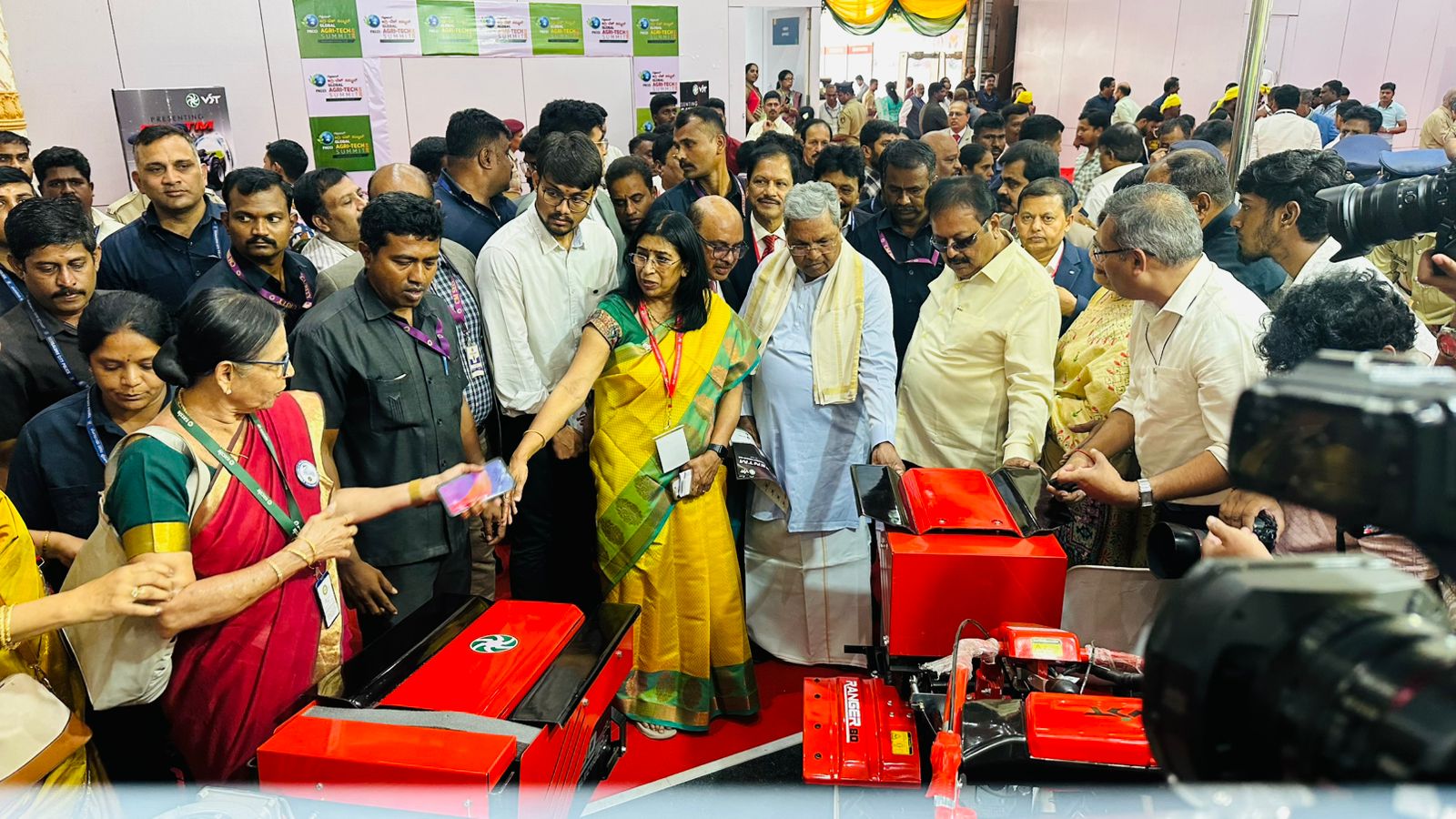
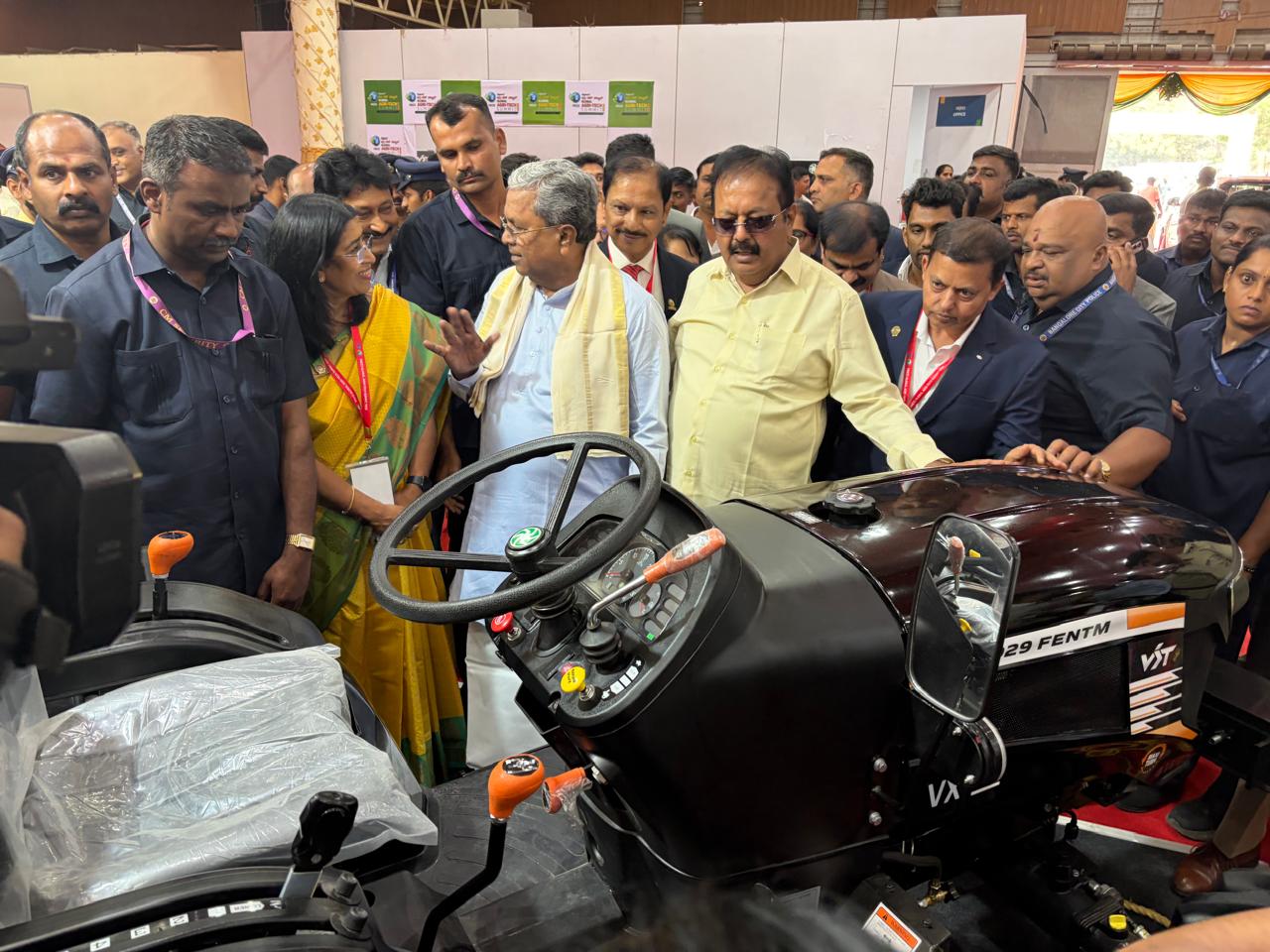
Bengaluru, Apr 27: VST Tillers Tractors Ltd., a pioneer in compact agricultural machinery in India, showcased its latest portfolio of advanced farm mechanisation solutions at the FKCCI Global AgriTech Summit 2026. The company’s new product range reflects a significant step forward in fuel efficiency, performance, and versatility, tailored to meet the evolving needs of modern small and mid-sized farming operations. Shri Siddaramaiah, Hon’ble Chief Minister of Karnataka, visited the VST stall at the exhibition and reviewed the innovative products on display, after the inaugural session of the Summit. Agriculture Minister, Shri N Chaluvaraya Swamy also accompanied the Chief Minister to the VST stall.
At the summit, VST unveiled a series of innovations, including the FENTM Series Tractors, Electric Power Tiller, and Electric Power Weeder, each underscoring the company’s commitment to sustainable, technology-driven agriculture.
The FENTM Series features five high-performance, fuel-efficient models, 180 FENTM, 224 FENTM, 225 FENTM, 929 FENTM EX , and 929 FENTM VX , spanning a horsepower range of 19 HP to 30 HP. Available in both 2WD and 4WD configurations, these tractors are engineered to deliver enhanced productivity, superior operator comfort, and long-term reliability. Designed as compact yet powerful solutions, the FENTM Series offers exceptional versatility across diverse terrains and agricultural applications, striking an optimal balance between power, manoeuvrability, and fuel efficiency.
Further strengthening its sustainability focus, VST showcased its Electric Power Tiller and Electric Power Weeder. These electric solutions are designed to deliver high performance with minimal environmental impact, aligning with India’s clean energy and decarbonisation goals. The electric range enables farmers to benefit from eco-friendly operations, reduced running costs, and ease of use—marking a significant shift towards green farming practices.
Building on its strong legacy of engineering excellence and indigenous innovation, VST is leveraging global EV advancements to strengthen India’s small-farm mechanisation ecosystem. With a focus on future-ready, locally developed solutions, the company continues to drive productivity, sustainability, and affordability for the next generation of farmers.
24, Apr 2026
OpenAI Launches GPT-5.5, Advances Toward Smarter End-to-End AI
New Delhi, Apr 24 (BNP): OpenAI has introduced its latest artificial intelligence model, GPT-5.5, positioning it as a significant upgrade designed to handle complex tasks more efficiently and with greater independence.
The company says the new model delivers improved performance in areas such as coding, research, analysis, and productivity tasks, while also generating faster and more structured responses. The focus, according to OpenAI, is on making AI systems more capable of completing multi-step work without continuous user guidance.
Unlike earlier versions that often required detailed prompting at each stage, GPT-5.5 is built to better manage full workflows. It can plan tasks, use tools, refine outputs, and continue working toward a final result, reflecting a shift toward more autonomous “agent-like” AI behaviour.
Early evaluations suggest stronger performance in technical and reasoning tasks, particularly in software development and problem-solving scenarios. The model is also said to be more efficient, aiming to reduce computing requirements for certain workloads while maintaining higher output quality.
The launch comes at a time of rising global competition in artificial intelligence, with major technology companies racing to develop systems that go beyond conversational abilities and move toward practical task execution.
Industry experts believe this latest release signals a broader transition in AI development—from simple assistants that respond to prompts, to systems capable of independently managing and completing real-world digital work.
24, Apr 2026
Pemmasani Calls for Design Driven Growth and Higher R&D in Telecom Sector
Bhubaneswar, Apr 24 (BNP): Union Minister of State for Telecommunications, Pemmasani Chandra Sekhar, has urged stakeholders in India’s telecom industry to move beyond cost-driven models and embrace design-led innovation as a core growth strategy.
Addressing industry representatives at a recent forum, the minister emphasized that India must strengthen its capabilities in research and development (R&D) to remain competitive in the rapidly evolving global telecom landscape. He noted that while the country has made significant progress in expanding connectivity, the next phase of growth will depend on indigenous innovation and technological leadership.
Pemmasani highlighted the need for telecom companies to invest more in developing homegrown solutions, particularly in areas such as 5G, network infrastructure, and emerging digital technologies. He stressed that a shift toward design-centric approaches would not only improve product quality but also enable Indian firms to capture greater value in global markets.
The minister also pointed out that collaboration between industry, academia, and government institutions will be essential to build a strong innovation ecosystem. Encouraging startups and supporting local manufacturing were identified as key pillars in driving this transformation.
Industry experts at the event echoed the minister’s views, noting that increased R&D spending and a focus on original design could help India transition from being primarily a consumer of telecom technology to a global innovator.
The call aligns with the government’s broader vision of strengthening domestic capabilities and reducing dependence on imports in critical technology sectors.
24, Apr 2026
Intertek opens its first EMC lab in India, expanding network across south of country