


10, Nov 2026
AVer Debuts CL02 PTZ Controller, Unifying Camera Control for Seamless Multi-Camera Production

Taipei, Taiwan – Nov 10: AVer Information Inc., an award-winning provider of AI audio-video solutions, today announced the AVer CL02, a professional camera controller designed to streamline reliable multi–camera production across hybrid AV environments. Built for organizations that need to operate PTZ cameras, the CL02 enables intuitive, centralized control without requiring a costly, disruptive replacement of installed equipment.
The CL02 enables professional multi-camera productions with greater efficiency and control. Designed for live event environments, it helps production teams streamline operations, reduce workflow complexity, and deliver a polished viewing experience across every event. As organizations expand hybrid communications, training initiatives, and content creation, the CL02 provides a centralized control platform that simplifies camera operations and helps teams create engaging, high-quality video experiences with confidence.
Key User Benefits at a Glance
- Simplify Multi–Camera Production: Control up to 255 PTZ cameras over IP from a single purpose-built console, with NDI® HX2 support for streamlined network-based camera control.
- Maintain Confident Live Control: View critical camera information, such as connection status, channel, exposure, white balance, and gain, on four dedicated LCD screens for faster decisions and consistent image quality.
- Accelerate Installation and Management: Use PoE connectivity to reduce cabling needs, while the embedded Web UI enables convenient remote configuration and management.
- Create Smoother On-Camera Experiences: Access frequently used controls through dedicated camera-select buttons, one-touch preset recalls, independent zoom control, and a responsive 2-axis joystick for quicker transitions and more natural camera movement.
- 0
- By Neel Achary

10, Nov 2026
Odisha Farmer Turns Rs 100 Investment Into Rs 1 Crore Kagzi Lemon Business, Exports to US and UK
Angul, Nov 10 (UDN): What began with a modest investment of just Rs 100 in lemon saplings has blossomed into an agricultural success story worth nearly Rs 1 crore annually. Odisha farmer Santosh Sahu has turned indigenous Kagzi lemon cultivation into a thriving business, connecting hundreds of farmers to profitable markets and taking the state’s traditional produce beyond India’s borders.

Representational Image
Hailing from Ogi village in Angul district, Santosh has built an extensive network of lemon growers, creating sustainable livelihood opportunities for nearly 700 to 800 farming families. Today, Kagzi lemons cultivated across more than 150 acres in and around the village are supplied to markets across Odisha and exported to countries such as the United States and the United Kingdom.
A Rs 100 Experiment That Changed Everything
The roots of this remarkable journey go back to Santosh’s father, Kartik Sahu, who was searching for an alternative source of income after repeated crop losses.
Farmers in Ogi village were struggling to sustain conventional agriculture due to frequent damage caused by elephants and monkeys. With cultivation becoming increasingly difficult, Kartik decided to experiment with indigenous Kagzi lemon farming.
He purchased 50 saplings at Rs 2 each, investing just Rs 100 in the initiative. What started as a small experiment gradually delivered encouraging results.
Inspired by the success of the plantation, Santosh took the initiative forward and transformed the family venture into a large-scale agricultural enterprise. Over the years, the small lemon garden expanded into a flourishing business, demonstrating how a low-cost farming experiment can create significant economic opportunities.
800 Farmers Become Part of the Success Story
Santosh’s achievement is not limited to his own earnings. One of the biggest milestones of his journey has been bringing hundreds of local farmers together under a common supply and marketing network.
Farmers from Ogi and surrounding areas now cultivate Kagzi lemons and sell their produce through Santosh, who helps connect them with larger markets.
“We harvest the lemons from our own land and sell some of the produce in the market. Farmers from across the village also bring sacks of lemons to us, and we also sell their produce. There are around 700 to 800 farmers in this village,” Santosh said.
The arrangement has given local growers a dependable channel to sell their harvest without having to independently search for buyers.
For many small farmers, this network has become an important source of household income.
Connecting Village Farms With Bigger Markets
The growing demand for Kagzi lemons has helped expand the business beyond the local market.
Farmers harvest lemons from their plantations and bring them to Santosh, who collects and markets the produce. A significant quantity is supplied to major commercial centres such as Cuttack and Bhubaneswar, while the enterprise has also reached international markets, including the US and UK.
Local farmers say the arrangement has helped them earn from produce that would otherwise have been difficult to market on their own.
“We harvest the lemons from our trees and sell them to Santosh. We give him around 3,000 to 4,000 lemons, depending on the quantity we harvest, and he pays us for the produce. He then sells them in Cuttack and Bhubaneswar. We depend on this income to support our families,” said farmer Panchanan Sahu.
An Inspiration for Rural Entrepreneurship
From 50 saplings to cultivation spread across more than 150 acres, the Sahu family’s journey highlights the potential of indigenous crops and locally driven agricultural entrepreneurship.
More importantly, the initiative has shown how one farmer’s effort can create opportunities for an entire rural community.
At a time when farmers across the country are exploring alternatives to traditional cultivation, Ogi village’s Kagzi lemon success story offers an encouraging example of how crop diversification, collective marketing and access to wider markets can strengthen rural livelihoods.
What began as a Rs 100 experiment has grown into a business generating nearly Rs 1 crore annually, while putting Odisha’s indigenous Kagzi lemons on the international map.
10, Nov 2026
India’s Digital Advertising Market and the Shift Towards Performance Measurement

India’s advertising industry is experiencing a structural shift in the way brands approach consumer engagement. Digital media, once viewed largely as a supplementary channel for marketing communication, has become a central component of corporate growth strategies. Businesses are no longer investing in online platforms merely to establish visibility. They increasingly expect advertising to contribute directly to customer acquisition, sales conversion, market expansion and revenue performance.
This transition reflects a broader change in India’s consumption and business environment. The expansion of internet access, smartphone usage, e-commerce and digital payments has created a large and increasingly connected consumer market. At the same time, the availability of campaign analytics and automated advertising technologies has given companies greater control over how marketing budgets are deployed and evaluated.
The result is a more commercially accountable advertising ecosystem. Brand reach continues to matter, but management teams are placing greater importance on the quality of customer engagement, the cost of acquiring buyers and the revenue generated from individual campaigns. For advertisers, marketing effectiveness is increasingly being judged by its contribution to business performance rather than the volume of exposure it generates.
Digital Media Strengthens Its Position in India’s Advertising Economy
The expansion of digital advertising reflects the changing relationship between consumers, brands and media platforms. Search engines, social networks, online video services, e-commerce applications and digital publishers have become important channels through which consumers discover products and evaluate purchasing decisions.
According to the dentsu-e4m Digital Advertising Report 2026, India’s digital advertising expenditure reached ₹71,621 crore in 2025, accounting for approximately 59% of total advertising spending. The market is projected to reach ₹98,034 crore by 2027, representing an estimated 70% share of the overall advertising industry.
These figures indicate that digital media is no longer simply competing for a larger portion of advertising budgets. It is increasingly influencing the way companies design their entire marketing strategies.
For established businesses, digital channels provide opportunities to complement traditional advertising with targeted consumer engagement. For emerging companies, they offer access to audiences without the extensive distribution and promotional infrastructure traditionally required to establish a market presence.
This development is particularly relevant to India’s small and medium-sized enterprises. Businesses can reach consumers beyond their immediate geographical markets, promote specialised products and generate enquiries from specific customer segments. The ability to start with relatively focused campaigns also allows companies to test market demand before making larger marketing commitments.
Advertising Budgets Are Moving Closer to Commercial Outcomes
One of the defining developments in the industry is the growing importance of performance-based advertising. Traditional advertising measurements have largely focused on exposure, audience reach and brand recall. While these remain relevant, businesses increasingly want to understand what happens after a consumer encounters an advertisement.
Performance marketing addresses this requirement by evaluating campaigns against defined actions, including product enquiries, registrations, qualified leads, app installations and completed purchases.
The distinction is important from a business perspective. A campaign generating thousands of website visits may appear successful, but its commercial value depends on whether those visitors demonstrate genuine interest and eventually become customers.
Companies are therefore examining indicators such as customer acquisition cost, conversion rates, average order value, repeat purchases and return on advertising spend. These measurements help management teams assess whether marketing expenditure is producing sufficient commercial value.
This approach is influencing budget decisions across sectors. Retailers are evaluating advertisements against sales performance, financial institutions are tracking qualified applications, and education companies are examining how digital campaigns translate into admissions.
The broader implication is that marketing departments are becoming more closely connected with sales, finance and business development functions. Advertising is increasingly treated as an investment that must support wider organisational objectives.
Retail Media Is Bringing Advertising Closer to the Point of Purchase
Retail media is emerging as a significant growth area within India’s digital advertising market. E-commerce platforms and online retailers are developing advertising networks that allow brands to promote products directly within shopping environments.
The commercial advantage is the ability to reach consumers when they are already exploring a particular product category. Sponsored listings, search placements, product recommendations and display advertisements can influence product discovery at a stage when purchase intent may be relatively high.
The dentsu-e4m report places e-retail advertising expenditure at ₹17,601 crore in 2025, following growth of more than 55%. This expansion reflects the increasing importance of commerce-led advertising in brand strategies.
For consumer goods companies, retail media offers an opportunity to connect promotional activity with product visibility and online transactions. It also provides smaller brands with another route to compete for consumer attention in established marketplaces.
The expansion of quick-commerce platforms is adding to this opportunity. As consumers increasingly purchase groceries, personal care products and everyday essentials through digital channels, brands are exploring advertising formats that can influence buying decisions closer to the transaction.
However, businesses must evaluate the economics carefully. Advertising placements can become expensive in competitive product categories, and high visibility does not necessarily guarantee profitable sales. Brands need to assess incremental revenue, repeat purchases and the actual contribution of retail media to overall business growth.
Data Intelligence Is Reshaping Marketing Decisions
The growing emphasis on accountability is making data analytics central to advertising strategy. Businesses now have access to detailed information about customer interactions, campaign engagement, website activity and purchasing behaviour.
The value of this information lies in its ability to improve decision-making. Rather than distributing budgets across platforms based on assumptions, companies can examine which channels generate qualified prospects, which audiences respond to particular messages and where potential customers abandon the buying process.
Artificial intelligence and machine learning are further strengthening these capabilities. Automated systems can assist with audience segmentation, bidding strategies, campaign optimisation, creative testing and performance forecasting. They also enable advertisers to adjust campaigns more quickly in response to changing consumer behaviour.
For businesses operating across multiple digital channels, these technologies can help improve the efficiency of marketing operations. However, successful implementation requires more than adopting new software. Companies need accurate data, appropriate measurement systems and professionals capable of interpreting campaign results in a commercial context.
Poor tracking, inconsistent reporting and low-quality customer information can undermine even sophisticated advertising strategies. Technology delivers value when it supports sound business decisions rather than simply increasing the volume of available data.
First-Party Data Is Becoming a Competitive Advantage
As businesses seek greater control over customer relationships, first-party data is gaining strategic importance. Information collected directly through customer registrations, transactions, loyalty programmes, subscriptions and enquiries can help companies understand their existing audiences and communicate more effectively.
For retailers, this may involve identifying purchasing patterns and recommending relevant products. For financial services providers, customer information can help improve the relevance of communications and service offerings, subject to appropriate consent and regulatory requirements.
A well-managed first-party data strategy can also reduce excessive dependence on external advertising platforms for audience access. Businesses gain a stronger understanding of their customers and can build marketing programmes around existing relationships.
The commercial benefits extend beyond advertising. Customer information can support demand forecasting, product development, retention strategies and service improvements.
Nevertheless, data collection must be accompanied by responsible governance. Transparency, customer consent, information security and compliance with India’s applicable data protection requirements are essential. Long-term consumer trust is more valuable than short-term gains from aggressive data collection.
Social Media and Video Are Changing the Economics of Brand Engagement
Social media and digital video have become important destinations for advertising investment because they combine broad audience access with interactive communication. Short-form videos, product demonstrations, creator partnerships and regional-language campaigns allow businesses to present products in formats that are closely aligned with changing media consumption habits.
For brands targeting India’s diverse consumer base, regional content offers particular commercial potential. Communication in familiar languages and cultural contexts can make campaigns more relevant to audiences beyond major metropolitan markets.
Creator partnerships are also evolving from occasional promotional arrangements into more structured marketing strategies. Businesses are increasingly assessing creators on audience relevance, credibility, engagement quality and their ability to influence purchasing decisions.
Yet the industry faces an important measurement challenge. Views, likes and follower counts do not necessarily translate into sales or customer loyalty. Advertisers must evaluate whether creator-led campaigns generate meaningful enquiries, conversions and sustained interest.
The commercial effectiveness of these formats depends on the relationship between creative quality, audience relevance and the overall customer journey.
Small Businesses Face New Opportunities and Greater Accountability
The shift towards performance measurement has particular significance for India’s MSME sector. Smaller businesses often operate with limited advertising budgets and cannot afford to sustain campaigns that generate attention without producing meaningful business results.
Digital platforms allow these companies to target specific locations, customer groups and product categories. A local manufacturer can generate enquiries from potential distributors, a retailer can promote products to nearby consumers, and a professional services firm can attract customers searching for specialised solutions.
However, the availability of advertising tools does not automatically ensure profitable marketing. Small businesses need to understand the complete cost of customer acquisition, including platform charges, creative production, agency fees and the resources required to convert enquiries into sales.
They also need to connect marketing activity with internal business operations. A successful advertising campaign can still produce disappointing results if customer enquiries are not answered promptly, product availability is inconsistent or the sales process is inefficient.
This makes marketing measurement a management priority rather than merely a technical exercise. Businesses that connect advertising data with sales performance are better placed to identify profitable customer segments and allocate resources effectively.
The Challenge of Measuring Returns Across Multiple Platforms
Despite the growing availability of analytics, measuring the true contribution of digital advertising remains complex. Consumers rarely follow a single, predictable path before purchasing a product. They may discover a brand through social media, compare alternatives through search engines, read online reviews and eventually complete a transaction through an e-commerce platform or physical store.
Attributing the final purchase to one advertising interaction can therefore be difficult. Different platforms may also report conversions using different measurement methods, making comparisons less reliable.
Businesses need a broader measurement framework that combines advertising analytics with website performance, sales records and customer relationship data. They should also distinguish between conversions that would have occurred naturally and those genuinely generated by additional advertising investment.
Another important consideration is the balance between immediate performance and long-term brand development. Excessive focus on short-term conversion targets can lead companies to overlook brand reputation, consumer trust and future demand creation.
An effective advertising strategy must recognise that brand building and performance marketing are complementary activities. One creates awareness and preference, while the other helps convert interest into measurable commercial outcomes.
A More Accountable Future for India’s Advertising Industry
India’s digital advertising market is moving towards a more sophisticated model in which technology, consumer intelligence and financial accountability will increasingly shape investment decisions. The expansion of retail media, artificial intelligence, digital video and first-party data is creating new opportunities for advertisers, but it is also raising expectations around transparency and campaign effectiveness.
For businesses, the next stage of digital advertising will require a closer connection between marketing strategy and organisational performance. Companies will need to establish clear objectives, understand the economics of customer acquisition and evaluate how advertising contributes to both immediate revenue and long-term market position.
For marketing agencies and technology providers, this shift creates demand for stronger analytical capabilities, transparent reporting and solutions that demonstrate commercial value. For MSMEs, it offers an opportunity to approach advertising with greater precision and make limited budgets work harder.
Ultimately, the future competitiveness of India’s digital advertising industry will depend not only on how much businesses spend, but on how effectively they translate that investment into sustainable growth. As marketing becomes increasingly measurable, the strongest brands will be those that combine creative communication with disciplined financial evaluation, reliable customer insights and a clear understanding of the markets they serve.
10, Nov 2026
24X Expands Digital Assets Prime Brokerage Partnership with Standard Chartered
Bitcoin and Ethereum to be offered alongside existing FX, NDF and Spot Trading
HAMILTON, Bermuda, Nov. 10, 2026 /PRNewswire/ — 24X Bermuda Limited (“24X“), one of a select few global platforms that offer both crypto spot and FX trading on a single, unified technology infrastructure, today announced that it has expanded its partnership with Standard Chartered to include digital assets Prime Brokerage. This expanded partnership will now enable trading in Bitcoin (BTC) and Ethereum (ETH) on 24X’s institutional-grade, multi-asset trading platform. Standard Chartered is a leading international banking group.
With this expansion, 24X becomes the first trading platform to offer both crypto and FX products with Standard Chartered acting as the central counterparty. This structure allows counterparties to face only Standard Chartered while accessing OTC liquidity through 24X, which operates the execution-only platform and handles liquidity configuration, matching and straight-through processing (STP). Globally recognized as a leading FX NDF platform and offering FX spot and swaps, 24X aims to apply that expertise to drive institutional adoption of digital assets.
24X and Standard Chartered’s Prime Brokerage business already give clients access to FX NDFs, FX Spot, FX Deliverable Swaps, FX Non-Deliverable Swaps, and Metals. Bitcoin and Ethereum trading will operate in a similar capacity. This announcement comes shortly after Standard Chartered served as liquidity taker for first spot cryptocurrency trades on the 24X platform, with Cumberland DRW and Wintermute serving as liquidity providers.
24X CEO and Founder Dmitri Galinov said, “Institutional interest in digital assets is rapidly increasing, and this expansion of our partnership with Standard Chartered will enable the 24X platform to continually meet that demand. Our crypto trading infrastructure delivers the deep liquidity, rigorous oversight, and the same seamless workflow global financial institutions have come to expect from 24X. We are proud to deepen our relationship as global markets continue to converge around digital assets.”
24X Bermuda Limited’s cryptocurrency activity is regulated by the Bermuda Monetary Authority. 24X also offers Deliverable Swaps, Non-Deliverable Swaps, Metals and Spot products to institutional customers in addition to NDFs. Since its launch in 2019, 24X’s multi-asset offering through a single trading interface has enabled market participants to access increased liquidity at lower cost. Through its subsidiary 24X National Exchange, trading in U.S. equities is available 16/5 via broker-dealers who are approved members of the Exchange.
About 24X
24X Bermuda Holdings LLC (“24X”) is a privately held company with two primary operating subsidiaries: 24X Bermuda Limited (“24X Bermuda”), which allows seamless and cost-effective exchange of currency exposures, metals and spot cryptocurrency; and 24X National Exchange LLC (“24X Equities”), the first national securities exchange approved by the U.S. Securities and Exchange Commission (SEC) to operate 23 hours each weekday. 24X’s mission is to enable cost-effective trades across a growing range of asset classes around the clock by lowering the cost of exchanging assets in the global markets and simultaneously delivering creative and unique workflows tailored to each asset class. 24X Bermuda is a registered Introducing Broker with the U.S. Commodity Futures Trading Commission (CFTC) and a member of the National Futures Association (NFA ID #0556980). 24X Bermuda and its crypto activity are regulated by the Bermuda Monetary Authority. More information is available at https://www.24exchange.com.
Media Contact:
Eric Andrus, KARV
24Xmedia@karv.global
 View original content:https://www.prnewswire.co.uk/news-releases/24x-expands-digital-assets-prime-brokerage-partnership-with-standard-chartered-302934245.html

10, Nov 2026
Quantinuum and RIKEN Expand Partnership to Accelerate the Commercialization of Quantum-AI Hybrid Supercomputing in Japan
- Completed upgrade of Quantinuum’s Reimei quantum computer to its H2 system establishes RIKEN’s hybrid quantum-supercomputing platform as the most capable of its kind in the world and creates a pathway to expand research across electronics, energy and life sciences.
- Quantinuum and RIKEN will build upon this pioneering computing architecture to develop a fault-tolerant “Made with Japan” quantum computer to extend Japan’s long-term quantum leadership.
- To further accelerate commercial adoption of quantum-AI hybrid supercomputing in Japan, the partners will collaborate with SoftBank Corp. to develop a path to connect quantum computers directly with AI data centers.
TOKYO, Nov. 10, 2026 /PRNewswire/ — Quantinuum (NASDAQ: QNT), a leading full-stack quantum computing company, and RIKEN, Japan’s leading national comprehensive research institute, today announced an expanded partnership to advance quantum-AI hybrid supercomputing in Japan. Following a significant upgrade to Quantinuum’s Reimei quantum computer at RIKEN, the partners will pursue more advanced scientific and industrial applications, work with Japanese universities and suppliers toward the development of a “Made with Japan” fault-tolerant quantum computer, and collaborate with SoftBank Corp. to explore the connection of quantum computer with AI data centers in Japan.

Quantinuum’s quantum computer, Reimei, installed at RIKEN, has successfully completed its upgrade to System Model H2. Reimei is operated as part of the JHPC-quantum project, funded by NEDO. This upgrade further enhances the capabilities of the project’s quantum–HPC hybrid computing platform and enables researchers to investigate more complex quantum systems that are increasingly difficult to simulate using classical computing alone, broadening the scientific problems they can explore.
Quantinuum and RIKEN will use the upgraded platform to combine quantum computing, supercomputing and AI in support of use case development across electronics, energy and life sciences. Building on their years-long collaboration, the partners will also draw on their experience integrating and operating Reimei to inform the development of a fault-tolerant “Made with Japan” quantum computer.
“Japan’s quantum ambitions require advanced capabilities today and a sustained commitment to developing what comes next,” said Dr. Rajeeb Hazra, Quantinuum CEO. “The upgrade to Reimei expands what we can explore with RIKEN across electronics, energy and life sciences. Together, we are building on this work to develop a fault-tolerant quantum computer with Japanese universities and suppliers, while exploring with SoftBank how these capabilities can become accessible to industry through Japan’s AI data centers.”
Two research projects that have begun operations on Reimei before the public launch of its services illustrate how Quantinuum and RIKEN are leveraging the hybrid platforms upgraded capabilities to push the frontiers of scientific discovery:
- Quantum-AI for materials simulation: The partners are using RIKEN’s JHPC-quantum GPU supercomputer, ROQUO, to train an AI model on Reimei-generated quantum data for magnetism simulations. Preliminary results suggest the model can make more accurate predictions than AI models trained on classical simulations alone and more precise predictions than the quantum computer itself. Understanding magnetism at the atomic level could inform the development of materials for next-generation technologies such as ultra-high-field MRI and smart power grids.
- Quantum-AI for biomolecular simulation: The partners are combining Reimei, RIKEN’s Fugaku supercomputer, and NVIDIA’s evolutionary AI agent running on ROQUO to simulate a complex photoactive biomolecule, targeting unprecedented scale and detail. Better understanding of how biomolecules respond to light could inform the design of more efficient solar cells among other industrial opportunities that could arise from advances in biomolecular engineering.
This research supports RIKEN’s AI for Science initiative and aligns with U.S.-Japan efforts to advance AI-driven discovery, including a planned $1 billion partnership under the U.S. Genesis Mission.
“With the upgraded Reimei quantum computer, we will be able to tackle more complex and larger-scale scientific problems that were difficult to address with the previous H1 system, further advancing quantum–HPC hybrid computing through our ongoing JHPC-quantum project,” said Dr. Mitsuhisa Sato, Division Director, Quantum-HPC Hybrid Platform Division, RIKEN Center for Computational Science (R-CCS). “Furthermore, the newly signed Memorandum of Understanding will pave the way for expanding our research into the use of quantum computing for AI for Science, a key initiative being promoted by RIKEN.”
The partners’ joint research and development toward a “Made with Japan” fault-tolerant quantum computer will involve Japanese universities and domestic components suppliers. This “Made with Japan” effort will combine Quantinuum’s quantum technology with domestic research and manufacturing expertise, drawing on lessons from integrating and operating Reimei at RIKEN.
Under a separate agreement, Quantinuum, RIKEN and SoftBank will explore how quantum computing can be connected directly with AI data centers in Japan. The partners will assess infrastructure readiness and examine how connected systems could support commercial quantum-AI hybrid computing services, broadening access beyond the research community.
“Japan has established a strong foundation for hybrid quantum-HPC computing through the NEDO-supported JHPC-quantum project,” said Takenori Kobayashi, Vice President, Head of Product Research & Development Division at SoftBank Corp. “Our responsibility is to turn these achievements into industrial value. Together with RIKEN and Quantinuum, we aim to advance a Quantum AI Datacenter that connects quantum computing with AI and HPC, making these capabilities accessible to businesses across Japan.”
Learn more about the expanded joint Quantinuum-RIKEN research available here.
Research Support
This project is supported by New Energy and Industrial Technology Development Organization (NEDO), an organization under the jurisdiction of Japan’s Ministry of Economy, Trade and Industry (METI)’s “Research and Development of Quantum-Supercomputers Hybrid Platform for Exploration of Uncharted Computable Capabilities” (Project Leader: Mitsuhisa Sato) as part of the “Project for Research and Development of Enhanced Infrastructures for Post 5G Information and Communications Systems (JPNP20017).”
About RIKEN
RIKEN, a National Research and Development Agency, is Japan’s leading national comprehensive research institution renowned for high-quality research in a diverse range of scientific disciplines. Founded in 1917, initially as a private research foundation, RIKEN has grown rapidly in size and scope, today encompassing a network of world-class research centers and institutes across Japan. To learn more, please visit https://www.riken.jp/en
About SoftBank Corp.
Guided by the SoftBank Group’s corporate philosophy, “Information Revolution – Happiness for everyone,” SoftBank Corp. (TOKYO: 9434) operates telecommunications and IT businesses in Japan and globally. Building on its strong business foundation, SoftBank Corp. is aiming to activate the potential of AI across its businesses and drive implementation in line with its “Activate AI for Society” growth strategy. While further growing its telecom business, SoftBank is expanding its AI computing infrastructure and AI and Cloud service businesses with the aim of becoming a provider of Next-generation Social Infrastructure. To learn more, please visit https://www.softbank.jp/en/corp/.
About Quantinuum
Quantinuum (NASDAQ: QNT) is a leading quantum computing company offering a full-stack platform designed to make quantum computing deployable in real-world environments. The company has commercially deployed multiple generations of trapped-ion based quantum systems built on the well-established QCCD architecture, which it has implemented with novel designs and capabilities to achieve the industry’s highest accuracy levels based on average two-qubit gate fidelity. Quantinuum has active engagements with market leaders across pharmaceuticals, material science, financial services, and government and industrial markets, as well as academic and research institutions globally. The company has a global workforce of approximately 800 employees, including top scientists and researchers. Over 70% of its technology team holds PhDs or Master’s degrees. Quantinuum’s headquarters is in Broomfield, Colorado, with additional facilities across the United States, United Kingdom, Germany, Japan, Qatar, and Singapore. For more information, please visit www.quantinuum.com.
Forward-Looking Statements
This press release contains forward-looking statements within the meaning of Section 27A of the Securities Act of 1933, as amended, and Section 21E of the Securities Exchange Act of 1934, as amended, which are intended to be covered by the safe harbor provisions of the Private Securities Litigation Reform Act of 1995. All statements other than statements of historical fact are forward-looking statements, including statements about the expected scope, benefits and outcomes of Quantinuum’s expanded partnership with RIKEN and Memorandum of Understanding; expected capabilities and research applications of the upgraded Reimei quantum computer and RIKEN’s hybrid quantum supercomputing platform; the planned joint research and development toward a “Made with Japan” fault-tolerant computer, including the participation of Japanese universities and domestic suppliers; the planned collaboration with SoftBank Corp. to connect quantum computers with AI data centers in Japan and potential development of commercial quantum-AI hybrid computing services; the expected results of ongoing research projects in Reimei, including preliminary results; Quantinuum’s ability to help customers prepare for and realize commercial value from quantum computing; and the potential impact of quantum computing on sectors including electronics, energy and life sciences. Words such as “aim,” “anticipate,” “believe,” “confidence,” “could,” “expect,” “explore,” “intend,” “may,” “path,” “pathway,” “plan,” “potential,” “seek,” “suggest,” “target,” “will,” “would” and similar expressions identify forward-looking statements, although not all forward-looking statements contain these words.
Forward-looking statements are based on Quantinuum’s current expectations and assumptions and are subject to risks and uncertainties that could cause actual results to differ materially from those expressed or implied. These risks include, among others: the Memorandum of Understanding with RIKEN and the agreement with RIKEN and SoftBank Corp. may not result in definitive agreements, joint development or commercial services on the expected terms or timeline, or at all; Quantinuum’s dependence on RIKEN, SoftBank Corp., NEDO, universities, suppliers and other third parties to perform their anticipated roles; the research results described in this press release are preliminary, were achieved in experimental settings and may not be confirmed or replicated at a larger scale, in logical computation, or in commercial use; Quantinuum may be unable to scale its systems, increase qubit counts or integrate its hardware, error-correction framework and software as planned; Quantinuum may not achieve its technology roadmap, including the development of a fault-tolerant quantum computer, on the expected timeline or at all; the pace of technical progress in quantum computing; Quantinuum’s ability to maintain the availability and performance of its systems, including Reimei; competition, including advances by companies using other quantum computing modalities or architectures; the availability of funding, personnel and government support, including continued Japanese government funding of the JHPC-quantum project; risks related to international operations and collaborations, including compliance with export control laws and regulations; and the other risks described under “Risk Factors” in Quantinuum’s Quarterly Report on Form 10-Q for the quarter ended September 30, 2026 and its subsequent filings with the Securities and Exchange Commission. Forward-looking statements speak only as of the date of this press release. Quantinuum undertakes no obligation to update any forward-looking statement, except as required by law.
 View original content to download multimedia:https://www.prnewswire.co.uk/news-releases/quantinuum-and-riken-expand-partnership-to-accelerate-the-commercialization-of-quantum-ai-hybrid-supercomputing-in-japan-302934099.html

10, Nov 2026
Godrej Industries Group Creates Delight This Diwali with Stories of Acceptance, Home and Hosting
Three campaigns from across the Group take the festival from the workplace to the living room and the dining table
MUMBAI, India, Nov. 10, 2026 /PRNewswire/ — This Diwali, Godrej Industries Group is celebrating the festival through campaigns from three of its businesses. Each begins with a different everyday moment, a new colleague’s first day, a family coming home and a host planning the festive spread, and each shows a different side of how the Group creates delight. Here is a look at all three.
- #CelebratingAcceptance brings the Diwali diya into the modern office
The fourth film in Godrej Industries Group’s #CelebratingAcceptance series, ‘The Roommate’, moves the conversation on inclusion from the family home to the workplace. Set in an office preparing for its Diwali party, it follows Ayaan, a new joiner, on his very first day. When Priyanka tells her team that Meera is not just her roommate but her partner, her colleagues smile. They already knew, and had never said a word. ‘It wasn’t our story to tell’, one of them says. The film closes on the line ‘Riwaaz toh saath aa hi jaayenge’ (You nurture your relationships, traditions will follow along).
The film follows earlier #CelebratingAcceptance films seen through a child, a domestic worker and a family. Tanya Dubash, Executive Director & Chief Brand Officer, Godrej Industries Group, said, “The film reminds us that inclusion is rarely a grand announcement. It is the ease of a team that makes room for you and trusts you to share your story when you are ready.” - Godrej Properties turns the home into the hero with ‘Khushiyon Ki Chaabi, Mera Godrej Ghar’
Godrej Properties has launched a digital-first, pan-India campaign built on the insight that happiness means different things to different people, but home is where many of life’s most meaningful moments unfold. The brand film moves through relatable Diwali moments. A mother and daughter get dressed in their festive finery, a family prepares delicacies, a young man returns home from college, a grandfather meets all his grandchildren and a couple celebrates their first Diwali in their new home. It closes on the line ‘Ghar ke kone kone mein khushi, ek chaabi se khulti hai’ (At home, happiness opens with a key).
The campaign extends beyond the film through nearly 100 homeowner-led stories across Godrej Properties projects, and its identity has been adapted into Marathi, Bengali, Telugu and Kannada. It is live across digital, social media and YouTube from 4 November 2026. Subhasish Pattanaik, Chief Sales, Marketing & Customer Centricity Officer, Godrej Properties, said, “A home is often where some of life’s most cherished moments unfold.” - Godrej Vikhroli Cucina makes the festive table something to feast your eyes on
Godrej Vikhroli Cucina, the culinary owned media property of Godrej Industries, presents ‘But First, Feast Your Eyes!’, a two-part festive content series with food stylist and influencer Shreya Joshi, and Godrej Yummiez as part of the experience. It is built on the idea that festive hosting now has a creative side, with hosts bringing together traditional touches and contemporary food styling. The first episode, ‘The Grazing Table’, reimagines everyday kitchen elements and traditional serveware into an inviting spread. The second, ‘An Intimate Dinner’, looks at plating, tablescaping and place settings for smaller gatherings.
The series draws on Godrej Yummiez’s STTEM 2.0 report, which found that 71% of Indians now include frozen snacks in their festive feasts, and shows how convenient food options can sit alongside festive favourites on a well-styled table. Anushree Dewen, Head of Marketing and Innovation, Godrej Foods Ltd, said, “Hosting is becoming less about elaborate preparation and more about making thoughtful choices that allow you to enjoy the occasion.”
From welcoming a new colleague and celebrating a first Diwali in a new home to creating memorable dining experiences, the campaigns highlight how everyday relationships, shared experiences and traditions continue to shape the spirit of Diwali.
About Godrej Industries Group
At the Godrej Industries Group, we serve over 1.4 billion people globally through a diverse portfolio of businesses, united by our purpose of Crafting tomorrow. With revenues of USD 7.2 billion in FY26 and a market capitalisation of USD 19 billion as of 31 March 2026, we operate across FMCG, real estate, financial services, agriculture and chemicals.
We are the leading player in India across several business categories, including residential real estate, animal feed, crude palm oil, oleochemicals, household insecticides, hair colour and air care.
We are committed to building a more sustainable future through our Good & Green programme, with ambitions of net-zero operations by 2035 and responsible supply chains by 2047. In 2025, Godrej Consumer Products and Godrej Properties were both ranked number one globally in their respective categories on the Dow Jones Best-in-Class Sustainability Indices. For more information, please visit: www.godrejindustries.com.

 View original content to download multimedia:https://www.prnewswire.com/in/news-releases/godrej-industries-group-creates-delight-this-diwali-with-stories-of-acceptance-home-and-hosting-302934377.html

10, Nov 2026
Shanghai Electric Integrates Industrial AI into Heavy-Duty Gas Turbine Manufacturing and Lifecycle Services
AI supports key processes in the manufacture, operation and maintenance of high-end power equipment
SHANGHAI, Nov. 10, 2026 /PRNewswire/ — As industrial artificial intelligence (AI) moves from pilot projects into core operations, manufacturers are increasingly focused on how it can deliver sustained value in production and long-term equipment performance. For heavy-duty gas turbines, described as a “crown jewel” of high-end equipment manufacturing, this involves both precision machining of complex components and reliable operation throughout their service lives.
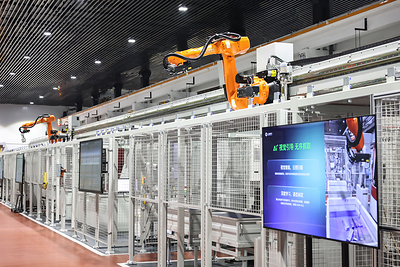
In its heavy-duty gas turbine business, Shanghai Electric (SEHK: 02727, SSE: 601727) is combining equipment engineering expertise with production and operating data. Applications span flexible blade manufacturing, inspection and servicing, as well as intelligent operations and maintenance (O&M), reflecting the company’s broader efforts to advance AI-enabled manufacturing.
Flexible Blade Manufacturing
Manufacturing critical components is an essential capability for gas turbine suppliers. Blade production involves different sizes, shapes and machining routes, requiring automated equipment to accommodate multiple blade types and process requirements. Shanghai Electric’s flexible manufacturing line combines AI vision, digital twins, intelligent scheduling and robotics to support mixed-model blade production and automatic changeovers.
Using 3D vision and AI, the system identifies blade blanks in randomly stacked piles, then picks and positions them. Picking accuracy exceeds 99.99%. The line integrates production scheduling, manufacturing execution and quality management systems, linking loading, machining, inspection and final packing. It can switch between fully automated production and standalone machine operation, providing flexibility to support production continuity.
AI-Assisted Quality Inspection
Alongside production flexibility, quality assurance is another focus of Shanghai Electric’s AI applications. Rotors are high-value, critical components in major power generation equipment, and weld quality directly affects their safe operation. To address the challenges of inspecting machined features on large components, the company has developed an AI-based visual inspection terminal that combines AI, robotic control and welding expertise. It provides real-time monitoring throughout welding operations to identify quality defects at an early stage.
The system’s embodied AI architecture combines a collaborative robot with a custom end effector. The arm can extend and retract at the touch of a button and automatically adapt to the welding cycle. Using 5G connectivity, the system completes image analysis and returns inspection results within seconds. A data feedback loop links shop-floor observations, process optimization and quality traceability, turning practical manufacturing experience into digital knowledge that can be retained and reused.
Data-Driven Operations and Maintenance
The applications extend from manufacturing and quality inspection to long-term plant operation. Shanghai Electric’s SIMPLE intelligent operation and maintenance platform draws on data from more than 60 turbine units, with over 1 million cumulative operating hours. It combines AI with knowledge of gas turbine operating principles to support real-time performance monitoring, dynamic optimization of operating performance and early warnings of potential faults.
Through cloud-edge coordination, the platform links design and operating data in a decision-support workflow covering monitoring, early warning, diagnosis and corrective action. This supports a shift from reactive repairs to proactive maintenance. Remote collaboration tools complement these capabilities, allowing experts to view live footage from plant sites and provide maintenance guidance through augmented reality annotations, supporting technical assistance across locations.
Shanghai Electric will continue to advance data integration across the gas turbine lifecycle, using feedback from manufacturing and operations to refine design, production and after-sales service. As it looks to international markets, Shanghai Electric will continue to validate and refine these capabilities in real-world projects. The company aims to meet power plants’ needs for reliable operation, timely maintenance support and cost-effective operation over the long term, laying the foundation for the international expansion of its gas turbine business.
 View original content to download multimedia:https://www.prnewswire.co.uk/news-releases/shanghai-electric-integrates-industrial-ai-into-heavy-duty-gas-turbine-manufacturing-and-lifecycle-services-302934397.html

10, Nov 2026
VT Markets Launches High-Stakes Reality Show Gold Cup 2026 Island Finale
- Four global traders compete for USD 100,000 prize in Phuket
SYDNEY, Nov. 10, 2026 /PRNewswire/ — Global multi-asset brokerage VT Markets is officially taking trading entertainment to the next level with its first-ever reality TV series, Gold Cup 2026: Island Finale! Set against the vibrant, high-energy backdrop of Phuket, Thailand, this action-packed three-part series brings together top global traders for an unscripted, high-stakes showdown that combines sharp market strategy with physical and mental endurance.
Four contestants from around the world will face off in various physical tests and execute live trades on the VT Markets platform. Along the way, they will also compete in trading-focused challenges to test their market skills. The top performer of the trading competition (based on final trading profit %) will claim the title of Gold Cup Champion and win the full USD 100,000 prize.
Stream the 3-part action exclusively on the official VT Markets YouTube Channel:
- Episode 1 (Premiere): November 9, 2026
- Episode 2: November 18, 2026
- Episode 3 (Finale): November 25, 2026
Viewers can also join the excitement with the Predict and Win interactive contest. Correctly forecast the ultimate Gold Cup Champion, and you could be one of five lucky winners to score USD 200 in trading credit!
How to Participate
- Cast Your Vote: Head to the official page and submit prediction of the winner before the season finale on November 25.
- Follow the Action: Subscribe to VT Markets YouTube channel, and catch every episode starting November 9 as four contenders battle it out in Phuket!
Beyond the adrenaline and high-stakes competition, Gold Cup 2026: Island Finale spotlights the core of high-performance trading: real-time decision-making, emotional discipline, and risk management under intense pressure. VT Markets continues to redefine trading entertainment by bringing the intensity of the markets to life in a way global audiences have never seen before.
About VT Markets
VT Markets is a regulated multi-asset broker with a presence in over 160 countries as of today. It has earned numerous international accolades including Best Gold Trading Platform, Best Online Trading and Fastest Growing Broker. In line with its mission to make trading accessible to all, VT Markets offers comprehensive access to over 1,000 financial instruments and clients benefit from a seamless trading experience via its award-winning mobile application.
 View original content to download multimedia:https://www.prnewswire.co.uk/news-releases/vt-markets-launches-high-stakes-reality-show-gold-cup-2026-island-finale-302934192.html

10, Nov 2026
ADNOC Gas Delivers Q3 Rebound with $1.34 Billion Net Income
Driven by strong operational performance and agile commercial execution, net income doubles quarter-on-quarter
Growth across business lines lifts EBITDA by 70% quarter-on-quarter
$940 million quarterly dividend approved, consistent with progressive dividend policy
Full-year net income guidance raised; now expected to be at least $4 billion
ABU DHABI, UAE, Nov. 10, 2026 /PRNewswire/ — ADNOC Gas plc and its subsidiaries (together referred to as “ADNOC Gas” or the “Company”) (ADX: ADNOCGAS) (ISIN: AEE01195A234), one of the world’s largest integrated gas companies, today announced its results for the third quarter of 2026, delivering net income of $1.34 billion – double the previous quarter. The strong performance across the domestic gas, LNG, export-traded liquids (ETL) and sulfur businesses drove the results, demonstrating the operational resilience, enhanced efficiency and commercial agility of the Company’s integrated portfolio.

Fatema Al Nuaimi, Chief Executive Officer of ADNOC Gas, said: “Our third-quarter results deliver a compelling message: strong execution across the business has been the key driver of our renewed momentum and excellent results. Our operational strength and commercial agility enabled us to safely and reliably meet domestic and international demand and drive strong financial results despite continued challenging external conditions. It is a clear demonstration of the value of our integrated business model, the disciplined execution of our teams and our commitment to leveraging and adopting advanced technologies across the business.”
“We continue to deliver on our dividend commitment to shareholders and invest in one of the industry’s largest gas growth programs. We are uniquely positioned to create lasting value for the UAE, our customers and for our investors.”
Strong Earnings Rebound
ADNOC Gas delivered net income of $1.34 billion in Q3 2026, up 101% from $665 million in Q2 2026. The rebound, driven by strong operational performance and agile commercial execution across the Company’s key business lines, drove EBITDA 70% higher quarter-on-quarter to $2.03 billion.
ADNOC Gas’ domestic gas business continued to provide a stable, progressive foundation for earnings. Sales within the UAE rose 20% quarter-on-quarter, supported by resilient demand, while robust margins lifted domestic gas EBITDA by 28% in the same period.
Leveraging its commercial expertise and operational strength, the Company scaled up its international product sales, lifting EBITDA by 106% quarter-on-quarter. Sulfur sales provided additional earnings support, with EBITDA up 249% over the same period.
Strong Cash Generation and Shareholder Returns
The Board has approved a quarterly dividend of $940 million, up 5% year-on-year and payable in December 2026. The dividend is in line with the Company’s target to increase the dividend by 5% annually through 2030. For the first nine months of the year, ADNOC Gas generated $3.82 billion of cash flow from operations, covering the $2.82 billion year-to-date dividend comfortably by 1.3 times. Our strong cash generation and balance sheet provide the financial capacity to fund our long-term growth program while continuing to deliver attractive shareholder returns. The Company’s full-year 2026 dividend commitment of 18 fils per share represents a dividend yield of 5.34%, based on the closing share price on 9 November, 2026. ADNOC Gas remains the largest dividend payer on the ADX.
Full-Year 2026 Outlook
Although market conditions improved during the third quarter, ongoing disruption to maritime movements through the Strait of Hormuz continued to create a challenging operating environment. Through proactive inventory, logistics and supply-chain management, ADNOC Gas worked closely with customers, contractors and partners to mitigate the impact of these disruptions. Following a strong third-quarter performance, ADNOC Gas has raised its full-year 2026 net income guidance to at least $4 billion. Our outlook remains subject to developments in regional maritime conditions, which we continue to monitor closely.
Continuing to Deliver Long-Term Growth
ADNOC Gas is delivering one of the largest gas growth programs in the industry, spanning four megaprojects – the Rich Gas Development (RGD), Ruwais LNG, Maximizing Ethane Recovery and Monetization (MERAM) and Estidama – which together are expected to generate $13.4 billion in In-Country Value (ICV), reinforcing the Company’s contribution to the UAE’s industrial development and economic diversification goals. Each of these projects reached important milestones during the third quarter. The Company remains focused on delivering strategic growth projects that expand capacity, capture future demand growth and create long-term shareholder value. The expansion program underpins the Company’s targeted EBITDA growth of 60%[1] by 2030 compared to 2023, with approximately $28 billion of investment planned between 2026 and 2030.
Supporting ADNOC Gas’ growth program are several key milestones on projects across the portfolio:
- ADNOC Gas broke ground on Phase 3 of the RGD project to add a natural gas liquids fractionation train at Ruwais that will produce over 8 million tonnes annually for export once complete.
- At Ruwais LNG, the first two main refrigeration compressor trains were installed as the project continues to make good progress.
- MERAM has safely completed its first tie-in to existing processing facilities as well as introducing first gas to the project. These developments are key to the current phase of the project and the progression of the plan overall.
- At Estidama, the first sales gas compression train was successfully started up and achieved operational readiness, a key step as the project advances toward commissioning.
- Restoration works at the damaged Habshan complex progressed in line with plan during the quarter. ADNOC Gas remains on track to restore full capacity by the second quarter of 2027.
Advancing AI-Enabled, Autonomous Operations
ADNOC Gas is scaling AI and robotics to deliver safer, smarter and more autonomous operations. AI-powered control rooms at Bu Hasa and Taweelah, alongside autonomous inspection robots, are improving productivity, reliability and real-time decision-making while targeting significant cost savings and creating over $900 million of value in the business by 2030. These initiatives accelerate ADNOC Gas’ ambition to become an AI-native company.
Cautionary note:
This announcement contains forward-looking statements concerning the financial condition, results of operations and businesses of ADNOC Gas. All statements other than statements of historical fact are, or may be deemed to be, forward-looking statements. Forward-looking statements are statements of future expectations that are based on management’s current expectations and assumptions and involve known and unknown risks and uncertainties (including, but not limited to, disruptions to maritime routes (including the Strait of Hormuz), geopolitical developments, fluctuations in commodity prices and product realizations, operational risks including those related to the Habshan complex, and the timing and execution of major capital projects) that could cause actual results, performance, or events to differ materially from those expressed or implied in these statements. ADNOC Gas does not undertake any obligation to publicly update or revise any forward-looking statement as a result of new information, future events, or other information. Results could differ materially from those stated, implied, or inferred from the forward-looking statements contained in this announcement. Readers should not place undue reliance on forward-looking statements.
About ADNOC Gas
ADNOC Gas, which refers to ADNOC Gas plc and its subsidiaries (ADX: ADNOCGAS) (ISIN: AEE01195A234), is a world-class, large-scale integrated gas processing and sales company operating across the gas value chain. Its activities extend from the receipt of feedstock from ADNOC through gas processing and fractionation to the sale of products to domestic and international customers. ADNOC Gas supplies approximately 60% of the UAE’s sales gas needs and serves customers in more than 20 countries.
To find out more, visit: www.adnocgas.ae (X) @ADNOCGas
For investor inquiries, please contact:
Richard Griffith
Vice President, Investor Relations
+971 (2) 6037445
ir@adnocgas.ae
For media inquiries, please contact:
Paloma Berenguer
Vice President, Corporate Communications
+971 (2) 6037444
media.adg@adnoc.ae
1 Based on a Brent crude oil price of $70 per barrel

 View original content to download multimedia:https://www.prnewswire.co.uk/news-releases/adnoc-gas-delivers-q3-rebound-with-1-34-billion-net-income-302934417.html

10, Nov 2026
Talos Integrates NEAR Intents, Becoming First Institutional Trading Platform to Connect Solver Network Liquidit
NEAR Intents integration adds cross-chain solver liquidity to the institutional RFQ execution workflow
NEW YORK, Nov 10 – Talos, the premier provider of institutional digital asset infrastructure, technology and data supporting the full investment lifecycle, today announced an integration with NEAR Intents, the universal liquidity protocol. Institutional clients can now request quotes and execute swaps against the NEAR Intents solver network using the same request-for-quote workflow they already use for spot blocks, over-the-counter options and ETF creation and redemption, with assets signed from their existing custody relationships.
Decentralized exchanges (DEXs) have played an increasingly important role in spot trading: Monthly DEX spot volume on Ethereum grew to over $26 billion in October 2026, according to Talos data. Sourcing liquidity onchain has historically required a desk to run a second operating model alongside its primary one: separate custody arrangements, separate counterparty exposure, wallet and gas token management, plus a reconciliation process disconnected from the firm’s existing books. For a desk with an established control framework, the liquidity on offer has rarely justified standing up a parallel process to reach it.
NEAR Intents operates on a competitive quoting model rather than a liquidity pool. When a client submits a swap request, a network of liquidity providers, known as solvers, compete to fill the order at the most competitive price, sourcing inventory from more than 30 blockchains and centralized venues globally. Solvers carry their own inventory risk, while the NEAR Intents infrastructure manages routing and cross-chain execution, enabling clients to receive a single price and fill. NEAR Intents has now settled around $37 billion in cumulative transaction volume, including $4.8 billion in the past month alone. Swaps typically settle in under a second, with fees of less than one cent, demonstrating the speed and efficiency of intent-based transactions at scale
An intent is a signed message rather than an instruction to a venue, Talos has built a delegated signing service to support the unique key structure they require. Once a client accepts a quote, Talos constructs the intent, routes it to the client’s custodian for approval and signature, and submits it to NEAR for execution by a solver. The signing layer is custodian-agnostic, and Talos plans to roll it out across to a wide range of custodians.
NEAR Intents settles swaps through a verifier contract designed to enusre that either every leg of the trade completes or none does. Bridging and gas management are handled by the NEAR Intents infrastructure, removing the need for trading desks to manage them separately. Positions established through NEAR Intents appear alongside the rest of a client’s book. Onchain balances, staked and delegated positions and holdings across custodians and centralized venues consolidate into one portfolio view, so a new venue does not introduce a separate reconciliation process.
“This is what institutional access to DeFi should look like: no new custody, no new workflow, and competitive cross-chain pricing on every order,” said Alex Shevchenko, CEO of Defuse Labs, developer of NEAR Intents. “Talos connects some of the largest trading desks in digital assets. NEAR Intents is now the route that brings their flow onchain, into the markets and liquidity the rest of DeFi runs on.”
“Talos clients asked for access to solver-sourced liquidity without standing up a second operating model to reach it,” said Daniel Packham, VP and Head of Provider Network at Talos. “Competitive quoting is becoming a real source of institutional liquidity, and it now reaches clients through the same Talos request-for-quote workflow they use for spot blocks, options and ETF creations and redemptions.”
The institutional venue set in digital assets is expanding rapidly. Each new execution paradigm, whether an onchain perpetual futures venue, a competitive quoting network or a tokenized settlement rail, arrives with its own mechanics and its own demands on custody, signing and reconciliation. Talos and partners like NEAR are working to absorb those mechanics into a single workflow.


