


27, Jun 2026
US Highlights India’s Role in New Pax Silica Initiative
June 27: A senior United States official has described India as a key technology partner, following the launch of the new Pax Silica initiative aimed at strengthening cooperation in advanced technologies and digital infrastructure.
Speaking after the announcement, the official emphasized that India’s rapidly growing innovation ecosystem and expanding digital economy make it an essential partner in shaping the future of global technology governance and secure digital development.
The Pax Silica initiative is expected to focus on collaboration in critical areas such as semiconductor supply chains, artificial intelligence, cloud infrastructure, and emerging digital standards. It also aims to deepen coordination between the two countries on secure and resilient technology ecosystems.
US officials noted that the initiative reflects a broader strategic effort to build trusted partnerships with like-minded nations in order to ensure stability, transparency, and security in global technology systems. India’s role in this framework is seen as increasingly significant due to its scale, talent pool, and expanding capabilities in high-tech sectors.
The announcement reinforces the growing alignment between India and the United States in the technology domain, with both countries expected to expand cooperation across research, innovation, and next-generation digital infrastructure.
- 0
- By Neel Achary

27, Jun 2026
India Opens Dumping Investigation into Steel Imports
New Delhi, June 27: The Government of India has initiated an anti-dumping investigation into imports of certain steel products from China, Japan, and Russia, responding to concerns that low-priced shipments may be impacting the domestic steel industry.
The investigation seeks to determine whether imported steel is being sold in the Indian market at unfairly low prices, potentially causing material injury to local manufacturers. If evidence of dumping is established, the government may consider imposing anti-dumping duties to ensure fair competition and protect domestic producers.
The move comes as Indian steelmakers have raised concerns over rising imports, arguing that an influx of cheaper steel has placed pressure on prices, production, and profitability. The investigation will assess the extent of the alleged dumping, its impact on the domestic industry, and whether remedial measures are warranted under international trade rules.
Industry experts believe the probe reflects India’s commitment to maintaining a level playing field for domestic manufacturers while continuing to uphold fair and transparent trade practices. At the same time, the government aims to balance the interests of producers, downstream industries, and consumers.
The outcome of the investigation could have significant implications for India’s steel sector, trade relations, and future import policies, particularly as the country continues to invest heavily in infrastructure and manufacturing under its industrial growth agenda.
27, Jun 2026
Prabhjeet Singh to Lead OpenAI’s India Operations as Managing Director
New Delhi, June 27: OpenAI has appointed Prabhjeet Singh as Managing Director for its India operations, marking a significant step in the company’s efforts to strengthen its presence in one of the world’s fastest-growing artificial intelligence markets.
Singh, who previously served in a leadership role at Uber, brings extensive experience in scaling technology businesses, driving digital transformation, and building strategic partnerships. His appointment reflects OpenAI’s commitment to expanding its footprint in India and supporting the country’s rapidly growing AI ecosystem.
As Managing Director, Singh will lead OpenAI’s business strategy, partnerships, and market expansion initiatives across India. He will work closely with enterprises, developers, startups, academic institutions, and policymakers to accelerate the responsible adoption of artificial intelligence and foster innovation across industries.
India has emerged as a key market for AI adoption, with increasing demand for advanced AI solutions across sectors including healthcare, education, financial services, manufacturing, and public services. OpenAI’s expanded leadership presence is expected to strengthen collaborations with local organizations while promoting the safe and responsible development of AI technologies.
The appointment underscores OpenAI’s long-term commitment to India as the country continues to play a pivotal role in shaping the future of global artificial intelligence innovation.
27, Jun 2026
India Marks Milestone in Nuclear-Powered Hydrogen Production
New Delhi, June 27: The Government of India has identified the integration of nuclear energy with hydrogen production as a significant milestone in the country’s transition toward a cleaner, more sustainable energy future.
The initiative demonstrates India’s commitment to leveraging advanced nuclear technology to produce low-carbon hydrogen, a fuel expected to play a vital role in decarbonizing industries, transportation, and other hard-to-abate sectors. By combining reliable nuclear power with hydrogen generation, the country aims to ensure a steady supply of clean energy while reducing dependence on fossil fuels.
Government officials emphasized that nuclear-powered hydrogen production can complement renewable energy sources by providing continuous, round-the-clock electricity for hydrogen generation. This approach is expected to strengthen India’s energy security, lower carbon emissions, and support the nation’s long-term climate goals.
The development aligns with India’s broader clean energy strategy, which focuses on expanding low-carbon technologies, promoting innovation, and accelerating the adoption of green hydrogen across key industrial sectors. It also reinforces the country’s vision of becoming a global hub for sustainable energy solutions.
Experts believe the successful integration of nuclear energy with hydrogen production could unlock new opportunities for industrial growth, technological advancement, and energy independence, positioning India as a leader in next-generation clean energy technologies.
27, Jun 2026
U.S. Approves Limited Access to Anthropic’s Mythos 5 AI Model
Washington, D.C., June 27: Anthropic has received approval from the U.S. government to restore limited access to its advanced Mythos 5 artificial intelligence model after addressing national security concerns raised during a regulatory review.
The approval follows months of collaboration between Anthropic and U.S. authorities to strengthen safeguards around the deployment of the company’s frontier AI technology. Officials acknowledged the company’s efforts to implement enhanced security measures designed to reduce potential risks associated with the model’s powerful capabilities.
Under the approval, access to Mythos 5 will be restored in a phased and controlled manner, allowing select organizations and enterprise users to leverage the technology while maintaining strict oversight and compliance with government requirements.
The decision underscores the U.S. government’s focus on ensuring that advanced AI systems are developed and deployed responsibly without compromising national security. It also highlights the growing importance of cooperation between policymakers and AI developers as governments worldwide work to establish regulatory frameworks for next-generation artificial intelligence.
For Anthropic, the approval represents an important milestone, enabling the company to continue expanding the availability of its flagship AI model while demonstrating its commitment to responsible innovation, transparency, and robust security standards.
The development is expected to influence future regulatory approaches for frontier AI models, setting a precedent for how advanced AI technologies can be safely introduced to the market through collaboration between industry and government.
27, Jun 2026
FIIs Turn Net Sellers This Week; Domestic Investors Provide Cushion to Indian Markets
New Delhi, June 27: Foreign Institutional Investors (FIIs) emerged as net sellers in the Indian equity market this week, reflecting cautious investor sentiment amid evolving global economic conditions. However, strong buying by Domestic Institutional Investors (DIIs) helped offset the foreign outflows, providing much-needed stability to the markets.
Domestic investors, led by mutual funds, insurance companies, and other institutional participants, continued to invest steadily, underscoring growing confidence in India’s long-term growth story. Their consistent participation helped cushion the impact of foreign selling and prevented sharp market volatility.
Market experts believe that the increasing strength of domestic capital has significantly improved the resilience of Indian equity markets. With regular inflows from retail investors and systematic investment plans (SIPs), the market is now better positioned to withstand fluctuations in foreign investment.
While FIIs remain watchful of global developments, including interest rate expectations and geopolitical uncertainties, domestic investors continue to play a crucial role in supporting market sentiment. Analysts expect this trend to keep Indian markets relatively stable even if foreign investment remains volatile in the near term.
The week’s trading activity highlights a notable shift in market dynamics, where strong domestic participation is increasingly balancing foreign investment movements and reinforcing confidence in India’s financial markets.
27, Jun 2026
Texas Tech Researchers Probe Interstellar Explosions, Unlock Knowledge
Researchers in the Department of Physics & Astronomy at Texas Tech University recently used audio to represent the spectacular explosion of a star in deep space while also delving into the data to better understand how the phenomenon unfolded.
The explosion of NovaV612 Scuti, also known as ASSASSN-17hx, was discovered in 2017 and observed by astronomers around the world. Those observations produced a rich set of data that allowed researchers to study how the eruption changed over time. At Texas Tech the work has been led by undergraduate student Pragati Acharya under the guidance of Assistant Professor Elias Aydi.
By transforming the nova’s changing light into audio, the team has added a new dimension to understanding how the explosion unfolded.
“This sonification allows people not only to see the changing brightness of the explosion, but also to hear its evolution,” Aydi said. “In other words, we can now offer audiences a way to experience what a stellar explosion might ‘sound’ like when astronomical data are translated into audio.”
The findings have been accepted for publication in the journal Monthly Notices of the Royal Astronomical Society (Oxford Press).
The project is another example of the high-quality research taking place in Physics & Astronomy, said Sung-Won Lee, department chair.
“This study is an outstanding achievement that showcases the international stature and research excellence of the Texas Tech astrophysics program,” he said. “By combining observations from around the world and transforming the nova’s data into sound, the team has opened an innovative pathway for exploring and communicating astronomical discoveries.”
For Acharya, the opportunity to work on a real stellar explosion was especially meaningful.
“The chance to study a star was deeply meaningful to me,” said Acharya. “Growing up in Nepal, there wasn’t much awareness or conversation about astronomy, but the night sky was so clear and beautiful that it was impossible not to ignore. The stars themselves were the reason I became interested in this field. There was a moment when they stopped being twinkling dots and revealed themselves as entire worlds, the universe itself.
“That shift changed everything for me. My curiosity grew from wondering why stars twinkle to exploring why they brighten, erupt and evolve. Texas Tech, and especially Dr. Aydi’s patient guidance, helped me build the foundation to turn that curiosity into real research.”
A nova occurs when a dense stellar remnant, known as a white dwarf, pulls material from a companion star. As that material builds up on the white dwarf’s surface, it can trigger a sudden thermonuclear explosion, causing the system to brighten dramatically.
Novae occur fairly regularly in the Milky Way with about 10 to 15 discovered each year. Because they take place within our own galaxy, astronomers can study them in far greater detail than many stellar explosions in distant galaxies.
Aydi explained that although scientists have long studied these explosions, recent discoveries have changed how researchers understand these events.
“About 15 years ago, NASA’s Fermi gamma-ray satellite detected strong high-energy gamma rays from novae,” Aydi said. “This was not expected at all, so we had to rethink how these explosions happen. It turned out there is a lot we don’t know, and what we thought we understood very well, apparently, we don’t understand at all.”
These discoveries led astronomers to explore how novae could produce such energetic radiation. One explanation centers on shock waves. During a nova eruption, gas can be ejected at different speeds. Later faster-moving material may collide with gas ejected earlier, creating powerful shocks.
“These later ejections slam into the earlier ones, creating shock waves that lead to high-energy emission,” Aydi said.
The shocks also heat the surrounding gas, causing it to radiate at visible wavelengths. Recent studies have shown that much of the visible light typically observed from novae, long thought to come primarily from nuclear reactions on the surface of the white dwarf, may instead originate, at least in part, from the shock-heated gas.
“This has further changed our understanding of how these explosions unfold, Aydi said. “We now know that novae are far more complex than once thought, and that they can serve as important laboratories for understanding other stellar explosions across the cosmos, especially because they occur relatively nearby in astronomical terms.”
Nova V612 Scuti was particularly interesting because it showed major flares, or jumps in brightness, for several months after the initial explosion was discovered.
“The jumps within the explosion were extreme,” Aydi said. “We had a huge amount of energy somehow released after the explosion happened, and we didn’t know what was causing it. One of our hypotheses was that, after the initial explosion, there were subsequent substantial ejections of gas colliding with previously ejected material, creating powerful shock waves. The challenge was to confirm this using observations and detailed analysis.”
To investigate the eruption, the researchers used spectroscopy, a technique that separates light into different wavelengths, much like spreading light into the colors of a rainbow. This allows astronomers to measure how strongly the object emits at different wavelengths and to track the motion of gas during the explosion.
Astronomers around the world observed V612 Scuti using spectroscopy and shared their data with the broader scientific community. The Texas Tech team used those observations to examine when the brightness jumps occurred, what caused them and how the gas moved during the eruption.
Aydi said the team found evidence that new ejections occurred with each jump in the light curve. By studying shifts in the spectra, they were also able to calculate the velocity of the material. Over several months of observations, they found that the gas increased significantly in velocity with each major jump.
The team decided to take the analysis a step farther.
“We had high-resolution spectra, which measure intensity versus frequency, and we said, ‘We can actually convert this extensive set of data into an equivalent of sound.’” Aydi said. “So, we converted the intensity of light into sound pitch and the frequency of light into frequency of sound.”
The process allowed the researchers to hear how the explosion changed over time. When the nova’s brightness jumped, the sound changed as well. The team could not only see the evolution of the explosion in the data, but also could hear it.
The sound also makes the discovery more accessible, including for people who are visually impaired.
“It is very difficult to transform astronomy data into audio data,” Aydi said. “You need really good data, and when we were working on this, I thought it was a perfect example. We had enough data because of the almost daily observations astronomers were taking, which allowed us to turn this set of spectra into a continuous sound that visually impaired people could listen to and use to imagine what was happening.”
Acharya carried out much of the data analysis, including creating the figures for the paper and producing the sonification.
“She created the graphs we are publishing in the paper, and she also did the sonification of the data,” Aydi said. “We experimented with multiple types of codes and decided on one that would make the sound as clear as possible for someone who could not see the data.
“This is significant scientifically because we are confirming something with the data for the first time in a very strong way. It is also significant because the work was done and led by Texas Tech students.”
Along the way, Acharya gained valuable experience in coding, spectroscopy and astronomical data analysis.
“I realized how it works bit by bit, code by code, and what the sonification script actually does,” she said. “When I did it all by myself and changed the wavelengths into frequencies and produced a sound, it felt like the best thing I had ever done, and it’s something I will never forget.”
Aydi said involving undergraduates in significant research is a point of pride for the Department of Physics & Astronomy.
“We are living in a very competitive academic world,” he said. “Our aim is that when our undergraduate students graduate and want to apply for graduate school, they already have the experience, the skills and the achievements that allow them to be competitive. This project is a clear example of the pioneering work we do with our students.”
Lee said the project reflects the department’s emphasis on challenging students to stretch themselves academically.
“It is especially noteworthy that this project was led by our very own undergraduate student, Pragati Acharya, whose leadership reflects both her remarkable potential and the strong research environment cultivated by Dr. Aydi and our astrophysics group,” Lee said. “I extend my sincere congratulations to Dr. Aydi’s team, particularly Pragati, for conducting this study with exceptional excellence.”
For Acharya, the project has been unforgettable.
“I cannot imagine this whole thing, but it actually feels like, ‘OK, I did something I always wanted to do.’ It’s why I chose physics,” she said. “You want people to hear you and understand your perspective on how you see the world and understand it. Overall, it feels like you are doing something meaningful for humanity and for science.”
27, Jun 2026
Odisha MSME Stakeholders Deliberate on Strengthening Enterprise Ecosystem at KIIT-TBI
Bhubaneswar: Industry leaders, entrepreneurs, policymakers, and ecosystem enablers came together at the Odisha MSME & Enterprise Stakeholder Connect, held at KIIT Technology Business Incubator (KIIT-TBI). The event was jointly organised by BCKIC and the Pernod Ricard Foundation under the Enterprise Odisha initiative to promote entrepreneurship and strengthen the state’s MSME ecosystem.
A key highlight of the programme was the panel discussion on “Understanding the Enterprise Ecosystem in Odisha,” which brought together experts and stakeholders to explore the current landscape of micro, small and medium enterprises (MSMEs) in the state. The discussion focused on identifying growth opportunities, addressing existing challenges, and developing collaborative strategies to foster innovation and sustainable enterprise development.
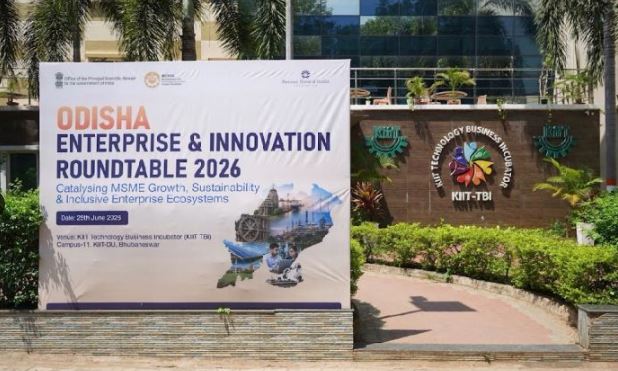
Panelists shared valuable insights on creating a more supportive environment for entrepreneurs through stronger institutional partnerships, access to resources, capacity building, and policy support. The session also underscored the importance of nurturing startups and empowering local enterprises to contribute to Odisha’s economic growth.
The stakeholder connect witnessed active participation from representatives of industry, academia, incubation centres, development organisations, and aspiring entrepreneurs. The gathering reflected a shared commitment to strengthening Odisha’s enterprise ecosystem through collaboration and collective action.
Participants appreciated the opportunity to exchange ideas, build meaningful connections, and contribute to discussions aimed at enhancing the state’s entrepreneurial landscape. The event concluded with a renewed focus on fostering innovation, supporting MSMEs, and accelerating inclusive economic development across Odisha.
27, Jun 2026
AI Embedded Across Curriculum as Management Education Adapts to Changing Workplace Demands
New curriculum integrates AI, experiential learning, industry projects, and emerging business practices across Marketing, Finance, Analytics, and HR
BENGALURU, June 27 — As Artificial Intelligence reshapes industries and redefines workplace expectations, management education is undergoing a significant transformation. Reflecting this shift, the International School of Management Excellence (ISME), Bengaluru, convened its Annual Board of Studies (BoS) meeting, bringing together 19 senior industry professionals and 23 faculty members for a comprehensive redesign of its Post Graduate Diploma in Management (PGDM) curriculum, embedding AI across all specialisations while strengthening industry integration, experiential learning and real-world business exposure.
As part of the redesign, ISME has introduced two new courses, AI for Management and Indian Knowledge System. The programme also places greater emphasis on practical learning through increased internship exposure, live projects and industry engagement. Summer internship credits have been increased from 3 to 6, every term will include a field project, and students will continue to participate in the institution’s Industry Trajectory Program, which enables them to work with organisations on real business challenges while pursuing their studies.
Dr. Nitin Garg, Founder & Director, ISME Bangalore, said, “The revised curriculum has been developed to align management education with the realities of a rapidly evolving business landscape where employers increasingly seek professionals who can combine technological fluency, analytical thinking and human decision-making. Rather than treating AI as a niche specialisation, the new framework integrates AI concepts, tools and applications throughout the learning journey, ensuring students understand how technology influences decision-making across business functions.”
Dr. Shampa Nandi, Convener of BOS, mentioned, “The Board of Studies for the PGDM programme goes well beyond a once-a-year compliance formality. BOS members contribute meaningfully to the programme’s academic quality by reviewing session plans for content currency, assessing select student assignments and projects, and engaging as mentors and guide for students across functional specialisations.”
The curriculum has been redesigned to reflect emerging industry trends and employer expectations in all functional domains. The Marketing curriculum now incorporates areas such as quick commerce, direct-to-consumer business models, Omni channel strategy, AI-driven advertising, prompt engineering and attribution models, ensuring students gain exposure to the tools and practices shaping modern marketing. The Finance curriculum moves beyond traditional transaction-focused learning to emphasise financial analysis, business decision-making and AI-enabled financial modelling. Embedded NISM certifications and contemporary case studies will help students connect financial concepts with real business scenarios.
In Business Analytics, the curriculum adopts a business-first approach that makes analytics more accessible and relevant for management students. New components include AI governance, DPDP compliance, analytics storytelling, Agentic AI and MLOps, enabling students to understand how data and technology can drive business outcomes.
The Human Resources curriculum has been strengthened with greater emphasis on workplace application and organisational effectiveness. Students will gain exposure to Labour Codes, Human Capital Management platforms, competency modelling, change management and AI-driven talent management practices, reflecting the evolving role of HR in modern organisations.
The revised curriculum was shaped through extensive consultation with industry leaders and academic experts. Recommendations were finalised by Dean Dr. Rony G Kurien and Dr. Shampa Nandi, Assistant Dean & Principal (PG), Prof. Sanjit Ghosh, Co-Convener and Dr. Rajni Pathak, Program Coordinator. Along with 19 senior industry professionals from organisations including JP Morgan & Chase, Coforge, Grant Thornton, Reliance Retail, Reliance JioMart, Godrej, Biocon, Acer, Aon and IISc, alongside faculty members, to review workforce trends and future skill requirements.
With this transformation, ISME aims to bridge the gap between classroom learning and industry expectations while ensuring that graduates are equipped with the knowledge, skills and adaptability needed to thrive in an increasingly technology-driven business environment.
26, Jun 2026
Toss Brings 30 Million Users Into the AI Data Economy in Partnership With Poseidon
Toss users can now contribute real-world data to train AI and get paid for it, in a first-of-its-kind model launching in Korea ahead of global expansion
SEOUL, June 26, 2026 — Poseidon, the data infrastructure built to source and license real-world data for AI, today announced a partnership with Toss, the mobile financial platform operated by Viva Republica, to let everyday users contribute to AI training and be paid for what they provide. It is Toss’s first move into AI data, and it opens that market to its roughly 30 million users.
Frontier AI has run out of internet to scrape. The next generation of models depends on real-world data, the kind that captures how people actually speak, move, and react, which does not exist on the open web and has never had a clean way to be sourced, licensed, or paid for. Poseidon is building the infrastructure to change that, and Toss brings the reach to do it at scale.
Through the partnership, Poseidon’s contributor app, Numo, launches inside the Toss app. Toss users can help build Korean-language training data across voice, image, and video, and receive payment tied directly to what they contribute. Poseidon provides the infrastructure that tracks each contribution and its value, while Toss provides the user base and the financial experience that turns participation into payment. Together they offer a working answer to a question the AI industry has struggled with, which is how to compensate the people whose data makes models better.
Every contribution made through Numo is registered on DATA, the AI data network that Poseidon refines data for. DATA gives each record a verifiable provenance trail through Trace, its public audit layer, so a buyer can see where a piece of training data came from and a contributor can see that their work was counted and paid. DATA Foundation, which launched this week from the rebrand of Story, is building this layer alongside integration partners including the human data marketplace Kled, and Poseidon is one of the largest sources of refined data flowing into it.
What Numo collects is first-person data, recorded by real people in real environments, which is among the hardest and most valuable categories to obtain. It is the raw material for physical intelligence, the AI that has to operate in the physical world across robotics, autonomous vehicles, and other applications. Demand from global AI labs for this kind of data is climbing, and Korea is positioned to supply it, with its dense real-life data and Toss’s user base. Poseidon and Toss intend to prove the model in Korea, then expand to global markets.
Changhoon Seo, Executive Director of New Business at Toss, said: “As the AI industry grows, demand for high-quality data is rising just as fast. Toss plans to build an environment where users can take part in the data economy more easily and naturally, and to expand a structure in which the value they contribute is rewarded transparently.”
SY Lee, Chief Strategy Officer and Chairman of Poseidon, said: “Korea is one of the few markets where the strategic importance of AI data, a mature financial system, and world-class mobile experience all exist at once. Toss is the right partner to turn user-contributed AI data from an early idea into a standard the rest of the world can adopt.” Lee previously founded the web-novel platform Radish and sold it to Kakao Entertainment, co-founded Story, the IP infrastructure that recently rebranded as DATA Foundation, and was named a Young Global Leader by the World Economic Forum this year.


