


19, Jun 2026
Algorand Foundation Announces Post-Quantum Security Roadmap, Targets Broad Quantum Resilience by 2027
The roadmap covers every layer of the Algorand protocol, from user wallets and developer tooling to consensus mechanisms, with milestones beginning in Q3 2026 and deployment progressing through the end of 2027
DOVER, DELAWARE, JUNE 19: The Algorand Foundation today announced a comprehensive post-quantum security roadmap, committing to advance broad quantum resilience by the end of 2027, well before NIST deprecates legacy RSA key sizes, and three years ahead of the NSA’s target for national security systems. Every layer of the protocol is included in the roadmap, from user wallets and developer tooling to consensus mechanisms.
Beginning Q3 2026, Algorand will introduce native post-quantum accounts for existing users or developers. Post-quantum account creation will be available directly within the Pera wallet, and all SDKs will be updated accordingly. Later this year, the Foundation will introduce post-quantum multi-signatures and begin migrating its own treasury to post-quantum accounts. Stakers will additionally be able to stake from post-quantum accounts. The roadmap comes four years after Algorand began post-quantum preparations with the deployment of State Proofs signed with the Falcon signature scheme in 2022.
“Post-quantum security cannot be retrofitted after Q-Day,” said Bruno Martins, Chief Technology Officer, Algorand Foundation. “Every institution tokenizing or staking, every developer building, and every user transacting on Algorand needs to know their assets will remain secure should the quantum threat materialize. This roadmap gives them that assurance, starting with concrete deployments in 2026.”
The roadmap addresses the deeper cryptographic layers of the protocol, including post-quantum consensus, a post-quantum Verifiable Random Function (VRF), an active research area in cryptography that Algorand is helping to advance from peer-reviewed research toward production deployment. Algorand is also committing to cryptographic agility and a hybrid approach to post-quantum preparations. Cryptographic agility will enable Algorand to be easily integrated by systems that support multiple signature schemes. A hybrid approach enables accounts to be secured by any combination of keys, providing a robust defense against both classical and post-quantum security risks.
“Migrating a live protocol takes years, and the probability of a quantum attack on legacy cryptography grows meaningfully as the end of this decade approaches,” said Chris Peikert, Chief Scientific Officer, Algorand Foundation. “Algorand’s roadmap deploys advanced, peer-reviewed post-quantum cryptography across every layer of a live production protocol, including the consensus mechanism, at an unprecedented scale.”
The quantum roadmap is being released as Algorand celebrates its seventh anniversary and seven years without downtime. Algorand is building toward broad quantum resilience before the end of next year. Further announcements on individual milestones will be made as development progresses.
- 0
- By Neel Achary

19, Jun 2026
IT Stocks Witness Sharp Correction as Mid-Caps Slide Deeply; Sector Under Profit-Booking Pressure
Mumbai, June 19: Several mid-cap IT stocks have witnessed significant corrections in recent trading sessions, with some declining by over 60 per cent from their recent highs, reflecting broader weakness in the technology sector.
Market data indicates sustained selling pressure in select IT counters amid concerns over global demand trends, valuation adjustments, and cautious investor sentiment.
Industry heavyweight Tata Consultancy Services (TCS) has also seen notable pressure, with its stock declining around 55 per cent from its record high levels, as part of the ongoing sector-wide correction.
Analysts suggest that the decline in mid-cap IT stocks reflects a combination of profit booking at higher levels, global macroeconomic uncertainty, and shifting investor preference toward other sectors.
Despite the correction, experts note that long-term structural demand for digital services remains intact, supported by cloud adoption, artificial intelligence integration, and enterprise technology transformation across global markets.
Market participants are closely watching upcoming earnings and global IT spending trends for cues on potential stabilization in the sector.
19, Jun 2026
India Emerging as Global Growth Engine as Investment Confidence and International Engagement Surge: PM Modi

New Delhi, June 19: Prime Minister Narendra Modi said that India is increasingly being viewed globally as a rising growth engine, with international engagement, investor confidence, and strategic partnerships witnessing steady expansion across sectors.
He noted that the world is looking at India with renewed optimism and trust, supported by the country’s strong economic fundamentals, consistent policy direction, and expanding opportunities in infrastructure, manufacturing, digital innovation, and services.
The Prime Minister highlighted that rising foreign investment inflows and deeper global collaborations reflect India’s strengthening position in global supply chains and its growing role in emerging technologies and innovation ecosystems.
He added that India’s development journey is now closely integrated with global economic progress, with increasing participation from international partners in areas such as trade, clean energy, technology, and sustainable development.
According to the Prime Minister, this growing global interest demonstrates that India is not only a major market but also a key driver of future economic growth and innovation worldwide.
19, Jun 2026
Father’s Day Gift Guide: Samsung Smart Appliances for Every Home’s Hero
This Father’s Day, go beyond the usual and surprise Dad with smart appliances that truly make his life easier and more enjoyable. Samsung’s Bespoke AI appliances innovative lineup is designed to simplify his daily routines, from keeping his meals fresh and delicious with the Bespoke AI Refrigerator to making laundry a breeze with the Bespoke AI Washing Machine. The Bespoke AI Air Conditioner ensures his room stays cool and comfortable, even during the hottest days, while the Bespoke AI AirDresser helps him look sharp and polished without the hassle of frequent dry cleaning. These thoughtful gifts not only enhance his everyday life but also show him how much you care about his comfort and convenience.
Samsung Bespoke AI Refrigerator- Upgrade Dad’s kitchen with the Samsung Bespoke AI Refrigerator, a smart appliance that ensures food stays fresh and hygienic. Its intelligent cooling technologies and flexible storage options make meal prep and organization effortless. By gifting him this innovative refrigerator, you’re not just enhancing his kitchen you’re simplifying his daily life with cutting-edge convenience.
-
Key Features: Twin Cooling Plus, AI Energy Mode, Power Cool & Power Freeze, Convertible 5-in Mode
-
Benefits: Keeps food fresh and odor-free, optimizes energy consumption, offers flexible storage options
-
Additional Highlight: Active Fresh Filter+ removes 99.9% of bacteria for a cleaner and more hygienic storage environment
-
Ideal For: Families looking for smarter food storage and hygiene
-
Available On: Samsung.com, Amazon, Flipkart, and leading retail outlets
2. Samsung Bespoke AI Washing Machine- Surprise Dad with the Samsung Bespoke AI Washing Machine—a thoughtful gift that simplifies his daily routine. Its intelligent features, like AI Wash and Hygiene Steam, ensure his clothes stay fresh and clean with minimal effort, making laundry a hassle-free task. By choosing this smart appliance, you’re not just giving a gift; you’re offering him the convenience of more free time to enjoy his favorite activities.
-
Key Features: AI Wash, Hygiene Steam, Air Wash, Washer Dryer functionality
-
Benefits: Intelligent fabric care, deep hygienic cleaning, odor removal without water, convenient drying solution
-
Additional Highlight: AI Wash automatically adjusts water and detergent usage based on fabric type and load size
-
Ideal For: Busy households and everyday laundry needs
-
Available On: Samsung.com, Amazon, Flipkart, and major retail platforms
3. Samsung Bespoke AI Air Conditioner- Treat Dad to the comfort of the Samsung Bespoke AI Air Conditioner, designed to tackle extreme summer heat with ease. Its AI-powered optimization and energy-efficient inverter technology ensure consistent cooling while saving on electricity bills. By gifting him this smart appliance, you’re providing a cooler, more comfortable home environment, allowing him to relax and enjoy the summer months stress-free.
-
Key Features: Fast Cooling, AI-powered optimisation, energy-efficient inverter technology
-
Benefits: Rapid cooling, consistent comfort, optimised power consumption
-
Additional Highlight: Smart cooling capabilities automatically adjust performance based on room conditions
-
Ideal For: Homes dealing with extreme summer temperatures
-
Available On: Samsung.com, Amazon, Flipkart, and leading retail outlets
4. Samsung Bespoke AI AirDresser-This Father’s Day, elevate Dad’s wardrobe with the Samsung Bespoke AI AirDresser, a smart solution for keeping clothes fresh and wrinkle-free. Its advanced steam and air technology sanitizes and deodorizes outfits, reducing the need for frequent dry cleaning. By choosing this innovative gift, you’re helping him maintain a polished look effortlessly, giving him more time to focus on what he loves.
-
Key Features: Advanced steam and air technology for sanitizing, deodorizing, and reviving clothes
-
Benefits: Reduces the need for frequent dry cleaning, keeps clothes fresh and wrinkle-free
-
Ideal For: Dads who want to maintain a polished look without the hassle of frequent laundry or dry cleaning
-
Available On: Samsung Store in BKC Mumbai
19, Jun 2026
Govt Removes Domicile Certificate Requirement for SC and OBC Scholarships
New Delhi, June 19: The government has removed the requirement of domicile certificates for students applying for Scheduled Caste (SC) and Other Backward Classes (OBC) scholarships.
The move is aimed at simplifying the application process and making it easier for eligible students to access financial assistance without facing unnecessary documentation hurdles.
Officials said the decision will help reduce delays in processing scholarship applications and ensure faster delivery of benefits to students.
The step is expected to improve accessibility and encourage greater participation from eligible students belonging to SC and OBC communities.
The reform is part of ongoing efforts to make welfare schemes more efficient, student-friendly, and easier to access through simplified procedures.
19, Jun 2026
AI Fashion Revolution 2026: How AR, Digital Twins & Smart Startups Are Transforming the Fashion Industry
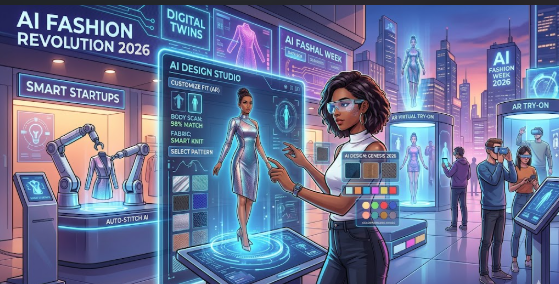
Fashion in 2026 is no longer just about what people wear—it is about how technology understands, predicts, and shapes personal style in real time. The industry has shifted into a powerful fusion of creativity and computation, where artificial intelligence, augmented reality (AR), digital twins, and blockchain systems are driving everything from design to purchase decisions.
What makes this transformation especially significant is its accessibility. Earlier, fashion innovation was limited to large global brands. Today, digital-first tools are empowering independent designers, small fashion startups, and direct-to-consumer (D2C) brands to scale globally without traditional retail barriers.
Fashion has effectively evolved into a data-driven, experience-led, and AI-powered ecosystem.
Fashion Technology 2026: From Clothing Industry to Intelligent Experience Economy
The modern fashion landscape operates less like a traditional retail industry and more like a real-time digital intelligence system.
Instead of seasonal cycles and static catalogs, brands now rely on:
- AI-powered trend forecasting systems
- Real-time consumer behaviour analytics
- Virtual design and prototyping tools
- Automated, personalized marketing engines
This means fashion is no longer pushed to consumers—it is generated dynamically based on their preferences, lifestyle, and digital behaviour.
The result is a shift from mass fashion to hyper-personalized fashion ecosystems.
AI in Fashion 2026: The Rise of Smart Styling, Prediction & Automation
Artificial intelligence has become the backbone of modern fashion operations and consumer experience.
How AI is transforming fashion today:
- Predicting upcoming fashion trends using global social data
- Generating design concepts and fabric combinations
- Acting as AI-powered personal stylists for users
- Creating dynamic pricing and personalized product feeds
AI is now functioning as both a creative assistant and a commercial strategist, enabling brands to respond instantly to shifting consumer demand.
For fashion startups, this is a major breakthrough—AI reduces dependency on large design, marketing, and analytics teams, allowing lean businesses to operate at scale.
AR Try-On Revolution: The End of Guesswork in Online Shopping
Augmented Reality (AR) has fundamentally changed how consumers shop for fashion online.
Instead of imagining how clothing will look, users can now:
- Try outfits virtually using mobile cameras
- Build accurate 3D body avatars
- Preview fabric texture, fit, and movement
- Compare multiple styling options instantly
This has significantly improved purchase confidence while reducing product returns across the fashion e-commerce sector.
For startups and D2C brands, AR acts as a virtual fitting room that eliminates the need for physical retail infrastructure.
Digital Twins in Fashion: Creating Virtual Versions of Consumers
One of the most advanced developments in 2026 fashion is the emergence of digital twins—virtual representations of real consumers.
These AI-generated profiles are built using:
- Body measurements and scanning data
- Purchase history and browsing behaviour
- Style preferences and lifestyle patterns
What digital twins enable:
- Precision virtual fitting of garments
- AI-curated wardrobe planning
- Real-time personalized styling recommendations
- Virtual product testing before manufacturing
For designers, this reduces production uncertainty. For consumers, it creates a fully personalized fashion journey that evolves over time.
Fashion Startups in 2026: How Digital Tools Are Democratizing the Industry
Perhaps the most disruptive impact of fashion technology is its role in empowering startups and independent designers globally.
1. Direct-to-Consumer (D2C) Global Expansion
Startups can now:
- Launch collections without physical inventory
- Sell directly via social media platforms
- Reach international customers instantly
This removes traditional dependency on retail chains and distributors.
2. AI-Powered Lean Fashion Businesses
Small brands are leveraging AI to:
- Design collections faster
- Forecast demand trends
- Automate digital marketing campaigns
- Optimize pricing strategies in real time
This allows startups to compete with established fashion houses using data instead of scale.
3. Social Commerce as the New Fashion Marketplace
Short-form video platforms and influencer ecosystems now act as:
- Digital fashion runways
- Instant sales channels
- Brand discovery engines
Fashion trends now spread through algorithms, not seasonal showcases.
Blockchain & Digital Product Passports: The Transparency Revolution
Modern consumers demand full visibility into product origins, and fashion brands are responding through blockchain-based Digital Product Passports (DPPs).
These systems allow users to:
- Track garment sourcing and production history
- Verify authenticity of luxury products
- Assess sustainability and ethical standards
For startups, transparency is becoming a competitive advantage in building trust and long-term loyalty.
Omnichannel Fashion: Where Physical Stores Become Digital Experiences
In 2026, the separation between online and offline retail no longer exists.
Modern fashion retail now includes:
- Smart mirrors with virtual outfit visualization
- RFID-enabled real-time inventory systems
- AI assistants in physical stores
- Seamless online-to-offline purchase journeys
Even small boutiques now function as hybrid digital-physical experience centers.
AI-Driven Fashion Marketing: Real-Time Personalization at Scale
Fashion marketing has evolved into a continuous, AI-optimized content system.
Brands now use:
- AI-generated ad creatives tailored to micro-audiences
- Real-time personalized shopping feeds
- Shoppable videos embedded in social media platforms
- Influencer-driven micro-launch campaigns
Every interaction is now both content and commerce combined.
Sustainable Fashion Through Technology: Reducing Waste with Intelligence
Technology is also addressing one of fashion’s biggest challenges—sustainability.
Key innovations include:
- Virtual sampling replacing physical prototypes
- AI demand forecasting reducing overproduction
- Digital-only fashion collections for online platforms
- Blockchain verification for ethical sourcing
Sustainability is no longer optional—it is becoming a core operational requirement in modern fashion systems.
Conclusion: Fashion Is Becoming a Fully Intelligent Digital Ecosystem
Fashion in 2026 is becoming a blend of creativity and technology, where AI, AR, and digital tools are changing how people shop, design, and experience style. It is making fashion more personalized, accessible, and innovative, while also helping startups and designers reach global audiences more easily.
19, Jun 2026
VU Researcher Develops AI Models to Assessthe Emotional Impact of Art and Advertising

June 19: Researchers from the Faculty of Physics at Vilnius University have developed a theoretical model that allows atoms to be “pre-programmed” by light alone to reshape laser beams that carry both a twist and a polarization.
The study by master’s student Dharma Prasetya Permana, alongside Mažena Mackoit-Sinkevičienė, Julius Ruseckas, and Hamid Reza Hamedi from the Institute of Theoretical Physics and Astronomy, opens a magnet-free route to controlling structured light for quantum technologies. The research was recently published in Physical Review A.

Twisted Light
The team’s research focuses on optical vortices—special light beams whose structure twists as they propagate.
“Unlike whirlpools in water, where the matter itself spins, optical vortices are twists in the wave structure of light. As the beam travels, its wavefronts form a helical, spiral-like structure,” explains Permana.
At the center of such a beam, the light intensity drops to zero, leaving a small dark core. The size of this region depends on a quantity called the topological charge, which counts how many full twists the wavefront makes around the beam’s axis.
“A topological charge of zero means there is no twist. When the charge increases to one, a small dark core appears at the center. As the charge grows, the structure becomes more pronounced. You can think of it like the thread of a screw—the higher the charge, the tighter the twist,” Permana explains.
In theory, this number has no upper limit; it can take any integer value, positive or negative. That makes optical vortices particularly attractive for encoding information in many distinct states. In practice, it is possible to create up to 10,000 distinct states.
“Researchers have already begun using these light vortices to build advanced quantum communication channels,” adds Hamedi. “Instead of a standard quantum bit, or qubit, which holds only two states, light vortices allow information to be encoded in higher-dimensional quantum states, called qudits, dramatically increasing how much data a single photon can carry.”
Spin and Swirl in Light
Light travels as a wave, and there are two distinct ways it can be manipulated: polarization and vortices. Normally, light from a bulb or the Sun is chaotic, with waves vibrating in many directions at once.
“Polarization is how the wave vibrates. Imagine tying a rope to a wall and shaking it. Shake your hand up and down, and the wave vibrates vertically; shake it side to side, and it vibrates horizontally. This direction of vibration is what physicists call the wave’s polarization. Polarized sunglasses act like a fence with vertical slats: they let through vertically vibrating light and block the horizontal glare bouncing off roads or water.
“A vortex, on the other hand, describes the overall shape of the beam. Instead of traveling as a flat wall of waves, the light is twisted into a spiral staircase as it moves forward,” says Mackoit-Sinkevičienė.
When scientists combine these two concepts, they get a vector vortex—a beam with both a structured shape and structured polarization.

“Imagine a spiral staircase where the direction of the steps changes as you climb. At the bottom, the steps face north—that is, vertical polarization. As you walk up the spiral, the steps gradually turn to face east—horizontal polarization. In a vector vortex, the light beam is twisting like a whirlpool, and the direction in which the light waves vibrate changes depending on where you are inside that whirlpool,” explains Mackoit-Sinkevičienė.
“Programmable” Atoms
To manipulate vector vortices and harness them for advanced information processing, the researchers studied how these beams interact with an atomic gas. They chose a medium of three-energy-level atoms, a standard model in quantum optics.
“We developed a theoretical model showing how these atoms can be ‘pre-programmed’ to modify the shape of optical vector vortices. When such light passes through the prepared atomic medium, the atoms respond in a highly structured way. They effectively inherit the spatial pattern of the light, forming regions where they absorb strongly and regions where they become almost transparent to the light,” says Hamedi.
This creates a feedback mechanism between light and matter: the light shapes the atomic response, and the atomic response reshapes the light.
As the beam propagates, it transforms. Instead of a simple ring-shaped intensity profile with a dark center, it evolves into a petal-like pattern, where light concentrates in several bright lobes arranged around the center. At the same time, the beam’s polarization structure evolves, demonstrating that the medium actively controls both its spatial shape and its spin properties.
“This demonstrates that by preparing the atomic medium in advance, we can control not only how complex light structures evolve in space, but also how their polarization changes as they pass through matter,” says Ruseckas.
Applications in Quantum Technologies
The study positions pre-programmed atoms as a powerful tool for manipulating light, with implications for quantum computing and high-density data transfer.
“Until now, controlling structured light in this way required strong external magnetic fields. Generating those fields takes complex, bulky, and often expensive equipment, which limits how easily these systems can be integrated into compact technologies,” says Permana.
“Our method is entirely optical. By using light itself to ‘program’ the atoms, we eliminate the need for magnetic fields. This offers a much more flexible, scalable, and elegant way to control light–matter interactions. Ultimately, it paves the way for faster quantum processors, highly secure quantum communication networks, and incredibly precise optical sensors,” says Hamedi.
19, Jun 2026
ASHRAE Celebrates World Refrigeration Day 2026, Highlights the Role of ‘Cool Intelligence’ in Shaping the Future of Refrigeration
ATLANTA, June 19: ASHRAE joins organizations, governments and industry partners around the globe in recognizing World Refrigeration Day (WRD 2026) on June 26. This year’s theme, “Cool Intelligence,” showcases the innovation, expertise and advanced technologies that are transforming refrigeration, air conditioning and heat pump systems to operate more efficiently, sustainably and intelligently.
World Refrigeration Day is an international awareness campaign that raises the profile of the refrigeration, air-conditioning and heat-pump industry and highlights the essential role cooling technologies play in supporting health, food security, economic development and quality of life worldwide.
The 2026 theme recognizes that “intelligence” in cooling extends beyond technology alone. From artificial intelligence and advanced controls to data-driven system optimization and the expertise of engineers, technicians and operators, intelligent cooling solutions are helping address some of today’s most pressing energy, environmental and resilience challenges.
“Intelligence in cooling goes beyond algorithms and automation, it is about applying knowledge, innovation and technology to create healthier, more sustainable environments,” said 2025–26 ASHRAE President Bill McQuade, P.E., CDP, Fellow ASHRAE, LEED AP. “This year’s World Refrigeration Day theme highlights how AI, digitalization and human expertise are working together to create smarter, more sustainable cooling solutions. ASHRAE is proud to support the professionals and technologies that are advancing the future of refrigeration around the world.”
To mark World Refrigeration Day, ASHRAE is encouraging industry professionals to explore the latest refrigeration guidance and technical resources, including the 2026 ASHRAE Handbook—Refrigeration (I-P) and 2026 ASHRAE Handbook—Refrigeration (SI), now available for preorder.
ASHRAE also continues to support global refrigeration education and capacity-building efforts through the ASHRAE-UNEP Portal, which provides access to technical resources, training materials and guidance designed to help industry professionals advance sustainable cooling practices worldwide.
As part of its ongoing commitment to industry advancement, ASHRAE will spotlight emerging refrigeration technologies during the 2026 Annual Conference, June 27– July 1 in Austin, Texas.
19, Jun 2026
SIP Investing in Focus: How Systematic Investing Builds Long-Term Financial Discipline in Uncertain Markets

In times of market volatility, most investors face the same dilemma—should they invest now, wait for a correction, or exit until things stabilize? This uncertainty often leads to delayed decisions, emotional reactions, and missed opportunities. It is precisely this behavioural challenge that has made Systematic Investment Plans (SIPs) one of the most widely adopted mutual fund investing methods in India.
A SIP allows investors to invest a fixed amount at regular intervals, helping remove the pressure of timing the market while encouraging disciplined, long-term wealth creation. In an environment where short-term market movements are unpredictable, SIPs offer a structured way to stay invested and build financial stability over time.
What is SIP Investing? A Simple System for Disciplined Wealth Creation
A Systematic Investment Plan (SIP) is a method of investing a fixed amount at regular intervals—monthly, quarterly, or as chosen by the investor—into mutual fund schemes.
Instead of investing a large lump sum at once, SIPs distribute investments across time, making the process more stable and predictable in terms of contribution behaviour.
Key Features of SIPs:
- Fixed and regular investment contributions
- Long-term disciplined investing approach
- Exposure to multiple market cycles
- Flexible investment amounts and tenure options
SIPs are designed to build consistency, which is often more important than timing in long-term investing.
SIP vs Market Timing: Why Consistency Wins Over Prediction
One of the strongest advantages of SIP investing is that it eliminates the need to predict market movements.
Financial markets are influenced by global events, economic cycles, interest rates, and investor sentiment—all of which are difficult to forecast accurately.
SIPs ensure that:
- Investors continue investing during market highs and lows
- Emotional decision-making is reduced
- Wealth building remains consistent over time
This makes SIPs especially relevant in volatile or uncertain market conditions.
Rupee Cost Averaging: The Built-in Advantage of SIPs
SIP investing naturally benefits from rupee cost averaging, a mechanism where investment units are purchased at different price levels over time.
- More units are bought when markets are low
- Fewer units are bought when markets are high
- Overall cost of investment is averaged out
This reduces the impact of short-term volatility and helps smooth the investment journey.
However, it is important to note that rupee cost averaging does not eliminate risk—it only distributes it over time.
Power of Compounding: The Core Engine of Long-Term Wealth
The real strength of SIP investing lies in compounding, where returns generate additional returns over time.
Compounding works best when:
- Investments are held for long durations
- Contributions are made consistently
- Withdrawals are avoided during growth phases
Even small monthly investments can grow significantly over time when compounded over several years, making SIPs suitable for long-term financial goals such as retirement planning, education funding, and wealth accumulation.
Why Time Horizon Matters in SIP Investing
Time is one of the most critical factors in SIP performance.
A longer investment horizon allows:
- Greater participation across market cycles
- Reduced impact of short-term volatility
- Stronger compounding effect
Short-term fluctuations tend to even out over longer periods, making patience a key element of successful SIP investing.
Asset Allocation and Diversification: Building a Balanced Portfolio
SIP investing becomes more effective when combined with asset allocation and diversification.
Asset Allocation:
Distributing investments across:
- Equity funds (growth-oriented, higher risk)
- Debt funds (stability-oriented, lower risk)
- Hybrid funds (balanced exposure)
Diversification:
Spreading investments across sectors, industries, and instruments to reduce concentration risk.
Together, these strategies help create a more stable and balanced investment portfolio.
SIP Investing in India’s Mutual Fund Ecosystem
SIPs are widely offered by Asset Management Companies (AMCs) across India, including major fund houses such as HDFC Mutual Fund and others.
Their growing popularity is driven by:
- Easy digital onboarding
- Low entry barriers
- Increased financial awareness
- Preference for structured investing habits
Today, SIPs have become one of the most common ways retail investors participate in mutual funds.
SIP Calculator: A Learning Tool, Not a Guarantee
A SIP calculator is often used to estimate potential growth based on assumed returns, investment duration, and monthly contributions.
It helps investors understand:
- How compounding works over time
- The impact of consistent investing
- The relationship between time and growth
However, these calculations are only illustrative. Actual returns depend on market performance and economic conditions.
Important Risks and Considerations
While SIPs are a disciplined investment approach, investors should be aware of:
Market Risk
Mutual fund investments are subject to market fluctuations.
No Guaranteed Returns
Returns vary based on market conditions and fund performance.
Discipline is Key
Consistency often matters more than investment size.
Product Understanding
Each mutual fund has different risk levels and objectives.
SIPs as a Behavioural Advantage in Investing
Beyond financial mechanics, SIPs also help shape better investor behaviour.
They encourage:
- Emotional discipline during volatility
- Long-term thinking over short-term reactions
- Regular saving habits
- Structured financial planning
In many ways, SIPs act as a bridge between financial theory and real-world investor behaviour.
Conclusion: A Structured Path to Long-Term Financial Stability
SIP investing is not about predicting markets or chasing short-term gains. It is about building a disciplined, consistent approach to wealth creation over time.
By combining:
- Regular investing
- Long-term time horizon
- Rupee cost averaging
- Power of compounding
- Diversification
SIPs provide a structured framework for navigating volatile markets while steadily building financial security.
In a world of uncertainty, SIPs offer one simple advantage—the ability to stay invested when it matters most.
19, Jun 2026
10ZiG Expands Strategic Partnership with ThinPrint to Advance Printing Flexibility Across 10ZiG Linux OS
Enhanced integration delivers seamless, driverless printing for Terminal Server environments, with a path to cloud printing through ezeep by ThinPrint for DaaS environments
PHOENIX , June 19: 10ZiG® Technology, a leading provider of thin and zero client hardware and software solutions for VDI, DaaS, and web app environments, today announced an expanded partnership with ThinPrint to further integrate the ThinPrint Engine Client into the 10ZiG Linux-based operating system portfolio for Terminal Server and centralized desktop environments. The collaboration enhances printing simplicity, security, and flexibility for organizations deploying modern digital workspaces powered by Microsoft Remote Desktop Services (RDS), Citrix Virtual Apps, and Omnissa Horizon VDI and hybrid infrastructure to name a few.
The expanded partnership builds on the integration of ThinPrint technology within 10ZiG operating systems, now extending deeper support for the ThinPrint Engine Client architecture and core ThinPrint platform. The combined solution is designed to simplify printing in Terminal Server environments by enabling secure, driverless printing directly from 10ZiG Linux-based thin clients without the need for complex print server infrastructure or manual driver management.
“As organizations continue shifting toward modern desktop infrastructure and hybrid work models, printing must evolve to be just as seamless as the rest of the digital workspace,” said Tom Dodds, Global Strategic Alliances Manager, 10ZiG Technology. “By expanding our partnership with ThinPrint and enhancing integration within 10ZiG Linux OS, we’re delivering a modern printing experience that removes complexity for IT teams while improving usability and security for end users.”
Modern Printing Built on ThinPrint Engine Client Technology
The ThinPrint Engine Client delivers secure, compressed and driverless printing by intelligently compressing and optimizing print jobs directly at the endpoint, eliminating the need for local printer drivers and print servers while also reducing bandwidth consumption. This approach allows users to print seamlessly from Terminal Server sessions, published applications and virtual desktops while maintaining high performance and reliability. By minimizing infrastructure dependencies and streamlining print management, organizations can reduce administrative overhead while ensuring consistent printing experiences across distributed environments.
The integration within 10ZiG Linux OS brings a streamlined printing experience for customers running server-based computing platforms such as Microsoft RDS, Citrix Virtual Apps and Desktops, and Omnissa Horizon environments. The combined solution helps eliminate common printing challenges like driver conflicts, manual configuration, and inconsistent printer mapping that often burden IT teams.
“Our mission has always been to make printing as easy and accessible as possible across modern workspace environments,” said Scott Seddon, Global Technical Partnerships Manager, ThinPrint. “Expanding our collaboration with 10ZiG ensures organizations can deliver a secure, cloud-ready printing experience directly from 10ZiG Linux-based thin client endpoints while simplifying management for IT administrators.”
Extending Printing to the Cloud with ezeep by ThinPrint
In addition to supporting on-premises and hybrid Terminal Server environments, the partnership also provides organizations with a path to cloud-managed printing through ezeep by ThinPrint for DaaS and cloud PC deployments. As organizations increasingly adopt Azure Virtual Desktop, Windows 365, and other cloud-delivered desktop services, ezeep by ThinPrint enables centralized, serverless printing management without requiring VPNs, print servers, or complex infrastructure.
By combining 10ZiG thin clients with ezeep’s cloud-native printing platform, organizations can extend the same simplified, driverless printing experience to remote users and distributed cloud workspaces. This approach helps IT teams reduce management overhead while delivering secure, reliable printing across modern DaaS, SaaS and Web App environments.
The expanded partnership also supports deeper go-to-market collaboration and customer engagement around integrated use cases for modernized printing via ThinPrint technology while reinforcing ThinPrint’s role within the growing 10ZiG Ready partner ecosystem.


