


12, May 2026
Beyond Acute-Phase Support: How “Ibasho” Aids Disaster Mental Health Recovery
Authors propose that rebuilding community, routine, and social roles is essential for long-term recovery after disasters
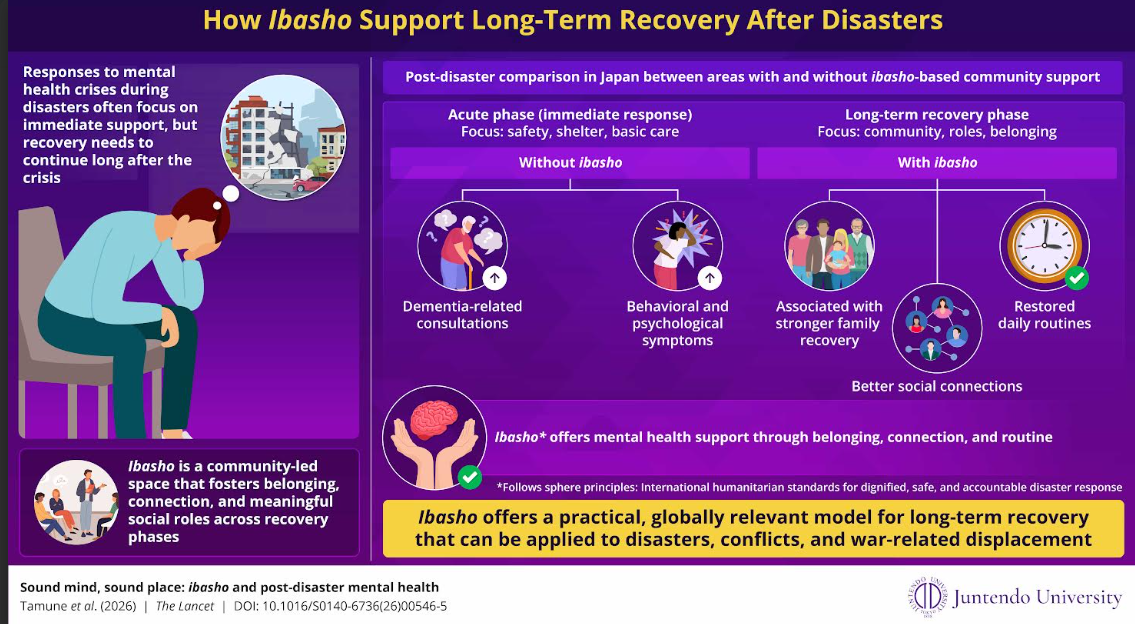
As disasters increasingly disrupt lives through displacement, conflict, and climate-related emergencies, addressing long-term mental health recovery remains a major challenge. A correspondence from Juntendo University discusses that, while acute symptom assessment remains important, disaster psychiatry may benefit from a community-led approach to care. The authors discuss the importance of ibasho (community spaces of belonging and social purpose) and suggest that rebuilding routines, roles, and neighborhood connections may support long-term recovery and resilience.
Natural disasters drastically affect human lives—destroying homes, separating families, leading to disruption of daily routines, which affects their stability. While emergency mental health responses are crucial in the beginning of the crisis, new correspondence discusses that psychological recovery may rely on a more meaningful approach to help restore a sense of place and belonging.
Ibasho: A Community-led Place for Belonging and Meaning
In this context, authors from Juntendo University, Japan, led by Associate Professor Hidetaka Tamune from the Department of Psychiatry and Behavioral Science, along with Dr. Yutaka Igarashi from Nippon Medical School, Japan, and Dr. Yuzuru Kawashima from the Disaster Psychiatric Assistance Team, Japan, discussed the approach of ibasho (a community-building concept in Japan) for people affected by disasters. The details were made available online on April 3, 2026, and published in Volume 407, Issue 10537 of The Lancet journal on April 11, 2026.
Dr. Tamune says, “Disaster recovery is not only about reducing acute psychiatric symptoms. It is also about restoring the social environments that give people stability, dignity, and a sense of purpose. In Japanese, the places that make this possible are called ibasho.”
Ibasho means a place of belonging where people are engaged in social networks, routines, and meaningful roles. The authors suggested that restoring this sense of connection among people affected by disasters may be just as important as detecting early symptoms, as it plays a vital role in supporting community recovery. Supporting this, the correspondence places ibasho within the internationally recognized Sphere humanitarian framework, which focuses on survival with dignity, continuity with care, and coordinated support systems during crises. It also suggests that ibasho aligns closely with those principles by offering social infrastructure for displaced and affected communities.
Ibasho in Japan: Community-Led Recovery in Practice
Compared to conventional interventions, ibasho refers to safe, community-led spaces where individuals can reconnect with others and resume daily routines. This may include neighborhood gathering spaces, shared community programs, and locally led recovery hubs. To support this perspective, the authors cited the evidence from disaster-affected regions in Japan. These include examples from the 2011 Great East Japan Earthquake and the Fukushima nuclear accident. Notably, there was an increase in the dementia consultations and behavioral and psychological symptoms of dementia (BPSD) among older adults near the evacuation zones of the affected areas. In contrast, the communities where older residents were helped by leading ibasho-style programs reported stronger recovery and more stable routines with improved social and family relationships. This suggests that recovery improved when people were able to regain meaningful roles in community life. The older adults not only receive support but are also actively contributing to the recovery efforts and rebuilding community life.
“What appears to be most important is not simply access to services, but whether people can reclaim their place within the community and continue to feel valued, useful, and connected. In Japan, a disaster-prone and super-aged society, we have both the experience and the responsibility to share what we have learned about caring for older adults with dementia, especially those who develop BPSD and delirium,” explains Dr. Tamune.
Redefining Recovery Through Connection, Culture, and Dignity
Although particularly relevant to natural disasters, the correspondence suggests that preparedness and recovery both depend not only on services but also on whether people can remain connected to local networks, routines, and meaningful social roles. The authors further note that trauma-informed support should remain culturally congruent; in some communities, restoring routines, roles, and communal life through ibasho may be the most acceptable first step.
Overall, the correspondence highlights the importance of ibasho in post-disaster mental health. It suggests that, although acute symptom detection matters, recovery also depends on whether people can continue to live safely, sustain relationships, and regain meaningful roles after displacement. In this sense, ibasho may function as a culturally congruent local social infrastructure through which dignity, continuity, and safety are restored in everyday life.

- 0
- By Neel Achary

11, May 2026
Ualett Launches “Ualett Rewards” to Give Back to Gig Workers
WILMINGTON, Del. —May 11, 2026 — Ualett, the leading financial technology platform serving gig workers, announced the launch of Ualett Rewards, a new loyalty program designed to recognize and reward clients for their engagement and financial activity.
With Ualett Rewards, clients can turn everyday interactions into real financial benefits through GigPoints, redeemable for remittance savings and digital rewards. The program deepens Ualett’s commitment to helping independent workers build more flexible, resilient financial lives while making the in-app experience more engaging and valuable over time.
“Gig workers are constantly balancing tight schedules, rising costs, and unpredictable income,” said Ricky Michel Presbot, Co-Founder and CEO of Ualett. “Ualett Rewards is our way of saying thank you to the workers who trust us every day. By turning routine actions into meaningful rewards, we’re helping clients get more value from every interaction with Ualett.”
Ualett Rewards will officially launch today, and all eligible clients can access the program directly through the Ualett app.
How Ualett Rewards Works
Through Ualett Rewards, clients earn GigPoints for simple, everyday actions in the app, including:
-
Client referrals: Points are awarded when a referred user successfully enrolls.
-
In-app gaming experiences: Points can be earned by participating in interactive features and experiences within the Ualett app.
Accumulated GigPoints are tracked over time and can be redeemed for tangible benefits, such as:
-
Savings on remittances, helping clients keep more of what they earn on eligible transactions.
-
Eligible digital rewards, including select gift cards and other digital benefits.
As Ualett scales its platform, the company is focused on ensuring that its most engaged clients share directly in the value they help create. Ualett Rewards is designed to feel intuitive and fair: clients earn points for the actions they’re already taking and can clearly see how those points convert into real, usable financial benefits over time.
By integrating rewards into everyday app interactions, Ualett is strengthening its role as a long-term financial ally for gig workers—providing not just access to fast, flexible capital, but also ongoing incentives that support smarter financial decisions and deeper engagement.
11, May 2026
COMAU and OMRON Robotics Partner to Advance Industrial Automation Worldwide
Turin, Italy and Pleasanton, California, USA – May 11, 2026 – COMAU and OMRON Robotics (Omron) have entered into a strategic collaboration agreement to accelerate the global adoption of advanced industrial automation solutions. The partnership will focus on fast-growing industries including electronics, semiconductors, medical manufacturing, and light industrial intralogistics, where demand continues to rise for flexible and easily deployable automation technologies.
The collaboration is designed to address increasing customer demand for scalable, adaptable automation systems that integrate efficiently with both existing production lines and next-generation manufacturing environments. By combining their complementary technologies, product portfolios, and industry expertise, COMAU and Omron aim to expand access to advanced automation solutions for manufacturers worldwide.
The companies also see the agreement as a foundation for future joint initiatives. By integrating robotics hardware, intelligent control systems, and software-driven automation, the partnership aims to help manufacturers improve operational efficiency, increase flexibility, and enhance overall production performance across a wide range of industrial applications.
“This initiative reflects our strategy to strengthen Comau’s solution portfolio through high-value partnerships,” said Pietro Gorlier, CEO of COMAU. “Omron is a strong strategic fit because we share a common vision centered on innovation and customer value. By combining Comau’s robotics expertise with Omron’s advanced technologies and software capabilities, we can deliver automation solutions that are easier to implement, highly adaptable, and ready to support future manufacturing needs. This collaboration also reinforces our position in high-growth industries and emerging markets, helping customers manage increasing industrial complexity with safe, reliable, and scalable automation.”
“By bringing together two highly complementary portfolios, this collaboration creates new opportunities for manufacturers seeking greater agility and efficiency,” said Olivier Welker, CEO of OMRON Robotics. “Combining our strengths in robotics, intelligent automation, advanced control, and application expertise will help customers respond more quickly to evolving market requirements. Together, we aim to deliver flexible, connected, and sustainable production systems that support long-term growth.”
11, May 2026
Numeros Motors Co-Powers The Walkathon 2026, Driving Community Action for Education Access in Bengaluru

Bengaluru, May 11: Bengaluru came together in large numbers on Sunday morning for ‘The Walkathon 2026’, a community initiative dedicated to health, fitness, and literacy. Hosted by 93.5 Red FM in association with o9 Solutions and co-powered by Numeros Motors, the event saw students, corporates, fitness enthusiasts, and families walking to support quality education through AI-powered learning tools.
The event took place on Sunday, 10 May 2026, at St. Joseph’s Indian Institution Grounds, Bengaluru, with as many as 3,500 participants from across the city. Olympic medalist Saina Nehwal graced the occasion as Chief Guest, inspiring participants and amplifying the message of collective action and social responsibility.
As a co-powering partner, Numeros Motors led the Walkathon with its electric two-wheelers, Numeros n-First and Numeros Diplos, highlighting the brand’s focus on smart, durable, and purpose-driven mobility solutions.
“At Numeros Motors, we strongly believe that brands have a responsibility to contribute meaningfully beyond business. The walkathon demonstrates how community participation can translate into tangible social impact. We are proud to support an event that unites people for a purpose greater than themselves while promoting sustainable mobility,” said a spokesperson from the Bengaluru-based EV company.
Through such collaborations, Numeros Motors continues to strengthen its commitment towards sustainability, responsible mobility, and initiatives that create lasting positive impact on the ground.
11, May 2026
From Awareness to Action: Avaada Group Flags Off ‘Avaada Bharat Uday Yatra’ to Drive India’s Clean Energy Movement
Noida, May 11 : Sensing urgency for adoption of green energy amid rising geopolitical uncertainty and ongoing disruptions in global fossil fuel supply chains, Avaada Group, one of India’s leading integrated green energy conglomerates, today flagged off its ambitious renewable energy awareness initiative, ‘Bharat Uday Yatra’, aimed at building grassroots level awareness around green energy.
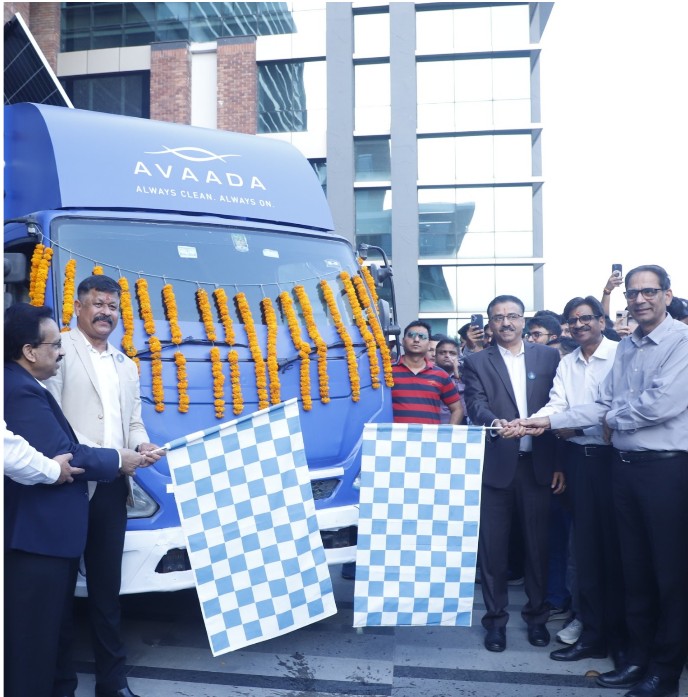
As part of the initiative, two custom-designed vans will travel across 9 states and 27 cities over 35 days, creating immersive, on-ground engagements with citizens, institutions, and communities. Through the initiative, the renewable energy company aims to touch millions of Indians, driving awareness around clean energy (solar, wind and water) adoption, energy efficiency, and sustainable living, while addressing common misconceptions around renewable energy.
Envisioned as a nationwide movement, ‘Avaada Bharat Uday Yatra’ goes beyond a conventional outreach campaign to take the message of sustainability from cities to citizens, aligning with the vision of Hon’ble Prime Minister Shri Narendra Modi to build a cleaner and more self-reliant India, while contributing to the national target of 500 GW of non-fossil fuel capacity by 2030.
The ‘Avaada Bharat Uday Yatra’ was flagged off from the company’s corporate office in Noida Sector 62 amid a large and spirited gathering, as crowds assembled to witness and celebrate the momentous occasion. The event was presided over by senior leadership including Mr. Kishor Nair, Chief Executive Officer, Avaada Energy; Mr. Vinoo George, President – Manufacturing, Avaada Electro; and Mr. Prashant Choubey, President & Head – Green Hydrogen/Ammonia Business & New Initiatives, Avaada Group, who collectively flagged off the Yatra amid much fervour and encouragement from those present.
Commenting on the launch of the Yatra, Mr Vineet Mittal, Chairman, Avaada Group, said,
“The time is now to accelerate adoption to the green energy in India. At a time when geopolitical uncertainties and disruptions in global fossil fuel supply chains continue to impact energy markets, India’s transition to clean energy is not just an environmental priority but a strategic imperative for energy security and self-reliance. India stands at a defining moment in this journey, and the next phase must be driven by citizen participation. Through Avaada Bharat Uday Yatra, we aim to make clean energy more accessible, relatable, and actionable—transforming awareness into a nationwide movement.”
The Yatra will traverse key urban and semi-urban centres across northern, central, western, and eastern India before culminating in Delhi. During its journey across nine states including Uttar Pradesh, Bihar, Odisha, Madhya Pradesh, Maharashtra, Gujarat, Rajasthan, Jharkhand and Delhi, the interactive vans will engage with communities, local leaders, and changemakers.
As a part of the initiative, street play (Nukkad Natak) will be organised to bring renewable energy concepts to life. This apart, there will be several myth-busting activities to help dispel common misconceptions. Citizens will also be encouraged to take Digital Green Pledge to become a part of the national movement and drive sustainability revolution.
By combining on-ground engagement with digital outreach, the initiative reinforces Avaada Group’s commitment to accelerating India’s clean energy transition not just through capacity creation, but by enabling widespread behavioural change and citizen participation.
11, May 2026
Tamil Nadu CM Vijay Meets MK Stalin, Udhayanidhi After Swearing-In
Chennai, May 11 (BNP): A day after taking oath as the Chief Minister of Tamil Nadu, C. Joseph Vijay met former Chief Minister M. K. Stalin and DMK leader Udhayanidhi Stalin at Stalin’s residence in Chennai on Monday.

The meeting, described as a courtesy call, marked the first interaction between the leaders after the recently concluded Assembly elections and Vijay’s swearing-in ceremony. Visuals from the meeting showed the leaders exchanging warm greetings and holding discussions on the state’s political developments.
According to reports, Stalin congratulated Vijay on assuming office and extended his best wishes for the new government. The meeting is being seen as a significant political gesture amid the changing political landscape in Tamil Nadu.
11, May 2026
Sayaji Hotel Vadodara Brings the Spirit of Punjab Alive with ‘Highway Dhaba Fiesta’ at Kebabsville
Vadodara, May 11: Bringing the vibrant and robust flavours of Punjab to the city, Sayaji Hotel Vadodara invites guests to indulge in Highway Dhaba Fiesta, a specially curated Punjabi food festival at their rooftop AC restaurant, Kebabsville. Inspired by the lively atmosphere of North India’s iconic roadside dhabas, the festival promises an authentic culinary experience that celebrates the warmth, richness and soulful charm of Punjabi cuisine.

Known for its bold spices, smoky grills and hearty preparations, Punjabi cuisine takes centre stage through an elaborate dinner buffet featuring a delectable selection of traditional delicacies. Guests can savour rich signature dishes such as Maa Ki Dal, Baingan Bharta, Amritsari Fish, Dhaba Gosht, Kukad da Saag, Keema Kaleji, Patiala Gosht, and Bhatti Ka Murgh, each thoughtfully prepared to recreate the authentic flavours of Punjab’s famous highway eateries. Freshly made parathas dipped in the richness of ghee, scrumptious gravies and refreshing Punjabi Lassi further elevate the dining experience, offering guests a wholesome and indulgent feast.
The festival goes beyond food to create a vibrant and immersive dining atmosphere. Live barbeque counters, interactive cooking stations, and soulful live music performances come together to recreate the festive spirit of a traditional Punjabi dhaba in a luxurious setting. The warm hospitality and lively ambience make Highway Dhaba Fiesta an ideal destination for families, food enthusiasts and diners looking to experience the rich culinary traditions of North India.
With this specially curated food festival, Sayaji Hotel Vadodara aims to offer guests more than just a meal; it is a celebration of Punjab’s culinary heritage, culture and flavours, thoughtfully designed to deliver a memorable dining experience filled with authentic tastes and festive charm.
Event Details:
Where: Kebabsville, Sayaji Hotel Vadodara
When: May 15 to May 24, 2026
Timings: Dinner, 7:30 PM onwards
11, May 2026
The Westin Pushkar Emerges as Luxury Wedding Destination in Rajasthan
Pushkar, Rajasthan : The Westin Pushkar Resort & Spa sets a new benchmark for destination weddings, offering a seamless blend of scenic beauty, luxury living, and curated experiences. Nestled amidst tranquil surroundings near Pushkar’s spiritual landmarks, the resort features sweeping 360° views of the Aravalli Hills and breathtaking sunset backdrops creating a picturesque setting for every celebration.

With four outdoor and two indoor venues, the resort offers versatile spaces for multi-day weddings, including a distinctive dome-shaped venue inspired by the Shiv Ling for sacred pheras. Expansive lawns and seamless baraat processions within the property ensure both grandeur and convenience.
The resort’s 98+ rooms and private villas including pool and plunge pool options are ideal for exclusive wedding buyouts, allowing guests to celebrate together in privacy and comfort. Complementing the celebrations are signature wellness offerings, a premium spa, Westin WORKOUT Fitness Studio, and multiple pools for relaxation.
Dining experiences range from global cuisine at Seasonal Tastes to panoramic rooftop views at Panorama, alongside curated wedding menus tailored to each celebration. A variety of indoor and outdoor activities ensures an engaging stay for guests of all ages, while the resort’s pet-friendly approach adds a thoughtful touch.
“Weddings today are about creating immersive, meaningful experiences, and at The Westin Pushkar Resort & Spa, we bring together nature, luxury, and thoughtful service to make every celebration truly personal and memorable,” said the General Manager, Vijay Chandran. “Our aim is to offer couples and their families a seamless, all-in-one destination where every detail is taken care of.”
Bringing together venues, villas, wellness, and bespoke experiences, The Westin Pushkar Resort & Spa delivers a seamless, all-in-one destination wedding experience.
A refined destination where serene landscapes, exclusive villas, and curated experiences come together to create truly unforgettable weddings.
11, May 2026
Fresh Militia Violence in DR Congo’s Ituri Province Leaves At Least 69 Dead
Bunia, May 11 (BNP): At least 69 people were killed in a fresh wave of militia violence in the conflict-hit Ituri province of the Democratic Republic of Congo (DRC), according to local authorities and security sources.
The deadly attacks were reportedly carried out by armed fighters linked to the Codeco militia, which claims to represent the Lendu community, in several villages in late April. The violence comes amid escalating tensions between the Hema and Lendu ethnic groups, who have been engaged in a long-running conflict in the gold-rich province bordering Uganda and South Sudan.
Officials said the attacks followed earlier clashes involving the Convention for the Popular Revolution (CRP), an armed group associated with the Hema community, and the Congolese Army near the locality of Pimbo. Security sources stated that the violence claimed the lives of civilians, militia members, and soldiers.
Local civil society leaders described the killings as a “massacre,” with reports of bodies lying unattended for days due to continued militia presence in the affected areas. Humanitarian agencies also reported widespread panic, displacement of civilians, and destruction of property across several villages.
The United Nations mission in the DRC (MONUSCO) strongly condemned the attacks and reiterated its concern over the deteriorating security situation in eastern Congo. Earlier, the UN mission had rescued nearly 200 civilians caught in crossfire during clashes between armed groups and government forces.
Eastern DRC has remained unstable for decades due to the activities of multiple armed groups competing for control over the region’s vast mineral resources, including gold, cobalt, copper, and diamonds. The violence has triggered a severe humanitarian crisis in Ituri province, where nearly one million people are currently displaced, according to UN agencies.
Authorities and humanitarian organisations have appealed for restraint and urged communities to avoid retaliatory violence as efforts continue to restore peace and stability in the region.
11, May 2026
Cosmo Films to Showcase Specialty and Sustainable Packaging Solutions at Interpack 2026

Mumbai, May 11: Cosmo Films, a global leader in specialty films for packaging, lamination, labeling and industrial applications, announces its participation at Interpack 2026, one of the world’s most influential exhibitions for the packaging and processing industry. The company is exhibiting at Stand B31, Hall No.9 from May 07-13, 2026.
As part of its showcase at the seven-day event, Cosmo Films is presenting its portfolio of high-performance BOPP and specialty films, solutions from Cosmo Speciality Films, packaging and lamination films, as well as rigid packaging solutions catering to diverse end-use industries including food packaging, FMCG, personal care, industrial and specialty applications. With a strong presence in both the domestic and global export markets, the company aims to further strengthen its international footprint through the platform.
Cosmo Films’ participation at Interpack 2026 is centered around the themes of sustainability, innovation and specialty packaging solutions. The company is focused on strengthening customer engagement through pre-scheduled meetings with global partners while also showcasing India’s growing capabilities as a global packaging solutions hub.
Speaking on the participation, Mr. Kulbhushan Malik, Global Business Head, Cosmo Films, said “Interpack is one of the most important global platforms for the packaging industry and offers a valuable opportunity to engage with stakeholders from across markets. At Cosmo Films, we remain focused on developing innovative and sustainable packaging solutions that balance performance, cost efficiency and environmental impact. Through our participation, we look forward to strengthening global partnerships, understanding emerging customer requirements, and showcasing India’s potential to lead the next phase of global packaging innovation.”
Cosmo Films’ product portfolio is backed by strong R&D capabilities that enable the development of customized solutions, including high-barrier and functional films designed to meet evolving industry requirements. The company continues to focus on delivering premium-quality specialty films to customers globally while supporting sustainability-led packaging transitions.
Industry trends expected to dominate discussions at Interpack 2026 include the growing emphasis on sustainability and circular economy practices, increasing adoption of mono-material packaging solutions, and rising demand for automation and efficiency across packaging processes. Against this backdrop, Cosmo Films aims to strengthen its global visibility, expand its customer base, and build long-term value-driven collaborations with converters and brand owners, particularly across Europe and North America.


