


12, May 2026
Agoda Reveals the Most Popular Search Filters for 2026: Indian Travelers Favor Choice, Culinary Convenience and Comfort
May 12: Digital travel platform Agoda has unveiled its ranking of what Asian travelers prioritize most when searching for accommodation in 2026. Looking at the most-used search filters on its website this year, Agoda reports that Indian travelers consistently prioritize accommodation type, included breakfasts and strong review scores when seeking holiday stays.
At 26% of all filter activity, choice of accommodation type ranked first for Indian traveler searches in 2026, emphasizing the importance of selecting the right stay over all other factors. This places India among the top markets, compared with the Asia-wide average of 19%.
‘Review scores of 7 and above’ rank among the top search criteria for Indian travelers in 2026 constituting 13% of all filter activity reflecting a strong preference for highly rated stays.
Dining and creature comforts drive Indian travel choices
The filter for breakfast-included stays is India’s second-most searched at 14%, reflecting a preference for convenience and value at the start of the day. Dinner-included stays also feature among India’s top 10 search filters, pointing to food as a consideration across the entire day, not just breakfast.
Indian travelers also seek specific creature comforts when choosing stays. Swimming pools and bathtubs both rank among the top 10 search filters for Indian travelers in 2026, reflecting a clear preference for amenities that support relaxation and enhance the overall stay experience.
Indian travelers want flexibility before, during and after the stay
Flexibility across booking, payment and stay options is a clear priority for Indian travelers in 2026. Free cancellation and pay-at-hotel options are featured among the top 10 search filters, highlighting the interest in refundable and on-site payment choices that reduce booking friction.
Other search options that offer flexibility, choice and convenience also feature among the top 10 searches for Indian travelers, including location score (of 9 and above) and car parking facilities. These indicate that travelers are increasingly keen on accommodation that can cater to their diverse preferences, whether this is traveling as a group, driving to their destination, or wanting to be close to public transport and other attractions.
Gaurav Malik, Country Director, Indian Subcontinent & Indian Ocean Islands at Agoda, said,
“In 2026, Indian travelers are becoming more intentional in how they choose their stays. Searches show a clear focus on accommodation type, breakfast-included options and highly rated properties, alongside flexible booking features such as pay-at-hotel and free cancellation. It is not just about availability, but about finding the right fit. Agoda’s easy-to-use search filters and wide range of accommodation choices, amenities, locations and more enable travelers to find the perfect stay based on individual needs and wants.”
With over 6 million holiday properties, more than 130,000 flight routes, and over 300,000 activities, Agoda enables travelers to plan and combine every part of their journey in one place. Running from 7 May to 21 May, Agoda’s 21st Birthday Sale will offer up to 60% off on hotel bookings, with a special flash sale of up to 70% on 19 May and exclusive deals on flights and activities. Agoda VIP members will receive early access to deals from 3 May to 6 May. Discover more on Agoda’s mobile app or at Agoda.com.
- 0
- By Neel Achary

12, May 2026
“Samsung Introduces ‘Certified Re-Newed’ Programme in India to Expand Access to Premium Galaxy Devices”
Hyderabad, May 12: Samsung India today announced the launch of its ‘Certified Re-Newed’ programme in India, aimed at making premium Galaxy smartphones more accessible through a trusted, company-backed refurbished device offering.

The programme brings refurbished Galaxy devices, including flagship and mid-range models, to consumers at more affordable price points while maintaining Samsung’s standards for quality, reliability, security, and user experience.
The introduction of the Certified Re-Newed programme reflects Samsung’s continued focus on expanding access to premium technology, promoting more sustainable product lifecycles, and strengthening consumer trust in the refurbished smartphone category.
“At Samsung, we are focused on expanding access to our technology while maintaining the quality and reliability that consumers expect from Galaxy devices. The Certified Re-Newed programme reflects this approach by offering a trusted pathway to premium experiences at more accessible price points,” said Sumit Walia.
Under the Certified Re-Newed programme, all devices undergo a comprehensive in-house refurbishment process, including detailed inspection, functional testing, and software validation. Devices are restored using genuine Samsung parts and packaged in new boxes to ensure a premium experience for customers.
Each device is reset to ensure complete data removal and is updated with the latest software, supporting long-term usability and enhanced security. Certified Re-Newed devices will also come with a one-year manufacturer warranty, aligned with the coverage offered on new Galaxy smartphones.
With this initiative, Samsung aims to make premium Galaxy experiences more widely available while supporting responsible consumption and sustainability in the technology ecosystem.

12, May 2026
Epson named CitySwitch Champion for third consecutive year
Recognising ongoing commitment to sustainability and carbon management
SYDNEY, May 12– Epson Australia has been recognised as a CitySwitch Champion for the third consecutive year, affirming the company’s long-term commitment to sustainability leadership, carbon management and practical climate action across its Australian operations.
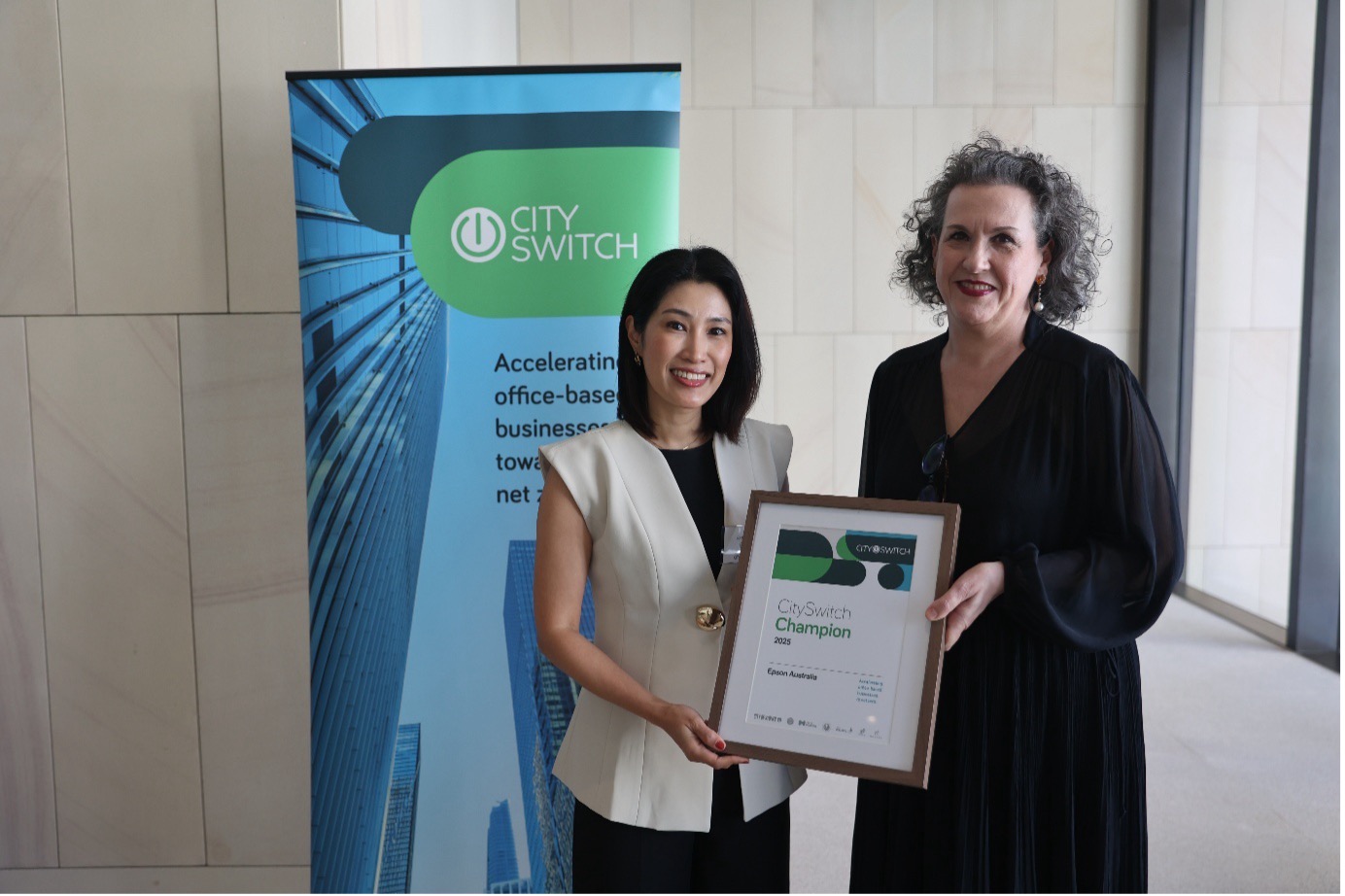
(l-r) Epson Australia’s environment and sustainability manager Fatida Un and North Sydney Mayor Zoë Baker
The CitySwitch Awards celebrate businesses demonstrating genuine progress in areas such as emissions tracking, waste reduction, sustainable procurement and staff engagement.
Epson was formally honoured at the North Sydney Council Champion Lunch with the award presented by North Sydney Mayor Zoë Baker.
This achievement reflects Epson’s sustained commitment to transparency, data-driven carbon reduction and continuous environmental improvement.
CitySwitch is Australia’s flagship decarbonisation program for businesses. Run by council partners and NABERS, the initiative supports office-based organisations to measure, manage and reduce their carbon footprint on the path to net zero emissions.
Since joining CitySwitch as a signatory in 2023, Epson has reported annually on energy use, emissions and waste across its five Australian workplaces and built a robust foundation for long-term carbon management.
Key achievements to date include:
• Transitioning all Australia and New Zealand offices to 100% renewable electricity
• Reducing landfill waste at its primary warehouse facility by more than half compared with FY2023 levels
• Shifting inbound freight from road to rail, cutting logistics-related emissions
• Developing a full Scope 1, 2 and 3 emissions framework, aligning local goals with Epson’s global science-based targets
• Enhancing energy efficiency at its Sydney head office, reducing overall electricity use
• Improving recycling processes across its Sydney offices and the recyclability of consumer product packaging
While continued emissions reduction remains a priority, Epson is equally focused on building robust systems, data quality and organisational capability to support meaningful, long-term progress.
Craig Heckenberg, Managing Director, Epson Australia and New Zealand said, “Being recognised for a third time as a CitySwitch Champion is a valued acknowledgement of the commitment and hard work of our teams across Australia. It reinforces our approach of connecting sustainability to everyday decisions from how we source electricity and manage waste, to how we design systems and ship products. Every improvement brings us closer to a low-carbon future.”
The annual CitySwitch Champions Forum also brings together participants to share practical insights into carbon management. This year, Epson presented on building a practical approach to carbon tracking, drawing from its own journey of “progress over perfection”. This includes:
• Starting with the data already available
• Focusing on key emissions hotspots
• Connecting reduction efforts directly to business priorities
• Maintaining steady momentum through collaboration and knowledge sharing
By applying this pragmatic approach, Epson continues to strengthen its operational sustainability while supporting the company’s broader global target of achieving carbon negativity and underground resource-free status by 2050.
Epson’s recognition as a three-time CitySwitch Champion demonstrates its leadership as an innovation-driven manufacturer that embeds sustainability into products and operations alike.
Through collaborations like CitySwitch, the company continues its commitment to act decisively on its decarbonisation journey.
Learn more about sustainability at Epson Australia here: https://www.epson.com.au/
Founded in 2005, CitySwitch initially focused on office energy efficiency before expanding to help businesses integrate broader sustainability practices — including waste reduction, green procurement and Scope 3 emissions management.
12, May 2026
Kafka Media Group Wins 2026 Communicator Award for Soft-Analytics®
The boutique marketing firm is recognized for its trademarked approach to interpreting marketing and communications impact through human-centered analysis
ORLANDO, FL (May 12) – Kafka Media Group, an integrated marketing firm, has been named a winner in the 32nd Annual Communicator Awards for its proprietary Soft-Analytics® methodology, recognizing the agency’s innovation in modern communications strategy and marketing intelligence.
Presented by the Academy of Interactive & Visual Arts, the Communicator Awards honor excellence and innovation across the communications industry, with thousands of entries submitted annually by agencies, organizations, and brands worldwide.
Soft-Analytics® is Kafka Media Group’s trademarked methodology that combines traditional performance metrics with human insight, strategic interpretation, and contextual analysis to help clients better understand the true impact of their marketing and communications efforts.
“Soft-Analytics® was built around a simple idea: data alone cannot tell the full story,” said Pierce Kafka, CEO & Creative Director of Kafka Media Group. “In a communications landscape increasingly shaped by automation and AI-generated content, interpretation, strategy, and context matter more than ever. This recognition validates the importance of understanding not just what happened in a campaign, but why it mattered.”
Unlike traditional reporting that focuses solely on impressions or mentions, Soft-Analytics® evaluates the context, sentiment, momentum, and strategic value behind media coverage and audience engagement.
Kafka Media Group officially trademarked Soft-Analytics® in 2025 as part of its broader effort to redefine how communications impact is evaluated and interpreted. The methodology has been applied across its integrated marketing and publicity campaigns, helping clients translate visibility into actionable strategic growth.
“This recognition reinforces what we believe the industry is moving toward: smarter measurement, stronger storytelling, and more strategic interpretation of what drives real influence,” Kafka added.
12, May 2026
CBSE Class 12 Result 2026 Likely Today; Students Await Official Announcement !
New Delhi, May 12 (BNP): The Central Board of Secondary Education (CBSE) is expected to announce the Class 12 Board Examination Results 2026 today, creating huge anticipation among lakhs of students and parents across the country. Although the board has not officially confirmed the exact date and time, a recent post by DigiLocker indicating “CBSE Class XII Results 2026 Coming Soon on DigiLocker” has strengthened speculation about today’s declaration.
As per reports, CBSE will not hold any press conference for the result announcement this year. Instead, students will be able to access their results online through multiple official platforms including cbse.gov.in, results.cbse.nic.in, cbseresults.nic.in, DigiLocker, UMANG app, and SMS services.
The CBSE Class 12 examinations were conducted from February 17 to April 10, 2026, in a single shift from 10:30 AM to 1:30 PM across India and at overseas examination centres.
Students are advised to keep their admit cards ready to avoid last-minute inconvenience while checking scores. Candidates can log in using their roll number, school number, admit card ID, and date of birth.
Students who have not yet activated their DigiLocker accounts can do so by visiting the DigiLocker portal, selecting “Get Started,” entering the access code provided by their respective schools, and verifying their mobile number through OTP authentication.
With no official result tab activated yet on cbseresults.nic.in, students continue to refresh official websites eagerly as the expected announcement window approaches.
12, May 2026
Palomar Medical Center Poway Earns an ‘A’ Hospital Safety Grade from The Leapfrog Group
Spring 2026 Safety Grade is a national recognition for commitment to patient safety
ESCONDIDO, CA — May 12, 2026 — Palomar Medical Center Poway earned an “A” Hospital Safety Grade from The Leapfrog Group, an independent national nonprofit watchdog focused on patient safety. Leapfrog assigns an “A,” “B,” “C,” “D” or “F” grade to general hospitals across the country using evidence-based measures of patient safety focused exclusively on errors, accidents, injuries and infections.
“This recognition from The Leapfrog Group underscores the exceptional standard of care our team delivers and affirms our unwavering commitment to patient safety,” said Diane Hansen, President and CEO of Palomar Health. “As we continue to thoughtfully reimagine the healthcare experience, innovation and the well-being of our patients will always be at the heart of everything we do.”
“An ‘A’ Grade is a strong sign that Palomar Medical Center Poway is deeply committed to protecting patients from harm,” said Leah Binder, president and CEO of The Leapfrog Group. “We commend the leadership, board, clinicians, staff and volunteers for the role each played in this distinction.”
The Leapfrog Hospital Safety Grade stands as the only hospital ratings program focused solely on preventable medical errors, infections and injuries that kill more than 500 patients a day in the United States. This program is peer-reviewed, fully transparent and free to the public. Grades are updated twice annually, in the fall and spring.
12, May 2026
Beyond Acute-Phase Support: How “Ibasho” Aids Disaster Mental Health Recovery
Authors propose that rebuilding community, routine, and social roles is essential for long-term recovery after disasters
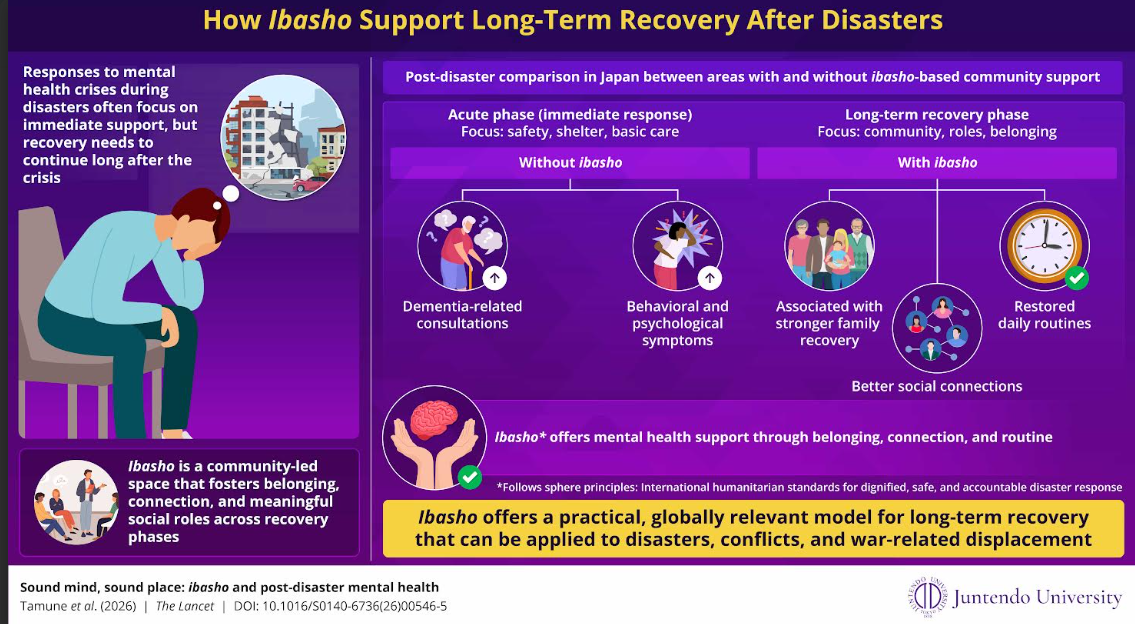
As disasters increasingly disrupt lives through displacement, conflict, and climate-related emergencies, addressing long-term mental health recovery remains a major challenge. A correspondence from Juntendo University discusses that, while acute symptom assessment remains important, disaster psychiatry may benefit from a community-led approach to care. The authors discuss the importance of ibasho (community spaces of belonging and social purpose) and suggest that rebuilding routines, roles, and neighborhood connections may support long-term recovery and resilience.
Natural disasters drastically affect human lives—destroying homes, separating families, leading to disruption of daily routines, which affects their stability. While emergency mental health responses are crucial in the beginning of the crisis, new correspondence discusses that psychological recovery may rely on a more meaningful approach to help restore a sense of place and belonging.
Ibasho: A Community-led Place for Belonging and Meaning
In this context, authors from Juntendo University, Japan, led by Associate Professor Hidetaka Tamune from the Department of Psychiatry and Behavioral Science, along with Dr. Yutaka Igarashi from Nippon Medical School, Japan, and Dr. Yuzuru Kawashima from the Disaster Psychiatric Assistance Team, Japan, discussed the approach of ibasho (a community-building concept in Japan) for people affected by disasters. The details were made available online on April 3, 2026, and published in Volume 407, Issue 10537 of The Lancet journal on April 11, 2026.
Dr. Tamune says, “Disaster recovery is not only about reducing acute psychiatric symptoms. It is also about restoring the social environments that give people stability, dignity, and a sense of purpose. In Japanese, the places that make this possible are called ibasho.”
Ibasho means a place of belonging where people are engaged in social networks, routines, and meaningful roles. The authors suggested that restoring this sense of connection among people affected by disasters may be just as important as detecting early symptoms, as it plays a vital role in supporting community recovery. Supporting this, the correspondence places ibasho within the internationally recognized Sphere humanitarian framework, which focuses on survival with dignity, continuity with care, and coordinated support systems during crises. It also suggests that ibasho aligns closely with those principles by offering social infrastructure for displaced and affected communities.
Ibasho in Japan: Community-Led Recovery in Practice
Compared to conventional interventions, ibasho refers to safe, community-led spaces where individuals can reconnect with others and resume daily routines. This may include neighborhood gathering spaces, shared community programs, and locally led recovery hubs. To support this perspective, the authors cited the evidence from disaster-affected regions in Japan. These include examples from the 2011 Great East Japan Earthquake and the Fukushima nuclear accident. Notably, there was an increase in the dementia consultations and behavioral and psychological symptoms of dementia (BPSD) among older adults near the evacuation zones of the affected areas. In contrast, the communities where older residents were helped by leading ibasho-style programs reported stronger recovery and more stable routines with improved social and family relationships. This suggests that recovery improved when people were able to regain meaningful roles in community life. The older adults not only receive support but are also actively contributing to the recovery efforts and rebuilding community life.
“What appears to be most important is not simply access to services, but whether people can reclaim their place within the community and continue to feel valued, useful, and connected. In Japan, a disaster-prone and super-aged society, we have both the experience and the responsibility to share what we have learned about caring for older adults with dementia, especially those who develop BPSD and delirium,” explains Dr. Tamune.
Redefining Recovery Through Connection, Culture, and Dignity
Although particularly relevant to natural disasters, the correspondence suggests that preparedness and recovery both depend not only on services but also on whether people can remain connected to local networks, routines, and meaningful social roles. The authors further note that trauma-informed support should remain culturally congruent; in some communities, restoring routines, roles, and communal life through ibasho may be the most acceptable first step.
Overall, the correspondence highlights the importance of ibasho in post-disaster mental health. It suggests that, although acute symptom detection matters, recovery also depends on whether people can continue to live safely, sustain relationships, and regain meaningful roles after displacement. In this sense, ibasho may function as a culturally congruent local social infrastructure through which dignity, continuity, and safety are restored in everyday life.
11, May 2026
Ualett Launches “Ualett Rewards” to Give Back to Gig Workers
WILMINGTON, Del. —May 11, 2026 — Ualett, the leading financial technology platform serving gig workers, announced the launch of Ualett Rewards, a new loyalty program designed to recognize and reward clients for their engagement and financial activity.
With Ualett Rewards, clients can turn everyday interactions into real financial benefits through GigPoints, redeemable for remittance savings and digital rewards. The program deepens Ualett’s commitment to helping independent workers build more flexible, resilient financial lives while making the in-app experience more engaging and valuable over time.
“Gig workers are constantly balancing tight schedules, rising costs, and unpredictable income,” said Ricky Michel Presbot, Co-Founder and CEO of Ualett. “Ualett Rewards is our way of saying thank you to the workers who trust us every day. By turning routine actions into meaningful rewards, we’re helping clients get more value from every interaction with Ualett.”
Ualett Rewards will officially launch today, and all eligible clients can access the program directly through the Ualett app.
How Ualett Rewards Works
Through Ualett Rewards, clients earn GigPoints for simple, everyday actions in the app, including:
-
Client referrals: Points are awarded when a referred user successfully enrolls.
-
In-app gaming experiences: Points can be earned by participating in interactive features and experiences within the Ualett app.
Accumulated GigPoints are tracked over time and can be redeemed for tangible benefits, such as:
-
Savings on remittances, helping clients keep more of what they earn on eligible transactions.
-
Eligible digital rewards, including select gift cards and other digital benefits.
As Ualett scales its platform, the company is focused on ensuring that its most engaged clients share directly in the value they help create. Ualett Rewards is designed to feel intuitive and fair: clients earn points for the actions they’re already taking and can clearly see how those points convert into real, usable financial benefits over time.
By integrating rewards into everyday app interactions, Ualett is strengthening its role as a long-term financial ally for gig workers—providing not just access to fast, flexible capital, but also ongoing incentives that support smarter financial decisions and deeper engagement.
11, May 2026
COMAU and OMRON Robotics Partner to Advance Industrial Automation Worldwide
Turin, Italy and Pleasanton, California, USA – May 11, 2026 – COMAU and OMRON Robotics (Omron) have entered into a strategic collaboration agreement to accelerate the global adoption of advanced industrial automation solutions. The partnership will focus on fast-growing industries including electronics, semiconductors, medical manufacturing, and light industrial intralogistics, where demand continues to rise for flexible and easily deployable automation technologies.
The collaboration is designed to address increasing customer demand for scalable, adaptable automation systems that integrate efficiently with both existing production lines and next-generation manufacturing environments. By combining their complementary technologies, product portfolios, and industry expertise, COMAU and Omron aim to expand access to advanced automation solutions for manufacturers worldwide.
The companies also see the agreement as a foundation for future joint initiatives. By integrating robotics hardware, intelligent control systems, and software-driven automation, the partnership aims to help manufacturers improve operational efficiency, increase flexibility, and enhance overall production performance across a wide range of industrial applications.
“This initiative reflects our strategy to strengthen Comau’s solution portfolio through high-value partnerships,” said Pietro Gorlier, CEO of COMAU. “Omron is a strong strategic fit because we share a common vision centered on innovation and customer value. By combining Comau’s robotics expertise with Omron’s advanced technologies and software capabilities, we can deliver automation solutions that are easier to implement, highly adaptable, and ready to support future manufacturing needs. This collaboration also reinforces our position in high-growth industries and emerging markets, helping customers manage increasing industrial complexity with safe, reliable, and scalable automation.”
“By bringing together two highly complementary portfolios, this collaboration creates new opportunities for manufacturers seeking greater agility and efficiency,” said Olivier Welker, CEO of OMRON Robotics. “Combining our strengths in robotics, intelligent automation, advanced control, and application expertise will help customers respond more quickly to evolving market requirements. Together, we aim to deliver flexible, connected, and sustainable production systems that support long-term growth.”
11, May 2026
Numeros Motors Co-Powers The Walkathon 2026, Driving Community Action for Education Access in Bengaluru

Bengaluru, May 11: Bengaluru came together in large numbers on Sunday morning for ‘The Walkathon 2026’, a community initiative dedicated to health, fitness, and literacy. Hosted by 93.5 Red FM in association with o9 Solutions and co-powered by Numeros Motors, the event saw students, corporates, fitness enthusiasts, and families walking to support quality education through AI-powered learning tools.
The event took place on Sunday, 10 May 2026, at St. Joseph’s Indian Institution Grounds, Bengaluru, with as many as 3,500 participants from across the city. Olympic medalist Saina Nehwal graced the occasion as Chief Guest, inspiring participants and amplifying the message of collective action and social responsibility.
As a co-powering partner, Numeros Motors led the Walkathon with its electric two-wheelers, Numeros n-First and Numeros Diplos, highlighting the brand’s focus on smart, durable, and purpose-driven mobility solutions.
“At Numeros Motors, we strongly believe that brands have a responsibility to contribute meaningfully beyond business. The walkathon demonstrates how community participation can translate into tangible social impact. We are proud to support an event that unites people for a purpose greater than themselves while promoting sustainable mobility,” said a spokesperson from the Bengaluru-based EV company.
Through such collaborations, Numeros Motors continues to strengthen its commitment towards sustainability, responsible mobility, and initiatives that create lasting positive impact on the ground.


