


6, May 2026
MathCo Collaborates with Google Cloud to Help Enterprises Adopt Workflow-Native AI on Gemini Enterprise

- 0
- By Neel Achary

6, May 2026
The Crimson Crown by Edith Layton now available from Histria Books
Histria Books is pleased to announce the release of The Crimson Crown by Edith Layton. This novel is published by Histria Romance, an imprint of Histria Books dedicated to outstanding books in the romance genre.
Set against the paranoid early years of Henry VII’s reign, The Crimson Crown follows Lucas Lovat, an exiled spy summoned back to a cold, unfamiliar England to investigate the royal pretender Perkin Warbeck. But what sounds like a traditional Tudor thriller actually reads like a claustrophobic psychological mystery where the locked room is the royal court itself. Edith Layton strips away the usual pageantry to expose the sheer exhaustion of surviving a regime built entirely on surveillance. Lucas is a brilliantly realized lead. He is cynical, deeply observant, and distinctly unheroic in his ambitions. The novel feels startlingly modern in its exploration of espionage, performative loyalty, and the emotional toll of political manipulation.

Readers hungry for historical fiction that prioritizes sharp dialogue and moral ambiguity over battlefield glory will find a refreshing, intensely atmospheric, and razor-sharp story that breathes genuine life into a famously treacherous era.
Edith Layton (1938-2009) began her career as a freelance journalist before publishing her debut novel, The Duke’s Wager. She went on to write over 30 novels, winning numerous accolades including the Romantic Times Award for Best New Regency Author. Today, her classic backlist is being brought back to a new generation of readers, along with several never-before-published works.
The Crimson Crown by Edith Layton, 360 pp., ISBN 978-1-59211-721-5 is available at HistriaBooks.com and from all major book retailers. This title is available as print on demand through Simon & Schuster. This title is also available as an eBook. For information on publishing with Histria Books, please visit HistriaBooks.com or contact us at info@histriabooks.com.
Histria Books
7181 N. Hualapai Way, Suite 130-86, Las Vegas, NV 89166 USA
HistriaBooks.com
(561) 299-0802
6, May 2026
The Broken Fence by James J. Antonio now available from Histria Books
Histria Books is pleased to announce the release of The Broken Fence by James J. Antonio. This story is published by Histria Kids, an imprint of Histria Books dedicated to outstanding works for children that both educate and entertain.
The Broken Fence follows a ten-year-old boy who inherits an unexpected foal on his grandfather’s thoroughbred farm, tracing their years-long journey from the birthing stall to the starting gates of a high-stakes race. But rather than leaning on the familiar beats of a sports triumph, James J. Antonio’s novel strips away the glamour of the track to focus on the dirt, sweat, and quiet patience of raising a difficult animal.

In a culture obsessed with instant gratification, this book offers a vital retreat into the slow, deliberate rhythm of barn life and intergenerational mentorship. The author writes with an unsentimental precision that captures the tactile reality of mucking stalls and the genuine frustrations of training an anti-social filly. It is a story about the unglamorous daily work of nurturing potential. Readers looking for a grounded, deeply felt exploration of discipline and animal connection will find something remarkably anchoring here.
James J. Antonio, a former French teacher and produce business manager, is now retired and dedicated to his passion for storytelling. Known for his works on numismatics, James has published numerous stories in Canadian coin publications, including the CNA Journal and the Ontario Numismatic Association Journal. His story “Miss Daisy” received an Editor’s Choice Award in Winning Ways, the journal of the Ohio State Numismatic Association. He is the author of Roads Here and There (two novellas in one book) and Stories for Coin Collectors and Everyone, both available on Amazon.
The Broken Fence by James J. Antonio, 114 pp., ISBN 978-1-59211-599-0 is available at HistriaBooks.com and from all major book retailers. This title is also available as an eBook. Titles published under the imprints of Histria Books are distributed in the United States and Canada by Simon & Schuster and in the rest of the world through Unified Book Distribution. For information on publishing with Histria Books, please visit HistriaBooks.com or contact us at info@histriabooks.com.
Histria Books
7181 N. Hualapai Way, Suite 130-86, Las Vegas, NV 89166 USA
HistriaBooks.com
(561) 299-0802
6, May 2026
The Seekers by Jack Bartley now available from Histria Books
Histria Books is pleased to announce the release of The Seekers by Jack Bartley, the second volume in the Hilo Dome series. This book is published by Histria YA, an imprint of Histria Books dedicated to outstanding works for teens and young adults.
The Seekers takes the framework of a post-apocalyptic survival story and roots it entirely in Hawaiian mythology and Polynesian wayfinding. Generations after a devastating global war, isolated communities on the Big Island must set aside bitter rivalries when the volcano goddess Pele awakens. To escape impending lava flows, a small crew builds a traditional double-hulled sailing canoe to chart a course into the unknown Pacific.

Jack Bartley’s second Hilo Dome novel trades standard dystopian action for a focus on cultural reclamation. The true tension comes not just from navigating a ruined world, but from the painstaking effort of relearning lost ancestral skills. The book asks what happens when a community must resurrect ancient traditions to save its future. It is a localized, community-driven approach to the end of the world that feels vital for readers tired of lone-wolf survival tropes.
Praise for The Seekers:
“The Seekers: Hilo Dome by Jack Bartley is a brilliant, nail-biting adventure that is full of action. It is one of the rare gems that take place on the water, where explorers must navigate uncharted territory to survive. It will appeal to anyone who enjoys an adventure full of suspense, thrills, and the awe of discovery.” — Readers’ Favorite
Jack Bartley is a U.S. Navy veteran, retired University of Delaware ecology professor, and the author of several books, including the 2025 naval memoir Smoke on the Water (Koehler Books) and the young adult series Hilo Dome (Histria Books). His extensive time spent in Hawaiʻi, both during his military service and while leading academic ecology expeditions, heavily influences his writing. Also an accomplished musician and former newspaper columnist, Jack now lives in Ocean View, Delaware, where he focuses on writing, music, and environmental volunteer work.
The Seekers by Jack Bartley, 214 pp., ISBN 978-1-59211-733-8, is available at HistriaBooks.com and from all major book retailers. This title is also available as an ebook. Titles published under the imprints of Histria Books are distributed in the United States and Canada by Simon & Schuster and in the rest of the world through Unified Book Distribution. For information on publishing with Histria Books, please visit HistriaBooks.com or contact us at info@histriabooks.com.
Histria Books
7181 N. Hualapai Way, Suite 130-86, Las Vegas, NV 89166 USA
HistriaBooks.com
(561) 299-0802
6, May 2026
Broomsedge Golf Club Entrusts KemperSports to Manage Club
Industry-leading management firm to oversee operations as Broomsedge expands hospitality and club activity
NORTHBROOK, IL. — May 6, 2026 — KemperSports, a leading golf, sports and hospitality experience company is excited to announce it has been selected to manage Broomsedge Golf Club – bringing together one of the game’s most respected and passionate operators with one of the country’s most distinctive modern golf destinations.
Located in the sandhills of central South Carolina, Broomsedge Golf Club has quickly earned recognition for its thoughtful design, understated luxury, and commitment to delivering an exceptional golf experience rooted in the tradition of the great clubs of British Isles. Under KemperSports management, Broomsedge will incorporate the company’s expertise in club operations, agronomy, guest experience, food and beverage, and strategic planning as the club elevates its hospitality experience with the construction of 4 Bedroom cottages for members and guests and a food and beverage venue overlooking the golf course.
“The people at KemperSports are smart and driven – exactly what we need to build around the incredible golf course that Mike Koprowski and Kyle Franz crafted here,” said Broomsedge Golf Club managing partner and CEO Baker Thompson. “Their relationships, industry knowledge, and operational excellence – along with a deep understanding of private club culture – make them the ideal partner as we extend the vision for Broomsedge.”
The club recently announced that developer Baker Thompson has stepped into the role of managing partner and CEO, Michael Keiser, Jr. serving as a senior advisor.
KemperSports manages a portfolio of highly regarded golf destinations, private clubs, and resorts across the country, with a proven track record of enhancing member satisfaction, cultivating high-performing teams and delivering long-term value for ownership groups.
“We are honored to partner with Broomsedge Golf Club and work along Baker Thompson and the development team to help bring their bold vision to life,” said KemperSports CEO Steve Skinner. “Broomsedge provides an authentic, high-quality golf experience. We appreciate that, and we are eager to work with the club team to create value for ownership, members, and guests.”
6, May 2026
Synology® officially introduces AI Advisor for accurate, reliable information discovery
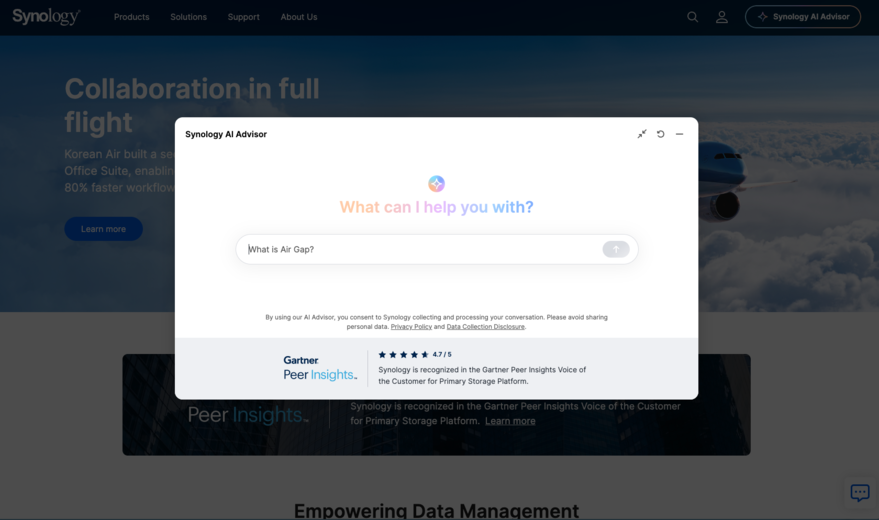
Taipei, Taiwan — May 6, 2026 Synology today officially introduces AI Advisor, an intelligent assistant designed to simplify information discovery. By delivering accurate, localized technical guidance directly on Synology’s website, the AI Advisor ensures reliable insights while significantly reducing resolution time for users worldwide.
“AI Advisor integrates over a decade of Synology’s AI expertise,” said Steven Liang, Manager of the Generative AI Application Group at Synology. “With an agent-as-tool design, dynamic knowledge injection, context optimization, and a continuous evaluation pipeline, AI Advisor delivers accurate, high-quality responses and continuously refines itself. These innovations will extend across Synology product lineup, advancing our vision of secure, intuitive solutions.
Self-hosted ecosystem to ensure AI sovereignty
Prioritizing customer privacy, the AI Advisor utilizes a self-hosted LLM that operates entirely independent of third-party AI providers, ensuring no context is shared externally. Moving toward complete data sovereignty, the service will transition to a dedicated Synology infrastructure later in 2026, guaranteeing 100% data residency and keeping all user interactions within a secure, sovereign ecosystem.
Streamlined navigation from inquiry to implementation
AI Advisor integrates with Synology’s NAS Selector and NVR Selector tools. Users are guided through preliminary sizing and product recommendation workflows tailored to their deployment needs, enabling faster and more informed early-stage purchasing decisions. By understanding the intent and context of each query, the Advisor further streamlines the journey by directing users to relevant support articles, downloads, or configuration guides to ensure a fast transition from question to solution.
Accessibility and Availability
Alongside the introduction of AI Advisor, this website update brings support for global web accessibility standards, ensuring an inclusive and user-friendly experience for audiences worldwide.
The Synology Website AI Advisor is available now on Synology’s official website. To learn more about Synology’s AI-driven services and experience the new Advisor, visit Synology’s official website. www.synology.com
5, May 2026
ITS America Conference & Expo 2026 Offers More Outdoor Demonstration Experiences Than Ever Before
DETROIT, Mich. (May 5, 2026) — ITS America Conference & Expo, organized in partnership by RX Global and ITS America, introduces an expanded demonstration program for the 2026 ITS America Conference & Expo, taking place June 9-11 in Detroit, Michigan. Attendees will see firsthand how the newest technologies installed along roadways and within vehicles are making transportation in Detroit safer and more efficient. The program marks a significant leap beyond traditional outdoor demonstrations, delivering hands-on, immersive experiences that connect attendees with the latest intelligent transportation technologies in real-world conditions.
The Michigan Department of Transportation (Michigan DOT) is spearheading the ITS America Conference & Expo’s outdoor demonstration experiences, sponsored by Integral Blue, under the theme “Everyday Interoperability,” showcasing how everyday people benefit from a seamless ecosystem of emerging technologies. The 2026 program features a record number of demonstration participants, a milestone that reflects growing industry momentum and commitment to advancing intelligent transportation solutions.
“Michigan Department of Transportation is proud to showcase the State of Michigan as a living laboratory for next‑generation transportation,” said Michele Mueller, Manager Connected, Automated, Electrification at the Michigan Department of Transportation. “By demonstrating emerging innovations in active corridors, we provide the ITS community with a rare opportunity to experience how integrated, data-driven mobility solutions are shaping a safer, smarter, and more efficient mobility ecosystem.”
What makes this year’s ITS America Conference & Expo’s demonstration program truly distinctive is that attendees will experience the technology in transit to see how it works in real time.
-
The I-94 Freeway Experience spans a 45-mile route between downtown Detroit and Ann Arbor, featuring work zone warnings, road hazard alerts, and emergency vehicle applications delivered through advanced roadside sensors, dedicated communication units, and vehicle-to-network (V2N) cellular connectivity.
-
The M-1 Intelligent Woodward Experience runs four miles along 31 vehicle-to-everything (V2X)-equipped intersections between Huntington Place and the Electreon Inductive Charging Tour at the Henry Ford Health Center, deploying autonomous vehicle (AV) shuttles to demonstrate intersection-based mobility and safety services.
-
The Everyday Downtown Experience extends V2N applications throughout downtown Detroit, connecting AV shuttles, pedestrians, and micromobility users through a dedicated smartphone app that functions as a personal on-board unit for collision avoidance and vulnerable road user alerts.
-
Anchoring the broader program is ITS America Conference & Expo’s Emergency Response Tech & Demo Day, scheduled for Thursday, June 11, from 10 a.m. to 6:30 p.m. in the Outdoor Demonstration Area. Brought to life by GFT Infrastructure Inc. and Michigan DOT, this immersive event spotlights infrastructure-based V2X communications for incident scene warnings, drone delivery integration for emergency operations, and an autonomous freight vehicle available for up-close technical exploration. Attendees will engage directly with practitioners and technology specialists throughout the day.
The Outdoor Demonstration Area, located directly outside Huntington Place’s Hall B entrance, features live product demonstrations from leading industry innovators including Brandmotion, showcasing its SmartHUD Digital Vehicle Alert System; Haas Alert, demonstrating networked V2X safety solutions; Integrity Security Services LLC; Miovision Technologies, presenting connected vehicle capabilities; PrePass Safety Alliance; and Ver-mac. Each company will give attendees direct access to hands-on evaluation of new solutions and one-on-one time with the experts driving these developments.
The expanded program includes curated small-group visits to Newlab, Detroit’s premier innovation center, where startups and emerging technologies are advancing the future of mobility. Attendees will also tour The Detroit Smart Parking Lab (DSPL), where live demonstrations from participating companies highlight EV charging, autonomous systems, robotics, and drone operations. An ADASTEC autonomous shuttle will transport attendees between event venues, the Smart Parking Lab, and Newlab. Tours run multiple times throughout the event and are limited to 15 participants per session. More information about demonstrations will be added to the website in the coming weeks.
“The demonstration experience program is what makes this event so distinct, and this year, we can truly say we are doing something new,” said Laura Chace, President and CEO of the Intelligent Transportation Society of America. “With a record number of demo participants and a reimagined experiential program, attendees will engage with technologies not just on the show floor, but out in the real world where they are making impact in our transportation systems.”
The demonstration program is sponsored by Integral Blue and powered by Michigan DOT. For more information on demonstrations and the full event experience, visit www.itsamericaevents.com/expo/
5, May 2026
Tech Startup Launches Tool Built to Catch AI Hallucinations in Legal Citations
CiteSentinel Helps Lawyers File Faster While Avoiding Sanctions and Embarrassment
LOS ANGELES, May 5, 2026 — Legal tech startup BrentWorks Inc. launched CiteSentinel, among the first dedicated platforms built specifically to detect and prevent AI hallucinations in legal citations. The tool scans legal documents and flags case law, statutes, and legal authorities that may be fabricated, misstated, or otherwise erroneous, before they reach a judge.
Courts across the country are increasingly sanctioning attorneys who submit briefs containing invented case citations, a well-documented byproduct of generative AI drafting tools that produce authoritative-sounding, but entirely fictional, legal authority. CiteSentinel was designed to close that verification gap, giving attorneys a fast and easy way to confirm that every citation in a filing corresponds to a real case, a real statute, and a real legal authority.
“The legal profession is learning, in very public ways, that AI doesn’t just make mistakes, it confidently lies to your face,” said BrentWorks co-founder Brent Britton. “CiteSentinel is about restoring trust. It lets lawyers move fast with the irresistible efficiencies of generative AI while still filing documents reciting authorities they can stand behind. It also enables them to scan opposing counsel’s documents, giving them a competitive edge in the courtroom.”
Many attorneys who do not personally use AI to draft documents are discovering they have a problem anyway. Opposing counsel may have used AI. Co-counsel may have. Contract attorneys and paralegals almost certainly have access to it and may be using it
without disclosing that fact. When a brief containing fabricated citations reaches the court, the question of who drafted it quickly becomes secondary to the question of whose name is on it.
CiteSentinel lets attorneys scan any document, their own, a colleague’s, or an adversary’s, for citation errors before those errors become their problem. Attorneys who review opposing counsel’s filings with CiteSentinel gain an additional advantage: the ability to identify and challenge citations to authorities that simply do not exist.
Today, a lawyer’s supervisory obligation includes a question that would have seemed absurd just a few short years ago: Are the cases cited in this brief real or imaginary?
Senior lawyers cannot personally verify every citation in every document produced by everyone under their supervision. CiteSentinel can. At a cost that is modest compared to a single sanctions proceeding or the reputational damage that comes with public embarrassment before a court, CiteSentinel is among the most cost-effective risk management tools available to any law firm, legal department, or solo practice today.
Unlike traditional research platforms that focus on finding more information, CiteSentinel focuses on confirming the law cited in a document is real. Attorneys can scan:
· Their own AI-assisted drafts, before filing
· Submissions from co-counsel, contract attorneys, and support staff
· Opposing counsel’s filings, for strategic advantage
· Any document where citation accuracy carries professional or ethical weight
Like a reality check for legal briefs, the tool flags citations that may be hallucinated, misstated, or inaccurately referenced, allowing lawyers to correct errors before courts, clients, or competitors discover them first.
Under mounting deadline pressure, many attorneys now rely on AI-generated research, but verification has not kept pace. CiteSentinel addresses that verification gap head-on, helping lawyers practice faster, more accurately, and with the confidence that their work reflects reality.
BrentWorks was founded by Brent Britton, a veteran technology attorney and MIT-trained engineer, and Brent Hunter, a longtime technologist and AI pioneer. CiteSentinel is the first in a series of products the company will be releasing to elevate the practice of law in the age of AI.
BRENT C.J. BRITTON/CEO
Brent Britton is what happens when law school meets the MIT Media Lab. A veteran engineer, technology attorney licensed in three states (California, New York and Florida), and entrepreneur who literally wrote the book on IP law, Britton has spent his career guiding creators and companies at the frontier of innovation, overseeing billions of dollars of aggregate deal flow in the process. The culmination of his life is re-engineering legal tools to think faster, decide better, and serve humanity at the speed of innovation.
BRENT N. HUNTER/PRESIDENT AND CIO
Brent N. Hunter is a technology pioneer who applied neural networks to finance in 1993. He has since led multimillion-dollar transformation programs for Fortune 500 giants, including GE, Wells Fargo, Disney, and Warner Bros. Discovery. An author, technologist, and systems thinker, he fuses psychology, technology, and leadership into a single mission: to build intelligent systems that serve humanity.
5, May 2026
GMEX Robotics Receives First Deployment Order for Bon Vivant 3.0 Cooking Robot Machines
GMEX Robotics Corporation (NASDAQ: GMEX) (“GMEX Robotics” or the “Company”), a developer of AI-powered robotic technologies, today announced it has received its first deployment order under its previously disclosed AU$4.2 million agreement with a leading Australian hospitality food and beverage group.
The initial purchase order includes multiple Bon Vivant 3.0 automated cooking systems, representing approximately AU$504,000 in value. Delivery of the systems is expected to be completed prior to June 30, 2026.
The order represents the first phase of execution under the purchase agreement announced on March 23, 2026, which provides for the planned deployment of at least 50 intelligent kitchen robotics systems, including Bon Vivant 3.0 and Max models, across the customer’s network of hospitality venues throughout Australia. The identity of the customer remains undisclosed; however, it is the same leading Australian food and beverage group referenced in the Company’s March 23, 2026 announcement.
“This initial deployment order marks an important milestone in the transition from commercial agreement to active deployment,” said Sam Lu, Chief Executive Officer of GMEX Robotics. “We are now executing on our first large-scale hospitality contract, bringing Bon Vivant 3.0 systems into real-world kitchen environments and demonstrating the operational value of our technology.”
GMEX Robotic’ Bon Vivant 3.0 platform integrates AI-driven control systems, advanced sensors, and programmable cooking workflows to support professional kitchen environments. The system is designed to reduce labor intensity, improve consistency, and enable scalable food preparation across multiple locations.
This deployment represents the first phase of execution under GMEX Robotics’ previously announced agreement and is expected to serve as a foundation for broader rollout activities across the customer’s network as GMEX Robotics advances the commercialization of its intelligent culinary robotics platform.
5, May 2026
Gujarat’s i-Hub empowers entrepreneurs, from eco-friendly firefighting solutions to superfoods for kids!
Gandhinagar, May 5 (BNP): Gujarat’s i-Hub initiative is playing a transformative role in nurturing innovation and supporting entrepreneurs across diverse sectors, ranging from sustainable firefighting technologies to nutritious superfood products for children.

Backed by a robust policy framework and institutional support, the initiative has enabled startups to develop practical, scalable solutions addressing real-world challenges. Entrepreneurs associated with i-Hub are increasingly focusing on sustainability, health, and technology-driven innovation, contributing to both economic growth and social impact.
Prime Minister Narendra Modi has laid a strong foundation for India’s startup ecosystem by consistently promoting entrepreneurship and innovation. His vision has significantly contributed to Gujarat’s emergence as a leading hub of enterprise and technological advancement.
Officials highlighted that i-Hub provides critical support including mentorship, funding access, incubation, and industry collaboration, helping startups move from ideation to execution. The initiative is also fostering a culture of innovation among youth, encouraging them to pursue entrepreneurial ventures.
With continued support from the government and industry stakeholders, Gujarat is poised to strengthen its position as a key driver of India’s startup ecosystem, creating opportunities and solutions that resonate both nationally and globally.


