


9, Nov 2026
Consello Strengthens Ireland Team with Managing Director Appointments
NEW YORK, Nov. 9, 2026 /PRNewswire/ — Consello, the leading global advisory and investing platform, today announced the appointment of Niamh Garvey and Peter Davis as Managing Directors in its Dublin office to strengthen the firm’s CEO advisory capabilities in Ireland. Garvey and Davis bring expertise in strategic communications, public policy, transactions, and capital markets to the firm.

Garvey has spent more than 25 years advising CEOs and boards, both internationally and locally, through complex reputational, regulatory and policy issues. She has held senior leadership roles in London and Dublin and led global mandates on issues central to long-term growth and enterprise value, with deep expertise in healthcare. Davis has nearly two decades of experience in public company advisory, mergers and acquisitions, and equity capital markets. He has held corporate finance and investment banking roles at KPMG, Citi and Deutsche Bank, supporting global equity capital markets and M&A.
Consello Founder, Chairman and CEO Declan Kelly said, “Niamh and Peter bring exceptional, complementary skill sets that further strengthen Consello’s ability to support clients in Ireland and across our global platform. As our presence and client needs continue to grow, these leaders will help us even better support the leaders on the ground navigating complex regulatory and capital-markets decisions.”
About Consello
Consello is an Advisory and Investing Platform with offices in New York, Miami, Atlanta, Dublin, Belfast, London, Brussels, and Abu Dhabi.
Consello’s distinct advisory practices provide the complete strategic counsel today’s leaders need to grow and transform their organizations. Consello’s advisory expertise spans Corporate Advisory; M&A; Management Consulting; Talent; Sports and Entertainment; Strategic Communications; Geopolitics; and Risk. Dedicated teams operate in each practice, led by a leadership group with deep operational experience across industries, business growth stages and market cycles and with an expansive set of global corporate relationships.
Consello’s investment business, Consello Capital, identifies high-potential mid-market companies and invests capital and expertise to transform their growth.
Consello Media Inquiries
media@consello.com
 View original content to download multimedia:https://www.prnewswire.co.uk/news-releases/consello-strengthens-ireland-team-with-managing-director-appointments-302933359.html

- 0
- By PRNewswire

9, Nov 2026
Dubai Future Finance Week concludes with global institutions, regulators and innovators setting the agenda for the future of finance
DUBAI, UAE, Nov. 9, 2026 /PRNewswire/ — The inaugural Dubai Future Finance Week concluded on 6 November, bringing together financial institutions, regulators and innovators alongside 1,000 speakers across 85 side events, 13 signature forums and 16 stages in Dubai. Led by Dubai International Financial Centre (DIFC), the leading global financial centre in the Middle East, Africa and South Asia (MEASA) region, the week delivered more than 80 partnerships and more than 100 strategic announcements, establishing an annual meeting point for the global financial industry and advancing the Dubai Economic Agenda D33 goal of positioning the city among the world’s top four financial centres.

Held under the overarching theme of “Finance Reimagined: Where Innovation Meets Policy and Purpose,” the week included the Dubai FinTech Summit as the anchor event, alongside the Future Sustainability Forum, the Future Islamic Finance Forum, the Dubai Family Wealth Summit, the Future Tokenisation Forum, IPEM Future Dubai, the Capital Exchange GP-LP Programme, the Investment Leaders Exchange, GAIP InsureTek Middle East, the MENA Banking Excellence Awards and the DealCatalyst Fixed Income Alternatives series.
DIFC confirmed that it is now home to more than 2,000 AI, FinTech and innovation companies and a wealth and asset management community surpassing 600 firms.
DIFC announced plans to launch the Dubai FinTech Stack, an initiative designed to give founders access to the essential capabilities needed to establish, operate and scale their businesses, from customer onboarding and payments to risk management, financial security and AI integration.
Additionally, DIFC Academy will expand by tenfold to 370,000 sq. ft. within DIFC Zabeel District, transforming into a purpose-built academic campus with capacity for 50,000 learners annually from 2030.
To develop the next generation of family-enterprise leaders, DIFC announced a 2027 NextGen Internship Programme under the Dubai Family Wealth Centre, placing participants within DIFC firms.
The DIFC Innovation Hub also announced plans to establish the Islamic Finance Innovation Centre, which will serve as a collaborative, global platform connecting financial institutions with regulators, Shariah scholars, standards bodies, FinTechs and technology companies.
Ignyte, Dubai’s official start-up ecosystem platform operating under DIFC signed several partnerships to develop market-ready solutions, advance Web3 innovation and offer access to banking services for associated start-ups and founders.
In 2027, Dubai Future Finance Week will return for its second edition in May 2027.

 View original content to download multimedia:https://www.prnewswire.co.uk/news-releases/dubai-future-finance-week-concludes-with-global-institutions-regulators-and-innovators-setting-the-agenda-for-the-future-of-finance-302933430.html

9, Nov 2026
Bybit RWA Earn Expands On-Chain Access to JPE, a Japanese High-Dividend Equity Strategy Managed by SBI Asset Management
DUBAI, UAE, Nov. 9, 2026 /PRNewswire/ — Bybit, the New Financial Platform trusted by more than 80 million users worldwide, is excited to add JPE, a Plume product backed by JX, to Bybit RWA Earn, the first equity product on the platform, broadening user access beyond fixed-income strategies into the dynamic Japanese equity markets. The underlying fund exposure is managed by SBI Asset Management Co., Ltd. (SBI AM).
The underlying JX token is issued by DigiFT, a digital asset exchange for institutional-grade real-world assets. JX is designed to provide accredited or institutional investors with on-chain exposure to a Japanese High Dividend Equity Fund Strategy managed by SBI AM which is a subsidiary of SBI Global Asset Management Co., Ltd.
The underlying JX token is issued on Ethereum. Plume, the Open Finance platform for institutional assets, provides the JPE wrapper offered through Bybit RWA Earn. Subscriptions and redemptions through Bybit are denominated in USDC, with a minimum subscription of 5,000 USDC. All on-chain gas fees are covered by Bybit, and subscribers enjoy zero subscription and redemption fees, and a T+5 settlement cycle (excluding non-trading days in Japan, Singapore, and the United States).
“Ecosystem synergy is crucial in the new era of real-world asset tokenization. Bybit is excited to bring on-chain access to another world-class traditional asset to our users, with Plume and DigiFT delivering institutional-grade infrastructure. The quality of the underlying strategy and the caliber of our partners reflect the standard of access our users deserve,” said Emily Bao, Head of Spot & Assets at Bybit.
“Our focus at Plume is taking institutional grade assets across borders and putting them to work onchain. JX is the first time a Japanese asset manager’s listed-equity strategy has come onchain through regulated infrastructure, and it’s the kind of bridge that moves onchain finance beyond crypto-native assets to the strategies that shape global portfolios,” said Ryan Wen, Chief Operating Officer of Plume.
“Our collaboration with Plume demonstrates how tokenization can connect financial markets with the digital asset ecosystem. We’re pleased to support Plume in this initiative with Bybit and look forward to exploring further opportunities together,” said Henry Zhang, Founder and Group CEO of DigiFT.
A New Asset Class for RWA Earn
Bybit RWA Earn has redefined on-chain access to traditional markets for everyday investors diversifying into global opportunities since the platform went live in June 2026. The unique platform removes barriers to entry to institutional-grade tokenized products across fixed-income and credit strategies for eligible Bybit users.
With JPE, Bybit RWA Earn now extends into equity markets for the first time, offering users indirect exposure to Japanese equities through a professionally managed fund with a disciplined investment approach.

Terms and conditions apply. For restricted regions, eligibility criteria, detailed product information and yield mechanisms, and other requirements, users may visit: Bybit RWA Earn Introduces JPE: Access SBI’s Japanese High-Dividend Equity Strategy
Disclaimer: RWA Earn is not principal protected and involves risk of loss. APR figures shown are based on historical NAV performance, are not guaranteed, and may change over time. Actual returns may differ materially. Availability varies by jurisdiction and user eligibility.
#Bybit / #NewFinancialPlatform
About Bybit
Bybit is The New Financial Platform.
We believe every person should have access to every financial opportunity on earth. That’s why we’re building the first intelligent platform that connects anyone, anywhere to the world’s finance.
Trusted by more than 80 million users worldwide, Bybit brings together investing, trading, payments, and wealth-building in a single secure and intelligent ecosystem. Through the combination of AI-powered technology, deep global liquidity, robust security, and transparent operations, Bybit makes global finance more accessible, efficient, and empowering for everyone.
Built for everyone. Powered by intelligence. Open to the world.
Learn more at Bybit.com.
For more details about Bybit, please visit Bybit Press
For media inquiries, please contact: media@bybit.com
For updates, please follow: Bybit’s Communities and Social Media
Facebook | Instagram | LinkedIn | Reddit | Telegram | TikTok | X | YouTube
 View original content to download multimedia:https://www.prnewswire.co.uk/news-releases/bybit-rwa-earn-expands-on-chain-access-to-jpe-a-japanese-high-dividend-equity-strategy-managed-by-sbi-asset-management-302933323.html

9, Nov 2026
EICMA, THE 83RD EDITION OFFICIALLY OPENS: THE BIGGEST EVER
The International Two-Wheeler Exhibition opened at Fiera Milano Rho in the presence of Deputy Prime Minister Matteo Salvini. Ten halls, 765 exhibitors and 2,142 brands from 52 countries. The 3rd and 4th November were dedicated to business, ahead of the public opening from 5 to 8 November.
MILAN, Nov. 9, 2026 /PRNewswire/ — The 83rd edition of EICMA – the International Two-Wheeler Exhibition – officially opened at Fiera Milano Rho, in the presence of Deputy Prime Minister and Minister of Infrastructure and Transport Matteo Salvini. The event ran until Sunday, 8 November.

With 765 exhibitors, 2,142 brands from 52 countries and 300,000 square metres of exhibition space, EICMA reaches a new milestone in its history, which began in 1914. For the first time since moving to the Rho exhibition district, the event occupies ten halls, one more than in 2025, making this the largest edition ever held at the venue.
The opening ceremony was attended by Minister Salvini, alongside Paolo Magri, CEO of EICMA S.p.A.; Pietro Meda, Chairman of EICMA S.p.A.; Mariano Roman, Chairman of Confindustria ANCMA; Giovanni Bozzetti, Chairman of Fondazione Fiera Milano; Matteo Zoppas, President of ICE – Italian Trade Agency; Giuseppe Sala, Mayor of Milan; and Attilio Fontana, President of the Lombardy Region.
The first two days, 3 and 4 November, were dedicated to the press and industry professionals, with thousands of journalists and tens of thousands of trade visitors expected from across the world. Product launches, international premieres, business meetings and networking opportunities are at the heart of these two days, confirming EICMA’s role as a global platform for the industry.
«Since 2021, we have doubled the number of halls, from five to ten. This growth reflects the decision of companies to continue investing in EICMA and in the value of face-to-face meetings», says Paolo Magri, CEO of EICMA. «The two B2B days are at the heart of this role, bringing companies into contact with a global audience and creating opportunities for business and access to new markets».
The exhibition’s international reach is confirmed by 74% of brands coming from abroad, while 30% of direct exhibitors are participating for the first time or returning to EICMA.
«An entire industry comes together around EICMA: companies present their latest innovations, professionals travel across the world to meet, and enthusiasts plan their visits», says Pietro Meda, Chairman of EICMA. «Our responsibility is to turn this attention into value for the entire supply chain, from major manufacturers to start-ups, while generating opportunities for Milan and the Lombardy Region».
From 5 to 8 November, EICMA opened to the general public, offering the latest products, technologies and accessories, alongside competitions, shows, test rides and special experiences. Highlights included the outdoor MotoLive arena, activities dedicated to urban mobility and an exhibition celebrating the history of MotoGP™.
“Always the first time. Every year, a new discovery” is the message accompanying this edition, capturing EICMA’s ability to anticipate the future of the two-wheeler industry and showcase the innovations and trends that will shape the seasons ahead.
EICMA was open to the public from 5 to 8 November, from 9:30 am to 6:30 pm. Information and tickets: www.eicma.it.
 View original content to download multimedia:https://www.prnewswire.co.uk/news-releases/eicma-the-83rd-edition-officially-opens-the-biggest-ever-302933273.html

9, Nov 2026
Delhi AQI Crosses 400 After Diwali, Severe Pollution Engulfs Capital
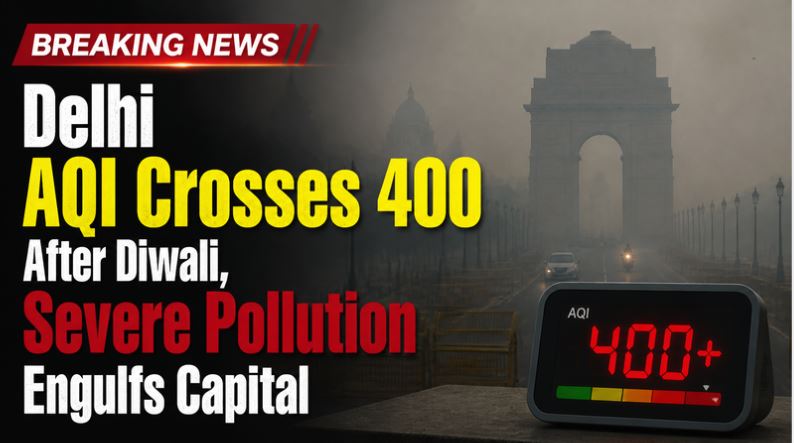
New Delhi, Nov 9 (UDN): Delhi woke up to a thick blanket of toxic smog on Monday, a day after Diwali celebrations, as air pollution levels surged across the national capital, with several monitoring stations recording an Air Quality Index (AQI) above 400, placing them in the ‘severe’ category.
Representational Image
A dense layer of haze covered several neighbourhoods, including Inderlok, significantly reducing visibility during the morning hours and raising fresh concerns over the health risks posed by deteriorating air quality.
According to Central Pollution Control Board (CPCB) monitoring data, Ghazipur recorded an AQI of 418, while the reading near Akshardham stood at 337, falling under the ‘very poor’ category.
Burari Crossing emerged as one of the worst-affected locations, recording an AQI of 441. Vivek Vihar followed at 437, while Delhi Technological University (DTU) registered 434. North Campus of Delhi University and Jahangirpuri both recorded 433, while Rohini reported 430.
Other locations in the severe category included Mundka (417), Punjabi Bagh (409), NIH Narela (407) and ITO (407).
Several other monitoring stations also reported alarming pollution levels. CRRI Mathura Road recorded an AQI of 396, Aya Nagar 386, Talkatora Garden 384, NSUT Jaffarpur 378 and Lodhi Road 370. Mandir Marg registered 369, Wazirpur 365, R K Puram 364, Badarpur and IHBAS Dilshad Garden 363 each, while Dr Karni Singh Shooting Range recorded 361.
Najafgarh reported an AQI of 340, Anand Vihar 335, IMD Lodhi Road 323, Ashok Vihar 319 and Sri Aurobindo Marg 267. Data for IIT Delhi and Dwarka Sector 8 was unavailable.
GRAP Stage III Restrictions Already in Force
The sharp deterioration in air quality comes after the Commission for Air Quality Management (CAQM) invoked Stage III of the Graded Response Action Plan (GRAP) across Delhi-NCR on Friday, ahead of Diwali, anticipating a further rise in pollution levels.
The emergency measures cover Delhi and adjoining districts of Haryana, Uttar Pradesh and Rajasthan. They are intended to curb pollution through stricter enforcement and additional restrictions before air quality deteriorates further.
Stage III measures include restrictions on construction and demolition activities, tighter controls on polluting vehicles and hybrid learning arrangements for younger school students, among other interventions.
Mumbai and Lucknow Also Wake Up to Hazy Skies
The impact of deteriorating air quality was also visible in other cities. Mumbai witnessed hazy conditions, with smog covering parts of Kalanagar and Bandra.
Kherwadi-Bandra East recorded an AQI of 264, followed by Sewri at 226, Ghatkopar at 221 and Chembur at 216. Byculla registered 193, Mindspace-Malad West 191, Kandivali West 187 and Worli 148. Kurla recorded a comparatively lower AQI of 96.
Meanwhile, several parts of Lucknow in Uttar Pradesh also woke up to hazy conditions as a layer of smog covered the city.
Understanding AQI Levels
According to CPCB classification, an AQI of 0–50 is considered ‘good’, 51–100 ‘satisfactory’, 101–200 ‘moderate’, 201–300 ‘poor’, 301–400 ‘very poor’ and 401–500 ‘severe’.
The GRAP framework operates through four progressively stricter stages. Stage I targets pollution levels in the poor category, while Stage II focuses on very poor air quality. Stage III applies stricter emergency controls when AQI enters the severe range, and Stage IV introduces additional restrictions when pollution reaches the severe-plus category, above 450.
The CAQM coordinates the implementation of these measures with the CPCB and concerned state authorities, based on pollution forecasts and meteorological assessments from the India Meteorological Department and the Indian Institute of Tropical Meteorology.
With several parts of Delhi recording severe pollution levels after Diwali, the latest readings underline the continuing challenge of controlling air pollution in the national capital and the wider NCR region.
9, Nov 2026
El Niño 2026–27: why humanitarian airlift planning must start before the weather turns

Nov 09: One of the strongest El Niño events on record could peak towards the end of 2026. Cam Bolton-Wilson, Vice President of Government & Humanitarian – Americas at Chapman Freeborn, explains how severe weather disrupts humanitarian supply routes, what can be planned in advance and why aviation decisions made only after a crisis begins may already come too late.
The World Meteorological Organisation expects El Niño to reach very strong intensity before peaking towards the end of 2026 and to persist into early 2027. The resulting droughts, floods and crop damage could push 49 million more people into acute food insecurity, bringing the total to 274 million across 45 countries by the end of 2027, according to the World Food Programme.
For humanitarian aviation, the main concern is how many crises could unfold at the same time. Flooding in the southern United States, fire risk across the Amazon and food emergencies on several continents could all draw on the same pool of suitable aircraft, airport capacity and specialist resources. Aid agencies increasingly act on forecasts like these, and with good reason – WFP estimates that every US$1 invested in anticipatory action can result in up to US$7 in avoided losses.
From forecast to flight plan
Knowing that a storm is coming is useful, but planners need to know what it will do to the places aid has to pass through. Can the nearest airport stay open? Will aid be able to move onward from there, and how many people depend on the route in question?

“Forecasts give us a window to get our plans in order before we lose access,” Bolton-Wilson says. “If you start planning once that has already happened, it’s a race against the clock with far fewer options.”
What can be planned before a crisis
According to Bolton-Wilson, more can be done in advance than many organisations realise. Aircraft options, alternative airports, regional staging locations, operating permissions, indicative costs and mobilisation procedures can all be assessed before an emergency. Documenting these assessments also helps organisations justify early investment of time and resources.
One option Chapman Freeborn is currently assessing is a retained aviation readiness arrangement. Such a model could combine data-driven risk monitoring with aviation specialists supporting an organisation’s crisis management team remotely. If developed, this approach could allow commercial terms and activation procedures to be agreed in advance, while keeping the final aircraft selection, routing and deployment timing flexible as conditions develop.
Common planning mistakes
Securing an aircraft does not mean the logistics problem has been solved. Aid still depends on permits, ground handling, fuel, functioning local infrastructure and transport waiting at the destination. Conditions can also remain unpredictable for hours or days after the immediate event has passed.
Planning is further complicated by regional conflicts and airspace closures, which can force longer routings and increase operating costs. Humanitarian flights already face limited budgets, while fuel shortages and sharp fluctuations in jet fuel prices can make urgent operations even more difficult to fund and execute.
Another common pitfall is the tendency to wait for absolute certainty. For example, early warning systems had flagged a likely food crisis in the Horn of Africa in August 2010. However, substantial response only started in July 2011, once famine had been officially declared in Somalia. A report published by Oxfam and Save the Children concluded that risk aversion had delayed the effort by six months.

While anticipatory action is becoming more common across the humanitarian sector, aviation is still often treated as a reactive procurement need. Bolton-Wilson believes it should be integrated into preparedness planning from the beginning.
When Hurricane Melissa approached Jamaica in October 2025, Chapman Freeborn began preparing before the storm made landfall. The team checked aircraft availability in the region and adapted the response as conditions developed. The operation ultimately involved fixed-wing flights for personnel, specialist helicopters and an Antonov AN-12 carrying critical communications equipment.
“The key was sourcing the right aircraft for each stage,” Bolton-Wilson says. “The AN-12 proved particularly useful because it loads from the rear and carries its own cargo-handling equipment, giving the team greater flexibility at airports already under strain.”
The last few miles
It is often easier to get aid into a country than to move it from the airport to the communities that need it. An aircraft may land on schedule, but damaged roads, fuel shortages, limited handling equipment or a lack of onward transport can prevent the cargo from reaching its destination.
A well-documented example of this is the Haiti earthquake relief in 2010, when aircraft carrying half of a Norwegian field hospital landed in Port-au-Prince, whereas the other half got diverted to the Dominican Republic and had to be transported over mountainous terrain, delaying the opening of one of Haiti’s first post-quake field hospitals.
“Humanitarian airlift works best when the whole journey is planned together, from the first flight into the country to the final delivery. A widebody freighter may establish an international air bridge, while regional aircraft, helicopters or potentially unmanned cargo platforms support onward distribution. Our team is also assessing how emerging air mobility technologies could reach isolated communities, deliver low-volume, high-impact goods such as medicines and improve situational awareness,” Bolton-Wilson says.
Scheduled flights or charter?
Whether scheduled flights will do or a charter is needed depends on the mission, Bolton-Wilson says. Planners must consider how quickly the goods are needed, their size and handling requirements, whether the destination can still accommodate aircraft and how long the response is likely to continue.
If scheduled services cannot provide the necessary speed, reliability, flexibility or reach, a dedicated charter may become the more suitable option. A large response may combine commercial services, dedicated freighters, passenger aircraft carrying relief personnel and helicopters rather than relying on a single solution. These operations work best when every requirement is coordinated by one team, allowing each flight to be planned as part of the wider response rather than as an isolated movement.
Local reach and integrated airlift
Building an effective response requires both local knowledge and central coordination. A globally distributed aviation services organisation with offices in or near potentially affected regions can assess airport conditions, permits, ground handling, fuel and onward transport as circumstances change.
Brokerage experience adds value by turning separate capacity options into an integrated airlift solution. Experienced brokers can determine how scheduled services, dedicated charters, passenger aircraft, helicopters and other modes should work together across different stages of the response, rather than treating each movement as an isolated flight.
What to do before El Niño peaks
With El Niño expected to peak within months, what should organisations be doing now? Bolton-Wilson’s advice is to move from monitoring to preparation. Organisations can start by mapping the regions most at risk and checking the transport links into them. From there, they can review the stocks already in place and work through aviation scenarios for the needs most likely to arise.
Timing matters more than usual this season. If emergencies hit several regions at once, suitable aircraft, airport capacity and specialist staff could quickly run short. One option Chapman Freeborn is currently assessing is a retained aviation readiness arrangement, with commercial terms and activation procedures agreed in advance while aircraft and routes remain flexible.
“A forecast gives you time. We want to help our partners use that time well, so that when the need becomes clear, the right aircraft can be on its way as quickly as possible,” Bolton-Wilson says.
9, Nov 2026
Chennai Diwali Celebration: Stunning Fireworks Light Up City Skyline, Video Goes Viral
Chennai, Nov 9 (UDN): The night sky over Chennai turned into a spectacular display of colours and lights as fireworks illuminated the Tamil Nadu capital during Diwali celebrations, captivating viewers across social media.

A stunning video showcasing the city’s festive skyline has gained attention on Instagram, offering a breathtaking glimpse of how the Festival of Lights transformed Chennai after sunset.
Shared by a content creator on November 7, the video captures numerous fireworks exploding across the city’s skyline in brilliant bursts of colour. Bright flashes lit up the night, creating a dazzling visual spectacle that reflected the festive enthusiasm of residents.
The creator shared the footage with the caption, “This is how Chennai looks on Diwali night”, drawing attention to the scale and vibrancy of the celebrations.
Diwali is traditionally celebrated with illuminated homes, decorative lamps, colourful rangolis and fireworks. However, the video captures the festivities from a wider perspective, presenting an entire cityscape glowing against the darkness.
The sweeping visuals provide a striking contrast to the usual neighbourhood-level celebrations, with fireworks lighting up different parts of the skyline and creating an unforgettable festive atmosphere.
The video has added to the growing collection of Diwali moments being shared online from across the country, showcasing how people in different cities marked the occasion with enthusiasm and traditional celebrations.
Chennai’s sparkling nightscape serves as a colourful reminder of the festive spirit that brings communities together during India’s much-loved Festival of Lights.
9, Nov 2026
Bay of Bengal Low Pressure Likely Around November 13, Tamil Nadu and South India May Receive Rain
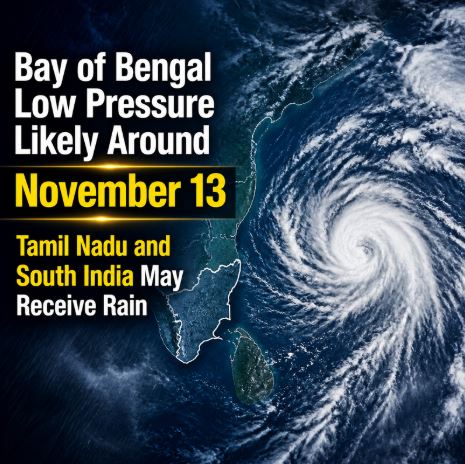
Bhubaneswar, Nov 9 (UDN): Weather activity over the Bay of Bengal may intensify next week, with the India Meteorological Department (IMD) forecasting the possibility of a fresh low-pressure system developing over the southeast Bay of Bengal around November 13.
Representational Image
According to the IMD’s extended-range weather outlook for November 6–19, a cyclonic circulation is likely to emerge over the southeast Bay of Bengal and adjoining Andaman Sea around November 11.
The weather system may subsequently concentrate into a low-pressure area over the southeast Bay of Bengal by November 13. There is also a possibility, although currently assessed as low, of the system intensifying into a depression over the southwest Bay of Bengal around November 15.
If the system develops as anticipated, rainfall activity could increase across parts of South India during the week beginning November 16. Tamil Nadu and neighbouring regions are likely to remain under close weather watch as the system evolves.
However, meteorologists are yet to establish the system’s eventual movement, intensity and geographical impact. The IMD is expected to provide a clearer assessment as the weather system takes shape over the coming days.
Odisha’s Weather Situation Under Watch
The possibility of another low-pressure system has drawn attention in Odisha, which recently experienced heavy rainfall and flooding in several areas, particularly in its southern districts.
The state had also witnessed adverse weather conditions following the recent cyclonic developments over the Bay of Bengal and adjoining coastal regions.
However, there is currently no clear indication that the developing system will bring significant rainfall to Odisha. Its possible influence on the state’s weather will depend on its eventual trajectory and intensity.
Not Yet a Confirmed Cyclone
The IMD’s latest outlook indicates the possibility of a low-pressure area developing over the Bay of Bengal, rather than a confirmed cyclone.
While the system could strengthen into a depression, such an intensification remains uncertain at this stage.
Residents across coastal and southern regions are advised to follow subsequent IMD bulletins for updated information on the system’s development and potential weather impacts.
9, Nov 2026
Liv by Emirates NBD, Universal and Aquanow to deliver the first integration of a CBUAE-registered USD-backed stablecoin into the UAE digital banking ecosystem

Dubai, UAE, Nov 09: Liv, the UAE’s first and largest digital bank by Emirates NBD, a leading banking group in the Middle East, North Africa, Türkiye and South Asia (MENATSA) region, has partnered with Universal Digital Intl Ltd (Universal) and Aquanow ME FZE (Aquanow) to introduce USDU, the UAE’s first Central Bank of the UAE (CBUAE)-registered USD-backed stablecoin, into the Liv ecosystem.
Universal is the issuer of USDU, registered by the Central Bank of the UAE under its Payment Token Services Regulation (PTSR). Aquanow is the regulated digital asset infrastructure partner behind both USDU distribution and Liv X crypto trading. This partnership marks a major milestone in the evolution of regional digital banking and the convergence of traditional and digital finance.
Following the launch of crypto trading through Liv X in 2025, this initiative extends Liv’s digital asset proposition into a fully regulated, USD-denominated digital asset. This integration allows customers to seamlessly manage both their traditional banking activities and digital asset portfolios within a single, highly secure and familiar environment.
The introduction of USDU provides Liv by Emirates NBD customers access to a USD-denominated digital asset issued under one of the region’s most comprehensive regulatory frameworks. Registered by the CBUAE and issued by Universal, USDU is backed by 1:1 physical US dollar reserves, safeguarded with UAE banks and verified through publicly available monthly attestations.
The integration is powered by Aquanow’s institutional-grade infrastructure, providing the liquidity and digital asset rails underpinning both USDU distribution and Liv X. Having processed over USD 130 billion in trading volume, Aquanow delivers the scale and resilience required for institutional digital asset services.
Rohit Garg, Group Head of Retail Products and Chief Digital Officer of Retail Banking and Wealth Management, Emirates NBD, said: “Emirates NBD continues to champion financial innovation that aligns with the goals of UAE’s progressive digital economy. By integrating the CBUAE-registered USDU stablecoin into the Liv ecosystem, we are not only expanding our digital asset capabilities, but also offering our customers a secure, transparent and regulated bridge to digital assets within their everyday banking app. Building on the momentum of our crypto trading launch in 2025, this strategic partnership with Universal and Aquanow empowers our customers to participate in the digital asset economy within a trusted, world-class banking environment.”
Phil Sham, CEO, Aquanow, said: “Aquanow’s role is to make regulated digital asset access work at bank-grade standards. Powering both USDU distribution and Liv X trading in a single stack is exactly the kind of integrated infrastructure the UAE market has been building toward: a CBUAE-registered stablecoin, a VARA-licensed broker-dealer and one of the region’s largest digital banks, working end-to-end within regulated rails.”
Juha Viitala, Senior Executive Officer, Universal, said: “USDU was built to bring transparent, USD-backed settlement into UAE regulatory frameworks. Seeing it become the first USD-backed token that Liv customers can trade, inside the app they already bank with, and through Aquanow’s VARA-licensed infrastructure, shows what happens when a CBUAE-registered digital asset meets a regulated distribution partner and a bank willing to lead. This is what bank-grade stablecoin infrastructure looks like when it reaches the customer.”
To mark the launch and accelerate customer onboarding, Liv by Emirates NBD is introducing a three-month promotional campaign offering customers zero-fee crypto trading for ninety days, serving as an accelerator to welcome both new and experienced users to the enhanced platform.
9, Nov 2026
Odisha Bigyan Academy Awards 2024: Eminent Scientists Honoured
Bhubaneswar, Nov 9 (UDN): Recognising outstanding contributions to scientific research and innovation, the Odisha Bigyan Academy, under the Science and Technology Department, organised its annual award investiture ceremony for 2024 at Jayadev Bhawan in Bhubaneswar on Monday.

Science and Technology Minister Krushna Chandra Patra attended the programme as the chief guest and presented awards to eminent scientists and researchers from Odisha for their achievements across various fields of science.
The ceremony was presided over by Odisha Bigyan Academy President Sibani Mohanty. Development Commissioner-cum-Additional Chief Secretary Deoranjan Kumar Singh and Additional Chief Secretary of the Science and Technology Department and Director General of Gopabandhu Academy of Administration, Chithra Arumugam, attended as guests of honour.
Distinguished Scientists Recognised
Five eminent personalities — Dr. Lala Aswini Kumar Singh, Dr. Sudhakar Kar, Prof. Rabindra Kumar Panda, Prof. Prafulla Kumar Mohanty and Prof. Bijay Kumar Mishra — were honoured with the Senior Scientist of Odisha recognition. Each received a memento, citation and uttariya in appreciation of their contributions to science.
Biju Patnaik Award for Scientific Excellence
Dr. Surendra Kumar Biswal received the prestigious Biju Patnaik Award for Scientific Excellence, one of the highest recognitions presented at the ceremony.
The award carries a cash prize of Rs 2 lakh, along with a gold-coated silver medallion, memento, certificate, citation and uttariya.
Samanta Chandra Sekhar Awards
Recognising significant research contributions, the Samanta Chandra Sekhar Award was presented to Prof. Umakanta Subudhi, Prof. Subhankar Bedanta and Prof. Jagadish Chandra Paul for their research work within Odisha.
Prof. Raghunath Sahoo received the same honour for his research contributions outside the state. Each recipient was awarded Rs 1 lakh, along with a medallion, memento and citation.
Young Researchers Encouraged
The Odisha Young Scientist Awards recognised emerging research talent, with Dr. Chita Ranjan Sahoo, Dr. Rudra Majhi and Dr. Ram Prasad Padhy honoured for their research within Odisha.
Dr. Rabindra Mohanty received the award for his scientific work outside the state. Each awardee received a cash prize of Rs 25,000.
Recognition for Popular Science Writing
The Prana Krushna Parija Popular Science Book Award was conferred on Prof. Bhagaban Patra in the General Category and Dr. Krutibas Nayak in the Children’s Category. Both received cash awards of Rs 25,000.
The ceremony highlighted the contributions of established scientists, promising young researchers and science communicators, while recognising the importance of research and scientific awareness in the state’s development.
The programme was hosted by Anuja Tarini Mishra, while Deputy Secretary of the Science and Technology Department Urmiprava Maharana delivered the vote of thanks.


