


22, Oct 2026
TerraPay Verify integrates with Kinexys by J.P. Morgan’s Liink network for Global Payee Verification
Collaboration expands access to bank account and digital wallet verification across global markets, helping financial institutions improve payment accuracy and strengthen trust in cross-border transactions.
LONDON and DUBAI, UAE, Oct. 22, 2026 /PRNewswire/ — TerraPay, a global money movement company, today announced it has integrated TerraPay Verify, its payee verification solution, into Kinexys by J.P. Morgan’s Liink Confirm application, enabling participants on the Kinexys Liink network and TerraPay Verify clients to validate bank account and digital wallet details across a broad range of global markets.

Through the collaboration, both financial institutions and non-bank financial institutions connected to the Kinexys Liink network will gain access to TerraPay Verify’s extensive bank account and wallet verification capabilities, helping validate recipient details before payments are initiated.
As cross-border payments continue to grow, ensuring beneficiary accuracy has become critical. True Impact of Failed Payments 2026 study from LexisNexis Risk Solutions estimates that 10-15% of international payments fail due to incorrect beneficiary details, leading to settlement delays, increased operational costs, and greater exposure to fraud. This challenge is amplified as payments increasingly move across a mix of bank accounts and digital wallets, making recipient verification a key enabler of faster, more reliable money movement.
TerraPay’s collaboration with Kinexys by J.P. Morgan – the firm’s industry-leading blockchain business unit – reflects a shared commitment to bringing greater transparency, trust, and efficiency to what can often be an opaque cross-border payments landscape. By helping organizations verify recipients before funds are sent, the solution supports global efforts to improve payment transparency, accessibility, and reach, helping align with the broader objectives set by the G20 roadmap for enhancing cross-border payments while helping banks worldwide deliver a more seamless customer experience.
Paul Atkinson, Head of Kinexys Liink Product, Kinexys by J.P. Morgan said, “By integrating Kinexys Liink’s Confirm application with TerraPay Verify, we’re making it easier for financial institutions and non-bank financial institutions to improve control and help reduce payment fraud throughout the cross-border payment lifecycle. Together, we’re supporting institutions as they adapt to a rapidly changing landscape and build greater trust with every transaction.”
The collaboration also expands the reach of TerraPay Verify among global institutions though the Kinexys Liink network, while reinforcing TerraPay’s commitment to building trusted payment infrastructure through interoperability.
“Trust is fundamental to every successful payment,” said David Backshall, VP, Payment Partnerships at TerraPay. “As payment ecosystems continue to evolve, financial institutions need a reliable way to verify recipients across both bank accounts and digital wallets. Our collaboration with Kinexys by J.P. Morgan extends the reach of TerraPay Verify to more institutions globally, helping improve payment certainty, reduce avoidable exceptions and support a better customer experience.”
The collaboration reflects TerraPay’s continued focus on embedding trust into global money movement through compliance, verification and interoperable infrastructure, while creating opportunities to expand verification coverage through strategic ecosystem partnerships.
About TerraPay
TerraPay simplifies global money movement, providing a single connection to one of the most expansive cross-border payment networks, regulated across multiple markets. Our network enables payments to receiving and sending countries worldwide, reaching a vast network of mobile wallets, bank accounts, and cards. We make money transfers instant, reliable, transparent, and fully compliant for its partners, connecting them to 7.5Bn+ bank accounts, in 156+ countries. We work behind the scenes as the trusted partners for some of the world’s most innovative financial players, from banks and digital wallets to MTOs, corporates and fintech platforms. On a mission to create a borderless financial world, TerraPay operates Xend – the first-of-its-kind payments interoperability network, enabling secure, real-time cross-border payments, to and from 3.7B wallets through a single, unified connection. TerraPay is headquartered in London, with offices in cities including, Dubai, Milan, Miami, Singapore, Bogota, Johannesburg, Kampala, Bangalore.
Media Contact:
juveria.n@terrapay.com
 View original content to download multimedia:https://www.prnewswire.co.uk/news-releases/terrapay-verify-integrates-with-kinexys-by-jp-morgans-liink-network-for-global-payee-verification-302916437.html

- 0
- By PRNewswire

22, Oct 2026
One Dead, Over 100 Injured in Traditional Stick Fight During Dussehra Celebrations in Andhra Pradesh
Kurnool, Oct 22: One person was killed and more than 100 others injured during a traditional stick fight held as part of the annual Dussehra celebrations at Devaragattu village in Andhra Pradesh’s Kurnool district, officials said.

Representational Image
The violent clash took place late Wednesday night during the Devaragattu Banni Utsav in Holagunda mandal, where devotees from several villages gathered for the centuries-old ritual associated with the Mala Malleswara Swamy temple.
The deceased was identified as Potaraju, 28, a resident of Alur. Among the injured, around 10 people were reported to be in critical condition, while others sustained varying degrees of injuries.
The injured were rushed to hospitals in Adoni and Alur for treatment. Those with minor injuries received medical attention at a temporary facility established by the authorities near the venue.
Thousands Gather for Annual Ritual
The Banni Utsav is observed every year during the Dussehra festivities at the Mala Malleswara Swamy temple, situated on a hillock at Devaragattu. The ritual centres on a symbolic battle in which participants wield sticks to gain possession of the idols of deities Mallamma and Malleswara Swamy following their ceremonial wedding around midnight.
According to local belief, Lord Shiva assumed the form of Bhairava and defeated the demons Mani and Mallasura with sticks. The annual event reenacts this mythological episode, with participants divided into two rival groups representing the divine forces and the demons.
Villagers from Nerani, Nerani Tanda and Kothapeta traditionally take part on one side, while devotees from Arikera, Alur, Suluvai, Ellarthi, Nidravatti and Bilehall participate on the other.
During the ritual, members of the two groups engage in fierce stick fighting as they attempt to seize the sacred idols from their rivals. The practice frequently results in serious injuries, which some devotees regard as an auspicious part of the tradition.
Police Measures Fail to Prevent Violence
Despite repeated efforts by the authorities to discourage the dangerous practice, the ritual continued this year. Police had reportedly issued directions against the stick fight and deployed more than 1,000 personnel to maintain order and prevent injuries.
However, the preventive measures failed to stop the participants from engaging in the clash, resulting in one death and more than 100 injuries.
The recurring violence during the annual festival has posed a persistent challenge for law enforcement agencies, which face resistance from sections of the local population who consider the ritual an integral part of their religious and cultural heritage.
Major Attraction for Devotees
The Devaragattu Banni Utsav draws thousands of devotees from across Kurnool district, neighbouring areas and states such as Telangana and Karnataka. Large crowds gather to witness the midnight ritual, which remains a significant annual event for the surrounding villages.
Despite repeated appeals from authorities to abandon the dangerous practice, the tradition continues to attract enthusiastic participation.
The latest casualty has once again brought the risks associated with the ritual into focus, highlighting the challenge of balancing longstanding religious customs with public safety during large-scale festivals.
22, Oct 2026
New research reveals growing consumer preference for natural fibres as Woolmark launches Return to Real
SYDNEY, Oct. 22, 2026 /PRNewswire/ — As consumers become more selective about what they wear, new Ipsos research commissioned by Woolmark across the United States, France, Germany, Italy and China reveals a growing preference for natural fibres.

On average across five markets, 82% of consumers prefer natural fibres over synthetics when price, style and fit are equal. Merino wool was preferred to polyester in every market surveyed, with 65% preferring Merino wool on average across five markets.
The findings point to a wider shift in fashion. Worldwide Google search interest in “Merino wool” has more than doubled over the past five years. On average across five markets, 67% of consumers say they would pay more for clothing made mainly from natural fibres.
“Consumers want to know what a garment is made from, what that means in everyday use and whether the claims can be trusted,” said Woolmark Managing Director Bryan Fry. “That puts fibre, and the evidence behind it, back at the centre of the conversation.”
On average across five markets, 71% of consumers consider independent certification or verification of fibre content and quality important.
For more than 60 years, Woolmark has supported research, testing, education and certification to provide evidence of wool’s quality and performance.
Woolmark’s new Natural Intelligence report explores Merino wool’s thermal comfort, moisture and odour management, durability and next-to-skin comfort. It includes four-year research with North Carolina State University showing how 100% Merino wool base layers helped create a more stable next-to-skin microclimate during stop-start activity.
These insights underpin Return to Real, Woolmark’s new global brand platform celebrating Merino wool’s Natural Intelligence: performance refined by nature over thousands of years and understood through scientific research.
Launching internationally through out-of-home, digital media and creators, the campaign revisits Woolmark’s 1960s belief that “you can’t fake the real thing”, with messages including “Not all intelligence is artificial” and “The original wearable tech”.
“Technology moves quickly, but innovation does not always mean starting from scratch,” said Fry. “Sometimes it means looking again at what nature has already worked out.”
Source: Ipsos AWI Natural Fibre Perception Report. Online interviews with 300 respondents per market in China, France, Germany, Italy and the US, aged 18–65. Fieldwork: 7–8 September 2026.
 View original content to download multimedia:https://www.prnewswire.co.uk/news-releases/new-research-reveals-growing-consumer-preference-for-natural-fibres-as-woolmark-launches-return-to-real-302916567.html

22, Oct 2026
Nexteer Expands Brazil Footprint with New Camaçari Facility Supporting BYD Production
CAMAÇARI, Brazil, Oct. 22, 2026 /PRNewswire/ — Nexteer Automotive today announced the opening of its new assembly facility in Camaçari, Bahia, Brazil. The facility, which began production in early October 2026, expands the Company’s manufacturing footprint in South America and strengthens its presence across Brazil, complementing Nexteer’s main plant in Porto Alegre in the south and its Porto Real facility in Rio de Janeiro with this new Camaçari location in the northeast. The new facility supports BYD’s growing vehicle production operations in Brazil.

Located approximately 10 kilometers from BYD’s manufacturing operations in Camaçari, the new facility will assemble Column-Assist Electric Power Steering (CEPS) systems for vehicles produced in Brazil. The investment enhances supply chain responsiveness and operational efficiency while providing localized support for BYD’s vehicle production in the region.
“The opening of our Camaçari facility marks an important milestone in Nexteer’s continued commitment to supporting customers through localized manufacturing and supply,” said Jeferson Oliveira, Country Director – Brazil, Nexteer Automotive. “By locating this facility near BYD’s operations in Camaçari, we can enhance supply chain efficiency, improve responsiveness and strengthen collaboration while delivering the high-quality steering solutions our customers expect.”
The operation will perform final assembly and logistics activities while leveraging components and subassemblies produced through Nexteer’s global manufacturing network. This approach combines the advantages of local production with Nexteer’s worldwide engineering, manufacturing and quality expertise.
“Brazil is an important market for both vehicle production and Nexteer’s long-term growth strategy,” said Alberto Rodriguez, Vice President and EMEASA Divisional President, Nexteer Automotive. “This investment reflects our commitment to supporting customers through localized manufacturing while contributing to the continued development of Brazil’s automotive industry.”
“The development of a localized supplier network is an important component of vehicle production in Brazil,” said Zheng Qiong, Director of Purchasing, BYD Brazil. “Nexteer’s new operation in Camaçari will support our manufacturing activities in the region, and we appreciate their investment and collaboration.”
The Camaçari facility reflects Nexteer’s strategy of aligning its global manufacturing footprint with customer production needs while supporting regional supply chain localization.
ABOUT NEXTEER AUTOMOTIVE
Nexteer Automotive (HK 1316) is a global leading motion control technology company accelerating mobility to be safe, green and exciting. Our innovative portfolio supports by-wire chassis control, including electric and hydraulic power steering systems, steer-by-wire and rear-wheel steering systems, steering columns and intermediate shafts, driveline systems, software solutions and brake-by-wire. The company solves motion control challenges across all megatrends – including electrification, software/connectivity, ADAS/automated driving and shared mobility – for global and domestic OEMs around the world including BMW, Ford, GM, RNM, Stellantis, Toyota and VW, as well as automakers in India and China including BYD, Xiaomi, ChangAn, Li Auto, Chery, Great Wall, Geely, Xpeng and others. www.nexteer.com
Link to Nexteer Media Center
 View original content to download multimedia:https://www.prnewswire.com/in/news-releases/nexteer-expands-brazil-footprint-with-new-camacari-facility-supporting-byd-production-302916589.html

22, Oct 2026
Clarivate Demonstrates Global Demand For AI-native Web Of Science Research Intelligence
More than 100 institutions across 25 countries and regions are using the AI-native research intelligence platform.
LONDON, Oct. 22, 2026 /PRNewswire/ — Clarivate Plc (NYSE: CLVT), a leading global provider of transformative intelligence, today announced that more than 100 institutions across 25 countries and regions have adopted Web of Science Research Intelligence, highlighting growing global customer demand since the platform launched in May 2026.

Web of Science Research Intelligence is an AI-native research intelligence platform designed to support institutional decision-making across funding, strategy and impact. It combines trusted, curated Clarivate data with responsible academic AI to help research offices, researchers and library teams secure funding, strengthen collaboration, inform strategy and demonstrate real-world impact.
Bar Veinstein, President, Academia & Government, Clarivate, said: “This important milestone demonstrates that we are addressing an important and growing need across the global research community for trusted, AI-enabled tools that help universities and research organizations make more informed decisions around research funding, strategy and impact.”
Kathleen Smeaton, Director, Collections and Technology, Monash University, Australia said: “Our experience as a Development Partner gave us confidence in Web of Science Research Intelligence’s potential to support research strategy, benchmarking, expert discovery, and institutional performance analysis. Our transition from Development Partner to customer reflects both the strength of the partnership and our belief in the value Web of Science Research Intelligence can deliver to the university.”
Hitoshi Takahashi, Ph.D., University Research Administrator, Research Strategy and Promotion Division, Headquarters for Co-creative Future Sciences, Hiroshima University said: “Web of Science Research Intelligence brings together capabilities we previously had to use separately, making sophisticated analysis accessible to researchers and research support professionals, not just specialist users. The AI can turn a simple question into thoughtful analysis, delivered in natural language, helping us reach deeper insights faster.”
Web of Science Research Intelligence is built on publisher-neutral Web of Science Core Collection data, long recognized as the global standard for bibliometric analysis. It was developed in close partnership with the research community and, by launch, had been shaped by more than 50 development partners and early adopters across 20 countries.
Customer engagement continues to inform the evolution of the platform.
About Clarivate
Clarivate is a leading global provider of transformative intelligence. We offer enriched data, insights & analytics, workflow solutions and expert services in the areas of Academia & Government and Intellectual Property. For more information, please visit www.clarivate.com
Media contact:
Dr Laura Pritsch
Director, External Communications, Academia & Government
newsroom@clarivate.com
 View original content to download multimedia:https://www.prnewswire.co.uk/news-releases/clarivate-demonstrates-global-demand-for-ai-native-web-of-science-research-intelligence-302916303.html

22, Oct 2026
Weak Monsoon May Push India’s Farm Loan NPAs To 5.6% By FY28: CareEdge
New Delhi, Oct 22: India’s agriculture gross non-performing assets (GNPA) at scheduled commercial banks could rise to 5.3–5.6 per cent by March 2028, as the weakest monsoon since 2015 strains kharif crop loans, according to a CareEdge Ratings report. Public sector banks are expected to bear the larger share of the stress.

Representational Image
Current Stress Levels
The agriculture GNPA ratio stood at 5.11 per cent in June 2026, with farm-loan GNPAs at Rs 1.41 lakh crore. Although agriculture accounts for only 12.9 per cent of scheduled commercial bank advances, it represents 37.5 per cent of all bank GNPAs.
CareEdge expects the ratio to improve to 4.6–4.8 per cent by March 2027, aided by strong credit growth and write-offs. However, it is projected to rise thereafter as crop loans in monsoon-deficient regions turn overdue and are classified as NPAs.
Monsoon Impact
The 2026 southwest monsoon ended at 87 per cent of the long-period average, the weakest season since 2015, according to the India Meteorological Department. The shortfall was concentrated in states that account for most agricultural credit.
About 68 per cent of scheduled commercial bank agriculture credit is in states where rainfall was at least 20 per cent below normal, compared with 48 per cent during the 2015 drought year. This concentration increases the risk of loan delinquencies in FY28.
NPAs May Reach Rs 2 Lakh Crore
Agriculture GNPAs are projected to rise from Rs 1.41 lakh crore in June 2026 to Rs 1.47–1.53 lakh crore by March 2027, and further to Rs 1.9–2 lakh crore by March 2028. The weak monsoon alone could add 70–80 basis points to the farm GNPA ratio.
Including restructured farm loans in drought-affected areas, which remain classified as standard assets, stressed agriculture advances could reach 6–6.3 per cent of total agriculture advances.
What It Means For Banks
The report signals that while headline farm-loan asset quality has improved sharply since the pandemic, the 2026 monsoon shortfall could reverse part of that gain. Banks with higher exposure to rain-dependent kharif crops and deficit rainfall states may need closer monitoring of repayments, restructuring and provisioning in the coming quarters.
22, Oct 2026
Sonia Gandhi Joins Instagram, Unveils First Look Of Memoir ‘Belonging’
New Delhi, Oct 22: Congress Parliamentary Party chairperson Sonia Gandhi made her Instagram debut on Thursday, using her first post to reveal the cover of her forthcoming memoir, Belonging: A Journey of Love. The book is scheduled for worldwide release on November 10, with pre-orders already open.

First Post On Instagram
In her debut video, Sonia Gandhi is seen receiving the first copies of the memoir and sharing sweets with her daughter, Congress MP Priyanka Gandhi Vadra. She described the book as “a story of love, duty, loss and finding a place to belong.”
Until now, the senior Congress leader had no personal social media account. Her new Instagram profile follows Rahul Gandhi, Priyanka Gandhi and the Indian National Congress, and had crossed 10,700 followers shortly after her first post.
Memoir Details
The 544-page memoir will be published globally by Alfred A. Knopf, while HarperCollins India will release it in India on November 10. HarperCollins has described it as a deeply personal account of love, identity, duty and belonging, offering an insider’s perspective on India’s journey.
The announcement ends weeks of uncertainty over the memoir’s Indian publication after Penguin Random House India said it would not be the domestic publisher. HarperCollins India subsequently acquired the publishing rights.
Publisher Row
Penguin Random House India rejected suggestions that it withdrew because Sonia Gandhi declined editorial changes. The publisher said fact-checking and editorial recommendations are a normal part of publishing, and maintained that it had remained willing to publish the book.
The company said it would not comment further on confidential discussions with the author. The memoir’s release is now being closely watched as one of the most anticipated political books of the year.
22, Oct 2026
Tata Power To Set Up Rs 54-Crore AI-Focused Global Capability Centre In Odisha
Oct 22: Tata Power is establishing a Global Capability Centre (GCC) in Khordha district, Odisha, with an initial investment of Rs 54.31 crore. The facility, expected to become fully operational within three months, will create 110 high-skilled jobs and is the first GCC approved under the state’s dedicated GCC policy.

Representational Image
AI-Led Energy Solutions
The centre will develop digital solutions for the power and energy sector using artificial intelligence, machine learning, generative AI and agentic AI. Its work will support asset health monitoring, demand forecasting, operational efficiency and investment planning across Tata Power’s businesses.
It will also work on emerging technologies such as knowledge graphs, blockchain, digital twins and simulation systems. These tools are expected to support renewable energy, manufacturing, power grids and pumped-hydro projects across both construction and operational requirements.
Jobs And Commercial Potential
The centre will bring together professionals in digital technology, engineering and energy analytics. Roles are expected to include AI specialists, data scientists, digital platform engineers, cloud infrastructure engineers and power-sector domain experts.
Besides serving Tata Power’s internal operations, the facility will develop digital products and services for external customers, opening possibilities to commercialise technologies created in Odisha.
Boost For Odisha’s GCC Push
Odisha’s GCC Policy, unveiled last year, aims to attract investments of more than Rs 1,000 crore and develop at least five GCC hubs across Bhubaneswar, Cuttack, Puri, Paradip, Bargarh, Jharsuguda and Sambalpur. The policy also targets over 50,000 direct and indirect jobs.
Tata Power’s project was among 19 proposals worth about Rs 3,280 crore cleared by the Odisha government in September, reinforcing the state’s effort to build a knowledge- and technology-driven services ecosystem.
22, Oct 2026
Delhi-NCR Sees Season’s First Poor Air Day; GRAP-I Curbs Take Effect As Winter Chill Sets In
Oct 22: Delhi-NCR woke up to a noticeable chill on Thursday morning, but the drop in temperature brought little relief from pollution. The capital recorded its first “poor” air-quality day of the season, prompting the Commission for Air Quality Management (CAQM) to enforce Stage I of the Graded Response Action Plan (GRAP) across the National Capital Region.

Representational Image
Air Quality Worsens
Delhi’s overall AQI rose sharply to 244 at 2 pm on October 21, up from 179 in the “moderate” category the previous day. The CAQM said the deterioration, combined with forecasts of persistently elevated pollution, necessitated immediate action.
Chandni Chowk was among the worst-affected areas, recording an AQI of 306 in the “very poor” category, with PM10 identified as the dominant pollutant. Several other stations, including Mandir Marg, Punjabi Bagh, Sirifort and Dwarka Sector 8, also recorded AQI levels in the poor range.
Under the CPCB scale, an AQI of 201–300 is “poor,” 301–400 is “very poor,” and 401–500 is “severe.” Authorities said pollution levels are expected to remain elevated over the coming days.
GRAP-I Restrictions
Stage I measures are now in force across Delhi and adjoining parts of Haryana, Uttar Pradesh and Rajasthan. The restrictions prohibit the use of coal and firewood in tandoors at hotels, restaurants and open eateries, and impose curbs on diesel generator sets.
The CAQM’s GRAP sub-committee has directed agencies to implement the measures immediately, strengthen surveillance and ensure compliance with the citizen charter. Officials will continue to track air quality and weather conditions before considering stricter steps.
Metro Adds Trips
To reduce reliance on private vehicles, the Delhi Metro Rail Corporation will operate 20 additional train trips on weekdays from October 22. The DMRC will also intensify dust-control work at construction sites and nearby roads, including clearing accumulated dust, removing garbage from footpaths and cleaning road medians.
Winter Action Plan Ahead
The curbs precede the Delhi government’s Winter Action Plan, which will come into effect from November 1. It includes measures targeting vehicular emissions, construction dust and industrial pollution, along with stricter dust monitoring and increased mechanised road sweeping.
The plan also proposes a “No PUC, No Fuel” policy, under which vehicles without valid Pollution Under Control certificates will be denied fuel. From November 1, non-Delhi registered vehicles that do not meet BS-VI emission norms will face entry restrictions, subject to exemptions.
22, Oct 2026
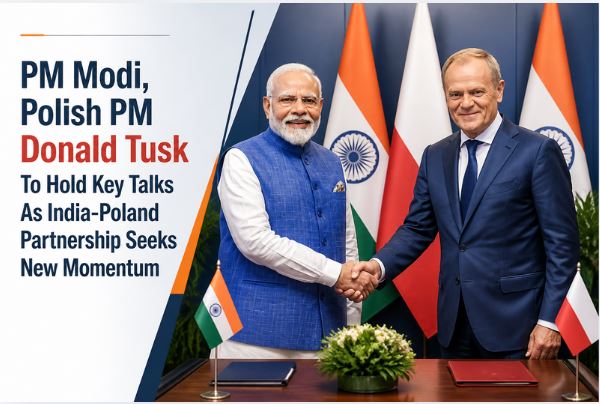
PM Modi, Polish PM Donald Tusk To Hold Key Talks As India-Poland Partnership Seeks New Momentum
Oct 22: Prime Minister Narendra Modi will hold bilateral talks with Polish Prime Minister Donald Tusk in New Delhi on Thursday, as the two countries look to deepen cooperation in defence, trade, technology and clean energy. The meeting comes during Tusk’s three-day official visit to India from October 21 to 23, undertaken at PM Modi’s invitation.
Agenda For Talks
The leaders are expected to review the entire range of India-Poland relations, which were elevated to a Strategic Partnership during PM Modi’s visit to Warsaw in August 2024. They will also exchange views on regional and global developments of mutual interest, including the Russia-Ukraine conflict and India-European Union relations.
Discussions are likely to focus on expanding cooperation in defence manufacturing, trade and investment, emerging technologies, space research, port infrastructure and renewable energy. The meeting is expected to give fresh momentum to the India-Poland Strategic Partnership.
High-Level Engagement
External Affairs Minister S. Jaishankar met the visiting Polish leader and discussed bilateral cooperation ahead of the prime ministerial talks. Tusk arrived in New Delhi on Wednesday evening and was received by Minister of State for Food Processing Industries and Jal Shakti, Raj Bhushan Choudhary.
The Polish delegation includes Finance and Economy Minister Andrzej Domanski and a high-level business delegation. The Ministry of External Affairs said the visit would further deepen the long-standing ties between the two countries.
Business Forum And Bengaluru Leg
An India-Poland Business Forum will be held in New Delhi on October 22, followed by another engagement in Bengaluru on October 23. Tusk is scheduled to interact with business stakeholders, particularly from the information technology and space sectors, during his Bengaluru visit.
This is Tusk’s second official visit to India as Polish Prime Minister; he earlier visited in 2010. He had also travelled to New Delhi in 2017 for the India-EU Summit in his capacity as President of the European Council.


