


16, Aug 2026
NIELIT Unveils CYBER KUSHTI 2026 to Sharpen Cybersecurity Decision-Making Skills
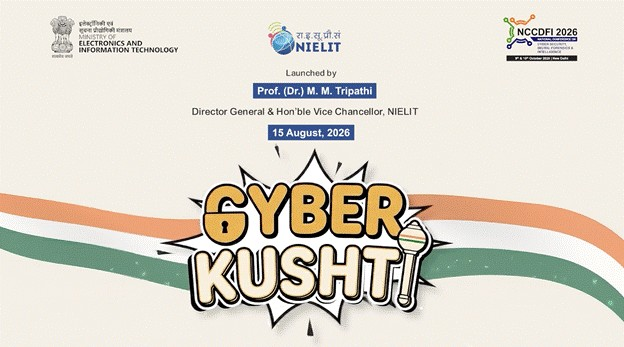
New Delhi, August 16: The National Institute of Electronics and Information Technology (NIELIT) has launched ‘CYBER KUSHTI 2026’, a cybersecurity assessment initiative designed to test how effectively individuals can apply human judgment while identifying, analysing and responding to cyber threats.
The initiative focuses on a critical aspect of cybersecurity that extends beyond technical knowledge — the ability to make sound decisions when confronted with complex and evolving digital threats.
CYBER KUSHTI 2026 is designed around the premise that cybersecurity professionals must do more than identify vulnerabilities or recognise known attack patterns. They must also evaluate situations, assess risks and make timely decisions when information may be incomplete or ambiguous.
Through the initiative, participants will be exposed to assessment scenarios intended to examine their ability to interpret cybersecurity situations and distinguish between genuine threats, potential risks and routine events.
The programme is expected to provide a platform for assessing practical cybersecurity capabilities in an environment that places emphasis on reasoning and decision-making.
As organisations increasingly deploy artificial intelligence, automation and advanced security tools, the role of human expertise in cybersecurity continues to remain important.
Automated systems can identify anomalies and flag potential threats, but security professionals are often required to determine the significance of an alert, establish priorities and decide what action should be taken.
CYBER KUSHTI 2026 seeks to bring this human element into sharper focus by examining how participants respond to cybersecurity challenges rather than relying solely on theoretical or textbook knowledge.
The launch comes at a time when India is expanding its digital infrastructure and strengthening cybersecurity capabilities across government, industry and other sectors.
A growing digital economy has also increased the potential attack surface for organisations, creating demand for professionals who understand both technology and cyber-risk management.
NIELIT’s initiative can contribute to this ecosystem by encouraging cybersecurity learners and professionals to develop stronger analytical and decision-making capabilities alongside technical skills.
Traditional cybersecurity assessments often concentrate on technical concepts, tools, vulnerabilities and predefined answers. CYBER KUSHTI 2026 takes a different approach by placing greater emphasis on judgment, interpretation and situational awareness.
This approach could prove particularly relevant for cybersecurity roles where professionals have to respond to rapidly changing circumstances and make decisions that can affect the security and continuity of an organisation.
The initiative also highlights the evolving nature of cybersecurity education, where practical problem-solving and human reasoning are becoming increasingly important components of professional preparedness.
With artificial intelligence, cloud computing, connected devices and digital services becoming increasingly embedded in everyday business and public infrastructure, cybersecurity challenges are becoming more complex.
Against this backdrop, initiatives such as CYBER KUSHTI 2026 underline the need to develop cybersecurity professionals who can combine technical expertise with critical thinking and responsible decision-making.
The NIELIT initiative is expected to provide participants with an opportunity to evaluate their preparedness for real-world cybersecurity situations while contributing to a broader conversation around the skills required for India’s evolving digital security ecosystem.
- 0
- By Neel Achary



