


16, Nov 2026
National Press Day 2026: Importance of Press Freedom, Role of Media and Challenges of Modern Journalism
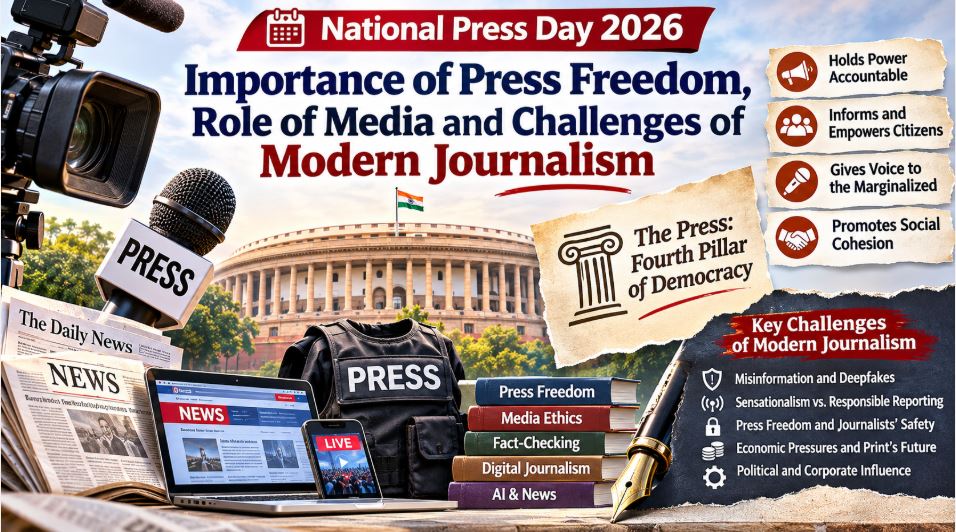
Observed on November 16 every year, National Press Day is a reminder of the indispensable role of a free, independent, and responsible press in sustaining democracy.
The occasion marks the establishment of the Press Council of India (PCI), which began functioning on November 16, 1966, as a statutory body entrusted with safeguarding press freedom and maintaining the standards of journalism in the country.
More than a celebration of the media fraternity, National Press Day provides an opportunity to reflect on the responsibilities of journalism, the challenges confronting the media industry, and the evolving relationship between the press and society in an increasingly digital world.
The Press: The Fourth Pillar of Democracy
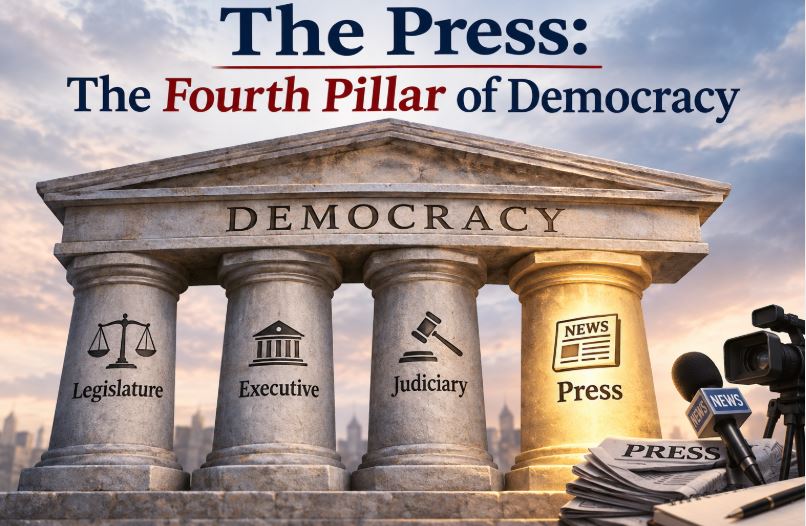
The press is widely recognised as the Fourth Pillar of Democracy, complementing the legislature, executive, and judiciary. While the other institutions exercise constitutional powers, the press plays a crucial role in ensuring transparency, encouraging public participation, and holding institutions accountable.
Its importance extends far beyond the dissemination of daily news.
1. A watchdog of democracy
An independent press acts as a vigilant watchdog by investigating corruption, questioning administrative decisions, examining public expenditure, and exposing the misuse of power. By bringing uncomfortable truths before the public, journalism strengthens democratic accountability.
2. An informed and empowered citizenry
Democracy becomes meaningful only when citizens have access to accurate and credible information. Through responsible reporting, newspapers, television channels, and digital platforms help people understand government policies, economic developments, social issues, and international affairs.
3. A voice for the voiceless
Journalism provides a platform for marginalised communities, vulnerable sections, and people living in remote regions whose concerns often remain outside mainstream public discourse. By highlighting grassroots realities and social inequalities, the press helps bring neglected issues into the national conversation.
4. A catalyst for social change
Responsible journalism encourages constructive debate, promotes awareness, challenges harmful practices, and supports social reform. It can strengthen national integration and democratic values by creating space for diverse perspectives and informed disagreement.
From the Age of Print to the Digital Revolution: How Journalism Has Changed
Indian journalism has undergone a remarkable transformation since the colonial period. From newspapers that played a significant role in the freedom movement to today’s digital-first newsrooms, the nature, speed, reach, and business model of journalism have changed considerably.
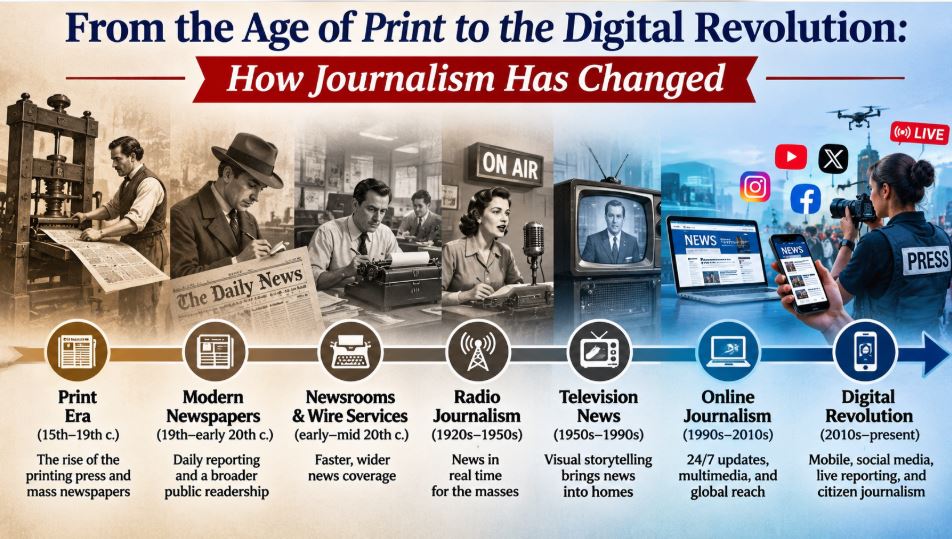
The evolution of journalism can be understood through the following comparison:
|
Aspect |
Past: Print and Traditional Media |
Present: Digital and AI Era |
|
Primary medium |
Newspapers, magazines, radio and state-run television |
Digital portals, news channels, social media, podcasts and mobile applications |
|
Driving force |
Nationalism, public awareness and nation-building |
Digital competition, audience engagement, commercial interests and instant news |
|
News cycle |
Relatively slower, with scheduled publication and broadcast |
Continuous, real-time and increasingly algorithm-driven |
|
Verification |
Editorial scrutiny and established newsroom procedures |
Fact-checking challenges amid pressure to publish instantly |
|
Audience participation |
Primarily one-way communication |
Interactive communication through comments, shares and citizen journalism |
|
Major challenges |
Colonial censorship, political restrictions, limited literacy and the Emergency |
Fake news, deepfakes, online harassment, surveillance and political or corporate influence |
During the freedom struggle, newspapers became powerful instruments of resistance, awareness, and national mobilisation. After independence, the press assumed an important role in nation-building, democratic debate, and public education.
The Emergency of 1975–77 remains a significant chapter in India’s media history, demonstrating how press freedom can come under pressure during periods of political crisis.
Today, technology has democratised the production and distribution of information. News can reach millions of people within seconds, and citizens can participate directly in public conversations. However, this unprecedented accessibility has also created new challenges for accuracy, accountability, and editorial independence.
Contemporary Challenges: Journalism at a Crossroads
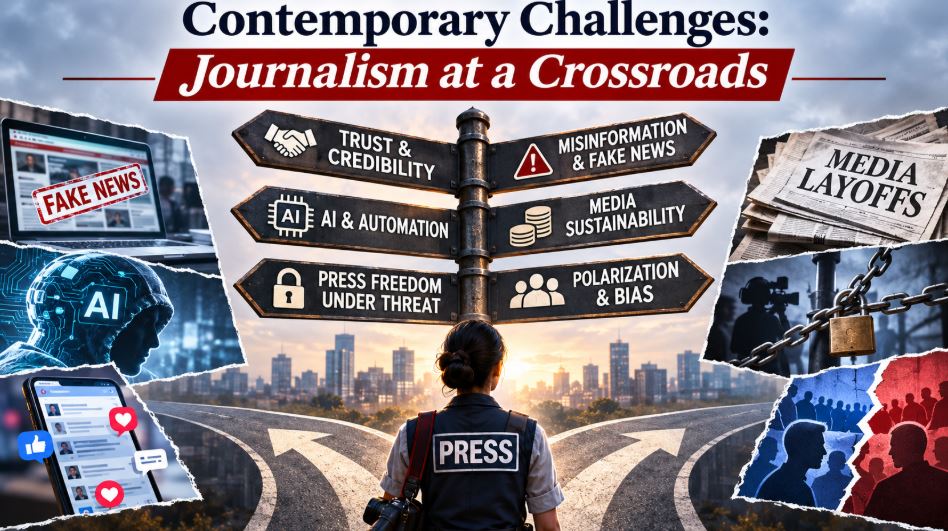
As India observes National Press Day in 2026, journalism stands at a critical crossroads. Technological advancement has expanded the reach of the media, but it has also intensified questions about credibility, independence, professional ethics, and public trust.
1. Misinformation and the challenge of artificial intelligence
The rapid spread of misinformation, manipulated videos, fabricated photographs, and AI-generated deepfakes has made distinguishing facts from fiction increasingly difficult.
A misleading social media post can reach millions before a verified report is published. Consequently, fact-checking, source verification, digital literacy, and transparent editorial practices have become essential responsibilities of modern news organisations.
Artificial intelligence can assist journalists in research, translation, data analysis, and content production. However, it cannot replace human judgment, ethical responsibility, and independent verification.
2. Sensationalism versus responsible journalism
The growing competition for television ratings, online traffic, and social media engagement has encouraged sensational headlines, speculative reporting, and sometimes polarising debates.
In the race to become the first to break a story, some media organisations risk compromising accuracy and fairness. Journalism must therefore distinguish between what attracts attention and what genuinely serves the public interest.
The credibility of a news organisation should be measured not merely by its speed or popularity but by the accuracy, fairness, and relevance of its reporting.
3. Press freedom and the safety of journalists
A free press cannot function effectively without an environment in which journalists can investigate, question, and report without fear.
Physical attacks, intimidation, legal pressure, online threats, digital surveillance, and economic vulnerabilities remain important concerns for media professionals.
International assessments, including the World Press Freedom Index published by Reporters Without Borders (RSF), provide a broader perspective on the challenges faced by journalists and media institutions across countries.
Protecting journalists, strengthening institutional independence, and ensuring access to information are essential for preserving democratic values.
4. Economic pressures and the future of print journalism
Traditional newspapers continue to face declining advertising revenues, changing readership habits, and competition from digital platforms.
Nevertheless, print journalism retains an important place in the media ecosystem. Its emphasis on editorial processes, detailed reporting, investigative journalism, and contextual analysis can provide depth that is often missing from rapidly circulating online content.
The challenge is not simply to preserve print media but to adapt its strengths to changing audience expectations.
5. Political and corporate influence
Media independence also depends on financial and institutional autonomy. Excessive dependence on powerful advertisers, ownership concentration, political affiliations, and commercial interests can influence editorial priorities.
Journalism must maintain sufficient distance from centres of power to question authority objectively, irrespective of political or corporate interests.
National Press Day and the Relevance of the Press Council of India
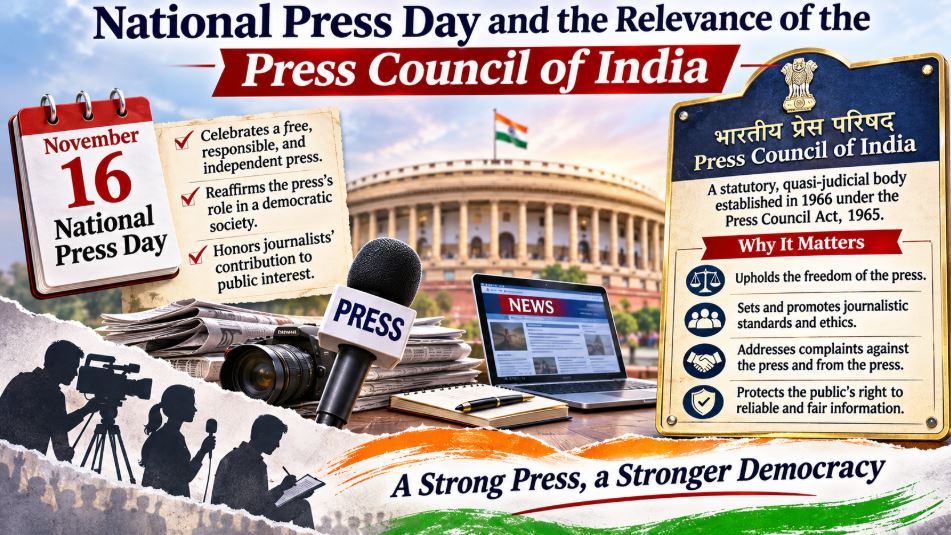
The Press Council of India occupies an important position in India’s media landscape. Established under the Press Council Act, 1965, and beginning its functioning on November 16, 1966, the Council was created to preserve the freedom of the press and maintain and improve the standards of newspapers and news agencies.
It serves as a moral watchdog of the print media and provides a framework for addressing complaints concerning journalistic conduct and professional standards.
Its significance becomes even more relevant in an era when the boundaries between professional journalism, social media commentary, citizen reporting, and digitally generated content are increasingly blurred.
However, safeguarding press freedom is not the responsibility of one institution alone. It requires cooperation among media organisations, journalists, policymakers, civil society, technology companies, and citizens.
The Way Forward: Making Journalism More Credible and Responsible
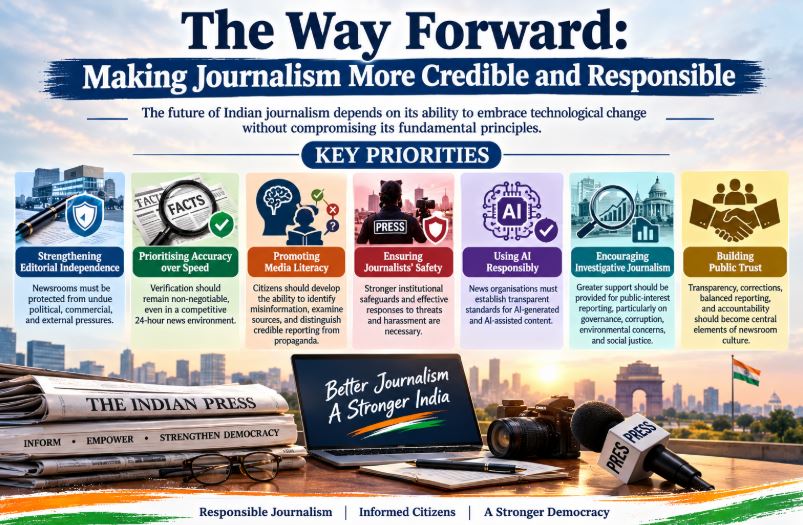
The future of Indian journalism depends on its ability to embrace technological change without compromising its fundamental principles.
Some important priorities include:
· Strengthening editorial independence: Newsrooms must be protected from undue political, commercial, and external pressures.
· Prioritising accuracy over speed: Verification should remain non-negotiable, even in a competitive 24-hour news environment.
· Promoting media literacy: Citizens should develop the ability to identify misinformation, examine sources, and distinguish credible reporting from propaganda.
· Ensuring journalists’ safety: Stronger institutional safeguards and effective responses to threats and harassment are necessary.
· Using AI responsibly: News organisations must establish transparent standards for AI-generated and AI-assisted content.
· Encouraging investigative journalism: Greater support should be provided for public-interest reporting, particularly on governance, corruption, environmental concerns, and social justice.
· Building public trust: Transparency, corrections, balanced reporting, and accountability should become central elements of newsroom culture.
Conclusion: A Free Press Is the Foundation of an Informed Democracy
National Press Day is not merely an occasion to recognise the contributions of journalists; it is a reminder that freedom and responsibility must go hand in hand.
Technology may change the way news is gathered, produced, and consumed, but the fundamental purpose of journalism remains unchanged: to seek the truth, question authority, inform citizens, and give voice to those who are often unheard.
In an age where information is abundant but credibility is increasingly contested, the value of responsible journalism has become greater than ever. A press that is independent in its thinking, fearless in its questioning, impartial in its approach, and accountable in its conduct is essential for a healthy democracy.
Ultimately, the strength of a democracy is not determined merely by the freedom to speak, but also by the freedom to question, investigate, and report the truth.
On National Press Day 2026, the message is clear: A free press is not simply an institution of democracy; it is one of the strongest safeguards of democracy itself.
- 0
- By Neel Achary