


16, Nov 2026
Transforming Small Business Marketing: How AI Helps Build a Stronger Digital Presence
In an increasingly digital world, establishing a strong online presence has become a key factor in the success of small businesses. Whether it is a startup, a local retail store, a service provider, or an e-commerce brand, reaching the right audience and building lasting customer relationships requires a well-planned digital marketing strategy. However, limited budgets, time constraints, and a lack of marketing resources often make it difficult for small businesses to compete in the digital marketplace.
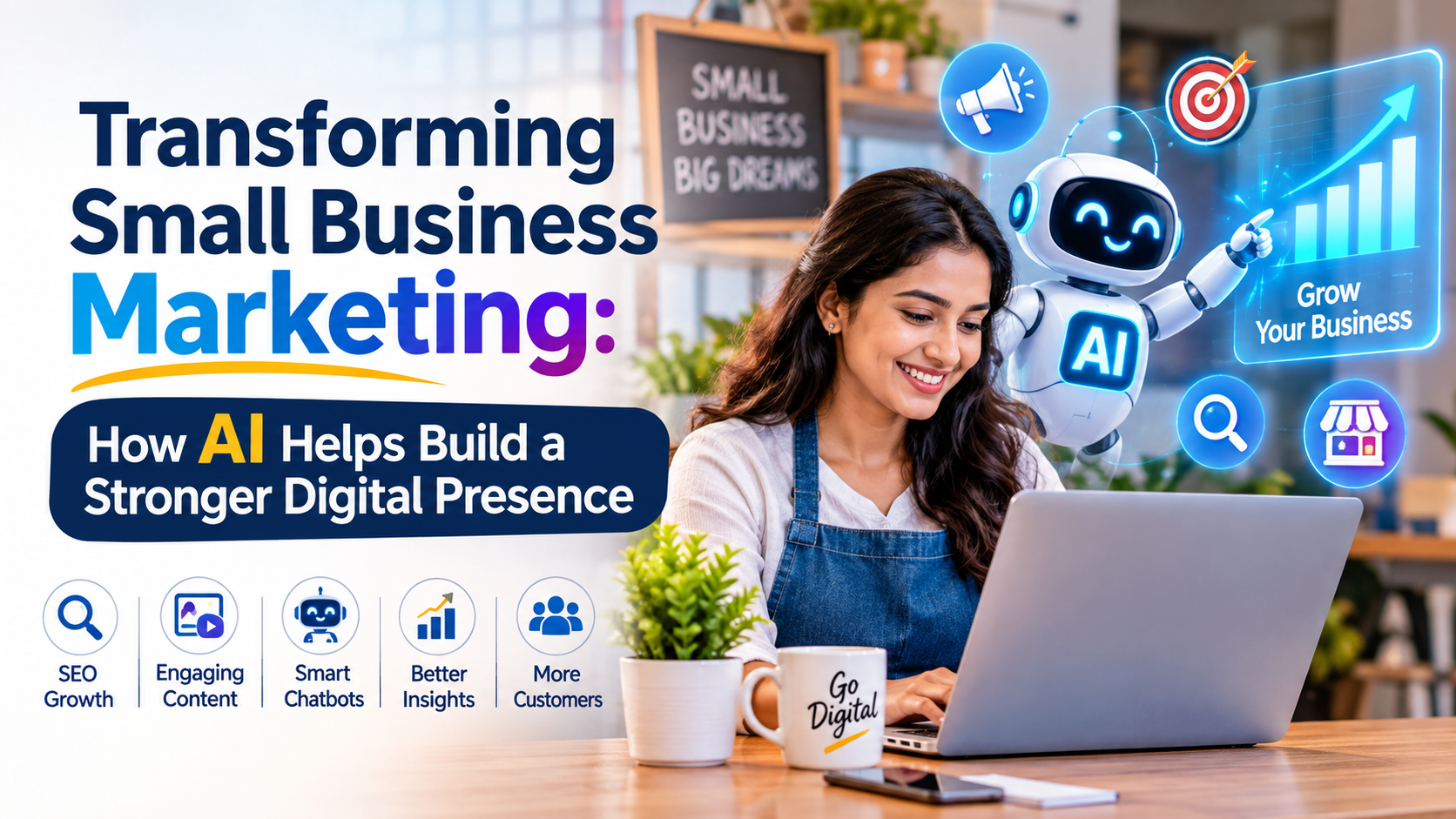
This is where Artificial Intelligence (AI) is creating new possibilities. By making digital marketing smarter, faster, and more accessible, AI is helping small businesses rethink how they promote their products and services online. From generating engaging content and improving search engine visibility to automating customer interactions and analysing marketing performance, AI-powered solutions are simplifying complex marketing tasks.
More importantly, businesses no longer need extensive marketing teams or large budgets to explore these opportunities. With the right tools and strategies, even small businesses can create meaningful digital experiences, strengthen brand visibility, and connect with potential customers. So, how can AI turn everyday marketing challenges into opportunities for business growth? Let’s explore the key ways AI is reshaping small business marketing and building a stronger digital future.
1. AI-Powered Content Marketing for Small Businesses
Content marketing is one of the most effective ways to build brand awareness, attract website visitors, and establish customer trust. However, consistently creating high-quality content can be time-consuming.
AI content creation tools such as ChatGPT and Google Gemini help small businesses generate blog ideas, website content, product descriptions, email newsletters, and social media captions.
For example, a small business owner can use AI to develop a monthly content calendar, generate blog topic ideas, and create engaging promotional messages.
AI can help businesses:
-
Generate SEO-friendly blog ideas.
-
Create website and product descriptions.
-
Write social media captions.
-
Develop email marketing content.
-
Repurpose existing content into different formats.
However, businesses should always review AI-generated content, add original insights, and ensure that the information is accurate and useful to readers.
2. Improving Search Engine Optimization (SEO) with AI
Search engine optimization is essential for improving website visibility and attracting organic traffic. When potential customers search for products or services on Google, an effective SEO strategy helps businesses appear in relevant search results.
AI-powered SEO tools can simplify keyword research, competitor analysis, content optimisation, and search intent analysis.
Small businesses can use AI to identify relevant keywords, optimise website headings, improve meta descriptions, and discover content opportunities.
For example, a local digital marketing agency can target keywords such as:
-
Digital marketing services for small businesses.
-
Affordable SEO services.
-
AI digital marketing solutions.
-
Social media marketing services near me.
AI can also help businesses prepare for emerging search technologies, including AI-powered search results and conversational search.
The key is to create helpful, original, and relevant content that answers users’ questions rather than simply adding keywords to website pages.
3. Smarter Social Media Marketing Using AI
Social media platforms such as Instagram, Facebook, LinkedIn, and YouTube provide valuable opportunities for small businesses to connect with customers.
However, managing multiple social media accounts requires consistent content creation and audience engagement.
AI tools can help businesses simplify social media marketing by generating post ideas, writing captions, creating visuals, and analysing engagement.
For example, a small fashion business can use AI to create promotional captions, develop seasonal campaign ideas, and plan a weekly Instagram content calendar.
With AI-powered social media strategies, small businesses can maintain consistency, strengthen brand recognition, and reach their target audiences more effectively.
4. AI Chatbots for Better Customer Engagement
Customer experience is an important factor in business growth. Customers often expect quick answers about product availability, pricing, services, and delivery.
AI chatbots help small businesses automate responses to frequently asked questions and provide customer assistance beyond normal business hours.
For example, a local restaurant can use an AI chatbot to answer questions about its menu, opening hours, location, and table booking process.
AI chatbots can help businesses:
-
Respond to common customer enquiries.
-
Generate potential customer leads.
-
Provide instant product information.
-
Improve customer support availability.
-
Guide website visitors towards relevant services.
This can improve customer convenience while allowing business owners to focus on other important activities.
5. Personalised Marketing Campaigns with Artificial Intelligence
Modern customers prefer marketing messages that match their interests and requirements. Generic promotional campaigns may not always attract the right audience.
AI helps businesses analyse customer behaviour, identify audience preferences, and develop personalised marketing campaigns.
For example, an online skincare store can recommend products based on customer interests, while an educational institute can share relevant course information with prospective students.
AI-powered personalisation can improve customer engagement, support better communication, and create more relevant shopping experiences.
Businesses should always use customer information responsibly and follow applicable privacy regulations.
6. AI in Digital Advertising and Lead Generation
Digital advertising is an effective way for small businesses to reach potential customers, but managing advertising campaigns requires careful planning and performance monitoring.
AI-powered advertising features available through Google Ads and Meta Ads can assist with audience targeting, automated bidding, creative testing, and campaign optimisation.
Small businesses can use AI to:
-
Generate attractive advertising headlines.
-
Create different ad copy variations.
-
Analyse campaign performance.
-
Identify potential customer segments.
-
Improve advertising strategies.
-
Support lead generation activities.
For better results, businesses should regularly monitor campaign performance, conversion rates, and advertising expenditure.
7. AI Tools Helping Small Businesses Simplify Digital Marketing
Choosing the right AI-powered tools can help small businesses streamline their digital marketing activities, save time, and improve overall productivity. Tools like ChatGPT and Google Gemini assist with content creation, marketing ideas, and research, while Canva AI helps businesses design attractive social media graphics, promotional banners, and marketing visuals. Similarly, Grammarly improves writing quality and ensures clear communication across websites, blogs, and marketing materials.
For SEO, customer engagement, and marketing automation, platforms like Semrush and HubSpot offer valuable features for keyword research, website optimisation, customer relationship management (CRM), and campaign management. Mailchimp also helps businesses create email marketing campaigns and maintain regular communication with customers. By choosing AI tools that match their business goals, marketing requirements, and budget, small businesses can build an effective digital marketing strategy, strengthen their online presence, and create more opportunities for sustainable growth.
8. How AI Helps Improve Local SEO for Small Businesses
Local SEO is particularly important for businesses that serve customers in specific geographical areas.
Restaurants, salons, retail shops, educational institutes, and local service providers need to appear in relevant local searches to attract nearby customers.
AI can help businesses discover location-based keywords, prepare local website content, analyse customer reviews, and develop location-specific marketing campaigns.
For example, a digital marketing agency in Bhubaneswar can create relevant website content targeting searches such as “digital marketing agency in Bhubaneswar” and “SEO services in Bhubaneswar”.
Businesses should also optimise their Google Business Profile by maintaining accurate contact details, business hours, photographs, services, and genuine customer reviews.
A strong local SEO strategy combined with AI-powered marketing can help small businesses improve their local online visibility.
9. The Future of AI in Small Business Marketing
Artificial Intelligence is continuously changing the digital marketing industry. Emerging technologies such as AI agents, predictive analytics, conversational search, and automated marketing workflows are creating new opportunities for businesses.
In the coming years, small businesses may increasingly use AI to manage marketing activities, understand customer preferences, improve customer experiences, and make data-driven decisions.
For small businesses in India, AI adoption also creates opportunities to improve operational efficiency and compete in the growing digital economy.
However, successful marketing will continue to depend on creativity, customer trust, quality services, and effective business strategies.
Conclusion
Artificial Intelligence is transforming small business marketing by making digital marketing activities more accessible, efficient, and data-driven.
From SEO and content creation to social media management, customer engagement, and digital advertising, AI provides practical solutions that can help businesses strengthen their online presence.
Small businesses do not need to adopt every available AI technology. Instead, they should identify their marketing challenges, choose suitable AI tools, and gradually integrate them into their business strategies.
- 0
- By Neel Achary



