


28, May 2026
Indian Bank partners with OpenText for advanced AI infrastructure & IT Service Management Solutions
Chennai, May 28: Indian Bank announces the adoption of advanced observability and service management from OpenText, a global leader in secure information management for AI, to further strengthen Bank’s digital transformation journey and modernise enterprise-wide IT and service management operations.
The objective of this initiative is to increase efficiency, improve the performance of the information technology infrastructure, and equip the Bank to deal with changing compliance requirements.
With increasing demand for compliance, resilience, and improved customer experience, financial institutions are expected to respond efficiently. Customers are also expecting responses to flow seamlessly and on real-time basis. The OpenText OSM solutions will help the Bank to effectively address challenges and opportunities.
“The OpenText OSM platform brings a transformative approach to IT and regulatory management, positioning Indian Bank for sustained growth in an increasingly digital financial landscape,” said Deepak Sarda, Chief Information Officer and Chief General Manager, Indian Bank. “This initiative will improve operational efficiency while enabling innovation across the IT infrastructure and application ecosystem of the Bank.”
This collaboration reinforces Indian Bank’s commitment to leveraging technology-led transformation to deliver efficient, secure, and customer-centric banking services.
- 0
- By Neel Achary

27, May 2026
India’s Global Trade Pivot: Mapping the Regions Powering the Nation’s Economic Rise
India’s trade diplomacy is entering a new era — one defined not by dependence on a single geography, but by diversified economic engagement across multiple global power centres. A recent visual released by the Department of Commerce, Ministry of Commerce and Industry, captures this transformation by highlighting five major regions shaping India’s international trade ecosystem: NAFTA, Europe, ASEAN, NEA (North-East Asia), and WANA (West Asia & North Africa).
Beyond its infographic appeal, the map reflects a deeper economic reality: India is strategically positioning itself as a pivotal node in global supply chains at a time when geopolitical shifts, manufacturing realignments, and energy transitions are redefining world trade.
Trade as Strategic Statecraft
For decades, India’s trade policy was often viewed through the lens of import management and tariff protection. Today, however, trade has become a critical instrument of strategic influence, industrial growth, and geopolitical balancing.
India’s outreach across North America, Europe, Southeast Asia, East Asia, and the Gulf demonstrates a deliberate “multi-alignment” strategy aimed at:
- Reducing overdependence on any single market
- Strengthening export competitiveness
- Securing energy supplies
- Expanding technology partnerships
- Integrating into resilient global supply chains
This diversification is particularly significant amid growing uncertainties surrounding global manufacturing concentration, protectionism, and geopolitical fragmentation.
North America: India’s Premium Export Corridor
The NAFTA region — led by the United States — continues to serve as India’s most lucrative export destination.
The US remains India’s largest trading partner, driven by robust demand for:
- Information technology services
- Pharmaceuticals
- Engineering goods
- Textiles and apparel
- Electronics and telecom products
India is also benefiting from the “China-plus-one” manufacturing strategy adopted by global corporations seeking alternative sourcing destinations. American firms are increasingly viewing India as a long-term manufacturing and innovation partner, especially in sectors such as semiconductors, clean energy, defence, and digital infrastructure.
Trade relations with Canada and Mexico are also expanding, opening opportunities in agriculture, automotive components, and industrial manufacturing.
Europe: Sustainability Meets Commerce
Europe represents more than just a trading partner for India — it is increasingly becoming a technology and sustainability collaborator.
Negotiations surrounding the India-European Union Free Trade Agreement have regained momentum, reflecting mutual strategic interests in:
- Green hydrogen
- Electric mobility
- Climate technologies
- Digital governance
- Advanced manufacturing
European markets continue to offer Indian exporters access to high-value consumers, particularly in pharmaceuticals, textiles, automotive components, and engineering products.
At the same time, emerging regulations such as the Carbon Border Adjustment Mechanism (CBAM) are pushing Indian industries toward cleaner and more sustainable manufacturing practices.
For India Inc., Europe is evolving into both a commercial opportunity and a compliance-driven transformation catalyst.
ASEAN: The Indo-Pacific Growth Engine
ASEAN remains central to India’s Act East Policy and Indo-Pacific ambitions.
The region’s importance lies not only in trade volumes but also in supply-chain integration, maritime connectivity, and strategic geography. Nations such as Singapore, Vietnam, Indonesia, Thailand, and Malaysia are becoming increasingly important for Indian businesses seeking regional manufacturing ecosystems.
India’s engagement with ASEAN is accelerating in sectors including:
- Electronics assembly
- Digital economy partnerships
- Fintech collaboration
- Logistics and shipping
- Food processing
- Renewable energy
As global companies diversify production bases away from concentrated markets, Southeast Asia and India are emerging as complementary growth hubs rather than competitors.
North-East Asia: Technology and Industrial Partnerships
North-East Asia — particularly Japan and South Korea — plays a foundational role in India’s industrial modernization journey.
Japanese and Korean investments have been instrumental in:
- Automotive manufacturing
- Metro rail infrastructure
- Electronics production
- Industrial corridors
- Smart city development
China, despite geopolitical and strategic tensions, remains deeply embedded in India’s trade matrix through electronics, industrial machinery, active pharmaceutical ingredients, and solar components.
This duality highlights one of India’s biggest economic challenges: balancing supply-chain dependence with national industrial resilience.
India’s growing focus on semiconductor manufacturing, electronics localization, and production-linked incentive (PLI) schemes reflects efforts to gradually reduce vulnerabilities while retaining integration with global technology ecosystems.
WANA: Energy Security and Investment Flows
The WANA region — encompassing West Asia and North Africa — remains indispensable to India’s economic stability.
The Gulf economies are among India’s largest suppliers of crude oil and LNG, making the region critical for India’s energy security. Beyond hydrocarbons, however, economic engagement is rapidly diversifying.
Sovereign wealth funds from the UAE and Saudi Arabia are increasingly investing in:
- Infrastructure
- Logistics
- Renewable energy
- Digital platforms
- Retail and consumer sectors
India’s large expatriate workforce in the Gulf also contributes significantly through remittances, creating strong economic interdependence.
The proposed India-Middle East-Europe Economic Corridor (IMEC) further underlines the region’s growing importance as a logistics and connectivity bridge linking Asia, the Middle East, and Europe.
India’s Emerging Trade Identity
The Department of Commerce’s regional trade map ultimately reflects a broader transformation in India’s economic identity.
India is no longer merely participating in global trade — it is actively shaping its position within the evolving world order. From supply-chain diversification and digital commerce to energy transition and strategic manufacturing, India’s trade policy is increasingly aligned with long-term geopolitical and economic ambitions.
For businesses, this presents substantial opportunities:
- Export market expansion
- Manufacturing relocation
- Technology partnerships
- Infrastructure investments
- Regional supply-chain integration
However, sustaining momentum will require continued reforms in logistics efficiency, regulatory simplification, export competitiveness, and industrial productivity.
Outlook
As global trade undergoes structural realignment, India’s diversified regional engagement strategy may prove to be one of its greatest economic strengths.
The message behind the government’s infographic is clear: India is building not just trade relationships, but a globally interconnected economic architecture designed to support its ambitions of becoming a leading manufacturing, technology, and consumption powerhouse in the decades ahead.
27, May 2026
Transforming Global Food Systems: New Geospatial Innovations Aim to Combat Hunger and Support Agricultural Stability
Strategic Funding Bridges the Gap Between Data and Real-World Action
ST. LOUIS – May 27, 2026 – A new suite of geospatial innovations designed to turn data into actionable intelligence for global food systems was announced today. The Geospatial Innovation for Food Security (GIFS) Challenge has selected three project awardees to develop tools that will aid humanitarian agencies, governments, and agricultural specialists to navigate the complexities of agricultural production, climate variability, and supply chain disruptions.
Launched by Taylor Geospatial, a nonprofit organization focused on advancing geospatial artificial intelligence (GeoAI) for global public benefit, the GIFS Challenge addresses a critical gap in technologies to address food insecurity. While geospatial research is abundant, it often does not align with the problems those on the front lines actually face and stops short of providing usable tools.
“These projects prioritize execution over theory, ensuring that the work functions under the real-world constraints of time, scale, and uncertainty,” said Rachel Opitz, GIFS program manager at Taylor Geospatial. “The GIFS awardees are not just producing research; they are building tools that can be used to manage resources more efficiently and that humanitarian teams in conflict zones can use to identify food system risks before they become crises.”
The selected projects, chosen through a competitive process with external expert review, include:
Early Warning Systems for Hunger & Malnutrition
The United Nations World Food Programme, in partnership with the REACH Initiative, is developing Afghanistan’s PULSE platform (Platform for Understanding Local Shocks and Emergencies). The system tracks hazards affecting food access and supply routes, helping responders plan in environments where ground-level data is often incomplete. This includes combining climate, food security, nutrition and market data to give a complete picture of the on-ground realities.
“AF-PULSE reduces the risk of hunger and malnutrition escalating into famine-like conditions during conflict and disasters by helping prioritize limited resources and reaching communities sooner – ultimately saving lives,” said Raul Cumba, Head of Research, Assessment and Monitoring for WFP Afghanistan. “It is a gamechanger for disaster risk reduction and preparedness, providing crucial insights tailored to local contexts.”
By integrating information and community feedback with GeoAI models trained by rapid assessment feeds, the system can forecast supply chain disruptions and identify alternate transport routes to ensure timely humanitarian response. The researchers’ work focuses on Afghanistan; however, their methodology and outcomes can serve as a template for other countries facing conflict.
Predicting Food System Instability
A collaboration between Arizona State University, the University of Maryland, and Washington University in St. Louis—alongside partners NASA Harvest, NASA’s Goddard Space Flight Center, and the Famine Early Warning Systems Network (FEWS NET)—is developing a GeoAI capability to identify early signals of instability in food systems.
“Decision-makers often have to assess food security risks with limited and delayed information about what is happening on the ground,” said Inbal Becker-Reshef, Director of NASA Harvest. “By generating more timely and transparent information, it will help address critical gaps and support organizations working to anticipate emerging food security risks.”
The system aligns in-season satellite-based embeddings with natural-language queries, enabling users to generate accessible, question-driven insights while explicitly communicating uncertainty. For example, a FEWS NET analyst could ask, “Which fields have been prepared?” The tool would generate a map showing likely prepared fields and provide an estimate, such as “about 80% of fields appear prepared,” along with an indication of how confident the system is in that estimate. The framework is designed to lower technical barriers and accelerate innovation across the GeoAI and food security communities.
The project team plans to test the open-source tool in active conflict regions, including Sudan, Ukraine, Syria, and Haiti; however, like AF-PULSE, their findings will be applicable to any active conflict region.
Precision Agriculture
Led by researchers at the University of Missouri in partnership with the MU Extension, this project focuses on “water first” GeoAI model development to improve nitrogen application decisions. By combining satellite imagery and machine learning, the team maps plant-available soil water at sub-field scales. This allows agronomists, farmers, and developers of variable rate application plans to make more accurate nutrient application decisions based on water availability.
“There are no reliable tools that dynamically update estimates of crop nitrogen needed throughout the growing season based on local conditions,” said project lead Tim Haithcoat, Associate Professor in Data Science and Analytics, MU Institute for Data Science and Informatics. “Advancing a system that does that is a win for everybody – better harvests, fewer inputs, healthier ecosystems.”
The initial open-source model is being developed for rainfed arable farms in the US Midwest, focused on claypan soil regions in Missouri and Iowa, and is designed to be adaptable to regions with similar agricultural systems and soils globally.
“What excites us most is that this model doesn’t need to stay proprietary or locked to one region,” said Jasmine Neupane, Assistant Professor of Agricultural Systems Technology at the Digital Agriculture Research and Extension Center. “By designing it to travel—to adapt to different soils and seasons—we’re building something the global agricultural community can eventually use for precision agricultural management.”
The GIFS Challenge awardees represent Taylor Geospatial’s commitment to collaborative innovation, pairing world-class researchers with the practitioners responsible for global food security. All initiatives will now move from the proof-of-concept phase toward full operational deployment during an 18-month period. Each team will receive up to $550K in funding as well as expert guidance and support.
27, May 2026
Zapata’s Harvard Quantum Lab Co-Founders Drs. Cao and Olson Return as CTO and VP of Strategy and Operations
Cao rejoins following tenure as Head of Quantum at BCG X; Olson is one of the few IP attorneys globally who also has a background in theoretical physics
BOSTON, Massachusetts – May 27, 2026 – Zapata Quantum (OTC: ZPTA) (“Zapata,” “Zapata Quantum” or the “Company”), a leader in quantum computing algorithm and application development, today announced the return of two of its co-founders to the Company’s leadership team: Yudong Cao, Ph.D., former Head of Quantum at BCG X, as Chief Technology Officer (CTO), and Jonathan Olson, Ph.D., J.D., as Vice President of Strategy and Operations.
“Yudong and Jonny are pioneers in quantum software and have helped shape the field through foundational work spanning algorithms, applications and intellectual property,” said Sumit Kapur, CEO of Zapata Quantum. “They know first-hand what it takes to translate scientific advances into practical applications, and their decision to return following our restructuring is a powerful validation of both our position and the opportunity ahead.”
Cao rejoins as CTO following his tenure as Head of Quantum at BCG X, a 3,000‑person global tech unit inside Boston Consulting Group. During his prior time at Zapata, he helped develop a significant portion of the Company’s foundational intellectual property portfolio, which today spans more than 60 granted and pending patents across quantum algorithms, optimization, machine learning and software techniques. His work in quantum application research includes Zapata’s quantum-enabled drug discovery study co-authored with Dana-Farber Cancer Institute that was recognized as one of Nature Biotechnology’s Top 10 Papers of 2025.
“Quantum computing has made extraordinary progress, but significant work remains in turning technological advances into practical applications,” said Cao. “The next phase of the industry will require software infrastructure that helps organizations identify, develop and deploy quantum applications more effectively, including by leveraging advances in AI and formal verification methods. I’m excited to work alongside Jonny and the broader team to advance that vision.”
Olson rejoins as VP of Strategy and Operations and is one of the few intellectual property attorneys globally with a deep expertise in quantum algorithms and a background as a theoretical physicist. His postdoctoral research at Harvard University focused on quantum computing and machine learning. He also helped Zapata secure the first significant quantum computing appeal before the Patent Trial and Appeal Board (PTAB), establishing an important precedent that expanded the accessibility of quantum algorithm patents.
“I believe Zapata Quantum holds the key to unlocking an entirely new era of developing quantum applications at scale,” said Olson. “Organizations need better infrastructure for evaluating and developing quantum applications in a rigorous and repeatable way. Zapata uniquely combines the scientific leadership, enterprise experience and foundational IP needed to meet that challenge, and I’m thrilled to be a part of it.”
27, May 2026
Ultrahuman launches Photon – the world’s first red light therapy with a daily plan, personalised to you
Dual-wavelength red light therapy with personalised daily protocols from Ultrahuman Ring biomarkers – on pre-order from $249
[London, 27 May 2026] – Ultrahuman, the global leader in wearable health technology, today opened pre-orders for Photon – the first dual-wavelength red light therapy device that, paired with the Ultrahuman Ring, delivers routines guided by your actual recovery score and sleep data.
Red light therapy has been studied for more than 50 years, first documented in 1967, and today the subject of thousands of peer-reviewed papers. Photon is built to make that science part of your daily routine.
Starting at just $249 – less than half the price of premium competitors – Photon delivers dual-wavelength light therapy: 660nm red and 850nm near-infrared.
But with the Photon Protocol PowerPlug for Ultrahuman Ring PRO (US and global) or Ring AIR (international) it tells you exactly which area to target, how far to hold it, and when to use it. Built to support muscle recovery and ease post-workout discomfort the next day.
Powerful Red Light Therapy
Every cell in the body runs on energy made by tiny power plants called mitochondria. When cells are stressed, tired, or inflamed, those power plants run below capacity. Red and near-infrared light passes through the skin and re-energises mitochondria, accelerating cellular repair, recovery, and adaptation.
Red light therapy may support muscle recovery and post-exercise comfort, promote the appearance of healthier-looking skin, including improvements in tone and texture, support general wellness, and contribute to overall relaxation.
Photon incorporates the two most effective wavelengths:
-
660nm red light is commonly studied for skin appearance, collagen-related benefits, and skin tone.
-
850nm near-infrared light penetrates deeper than visible red light and is commonly studied for recovery-related applications.
Every one of Photon’s 12 LEDs emits both wavelengths simultaneously with stable irradiance. Photon is being developed to meet FCC, CE, UKCA, and RoHS standards, with certifications in process for each relevant market. It weighs ~600g, charges over USB-C, runs six sessions per charge, and has a 10-minute auto-shutoff – built to be picked up and used, every day.
Mohit Kumar, CEO of Ultrahuman, said: “The science behind RLT is real – what’s been missing is the layer that makes it personal. Photon adds another layer to Ultrahuman’s full-stack health ecosystem, offering structured daily guidance to support your wellness routine, personalized to your recovery data when used with Ultrahuman Ring.”
Powered by Ultrahuman Ring PRO and Ring AIR
Every other red light therapy device treats every day the same. While Photon works beautifully on its own, with the Ultrahuman Ring, it offers something no other RLT device can: personalised, targeted recovery. It offers:
-
A daily session card recommending which protocol to follow today (recovery, skin, or wind-down), session length, and suggested time of day, informed by your recovery and sleep data. Body areas follow your chosen protocol rotation.
-
A goal-led protocol – Recovery, Skin, Sleep, or General Wellness – that rotates focus areas through the week so you build consistency with variety across body areas.
-
Time-of-day guidance: morning sessions framed for activation, evening sessions for wind-down, based on your preferred schedule and daily context.
-
Built-in education: every session includes a short, educational explainer, so users understand the why behind each protocol and become better RLT users over time.
Premium therapy at a fraction of the price
Today’s premium RLT devices cost $549 to $1,000+, while budget options cut corners on irradiance and wavelength accuracy. Photon is built to end that trade-off.
Ultrahuman Photon is available for pre-order from today at $249. The Photon Protocols PowerPlug is included free for Ring PRO and Ring AIR users. Pre-orders open today at ultrahuman.com/photon, with deliveries from June 2026.
27, May 2026
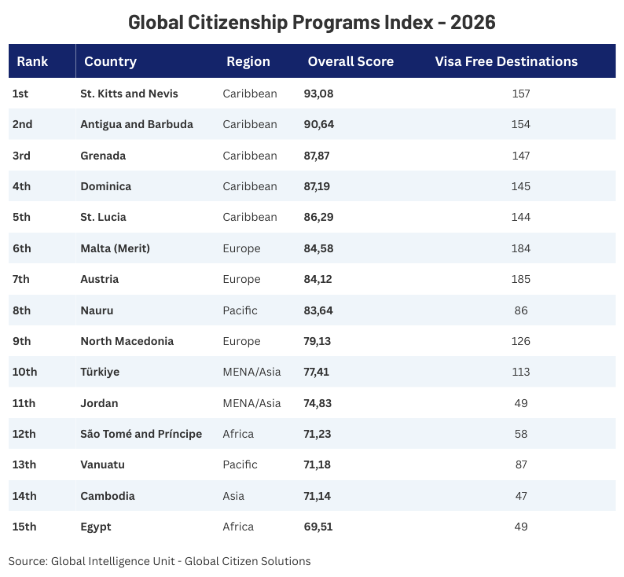
Global Citizen Solutions ranks 15 active citizenship programs in Global Citizenship Programs Index 2026
London – May 27, 2026 — Global Citizen Solutions (GCS), a leading citizenship and residency advisory firm, today releases the Global Citizenship Programs Index 2026 (GCP Index 2026) — an independent, data-driven assessment of active sovereign Citizenship Programs worldwide. The 2026 edition evaluates fifteen schemes across five continents through eighteen performance indicators grouped in five thematic sub-indexes: Procedure, Mobility, Tax Optimization, Quality of Life, Investment, and two cross-cutting indicators: Compliance and Credibility.
Published over forty years after the Saint Kitts and Nevis Act of 1984 created the world’s first investment migration program, the GCP Index 2026 arrives at a moment of genuine structural change. The 2026 edition spanning five continents — from the Eastern Caribbean to Europe, the Pacific, MENA, and an emerging African presence — reflects an industry that has grown far beyond its island origins. The overarching finding is that the market is consolidating governance quality rather than price, with compliance, not cost, now the primary axis of competition across all regions.
“The most important shift in our industry is no longer about which single program is best suited to your needs, but about which combination of programs is the right one,” said Patricia Casaburi, CEO, Global Citizen Solutions. “Families today are constructing citizenship portfolios of mobility, tax residence, and legal access that reflect a far more sophisticated understanding of risk, opportunity, and belonging in a fragmented world. The 2026 GCPI reflects that reality. It assesses each program on its own merits, but it is designed to be read as a map: showing where each jurisdiction excels, where it falls short, and how it fits into the broader strategic picture our clients are building.”
Caribbean: Governance over Price
The five Eastern Caribbean nations — St. Kitts and Nevis (93.08), Antigua and Barbuda (90.64), Grenada (87.87), Dominica (87.19), and St. Lucia (86.29) — sweep the top five positions. The competitive story here is not dominance by default: the October 2025 ratification of ECCIRA, the first unified regional CBI regulator in the industry’s history, and a Memorandum of Understanding explicitly establishing a minimum investment threshold of no less than $200.000 together mark a structural shift from competing national programs toward a single, regulated regional market.
Europe: Unmatched Mobility and Quality of Life in Austria & Malta
Two of Europe’s programs — Malta’s Citizenship by Merit (83.58) and Austria’s Citizenship by Merit (80.12) — lead the global index on two of its most applicant-critical dimensions. Austria records a perfect Mobility score of 100.0, providing access to 185 visa-free destinations, and leads Quality of Life at 90.6. Malta’s full EU and Schengen access underpins its 98.5 Mobility score. Compliance is equally the European strength: Austria (95) and Malta (93) sit at the top of the global governance ranking — a position that directly translates into banking access and long-term program durability.
Pacific: A New Budget Tier and Zero-Tax Proposition in Vanuatu & Nauru
The 2026 cycle’s most significant supply-side development is the emergence of a credible budget tier below $150,000 USD. Vanuatu (86.14) and Nauru (83.64) both achieve perfect Tax Optimization scores of 100.0 — the only programs in the index to do so — on the strength of fully zero-tax regimes covering income, corporate, capital gains, wealth, and inheritance. Processing windows of two to four months are also the fastest in the global market.
Middle East, Turkey and Africa: Scale, Strategic Positioning and Emerging Markets
Türkiye (77.41), Jordan (74.83), and Egypt (69.51) offer a value proposition unavailable elsewhere: access to large domestic economies, and in Türkiye’s case, NATO membership and EU customs union access in case, due to its geostrategic location at the crossroads of Europe and Asia, and US E-2 Treaty eligibility (under three-year domicile requirement rule)— a combination no other citizenship program can match. Jordan’s 2025 reforms repositioned its program around active job creation. The region’s structural weakness is consistent: worldwide tax systems weigh Tax Optimization scores across all three. Africa’s São Tomé and Príncipe (71.23) meanwhile launched a development-linked framework in 2025.
The Portfolio Model Replaces the Single-Program Approach
Across all regions, the 2026 Index reflects a deeper behavioural shift among applicants. Ultra-high-net-worth families are no longer seeking a single best programme — they are constructing diversified portfolios of citizenship, residence, and digital access rights calibrated to risk profile, time horizon, and tax footprint. The GCP Index has been designed to serve that question: assessing each program on its own merits while functioning as a map of where each jurisdiction excels, where it falls short, and how it fits into a broader strategic picture.
“For the small island states of the Eastern Caribbean, citizenship by investment is a development engine that has translated mobility demand into schools, hospitals, climate-resilient housing, and post-disaster reconstruction,” said Joe Rice, Head of Caribbean Programs, Global Citizen Solutions. “The GCP Index captures the technical strength of these programs, but the deeper story is what they make possible: a model in which sovereign reputation, family legacy, and national development are mutually reinforcing.”
“At Global Citizen Solutions, we believe that informed decisions begin with rigorous data,” said Dr. Laura Madrid, Lead Researcher, Global Intelligence Unit, Global Citizen Solutions. “This Index is our contribution to a more transparent, evidence-based industry: a framework that allows applicants, policymakers, and practitioners to evaluate 15 programs against the dimensions that genuinely matter: procedural integrity, mobility, fiscal environment, quality of life, and institutional credibility.”
27, May 2026
NABARD Hosts Lecture on ‘Developed India 2047’ in Memory of Dr. B.R. Ambedkar
New Delhi, May 27: In the memory of Baba Saheb, NABARD, New Delhi Regional Office organized an inspirational lecture series on the topic ‘Developed India 2047 – Relevance of the thoughts of Dr. Bhimrao Ambedkar (Baba Saheb)’.

The event was graced by the presence of Dr. Sanjay Paswan, former Union Minister of State (Ministry of Human Resource Development, Ministry of Social Justice and Empowerment, Ministry of Communications and Information Technology) as the Chief Guest. Dr. Sanjay Paswan is a prominent Dalit thinker and has edited the 14-volume ‘Encyclopedia of Dalits in India’.
The programme was presided over by Shri BB Ghadge, National General Secretary, All India NABARD Progressive Employees Welfare Association.
The event was attended by Sh. Nabin Kumar Roy, Chief General Manager, NABARD New Delhi Regional Office, along with Dr. Har Gopal Yandra, Managing Director, NABCONS and office staff members and NABCONS personnel. Special invitations were also given to sanitation workers, security guards, maintenance personnel, and others.
First of all, the guests present offered flowers and garlands on the statue of Baba Saheb, after which in the welcome speech by Mr. Manjeet Siwan, Secretary of NABARD Delhi Progressive Employees Welfare Association threw light on the ideology of Baba Saheb Dr. Bhimrao Ambedkar. Mrs. Anita Rana, Development Assistant, recited a self-composed poem based on the life of Baba Saheb.
In his address, Dr. Sanjay Paswan highlighted the relevance of Baba Saheb’s ideas for India’s social and economic development and underlined their role in building an inclusive and strong nation by 2047. He particularly highlighted his vision for rural development, social inclusion, and ensuring equal opportunity which is crucial in today’s times.
Shri B.B. Ghadge, National General Secretary, All India NABARD Progressive Employees Welfare Association, while mentioning various initiatives of NABARD, said that the organization is committed to inclusive development inspired by the principles of Baba Saheb to achieve the goal of “Developed India 2047”.
In his address, Sh. Nabin Kumar Roy, Chief General Manager, highlighted NABARD’s transformative journey over the past four decades and its vital role in rural development. He also stated that achieving the vision of “Developed India 2047” depends on strengthening the rural economy, strengthening the institutional framework, and ensuring inclusive and sustainable development.
Dr. Har Gopal Yandra, Managing Director, NABCONS, in his address, emphasized the historical significance of the CRAFICARD Committee, whose recommendations led to the establishment of NABARD in 1982 as a dedicated development financial institution to meet the credit and development needs of agriculture and rural areas. He also underlined that NABARD’s operations are in accordance with the constitutional ideals of social justice, inclusive growth, and equal opportunity.
The discussions at the lecture reaffirmed that the principles propounded by Dr. B.R. Ambedkar—especially social justice, inclusiveness, and economic empowerment—remain highly relevant today for achieving the goals of a ‘Developed India 2047’.
Officers and employees actively participated in the program and deliberated on the topic. All participants in the lecture series were encouraged to reflect on their contributions to nation-building.
The program was moderated by Mrs. Sheena, Assistant Manager, and organized in collaboration with the NABARD Progressive Employees Welfare Association.
The program concluded with a vote of thanks by Mr. Samarth Rai, Assistant Manager.
|
|
27, May 2026
IFC and Banco de Bogotá Announce Up to USD150 Million Financing to Create Jobs and Boost Sustainable Growth
Bogotá, Colombia, May 26: To support job creation, advance sustainable infrastructure, expand access to finance for small and medium enterprises (SMEs), and strengthen Colombia’s transition to a low-carbon economy, the International Finance Corporation (IFC), a member of the World Bank Group, announced a financing package of up to US$150 million for Banco de Bogotá.

The investment aims to mobilize private capital into key sectors such as construction, transport, energy, and manufacturing—critical drivers of productivity, competitiveness, and job creation in the country. These labor-intensive sectors face structural constraints linked to infrastructure gaps and limited access to financing.
The investment will focus on three key areas. Approximately 20 percent will support transition finance, helping companies advance technological upgrades and improve operational efficiency. Around 30 percent will be channeled to small and medium enterprises (SMEs) to support their growth and expansion. The remaining 50 percent will be allocated to sustainable construction, exclusively financing projects certified under EDGE Advanced or comparable international standards such as LEED Gold or Platinum, with a strong emphasis on reducing water and energy footprints in Colombia’s construction sector.
In addition to financing, IFC provided technical assistance to Banco de Bogotá to develop the first transition finance frameworks in Latin America, strengthening the financial system’s capacity to channel resources toward investments aligned with decarbonization goals.
“This transaction demonstrates our ability to structure innovative financial solutions aligned with international standards, mobilizing capital toward projects that enhance business competitiveness, accelerate the energy transition, and deliver tangible economic and environmental impact for Colombia. The mobilization of these US$150 million will enable more companies to access financing to modernize their processes, reduce energy and water consumption, adopt more efficient technologies, and strengthen their competitiveness in an increasingly demanding environment,” said Juan Carlos Echeverry, President of Banco de Bogotá.
“This project reinforces our commitment to supporting sustainable economic growth in Colombia by expanding access to long-term financing for sectors that are critical for job creation and competitiveness,” said Elizabeth Martínez Marcano, IFC Division Director for Colombia, the Andean Region, and the Caribbean. “At the same time, we are helping mobilize capital toward investments that drive climate transition and strengthen the country’s resilience.”
The investment is supported by a performance‑based incentive under the IFC-UK Market Accelerator for Green Construction (MAGC), a blended finance program supported by the United Kingdom, acting through the Department for Energy Security and Net Zero. MAGC helps scale green construction across emerging markets by incentivizing financial intermediaries to offer or expand green construction lending products.
27, May 2026
Auditoria.AI introduces Governed Autonomy for Enterprise Office of the CFO at 2026 Gartner CFO Symposium
Santa Clara, CA, May 26: Auditoria.AI, the leader in agentic artificial intelligence for the Office of the CFO, today introduced Governed Autonomy, a new operating framework for enterprise finance AI that allows autonomous agents to execute work inside enterprise-defined guardrails instead of requiring human approval at every step. Auditoria believes the biggest barrier to enterprise AI deployment is no longer model capability, but governance.
The enterprise AI conversation inside finance is changing quickly. Most organizations no longer question whether AI can automate work. The bigger issue is whether autonomous systems can operate inside financial environments without introducing new governance, compliance, and operational risks. The announcement coincides with Gartner’s 2026 CFO Symposium, where Autonomous Finance has emerged as a central theme for finance leaders evaluating how AI agents can safely operate across accounts payable, accounts receivable, planning, and controllership functions.
McKinsey reports that 88% of organizations are already using AI in at least one business function, yet most have not embedded it deeply enough to capture enterprise-level value. According to Deloitte’s 2026 State of AI in the Enterprise report, 46% of organizations cite governance and oversight as a key AI risk, while only 21% say they have a mature governance model in place. Auditoria believes the gap between AI experimentation and operational deployment now comes down to governance, not capability.
“Human-in-the-loop was how the industry learned to trust AI. It is not how the enterprise will ultimately run on it,” said Rohit Gupta, CEO and Co-Founder of Auditoria.AI. “If every invoice or approval still needs a human to validate the system, AI is just sitting on top of the old operating model. The bottleneck shifts from doing the work to approving it. Governed Autonomy changes that. The enterprise sets the policies upfront: what agents can do, when they can act, how authority is enforced, and how every action is audited. Trust shifts from approving every transaction to designing systems that are trustworthy by construction.”
Governance becomes the new enterprise AI battleground
The introduction of Governed Autonomy reflects a broader shift underway across enterprise technology markets. Over the last year, every major enterprise platform vendor has accelerated its AI agent strategy. Yet most enterprise environments remain deeply fragmented, with finance workflows spanning multiple systems of record, productivity platforms, procurement systems, and service management environments.
According to Auditoria, that fragmentation creates a new challenge for enterprise AI governance. Governed Autonomy allows finance organizations to move human oversight upstream into policy design, operational governance, and exception management, rather than inserting people into every transaction flow. Under the framework, AI agents dynamically adapt as governance policies change, automatically applying updated rules and controls across categories of work.
The framework operates across Auditoria’s agentic finance platform, spanning accounts payable, accounts receivable, and FP&A workflows. It is designed to operate on continuously validated financial data across enterprise systems, allowing governance policies, identity controls, and audit logic to remain consistent as workflows move between platforms.
Governance cannot stop at the edge of a single platform. Enterprise AI requires identity propagation, policy enforcement, entitlement controls, and auditability across the entire operating environment. Auditoria’s Governed Autonomy framework is designed to operate across multi-system enterprise environments, including Workday, Oracle, SAP, NetSuite, Coupa, Microsoft 365, Google Workspace, and ServiceNow. The platform combines cross-system orchestration with identity-bound execution, configurable rule enforcement, and controller-grade audit logging.
Every agent action is tied to enterprise identity, runtime authorization, and entitlement enforcement. Organizations can define configurable operational boundaries around what agents can do, under which conditions, and with what level of authority. The company says this represents a fundamental shift from reactive review-based AI governance toward policy-driven operational governance.
“Autonomy without governance creates risk. Governance without autonomy creates friction,” Gupta said. “Get that balance right and AI stops being a pilot and starts being how the enterprise actually runs. Trust cannot depend on reviewing every transaction forever, it must be engineered into the operating model itself.”
New capabilities operationalize Governed Autonomy across AP workflows
Auditoria also announced expanded capabilities across its AP platform that operationalize the framework inside live enterprise workflows.
The latest version of AP Helpdesk introduces deeper visibility and classification across vendor and finance communications, using configurable rules that allow agents to process, route, and respond to inquiries autonomously while maintaining complete auditability. Auditoria also expanded AP Invoices with configurable policy logic that enables agents to process invoice data, routing decisions, coding structures, and exception handling based on enterprise-defined governance parameters rather than static workflow rules.
The company says these capabilities allow finance teams to automate increasingly complex operational scenarios without sacrificing transparency or control.
“What enterprises want now isn’t just AI capability, but operational accountability,” said Swami Chandrasekaran, Partner & Global Head of AI & Data Labs at KPMG. “As autonomous agents move into financial workflows, they need clear boundaries, identity-bound execution, and auditability that runs with every action, not after it. That’s what separates a true digital teammate/collaborator from an automation script. Governance isn’t the friction layer. It’s how trust gets engineered into the operating model. Auditoria’s Governed Autonomy framework reflects and leads the direction serious enterprises are already moving in.”
“Within a decade, AI will execute most transactional work in finance, leaving governance as finance’s only remaining lever of control and oversight. Teams that adapt their governance approach to accommodate AI now will adopt and scale quickly. Teams that delay and focus on short-term wins will end up with a fragmented AI landscape heavily dependent on people to ensure transactional integrity,” said Mark D. McDonald, founder of Finance Next.
Ecosystem alignment across enterprise governance platforms
Auditoria’s Governed Autonomy framework is designed to interoperate with emerging enterprise AI governance ecosystems, including Workday Agent System of Record, ServiceNow AI Control Tower, Microsoft governance services, and OpenAI governance frameworks.
The company recently achieved official certification in Workday’s Agent System of Record, reinforcing Auditoria’s position within the evolving enterprise governance stack for AI agents operating within finance environments.
Availability
Governed Autonomy capabilities are now available across the Auditoria platform, including AP Helpdesk, AP Invoices, SmartResearch, and broader agentic finance workflows that support the Office of the CFO.
27, May 2026
In an industry-first collaboration, Mews and Uber bring ride booking inside the hotel operating system
AMSTERDAM and SAN FRANCISCO – May 26: Mews, the hospitality operating system, has announced a strategic partnership with Uber to embed ride booking, real-time tracking and integrated billing directly into the Mews platform.
Uber announced GO-GET 2026 last month, organizing the app around three actions: go, get and travel. Alongside a series of partnerships on the rider side, the Mews integration extends the same direction into the hotel’s property management system (PMS), giving hoteliers a way to offer Uber rides as part of the guest stay rather than a transaction that happens outside their walls.
At Mews Unfold on May 27 in Amsterdam, Christophe Peymirat, Sr. Director, General Manager, Uber for Business EMEA, and Mike Coscetta, President of Mews, will take the stage together to discuss how collaboration between travel technology, hotels and companies outside the traditional travel sector is reshaping the guest experience.
Transportation bookings are one of the most common guest requests and one of the most manual processes in hotel operations. Mews research from 2026 found that guests arrange their own transportation and spend an average of $50 on it per stay, money that bypasses the hotel entirely1. With this integration hoteliers can drive additional ancillary revenue by offering this service to guests.
This highlights a significant opportunity: guests today want a ‘frictionless’ stay where the hotel solves every problem for them, not just the room. By bringing these moments together, this integration allows hotels to move beyond just accommodation and deliver the fully connected experience guests are looking for.
The integration will enable hotel staff to request rides for guests in just a few clicks, track journeys in real time, and manage payments seamlessly — all within Mews. Airport pickups and last-minute changes will be visible and manageable from within the Mews platform.
“Hotels put enormous effort into the guest experience within their four walls,” said Christophe Peymirat, Sr. Director, GM, Uber for Business EMEA. “The journey to and from the property is just as much a part of that experience. Connecting Uber’s network directly into the Mews platform is a practical step toward giving hotels visibility and control over something they have been managing manually for decades.”
The same logic applies to hotel teams: staff transportation for late and night shifts gives hotels a simple way to arrange stress-free, reliable journeys home for team members and improve staff satisfaction.
The integration is being built to include:
– Staff-initiated and guest-initiated ride booking, available via the Mews platform through accounts and the guest portal
– Live vehicle tracking and trip confirmations, so staff and guests know exactly where a ride is
– Automatic billing to the guest folio through Mews Payments, removing manual reconciliation and keeping every transaction inside the same platform
– Full visibility for the hotel regarding all ride activity, and full transparency for the customer regarding costs
– Insights into guest transportation patterns to help hotels plan better and manage services across the guest journey
“Embedding Uber into the Mews Operating System means hotels can offer transportation services as part of the stay and add it to the one unified guest bill, making it part of the guest relationship rather than a separate transaction. Transportation is one of the clearest examples of a regular guest requirement that hotels are best positioned to provide, but not currently set up to do seamlessly,” said Mike Coscetta, President of Mews.
The Mews and Uber integration is in development, with a pilot launching this year. Further details will be shared directly with customers and partners ahead of launch.
The entire Unfold program will be available to stream live and for free, with the session, “Vision for the industry – Uber” running on Wednesday, May 27, 11:50 AM to 12:05 PM CET.


