


30, Apr 2026
New Study Shows Mental Health Campaigns and Digital Tools Reduce Risk in Slums

New Delhi, Apr 30 (BNP): A recent study has found that community-based anti-stigma programmes, along with a digital mental health support tool, have helped reduce risks of depression, self-harm, and suicide among adolescents living in urban slum areas.
The research covered 60 slum clusters across New Delhi and Vijayawada in Andhra Pradesh, focusing on improving awareness and access to mental health care for vulnerable teenagers.
India has one of the largest adolescent populations in the world, and a significant share of young people face mental health issues such as anxiety and depression, according to global health estimates.
Researchers observed that adolescents in urban slums are particularly at risk due to factors such as poverty, low awareness about mental health, and limited access to professional support services.
The study suggests that combining community outreach efforts with digital tools can help strengthen mental health support systems in underserved communities.

- 0
- By Neel Achary

30, Apr 2026
From Promise to Proof: Strengthening the Evidence Base for Digital Health Technologies
Lawrenceville, NJ, USA, Apr 30: Value in Health, the official journal of ISPOR, has announced the publication of a special themed section focused on advancing methods to evaluate the real-world value of digital health technologies.
The April 2026 issue features a curated series of research papers exploring how digital health solutions create value across clinical, behavioral, and healthcare system pathways, while addressing the challenges of measuring their impact effectively.
The themed section is led by guest editors Axel Mühlbacher (Hochschule Neubrandenburg, Germany), Volker Amelung (Medizinische Hochschule Hannover, Germany), and Katarzyna Kolasa (Kozminski University, Poland).
In their editorial, the editors highlight that digital health technologies are becoming integral to modern healthcare delivery but remain complex to evaluate due to variations in definitions, applications, and outcomes. They emphasize that value is not inherent in the technology itself but emerges through its integration into healthcare systems.
Key Insights from the Research
The collection includes seven research papers covering topics such as health technology assessment frameworks, AI-driven clinical tools, predictive modeling, cost-effectiveness, and sustainability in digital health.
The findings reveal that current evaluation frameworks are often inadequate for capturing the multi-dimensional value of digital health technologies, particularly when benefits are distributed across complex healthcare pathways and systems.
Key Recommendations for the Sector
- Multi-dimensional evaluation: Expanding beyond clinical outcomes to include system efficiency, implementation feasibility, and real-world monitoring
- Decision-relevant models: Incorporating real-world factors such as patient adherence, healthcare capacity, and population-level outcomes
- Behavioral and cost analysis: Measuring health outcomes driven by behavioral change and adopting comprehensive costing frameworks
- Sustainability focus: Integrating environmental impact into evaluation metrics, including lifecycle and energy usage considerations
- Equity considerations: Ensuring fair access and assessing how benefits and burdens are distributed across populations
The editors note that while digital health technologies hold immense promise, their adoption remains limited due to challenges in demonstrating scalable and credible value, as well as barriers in market access and system integration.
The themed section aims to guide policymakers, researchers, and healthcare stakeholders in developing robust, transparent, and actionable frameworks that support the adoption and scaling of digital health innovations.
30, Apr 2026
Azara Healthcare Recognized with KLAS 2026 Points of Light Award for Maternal Risk Reporting Collaboration Across Ohio
Statewide initiative with the Ohio Association of Community Health Centers, CareSource, and Humana more than doubled Pregnancy Risk Assessment Form submission rates, accelerating identification of high-risk pregnancies and strengthening Medicaid continuity
BURLINGTON, Mass. — [April 30, 2026] — Azara Healthcare, the four-time Best in KLAS provider of population health and value-based care solutions for the safety net, together with the Ohio Association of Community Health Centers (OACHC), CareSource, and Humana, has received a 2026 KLAS Points of Light Award. The award recognizes the collaborators’ work to automate the creation and submission of Pregnancy Risk Assessment Forms (PRAFs) across Ohio, which more than doubled statewide submission rates and accelerated the identification of high-risk pregnancies covered by Medicaid. The collaboration is documented in case study titled “Improving Maternal Health in Ohio via Interoperability & Incentivized Care.”
Before the initiative, only about 30% of PRAFs were being submitted statewide, leaving many Medicaid-covered pregnancies unreported to the state and delaying the identification of high-risk mothers. Physicians were completing PRAFs on paper or in standalone web forms, manually locating and re-entering information already documented in the EHR, a process that routinely took 15 to 20 minutes per patient.
To solve the problem, OACHC convened community health centers, seven Managed Care Organizations including CareSource and Humana, the Ohio Department of Medicaid, the Ohio College of Medicine Government Resource Center, and Azara Healthcare. The MCOs jointly funded a single electronic PRAF (ePRAF) solution so provider partners would not bear implementation costs. Azara added a new module to the existing Ohio Data Integration Platform, powered by Azara. The additional tool automatically populates ePRAFs using data already documented in the EHR and securely transmits the information to ODM’s NurtureOhio portal.
“For safety-net providers caring for Ohio’s most vulnerable mothers, the barrier to better maternal outcomes has never been a lack of clinical insight—it’s been the administrative burden of getting that insight into the right hands in time to act on it,” said LuAnn Kimker, SVP of Clinical Innovation at Azara Healthcare. “By automating the PRAF workflow inside the tools providers already use every day, we’ve ensured that high-risk pregnancies are identified and coordinated earlier. This is what interoperability looks like when it’s built around the clinician and the patient, not around the form.”
The results have been significant. –
The KLAS Points of Light Award recognizes successful collaborations between payers, providers, and healthcare technology companies that have led to measurable improvements in patient experience, cost, and efficiency.
Building on the initiative’s success, the collaborators plan to extend automation across the pregnancy continuum, including additional PRAF submissions triggered by changes in maternal risk, and the electronic capture of delivery and postpartum data. The ePRAF model is also positioned as a replicable blueprint for other states and for additional Medicaid and public health reporting use cases.
The full case study is available here.
29, Apr 2026
India Strengthens Position as Global Centre for Affordable CAR-T Cancer Therapy
Apr 29 (BNP): India is rapidly positioning itself as one of the world’s most accessible destinations for CAR-T cell therapy, driven by advances in biotechnology and more affordable treatment options, according to ImmunoACT.
The company highlighted that India’s growing capabilities in cell and gene therapy are helping make advanced cancer treatments more accessible to patients, both domestically and internationally. CAR-T therapy, which involves modifying a patient’s immune cells to target cancer, is considered a breakthrough in oncology but remains highly expensive in many parts of the world.
Industry experts note that India’s cost advantage, expanding clinical infrastructure, and skilled scientific talent pool are contributing to its emergence as a competitive global centre for advanced therapies. This is also supported by increasing investment in biotech research and stronger collaboration between academia and industry.
ImmunoACT said that India’s progress in this field reflects a broader shift toward innovation-led healthcare solutions that are both effective and affordable. The country is also focusing on scaling up production capabilities and improving regulatory pathways to support faster access to such therapies.
With growing global interest in cost-effective cancer treatment solutions, India is expected to play a more significant role in the future of cell and gene therapy worldwide.
The development marks a key milestone in the country’s journey toward becoming a global hub for advanced medical innovation and accessible healthcare technologies.
28, Apr 2026
Dr. Hemant Barua Receives Rastriya Ratan Samman for Work in Vedic Astrology
New Delhi, Apr 28 (BNP): Dr. Hemant Barua has been honoured with the prestigious Rastriya Ratan Samman in recognition of his contributions to research and practice in Vedic astrology.
The award ceremony was held on April 25 at Bharat Mandapam, New Delhi, where eminent personalities from various fields gathered to celebrate achievements across specialised domains.
The honour was presented by actress and Member of Parliament Kangana Ranaut at an event organised by VKonnet Star, which recognised individuals for excellence in knowledge-based and cultural fields.
Dr. Barua was acknowledged for his extensive work in modern Vedic astrology, including research efforts aimed at making traditional astrological knowledge more structured and relevant for contemporary audiences. Organisers highlighted his contribution in promoting wider understanding and engagement with the discipline.
The recognition reflects the continued prominence of traditional knowledge systems in India and their evolving role alongside modern academic and analytical frameworks.
26, Apr 2026
BMJRFT replaced 129 Dialysis Machines worth ₹12 Crore with donor support and felicitated them for their generosities
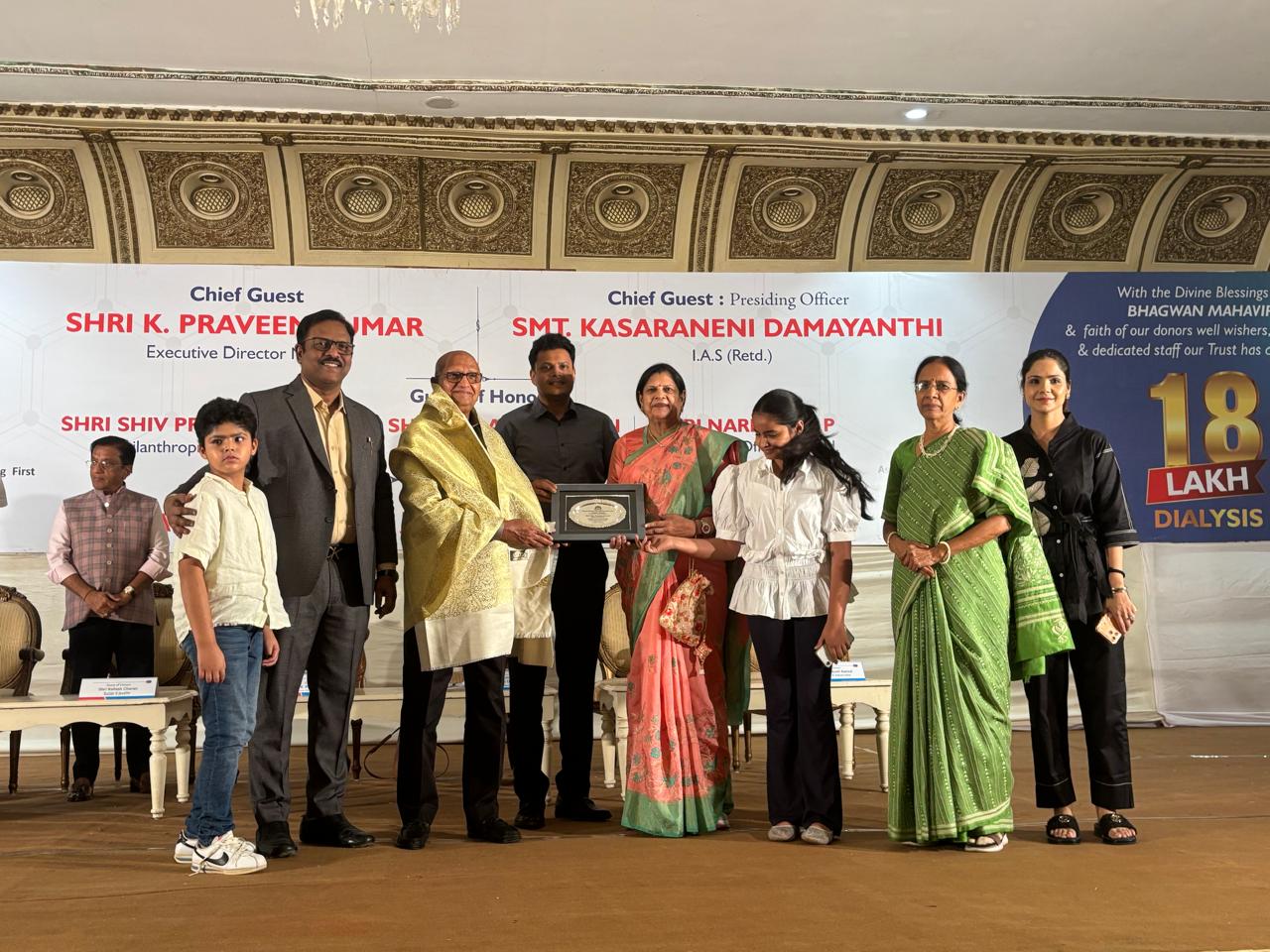
Hyderabad, Apr 26: Bhagwan Mahavir Jain Relief Foundation Trust (BMJRFT) has once again set a benchmark in affordable healthcare by replacing 129 dialysis machines worth ₹12 crore through donor support, further strengthening its mission of providing low-cost dialysis services.
BMJRFT has revolutionised access to dialysis by offering treatment at just ₹300 per session, compared to ₹2,500–₹5,000 typically charged in corporate hospitals. This initiative has significantly reduced the financial burden on patients while ensuring quality care.
Typically, dialysis machines have a lifespan of around 20,000 sessions or 5–7 years, depending on safety standards and performance audits. However, through efficient management and maintenance, BMJRFT has extended the life of its machines to 30,000–35,000 sessions. When the Trust decided to replace the machines, it was able to mobilise donor support within a week, reflecting the strong trust and goodwill it enjoys.
To honour this generosity, the Trust organised a Felicitation Ceremony for Donors of 129 Dialysis Machines on Saturday night at Marvel Imperial Garden, Secunderabad.
Praveen Kumar, Executive Director NMDC LIMITED and SMT KASARANENI DAMAYANTHI I.A.S (Retd.) were the guests at the felicitation
Among the key contributors, NMDC donated 40 machines worth ₹3.5 crore under its CSR initiative. Shivprakash Bansal, philanthropist and industrialist, contributed 16 machines and also pledged an annual donation of ₹50 lakh to support the Trust’s working capital needs.
Some of the big donors, such as Kailash Charan, Builder & Jeweller and the owner of Imperial Garden and P. Narendra, CEO -Pragati Offset Pvt Ltd, were also honoured
Other prominent donors include Pokarna Engineered Stone Ltd and a well-wisher (8 machines each), PL Raju Construction (3 machines), and Sirisha Projects Pvt Ltd (2 machines).
Additional contributions came from Hariom Pipe Industries Limited, Goutam Chand and Santosh Bokadia (Chennai), and several individual donors, including members associated with Swastik Spices, as well as families such as that of Harish Gandhi Linga and Café Niloufer, each contributing one or more machines. In total, these contributions amount to 129 dialysis machines.
Delivering the welcome address, Trust Chairman P. C. Parakh, a former IAS officer, said that the ability to mobilise resources for replacing 129 machines within a short time reflects the confidence people have in BMJRFT’s work. Despite rising inflation and increasing costs of medicines, the Trust continues to provide dialysis at ₹300 per session, saving an estimated ₹200 crore in dialysis costs and an additional ₹100 crore in medicines for patients. He added that upgrading machines is not just a technical improvement but an enhancement of dignity in patient care, and expressed gratitude to NMDC and all donors.
Currently, BMJRFT performs around 600 dialysis sessions per day and approximately 15,000 sessions per month across 11 centres. The Trust has completed over 18 lakh dialysis sessions in 17 years and is expected to reach 20 lakh sessions by April–May next year.
25, Apr 2026
The Medical Minute: Your Daughter’s First Gynecological Visit: A Parent’s Guide
Laura Laucks’ daughter was around 14 years old when her periods started disrupting her life. Heavy bleeding, severe cramps and migraine headaches made her miss classes.
“She wasn’t comfortable sitting in school,” says Laucks, who lives in Lebanon. “She would have to go to the nurse a lot.” At a primary care physician’s recommendation, Laucks brought her daughter to see Dr. Christina DeAngelis, an obstetrician-gynecologist at Penn State Health Obstetrics and Gynecology. “We often receive referrals for young women who have really heavy menstrual flow, painful periods or premenstrual syndrome (PMS) symptoms so severe that they affect their ability to enjoy time with their friends or function at school,” DeAngelis says.
Laucks wasn’t sure what to expect. She remembered her own first gynecologist visit, in her 20s. It felt abrupt and uncomfortable. Her daughter’s appointment was a different story. “They went over things with her, asked her about herself and helped her feel comfortable,” Laucks says. “Their whole approach was so different from what I expected. It really put us both at ease.”
Here’s how to prepare for your child’s first visit to the gynecologist.
When should my teen have their first gynecologist appointment?
It depends. Between ages 13 and 15, your child’s pediatrician or family medicine doctor should offer them a chance to talk one-on-one about puberty, menstruation and reproductive health. If that doesn’t happen or if you or your teen’s doctor identifies a concern, consider a visit to a gynecologist, DeAngelis says.
A gynecologist can treat:
- Heavy, absent, irregular or infrequent periods
- Painful periods
- PMS symptoms
- Breast abnormalities
- Ovarian cysts
- Pelvic pain
- Ovarian cysts
- Sexually transmitted infections (STIs)
- Yeast infections
- Bacterial vaginosis
- Endometriosis
How do I choose a gynecologist for my teen?
Ask your doctor for a referral. If you find a health care provider yourself, call the office and ask whether they see pediatric patients. Many treat adults only. What happens at the first visit? The first visit usually doesn’t require a pelvic exam. “The first thing I do when I walk in the room to see the patient is tell them that we’re just going to talk,” DeAngelis says.
Often, the focus is on preventive care and education. A gynecologist can teach your child the facts about puberty, menstruation, hygiene, sexual activity and contraception. They can also discuss cancer screening and prevention tools, such as the human papillomavirus (HPV) vaccine, which helps prevent cervical cancer.
If your daughter has symptoms such as abnormal bleeding, discharge or pain, a pelvic exam might be recommended. Sometimes a noninvasive abdominal ultrasound is used instead. It helps spot ovarian cysts or other causes of pelvic pain. If your daughter is sexually active, the doctor might share facts about birth control methods and recommend testing for sexually transmitted infections (STIs). A simple urine test can check for gonorrhea and chlamydia.
What questions can my teen ask a gynecologist?
Give your teen privacy to ask questions or share concerns without you in the room. “It’s important to have some one-on-one time because there are some things they just may not feel comfortable sharing otherwise,” DeAngelis says.
Many kids have questions about their bodies. They often wonder whether their anatomy is normal, DeAngelis says. They might feel embarrassed to bring up these subjects in front of their parents, but the doctor can share information that will help them stay healthy. “Unintended pregnancies and STIs seem to be more common in situations where families aren’t receptive to discussing it or having the child be seen by a health care provider to discuss it,” she says. Make sure these subjects are not taboo, she says. Let kids know they’re normal things to talk about. “Most times when there are poor outcomes, it’s just because they got no support or didn’t have the right information,” DeAngelis says. Minors can also consent to some medical tests and services, such as STI testing, under Pennsylvania law.
Laucks says she and her daughter both learned a lot from that first gynecology appointment. They talked about ways to manage periods. With treatment, her daughter now has lighter, more regular periods and misses fewer days of school.
They also learned other ways to support reproductive health, including healthy eating and regular physical activity.
“A lot of it I had never heard before,” Laucks says. “It was great that she was able to learn all of that at 14.”
25, Apr 2026
Why Working Out Hungover in the Heat May Be Risky
Minneapolis, April 25: Drinking alcohol the night before physical labor or exercising in the heat causes inflammation in the body to rise and may increase the risk of heat-related illness. Researchers will present their findings at the 2026 American Physiology Summit in Minneapolis. The Summit is the flagship annual meeting of the American Physiological Society (APS).
Working or exercising in hot conditions causes inflammation in the body to increase as part of a normal stress response. However, too much inflammation may contribute to heat-related illness. Drinking alcoholic beverages can also increase inflammation levels, especially from chemicals found in darker drinks such as whiskey, tequila and red wine, or from a toxic compound called acetaldehyde that the body produces as it metabolizes alcohol. In addition, alcohol may irritate the gastrointestinal tract and allow bacteria to leak into the circulatory system, which activates an inflammatory response.
It’s less clear what happens in the body when the two factors—exertion in the heat and alcohol consumption—are combined, but previous research shows that around 30% of construction workers report working with hangover symptoms at least once a month. Alcohol-induced inflammation is usually temporary and resolves over time.
In two separate trials, volunteers walked on a treadmill at varying speeds for four hours, mimicking half of an 8-hour workday. They exercised in a hot room (100-degrees F with 40% relative humidity). In one trial, the participants drank an average of eight standard alcoholic drinks (enough to reach a targeted 0.11 blood alcohol content) the evening before the exercise test, while abstaining from alcohol before the other session. Blood samples taken after the exercise session revealed higher levels of inflammatory markers when participants had consumed alcohol the night before.
“These findings suggest that drinking alcohol the night before prolonged physical work in the heat may amplify parts of the body’s inflammatory response. More research is needed to determine whether this increases the risk of heat-related illness or affects recovery and immune function,” wrote Jonathan Specht, PhD, corresponding author of the study. “Those who physically exert themselves after a night of alcohol consumption should take extra precautions to protect themselves from heat illnesses, including proper hydration, rest and seeking cool areas such as shade.”
24, Apr 2026
Government Strengthens Quality Checks for Medicines at Jan Aushadhi Kendras
New Delhi, Apr 24 (BNP): The government has taken steps to further strengthen the quality assurance framework for medicines sold through Jan Aushadhi Kendras across the country by signing new Memorandums of Understanding (MoUs) with key agencies involved in the scheme.
The initiative aims to ensure that medicines available under the affordable healthcare programme continue to meet strict safety and quality standards. The Pradhan Mantri Bhartiya Janaushadhi Pariyojana provides low-cost generic medicines through a wide network of retail outlets, helping reduce healthcare expenses for millions of citizens.
Officials said the latest MoUs will enhance monitoring systems, strengthen coordination between implementing bodies, and improve quality testing processes for medicines supplied to Jan Aushadhi stores. The focus is on making the supply chain more robust and transparent.
At present, medicines under the scheme are sourced only from certified manufacturers and undergo quality checks before being distributed. The new arrangements are expected to further tighten these procedures and ensure greater consistency in standards across all outlets.
The government has been expanding the Jan Aushadhi network in recent years to improve access to affordable healthcare, particularly in rural and underserved regions.
Officials added that strengthening quality assurance will help boost public confidence in generic medicines and support the broader goal of making essential drugs more accessible and affordable across the country.
23, Apr 2026
Texas Children’s Researcher Awarded $6.7 Million NIH Grant to Accelerate Alzheimer’s Drug Discovery and Advance New Therapies
HOUSTON (April 23, 2026) – Dr. Damian Young, investigator at Texas Children’s Duncan Neurological Research Institute (Duncan NRI) and director of the Center for Drug Discovery at Baylor College of Medicine, along with collaborators, has been awarded a $6.7 million grant from the National Institute on Aging (NIA), part of the National Institutes of Health (NIH), to develop new approaches to rapidly identify potential treatments for Alzheimer’s disease and related dementias with the goal of accelerating the discovery of new therapies.
While Alzheimer’s is often associated with aging, researchers at Texas Children’s are uniquely positioned to study it. By examining how the brain develops and functions early in life, scientists can better understand how those same systems break down over time—revealing new opportunities to prevent and treat neurodegenerative disease.

This five-year project brings together experts in chemistry, artificial intelligence and translational science to tackle one of the most complex challenges in Alzheimer’s research—quickly identifying therapies that are both safe and effective.
“This grant will enable the most expansive screening effort to date for compounds targeting Alzheimer’s disease,” Dr. Young said. “By integrating cutting-edge biological insights from Alzheimer’s disease research worldwide with a highly innovative chemistry and machine learning platform, we aim to unlock new opportunities for discovery. This work will represent the first critical step toward developing transformative therapies for Alzheimer’s disease and related dementias.”
Alzheimer’s disease and related dementias affect millions of people worldwide, yet developing new treatments remains a slow and complex process. One of the biggest challenges is identifying which molecules can successfully target the biological drivers of disease and reach the brain in a safe and effective way.
To address this, Dr. Young’s team will use DNA-encoded chemical libraries, a technology that allows researchers to screen hundreds of millions of potential drug compounds at once. Each compound carries a unique DNA “barcode,” enabling scientists to quickly identify which molecules interact with proteins linked to Alzheimer’s.
The team will then use artificial intelligence and machine learning to analyze the data and predict which compounds are most likely to succeed—significantly reducing the time from early discovery to viable drug candidates. Ultimately, this approach is designed to shorten the timeline for identifying new treatments—bringing potential therapies to patients faster and with greater precision.
The project will move through multiple phases, starting with large-scale screening and advancing to refining the most promising compounds to improve their strength, safety and ability to reach the brain. Researchers will also explore whether existing drugs can be repurposed, potentially accelerating the path to clinical testing.
A key component of the project is its open science approach. Data and compounds generated—including results from screening more than 900 million unique compounds—will be shared publicly, enabling researchers worldwide to build on the findings and advance new treatments. An internal advisory board of Texas Children’s and Baylor faculty consisting of Drs. Huda Zoghbi, Joshua Shulman, Hugo Bellen, and Juan Botas will provide critical expertise in prioritizing protein targets most strongly implicated in Alzheimer’s disease.
The work will be supported in part through collaboration with the Structural Genomics Consortium, which will provide critical protein targets needed for the research.
This research reflects Texas Children’s commitment to solving the unsolvable by advancing innovative, collaborative approaches to complex neurological diseases. Insights gained from pediatric research often inform adult treatments, and discoveries in adult disease can in turn accelerate breakthroughs in children’s health. By bridging these areas, researchers at the Duncan NRI are helping drive progress across the full spectrum of neurological disease, with the goal of improving outcomes for patients of all ages. For patients and families affected by Alzheimer’s and related dementias, this work represents a critical step toward earlier detection, more effective treatments and ultimately, prevention.


