


17, Apr 2026
Herbalife India and IIT Madras Sign Agreement to Establish Centre of Excellence
Apr 17 (BNP): Herbalife International India Private Limited and the Indian Institute of Technology Madras have entered into a partnership to set up a Centre of Excellence on Plant Cell Fermentation Technology at IIT Madras Research Park.
The centre will focus on advanced research in plant cell fermentation, a biotechnology process used to grow plant cells in controlled environments to produce useful compounds such as herbal ingredients and bioactive substances.
The initiative aims to:
- Promote research in plant-based biotechnology and fermentation science
- Support development of scalable and sustainable production methods
- Encourage collaboration between academia and industry
- Provide training and innovation opportunities in bio-manufacturing
This facility is intended to strengthen translational research, helping move scientific discoveries from the lab toward practical applications in health, nutrition, and wellness industries.
- 0
- By Neel Achary

17, Apr 2026
Apple Expands Sustainability Push in 2025
Apr 17 (BNP): US tech giant Apple Inc. has reported a major expansion in its sustainability efforts, saying that a record 30% of all materials used in products shipped in 2025 came from recycled sources.
In its latest statement, the Cupertino-based company said it has eliminated plastic from product packaging and now uses 100% recycled cobalt in Apple-designed batteries. It also confirmed the use of fully recycled rare earth elements in all magnets across its devices.
Apple said its products are now shipped in fibre-based packaging designed for easy household recycling, marking a significant shift away from plastic-based materials.
The company also reported a more than 60% reduction in greenhouse gas emissions in 2025 compared to 2015 levels, with emissions remaining stable from 2024 despite strong business growth.
Highlighting progress across multiple sustainability areas, Apple pointed to improvements in renewable energy use, recycling systems, water conservation, and zero-waste initiatives.
Apple CEO Tim Cook said the company remains committed to environmental responsibility, adding that its sustainability goals are also driving innovation across its product ecosystem.
The company further stated that Apple-designed circuit boards now use 100% recycled gold plating and tin soldering, and it has avoided more than 15,000 metric tons of plastic over the past five years through packaging redesign.
Over the last decade, Apple engineers have replaced several plastic components in packaging with recycled or responsibly sourced paper alternatives, including screen protectors and trays.
The company also noted an increase in iPhone production in India, reflecting its ongoing effort to diversify manufacturing locations.

17, Apr 2026
Wipro Stock Drops After Profit Decline and Soft Future Guidance
New Delhi, Apr 17 (BNP): Shares of IT major Wipro slipped in early trade on Friday, falling nearly 4% after the company reported a marginal decline in quarterly earnings and issued a subdued outlook.
The stock was under pressure following the company’s March quarter results for FY26, where net profit stood at ₹3,501.8 crore, marking a 1.89% drop compared to the same period last year. Investors also reacted negatively to the firm’s muted guidance for the coming quarters.
In morning trade, the stock declined 3.61% to ₹202.60 on the BSE, while on the NSE it fell 3.69% to ₹202.
Market participants said the reaction reflected concerns over near-term demand visibility in the IT sector, with investors remaining cautious amid global macroeconomic uncertainty and selective client spending.
Despite the fall, analysts note that broader sector trends will continue to depend on deal pipeline strength and discretionary IT spending recovery in key markets.
16, Apr 2026
DuploCloud Strengthens Enterprise Trust Position with SOC 2 Type II and ISO/IEC 42001 Milestones
Certifications reinforce the company’s commitment to secure cloud operations and responsible AI management
SAN JOSE, Calif. – April 16, 2026 – DuploCloud, the industry pioneer for DevOps automation and built-in compliance, today announced that it has successfully completed its SOC 2 Type II compliance in accordance with American Institute of Certified Public Accountants (AICPA) standards for SOC for Service Organizations, also known as SSAE 18, and achieved ISO/IEC 42001 certification. These attributions will further strengthen the company’s foundation for enterprise security, governance, and responsible AI management.
These milestones reflect DuploCloud’s continued investment in the controls, processes, and management systems that enterprise customers increasingly expect as they evaluate cloud infrastructure platforms and AI-enabled operational technologies.
“Enterprises are moving quickly to modernize infrastructure and adopt AI, but they also need confidence that these systems are being built and managed responsibly,” said Venkat Thiruvengadam, Founder and CEO of DuploCloud. “Completing our SOC 2 Type II examination and achieving ISO/IEC 42001 certification are important milestones for DuploCloud and for the customers who rely on us to help them operate securely, stay compliant, and scale with confidence.”
A SOC 2 Type II examination evaluates the design and operating effectiveness of controls relevant to security and other Trust Services Criteria over a defined period. ISO/IEC 42001 is an international standard for AI management systems that helps organizations establish a structured approach to governing AI responsibly.
Together, these milestones support DuploCloud’s broader mission to help organizations streamline cloud operations while maintaining strong security, compliance, and governance standards. They also reinforce the company’s position as enterprises increasingly look for partners that can support both infrastructure automation and responsible AI adoption.
DuploCloud’s platform helps teams automate cloud operations, accelerate deployment, and manage compliance across complex environments. The company’s growing AI capabilities are designed to help engineering and operations teams move faster while maintaining visibility, control, and accountability.
16, Apr 2026
Pinky Promise Opens First Physical Clinic in Mumbai, Expands Hybrid Women’s Healthcare Model
Mumbai, Apr 16(BNP): Pinky Promise, an AI-enabled women’s healthcare platform, has launched its first physical clinic in Mumbai, expanding its digital-first model into in-person care.
The company, which has served over 4 lakh women across India through its mobile platform, aims to combine online consultations with physical healthcare services for a more seamless experience.
The clinic has been designed as a women-focused, empathetic care space, prioritising comfort, privacy, and a non-intimidating environment.
The company said the initiative reflects its goal of making women’s healthcare more accessible, supportive, and patient-friendly across both digital and physical channels.
16, Apr 2026
Indian Railways Records Sharp Safety Gains, Accidents Fall 89 pc in 10 Years
Apr 16 (BNP): Prime Minister Narendra Modi on Thursday highlighted the significant transformation of Indian Railways, noting that sustained reforms and technology-led upgrades have strengthened the system and improved safety standards.
Sharing an article by Railway Minister Ashwini Vaishnaw, the Prime Minister emphasized that safety has remained a core priority, supported by policy changes, modern technology adoption, and consistent funding over the past decade.
According to the article, Indian Railways has undergone a major safety overhaul since 2014–15. Train accidents have declined from 135 incidents in 2014–15 to 16 in 2025–26, marking an 89% reduction, even as passenger traffic and train operations have increased significantly.
The consequential accident index, which measures accidents per unit of train running distance, has also improved sharply—from 0.11 to 0.01—reflecting a much safer operational system.
Fatalities have similarly reduced over the period, with rail accident-related deaths falling from 292 in 2014–15 to 16 in 2025–26.
The government said the improvements reflect a broader shift toward a technology-driven safety ecosystem aimed at enhancing reliability and public trust in one of the world’s largest railway networks.
16, Apr 2026
Scaler Goes AI Native, Rebuilds Programs to Bridge Industry Skill Gap
Apr 16 (BNP): Bengaluru-based Scaler has become India’s first fully AI-native technology career platform, redesigning its entire learning ecosystem around artificial intelligence.
The platform has rebuilt its curriculum, projects, and hiring preparation modules to focus on hands-on AI skills rather than tool-based or theoretical learning.
The move follows a joint study with CyberMedia Research, which found that while 89% of engineers believe they are AI-ready, only 19% are actually working on AI systems, highlighting a major capability gap in the industry.
Scaler said the transformation is aimed at addressing this gap by working closely with over 1,200 companies, which reported a shortage of engineers with real-world AI development experience.
The initiative is designed to better align learning outcomes with industry needs in an increasingly AI-driven job market.
16, Apr 2026
AAEON Looks to Break New Ground in AI Robotics Development with the Release of the CEXD-INTRBL
Available for preorder on the company’s e-commerce platform, the CEXD-INTRBL provides an all-in-one system for AI-optimized robotics development.
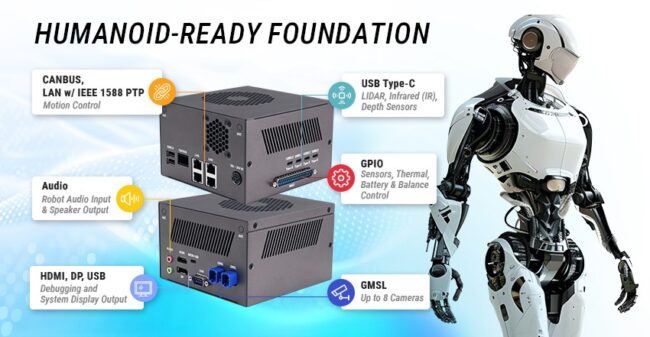
Taipei, Taiwan – Apr 16: Leading-edge AI platform provider AAEON (Stock Code: 6579) today announced the release of the CEXD-INTRBL, an open robotics development system from its Embedded Computing Business Unit. Featuring an Intel Core Ultra X7 Processor 358H CPU, an integrated Intel Arc B390 GPU, and NPU 5.0, the CEXD-INTRBL provides up to 180 TOPS of AI performance. As such, AAEON has noted the product is designed to target emerging AI development segments such as humanoid robotics and autonomous vehicle platform building.
The CEXD-INTRBL’s I/O lends itself to the system’s target market, with a notable feature being its two FAKRA connectors, which offer support for up to eight GMSL camera inputs. Other interfaces for peripheral device installation include four USB Type-C ports for the LiDAR, infrared, and depth sensors required for robotics, as well as a 22-bit GPIO through a HAT 40. Elsewhere, the system hosts four 2.5GbE LAN ports with IEEE 1588 PTP (Precision Time Protocol) alongside an external CANBus port.
For OS support, the CEXD-INTRBL is compatible with Windows 11 (64-bit) and Ubuntu 25.04, or Ubuntu 24.04 and later.
“We pride ourselves not only on how quickly we are able to leverage new technologies, but also on our dedication to building unique, creative solutions to address the needs of our customers,” said Kevin Chiu, Vice President of AAEON’s Embedded Computing Business Unit and Design Support Division. “From the outset we were confident we could create an all-in-one development system with the potential to usher in the next generation of advanced robotics, and with the CEXD-INTRBL, we feel we have succeeded in doing so.” Chiu added.
16, Apr 2026
Auctor Raises $20M Led by Sequoia Capital to Build the AI System of Action for the Enterprise Software Implementation Market
Enterprise software implementations fail because of fragmented institutional knowledge and tools. Auctor fixes that with one unified system built for the work itself.
New York City, New York – Apr 16; Hundreds of billions are spent on software implementation each year, yet 50 percent of projects fail to meet deadlines, and one out of every six exceeds budgets by over 200 percent.
Today, Auctor, the AI-native system of action for the entire software implementation lifecycle, emerges from stealth. It enables professional services teams and system integrators to deliver faster, more consistently, and smarter with every project.
Auctor has raised a total of $20 million, including a Series A led by Sequoia Capital with participation from M12, Microsoft’s Venture Fund, HubSpot Ventures, Workday Ventures, OneStream, Y Combinator, Tercera, and Dig Ventures.
William Sun, the Co-Founder and CEO of Auctor, said, “Enterprise software has transformed how every industry operates, but it only creates value when it’s actually implemented well. That’s why we built Auctor: one system for the entire lifecycle, so humans can focus on the high-judgment work clients need, while Auctor handles the rest.”
Professional services and implementation teams still rely on a patchwork of meetings, spreadsheets, documents, and internal knowledge to manage discovery, scoping, solutioning, and delivery. As a result, requirements, decisions, and context are fragmented across systems and stakeholders, with no single source of truth. This fragmentation leads to misalignment, rework, margin erosion, and delayed time-to-value for customers.
“As HubSpot moves upmarket, faster and smarter implementations aren’t just nice to have, they’re essential. Auctor is built specifically to solve that problem, giving system integrators and services teams an AI-native platform that brings together critical project context and turns weeks of manual work into minutes. We’re excited to support a team that’s creating an entirely new category and solving a problem that matters for our partners and customers,” says Adam Coccari, Managing Director at HubSpot Ventures.
Auctor’s AI-native system of action is purpose-built for how implementation work actually runs in practice. It curates execution-ready artifacts like rough orders of magnitude, resource plans, process flows, user stories, and more – already aligned and ready for delivery.
As a result, users and teams always know what was decided, why it was decided, and how it impacts the rest of the engagement. Most importantly, Auctor helps companies standardize what great looks like, turning their best work into repeatable, reusable practices across every project.
Auctor is already seeing top teams across leading software ecosystems fundamentally change how they run implementations. Customers are driving upwards of 80% efficiency gains across discovery and design, improving margins and even shifting toward fixed-fee models.
“The improvement in collaboration and delivery quality has been immediate. As we continue to scale globally, Auctor is becoming a core enabler of how we operate,” said Dan Buffham, CIO of Valiantys, Atlassian’s largest global partner, which serves 65 Fortune 500 companies.
The results extend across the entire implementation lifecycle. One team used Auctor to respond to an RFP (request for proposal) over a single weekend with just one person, secured the opportunity, and closed it within two days — work that previously required weeks and multiple team members. Separately, a principal consultant at a large enterprise software company produced a comprehensive manufacturing scoping guide in roughly 10 minutes, replacing a three-week manual effort.
The market dynamics driving Auctor’s growth are structural.
Implementation firms are caught between a talent model that doesn’t scale and a competitive environment that won’t wait. Senior consultants are spread too thin. Junior staff lack institutional knowledge. Mid-project swaps mean someone is always ramping up. The firms that figure out how to run leaner without sacrificing quality will take market share from those that don’t.
For system integrators stuck in margin-constrained models where delivery costs scale linearly with headcount, the math is straightforward: Auctor can unlock multiple points of EBITDA margin by fundamentally changing the way of operating.
Julien Bek, partner at Sequoia Capital, who recently wrote a viral thought leadership piece (Services: The New Software), says, “For every dollar spent on software, six are spent on services. Auctor is building the agentic operating system for software implementation to go after those six dollars.”
15, Apr 2026
Government Notifies SEZ for Tata Semiconductor Project in Dholera
Apr 15 (BNP): The government on Wednesday approved and notified a Special Economic Zone (SEZ) to be developed by Tata Semiconductor Manufacturing Pvt Ltd in Dholera, Gujarat. The proposed zone will focus on electronic hardware, software, and IT/ITeS services.
The project includes a planned investment of ₹91,000 crore to set up India’s first semiconductor fabrication facility, marking a major step toward strengthening the country’s semiconductor and electronics manufacturing ecosystem.
The proposal was cleared by the Board of Approval, the highest authority for SEZ-related decisions, which is headed by the Commerce Secretary.
The SEZ is expected to support large-scale manufacturing, attract investment, and boost India’s presence in the global semiconductor supply chain.


