


12, Oct 2026
HR Path accelerates its Artificial Intelligence strategy with the acquisition of SnapAI
PARIS, Oct. 12, 2026 /PRNewswire/ — HR Path, a global leader in HR consulting and HRIS solutions, announces the acquisition of SnapAI, a start-up specialising in Artificial Intelligence and regulatory compliance. This acquisition strengthens HR Path’s expertise in a strategic field for the future of Human Resources and accelerates the development of its AI-based offerings and solutions.
Operating in 34 countries with nearly 2,900 employees, HR Path supports companies in transforming their HR function through its three service lines: Advise, Implement and Outsource. Since its creation in 2001, the Group has placed technological innovation at the heart of its development and supports clients in evolving their organisations, processes and HR technologies.
AI: a major opportunity to transform Human Resources
HR Path sees Artificial Intelligence as a major opportunity to transform professions, enhance the employee experience and create new sources of value for companies.
This vision is based on a strong ethos: AI should reduce repetitive tasks, augment teams’ capabilities and free up more time for high-value activities. It also gives employees the opportunity to develop new skills and focus on more rewarding assignments.
To accelerate this momentum, HR Path has created a Task Force dedicated to Artificial Intelligence, bringing together expertise from across the Group to explore AI use cases and opportunities.
HR Path has also recently launched a dedicated AI offering to support clients in their transformation. It includes assessing AI maturity and HR data, identifying and prioritising use cases, transforming HR processes, driving adoption and skills development, and defining roadmaps to generate and measure the value created.
HR Path’s ambition is to make AI a common theme across its entire portfolio: in Advise, to support organisations in defining their AI strategy and transformation; in Implement, to activate and integrate new AI capabilities within HR solutions; and in Outsource, to automate selected activities and continuously improve HR operations.
SnapAI: a new milestone in HR Path’s AI ambition
The acquisition of SnapAI is fully aligned with this strategy. It enables HR Path to strengthen its expertise and accelerate its ability to turn rapid advances in Artificial Intelligence into practical solutions that create value for its clients. AI applications in recruitment, assessment and employee management are among the systems classified as high-risk under the European AI Act. SnapAI’s expertise in governance and compliance enables HR Path to support clients in deploying AI in a way that is both ambitious and controlled.
Contact:
Fabienne LATOUR
Fabienne.latour@hr-path.com

 View original content to download multimedia:https://www.prnewswire.co.uk/news-releases/hr-path-accelerates-its-artificial-intelligence-strategy-with-the-acquisition-of-snapai-302903579.html

- 0
- By Sai Krishna

12, Oct 2026
Vegetable Prices Surge Across Odisha, Household Budgets Come Under Pressure
Bhubaneswar, Oct 12 (UDN): A sharp rise in vegetable prices across Odisha has left consumers struggling to manage their daily household expenses, with several commonly used vegetables selling for Rs 60 to Rs 80 per kg in retail markets. The price hike has placed an additional burden on middle-class families already grappling with rising kitchen expenses.

Representational Image
Brinjal, okra, pointed gourd and bitter gourd are among the vegetables commanding higher prices in markets across the state. Consumers say the sudden increase over the past few days has made even routine vegetable shopping increasingly expensive.
Prices Remain High in Cuttack Markets
At Chhatra Bazaar, one of Cuttack’s major vegetable markets, onions are selling at Rs 60 per kg, while pointed gourd is priced at Rs 80 per kg. Brinjal costs Rs 60 per kg, whereas tomatoes are available at Rs 40 per kg.
Bitter gourd, spine gourd, yardlong beans and okra are also selling at around Rs 60 per kg, adding to the financial strain on consumers.
Bhubaneswar Consumers Face Similar Rates
A similar trend has been reported at Unit-1 Haat in Bhubaneswar. Onions are selling at Rs 60 per kg, while pointed gourd and brinjal are priced at Rs 50 per kg. Tomatoes are available at Rs 40 per kg.
Bitter gourd and okra are commanding prices ranging from Rs 60 to Rs 80 per kg. Spine gourd is selling at Rs 60 per kg, while ridge gourd costs Rs 50 per kg.
With several essential vegetables becoming more expensive, consumers say they are being forced to cut back on purchases or adjust their daily menus to stay within their budgets.
Rainfall, Supply Disruptions Blamed for Price Hike
Prolonged rainfall over the past few days has been cited as one of the reasons behind the price surge. The adverse weather conditions are reportedly affecting crops and disrupting the supply of vegetables to markets across Bhubaneswar, Cuttack and other coastal areas of Odisha.
Odisha’s dependence on supplies from other states during certain periods also contributes to price fluctuations, according to Sudhakar Panda, general secretary of the State Business Association.
“Vegetable prices tend to remain high during this season as we depend heavily on supplies from other states. This increases prices. While wholesalers sell vegetables at lower prices, some vendors double the rates, putting consumers under financial pressure,” Panda said.
His remarks point to concerns over the gap between wholesale and retail prices, with consumers bearing the brunt of rising costs at the marketplace.
Middle-Class Families Feel the Pinch
The price rise has become a concern for households trying to balance food expenses with other essential needs. Consumers say their incomes have not increased in line with the rising cost of everyday commodities, making it increasingly difficult to manage monthly budgets.
“The rise in prices of essential commodities, including vegetables, has affected the budget of the middle-income group. While our income has not increased, the prices of kitchen essentials have risen significantly,” a consumer said.
As vegetable prices remain elevated, consumers are hoping for improved supplies and a moderation in retail rates in the coming days. Until then, households across Odisha may continue to feel the pressure of increasingly expensive everyday essentials.
12, Oct 2026
Rayagada Division Landslide Disrupts Rail Services in Odisha; Several Trains Cancelled Till October 21
Koraput, Oct. 12 (UDN): Train services in Odisha’s Rayagada railway division have been disrupted following a landslide between MVG and CTS stations, prompting the East Coast Railway (ECoR) to cancel several trains and modify the routes of others.
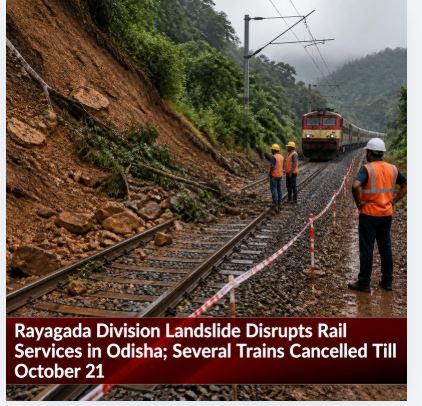
Representational Image
According to a railway bulletin, the changes will affect multiple express and passenger services connecting Visakhapatnam, Kirandul, Jagdalpur, Rourkela, Howrah and Bhubaneswar. Passengers travelling on the affected routes have been advised to check the latest service updates before leaving for their journey.
Four Express Trains Cancelled
The following trains have been cancelled for the specified dates:
18515 Visakhapatnam–Kirandul Express: October 13 to 20.
18516 Kirandul–Visakhapatnam Express: October 13 to 20.
18107 Rourkela–Jagdalpur Express: October 13 to 20.
18108 Jagdalpur–Rourkela Express: October 14 to 21.
Other Trains to Run on Restricted Routes
Several other services will operate with changes to their originating or terminating stations.
18005 Howrah–Jagdalpur Express: Will terminate at Koraput from October 13 to 20.
18006 Jagdalpur–Howrah Express: Will originate from Koraput from October 15 to 22.
18447 Bhubaneswar–Jagdalpur Express: Will terminate at Koraput from October 13 to 20.
18448 Jagdalpur–Bhubaneswar Express: Will originate from Koraput from October 14 to 21.
58501 Visakhapatnam–Kirandul Passenger: Will terminate at Koraput from October 13 to 20, subject to a separate October 13 adjustment.
58502 Kirandul–Visakhapatnam Passenger: Will originate from Koraput from October 13 to 20, subject to a separate October 13 adjustment.
The affected services will not operate between Koraput and Jagdalpur during the respective periods.
Additional Traffic Block on KK Line
Separately, railway authorities have given in-principle approval for an eight-hour traffic block at DPC Yard on the KK line in the Rayagada division on October 13. The block is linked to the proposed launch of a Limited Height Subway (LHS).
Due to this arrangement, Train Nos. 58501 and 58502, scheduled to operate on October 13, will instead terminate and originate at Araku, respectively, rather than Koraput, as previously notified.
Passengers Advised to Check Updates
Railway authorities have urged passengers to verify train schedules and operational changes before travelling. Updates will be available through station notice boards, public announcement systems, media reports, bulk SMS alerts and official railway websites and apps.
Passengers using the Koraput–Jagdalpur route should pay particular attention to the revised arrangements to avoid inconvenience during the disruption.
12, Oct 2026
2026 Nobel Prize in Economics Awarded to Robert E. Hall and Michael Woodford for Macroeconomic Research
Stockholm, Oct. 12: American economists Robert E. Hall and Michael Woodford have been awarded the 2026 Sveriges Riksbank Prize in Economic Sciences in Memory of Alfred Nobel for their contributions to the development of macroeconomic models that help policymakers understand economic fluctuations and respond to periods of growth and recession.

Representational Image
The Royal Swedish Academy of Sciences announced the award on Monday, recognising the economists’ work in strengthening the theoretical foundations of fiscal and monetary policy. Their research has helped explain how government decisions and central bank policies can influence economic activity through the expectations and decisions of households and businesses.
Research Strengthened Economic Policy Frameworks
According to the Nobel Committee, Hall, a professor at Stanford University, and Woodford, a professor at Columbia University, advanced macroeconomic analysis by grounding economic models in the decision-making behaviour of individuals and firms.
Their work gained significance amid criticism of conventional Keynesian models following the oil shocks of the 1970s. Several advanced economies at the time faced high inflation, sluggish growth and rising unemployment, presenting major challenges for policymakers.
The economists’ research emphasised that consumers and businesses make decisions based not only on current conditions but also on their expectations about the future. Choices involving consumption, savings, investment and pricing can collectively shape the broader economy.
By incorporating these forward-looking expectations into macroeconomic models, their work helped improve the understanding of how policy announcements and interventions affect economic behaviour.
Implications for Central Banks and Governments
The academy noted that the theoretical insights developed by the laureates have contributed to the models used by central banks and governments to assess economic conditions and formulate policy responses.
Such frameworks can help policymakers evaluate the effects of economic shocks, including energy crises and sudden changes in household spending, while designing measures to support stability.
John Hassler, chair of the Committee for the Prize in Economic Sciences, said the laureates’ work had provided a sound theoretical basis for models now used by central banks and governments worldwide.
About the Laureates
Robert E. Hall was born in 1943 in Palo Alto, California. He earned his PhD from the Massachusetts Institute of Technology (MIT) in 1967 and is a professor at Stanford University.
Michael Woodford was born in 1955 in Chicopee, Massachusetts. He received his PhD from MIT in 1983 and is a professor at Columbia University in New York.
The 2026 economics prize carries an award of 12 million Swedish kronor, to be shared equally between the two recipients.
The Sveriges Riksbank Prize in Economic Sciences was established in memory of Alfred Nobel and is administered by the Royal Swedish Academy of Sciences.
12, Oct 2026
SPJIMR #2 in India and #15 globally in Financial Times’ teaching cases rankings
Recognition highlights the role of teaching cases in translating management scholarship into practice; SPJIMR advances the conversation on research impact through TASIC 2027
MUMBAI, India, Oct. 12, 2026 /PRNewswire/ — How can business schools demonstrate that research matters beyond academia? In his recent article, ‘Business school research with impact, ranked’, Andrew Jack, Financial Times (FT) Global Education Editor, examines the challenge of assessing how academic work influences business practice and public policy. Among the approaches explored is the reach of teaching cases, which bring research and real-world business dilemmas into the classroom, shaping how future leaders think and make decisions.

The question is also explored by SPJIMR through a paper by Prof. Varun Nagaraj, Dean, SPJIMR, ‘Making Management Research Matter: A Dean’s Reflection on Translation, Diffusion, Crossover, and ROI‘. It examines how management scholarship can move beyond publication to inform practice and create meaningful impact.
In this context, Bharatiya Vidya Bhavan’s S.P. Jain Institute of Management and Research (SPJIMR) has ranked second in India and 15th globally in the FT 2026 rankings of the world’s most popular teaching cases. SPJIMR features alongside leading global institutions, including Harvard Business School, Western University’s Ivey Business School, the University of Virginia’s Darden School of Business, INSEAD and Northwestern University’s Kellogg School of Management, among others.
Commenting on the recognition, Prof. Varun Nagaraj, Dean, SPJIMR, said, “The question for management education is not simply how much research we produce, but whether it addresses problems that matter and influences practice. The global reach of our teaching cases, many rooted in Indian contexts, reflects how scholarship can shape how people think and make decisions. Through TASIC 2027, we hope to advance the wider conversation on research impact. The multi-track conference includes a unique session on teaching cases, recognising those with the potential to challenge assumptions and change how students think. This is part of a broader effort to explore how engaged management scholarship can inform industry, influence practice and address consequential real-world challenges.”
The FT’s second annual assessment recognises a form of academic contribution that extends beyond conventional research publication citation metrics: the development of learning materials used by educators and students in business school classrooms worldwide. The analysis draws on data provided by five leading teaching case publishers and distributors: CEIBS, Harvard Business Impact, IESE Publishing, Ivey Publishing and The Case Centre, which publish their own cases or distribute those of others. It also considers authorship by faculty at schools featured in recent FT rankings.
While no single measure can fully capture the influence of research on business and policy, the reach of teaching cases offers one indication of how academic ideas enter management education and potentially inform decisions beyond the classroom.
The recognition builds on SPJIMR’s sustained focus on connecting scholarly rigour with real-world relevance. This focus on research impact will continue through TASIC 3.0, The Asia-Pacific Scholarly Impact Conference, scheduled for 25–27 February 2027 at SPJIMR, Mumbai. Grounded in the principles of engaged management scholarship and impact pathways, the conference will bring researchers and practitioners together to explore how they can co-create knowledge, translate academic insights into action and address consequential challenges in industry and policy.
Congratulations to SPJIMR faculty on this recognition and their continued contribution to management learning worldwide.
For more news and updates from SPJIMR, visit our Newsroom.
About SPJIMR
Bharatiya Vidya Bhavan’s S.P. Jain Institute of Management & Research (SPJIMR) is one of India’s leading postgraduate management institutes. It is recognised in the Financial Times Masters in Management 2026 ranking as the #26 business school globally and #2 in India and in the Financial Times Global MBA 2026 ranking as the #74 business school globally for its PGPM programme. SPJIMR is also consistently ranked among India’s top business schools by leading publications, including Business Today, Fortune India, India Today, and MBAUniverse. It has also been recognised by the Positive Impact Rating as one of the world’s top five business schools for societal impact. Known for its innovative and socially conscious approach to management education, research, and community engagement, SPJIMR seeks to influence managerial practice and enable value-based growth for students, alumni, organisations, and society. The institute holds the international Triple Crown of accreditations from EQUIS, AACSB, and AMBA, placing it among a select group of business schools worldwide to hold all three accreditations.
Visit SPJIMR.org for more information.
 View original content to download multimedia:https://www.prnewswire.com/in/news-releases/spjimr-2-in-india-and-15-globally-in-financial-times-teaching-cases-rankings-302905604.html

12, Oct 2026
BMC Destroys 60 Kg of Stale Food in Bhubaneswar Eateries During Festive Season Raids
Bhubaneswar, Oct. 12 (UDN): The Bhubaneswar Municipal Corporation (BMC) has intensified its food safety enforcement drive ahead of the festive season, carrying out inspections at hotels and restaurants in the Patia area to ensure that customers are served safe and hygienic food.

Representational Image
During Monday’s raids, officials inspected food items at several establishments and destroyed stale and unfit food found during the operation. The drive aims to prevent unsafe food from reaching consumers as visits to eateries increase during the festive period.
60 Kg of Food Destroyed
BMC Food Safety Officer Satyajit Patel said around 60 kg of food had been destroyed so far as part of the enforcement campaign.
He said inspections were being conducted to identify stale and unhygienic food, with fines imposed on establishments found violating food safety requirements. Officials are also issuing warnings, while repeated or serious violations could lead to establishments being sealed.
The department is continuing its monitoring of hotels and restaurants to ensure that food served to the public meets basic hygiene and safety standards.
Strict Action Against Violations
With the festive season underway, the civic body has stepped up surveillance of food outlets to protect consumers from food that may be unsafe for consumption.
Alongside inspections and enforcement, officials are also raising awareness about food safety among the public and food business operators.
Patel said the raids would continue in the coming days, with the department maintaining vigilance over eateries across the city.
The intensified drive is intended to strengthen food safety compliance and ensure that residents and visitors can enjoy festive meals without compromising their health.
12, Oct 2026
From Dwarka to Noida: Dandiya Nights to Celebrate Navratri in Style

Oct 12: As Navratri brings Delhi-NCR alive with colour, music and festive cheer, the region is gearing up for a series of vibrant Dandiya Nights that promise more than just traditional celebrations. From live music and energetic dance performances to DJs, contests, giveaways and immersive festive experiences, malls across the city are creating the perfect setting for people to come together and celebrate. If you are looking to swap your regular weekend plans for an evening of music, dance and festive revelry, here are two Dandiya Nights across Delhi-NCR that you can look forward to this Navratri.
1. Vegas Mall, Dwarka, Delhi
This festive season, Vegas Mall, Dwarka, is all set to turn up the festive fervour with The Dandiya Tales, powered by Bata, a vibrant two-day celebration of music, dance and Navratri festivities on October 18–19, from 5 PM onwards. Adding star power to the celebrations, Bollywood actress Rakul Preet Singh will join the festivities on October 18, making the evening even more special. Visitors can look forward to electrifying performances by a live DJ and percussionist, high-energy acts by a professional dance group, exciting contests and giveaways, and a spectacular SFX showdown. With tickets starting at ₹599, The Dandiya Tales promises an unforgettable festive experience, bringing together celebrity glamour, cultural traditions and high-energy entertainment at Vegas Mall, Dwarka.
Spectrum@Metro, Noida
Get ready to groove to the beats of festivity as Spectrum@Metro presents Dandiya Night 4.0 on October 17, from 6 PM onwards at Spectrum@Metro, Sector 75, Noida. Bringing together the infectious energy of Navratri and the magic of live music, the evening will feature popular DJs DJ Perisha and DJ Gaurav, setting the stage for a high-energy celebration of dance, music and festive spirit. Gather your friends and family, put on your best festive colours and get ready for an unforgettable night of dandiya, music and celebration.
With a mix of traditional festive spirit and contemporary entertainment, these Dandiya Nights are set to make Navratri celebrations across Delhi-NCR even more exciting. Whether you are heading to Dwarka for an evening of live performances and festive activities or planning a high-energy night out in Noida with friends and family, both celebrations offer something for everyone. So, dress up in your festive best, pick up your dandiya sticks and get ready to dance the night away as Delhi-NCR celebrates the spirit of Navratri.
12, Oct 2026
KuCoin Unveils 5.0, Building Trust into Every Layer of the User Experience
PROVIDENCIALES, Turks & Caicos Islands, Oct. 12, 2026 /PRNewswire/ — KuCoin, a leading global crypto platform built on trust, today unveiled KuCoin 5.0, a comprehensive platform upgrade designed to make trust tangible across the way users trade, manage assets and interact with the platform.

KuCoin 5.0 is the product expression of the global brand initiative “Trust, Built-in.” Introduced under KuCoin’s enduring “Trust First. Trade Next.” proposition, the upgrade spans six areas—Compliance, Technology, Assets, Experience, AI and Wealth Management—bringing them together around a more unified, efficient and user-centered platform experience rather than centering on a single feature.
Among the most visible changes in KuCoin 5.0 are a redesigned experience that creates clearer paths for different types of users; an AI service layer that extends across the platform; and more flexible ways to trade, manage and put assets to work. Underneath these user-facing changes, KuCoin is also strengthening the technology, compliance and asset foundations that support the platform as it continues to evolve.
A Clearer, More Inclusive Experience
KuCoin 5.0 makes everyday use of the platform clearer and more flexible. Profile Center 2.0 introduces a cleaner visual design and a card-based layout that makes information and frequently used functions easier to find. The upgraded sub-account system streamlines account creation, strengthens security controls and improves sub-account management. Enhanced K-line charts offer more practical tools and real-time data, with settings that sync across devices to help users follow the market more efficiently.
KuCoin 5.0 also introduces a color vision accessibility mode, making charts and other visual information easier to distinguish for users with different color vision needs. An estimated 360 million people worldwide experience some degree of difficulty distinguishing colors. By offering a clearer visual experience, KuCoin aims to make the platform more accessible to more users. The Lite and Pro experiences offer paths suited to different levels of familiarity and trading needs.
For users with more advanced trading needs, KuCoin 5.0 introduces the Unified Trading Account (UTA), now available to eligible KuCoin users at VIP1 and above. UTA brings spot, margin and futures trading into a shared framework for funds, margin and risk management. This reduces the need to transfer funds between separate accounts and supports more efficient use of capital across eligible products.
AI That Extends Across the User Journey
KuCoin 5.0 introduces a major upgrade to AI Assistant 5.0, creating a unified AI entry point that brings together conversations, Q&A and task completion across the platform. Spanning market insights, Earn, trading, customer support and campaigns, the assistant uses page context and user actions to better understand what users need, recommend relevant services and help them complete tasks.
Making Assets Work More Efficiently
KuCoin 5.0 connects earning and trading more closely through exclusive wealth management products and benefits for VIP users, Earn access through sub-accounts, and support for selected wealth assets within the Unified Trading Account framework. Main accounts and sub-accounts can participate in Earn while managing funds separately, while KCUSD can be used as margin within the Unified Trading Account, reducing the need to move funds repeatedly between earning and trading activities.
These user-facing changes are supported by continued development across KuCoin’s Compliance, Technology and Assets foundations. Together, the six upgrade areas form a platform designed to remain straightforward where possible and provide greater control where needed.
“Trust should be something users can experience in every interaction—not only in how their assets are protected, but in how clearly, reliably and efficiently the platform works,” said BC Wong, CEO of KuCoin. “KuCoin 5.0 is an important step in translating our long-term commitment to trust into the product itself. By bringing our core capabilities into a more connected, intuitive and intelligent platform, we are giving users greater confidence and control today while building the foundation for the next stage of digital finance.”
KuCoin 5.0 establishes the foundation for the platform’s next phase of development. By connecting trading, asset management and intelligent services through a clearer experience, KuCoin is building a platform designed for how users participate today and how digital finance will continue to evolve.
About KuCoin
Founded in 2017, KuCoin is a leading global crypto platform built on trust and security, serving over 45 million users across 200+ countries and regions. Known for its reliability and user-first approach, the platform builds trust into every layer of the user experience, combining advanced technology, deep liquidity, and strong security safeguards to deliver a seamless trading experience. KuCoin provides access to 1,000+ digital assets through a broad product suite and remains committed to building a compliant and user-centric ecosystem for the future of finance, backed by SOC 2 Type II, ISO/IEC 27001:2022, ISO/IEC 27701:2019, ISO 22301:2019 and ISO/IEC 42001:2023 certifications. In recent years, KuCoin has continued to strengthen its global compliance foundation, marked by key milestones including AUSTRAC registration in Australia, a MiCA license in Europe, and regulatory progress in other markets.
Learn more at www.kucoin.com.

 View original content to download multimedia:https://www.prnewswire.co.uk/news-releases/kucoin-unveils-5-0–building-trust-into-every-layer-of-the-user-experience-302905369.html

12, Oct 2026
NHAI Plants 5.20 Lakh Saplings Across Odisha, Focuses on Medicinal Forests and Bee Corridors
Bhubaneswar, Oct. 12 (UDN): The National Highways Authority of India (NHAI) has planted around 5.20 lakh saplings across Odisha over the past four months as part of a series of environmental initiatives aimed at expanding green cover, protecting biodiversity and supporting pollinators.

Representational Image
The plantation drive includes medicinal gardens, bee-friendly corridors, greenery along highway medians and community-based planting programmes, reflecting efforts to integrate environmental conservation with highway infrastructure development.
Arogya Van to Preserve Medicinal Plants
Under its Arogya Van initiative, NHAI has planted 2,500 medicinal saplings at Kunduli in Koraput district along the Raipur–Visakhapatnam Economic Corridor (NH-130CD).
The plantation features traditional medicinal species such as Bahada, Neem, Harida and Amla. The initiative seeks to conserve indigenous plants while highlighting their ecological and medicinal significance.
NHAI plans to develop medicinal green spaces on suitable vacant land along national highways. These areas are expected to provide habitats for birds and small wildlife, support pollinators and improve ecological resilience.
Bee Corridors to Support Pollinators
As part of its Bee Corridor Plantation initiative, NHAI has planted at least 39,337 saplings of species including Neem, Spathodea, Arjun, Patoli, Kadamba, Tabebuia rosea and Radhachuda.
The initiative aims to create more pollinator-friendly stretches along highway corridors, helping strengthen local biodiversity.
Highway Medians and Community Plantations
The greening campaign also covers highway medians, where 87,338 plants have been planted. Species such as Bougainvillea, Tecoma, Calliandra and Caesalpinia have been selected to enhance the appearance and ecological value of highway stretches.
In addition, the authority has planted 6,000 bamboo saplings and undertaken community plantation activities involving another 7,097 plants.
Plantation drives have also been extended to schools, colleges and other community spaces to encourage public participation in environmental protection and expand green cover beyond highway land.
Green Infrastructure Push
Through medicinal plantations, pollinator-friendly corridors and community greening programmes, NHAI aims to make highway development more environmentally sustainable.
The initiatives are expected to contribute to biodiversity conservation and environmental awareness while improving greenery along Odisha’s national highway network.
12, Oct 2026
BJP National Leader Saudan Singh Begins Three-Day Odisha Visit Ahead of Local Body Polls
Bhubaneswar, Oct. 12 (UDN): The Bharatiya Janata Party (BJP) has stepped up its organisational preparations for the upcoming panchayat and municipal elections in Odisha, with party National Joint Organisation General Secretary Saudan Singh beginning a three-day visit to the state.

During his visit, Singh is scheduled to interact with senior party leaders, elected representatives and grassroots workers to strengthen the organisation and assess its preparedness for the upcoming local body polls.
According to reports, Singh arrived in Odisha on Sunday and visited Puri to seek the blessings of Lord Jagannath before proceeding to the BJP state headquarters in Bhubaneswar.
His visit comes amid renewed organisational activity within the state unit following the appointment of Daggubati Purandeswari as the BJP’s state in-charge and Swadesh Singh as co-in-charge. The two leaders recently held discussions with party office-bearers on organisational matters.
Senior Leaders Expected to Meet Saudan Singh
BJP Odisha president Manmohan Samal and other senior party leaders are expected to hold discussions with Singh during his stay. Chief Minister Mohan Charan Majhi, along with ministers, MLAs and MPs, may also meet the national leader, depending on their availability.
The interactions are expected to focus on strengthening coordination within the party, improving organisational effectiveness and preparing workers for the electoral challenges ahead.
With local body elections approaching, the BJP is seeking to reinforce its organisational network and improve coordination between its leadership and grassroots cadres.
Manmohan Samal Highlights Singh’s Organisational Experience
Speaking about the visit, state BJP president Manmohan Samal said Singh’s extensive experience in organisational affairs would benefit the party’s expansion and election preparations in Odisha.
Samal noted that Singh had handled organisational responsibilities across several states over the years and said his guidance would help strengthen the party’s structure and improve its readiness for the upcoming polls.
He expressed confidence that Singh’s experience would contribute to building a stronger organisation in the state.
Party Workers to Interact With National Leader
A key component of Singh’s programme at the BJP state headquarters is interaction with party workers, including those who have recently joined the organisation.
Rather than being limited to formal meetings, the programme is intended to give workers an opportunity to introduce themselves, share their views and raise organisational concerns directly with the national leader.
The interactions are expected to help the party leadership understand grassroots-level issues and identify areas requiring greater attention ahead of the local elections.
Singh’s three-day visit is part of the BJP’s broader organisational efforts to consolidate its position in Odisha and strengthen its election preparedness through closer engagement with leaders and workers across the state.


