


7, Oct 2026
Johan Sverdrup Crude Hits Record US$24/bbl Premium to Brent as Saudi Pipeline Suspension Tightens European Medium-Sour Supply
LONDON/HOUSTON/SINGAPORE, 7 October 2026 – As Saudi Arabia’s suspension of its East-West pipeline drives medium-sour crude prices above US$140/bbl and European refiners scramble for alternatives, a new Wood Mackenzie analysis finds Johan Sverdrup crude has hit a record US$24/bbl premium to Brent, putting field partners on course for a cashflow windfall of up to US$7.1 billion in 2026 against a US$500 million forecast made at the start of the year.
European refiners, including Poland’s Orlen, expect October Saudi cargoes to be disrupted. Johan Sverdrup, with 0.8% sulphur content, is a natural substitute for those barrels. Buyers bid aggressively for the North Sea grade, driving its price from a typical 3% discount to Brent to a record US$24/bbl premium. As Western Europe’s largest producing oil field and the source of around one third of Norway’s oil output, Sverdrup had the volume and crude quality to fill part of the gap.
Wood Mackenzie’s cashflow analysis is based on published price deck assumptions and field-level production data. At the start of 2026, combined company cashflow from Johan Sverdrup was forecast at US$500 million, based on a 2026 Brent price of US$62.90/bbl and a 3% discount on Sverdrup crude. These are gross pre-distribution cashflow figures at the field level. On the Q3 price of US$85/bbl, that figure rises to US$3.6 billion. If current prices hold through year-end, producing a full-year average of US$111.50/bbl, cashflow reaches US$7.1 billion. Each dollar per barrel adds approximately US$130 million. These projections are Wood Mackenzie estimates and have not been independently verified by the field’s operator or partners.
Norway’s public finances stand to gain significantly as tax receipts from the field are set to rise by US$3 billion to US$4 billion above Wood Mackenzie’s Q1 2026 forecast of US$12 billion. With around 50% of taxes paid the following year, 2027 state revenues are also in line for a boost. Those figures exclude the benefit flowing to the state through Petoro’s 16.94% direct interest in the field and its 67% shareholding in Equinor.
“The numbers here are clear, but so is the conditionality,” said Ross McGavin, Senior Research Analyst, Europe Upstream, Wood Mackenzie. “If current prices hold through year-end, Johan Sverdrup partners are looking at US$7.1 billion in cashflow against a US$500 million forecast made less than nine months ago. Even on our more conservative Q3 price deck of US$85/bbl, the figure is US$3.6 billion. The H2 question is whether the crude premium holds as refiners and Saudi Arabia respond. What is not in doubt is the structural point: Sverdrup’s production resilience and its deep integration into European refining supply chains have made it the default alternative for the continent when North African or Middle Eastern supply is disrupted. That role is unlikely to diminish.”
H1 2026 production averaged 690 kboe/d, 12% above Wood Mackenzie’s base-case forecast of 616 kboe/d, despite the field being expected to decline between 10% and 20% over the year. Full-year output could finish 4% above current estimates depending on how production performs in H2, implying a 12% year-on-year decline rather than 15%. That outperformance adds a further US$500 million to US$1 billion to company cashflows. Both projections remain conditional on H2 price and production outcomes.
For Aker BP, which owns a 31.72% stake, the financial turnaround is the sharpest among the listed partners and is potentially material to its investor guidance. Heavy capital commitments to its Yggdrasil development had been expected to push 2026 cashflow slightly negative. At current prices, Wood Mackenzie estimates the company is on track for a US$1.5 billion net cash inflow, a shift that investors and analysts will be watching against the company’s published outlook. Equinor (42.63%), Petoro (16.94%) and TotalEnergies (8.72%) share the remaining uplift.
Key details:
- 2026 combined cashflow (Wood Mackenzie estimate): US$500 million (start-of-year forecast, Brent at US$62.90/bbl) rising to US$7.1 billion (current-price scenario, full-year average US$111.50/bbl). Gross, pre-distribution, field-level figures
- Norwegian state tax uplift (Wood Mackenzie estimate): US$3–4 billion above the Q1 2026 forecast of US$12 billion; approximately 50% of taxes paid in the following year; excludes benefit via Petoro equity and Equinor shareholding
- Aker BP 2026 cashflow (Wood Mackenzie estimate): Shift from slightly negative to US$1.5 billion net cash inflow; investors should cross-reference against Aker BP’s published guidance
- Full-year production: Could be 4% above current estimate depending on H2 decline trajectory; implies 12% year-on-year decline vs. forecast 15%
–
- 0
- By Neel Achary

7, Oct 2026
Capital Group secures FSRA licence in Abu Dhabi as it expands in the Middle East
ABU DHABI, UAE, Oct. 7, 2026 /PRNewswire/ — Capital Group, one of the world’s largest and most experienced active investment managers with US$3.6 trillion of assets under management, announced today that it has secured a Financial Services Permission from the Financial Services Regulatory Authority (FSRA) of ADGM, the international financial centre of Abu Dhabi, the Capital of the United Arab Emirates, enabling the firm to operate as a regulated investment manager. The approval authorises Capital Group to conduct trading, investment management and distribution activities within ADGM.
The regulatory milestone marks the next phase of Capital Group’s long-term commitment to the region, following its May 2026 announcement of plans to establish its first Middle East office in Abu Dhabi. The firm has since relocated associates from North America, Europe and Asia, bringing investment, operational and client-facing expertise closer to clients and opportunities in the region. Its local presence is expected to grow over time, in line with business and client needs.
Benno Klingenberg-Timm, Head of Abu Dhabi Office & Head of Institutional for Europe and Asia, Capital Group, said: “Establishing a regulated presence in Abu Dhabi brings us closer to our clients and to the investment opportunities across the Middle East, a region where we have been active for many years. From day one, we will have a meaningful presence, with on-the-ground investment, operational and client-facing capabilities. Much like the opening of our Singapore office in 1989, we’re bringing together the full breadth of Capital Group’s expertise in Abu Dhabi, reflecting our confidence in the region’s long-term growth.”
H.E. Ahmed Jasim Al Zaabi, Chairman of ADGM, said: “We are pleased to welcome Capital Group, a global investment manager, as it establishes a presence in Abu Dhabi. Its decision reflects the strength of Abu Dhabi’s financial ecosystem and ADGM’s growing position as a leading international financial centre for global institutions seeking long-term opportunities across the region.”
Mike Gitlin, President and CEO of Capital Group, said: “The Middle East is strategically important to Capital Group and our clients. Securing our regulatory licence in Abu Dhabi reflects our long-term commitment to the region and our conviction in its continued development as a leading international financial centre. We look forward to deepening our relationships with clients and partners.”
 View original content:https://www.prnewswire.co.uk/news-releases/capital-group-secures-fsra-licence-in-abu-dhabi-as-it-expands-in-the-middle-east-302900995.html

7, Oct 2026
Odisha Landslide Disrupts Train Services; Several Koraput-Jagdalpur Trains Short-Terminated
Bhubaneswar, Oct 7 (UDN): Train services on the Koraput-Jagdalpur section have been disrupted following a landslide between Maligura and Chhatariput stations in the Rayagada division.

Representational Image
In view of passenger safety and to facilitate restoration work on the affected stretch, the East Coast Railway has announced temporary changes to several train services.
Passengers travelling between October 8 and 14 have been advised to take note of the revised train schedules, as some services will be short-terminated at Koraput while corresponding return journeys will originate from the station.
Howrah-Jagdalpur Express
The Howrah-Jagdalpur Express (18005) will operate from October 8 to 12 but will terminate at Koraput instead of Jagdalpur.
The corresponding Jagdalpur-Howrah Express (18006) will originate from Koraput from October 10 to 14.
Hirakhand Express Services Affected
The Bhubaneswar-Jagdalpur Hirakhand Express (18447) will also be short-terminated at Koraput from October 8 to 12.
Meanwhile, the Jagdalpur-Bhubaneswar Hirakhand Express (18448) will originate from Koraput between October 9 and 13.
Passenger Train Services Also Hit
The disruption will also affect passenger train operations on the route.
The Visakhapatnam-Kirandul Passenger (58501) will terminate at Koraput from October 8 to 12.
Its return service, the Kirandul-Visakhapatnam Passenger (58502), will also originate from Koraput during the same period.
Restoration Work Underway
The temporary changes have been introduced to facilitate clearance and restoration work following the landslide and to ensure safe movement of passengers.
Railway authorities are expected to restore normal operations on the affected section once the track is cleared and declared safe for train movement.
Passengers planning to travel on the Koraput-Jagdalpur route during the affected period are advised to check the latest railway updates before commencing their journey.
7, Oct 2026
BIScience Partners with Maiden Century to Bring Global Web Traffic Data to IDEA
The partnership integrates BIScience global web traffic intelligence into Maiden Century’s IDEA platform, expanding KPI modeling and forecasting across hundreds of public companies and global markets.
NEW YORK, NY, Oct 07. BIScience, a global leader in digital and behavioral data intelligence, today announced a strategic data partnership with Maiden Century, a technology and analytics infrastructure provider for institutional investors and alternative-data providers. Through the partnership, BIScience global web traffic data is now available on Maiden Century’s IDEA platform, giving investors a new source of digital demand intelligence for company and KPI forecasting.
The new BSC TRFC dataset measures sessions and unique visitors across digital properties behind hundreds of publicly traded companies. Built on BIScience’s global human panel of 35 million opt-in users, the data is delivered weekly at the aggregate sub-domain level on a four-day lag. Maiden Century maps each property to the public companies that own or monetize it and models the associated business KPIs.
The initial integration covers 776 merchant properties mapped to 399 public-company tickers across 25 exchanges, including 116 companies listed outside the United States. It supports 887 distinct KPIs across 3,307 mappings, with 44 percent tied to segment, regional, or brand-level business lines.
“A decade ago web traffic told you something about a company’s marketing. Today, for a large share of the companies we cover, it is the transaction – the booking, the sign-up, the checkout, the renewal,” said Jack Killea, Head of Data Strategy & Partnerships at Maiden Century. “As more revenue moves onto digital properties, measuring those properties accurately stops being a supplementary signal and starts being a primary one. That shift is why we keep investing in this category, and why we’re thrilled to formally partner with BIScience and have their web traffic data on the IDEA platform.”
Initial backtesting in IDEA shows the dataset’s potential as a forecasting signal. Across 1,548 comparable ticker-and-KPI pairs, BSC TRFC ranked first on 178 and within the top two on 385, against a median comparison set of six datasets. On non-US listings, it ranked first on 19 percent of contested pairs, compared with 10 percent for US listings. Across the trailing reporting period, it also came closer to the reported company figure than sell-side consensus on 60 reporting events spanning 50 companies.

“Digital behavior increasingly reflects business performance directly,” said Assaf Toval, Co-Founder and General Manager at BIScience. “By combining BIScience’s large-scale, real-world behavioral data with Maiden Century’s company mapping and KPI forecasting capabilities, this partnership gives investors a powerful way to translate digital activity into actionable financial intelligence.”
BIScience’s web traffic methodology is grounded in real human behavior collected through its global opt-in panel and normalized to produce comparable estimates across markets, devices, and digital properties.
7, Oct 2026
Education in Ireland Fair in Chennai on 10th of October 2026 at Hyatt Regency.

~ Students will interact directly with leading Irish institutions and learn about programmes at this high-quality study destination~
|
List of Participating institutions
|
||
|
Atlantic Technological University
|
Dublin Business School
|
|
|
Dundalk Institute of Technology
|
Independent College
|
Maynooth University
|
|
Munster Technological University
|
National College of Ireland
|
University College Dublin
|
|
South East Technological University
|
Trinity College Dublin, the University of Dublin
|
Technological University of the Shannon
|
|
Technological University Dublin
|
University College Cork
|
RCSI: University of Medicine & Health Sciences
|
|
University of Galway
|
University of Limerick
|
Dublin City University
|
7, Oct 2026
Sudarsan Pattnaik Marks PM Modi’s 25 Years in Public Service With Sand Art at Puri Beach
Puri, Oct 7 (UDN): Renowned Odisha sand artist and Padma Shri awardee Sudarsan Pattnaik has paid tribute to Prime Minister Narendra Modi on the completion of his 25 years in public service with a special sand sculpture at Puri Beach.
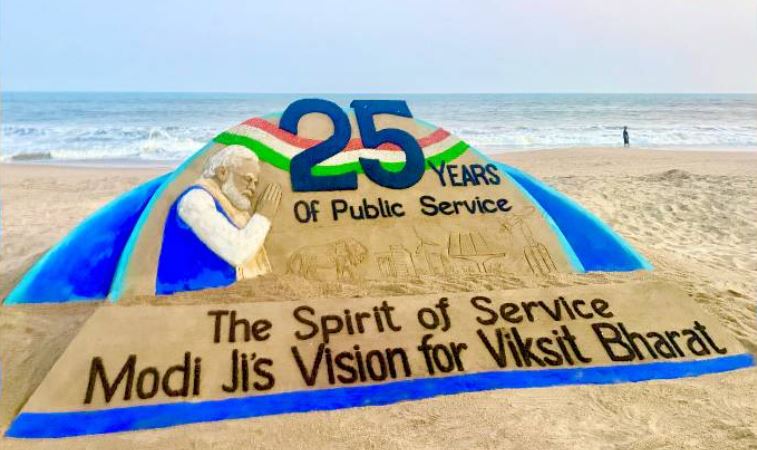
Pattnaik shared images of the artwork on social media, describing the creation as a tribute to Modi’s journey of public service, leadership and dedication to the nation.
Sand Art Celebrates 25 Years of Public Service
The striking sculpture features an image of Prime Minister Modi with folded hands, accompanied by messages highlighting his 25-year public life and his vision of a ‘Viksit Bharat’.
Sharing the artwork, Pattnaik congratulated the Prime Minister and said the sand sculpture was a humble tribute to his “remarkable journey” and vision for a developed India.
The installation carries prominent messages including “25 YEARS Of Public Service” and “The Spirit of Service, Modi Ji’s Vision for Viksit Bharat.”
Artwork Draws Attention at Puri Beach
The sand sculpture has attracted attention from visitors at the popular Puri beach, while photographs of the artwork shared online have also received appreciation from netizens.
Known for creating sand sculptures on prominent personalities, national occasions and global events, Pattnaik once again used the sands of Puri to mark a significant milestone in the public life of the Prime Minister.
7, Oct 2026
Odisha Government Reshuffles IAS Cadre, Appoints New Collectors for Nabarangpur and Nuapada
Bhubaneswar, Oct 7 (UDN): The Odisha Government on Wednesday carried out a minor reshuffle in the IAS cadre, including the appointment of new Collectors for Nabarangpur and Nuapada.
Representational Image
The General Administration & Public Grievance Department issued a notification announcing transfers and fresh postings involving seven IAS officers.
New Collectors for Two Districts
Anya Das, IAS (RR-2019), currently serving as Deputy Secretary in the Health and Family Welfare Department, has been appointed Collector and District Magistrate of Nabarangpur.
Similarly, Madhumita, IAS (RR-2020), who recently joined the General Administration & Public Grievance Department after availing maternity leave, has been posted as Collector and District Magistrate of Nuapada.
The two appointments follow the transfer of the incumbent Collectors of the respective districts.
Existing Collectors Get New Assignments
Dr Maheswar Swain, IAS (SCS-2014), who was serving as Collector and District Magistrate of Nabarangpur, has been transferred and appointed Additional Secretary to the Chief Minister.
Madhusudan Dash, IAS (SCS-2014), Collector and District Magistrate of Nuapada, has been posted as Additional Secretary to the Government in the GA & PG Department.
In another posting, Pradeep Kumar Nayak, IAS (SCS-2014), Additional Commissioner of the Additional Revisional Court, Bhubaneswar, has been appointed Additional Secretary in the Fisheries & Animal Resources Development Department.
Other Administrative Changes
The government has also made changes at the sub-divisional level.
Ashni A L, IAS (RR-2023), Under Secretary in the Health and Family Welfare Department, has been transferred and posted as Sub-Collector, Bhabanipatana.
Her predecessor, Kasturi Sha, IAS (RR-2024), Sub-Collector, Bhabanipatana, has been transferred and posted as Under Secretary to the Government in the GA & PG Department.
The latest reshuffle is part of the State Government’s ongoing administrative reorganisation and includes changes at both district and departmental levels.
7, Oct 2026
United Nations Spotlight Initiative launches Sync or Storm, a new interactive game to help prevent violence against women and girls before it starts
Built on Equimundo: Center for Masculinity & Social Justice’s research into boyhood and masculinity, the game aims to raise awareness among young people about the attitudes and behaviours that contribute towards violence against women and girls.
NEW YORK, Oct. 7, 2026 /PRNewswire/ — The United Nations Spotlight Initiative has introduced Sync or Storm, an immersive adventure game for young people, as part of the #WithHer digital advocacy campaign to build awareness, encourage positive intervention, and advance efforts to end violence against women and girls.

With nearly one in three women experiencing violence during their lifetime, the need for prevention is critical. As digital spaces become an increasingly important part of young people’s lives, Sync or Storm reaches kids where they already spend their time, using interactive gameplay to encourage positive behaviours and collaborative problem-solving.
“Gaming has become an important space where young people connect, interact and shape how they see the world,” said Koye Adeboye, Head of Communications for the United Nations Spotlight Initiative. “Through this campaign, we aim to reach some of the estimated 43 million Roblox users under the age of 13 who play every day. If we are serious about preventing violence before it starts, we need to engage young people in the spaces where they spend their time.”
Developed by Bad Ape in collaboration with Equimundo and Spotlight Initiative, the interactive game encourages young players to reflect on how their actions affect others.
The game’s foundation is informed by Equimundo’s Man Box research in the US, UK and Mexico, which found that those with the most rigid views of manhood were up to five times more likely to bully or sexually harass others, and were also more likely to report depression and suicidal thoughts (Hill et al., 2020). The Global Early Adolescent Study also surveyed 10–14-year-olds globally and showed that gender norms are already entrenched by early adolescence.
Caroline Hayes, Senior Technical Specialist, Digital Strategies at Equimundo, said: “Boys don’t form harmful ideas about manhood in isolation; they absorb them from the culture around them, including the games they play. Sync or Storm shows boys at a formative age that respect and cooperation are expressions of strength. That’s exactly the kind of prevention work we need more of.”
Sync or Storm is now available on Roblox.
 View original content to download multimedia:https://www.prnewswire.co.uk/news-releases/united-nations-spotlight-initiative-launches-sync-or-storm-a-new-interactive-game-to-help-prevent-violence-against-women-and-girls-before-it-starts-302900957.html

7, Oct 2026
Assam Rifles Jawan V Teja Cremated With Full Military Honours in Rayagada
Rayagada, Oct 7 (UDN): Assam Rifles jawan V Teja, who succumbed to gunshot injuries sustained during operational duty in Nagaland, was cremated with full military honours at Swargadwara in Siriguda, Rayagada, on Wednesday.

The final rites drew a large gathering of residents, youths and ex-servicemen, who assembled to pay their last respects to the soldier and honour his sacrifice.
Teja’s mortal remains had reached Rayagada late Tuesday night after being transported from Visakhapatnam by ambulance. Earlier, his body was flown to Guwahati and subsequently taken to Hyderabad and Visakhapatnam before being brought to his hometown.
Guard of Honour Before Final Rites
Rayagada Collector Ashutosh Kulkarni and Superintendent of Police paid floral tributes to the jawan before his final journey.
The Assam Rifles personnel accompanying the mortal remains accorded Teja a Guard of Honour as part of the military funeral.
Local residents gathered along the route to bid a final farewell to the soldier, with many expressing solidarity with his family and saluting his service to the nation.
Joined Assam Rifles in 2022
Teja, a resident of the Katur area of Rayagada town, had joined the force in 2022.
According to reports, he sustained gunshot wounds while performing operational duties in Nagaland. He was subsequently admitted for treatment but succumbed to his injuries.
His death has left his family and the local community in deep grief.
Final Farewell on His 31st Birthday
In a poignant coincidence, Teja was cremated on what would have been his 31st birthday.
The jawan was also reportedly scheduled to get married in December this year, adding to the tragedy surrounding his untimely death.
As Rayagada bid farewell to the young soldier, his family, fellow personnel and residents remembered him for his service and the sacrifice he made in the line of duty.
7, Oct 2026
CM Majhi Hails PM Modi’s 25 Years in Public Life, Calls Journey an Inspiration
Bhubaneswar, Oct 7 (UDN): Odisha Chief Minister Mohan Charan Majhi on Tuesday congratulated Prime Minister Narendra Modi on completing 25 years in public life, describing his political journey as an example of dedicated public service, social justice and committed leadership.

Representational Image
In a series of posts on X, Majhi praised Modi’s long tenure in public service and said his contribution to governance had strengthened the democratic ethos of the country.
The Odisha Chief Minister said Modi’s 25-year journey, marked by a focus on social justice and the welfare of marginalised sections, would continue to serve as an example of selfless leadership for future generations.
Majhi also highlighted what he described as the Prime Minister’s governance philosophy, saying that public trust remains central to effective governance.
Modi’s Vision Inspiring Odisha’s Development
Majhi said Modi’s vision of an empowered and developed Bharat was providing fresh momentum to Odisha’s development priorities.
“Under the visionary leadership of Hon’ble Prime Minister Shri Narendra Modi Ji, India continues to move forward with the spirit of Seva, Sankalp and Samarpan,” Majhi said, referring to the principles of service, resolve and dedication.
He added that Modi’s journey of 25 years in public life continues to inspire millions of people across the country.
‘India Has Emerged as a Self-Reliant Global Power’
In another message, Majhi credited Modi’s leadership with helping India strengthen its position on the global stage.
He said the past 25 years had been marked by “visionary resolve and relentless duty” and asserted that India had emerged as a more confident and self-reliant global power.
“On behalf of the Government and the people of Odisha, I offer my deepest congratulations on this significant accomplishment,” Majhi said.
The Chief Minister’s remarks come as BJP leaders and supporters across the country mark Modi’s completion of 25 years in public service, highlighting his transition from Gujarat politics to national leadership.


