


7, Oct 2026
RBI Raises Repo Rate To 5.50 percent, Signals Calibrated Tightening Amid Inflation Risks
By Umesh Sharma, CIO – Debt, The Wealth Company Mutual Fund
“ The RBI raised the repo rate by 25 bps to 5.50% and changed its stance to calibrated tightening, with the Governor saying rate cuts are off the table for now. This was the first hike since February 2023. The RBI raised its FY27 growth forecast to 7.1% and inflation forecast to 5.2%, while core inflation is now seen at 4.4%. The move came as oil prices rose above $100, the monsoon was weak and global central banks tightened. The rate hike was expected, but the stance change was a mild surprise. The 10-year G-Sec yield rose 3-4 bps, and shorter-term yields rose 5-10 bps. We expect 2-3 more hikes in this cycle, as inflation is above target and global yields keep rising. Each policy meeting remains live. We continue to expect accrual strategies to perform well under these conditions, however investors with longer time horizon could look to add duration to their portfolio in a staggered manner “
- 0
- By Neel Achary

7, Oct 2026
Odisha Bandh on October 8: Transport, Markets and Schools May Face Disruptions
Bhubaneswar, Oct 7 (UDN): Odisha is bracing for a statewide bandh on Thursday, October 8, with the INDIA bloc opposition parties calling for a 12-hour shutdown over a range of political and governance-related issues.

Representational Image
The bandh was announced by Odisha Pradesh Congress Committee (OPCC) president Bhakta Charan Das on behalf of the alliance. Congress and its allies, including the CPI(M), CPI, CPI(ML) Liberation, Forward Bloc, NCP, Samajwadi Party and RJD, are backing the agitation.
The opposition has appealed to people to support the shutdown and said the bandh would be observed peacefully across the State.
Why Has the Bandh Been Called?
The INDIA bloc has listed several demands behind the October 8 shutdown.
A key demand is the withdrawal of the Mines and Minerals (Development and Regulation) Amendment Act, 2026. Opposition parties have alleged that the amended law could undermine Odisha’s interests in its mineral resources and affect the State’s financial rights.
The alliance is also demanding action against Chief Election Commissioner Gyanesh Kumar over alleged irregularities linked to the Special Intensive Revision (SIR) of electoral rolls. The demand for Kumar’s resignation has become a major issue in the Opposition’s ongoing campaign.
Another major issue is the controversy over errors in school textbooks. The Opposition has sought accountability from the State Government and demanded the resignation of School and Mass Education Minister Nityananda Gond.
Transport Services May Be Hit
Normal movement of vehicles is expected to be affected in several parts of Odisha during the bandh.
Public and private transport services may face disruptions as supporters could stage road blockades and demonstrations at major junctions. Commuters travelling between cities and districts have been advised to plan their journeys accordingly.
Railway services are not automatically covered by a bandh call, but road blockades and protests near transport hubs could affect access to railway stations.
Shops and Markets
Commercial establishments, markets and shops may remain closed in areas where traders and business associations extend support to the bandh.
The extent of disruption, however, is likely to vary from district to district depending on local participation.
Schools and Colleges
There is no indication in the material reviewed of a blanket statewide government order directing all schools and colleges to close for the bandh.
However, educational institutions may take local decisions depending on the situation in their respective areas. Students and parents should therefore check advisories issued by their individual institutions before travelling.
Essential Services Expected to Continue
Essential and emergency services are generally expected to remain operational during the bandh.
These include:
Hospitals and emergency medical services
Ambulances
Pharmacies
Fire and rescue services
Electricity and water supply
Other essential services
Authorities are expected to deploy additional security personnel at sensitive locations, including major roads, transport hubs and government establishments, to prevent violence, forced closures and disruption of essential services.
Government, Police on Alert
The bandh comes against the backdrop of heightened political activity in Odisha. The INDIA bloc had earlier staged protests over the MMDR amendment, SIR and textbook controversy, with tensions reported during demonstrations in Bhubaneswar.
The State administration is expected to closely monitor the situation and take steps to maintain law and order throughout the 12-hour shutdown.
7, Oct 2026
Noatum Logistics Launches a New Global Fairs & Events Logistics Business Line

Photo caption: From left to right, Derek Cassidy, Vice President, Global Fairs & Events Product Management; Lars Pohlmann, Senior Vice President, Global Head of Fairs & Events; Luke Wrigley, Head of Global Operational Process and Head of UK; and Ozkan Aksoy, Head of Global Business Solutions and Head of Benelux.
Barcelona/ Hamburg/ Abu Dhabi, UAE – 07 October 2026: Noatum Logistics, an AD Ports Group company (ADX: ADPORTS) and global provider of integrated logistics services, has launched Fairs & Events Logistics as a dedicated business, bringing together industry experience and established capabilities to better serve customers across international exhibition markets. The business will operate with its own leadership team, product organisation and growth strategy.
The company’s vision is to build a leading global Fairs & Events Logistics business line. By working closely with customers, organisers and venues, Noatum Logistics aims to integrate logistics more strategically into the planning and delivery of exhibitions, supported by precise planning, consistent local execution and experienced teams with deep operational expertise. The approach goes beyond traditional freight forwarding to deliver integrated, tailored services and a consistent customer experience worldwide.
Thorsten Meincke, Executive Vice President, Air & Ocean Freight, Noatum Logistics, said: “The demands on logistics for fairs and events are becoming more complex. As organisers and exhibitors expect seamless execution across multiple markets, demand is growing for a truly international provider. We see a clear opportunity to combine specialised exhibition expertise with the scale and reach of our global network, helping customers deliver increasingly sophisticated events consistently across borders.”
The new organisation will be led by an international management team comprising Lars Pohlmann, Senior Vice President, Global Head of Fairs & Events; Derek Cassidy, Vice President, Global Fairs & Events Product Management; Luke Wrigley, Head of Global Operational Process and Head of UK; Christine Pan, Head of Greater China; and Ozkan Aksoy, Head of Global Business Solutions and Head of Benelux. Together, the team brings a wealth of exhibition logistics experience and long-established industry relationships rarely assembled within a single organisation.
Lars Pohlmann, Senior Vice President and Global Head of Fairs & Events, Noatum Logistics, said: “Exhibition logistics depends on precise planning, reliable local execution and experienced teams on site. Customers need partners who understand the operational realities of events and can deliver consistently across markets. Our goal is to build one coordinated global organisation for customers across the world’s major exhibition markets. We are investing in the people, structure and capabilities needed to support that growth.”
In addition to its new leadership team, the company brings extensive experience to the sector through its established UAE-based Fairs & Events Logistics business, which has served as the preferred logistics partner for major global events, including the International Defence Exhibition and Conference (IDEX) and the Naval Defence & Maritime Security Exhibition (NAVDEX). The experience and track record gained through these events underpin the company’s ability to extend a proven service model to customers worldwide.
At launch, teams will be based in Germany, the United Kingdom, Greater China, Benelux, the United Arab Emirates and Iberia, supported by Noatum Logistics’ wider operational network.
The business will focus on strengthening its capabilities, expanding customer relationships, and delivering exceptional value to exhibitors, organisers and venues worldwide.
7, Oct 2026
World Wellness Weekend Celebrates Its 10th Anniversary with a Global Wave of Wellness Across Cities and Countries
Mexico leads the world in wellness activities, Italy tops the venue count, while Jakarta’s iconic Monas turns blue for the milestone edition
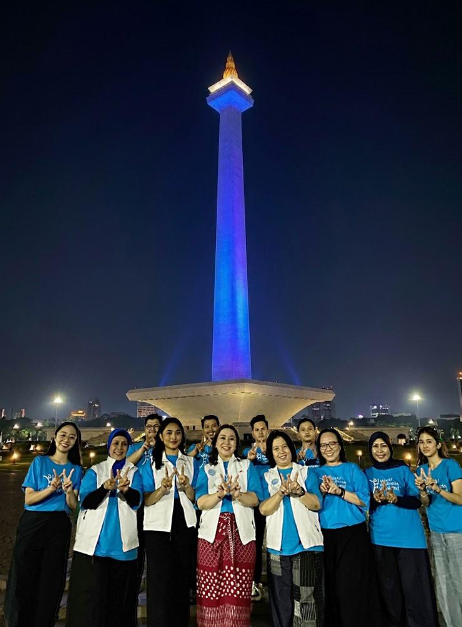
Oct 07 — From 18–20 September 2026, communities around the world came together for the 10th World Wellness Weekend, celebrating a decade of making wellness more accessible, inclusive and meaningful for people everywhere.
The milestone edition demonstrated the continued global momentum of the movement, with countries and cities on all 5 continents recording significant participation through wellness activities and venues.
The Stats & Facts of the 10th edition place Mexico first for net activities, Italy first for net venues, and Cancún first among cities for net activities and venues.
A decade of wellness, celebrated around the world
The final country statistics show Mexico with 754 net activities, followed by Spain with 500, Vietnam with 469, the USA with 424 and the Dominican Republic at 5th position with 421. Other countries among the leading 10 were Italy, India, Japan, Indonesia and Argentina.
In terms of net venues with sessions, Italy led with 272, followed by Spain with 234, Japan with 210, Mexico with 170, and the USA with 163.
These figures reflect the official final methodology used for the 10th edition. Where applicable, the statistics exclude fitness clubs without classes or sessions and parks/public spaces that were not confirmed by the relevant authorities.
Country figures are based on the official final country statistics. City figures use a 25 km radius from the city centre.
MEXICO LEADS THE GLOBAL WELLNESS MOVEMENT
Mexico emerged as the leading country in the final activity statistics, recording 754 net activities across 170 net venues.
Its strong national performance was reinforced by several Mexican destinations appearing among the world’s most active cities.
Cancún led the city statistics with 307 net activities and 58 net venues, followed by Tulum (5th place) with 94 activities and 25 venues, Playa del Carmen (8th place) with 50 activities and 11 venues, Los Cabos (9ex) with 48 activities and 14 venues, Merida (14th) with 42 activities and 12 venues.
This gives Mexico a particularly strong presence not only at national level but also among the leading individual wellness destinations.
ITALY LEADS IN WELLNESS VENUES
Italy recorded 272 net venues with sessions, the highest country figure in the official 10th-edition statistics. It also recorded 401 net activities.
Several Italian cities featured prominently in the city statistics, including:
● Casciana Terme Lari – 30 activities / 23 venues
● Rome – 28 activities / 17 venues
● Milan – 22 activities / 15 venues
● Florence – 18 activities / 8 venues
The results underline the breadth of participation across Italy, especially with the support of CIWAS (Confederazione Italiana de Wellness and Sport) and Fondazione SportCity with free activities nationwide.
SPAIN CONTINUES TO SHINE AS A WELLNESS DESTINATION
Spain stands as the 2nd most Active Country with 234 net venues with sessions, and 500 net activities.
Several Spanish cities featured prominently in the city statistics, including:
● Marbella (3rd) – 107 activities / 41 venues
● Malaga (9ex) – 48 activities / 30 venues
● Madrid (15) – 38 activities / 10 venues
● Santa Cruz de Tenerife (16) – 36 activities / 12 venues
● Barcelona (21) – 27 activities / 16 venues
● Las Palmas (29ex) – 17 activities / 8 venues
TOP 10 CITIES BY NET ACTIVITIES
Within a 25 km radius from the city centre, the official statistics recorded:
|
Rank |
City |
Country |
Net Activities |
|
1 |
Cancún |
Mexico |
307 |
|
2 |
Punta Cana |
Dominican Republic |
182 |
|
3 |
Marbella |
Spain |
107 |
|
4 |
Tulum |
Mexico |
94 |
|
5 |
Caracas |
Venezuela |
77 |
|
6 |
Singapore |
|
76 |
|
7 |
Punta del Este |
Uruguay |
51 |
|
7 |
Playa del Carmen |
Mexico |
50 |
|
9= |
Malaga |
Spain |
48 |
|
9= |
Los Cabos |
Mexico |
48 |
PUNTA CANA: A GLOBAL WELLNESS HOTSPOT
Punta Cana was a standout city in the Caribbean of the 10th edition, recording 182 net activities and 16 net venues with sessions within the official 25-kilometre city radius with thousands of people taking part in a raceç
MONAS TURNS BLUE FOR WELLNESS
In Jakarta, the 10th anniversary was marked by a particularly visual celebration.
On 18 September 2026, the iconic Monas (National Monument) lit up in blue as part of World Wellness Weekend.
The blue illumination symbolized the spirit of wellness and a shared commitment to creating healthier, more balanced and more meaningful lives.
The special moment brought the World Wellness Weekend message into one of Jakarta’s most recognizable landmarks:
“Wellness for All – because wellness belongs to everyone.”
Residents and visitors were invited to witness and capture the rare sight of Monas illuminated in blue, creating a memorable visual symbol for the 10th anniversary.
Indonesia itself recorded 205 net activities across 86 net venues in the final country statistics, placing it at N°9 among 185 countries in the 2026 edition.
A GLOBAL MOVEMENT, ONE SHARED MESSAGE
From Mexico to Spain, Japan to Vietnam, Indonesia to Argentina, the 10th World Wellness Weekend demonstrated the diversity of the global wellness community.
The city statistics also demonstrate this geographic diversity: alongside the leading Mexican and Spanish destinations are cities including Caracas, Singapore, Punta Del Este, Santo Domingo, Ho Chi Minh City…
JEAN-GUY DE GABRIAC, FOUNDER OF WORLD WELLNESS WEEKEND
“Ten years ago, we began with a simple idea: wellness should be something everyone can experience and share. Ten years later, seeing communities across the globe come together around wellness is incredibly meaningful. The 10th edition reminds us that wellness has no borders and that small local actions can contribute to a truly global movement turning free classes into food donations and blood donations.”
WELLNESS STARTS WITH “WE”
The statistics tell only part of the story.
Behind every activity is a person choosing to move, breathe, connect, learn, rest or simply take a moment for their wellbeing. Behind every venue is a community creating a space where wellness can be experienced and shared.
That is the essence of World Wellness Weekend after ten years:
Wellness is not a luxury reserved for a few.
Wellness is best when shared with family, friends, colleagues and wellness buddies.

7, Oct 2026
ChainIT® Brings “Your Face Is Your Password” to Web3 with Organizational MPC Wallets
Production wallets combine passwordless ChainIT ID with transaction-specific authority checks, advancing Agentic Web3 Complete Commerce during TOKEN2049 Week.
SINGAPORE, Oct. 7, 2026 /PRNewswire/ — ChainIT Inc. today announced production availability of its organizational Multi-Party Computation (MPC) wallets, connecting passwordless ChainIT ID with transaction-specific authority checks before signing. This release requires a verified, authorized organizational member to approve each transaction signed through the wallet. The capability is included at no additional cost in each ChainIT organizational digital identity profile.

The announcement follows ChainIT’s October 6 presentation of its Agentic Web3 Complete Commerce architecture during TOKEN2049 Week. The wallet launch focuses on the people and organizations behind those transactions: confirming who they are, confirming they are currently authorized to act, and requiring their approval before any funds move.
“A password is not a verified identity, and logging in is not authority to move company assets,” said Jeremy Blackburn, Founder and Chief Executive Officer of ChainIT. “ChainIT connects who you are, what you are authorized to do and the transaction you approve. Your face is your password. Your authority is verified before the wallet signs. That is a Web3 solution for Web3 companies.”
No memorized password. No blanket permission.
Passwords and passphrases can be copied, shared, phished or forgotten. ChainIT ID removes the need for a memorized account password or passphrase, combining biometric liveness, device verification and cryptographic proof of identity. One-time verification challenges remain part of applicable security workflows.
In the organizational wallet flow, the member completes biometric liveness and wallet authentication, then signs an operation-specific approval using their own wallet identity. The live-person check occurs outside the signing enclaves. The Primary enclave—the isolated environment that verifies authorization before signing—then confirms that the wallet-signed approval came from a registered member of the organization and matches the requested action.
Authority before every transaction – not just at onboarding
Before any transaction is signed through the organization’s wallet, the Primary enclave runs a series of checks. It confirms that the wallet approval is valid, that the person is still an active member of the organization, and that the approval matches the exact action and transaction being requested. Each approval also expires after a short time and can be used only once. Logging in or approving one transaction does not give anyone permission to carry out a different one.
ChainIT’s organizational governance model connects officer registration, assigned roles and authority, and attested wallet policy. Invitations, member additions and member removals require their own verified authorization. The objective is to connect not only who may transact, but also who may change the permissions governing future transactions.
Distributed signing without assembling the private key
The organizational wallet uses two-party Multi-Party Computation (MPC) signing. Its signing key is represented by two separate cryptographic shares, each protected inside an isolated AWS Nitro Enclave. Both enclaves must participate to produce a standard Ethereum-compatible signature without reconstructing the complete private key. Persisted MPC key material is encrypted.
A member’s personal authorization key is separate from those organizational signing shares. The member approves the specific action; the Primary enclave verifies the authorization before initiating the joint signing process. The organizational shares remain within the enclave infrastructure, not on members’ devices. Neither MPC party can produce the organizational signature alone.
A Web3 solution for Web3 companies
ChainIT ID can be used wherever ChainIT-enabled applications support it, rather than requiring a new password for each participating service. Each integration retains its applicable verification, authorization and product requirements. ChainIT invites wallet providers, exchanges, marketplaces, payment platforms and enterprise Web3 teams to explore integrations for verified access and governed organizational transactions.
“Web3 companies need more than just another way to sign a transaction,” said Eric Tacl, PhD, Executive Vice President, Verified Payments and Commerce, at ChainIT. “They need to connect the verified person, the organization, the appropriate level of authority and the action. Passwordless access simplifies the experience. Verifying authority for each specific transaction gives businesses control over what happens next.”
The production wallet adds a human-authorized execution component to ChainIT’s broader Complete Commerce architecture, which places authority and transaction-specific compliance before execution and preserves transaction evidence. This release covers transactions approved by people. Full integration with partners’ systems and transactions carried out by AI agents within set limits are being developed and tested separately.
Availability and TOKEN2049 meetings
The organizational MPC wallet is available in production as of October 6, 2026 and is included in new ChainIT organizational digital identity profiles at no additional cost. Existing organizational wallets are being migrated from the prior model. Supported functionality and integrations vary by deployment.
Dr. Eric Tacl is representing ChainIT at TOKEN2049 in Singapore and is available for media, product and integration discussions. Meeting requests and further information are available through ChainIT’s TOKEN2049 Singapore page.
About ChainIT®
ChainIT is native Web3 infrastructure for verified identity, provable authority, compliance and Complete Commerce. Its Web3 architecture is supported by a portfolio of 15 issued patents. ChainIT connects passwordless identity, organizational governance, digital agreements, payments and verifiable transaction evidence, bringing authority and accountability to commerce involving people, organizations and AI agents.
ChainIT technology already supports treasury operations at major U.S. banks, connecting its Web3 foundation to established financial infrastructure. Through ChainIT ID, organizational MPC wallets, Pactvera and ChainIT Pay, the platform connects who is acting, what they are authorized to do and the transaction they approve across ChainIT-enabled environments.
ChainIT® — The Authority on Authority™ for Agentic Commerce.
https://chainit.com/singapore-token2049/
 View original content to download multimedia:https://www.prnewswire.co.uk/news-releases/chainit-brings-your-face-is-your-password-to-web3-with-organizational-mpc-wallets-302900684.html

7, Oct 2026
Nayax Enters US Fuel Retail Through Distribution Partnership with Allied Electronics, Inc.
HERZLIYA, Israel, Oct 07 – Nayax Ltd. (Nasdaq: NYAX; TASE: NYAX), a global commerce enablement, payments, and loyalty platform, today announced a distribution partnership with Allied Electronics, Inc. to bring Nayax Fuel’s VPOS Media 5 outdoor payment solution to fuel retailers across the United States.
The US fuel market operates at exceptional scale, with convenience stores generating over $450 billion in fuel sales in 2025 and selling an estimated 80% of the fuel Americans buy, according to the National Association of Convenience Stores (NACS). Drivers increasingly pay for that fuel by card, which now represents 81% of transactions at the pump, up from 64% a decade ago. That shift has made modern payment infrastructure at the pump a necessity for US fuel retailers, central to how they serve customers.
This partnership meets that need by bringing Nayax payment infrastructure to US fuel retailers alongside Allied, a partner retailers know and trust. Allied has served the retail petroleum industry since 1978, and its systems, including the NeXGen PRIME forecourt controller, operate at tens of thousands of locations nationwide. Nayax Fuel, a dedicated vertical within the Nayax group, extends that foundation with a comprehensive portfolio spanning payment at the dispenser, forecourt control, and station management, building on the successful integration of OTI PetroSmart and Roseman.
“Allied and Nayax share an important focus on making the forecourt work better for retailers,” said Eli Bar, General Manager, Nayax Fuel. “Allied is one of the most respected names in US fuel retail, and our payment technology and solution give its customers a fuel-specific option built to meet the same high standard.”
“The US fuel industry is moving through a modernization cycle, and operators need both reliable forecourt systems and modern payment solutions at the pump,” said Bob Danford, Director of Engineering & Development at Allied Electronics, Inc. “Nayax complements our solutions with a purpose-built payment terminal backed by global payments infrastructure, allowing us to deliver the complete package to retailers together.”


Nayax Fuel will present its fuel retail solutions at the NACS Show, October 7-9, 2026, at the Las Vegas Convention Center. Visitors can find Nayax at booth C6385.
7, Oct 2026
Hoola Health Acquires UpTodd and Unveils Hoola 1000 for a Child’s First 1,000 Days
Bengaluru, Oct 07th, 2026: Hoola Health, a paediatric healthcare company building an integrated care ecosystem for children and families, today announced the acquisition of UpTodd, an early-childhood development platform, and unveiled Hoola 1000, a paediatrician-led programme that guides families from pregnancy through a child’s second birthday. Registrations for the programme are now open, ahead of its December 2026 launch in Bengaluru. Built on UpTodd’s early-childhood content and parent-engagement capabilities, Hoola 1000 combines guided paediatric care, specialist support and everyday guidance in one place.
The programme takes its name from the first 1,000 days of a child’s life, from conception to the second birthday, widely recognised as the most important window for a child’s growth, brain development and long-term health.
For most families, pregnancy comes with a clear structure of regular check-ups, scans and antenatal classes. After birth, that structure largely falls away. Paediatric visits in the first two years tend to be brief and built around a vaccine or an illness, and parents often leave without knowing what to expect next, what to watch out for or what is perfectly normal. Once they leave the clinic, the everyday questions are theirs to answer alone, with advice pieced together from search engines and social media. And many urban parents are raising children away from the extended families who once guided them through these early years.
Breastfeeding is a clear example of what happens when support thins out after birth. Nearly four in ten babies in Karnataka are not exclusively breastfed through their first six months, a figure that has barely moved in recent years, according to the National Family Health Survey (NFHS-6). For many families, what is missing is not intent, but the right guidance at the right moment.
Hoola 1000 is designed to give parents that village, a clinical one, starting with the paediatric visit itself. At each Guided Check-in, a Hoola paediatrician walks parents through how their child is growing, what to expect in the weeks ahead, what to watch out for and what they do not need to worry about. Beyond the check-ins, families have unlimited consultations with Hoola paediatricians and specialists, including lactation consultants, nutritionists, sleep coaches and developmental therapists, over chat, video or in person at a Hoola clinic, with no per-consultation charges. A dedicated Care Concierge acts as each family’s single point of contact, helping parents with their questions, connecting them with the right specialist and managing appointments all seven days a week, and keeping track of every vaccination, with paediatricians guiding parents on each vaccine.
Alongside clinical care, the programme gives parents structured, everyday support at home:
• Daily nutrition plans and an on-demand recipe library, matched to the child’s age and feeding stage
• Weekly play and development activities suited to the child’s developmental stage
• Monthly milestone reports that help parents track growth and development
• Stage-wise toy and activity kits delivered home as the child grows
Commenting on the unveiling, Deeksha Senguttuvan, Founder & CEO, Hoola Health, said, “When a baby is born, parents have a hundred questions, and a typical paediatric visit answers very few of them. Families come in for a vaccine or when their child is unwell, and leave without a sense of what’s coming next. We built Hoola 1000 so that every visit helps parents understand what to expect, what to watch for and what not to worry about, and so that the support doesn’t stop when they leave the clinic. Across more than 20,000 families at Hoola, and through UpTodd’s work with over 100,000 parents, we have seen how much that guidance matters. We want Hoola to be the partner parents turn to through every stage of early childhood, not just when their child is sick.”
The unveiling follows Hoola Health’s acquisition of UpTodd, an early-childhood development platform offering personalised, milestone-driven programmes across child development, nutrition and parenting guidance. UpTodd has engaged more than 100,000 families and built a base of over 10,000 paying customers. The acquisition brings UpTodd’s content, milestone-tracking and parent-engagement capabilities into Hoola Health, where they are combined with Hoola’s clinical expertise to shape Hoola 1000. UpTodd’s founders, Abhishek Singh, Devesh Kaushik and Richa Singh, have joined Hoola Health to lead new initiatives, technology and the therapy business respectively. Financial terms of the transaction were not disclosed.
Hoola 1000 will launch in Bengaluru in December 2026, with pricing and programme details to be announced at launch.
7, Oct 2026
izmo Microsystems and IIT Madras Enter Phase II of ₹99.94 Crore MeitY-Sanctioned Silicon Photonics Program
Five-year CPPICS SPECTRA program targets 1.6 Tbps optical transceivers, co-packaged optics, quantum communications and photonic AI
BENGALURU, India, Oct. 7, 2026 /PRNewswire/ — izmo Limited (NSE: IZMO) (BSE: 532341) today announced that its semiconductor subsidiary, izmo Microsystems Pvt. Ltd., has entered into a Memorandum of Understanding with the Indian Institute of Technology Madras (IIT Madras) for Phase II of the Centre for Programmable Photonic Integrated Circuits and Systems (CPPICS).

The Phase II program, titled Silicon Photonics Enabled Cutting-edge Technology Research and Applications (SPECTRA), has been sanctioned by the Ministry of Electronics and Information Technology (MeitY), Government of India, with a total project outlay of ₹99.94 crore. The five-year program includes a MeitY contribution of ₹97.54 crore and a ₹2.40 crore cash and in-kind commitment from izmo Microsystems.
CPPICS Phase II is designed to advance silicon photonics technologies from research towards commercially deployable products, covering photonic integrated circuit design, fabrication, characterization, advanced packaging, testing and system integration.
Silicon Photonics for the AI infrastructure era
The program comes at a time when optical connectivity is becoming critical infrastructure for AI and high-performance computing.
As GPU and accelerator clusters scale, data-center networks require substantially higher bandwidth while controlling power consumption, latency and interconnect density. This is driving the transition towards 800G and 1.6T optical interconnects, silicon photonics and, increasingly, co-packaged optics (CPO).
According to LightCounting, global sales of optical transceivers and related products reached $26.8 billion in 2025, up 74% year-on-year. The research firm estimates the optical transceiver market at approximately $40 billion in 2026, with silicon-photonics-based transceivers expected to represent more than half of the market for the first time.
LightCounting further estimates that the market for optical chips used across transceivers, active optical cables and near- and co-packaged optics could grow from approximately $4 billion in 2025 to $15 billion by 2031.
The transition is already moving into commercial infrastructure, with major networking and semiconductor companies introducing silicon-photonics-based co-packaged-optics platforms for large AI clusters.
Targeting 1.6 Tbps optical engines and co-packaged optics
CPPICS Phase II targets commercially viable photonic technologies across four major application areas: high-speed optical transceivers for data centers, microwave photonics for advanced wireless communications, quantum photonics, and photonic computing for AI.
Among the planned developments is a 1.6 Tbps silicon photonics transceiver engine operating at 1550 nm for high-performance computing and data-center routing. The project also targets microwave photonic engines operating beyond 50 GHz, integrated QRNG/QKD systems and photonic processors for AI workloads.
The program also proposes development of a silicon photonics Process Design Kit incorporating more than 100 IP blocks for 200 mm wafer platforms, supporting the design and manufacture of increasingly complex photonic integrated circuits.
izmo Microsystems to drive packaging and industrialization
A key challenge in silicon photonics is converting a fabricated photonic chip into a reliable and manufacturable optical system.
CPPICS Phase II specifically envisages development of a volume photonics packaging ecosystem in collaboration with izmo Microsystems, addressing precision assembly, photonic packaging, testing and reliability required for commercial deployment.
Under the program, izmo Microsystems’ role progresses from packaging architecture and CPO interface definition to PIC-EIC co-integration, fiber alignment and attachment, production-grade packaging, process optimization, prototype assembly and reliability validation.
The five-year roadmap ultimately targets a certified co-packaged optics design rule and service capability, creating a pathway from silicon photonics research and foundry fabrication through packaging, qualification and system-level deployment.
Dinanath Soni, Director, izmo Microsystems Pvt. Ltd., said:
“Silicon photonics is becoming a critical technology for the next generation of AI and data-center infrastructure as network speeds move from 400G and 800G towards 1.6T and beyond.
The challenge is no longer only designing the photonic chip. Converting that chip into a reliable product requires precision packaging, fiber attachment, electronic-photonic integration, thermal management and high-speed testing.
CPPICS Phase II brings together IIT Madras’ silicon photonics research capabilities with izmo Microsystems’ advanced packaging and manufacturing expertise. Our role is to help move these technologies from research prototypes towards production-ready modules and co-packaged optical systems.”
Building on CPPICS Phase I
CPPICS Phase II builds on the first phase of the program, which achieved more than 95% of its planned milestones and generated research, IP and prototypes across programmable photonics, microwave photonics and quantum technologies.
Phase II expands the program toward technology translation, industrialization and commercialization, with applications spanning data centers, telecommunications, defence, quantum technologies and advanced computing.
Through the collaboration, izmo Microsystems intends to strengthen its advanced photonic packaging capabilities and participate in the emerging global market for silicon photonics, high-speed optical interconnects and co-packaged optics for AI and high-performance computing infrastructure.
About izmo Microsystems Pvt. Ltd.
izmo Microsystems Pvt. Ltd., a subsidiary of izmo Limited, is an advanced semiconductor packaging and manufacturing company based in Bengaluru, India. The company provides semiconductor package design, development, prototyping, qualification and manufacturing capabilities across advanced IC packaging, System-in-Package, RF and microwave packaging, and silicon photonics and optical packaging.
For more information, visit www.izmomicro.com / www.izmoltd.com or contact:
Investor Contact
izmo Limited
No. 177/2C, Bilekahalli Industrial Area, Bannerghatta Road, Bangalore 560076
CIN: L72200KA1995PLC018734
Email ID: investors@izmoltd.com
Caution Concerning Forward- Looking Statements: Certain statements in this document may be forward-looking statements. Such forward-looking statements are subject to certain risks and uncertainties like regulatory changes, local political or economic developments, and many other factors that could cause our actual results to differ materially from those contemplated by the relevant forward-looking statements. Further, past performance is not necessarily indicative of future results. Given these risks, uncertainties and other risk factors, viewers are cautioned not to place undue reliance on these forward-looking statements. The Company will not be in any way responsible for any action taken based on such statements and undertakes no obligation to publicly update these forward-looking statements to reflect subsequent events or circumstances.
 View original content to download multimedia:https://www.prnewswire.com/in/news-releases/izmo-microsystems-and-iit-madras-enter-phase-ii-of-99-94-crore-meity-sanctioned-silicon-photonics-program-302900769.html

7, Oct 2026
All 365 SPJIMR PGDM Class of 2028 participants placed; median stipend up 17% to ₹2 lakhs a month
91 companies take part, including 37 first-time recruiters
Key pointers:
- 365 participants placed, representing 100% of the Class of 2028
- ₹2 lakhs per month median stipend, up 17% year-on-year
- ₹3 lakhs per month highest stipend, up 20%
- 91 companies participated, including 37 first-time recruiters
- Average stipend rose 12% to ₹1.86 lakhs per month
MUMBAI, India, Oct. 7, 2026 /PRNewswire/ — All 365 participants of the Class of 2028 at Bharatiya Vidya Bhavan’s S.P. Jain Institute of Management & Research (SPJIMR) have secured summer internships, with the median stipend rising 17% to ₹2 lakhs per month. Stipends rose at every level of the batch, the highest offer reached ₹3 lakhs per month, and 37 of the 91 participating companies recruited from SPJIMR for the first time.
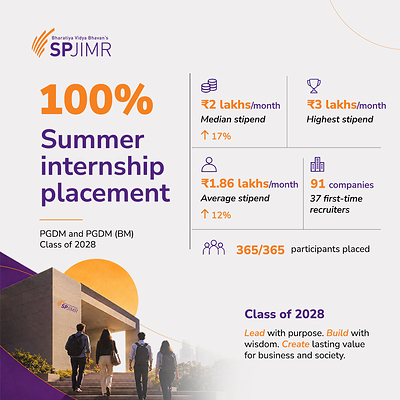
The Summer Internship Cycle covered the Post Graduate Diploma in Management (PGDM) and Post Graduate Diploma in Management Business Management (PGDM (BM)), SPJIMR’s flagship two-year programmes.
Prof. Varun Nagaraj, Dean, SPJIMR, said: “An internship is a student’s first real conversation with the world of work. What gratifies us this year is its breadth: every student placed, across consumer businesses, consulting, finance, technology and healthcare. Our purpose is to shape leaders who are willing to roll up their sleeves, work through ambiguity and create value for the right reasons. This cycle suggests that industry sees those qualities in our students.”
Key figures at a glance
|
Measure |
Class of 2028 |
Class of 2027 |
Change |
|
Students placed |
365 (100 %) |
361 |
NA |
|
Average stipend (per month) |
₹1.86 lakhs |
₹1.66 lakhs |
+12 % |
|
Median stipend (per month) |
₹2 lakhs |
₹1.71 lakhs |
+17 % |
|
Top 50% of batch, average |
₹2.18 lakhs |
₹2.00 lakhs |
+9 % |
|
Top 20% of batch, average |
₹2.44 lakhs |
₹2.16 lakhs |
+13 % |
|
Highest stipend |
₹3 lakhs |
₹2.50 lakhs |
+20 % |
|
Participating companies |
91 |
81 |
NA |
|
First-time recruiters |
37 |
22 |
NA |
More than half the batch secured ₹2 lakhs per month, while the top 20% of students received an average of ₹2.44 lakhs per month, and the top 50% received an average of ₹2.18 lakhs per month. The gains were not confined to the top of the cohort: the average rose 12% and the median 17%, which indicates broad-based demand rather than a few outlier offers.
Prof. Renuka Kamath, Associate Dean, Full-time Programmes, said: “True institutional excellence is measured not just by milestones, but by the meaningful trajectory of our participants’ careers. As our students begin this journey, they carry with them the SPJIMR ethos: to drive performance with integrity and build businesses that create value for society.”
New recruiters join the campus
Thirty-seven companies recruited from SPJIMR for the first time, including Amgen, Bajaj Auto, Britannia, Citi, D.E. Shaw & Co, Danone, DBS, Flipkart, Galderma, IBM, IDFC FIRST Bank, Kenvue, Kotak, NeoLiv, o3 Capital, SKF, Warner Bros., and Axis Bank.
FMCG and Consumer accounted for 33.1% of placements, followed by Consulting (23.5%) and BFSI (20.2%). General Management and Conglomerate roles made up 7.6%, and Technology, E-Commerce and Product roles 5%. The remaining 10.6% came from Automotive, Pharmaceuticals, Media, Energy, Real Estate, Engineering, Healthcare, and Biotech.
Prof. Ashita Aggarwal, Chairperson, PGDM and PGDM (BM), added: “Repeat recruiters show loyalty. First-time recruiters show conviction. Thirty-seven companies came to us for the first time this year, and they came for what our students bring: rigour, resilience, and a sense of responsibility.”
SPJIMR does not measure its success by the size of an offer. It measures it by the careers that follow, by how its graduates lead, build and serve. A first internship is where the journey begins, and a cohort placed in full, across sectors and with 37 first-time recruiters, begins it from a position of strength. The Financial Times Masters in Management ranking SPJIMR #2 globally for Careers Service reflects the same belief: that an institution’s real impact is seen in what its alumni go on to achieve.
The Class of 2028 now steps into the world of work with that foundation behind it, and with every opportunity to lead with purpose, build with wisdom, and create lasting value for business and society.
About SPJIMR
Bharatiya Vidya Bhavan’s S.P. Jain Institute of Management & Research (SPJIMR) is one of India’s leading postgraduate management institutes. It is recognised in the Financial Times Masters in Management 2026 ranking as the #26 business school globally and #2 in India and in the Financial Times Global MBA 2026 ranking as the #74 business school globally for its PGPM programme. SPJIMR is also consistently ranked among India’s top business schools by leading publications, including Business Today, Fortune India, India Today, and MBAUniverse. It has also been recognised by the Positive Impact Rating as one of the world’s top five business schools for societal impact. Known for its innovative and socially conscious approach to management education, research, and community engagement, SPJIMR seeks to influence managerial practice and enable value-based growth for students, alumni, organisations, and society. The institute holds the international Triple Crown of accreditations from EQUIS, AACSB, and AMBA, placing it among a select group of business schools worldwide to hold all three accreditations.
Visit SPJIMR.org for more information.
 View original content to download multimedia:https://www.prnewswire.com/in/news-releases/all-365-spjimr-pgdm-class-of-2028-participants-placed-median-stipend-up-17-to-2-lakhs-a-month-302900627.html

7, Oct 2026
RBI Turns Cautious, Raises Repo Rate to 5.50 pc Amid Inflation and Global Uncertainty
New Delhi, Oct 7: The Reserve Bank of India (RBI) has increased the benchmark repo rate by 25 basis points to 5.50 per cent, taking a cautious approach as rising inflation, higher crude oil prices and growing global economic risks put pressure on the domestic economy.
The decision was announced on Wednesday after a three-day meeting of the six-member Monetary Policy Committee (MPC), chaired by RBI Governor Sanjay Malhotra.
Along with the repo rate hike, the RBI raised the Standing Deposit Facility (SDF) rate to 5.25 per cent, while the Marginal Standing Facility (MSF) rate and bank rate were adjusted to 5.75 per cent.
The rate increase comes after the central bank had maintained the repo rate at 5.25 per cent for an extended period. It also marks the first increase in the repo rate since February 2023, reflecting a shift in the policy environment as inflationary pressures have become more pronounced.
Inflation has been one of the key factors behind the RBI’s decision. India’s Consumer Price Index (CPI) inflation rose to 4.82 per cent in August from 4.45 per cent in July, bringing price pressures closer to the upper end of the RBI’s tolerance band.
The global environment has also become more challenging. Crude oil prices have moved above $100 a barrel, partly due to escalating tensions in West Asia. A sustained rise in oil prices could increase input, transportation and energy costs across several sectors and add to inflationary pressures.
Global bond yields and inflation trends have further complicated the policy outlook. With several major economies facing renewed price pressures, the room for central banks to maintain easier monetary conditions has narrowed.
Domestic food inflation remains another area of concern. Strong El Nino conditions and below-normal rainfall in October could affect Rabi crop production, potentially creating additional pressure on food prices in the coming months.
SBI Research had earlier indicated that the balance of risks favoured a 25-basis-point rate increase, citing broader inflationary pressures, changing global macroeconomic conditions, liquidity developments and renewed repricing of risks in financial markets.
The RBI’s latest decision underlines its priority of containing inflation while keeping a close watch on growth and financial stability. Borrowers, banks, businesses and investors will now track upcoming policy meetings for further signals on interest rates and liquidity conditions.
The repo rate hike could have implications for borrowing costs across the economy, particularly for loans linked to external benchmarks, while also influencing deposit rates and financial market sentiment.


