


12, Nov 2026
How AI Is Transforming Agriculture: Smart Farming and the Future of Indian Farmers
Agriculture has always been one of the cornerstones of the Indian economy. Millions of farmers depend on it for their livelihoods, making it essential to the country’s economic growth and food security. However, Indian agriculture continues to face several challenges, including unpredictable weather conditions, water scarcity, rising input costs, crop diseases, pest attacks, and fluctuating market prices.
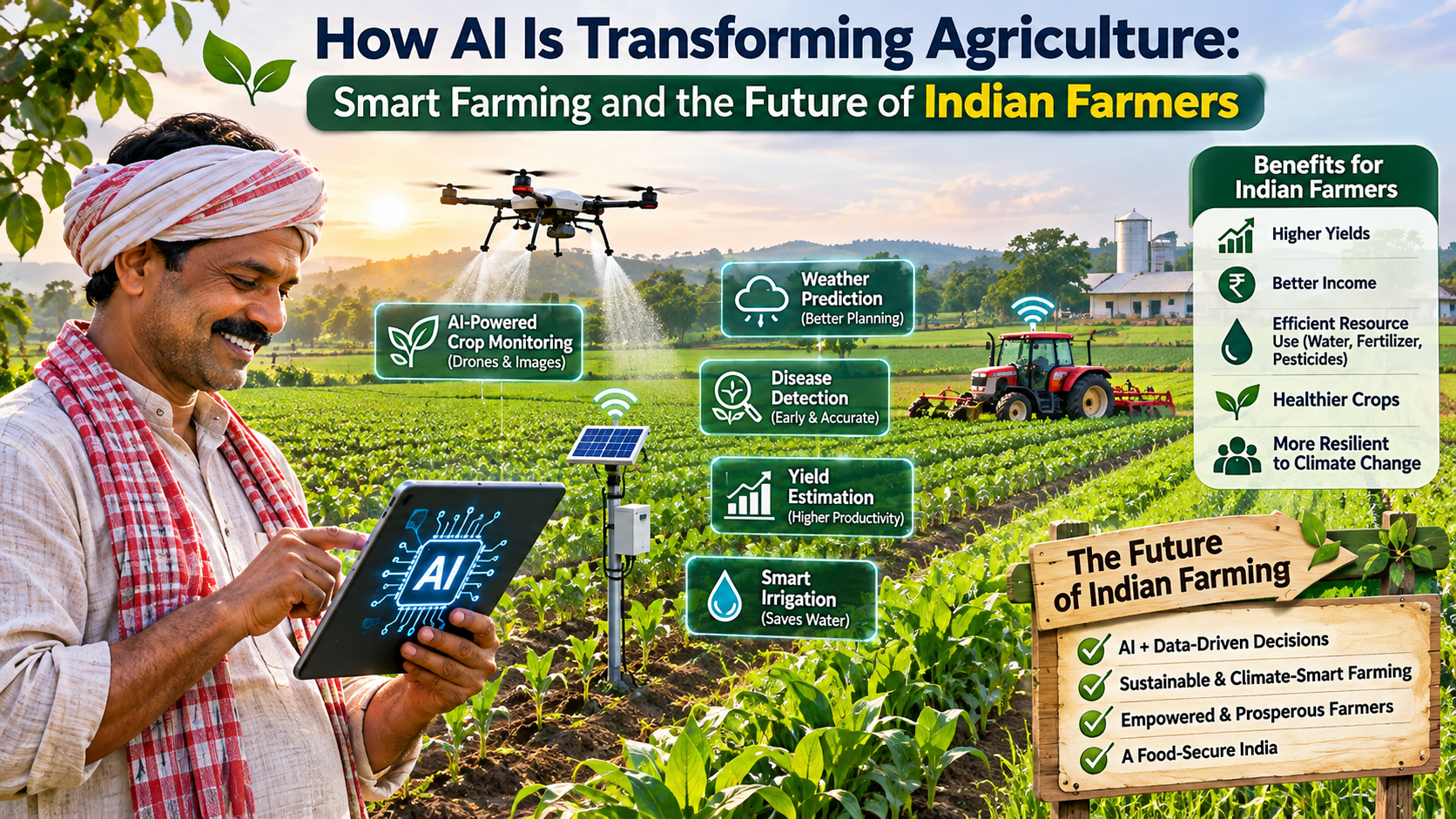
In recent years, Artificial Intelligence (AI) has emerged as a promising technology with the potential to transform the agricultural sector. From predicting weather patterns and identifying crop diseases to optimising irrigation and improving farm management, AI is helping farmers make smarter, faster, and more informed decisions.
By integrating AI with modern agricultural technologies, India is gradually moving towards a more efficient, productive, and sustainable farming system. Smart farming is no longer just a concept for the future; it is becoming an increasingly important part of modern agriculture.
Understanding AI-Powered Smart Farming: How Technology Is Changing Agriculture
AI-powered smart farming is a modern agricultural approach that uses Artificial Intelligence (AI), Machine Learning (ML), smart sensors, drones, satellite imagery, and data analytics to make farming more efficient, productive, and sustainable.
These technologies collect and analyse real-time and historical data related to soil health, crop conditions, temperature, rainfall, humidity, and soil moisture. By processing this information, AI-powered systems generate valuable insights and practical recommendations that help farmers make informed decisions at every stage of cultivation.
For instance, AI-based agricultural applications can help farmers identify crop diseases, monitor field conditions, determine the appropriate time for irrigation, select suitable sowing periods, and plan harvesting activities more effectively.
By combining traditional agricultural knowledge with data-driven insights, smart farming can reduce unnecessary input costs, minimise resource wastage, improve crop productivity, and optimise overall farm management. Ultimately, it helps farmers adopt a smarter, more precise, and sustainable approach to agriculture.
AI Helps Farmers Identify Crop Diseases and Pest Attacks
Crop diseases and pest infestations are among the major challenges facing Indian farmers. When these problems are not identified at an early stage, they can spread rapidly, damage crops, and significantly reduce agricultural yields.
AI-powered crop monitoring applications can analyse photographs of leaves, stems, and fruits to identify signs of diseases, nutrient deficiencies, and pest infestations.
Farmers can simply upload a photograph of an affected plant through a compatible mobile application. The AI system analyses the image and provides information about potential crop problems, along with recommendations for further action.
Early detection allows farmers to take preventive measures, minimise crop losses, and use pesticides more responsibly.
This technology can be particularly beneficial for farmers who do not have immediate access to agricultural experts or plant disease specialists.
Smart Irrigation and Efficient Water Management
Water is one of the most essential resources in agriculture. However, traditional irrigation practices can sometimes lead to excessive water consumption, increasing farming costs and putting additional pressure on available water resources.
AI-powered irrigation systems combine soil moisture sensors, weather forecasts, and crop water requirements to determine when and how much water a field needs.
These intelligent systems help farmers:
-
Monitor soil moisture levels in real time.
-
Avoid unnecessary irrigation.
-
Save water and electricity.
-
Maintain suitable moisture conditions for crop growth.
-
Improve the overall efficiency of water resources.
Smart irrigation can be particularly beneficial in drought-prone and water-scarce regions of India, where efficient water management is essential for sustainable agricultural development.
AI-Based Weather Forecasting for Better Farming Decisions
Weather conditions play a crucial role in agricultural production. Unexpected rainfall, droughts, floods, heatwaves, and extreme temperatures can cause serious crop damage and create financial difficulties for farmers.
AI-based weather forecasting systems analyse historical weather records, satellite observations, and real-time environmental data to generate more localised weather insights.
These forecasts can help farmers make informed decisions about:
-
Selecting suitable sowing periods.
-
Planning irrigation activities.
-
Scheduling fertiliser and pesticide applications.
-
Choosing the appropriate time for harvesting.
-
Preparing for extreme weather events.
In India, AI-based monsoon forecasting initiatives have demonstrated the potential of technology-driven agricultural advisories. During the 2025 Kharif season, a pilot programme reportedly delivered localised monsoon forecasts to approximately 3.88 crore farmers across 13 states through SMS alerts.
Such initiatives highlight how timely weather information can help farmers prepare for changing climatic conditions and reduce weather-related agricultural risks.
Agricultural Drones and AI-Based Crop Monitoring
Agricultural drones are becoming an important component of modern precision farming. Equipped with cameras, sensors, and advanced imaging technologies, drones can capture detailed information about large agricultural fields in a relatively short time.
AI systems analyse the collected images to identify crop stress, uneven plant growth, pest infestations, water shortages, and other potential problems.
Drones can also support precision spraying by applying agricultural inputs to specific areas that require treatment, reducing the need for unnecessary spraying across entire fields.
Some of the major benefits of AI-powered agricultural drones include:
-
Faster and more efficient crop monitoring.
-
Reduced dependence on manual field inspections.
-
Early identification of crop health problems.
-
More efficient use of fertilisers and pesticides.
-
Better monitoring of large agricultural areas.
-
Improved farm management and decision-making.
By combining drone technology with AI-based analytics, farmers can monitor their crops more effectively and respond to agricultural problems at the right time.
AI in Soil Testing and Fertiliser Management
Healthy soil is the foundation of successful agriculture. However, excessive or inappropriate fertiliser application can increase cultivation costs, damage soil health, and contribute to environmental pollution.
AI-powered soil analysis systems combine soil test results, crop requirements, weather information, and environmental data to provide recommendations for better nutrient management.
These systems help farmers understand the nutritional condition of their soil and identify suitable fertilisers according to the specific requirements of their crops.
For example, AI-based advisory tools can support decisions regarding the appropriate application of nitrogen, phosphorus, and potassium, depending on soil conditions and crop requirements.
Better soil and fertiliser management can reduce unnecessary input costs, improve nutrient efficiency, and support long-term agricultural sustainability.
Government Initiatives Promoting AI in Indian Agriculture
The Government of India is increasingly promoting digital technologies and AI-based solutions to modernise agriculture, improve agricultural services, and strengthen farmers’ access to reliable information.
Several important initiatives are contributing to this transformation.
Bharat-VISTAAR: An AI-powered multilingual agricultural platform launched in February 2026. It aims to connect farmers with agricultural information, scientific recommendations, weather updates, and market intelligence through digital and voice-based services.
Kisan e-Mitra: An AI-powered, voice-enabled chatbot designed to help farmers access information about government agricultural schemes, including PM-KISAN and the Pradhan Mantri Fasal Bima Yojana.
Digital Agriculture Mission: An initiative focused on developing digital infrastructure for the agricultural sector through platforms such as AgriStack. It aims to improve agricultural services, integrate data, and support informed decision-making.
National Pest Surveillance System (NPSS): A technology-based initiative that uses AI to support pest identification and monitoring, helping farmers and agricultural officials take timely action to manage pest-related problems.
Together, these initiatives demonstrate how digital innovation and AI can improve agricultural information services and make technology-driven solutions more accessible to Indian farmers.
How AI Can Benefit Small and Marginal Farmers
Small and marginal farmers form a significant part of India’s agricultural community. However, many face financial constraints, limited access to modern equipment, and difficulties in obtaining timely agricultural information.
AI has the potential to address some of these challenges by providing affordable digital advisory services, localised weather information, crop disease identification, and personalised farming recommendations.
Voice-based AI applications can be particularly useful for farmers who are unfamiliar with complex mobile applications or have limited digital literacy.
Providing information in regional languages can further improve accessibility and make agricultural technology easier to understand and use.
For instance, farmers in Odisha could benefit from AI-based agricultural advisories in Odia, providing locally relevant information about crops, rainfall conditions, irrigation, and pest management.
However, affordable smartphones, reliable internet connectivity, digital literacy programmes, and access to local agricultural experts will remain essential to ensure that small and marginal farmers can benefit from these innovations.
Challenges of Adopting Artificial Intelligence in Agriculture
Although AI offers significant opportunities for agricultural development, its adoption in India still faces several challenges.
High Technology Costs: Advanced drones, sensors, smart irrigation systems, and automated agricultural equipment can be expensive for individual farmers, particularly those with small landholdings.
Limited Internet Connectivity: Farmers in remote rural areas may not always have access to reliable internet services, making it difficult to use certain AI-powered applications.
Lack of Digital Literacy: Some farmers may require proper training and technical assistance to understand and effectively use AI-based agricultural tools.
Data Accuracy and Reliability: AI recommendations depend on accurate and updated information. Incorrect soil data, weather predictions, or crop-related information can lead to unsuitable farming decisions.
Regional Language Support: AI applications must understand local languages, agricultural practices, soil conditions, and regional cropping patterns to provide relevant recommendations.
Limited Technical Support: Farmers need access to agricultural experts and technical assistance when AI-generated recommendations are unclear or difficult to implement.
Addressing these challenges will be essential to making AI-based agriculture affordable, reliable, and accessible to farmers across India.
The Future of AI in Indian Agriculture
The future of Indian agriculture is expected to become increasingly digital, connected, and data-driven.
In the coming years, AI-powered agricultural robots, autonomous machinery, advanced drones, smart irrigation systems, and intelligent crop monitoring technologies could become more widely adopted.
AI may also play an important role in:
-
Predicting crop yields and estimating agricultural production.
-
Improving agricultural supply chains and logistics.
-
Monitoring food quality and reducing post-harvest losses.
-
Supporting better access to agricultural markets.
-
Promoting climate-resilient farming practices.
-
Developing more efficient and sustainable agricultural systems.
For states such as Odisha, where agriculture plays a major role in rural livelihoods, these technologies could create valuable opportunities.
AI-based weather advisories, crop monitoring, pest identification, and efficient water management could help farmers make better decisions and improve their preparedness for changing climatic conditions.
Combining India’s traditional agricultural knowledge with modern technological innovations could pave the way for a more productive, resilient, and sustainable agricultural ecosystem.
Conclusion
Artificial Intelligence is opening up new possibilities for the future of Indian agriculture. From identifying crop diseases and predicting weather conditions to improving irrigation, monitoring soil health, and optimising fertiliser use, AI has the potential to make farming smarter, more productive, and more efficient.
Government initiatives, agricultural research institutions, technology companies, and farming communities will play an important role in bringing these innovations to farmers across the country.
However, technology alone cannot solve every agricultural challenge. Farmers also need affordable tools, accurate information, proper training, reliable connectivity, and access to agricultural experts.
The real success of AI in Indian agriculture will depend on how effectively these technologies reach farmers, particularly those living in rural and underserved communities.
- 0
- By Neel Achary



