


15, Oct 2026
TGE Value Creative Solutions Celebrates Recent NYSE Listing: NYSE Content Update
NYSE issues a pre-market daily advisory direct from the trading floor.
NEW YORK, Oct. 15, 2026 /PRNewswire/ — The New York Stock Exchange (NYSE) provides a daily pre-market update directly from the NYSE Trading Floor. Access today’s NYSE Pre-market update for market insights before trading begins.
Kristen Scholer delivers the pre-market update on October 15th
- TGE Value Creative Solutions rings the Opening Bell
- The firm has a mission to merge with private companies generally in the media or hospitality space.
- Founder Calvin Choi will join NYSE Live to discuss the firm’s current portfolio of companies and next steps for TGE.
- Alpaca Co-Founder and CEO Yoshi Yokokawa to join NYSE Live
- The company’s push to establish its prime brokerage business was inspired by tokenized stocks.
- The firm also recently participated in DTCC’s tokenized equities pilot.
- Investors continue to monitor inflation and earnings reports
- PPI data was released earlier this morning, with economists expecting producer prices to drop slightly to 5.3%.
- The report comes one day after CPI data came in hotter than expected at 3.7%.
- Taiwan Semiconductor (NYSE: TSM), Charles Schwab (NYSE: SCHW), BNY (NYSE: BNY) and PNC (NYSE: PNC) reported earnings this morning.
Opening Bell
TGE Value Creative Solutions (NYSE: BEBE) celebrates its NYSE listing
Closing Bell
The Headstrong Project celebrates 14 years providing PTSD treatment to veterans
For market insights, IPO activity, and today’s opening bell, download the NYSE TV App and check out the NYSE YouTube: TV.NYSE.com and YouTube.com/@NYSEofficial


 View original content to download multimedia:https://www.prnewswire.co.uk/news-releases/tge-value-creative-solutions-celebrates-recent-nyse-listing-nyse-content-update-302910096.html

- 0
- By Sai Krishna

15, Oct 2026
Leostream Simplifies Secure Remote Access with New Cloud Offering
Leostream Cloud connects authorized users directly to the workstations and resources they need, providing an alternative to VPN-based remote access
BOSTON – October 15, 2026 – Leostream Corporation, a leading provider of secure remote access and digital workspace management solutions, today announced Leostream Cloud, a new cloud-based offering designed to simplify secure remote access to physical and cloud-hosted workstations and other protected resources.
Remote users often need access to a specific workstation or resource, not an entire corporate network. Yet organizations have traditionally relied on virtual private networks (VPNs) to provide remote connectivity, potentially giving users broader network access than their work requires. Leostream Cloud enables organizations to replace or avoid VPN deployments for these remote access use cases by authenticating users, applying access policies and connecting them only to the resources they are authorized to use.
“Remote access has traditionally been associated with providing users a path into the corporate network, often through a VPN, but in many cases that is more access than they actually need,” said Karen Gondoly, CEO of Leostream. “With Leostream Cloud, we’re applying the same principles of choice and controlled access that have always been central to Leostream, but now delivered through the cloud. Organizations can provide secure remote access without requiring users to first connect to the corporate network through a VPN. Instead, they can authenticate the user, authorize the specific resource and limit everything else, giving users a simple way to connect while giving IT greater control over what they can access.”
Leostream Cloud also supports vendor privileged access management (VPAM) use cases, giving organizations a way to provide third-party users and contractors controlled access to specific resources without granting broader network access.
“Organizations need a practical way to give vendors and other external users access to the systems required to do their jobs without unnecessarily opening up the broader environment,” said Piotr Baranowski, Owner, Instructor and CTO, Open Source Education Center (OSEC). “In validating the VPAM workflow in Leostream Cloud, we saw how identity and access policies can be used to connect an authorized user directly to an approved resource. It’s a straightforward approach to a remote access challenge that many organizations are trying to solve.”
Secure Access to the Resource, Not the Network
Leostream Cloud combines identity-based authentication with policy-driven resource assignment to control who can connect, what they can access and how the connection is established. Users sign in through a centralized access experience and see only the resources they are authorized to use. By connecting users directly to approved resources rather than first placing them on the corporate network, Leostream Cloud can eliminate the need for a VPN in remote access scenarios where users only require access to specific workstations or systems.
The Leostream Cloud Agent uses outbound connectivity to help organizations provide access to protected resources without directly exposing remote access services such as RDP or SSH to the internet. Organizations can also centrally manage access policies and resource assignments while maintaining logs and optional session recordings for greater visibility into remote activity.
Leostream Cloud can support remote access across physical workstations, data centers, branch or project sites, and cloud environments. Organizations can select from connection protocols including RDP, VNC, SSH, HTML5, Amazon DCV, Jump Desktop, and Sunshine/Moonlight based on the requirements of different users and workloads.
This flexible approach enables a range of remote access scenarios, including connecting engineers to CAD workstations, creative professionals to cloud GPU resources, researchers to Linux systems, and contractors to specific approved resources. For organizations evaluating alternatives to HP Anyware, Leostream Cloud provides a flexible path forward that supports multiple connection protocols and diverse physical, virtual and cloud-hosted resources without locking users into a single protocol or infrastructure model. Rather than deploying a separate access solution for each environment or use case, IT teams can manage diverse users, resources and connection methods through a centralized platform.
Leostream Cloud is part of an organization’s Zero Trust Network Architecture (ZTNA), by applying identity and policy at the point of access and limiting users to authorized resources. For organizations looking to reduce reliance on VPNs, this resource-specific model provides an alternative to extending network-level access to remote users. It is designed to address a specific component of ZTNA: securely connecting authenticated users to individual workstations and protected resources without providing unnecessary access to the surrounding network.
15, Oct 2026
Beyond Generation: RE: DIALOGUES 2026 Puts India’s Power Distribution and Infrastructure Challenges in Focus
- Policy Perspectives Foundation and Orange Circle Energy convene energy sector experts to examine India’s evolving electricity requirements, grid constraints and power-system planning
- Energy experts highlight the need to plan for rising demand alongside transmission infrastructure, regulatory stability and investment
NEW DELHI, Oct. 15, 2026 /PRNewswire/ — India’s electricity planning faces a growing challenge: anticipating how demand will evolve while ensuring transmission infrastructure can deliver power reliably and affordably. At RE: DIALOGUES 2026: Powering a Developed India, convened by Policy Perspectives Foundation (PPF) and Orange Circle Energy (OCE) in New Delhi on 14 October, discussions centred on the gap between future electricity requirements and the infrastructure, investment and regulatory frameworks needed to meet them.

The dialogue examined four interconnected priorities for the power sector: electricity demand, transmission and distribution infrastructure, regulatory stability, and the economics of power generation. A central theme emerging from the discussions was the need to look beyond generation capacity and address the infrastructure, planning and investment required to deliver electricity reliably and affordably as India’s economy grows.
The dialogue featured Shri Bhupinder Bhalla, former Secretary, Ministry of New and Renewable Energy, Government of India, as Chief Guest. Speaking about the energy and power ecosystem he said, “India’s energy transition must be viewed in the wider context of its development priorities. Beyond expanding generation capacity, we need to strengthen domestic manufacturing, advance technology, mobilise investment and create jobs while safeguarding energy security. This calls for a coordinated approach to planning and implementation, with the Centre and states working together to address infrastructure and regulatory challenges.”
In his opening presentation, Nikesh Sinha, Founder, Orange Circle Energy, used international per-capita electricity consumption benchmarks to explore the potential scale of India’s future power requirements. The discussions highlighted the time needed to build transmission infrastructure, alongside right-of-way constraints, transformer availability and the distance between renewable energy generation centres and consumption hubs.
Nikesh Sinha, Founder, Orange Circle Energy, said: “India’s power-sector planning needs to look beyond how much electricity we can generate to how much the country will need, where that demand will emerge, and how reliably it can be delivered. Transmission infrastructure takes time to build, and generation and consumption centres are not always in the same locations. Anticipating these requirements and aligning transmission planning with generation, while also considering decentralised solutions, will be critical to meeting India’s future electricity needs.”
The discussions highlighted that India’s energy transition will depend not only on expanding generation capacity but also on deploying domestic capital effectively, strengthening electricity distribution and translating policy into implementation. Looking ahead, wind energy was identified as a potential area of significant growth alongside solar and other renewable sources, reinforcing the need for coordinated investment, infrastructure development and power-system planning to support India’s evolving energy mix.
Safi Ahsan Rizvi, former Advisor to the National Disaster Management Authority (Policy Perspectives Foundation), said “India needs to look beyond creating new funding mechanisms and examine how existing public resources can be strategically channelled towards national priorities such as renewable energy and disaster resilience. Even a small reallocation of resources, supported by the right institutional frameworks, can help unlock investment at scale. Building a dialogue between government and industry is critical to identifying these opportunities and translating public capital into meaningful outcomes.”
Discussions also brought together Ronnie Khanna, NITI Aayog; Prakash Garg, National Solar Energy Federation of India; Nidhi Sarin, Global Energy Alliance for People and Planet; Dr Ritu Mathur, TERI; Professor Bhim Singh, IIT Delhi and Netaji Subhas University of Technology; Professor V. K. Jain, Amity University; Dr R. K. Tyagi, Power Foundation of India; Manika Malhotra Jain, Policy Perspectives Foundation; Manoj Kumar Upadhyay, NITI Aayog; Dr Kavita Singh, TERI School of Advanced Studies; Rashi Singh, Council on Energy, Environment and Water; Mohit Kumar Gupta, Grid Controller of India Limited; Safi Ahsan Rizvi, former Advisor to the National Disaster Management Authority; Shubhashis Dey, Solutions for Sustainable Living (SoSuL LLP); Srishti Ahuja, EY; and Arushi Relan, CEEW.
RE: DIALOGUES 2026 concluded with a call for continued engagement among policymakers, industry stakeholders, financial institutions, technology experts and research organisations to address the interconnected challenges of India’s energy transition.
About Policy Perspectives Foundation (PPF)
Policy Perspectives Foundation is an independent public policy think tank working through research, community outreach, capacity building and policy advocacy to promote inclusive and sustainable development. The Foundation is directed by Sh. P. C. Haldar, former Director of the Intelligence Bureau, Government of India.
About Orange Circle Energy (OCE)
Orange Circle Energy is committed to accelerating India’s transition to clean, affordable and reliable solar energy. With expertise spanning rooftop installations and utility-scale solar projects, the companyc delivers tailored solar solutions across residential, commercial, industrial and utility sectors. Combining engineering expertise with a client-centric approach, Orange Circle Energy works closely with its partners to address their energy goals, financial considerations and operational requirements.

 View original content to download multimedia:https://www.prnewswire.com/in/news-releases/beyond-generation-re-dialogues-2026-puts-indias-power-distribution-and-infrastructure-challenges-in-focus-302909991.html

15, Oct 2026
OrbiMed Raises $3 Billion Across Global and Asia Private Equity Funds
NEW YORK, Oct. 15, 2026 /PRNewswire/ — OrbiMed, a leading global healthcare investment firm, is pleased to announce that it has raised $3 billion in commitments for two new private equity funds: OrbiMed Private Investments X and OrbiMed Asia Partners VI.

OrbiMed Private Investments X raised over $1.9 billion to invest in U.S. and European life sciences venture capital opportunities. OrbiMed Asia Partners VI raised over $1 billion to invest in healthcare growth equity and venture capital opportunities across Asia. Both funds seek to build leading healthcare companies focused on biopharmaceuticals, medical devices, diagnostics, and technology-enabled healthcare services.
“There has never been a more exciting time to invest in life sciences innovation,” said Carl Gordon, a managing partner of OrbiMed. “AI, a proliferation of new therapeutic modalities and China’s emergence as a biotechnology powerhouse are expanding the opportunities to develop transformative treatments. We look forward to helping entrepreneurs turn these advances into leading healthcare companies.”
OrbiMed is led by 20 partners and supported by a team of over 150 professionals with complementary expertise in company incubation, strategy, operations and finance. The firm operates from 12 global locations across key healthcare markets.
Investors in these new funds include a broad range of medical institutions, university endowments, foundations, pension funds, sovereign wealth funds and family offices.
“We are grateful for the continued support of our many long-standing investors,” said Carter Neild, a managing partner of OrbiMed. “We will work tirelessly over the coming years to meet their high expectations.”
About OrbiMed
OrbiMed is a leading healthcare investment firm with over $21 billion in assets under management. OrbiMed invests globally across the healthcare industry, from start-ups to large multinational corporations, through private equity funds, public equity funds and royalty/credit funds. OrbiMed seeks to be a capital provider of choice, providing tailored financing solutions and extensive global team resources to help build world-class healthcare companies. OrbiMed’s team of over 150 professionals is based in New York City, London, San Francisco, Shanghai, Hong Kong, Mumbai, Herzliya and other key global markets. For more information, please visit www.orbimed.com.
 View original content to download multimedia:https://www.prnewswire.co.uk/news-releases/orbimed-raises-3-billion-across-global-and-asia-private-equity-funds-302909249.html

15, Oct 2026
In Karntaka – Stress Builds Through Every Decade, And The Hair Pays The Price
Traya Health’s Study of Karnataka Men Finds the State Above the National Average on Every Internal Health Marker Linked to Hair Loss, i.e., Stress, Sleep, and Metabolism.
Bangalore, Oct 15 – Traya Health today released state-level findings from India’s male hair health study covering more than 5 lakh men across the country. Karnataka men were assessed as part of the national study.
In Karnataka, stress, sleep and metabolism are all above the national average. This is not a story about one alarming number. It is a story about three internal health conditions running above the national baseline at the same time, building quietly through a man’s twenties and thirties, and showing up in the hair before most men know to look for a cause.
The Findings:
The median age of people with hair loss in this study is 29.
|
Health Marker |
Karnataka |
National Average |
Difference |
|
Stress |
61.3% |
54.6% |
+6.7 pts |
|
Poor Sleep |
33.4% |
29.5% |
+1.2 pts |
|
Metabolism |
57.3% |
55.8% |
+1.5 pts |
Stress, sleep, and metabolism are not separate lifestyle concerns sitting alongside hair loss. They are the internal conditions that drive it. Sustained stress disrupts the hormonal signals that keep hair follicles in their growth phase. Poor sleep cuts short the cellular repair that follicles depend on. Metabolic pressure means the body deprioritises hair redirecting nutrients to more critical functions first.
In Karnataka, all three are running above the national average. Together, they create a compounding internal environment where hair loss is not just likely; it is almost inevitable.
More than 3 in 5 Karnataka men are under moderate to high stress. It’s significant how at 18-20 it’s 49.5% and at 36-40 it’s 65.7%. They become progressively more stressed through every decade of adult life. Sustained stress elevates cortisol, disrupts hormone balance and pushes hair follicles out of their growth phase. And because the process is gradual, most men never connect the stress they have been carrying for years to the hair loss they are now experiencing.
Nearly 1 in 3 Karnataka men are not sleeping well. It leads by 3.9 percentage points above the national average. Worsens steadily with age from 30.3% at 18–20 to 38.1% at 41–50. Sleep is when the body repairs. When it is consistently disrupted year after year, the deficit compounds. The hair loss that follows is slow, diffuse, and almost impossible to trace back to its source.
Metabolism issues are highest in the youngest Karnataka men: 61.2% at 18–20. For metabolism. The metabolic and nutritional pressure starts before a Karnataka man has turned 21 and stays elevated through every age group. When the body is running low, hair is the first thing it cuts.
HOW FAR IT HAS GONE
Hair loss in Karnataka is not being caught early. By the time most men seek help, the condition has already progressed significantly.
Only 16.8% come in at Stage 1 – the earliest and most addressable point. More than half, 53.5%, are already at Stage 3 or beyond.
At 18–20, 12.9% of Karnataka men are already experiencing heavy hair fall – sudden, widespread shedding in men who are barely adults.
By 26–30, only 15.7% remain at Stage 1. By 41–50, that drops to 5.1%, while 55.9% are at Stage 4 or beyond. The window to act is open longest in a man’s early twenties.
TRAYA’S READ
Hair loss is not driven by a single cause that can be identified and fixed. It is driven by sustained, compounding stress, sleep, and metabolism. In Karnataka – all running above the national baseline, building quietly through a man’s twenties and thirties, showing up in your hair.
In Traya’s POV, most men experiencing hair loss have been addressing it with oil and shampoos. The real problem is internal and needs a holistic solution addressing the root cause.
15, Oct 2026
Nation Remembers ‘Missile Man’ APJ Abdul Kalam on Birth Anniversary; Amit Shah, Jaishankar Pay Tributes
New Delhi, Oct 15: India on Thursday remembered former President and Bharat Ratna awardee Dr APJ Abdul Kalam on his birth anniversary, with Union ministers and chief ministers paying tribute to the legendary scientist whose contributions to defence technology, space research and education left a lasting imprint on the nation.

Representational Image
Union Home Minister Amit Shah, External Affairs Minister S. Jaishankar, Union Minister G. Kishan Reddy and several chief ministers highlighted Kalam’s scientific achievements, democratic values and enduring commitment to inspiring young Indians.
Widely known as the ‘Missile Man of India’ and the ‘People’s President’, Kalam continues to be remembered for his vision of a scientifically advanced, self-reliant and developed India.
Amit Shah Recalls Kalam’s Contribution to National Security
Paying tribute on social media platform X, Home Minister Amit Shah described Kalam as an exceptional scientist who dedicated his abilities to strengthening India’s strategic capabilities.
“Tributes to the People’s President, Dr APJ Abdul Kalam Ji, on his Jayanti,” Shah wrote, adding that Kalam’s life would continue to inspire younger generations to devote themselves to serving the nation.
External Affairs Minister S. Jaishankar also honoured the former President, praising his vision, commitment and dedication to the country.
“Pay my tribute to Bharat Ratna Dr. APJ Abdul Kalam on his birth anniversary today. His vision, commitment & dedication for the nation continue to inspire,” Jaishankar said.
Union Minister G. Kishan Reddy remembered Kalam as a pioneering scientist and visionary leader who devoted his life to advancing India’s scientific capabilities and nurturing the aspirations of young people.
He emphasised Kalam’s belief in the transformative power of knowledge, innovation and education, describing his legacy as a continuing source of inspiration for generations.
Chief Ministers Honour the Missile Man
Uttar Pradesh Chief Minister Yogi Adityanath paid homage to Kalam, highlighting his contribution to India’s strategic strength and defence preparedness.
In his message in Hindi, Adityanath described the former President as a visionary who helped elevate the country’s strategic capabilities and whose exemplary life would continue to inspire citizens.
Maharashtra Chief Minister Devendra Fadnavis also paid tribute to Kalam, linking his legacy to the importance of reading and lifelong learning.
Maharashtra observes Kalam’s birth anniversary as Vachan Prerna Divas, an initiative aimed at encouraging reading habits and promoting the pursuit of knowledge.
From Rameswaram to Rashtrapati Bhavan
Born on October 15, 1931, in Rameswaram, Tamil Nadu, Avul Pakir Jainulabdeen Abdul Kalam rose from a modest background to become one of India’s most admired scientists and public figures.
He served as India’s 11th President from 2002 to 2007 and earned widespread affection for his simplicity, humility and close engagement with students.
Kalam began his professional journey at the Defence Research and Development Organisation (DRDO) in 1960 before joining the Indian Space Research Organisation (ISRO) in 1969.
At ISRO, he led the Satellite Launch Vehicle-III project, which successfully placed the Rohini satellite into near-Earth orbit in 1980, marking a significant milestone in India’s indigenous space programme.
He later played a leading role in the Integrated Guided Missile Development Programme, which advanced the development of indigenous missile systems, including Agni and Prithvi. These contributions earned him the enduring title ‘Missile Man of India’.
Kalam also served as a key scientific adviser during the 1998 Pokhran-II nuclear tests, a landmark moment in India’s strategic and defence history.
In recognition of his outstanding contributions, he received the Padma Bhushan in 1981, the Padma Vibhushan in 1990 and the Bharat Ratna, India’s highest civilian award, in 1997.
A Lasting Message for Students and Young India
Beyond laboratories, missile programmes and the presidency, Kalam’s greatest legacy arguably lies in his unwavering belief in the potential of young people.
He consistently encouraged students to dream ambitiously, develop scientific thinking, pursue knowledge and use their abilities to address national challenges.
His birth anniversary is widely associated with World Students’ Day, reflecting his enduring connection with education and youth empowerment. The observance celebrates the values he championed throughout his life: curiosity, discipline, innovation and the courage to pursue ambitious goals.
Years after his death in 2015, Kalam remains a powerful symbol of how scientific excellence, humility and public service can come together to shape a nation’s future.
As leaders across the country paid tribute to him, the central message of his life remained relevant: building a stronger India begins with empowering its people, especially its young minds, through education, innovation and a shared commitment to national progress.
15, Oct 2026
India to Remain World’s Fastest-Growing Major Economy for 20–25 Years: Piyush Goyal
Commerce Minister cites India’s young population, expanding consumer market and entrepreneurial spirit as key drivers of long-term growth; calls for collective efforts to achieve developed-nation status by 2047.
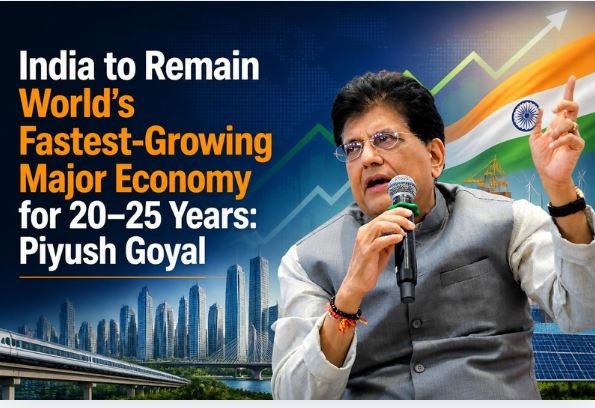
New Delhi, Oct 15: Union Commerce and Industry Minister Piyush Goyal has expressed confidence that India will remain the world’s fastest-growing major economy for the next two to two-and-a-half decades, citing its demographic advantage, expanding domestic market and growing global economic influence.
Addressing the SRCC Centenary Conclave in New Delhi on Thursday, Goyal said India was increasingly attracting international attention as countries recognised the potential of its young, ambitious population and its growing role in technology, trade and global economic development.
“The world wants to engage with India today because they recognise the young aspirational India is going to lead global growth,” the minister said, adding that the country could emerge as a major engine of technological advancement and international trade.
Young Population, Large Market to Drive Growth
Highlighting India’s long-term economic prospects, Goyal identified its demographic dividend, entrepreneurial energy and large consumer base as key strengths that could sustain growth over the coming decades.
He said these advantages would not only influence India’s economic trajectory but also shape its role in the evolving global economy.
“We will continue to be the fastest-growing large economy in the world for the next 20-25 years,” Goyal said, expressing confidence in the country’s ability to maintain its growth momentum.
His remarks come amid India’s broader ambition to strengthen its position in global manufacturing, expand international trade and attract investment across key sectors.
Collective Effort Needed to Achieve Developed-Nation Status
The minister also stressed that India’s ambition to become a developed nation by 2047 would require sustained participation from citizens across all sections of society.
Emphasising individual responsibility and public participation, Goyal urged people to move beyond a mindset of avoiding challenges and take an active role in the country’s development.
“There’s a very large segment of people that is running away from the problems. They are not willing to accept that our destiny is in our own hands,” he said.
He added that achieving the developed-nation goal would depend on collective determination and a willingness to contribute to nation-building.
India’s Growing Global Economic Role
Goyal said the ambition to pursue larger goals had become a defining feature of modern India and was contributing to the country’s rising international standing.
As global economic and technological priorities evolve, India’s young workforce, domestic demand and entrepreneurial ecosystem could provide important advantages. However, sustaining rapid growth over the long term will also depend on productivity, job creation, infrastructure, investment and the ability to translate economic expansion into broader improvements in living standards.
The minister’s remarks underline the government’s confidence in India’s long-term economic potential, with the 2047 developed-nation vision serving as a central milestone in its development agenda.
15, Oct 2026
Herbalife India Launches Phyto Innovation Accelerator with IIT Madras to Advance India’s Plant Biotechnology Ecosystem
Industry-academia initiative inaugurated by Union Minister Shri Pralhad Joshi to support innovation, entrepreneurship and global research collaboration
CHENNAI, India, Oct. 15, 2026 /PRNewswire/ — Herbalife International India Pvt. Ltd. and the Indian Institute of Technology Madras (IIT Madras) launched the Herbalife–IIT Madras Phyto Innovation Accelerator Programme, an industry-academia initiative to translate plant biotechnology research into scalable solutions for health, wellness and sustainable biomanufacturing. Shri Pralhad Joshi, Union Minister of Education, Consumer Affairs, Food & Public Distribution, and New & Renewable Energy, inaugurated the programme at the IIT Madras Research Park in the presence of Prof. V. Kamakoti, Director, IIT Madras, and Mr. Ajay Khanna, Managing Director, Herbalife India.
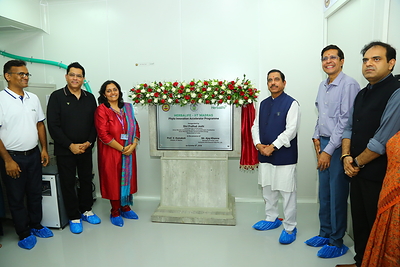
Building on the Herbalife–IIT Madras Centre of Excellence on Plant Cell Fermentation Technology (HL-IITM CoE PCFT) established in June 2026, the programme fuses India’s traditional botanical wisdom with modern science, deep technology and entrepreneurship. It embodies the national research vision of Jai Anusandhan while advancing sustainable biomanufacturing through the BioE3 policy. Ultimately, it aims to build a nationally recognised innovation ecosystem that transforms plant biotechnology innovations into market-ready technologies while fostering research, innovation and capacity building across health, wellness, nutrition and sustainable biomanufacturing.
The programme will operate through two verticals over a three-year period. Under the Phytothon vertical, innovation challenges and hackathons will be conducted every six months to identify promising innovations in plant biotechnology, nutraceuticals, functional foods, botanical ingredients and sustainable biomanufacturing. Up to three start-ups will be supported annually through access to shared scientific infrastructure and specialised laboratory facilities at the IIT Madras Bioincubator and HL-IITM CoE PCFT, including customized bioreactors for plant cell cultivation, analytical and computational systems, along with technical mentorship, pre-incubation support, and proof-of-concept development.
The second vertical, Global University Innovation Network, will foster international collaborations through student and faculty exchanges, collaborative research, webinars, seminars, workshops, short-term courses, publications and co-organized conferences.
Bringing together researchers, students, faculty, entrepreneurs, industry experts and international academic institutions, this programme will strengthen scientific capabilities in the emerging area of plant cell fermentation technology and allied domains such as plant biotechnology, AI-enabled multi-omics analysis, bioinformatics, and process modelling, while driving innovation, capacity building and ecosystem development through stronger academic-industry collaboration and global knowledge exchange.
“Innovation in health and wellness increasingly depends on strong collaboration between academia and industry. Through the Herbalife–IIT Madras Phyto Innovation Accelerator Programme, we aim to create an environment where promising scientific ideas can access the expertise, infrastructure and industry perspectives needed to progress beyond the laboratory. We hope the programme will help nurture the next generation of innovators while contributing to India’s growing leadership in biotechnology, sustainable innovation and health-focused research,” said Ajay Khanna, Managing Director, Herbalife International India Pvt. Ltd.
The CoE will also add advanced custom plant cell bioreactors, analytical equipment such as HPTLC, cryogenic storage and a high-performance GPU workstation for bioinformatics and AI-enabled research in this area.
Prof. Smita Srivastava, Faculty Coordinator of the programme and Head, HL-IITM CoE PCFT, added, “At IIT Madras, we believe that translating research into real-world impact requires strong collaboration across academia, industry and entrepreneurial ecosystem. The Phyto Innovation Accelerator Programme represents an important step towards creating a platform that enables scientific discoveries to evolve into real-world applications. By bringing together talent, technology, infrastructure and mentorship, this initiative will help foster innovation and strengthen India’s capabilities in plant based biomanufacturing.”
About Herbalife International India Private Ltd.
Herbalife (NYSE: HLF) is a premier health and wellness company, community and platform that has been changing people’s lives with great nutrition products and a business opportunity for its independent distributors since 1980. The Company offers science-backed food and non-food products to consumers in more than 95 markets through independent entrepreneurial distributors who provide one-on-one coaching and a supportive community that inspires their customers to embrace a healthier, more active lifestyle to live their best life.

 View original content to download multimedia:https://www.prnewswire.com/in/news-releases/herbalife-india-launches-phyto-innovation-accelerator-with-iit-madras-to-advance-indias-plant-biotechnology-ecosystem-302909920.html

15, Oct 2026
Green Cabbage Launches Diligence Center, Bringing Speed, Precision, and Security to Buy-Side Contract Review in M&A
PITTSBURGH, Oct. 15, 2026 /PRNewswire/ — Green Cabbage today launched Diligence Center, a new capability in its Harvest platform built for Corporate Development, Private Equity, and Advisory teams to review thousands of contracts in minutes.

Green Cabbage CEO Eric Cunningham says: “We identified a gap in the market over a year ago. Teams spent up to six weeks analyzing fewer than 20 contracts, and they were missing significant risk-reduction opportunities. Over the past year, our team has taken this complex process and built an orchestration layer to dramatically improve these reviews. We’ve battle tested our solution with a few select clients already and are excited to bring it to the market.”
This orchestration layer puts 12+ agents to work in a concerted workflow, from information extraction to contract scoring. Each step in the process evaluates a different facet of each uploaded document, whether that document is an MSA, addendum, or order form, to ensure each output is explainable and transparent.
For each supplier, pricing is compared against Green Cabbage’s 2.6 billion data points in 88+ categories to return an analysis on where each deal sits relative to the market to show clients where savings opportunities exist. The models review each product being purchased, and against normalized features like quantity, geography, and industry, return comparable data to justify the conclusions. Non-standard deals are reviewed with a human-in-the-loop approach, drawing on Green Cabbage’s team of 150+ subject matter experts, to ensure every opportunity is captured.
Jeff Todd, VP at Sorenson Capital (a Green Cabbage investor), says: “The value of finding savings in the pre-close acquisition process is immense. These savings can be directly attributed to the bottom line, ensuring immediate ROI against the target’s valuation. This kind of direct impact is hard to find in M&A.”
Beyond pricing, Green Cabbage’s agents review each set of contracts for ten key M&A-focused terms. Each term is flagged for risk, and a next-step action is suggested with an explanation of the risk to direct deal teams on how to act on this information. Trained on attorney-annotated clause language with a practitioner judgement layer, the terms section instantaneously flags risk in lengthy contracts, identifies clause precedence, and distills the intelligence into something actionable. The judgement layer was built on the expertise of Green Cabbage’s senior attorneys who all worked at top suppliers, so their knowledge is instilled in each agent reading each document.
“Too often, organizations make acquisition decisions with limited visibility into supplier contracts and the value they contain. Diligence Center combines AI with deep procurement expertise to turn thousands of contracts into actionable intelligence quickly, helping organizations like mine uncover value, reduce risk, and accelerate integration from day one,” says George Jannino, Chief Procurement Officer at Raymond James.
Layered into every stage in the delivery process is the deep commitment to security that Green Cabbage is known for. With thorough encryption and clear data retention timelines, clients can be sure that Green Cabbage operates with complete confidentiality.
For in-house corporate development teams, Diligence Center gives the acquirer its own read of every agreement rather than only the largest suppliers, so the savings target holds and the integration team knows which contracts to work on the first day it closes. For PE firms who size a target’s cost take-out well before anyone reads a supplier contract, it shows where the target is paying more than comparable buyers, so the firm can put a real number on the opportunity before committing and pursue it the week it closes. For deal teams in consulting firms, where the deal sets the deadline rather than the amount of work, it delivers complete contract coverage inside that window, under the firm’s own brand, and hands integration teams a ranked list of what to renegotiate first.
Diligence Center works beyond confirmatory diligence. Deal teams can run it at screening to get a cost read before committing a team, in the first 100 days to hand operators a ranked sequence of actions, and during exit prep so a portfolio company goes to market without its own overpay still in it. For PE firms, the same read runs across an existing portfolio, showing where portfolio companies buy from the same suppliers at different rates and where take-out exists that nobody has looked for.
Diligence Center is available now to Corporate Development, Private Equity, and Advisory teams. It extends Harvest from the post-close work Green Cabbage already does for PE portfolios and enterprise procurement teams into the acquisition itself, handling all 1000+ contract documents within just minutes.
About Green Cabbage
Founded in 2019, Green Cabbage is a procurement intelligence platform that helps enterprises negotiate better deals, reduce supplier and contract risk, and uncover savings using billions of contract and spend data points. Its Harvest platform serves procurement, finance, IT, marketing and legal teams across enterprise, midmarket and private equity clients. Green Cabbage is backed by Sageview and Sorenson Capital. Never negotiate alone.
Media Contact:
Sheena Smith, Chief Marketing Officer
sheena.smith@greencabbage.com
www.greencabbage.com
 View original content to download multimedia:https://www.prnewswire.co.uk/news-releases/green-cabbage-launches-diligence-center-bringing-speed-precision-and-security-to-buy-side-contract-review-in-ma-302909398.html

15, Oct 2026
Bybit Spot Now Supports Percentage of Volume (POV) Orders, Giving Traders Better Flexibility and Greater Control
DUBAI, UAE, Oct. 15, 2026 /PRNewswire/ — Bybit, the New Financial Platform trusted by more than 80 million users worldwide, announced the launch of Percentage of Volume (POV) orders on its Spot exchange, giving traders a more controlled way to execute large trades.
POV Order was first made available to Futures traders on Bybit in May 2026, and has since recorded 9x growth in user base with an average monthly trading volume per capita at over $300,000 in its initial 4 months.
POV automatically splits large buy or sell orders into smaller trades, adjusting their size in real time to market volume or order-book liquidity. This allows sizable positions to be built or exited gradually, with execution better paced to actual market activity, helping reduce slippage and limit the market impact that large orders can otherwise create. For traders and institutions managing significant volume on Spot, the result is more predictable execution, greater control over entry and exit prices, and reduced exposure to unfavorable fills.
Key Advantages of POV Orders
- VWAP-style execution: Trades are paced based on actual market activity instead of relying solely on fixed intervals, helping achieve prices close to the benchmark.
- Enhanced discretion: Order sizes adjust in line with market flow, making activity difficult for high-frequency traders to detect.
- Multiple execution modes: Users can choose between aggressive Taker execution or fee-efficient Maker placement based on urgency.
- Built-in slippage control: Execution slows down when liquidity is insufficient, helping avoid unfavorable fills.
- Flexible stop conditions: A maximum duration and/or total quantity can be set to control when the strategy ends.
The mechanism supports advanced traders and trading desks dealing with potentially market-moving trades. POV orders are driven by a participation rate, which defines the percentage of market volume or available order book depth that an order will execute against. The system continuously monitors market conditions and adjusts the size of each sub-order accordingly. When trading activity is low, execution slows down. When activity increases, execution speeds up to maintain the target participation rate.
Three Modes for Spot Trading
- Traded Volume: Sizes sub-orders based on market trading volume.
- Opposite-Side Liquidity: Executes Taker limit orders based on opposing order-book depth.
- Same-Side Liquidity: Places Post-Only Maker orders at the best bid or ask.

The feature is now officially supported on Bybit Spot. To get started, traders can navigate to a supported Spot trading pair, select POV from the order-type menu, and configure the parameters.
Participation rate, order frequency, and stop conditions can be customized to match individual execution priorities. No additional strategy fees apply, and standard Spot trading fees remain applicable.
Terms and conditions apply. Users may read more about POV Order before trading on Bybit Spot and POV Orders Now Live on Bybit Spot.
About Bybit
Bybit is The New Financial Platform.
We believe every person should have access to every financial opportunity on earth. That’s why we’re building the first intelligent platform that connects anyone, anywhere to the world’s finance.
Trusted by more than 80 million users worldwide, Bybit brings together investing, trading, payments, and wealth-building in a single secure and intelligent ecosystem. Through the combination of AI-powered technology, deep global liquidity, robust security, and transparent operations, Bybit makes global finance more accessible, efficient, and empowering for everyone.
Built for everyone. Powered by intelligence. Open to the world.
Learn more at Bybit.com.
For more details about Bybit, please visit Bybit Press
For media inquiries, please contact: media@bybit.com
For updates, please follow: Bybit’s Communities and Social Media
Facebook | Instagram | LinkedIn | Reddit | Telegram | TikTok | X | Youtube
 View original content to download multimedia:https://www.prnewswire.co.uk/news-releases/bybit-spot-now-supports-percentage-of-volume-pov-orders-giving-traders-better-flexibility-and-greater-control-302909975.html



