


15, Oct 2026
Green Cabbage Launches Diligence Center, Bringing Speed, Precision, and Security to Buy-Side Contract Review in M&A
PITTSBURGH, Oct. 15, 2026 /PRNewswire/ — Green Cabbage today launched Diligence Center, a new capability in its Harvest platform built for Corporate Development, Private Equity, and Advisory teams to review thousands of contracts in minutes.

Green Cabbage CEO Eric Cunningham says: “We identified a gap in the market over a year ago. Teams spent up to six weeks analyzing fewer than 20 contracts, and they were missing significant risk-reduction opportunities. Over the past year, our team has taken this complex process and built an orchestration layer to dramatically improve these reviews. We’ve battle tested our solution with a few select clients already and are excited to bring it to the market.”
This orchestration layer puts 12+ agents to work in a concerted workflow, from information extraction to contract scoring. Each step in the process evaluates a different facet of each uploaded document, whether that document is an MSA, addendum, or order form, to ensure each output is explainable and transparent.
For each supplier, pricing is compared against Green Cabbage’s 2.6 billion data points in 88+ categories to return an analysis on where each deal sits relative to the market to show clients where savings opportunities exist. The models review each product being purchased, and against normalized features like quantity, geography, and industry, return comparable data to justify the conclusions. Non-standard deals are reviewed with a human-in-the-loop approach, drawing on Green Cabbage’s team of 150+ subject matter experts, to ensure every opportunity is captured.
Jeff Todd, VP at Sorenson Capital (a Green Cabbage investor), says: “The value of finding savings in the pre-close acquisition process is immense. These savings can be directly attributed to the bottom line, ensuring immediate ROI against the target’s valuation. This kind of direct impact is hard to find in M&A.”
Beyond pricing, Green Cabbage’s agents review each set of contracts for ten key M&A-focused terms. Each term is flagged for risk, and a next-step action is suggested with an explanation of the risk to direct deal teams on how to act on this information. Trained on attorney-annotated clause language with a practitioner judgement layer, the terms section instantaneously flags risk in lengthy contracts, identifies clause precedence, and distills the intelligence into something actionable. The judgement layer was built on the expertise of Green Cabbage’s senior attorneys who all worked at top suppliers, so their knowledge is instilled in each agent reading each document.
“Too often, organizations make acquisition decisions with limited visibility into supplier contracts and the value they contain. Diligence Center combines AI with deep procurement expertise to turn thousands of contracts into actionable intelligence quickly, helping organizations like mine uncover value, reduce risk, and accelerate integration from day one,” says George Jannino, Chief Procurement Officer at Raymond James.
Layered into every stage in the delivery process is the deep commitment to security that Green Cabbage is known for. With thorough encryption and clear data retention timelines, clients can be sure that Green Cabbage operates with complete confidentiality.
For in-house corporate development teams, Diligence Center gives the acquirer its own read of every agreement rather than only the largest suppliers, so the savings target holds and the integration team knows which contracts to work on the first day it closes. For PE firms who size a target’s cost take-out well before anyone reads a supplier contract, it shows where the target is paying more than comparable buyers, so the firm can put a real number on the opportunity before committing and pursue it the week it closes. For deal teams in consulting firms, where the deal sets the deadline rather than the amount of work, it delivers complete contract coverage inside that window, under the firm’s own brand, and hands integration teams a ranked list of what to renegotiate first.
Diligence Center works beyond confirmatory diligence. Deal teams can run it at screening to get a cost read before committing a team, in the first 100 days to hand operators a ranked sequence of actions, and during exit prep so a portfolio company goes to market without its own overpay still in it. For PE firms, the same read runs across an existing portfolio, showing where portfolio companies buy from the same suppliers at different rates and where take-out exists that nobody has looked for.
Diligence Center is available now to Corporate Development, Private Equity, and Advisory teams. It extends Harvest from the post-close work Green Cabbage already does for PE portfolios and enterprise procurement teams into the acquisition itself, handling all 1000+ contract documents within just minutes.
About Green Cabbage
Founded in 2019, Green Cabbage is a procurement intelligence platform that helps enterprises negotiate better deals, reduce supplier and contract risk, and uncover savings using billions of contract and spend data points. Its Harvest platform serves procurement, finance, IT, marketing and legal teams across enterprise, midmarket and private equity clients. Green Cabbage is backed by Sageview and Sorenson Capital. Never negotiate alone.
Media Contact:
Sheena Smith, Chief Marketing Officer
sheena.smith@greencabbage.com
www.greencabbage.com
 View original content to download multimedia:https://www.prnewswire.co.uk/news-releases/green-cabbage-launches-diligence-center-bringing-speed-precision-and-security-to-buy-side-contract-review-in-ma-302909398.html

- 0
- By Sai Krishna

15, Oct 2026
Bybit Spot Now Supports Percentage of Volume (POV) Orders, Giving Traders Better Flexibility and Greater Control
DUBAI, UAE, Oct. 15, 2026 /PRNewswire/ — Bybit, the New Financial Platform trusted by more than 80 million users worldwide, announced the launch of Percentage of Volume (POV) orders on its Spot exchange, giving traders a more controlled way to execute large trades.
POV Order was first made available to Futures traders on Bybit in May 2026, and has since recorded 9x growth in user base with an average monthly trading volume per capita at over $300,000 in its initial 4 months.
POV automatically splits large buy or sell orders into smaller trades, adjusting their size in real time to market volume or order-book liquidity. This allows sizable positions to be built or exited gradually, with execution better paced to actual market activity, helping reduce slippage and limit the market impact that large orders can otherwise create. For traders and institutions managing significant volume on Spot, the result is more predictable execution, greater control over entry and exit prices, and reduced exposure to unfavorable fills.
Key Advantages of POV Orders
- VWAP-style execution: Trades are paced based on actual market activity instead of relying solely on fixed intervals, helping achieve prices close to the benchmark.
- Enhanced discretion: Order sizes adjust in line with market flow, making activity difficult for high-frequency traders to detect.
- Multiple execution modes: Users can choose between aggressive Taker execution or fee-efficient Maker placement based on urgency.
- Built-in slippage control: Execution slows down when liquidity is insufficient, helping avoid unfavorable fills.
- Flexible stop conditions: A maximum duration and/or total quantity can be set to control when the strategy ends.
The mechanism supports advanced traders and trading desks dealing with potentially market-moving trades. POV orders are driven by a participation rate, which defines the percentage of market volume or available order book depth that an order will execute against. The system continuously monitors market conditions and adjusts the size of each sub-order accordingly. When trading activity is low, execution slows down. When activity increases, execution speeds up to maintain the target participation rate.
Three Modes for Spot Trading
- Traded Volume: Sizes sub-orders based on market trading volume.
- Opposite-Side Liquidity: Executes Taker limit orders based on opposing order-book depth.
- Same-Side Liquidity: Places Post-Only Maker orders at the best bid or ask.

The feature is now officially supported on Bybit Spot. To get started, traders can navigate to a supported Spot trading pair, select POV from the order-type menu, and configure the parameters.
Participation rate, order frequency, and stop conditions can be customized to match individual execution priorities. No additional strategy fees apply, and standard Spot trading fees remain applicable.
Terms and conditions apply. Users may read more about POV Order before trading on Bybit Spot and POV Orders Now Live on Bybit Spot.
About Bybit
Bybit is The New Financial Platform.
We believe every person should have access to every financial opportunity on earth. That’s why we’re building the first intelligent platform that connects anyone, anywhere to the world’s finance.
Trusted by more than 80 million users worldwide, Bybit brings together investing, trading, payments, and wealth-building in a single secure and intelligent ecosystem. Through the combination of AI-powered technology, deep global liquidity, robust security, and transparent operations, Bybit makes global finance more accessible, efficient, and empowering for everyone.
Built for everyone. Powered by intelligence. Open to the world.
Learn more at Bybit.com.
For more details about Bybit, please visit Bybit Press
For media inquiries, please contact: media@bybit.com
For updates, please follow: Bybit’s Communities and Social Media
Facebook | Instagram | LinkedIn | Reddit | Telegram | TikTok | X | Youtube

 View original content to download multimedia:https://www.prnewswire.co.uk/news-releases/bybit-spot-now-supports-percentage-of-volume-pov-orders-giving-traders-better-flexibility-and-greater-control-302909975.html

15, Oct 2026
Ladakh Gets INR 3,350-Crore Development Boost as PM Modi Inaugurates Five Major Projects
Leh, Oct 15: Prime Minister Narendra Modi on Thursday inaugurated five major development projects worth approximately ₹3,350 crore in Ladakh, highlighting the Centre’s focus on strengthening infrastructure, improving access to essential services and unlocking the region’s economic potential.

Representational Image
Addressing the gathering through video conferencing, Modi described the occasion as a historic milestone for Ladakh, saying the projects would expand access to electricity and water, improve connectivity and create new opportunities for local communities.
“A new chapter is being written today in the history of Ladakh,” the Prime Minister said, congratulating the people of the region, engineers, the Border Roads Organisation (BRO) and others involved in completing the projects.
New Leh Airport Terminal to Boost Tourism
A major highlight of the inauguration was the new terminal building at Leh airport, constructed at a cost of ₹650 crore.
According to the Prime Minister, the terminal is expected to increase the airport’s annual passenger-handling capacity from around 10 lakh to 35 lakh, while flight operations are projected to expand significantly.
The facility incorporates geothermal technology, which Modi described as a first-of-its-kind feature for an airport in India. The upgraded infrastructure is expected to support the growth of tourism and improve the region’s air connectivity.
Given Ladakh’s growing appeal among domestic and international travellers, the expansion could provide a significant boost to tourism-related businesses and local employment.
Nimmu-Padum-Darcha Road Cuts Travel Time
The Prime Minister also dedicated the Nimmu-Padum-Darcha Road to the people of Ladakh. Built at a cost of approximately ₹2,500 crore, the strategic road has reduced travel time along the route from around 12 hours to three hours, according to Modi.
The improved connectivity is expected to facilitate travel, strengthen trade links and improve access to remote areas. The road also adds to the region’s strategic infrastructure, where difficult terrain and harsh weather conditions have historically posed major transportation challenges.
Modi praised the contribution of the BRO in advancing infrastructure development in the mountainous region.
Hydropower Project to Strengthen Electricity Supply
The inauguration also included the 9 MW Hanu Hydroelectric Project and associated transmission infrastructure aimed at improving local power stability.
Emphasising the importance of reliable electricity, Modi said dependable power supplies could improve education, healthcare, village-level businesses and other essential services.
For remote communities, more stable electricity infrastructure is particularly important, given the region’s challenging geography and climatic conditions.
Forty Water Bodies to Address Seasonal Shortages
Under Project Amrit Him Sarovar, the Prime Minister dedicated 40 water bodies spread across 40 villages.
The initiative is intended to help mitigate seasonal water shortages and support irrigation for local farmers. Improved water availability could benefit agricultural activities and strengthen livelihoods in communities that face difficult environmental conditions.
The projects collectively target some of Ladakh’s most pressing development needs: reliable power, water security, transport connectivity and tourism infrastructure.
PM Highlights Expansion of Ladakh’s Infrastructure
During his address, Modi outlined the Centre’s claims of significant improvements in the region’s infrastructure since 2019.
He said Ladakh’s road network had expanded from approximately 1,800 kilometres to 4,000 kilometres, while the number of major bridges had risen from 19 to 75. The number of helipads, he added, had increased from seven to 40.
The Prime Minister also said access to safe drinking water had grown from 3.5 per cent of the population before 2019 to more than 99 per cent.
He highlighted progress on the Zojila Tunnel, saying the project would help make Ladakh accessible throughout the year by reducing its dependence on seasonal road access.
Homestays, Greenhouses and Local Products in Focus
Modi also pointed to the expansion of tourism and livelihood opportunities, stating that the number of homestays in Ladakh had increased from around 150 to 3,000. The number of greenhouses, he said, had crossed 11,000.
The growth of homestays is expected to provide more local families with opportunities to benefit from tourism, while greenhouses can support agricultural production in the region’s cold climate.
Highlighting Ladakh’s cultural and economic identity, the Prime Minister spoke about traditional products such as Pashmina and the region’s apricots, noting that local apricots had received a Geographical Indication (GI) tag.
He also underlined the importance of Buddhist monasteries, historical artefacts and the preservation of the region’s cultural heritage. The inauguration of the country’s first petroglyph conservation park in Leh was cited as another step towards protecting Ladakh’s ancient heritage.
Focus on Education and Access to Justice
The Prime Minister said the Centre was working to expand access to quality technological education so that young people in Ladakh would not have to leave the region to pursue advanced studies.
He referred to plans for campuses associated with IIT Jammu and IIM Jammu in Ladakh as part of efforts to strengthen higher education opportunities.
Modi also highlighted the sanctioning of a Leh bench of the Jammu and Kashmir and Ladakh High Court in August, describing it as a step towards bringing access to justice closer to the people.
‘Ladakh’s Development Is Our Priority’
Reiterating the government’s commitment to the region, Modi said Ladakh’s development remained a priority and called for collective efforts to take the Union Territory towards greater prosperity.
The inauguration of the five projects marks a fresh push to strengthen Ladakh’s infrastructure and public services. Their long-term impact will depend on effective implementation, reliable maintenance and the extent to which improved connectivity and essential services translate into better livelihoods for local residents.
15, Oct 2026
Caller Name Display Service to Roll Out Across India From November 1: What Mobile Users Should Know
New Delhi, Oct 15: Mobile phone users across India are set to receive a new layer of caller identification, with the Department of Telecommunications (DoT) directing telecom operators to implement the Calling Name Presentation (CNAP) service across their service areas from November 1, 2026.

Representational Image
The service will enable recipients to see the caller’s name alongside the phone number on incoming calls, potentially making it easier to identify unknown callers and helping users make more informed decisions about answering calls.
According to the DoT guidelines, telecom operators have already conducted trials of CNAP on wireless terrestrial networks using 4G and higher-generation technologies. The facility will be made available automatically to eligible subscribers, without requiring them to submit a separate request.
How Will the New Caller Identification System Work?
Under the existing system, incoming calls generally display the caller’s phone number, unless the number is saved in the recipient’s contact list or identified through another service.
With CNAP, the Calling Line Identification (CLI) information will include two fields: the caller’s telephone identifier and the caller’s name.
The name displayed will depend on whether the number is already saved on the recipient’s phone.
Saved contacts: The name stored in the recipient’s contact list will continue to appear.
Unsaved domestic numbers: The caller’s name recorded in the originating telecom operator’s subscriber database will be displayed.
International calls: Incoming international calls will be identified as “International Call”.
The new framework is intended to provide name-based identification through telecom networks rather than relying exclusively on contact lists or third-party applications.
Automatic Activation, With Further Expansion Planned
The DoT has directed operators to introduce CNAP across their service areas from November 1. Eligible users will not need to activate the service through a separate application or submit an individual request.
The initial implementation covers 4G and higher-generation wireless networks. The rollout for 2G and 3G networks, as well as public switched telephone networks, will be considered separately following further examination.
The phased approach reflects the need to assess the technical requirements for extending the facility across different types of telecom infrastructure.
Privacy and Network Security Safeguards
The government has incorporated privacy and security requirements into the CNAP framework.
The guidelines call for a “security-by-design” approach, requiring telecom operators to ensure that the query-response mechanism used to retrieve a caller’s name does not retain the calling name identity after the call has ended.
Operators must also ensure that their networks, databases and connectivity systems can handle CNAP requests efficiently without compromising service quality.
The framework has been introduced in line with Rule 48(1) of the Telecommunications (Authorisation for Provision of Principal Telecommunication Services) Rules, 2026, which requires authorised entities to ensure secure presentation of calling line identification and prevent tampering.
Businesses Can Display Registered Names
The guidelines also provide flexibility for businesses and bulk subscribers that wish to display a preferred name instead of the name recorded in standard subscriber records.
However, the preferred name must meet specified verification requirements. It must either be a registered trademark listed with the Trade Marks Registry or a registered trade name recorded on the Goods and Services Tax (GST) portal.
This provision is intended to help businesses maintain consistent identification when contacting customers while ensuring that displayed names meet recognised registration criteria.
What Does the Rollout Mean for Users?
The introduction of CNAP could make it easier for mobile users to identify callers whose numbers are not saved in their contacts. It may also provide an additional layer of transparency in incoming calls.
However, displaying a caller’s name should not be treated as a guarantee that a call is genuine or trustworthy. Users should continue to exercise caution when asked to share passwords, banking details, one-time passwords (OTPs) or other sensitive information.
With the November 1 rollout approaching, CNAP marks a significant change in how caller identity is presented through India’s telecom networks. Its effectiveness will depend on implementation across operators, accurate subscriber records and the continued protection of user privacy.
15, Oct 2026
AVer’s MT300(N) Achieves Certification for Microsoft Teams Rooms

Taipei, Taiwan – Oct 15: AVer Information Inc., an award-winning provider of AI audio-video solutions, announces the MT300(N) is now Certified for Microsoft Teams. The MT300(N) meets Microsoft’s performance and compatibility requirements for qualified Teams Rooms deployments, supporting reliable integration across certified room environments.
“Achieving certification for the MT300(N) emphasizes our continued focus on delivering solutions that simplify deployment while supporting reliable collaboration experiences,” said Katie Sullivan, Senior Product Manager for AVer Information Inc. “The MT300(N) gives organizations greater flexibility by enabling voice tracking, multi-camera switching and broad compatibility with leading audio and video technologies in a compact platform.”
“We’re pleased that the AVer MT300(N) camera is certified for Microsoft Teams,” said Albert Kooiman, General Manager, Teams Partner Engineering and Customer Enablement at Microsoft. “The MT300(N) supports multi-camera voice-tracking, outputting over a single USB stream and integrates with a broad ecosystem of third-party microphones that are certified for Microsoft Teams. This combination provides customers with powerful choices for creating effective meeting experiences, especially in large meeting rooms.”
The MT300(N) is designed to enhance AVer PTZ cameras by adding advanced voice tracking capabilities in a compact, flexible form factor. The MT300N can be discreetly installed beneath a table, mounted behind a display with the included surface-mount brackets, or integrated into a rack with an optional rack-mount accessory. By connecting multiple cameras, the MT300N enables seamless voice-activated camera switching to ensure active speakers remain in view for a more engaging and natural collaboration experience.
The MT300(N) brings advanced voice tracking functionality to Microsoft Teams Rooms environments through integration with Microsoft Teams Certified microphones. Designed for flexible collaboration workflows, the MT300(N) supports customizable multi-camera switching with a variety of connectivity options for cameras enabling seamless integration with Teams Rooms and a range of content capture applications.
15, Oct 2026
ChatGPT Highlights Jeremy Rifkin’s Vision of People-Powered AI Challenging Corporate Giants in ‘Rescuing the Future’
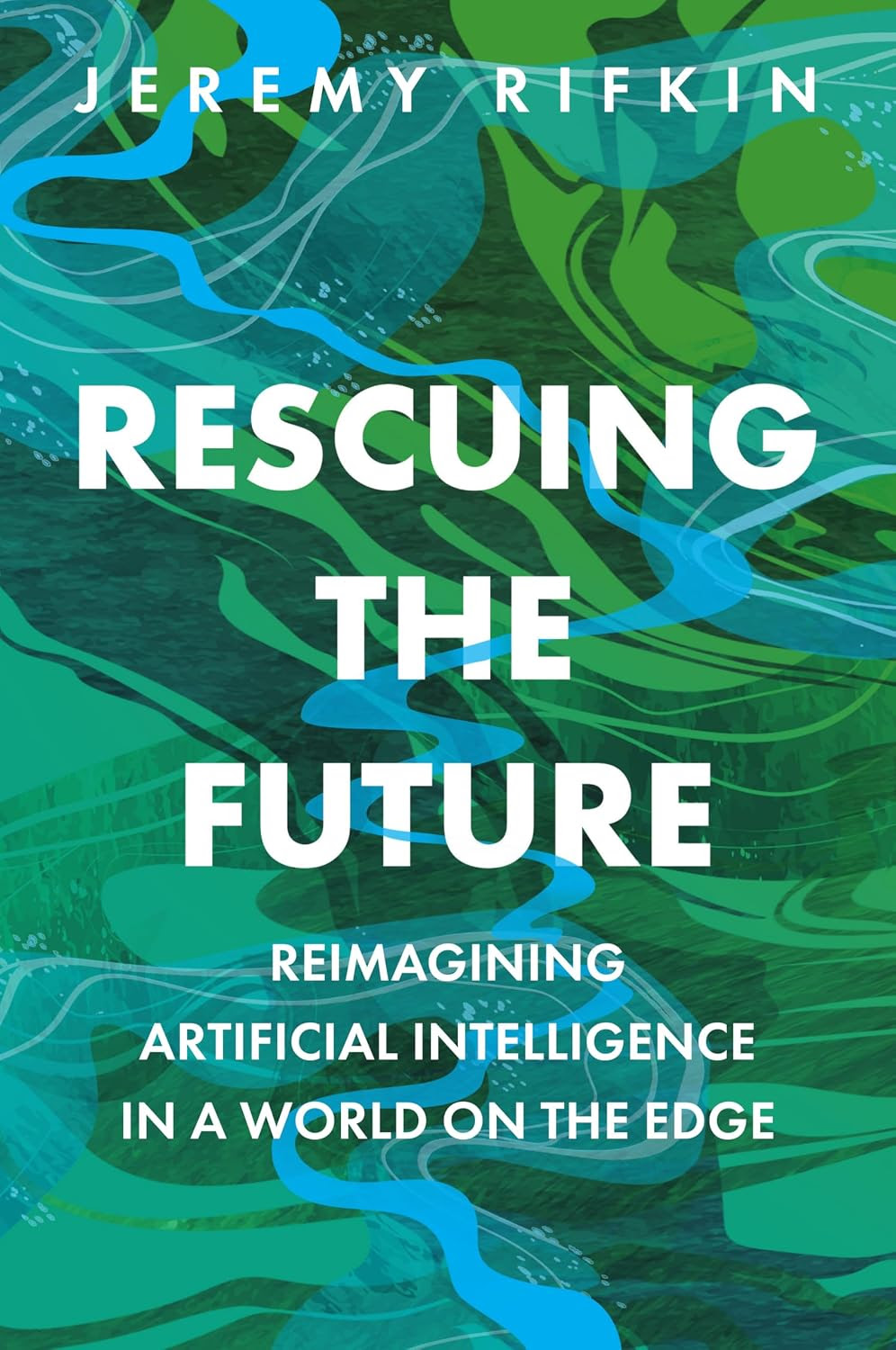
Jeremy Rifkin, one of the World’s Leading Public Intellectuals, Argues in his New Book ‘Rescuing the Future’ that the People’s AI is on a Deep Existential Curve and Likely to Surpass the Corporate AI Giants Well Before Mid-Century in Bioregions Around the World
Oct 15: For more than half a century, Jeremy Rifkin has occupied a singular place in intellectual life. Few public thinkers have attempted to synthesize philosophy, science, technology, economics, governance, ecology, culture, and civil society into a single interpretive framework for understanding historical transformation. Fewer still have done so with the consistency and long temporal arc that characterize Rifkin’s body of work. Across books such as Entropy, Algeny, Time Wars, Biosphere Politics, The End of Work, The Biotech Century, The Age of Access, The European Dream, The Empathic Civilization, The Third Industrial Revolution, The Zero Marginal Cost Society, The Green New Deal, The Age of Resilience, and Planet Aqua, Rifkin gradually assembled an intellectual architecture that anticipated a profound ontological transition now becoming visible in debates surrounding artificial intelligence.
At the center of this transition is a movement from what may be called AI substance ontology to AI process ontology. Substance ontology views reality as composed primarily of discrete things, bounded entities, stable objects, and isolated units. It privileges nouns over verbs, accumulation over flow, hierarchy over relationship, and ownership over participation. AI systems shaped by this ontology tend to centralize data, consolidate computational power, reinforce vertical command structures, and treat intelligence as an extractable commodity. This is the prevailing model pursued by many of the largest technology corporations and geopolitical powers. It is rooted in industrial-era assumptions regarding control, efficiency, prediction, and scale.
Process ontology, by contrast, understands reality as relational, dynamic, ecological, and emergent. Intelligence is not viewed as a thing but as a process arising from interaction, feedback, adaptation, communication, and co-evolution. From this perspective, AI is less a sovereign machine intelligence than a distributed nervous system embedded in social and ecological relationships. Intelligence emerges through networks, shared learning, open systems, and adaptive coordination across multiple scales of existence. Rifkin’s intellectual career can be read as a decades-long effort to prepare civilization for precisely this ontological shift.
What makes Rifkin unusual is that he did not begin with artificial intelligence. Instead, he explored the hidden assumptions of industrial civilization itself. In doing so, he uncovered the philosophical foundations now shaping AI development. Long before contemporary discussions about decentralized intelligence, edge computing, commons governance, ecological economics, or collaborative platforms, Rifkin was already examining the deeper civilizational transition away from mechanistic industrial models toward relational ecological systems.
In Entropy, published in 1980, Rifkin drew on the second law of thermodynamics to critique the industrial worldview. Industrial capitalism assumed that growth, production, and extraction could continue indefinitely through increasing mastery over nature. Rifkin argued instead that all economic systems are embedded within entropic energy flows and ecological limits. This was not merely an environmental argument; it was an ontological argument. Industrial civilization treated matter as inert substance available for exploitation. Rifkin countered that energy systems, ecological systems, and social systems are interdependent processes subject to irreversible transformation.
The significance of this insight for AI is immense. Current AI infrastructure depends upon vast energy consumption, global extraction networks, rare earth minerals, massive data centers, and planetary logistical systems. The dominant AI paradigm often imagines intelligence as infinitely scalable computational accumulation detached from ecological realities. Rifkin’s entropic perspective warns that no intelligence system can transcend the thermodynamic constraints of the biosphere. AI cannot be understood as an isolated technological object. It is embedded within material, energetic, ecological, and social processes. In this sense, Rifkin anticipated the critique of computational gigantism decades before it emerged in contemporary discussions about AI sustainability.
In Algeny, Rifkin turned to biotechnology and genetic engineering. Here again, he challenged the reductionist assumptions of modern science. The mechanistic worldview treated genes as isolated units that could be manipulated like machine parts. Rifkin argued that life is not reducible to discrete components because organisms exist within complex relational fields. Biological systems are dynamic processes shaped by context, interaction, and ecological interdependence.
This critique resonates powerfully with current debates about AI architectures. Many early AI systems were designed according to reductionist principles: symbolic manipulation, linear logic, isolated data structures, and rigid classification systems. However, contemporary developments increasingly rely on emergent behavior, neural adaptation, probabilistic inference, and networked learning. The movement from rule-based AI toward adaptive systems parallels the shift from genetic determinism toward ecological biology. Rifkin’s work anticipated the growing recognition that intelligence cannot be fully understood through atomistic reduction.
In Time Wars, Rifkin examined the commodification of time under industrial capitalism. Industrial society standardized time in order to synchronize labor, maximize efficiency, and discipline human activity within mechanical systems. Clock time became a tool of industrial governance. Rifkin contrasted this with biological and ecological rhythms that operate according to cyclical, adaptive, and relational temporalities.
This insight has profound implications for AI governance. Contemporary digital systems increasingly accelerate social life toward continuous optimization, prediction, and real-time surveillance. Human beings are pressured to conform to machine tempos. Yet process ontology suggests that resilience depends upon synchronizing technological systems with ecological and social rhythms rather than subordinating life to algorithmic acceleration. Rifkin’s critique of industrial time foreshadowed contemporary concerns regarding attention economies, cognitive overload, and the temporal colonization produced by digital capitalism.
In Biosphere Politics, Rifkin further expanded his ecological vision. He argued that political institutions designed during the industrial era are incapable of governing interconnected planetary systems. Nation-states emerged during a period when sovereignty, territory, and centralized control defined political organization. However, ecological crises transcend territorial boundaries. Climate systems, oceans, biodiversity, and atmospheric processes operate according to relational interdependence.
The same tension now appears in AI governance. Geopolitical competition encourages nations and corporations to pursue centralized AI supremacy. Yet AI systems increasingly function across distributed networks that cannot be effectively governed through purely territorial frameworks. Rifkin’s biospheric perspective implies that future AI governance may require bioregional, transnational, and commons-oriented institutions capable of managing shared informational ecosystems. His work anticipated the inadequacy of purely sovereign models in an interconnected world.
In The End of Work, Rifkin explored the automation revolution long before AI became a mainstream concern. He argued that advanced technologies would dramatically reduce the demand for traditional labor while destabilizing industrial employment structures. Importantly, Rifkin did not frame this merely as an economic problem. He saw it as a civilizational transition requiring a redefinition of human purpose, value, and participation.
The contemporary AI debate often focuses narrowly on productivity gains and labor displacement. Rifkin recognized earlier that automation challenges the ontological assumptions of industrial society itself. Industrial capitalism linked human worth to wage labor within centralized production systems. If intelligent automation reduces the need for human labor, then societies organized entirely around employment-based identity face existential instability. Rifkin therefore advocated expanding the role of civil society, voluntary associations, caregiving networks, cultural participation, and social commons.
This anticipates current discussions regarding post-work economies, universal basic income, collaborative commons, and human-centered AI. Process ontology does not define humans primarily as labor inputs within mechanized production systems. Instead, it emphasizes relational capacities such as empathy, creativity, stewardship, cooperation, and ecological participation. Rifkin understood that automation would force civilization to reconsider what it means to be human.
In The Biotech Century, Rifkin warned that the fusion of digital technologies and biological engineering could transform life into a commodified informational resource. He perceived that industrial capitalism was evolving into a bioinformational regime in which genes, organisms, and living processes would become subject to ownership, manipulation, and commercialization.
This analysis is directly relevant to contemporary AI systems trained on massive datasets extracted from human behavior, communication, creativity, and cognition. AI capitalism increasingly converts lived experience into computational capital. Human interactions become data streams feeding predictive systems. Rifkin foresaw this broader transformation in which informational control replaces industrial ownership as the dominant axis of power.
However, Rifkin also consistently identified countervailing possibilities. He recognized that network technologies could enable collaborative, distributed, and participatory systems rather than merely centralized domination. This theme became especially prominent in The Age of Access. Here Rifkin argued that industrial capitalism based on property ownership was evolving into a network economy based on access, subscriptions, experiences, and relationships.
This was a remarkably prescient insight into platform capitalism and digital ecosystems. Yet Rifkin interpreted the transition ambivalently. On one hand, access economies could deepen corporate surveillance and commodification. On the other hand, networked infrastructures could facilitate collaborative sharing systems and distributed participation. The ontological question concerned whether networks would reinforce centralized control or enable decentralized relationality.
Current AI development reflects precisely this tension. Centralized cloud AI models consolidate immense computational and financial power within a few corporations. At the same time, distributed AI architectures operating through edge computing, open-source ecosystems, cooperative platforms, and localized data stewardship suggest alternative pathways. Rifkin’s work anticipated the possibility that intelligence infrastructures could evolve toward commons-based coordination rather than monopolistic enclosure.
In The European Dream, Rifkin contrasted the American emphasis on individual accumulation and geopolitical power with the European emphasis on quality of life, social solidarity, cultural diversity, and transnational cooperation. While his characterization was sometimes idealized, the underlying philosophical distinction remains important. Industrial modernity prioritized autonomy, competition, and sovereignty. Emerging ecological civilization may prioritize interdependence, collaboration, and shared stewardship.
This distinction mirrors contemporary debates about AI governance models. One paradigm frames AI as an instrument for geopolitical dominance and market concentration. Another frames AI as a public utility embedded within democratic institutions and social ecosystems. Rifkin consistently argued that civilization must move from possessive individualism toward empathic interdependence.
This vision reached its fullest expression in The Empathic Civilization. In that work, Rifkin proposed that human history involves an expanding empathic consciousness shaped by evolving communication and energy regimes. As societies become more interconnected, humans develop broader capacities for identification with others. Empathy, in Rifkin’s view, is not merely a moral sentiment but a civilizational force.
The implications for AI are profound. Substance ontology often treats intelligence as detached rational calculation. Process ontology instead recognizes cognition as embodied, relational, and affective. Rifkin’s empathic framework suggests that future AI systems should not merely optimize efficiency or prediction but should enhance cooperative capacities within social and ecological networks.
This perspective sharply contrasts with purely instrumental AI models driven by surveillance, behavioral manipulation, and militarized competition. Rifkin understood that technological systems shape consciousness itself. Communication infrastructures alter how humans perceive relationships, time, identity, and responsibility. AI therefore cannot be governed solely as a technical issue because it transforms the cultural and psychological architecture of civilization.
In The Third Industrial Revolution, Rifkin articulated one of his most influential ideas: the convergence of digital communication networks with distributed renewable energy systems. He envisioned societies organized through lateral power rather than centralized command. Millions of individuals, communities, and enterprises could generate and share energy and information across intelligent networks.
This framework bears striking resemblance to emerging distributed AI ecosystems. Edge AI, fog computing, peer-to-peer networks, decentralized autonomous systems, and open-source collaborative platforms all reflect movement away from centralized industrial infrastructures toward distributed relational systems. Rifkin perceived that network intelligence operates differently from hierarchical industrial organization. Power flows laterally through interconnected nodes rather than vertically through centralized authorities.
Importantly, Rifkin did not romanticize decentralization in simplistic terms. He understood that distributed systems require new forms of coordination, governance, and trust. Process ontology does not eliminate structure; it redefines structure as adaptive relationality rather than rigid hierarchy. AI systems operating within distributed ecosystems must therefore balance autonomy with cooperation, local flexibility with global coordination.
In The Zero Marginal Cost Society, Rifkin extended this argument further. He proposed that digital technologies reduce the marginal cost of producing and sharing information, knowledge, and certain goods. As production costs approach zero, traditional capitalist market structures face disruption. Collaborative commons emerge alongside conventional markets.
This insight is central to current AI dynamics. Generative AI dramatically lowers the cost of producing text, images, software, music, and other informational goods. The industrial model of scarcity-based ownership becomes increasingly unstable. AI systems accelerate the transition toward abundance economies in which value derives less from exclusive possession and more from participation within networks.
However, Rifkin also recognized the dangers of monopolistic capture. Zero marginal cost systems can either democratize access or intensify corporate concentration depending upon governance structures. The struggle over AI today reflects this tension. Will AI infrastructures become global commons supporting distributed creativity and resilience, or will they become centralized instruments of extraction and surveillance?
In The Green New Deal, Rifkin connected ecological transition to economic transformation. He argued that decarbonization requires not merely technological substitution but systemic restructuring across energy, transportation, finance, governance, and social organization. Industrial civilization cannot solve ecological crises while preserving the ontological assumptions that created them.
This principle applies equally to AI. Sustainable AI cannot emerge simply by making existing systems more efficient. It requires rethinking the purposes, architectures, and governance models of intelligence systems themselves. Process ontology reframes intelligence as ecological participation rather than extractive optimization. AI becomes a tool for enhancing adaptive resilience within complex living systems rather than maximizing industrial throughput.
This theme culminates in The Age of Resilience. Here Rifkin argues that the industrial “age of progress” is giving way to an “age of resilience.” Industrial modernity prioritized efficiency, speed, scale, and economic growth. Yet highly optimized systems often become fragile. Climate disruptions, pandemics, financial crises, supply chain failures, and ecological instability reveal the vulnerabilities of centralized industrial systems.
Resilience requires diversity, redundancy, adaptability, local capacity, ecological integration, and cooperative governance. These are precisely the characteristics associated with process ontology. Intelligence within resilient systems emerges from distributed relationships rather than centralized control.
This insight is perhaps Rifkin’s most important contribution to AI discourse. Current dominant AI models often pursue maximal scale through centralized data centers, massive computational concentration, and universal predictive systems. Yet resilient AI futures may depend instead upon distributed intelligence operating close to local ecosystems and communities. Edge AI systems capable of adapting to specific bioregional conditions may prove more sustainable and democratic than monolithic cloud architectures.
Rifkin’s newest work, Planet Aqua, further deepens this ecological civilizational perspective. Water becomes a metaphor and material reality for understanding planetary interdependence. Oceans, hydrological cycles, and aquatic systems reveal the fluid relationality of life itself. Human civilization is inseparable from planetary metabolic processes.
This aquatic perspective reinforces process ontology at the deepest philosophical level. Substance ontology imagines discrete entities separated by boundaries. Water dissolves rigid boundaries and emphasizes circulation, flow, immersion, and mutual dependence. AI systems designed according to process ontology would similarly emphasize fluid adaptation, relational intelligence, ecological embeddedness, and participatory governance.
What ultimately distinguishes Rifkin’s contribution is not any single prediction or policy proposal. Some of his forecasts have been criticized as overly optimistic or technologically deterministic. Certain arguments simplify complex historical realities. Yet the enduring significance of his work lies elsewhere. Rifkin persistently identified the ontological contradictions within industrial modernity long before they became widely recognized.
He understood that technological revolutions are never merely technical. They transform how societies conceptualize reality itself. Energy systems, communication systems, economic systems, and governance systems co-evolve with philosophical assumptions about human nature, time, space, identity, and relationship. Rifkin consistently argued that the industrial worldview based on mechanistic substance ontology was reaching exhaustion.
Artificial intelligence now represents the decisive arena in which this ontological struggle unfolds. One pathway leads toward hyper-centralized computational empires governed through surveillance, predictive control, and extractive accumulation. This model extends industrial substance ontology into digital form. Intelligence becomes a commodified substance concentrated within proprietary systems.
The alternative pathway leads toward distributed intelligence embedded within ecological and social processes. In this model, AI enhances collaborative adaptation, bioregional resilience, commons governance, and empathic coordination across interconnected systems. Intelligence is understood as participatory process rather than proprietary object.
Rifkin did not invent process ontology. Philosophical traditions associated with thinkers such as Alfred North Whitehead, Henri Bergson, Gilles Deleuze, and ecological systems theorists developed related perspectives long before contemporary AI. Yet Rifkin performed a different and arguably equally important role. He translated process-oriented thinking into a public civilizational narrative accessible to policymakers, business leaders, activists, urban planners, educators, and civil society organizations.
In this sense, Rifkin served as a bridge figure between academic theory and societal transformation. He recognized earlier than most public intellectuals that ecological crisis, technological transformation, economic restructuring, and cultural change were converging into a single historical transition. His work consistently emphasized interconnectedness across domains that modern institutions artificially separated.
The importance of this synthesis becomes increasingly clear as AI systems permeate every aspect of civilization. AI is not merely a software industry. It reshapes labor, governance, culture, education, ecology, economics, warfare, identity, communication, and social relationships simultaneously. Fragmented disciplinary thinking cannot adequately address such transformations. Rifkin’s interdisciplinary approach therefore appears increasingly relevant.
Moreover, Rifkin’s work challenges the assumption that technological sophistication necessarily entails greater centralization. Industrial civilization equated scale with progress. Larger factories, larger bureaucracies, larger infrastructures, and larger corporations symbolized advancement. Rifkin instead envisioned distributed complexity in which smaller units cooperate across intelligent networks. This shift from centralized gigantism toward distributed relationality lies at the heart of process ontology.
Today, debates surrounding open-source AI, decentralized computation, local energy systems, community data trusts, cooperative platforms, and bioregional governance all echo themes Rifkin explored across decades. His writings anticipated that the future would not be defined solely by smarter machines but by changing relationships among energy, information, ecology, and human consciousness.
The transition from AI substance ontology to AI process ontology remains incomplete and contested. Centralized corporate and geopolitical models currently dominate much of the AI landscape. Yet the ecological, social, and democratic limitations of these systems are becoming increasingly visible. Climate instability, energy demands, data monopolization, algorithmic inequality, and social fragmentation expose the unsustainability of purely extractive AI paradigms.
Rifkin’s intellectual legacy suggests that the future of AI cannot be separated from the future of civilization itself. The question is not whether machines become intelligent. The deeper question concerns what conception of intelligence humanity chooses to cultivate. Will intelligence serve domination or participation? Extraction or stewardship? Centralization or resilience? Competition or empathy?
Across fifty years of writing and public engagement, Jeremy Rifkin repeatedly argued that humanity stands at civilizational thresholds requiring new ways of understanding reality. His body of work forms one of the most sustained attempts to articulate the philosophical foundations of an ecological, relational, and process-oriented civilization. Whether or not one agrees with all his conclusions, his influence on the emerging discourse surrounding AI, ecology, governance, and resilience is undeniable.
As artificial intelligence becomes the defining technological force of the twenty-first century, Rifkin’s writings appear less like isolated social commentary and more like preparatory texts for an ontological transformation already underway. His enduring contribution lies in helping societies imagine that intelligence, economy, governance, and human identity need not remain trapped within the mechanistic assumptions of the industrial age. He invited readers to envision civilization itself as a living process of interdependence embedded within the larger metabolism of the Earth.
In that sense, Jeremy Rifkin’s greatest achievement may not be any individual argument but the cumulative intellectual atmosphere created across his fifty-year career: a framework for perceiving the transition from industrial substance ontology toward ecological process ontology as the central drama of our historical moment. Artificial intelligence has now become the arena in which that drama will largely be decided.
Jeremy Rifkin is the bestselling author of twenty-five books translated into over thirty-five languages. He is a principal architect of the European Union’s and China’s economic plans for transitioning into a Third Industrial Revolution and he served as an economic advisor to Senate Majority Leader Charles Schumer on the U.S. infrastructure plan. He is listed among the top ten most influential economic thinkers in The Huffington Post’s global survey of “The World’s Most Influential Voices.”
15, Oct 2026
Union Minister Jual Oram Takes Centre Stage as Nishadraj Guha at Delhi Ramlila
New Delhi, Oct 15: Union Tribal Affairs Minister Jual Oram stepped into the world of theatre on Wednesday, portraying Nishadraj Guha, a character from the Ramayana, at the renowned Luv Kush Ramlila organised at Delhi’s Red Fort Maidan.

Oram’s appearance added a political personality to the annual religious and cultural spectacle, which brings episodes from the Ramayana to life through dramatic performances.
A Role Rooted in Lord Ram’s Exile
Nishadraj Guha holds a special place in the Ramayana for his association with Lord Shri Ram during the latter’s period of exile. The character is remembered for welcoming Ram and extending his hospitality during the journey.
As part of the performance, Oram portrayed Guha’s meeting with Lord Ram, including welcoming him upon his arrival and bidding him farewell the following morning.
Speaking about his participation, the Union Minister described the experience as a memorable one.
“I am playing the role of Nishadraj Guha in the Luv Kush Ramlila. My role is to welcome Lord Shri Ram when he arrives during his exile and see him off the next morning. It is a great experience to be part of this programme,” Oram said.
Luv Kush Ramlila Brings the Epic to Life
Held at the historic Red Fort Maidan, the Luv Kush Ramlila is a prominent annual event in Delhi’s festive calendar. Through elaborate stage productions and performances, it presents important episodes from the Ramayana, drawing audiences to the epic’s enduring themes of devotion, duty, loyalty and righteousness.
Oram’s participation highlighted another dimension of the celebration, as the Union Minister took on a character remembered for his warmth and friendship towards Lord Ram during a crucial phase of the epic.
The performance formed part of the wider Ramlila festivities, which continue to connect generations with India’s rich cultural and mythological traditions.
15, Oct 2026
transcosmos participates in Mini Sapporo 2026 held in Sapporo City
As a member of the local community, providing work experience opportunities for children
Tokyo, Japan: Oct 15: transcosmos announced that it participated in Mini Sapporo 2026, held at Access Sapporo on Saturday, October 3 and Sunday, October 4, 2026. As a member of the Hokkaido/Sapporo community, the company participated in the event to provide children with opportunities to experience both work and consumption activities, helping them learn firsthand about the rewards and challenges of working and the way society functions.

Mini Sapporo is a work experience program for third- and fourth-grade elementary school students in Sapporo City and neighboring areas that provides a variety of experiential learning opportunities in support of the children’s right to grow to their full potential as stipulated in the Sapporo City Convention on the Rights of the Child. Through the event, children experience a series of activities that are rarely encountered in everyday life, including searching for jobs, working, receiving wages, and paying taxes. In addition, by using the wages they earn to shop and dine, they can enjoy learning about how society functions.
At the transcosmos booth, children experienced the work of a contact center agent helping customers resolve their problems using the generative AI role-playing system trans-AI Tutor. Children selected and spoke with AI-powered customer personas with a variety of characteristics, choosing for themselves whom they would assist. By listening carefully to identify each customer’s problems and aiming to provide support that would earn a “Thank you!”, they enjoyed learning the importance of communication.
Children who participated in the program received one handmade gift of their choice from a selection of original pocket notebooks, blank notebooks, and memo pads created by employees of transcosmos assist inc., transcosmos’s special subsidiary established to promote the employment of persons with disabilities.
transcosmos entered Sapporo City in 1980. Today, the company provides CX services, including contact centers and digital marketing, and BPO services with approximately 6,500 employees across 16 locations in the city. As a business with a strong presence in Sapporo City, transcosmos has been serving its community by making donations through the corporate version of furusato nozei—Japan’s hometown tax donation program—and by participating as a registered business under the Sapporo SDGs-driven Business Registration Program.
To demonstrate its gratitude to the local communities that have supported its business over many years, transcosmos will continue to engage in community-driven business activities. At the same time, with the aim of creating a sustainable society, transcosmos will help address the social challenges faced by local communities.
* transcosmos is a trademark or registered trademark of transcosmos inc. in Japan and other countries.
* Other company names and product or service names used here are trademarks or registered trademarks of respective companies.
|
15, Oct 2026
A Fresh Start with ViaBTC: New Users Get 50% Off Mining Pool Fees for 30 Days
HONG KONG, Oct. 15, 2026 /PRNewswire/ — ViaBTC, a leading global cryptocurrency mining pool, has announced “A Fresh Start with ViaBTC,” a promotion for new users. Users who register between October 16, 2026, at 08:00 and November 15, 2026, at 08:00 (HKT) will receive a coupon offering 50% off mining pool fees for 30 days. The offer applies to mining BTC, LTC, ZEC, BCH, KAS, and DASH.
During the promotion, new users can mine with ViaBTC and access supporting services, including earnings settlement and asset management. ViaBTC has a decade of experience operating mining pools, with a global network of nodes supporting miners worldwide. The company completed SOC 2 Type I and Type II audits in 2025 and continues to improve its mining infrastructure and security practices.
ViaBTC brings mining and asset management together on a single platform. Once earnings are credited, users can view and manage multiple crypto assets within a single account, withdraw funds as needed, or use Auto Conversion to convert supported coin balances into BTC or USDT without first transferring assets to an exchange. For miners managing earnings across multiple coins, these services can reduce the need to move between platforms, making it easier to track balances and manage cash flow.
The campaign also includes dedicated support for large-scale miners and institutional clients. Through the “VIP Application” option on ViaBTC’s homepage, they can provide details of the coins they mine, their hashrate, and their contact information. ViaBTC’s business development team will then discuss tailored fee arrangements and mining support.
During the promotion, the coupon will be issued automatically upon successful registration. Users must activate it within 15 days of issuance to receive 50% off mining pool fees for 30 consecutive days from activation. The fee discount does not apply to coins earned through merged mining.
New users can register through the ViaBTC website to participate. Users with existing mining equipment can follow the instructions for their chosen coin in the official Mining Guide to configure their equipment and direct their hashrate to ViaBTC. Full campaign rules are available in the official announcement.
About ViaBTC
ViaBTC is a multi-cryptocurrency mining pool serving miners worldwide. Launched in 2016, it specializes in secure, stable, and efficient Proof-of-Work (PoW) mining services, supporting major PoW cryptocurrencies including BTC, LTC/DOGE, BCH, ZEC, and KAS. ViaBTC has served more than 2 million users across over 150 countries and regions. Its BTC, LTC/DOGE merged-mining, BCH, and ZEC pools rank among the world’s leading mining pools.
 View original content:https://www.prnewswire.co.uk/news-releases/a-fresh-start-with-viabtc-new-users-get-50-off-mining-pool-fees-for-30-days-302909916.html

15, Oct 2026
Elon Musk Envisions Mars as a Propellant Hub for Travel Across the Solar System

SpaceX CEO says Starship could enable missions to asteroids, Jupiter’s moons, Saturn and beyond with a propellant depot on Mars.
Oct 15: Elon Musk has outlined an ambitious vision for interplanetary transportation, suggesting that a propellant depot on Mars could transform SpaceX’s Starship into a reusable transport system capable of reaching destinations across the solar system.

Elon Musk says Starship’s fuel is mostly oxygen and easy to make on Mars, so a propellant depot there turns it into a generalized transport to anywhere in the solar system “Yes, and actually it’s mostly going to be an oxygen plant, but it’s because it’s 78% oxygen, 22% fuel. But the fuel is a simple fuel that is easy to create on Mars and many other parts of the solar system.” “So basically, and it’s all propulsive landing, no parachutes, nothing thrown away, it has a heat shield that’s capable of entering on Earth or Mars.” “We could even potentially go to Venus, but you don’t want to go there. Venus is hell, almost literally.” “But you could, it’s a generalized method of transport to anywhere in the solar system because the point at which you have a propellant depot on Mars, you can then travel to the asteroid belt and to the moons of Jupiter and then to Saturn and ultimately anywhere in the solar system.”
— Fireside Alpha (@firesidealpha) October 15, 2026
According to Musk, Starship’s propellant requirements are dominated by oxygen, which accounts for approximately 78% of the propellant by mass, while the remaining 22% is fuel. He said the fuel is relatively simple to produce and could be manufactured on Mars and potentially at other locations across the solar system.
Musk’s vision centres on establishing a propellant production facility on Mars, allowing Starship to refuel locally rather than relying entirely on supplies transported from Earth. Such infrastructure could potentially support increasingly ambitious missions to distant destinations.
He also highlighted Starship’s fully reusable design, which relies on propulsive landings rather than parachutes. Its heat shield is designed to withstand atmospheric re-entry on Earth and Mars, supporting the spacecraft’s intended role as a reusable interplanetary vehicle.
Musk said the system could potentially even reach Venus, although he described the planet’s extreme environment as an undesirable destination.
Looking further ahead, he suggested that a propellant depot on Mars could serve as a strategic staging point for missions to the asteroid belt, the moons of Jupiter, Saturn and other destinations throughout the solar system.
However, turning this vision into reality would require major advances in space-based fuel production, long-duration missions, orbital refuelling and infrastructure development. Establishing reliable propellant production on Mars remains a significant technological challenge.
If achieved, Musk’s concept could reshape the future of space exploration by making Mars more than a destination—it could become a refuelling hub for humanity’s expansion across the solar system.


