


21, Sep 2026
Dubai registers 2,046 residential-use rental contracts above AED1million in first eight months of 2026
Palm Jumeirah remains among strongest hubs for high-value residential leasing, fäm Properties analysis shows

Dubai, UAE, Sept 21: Dubai registered 2,046 distinct residential-use rental contracts valued at AED1 million or more during the first eight months of 2026, with their combined contract value reaching AED6.79 billion, highlighting the scale of the market’s top tier.
A market analysis from fäm Properties shows that the contracts registered between 1 January and 31 August had a median annualised rent of AED1.35 million. New leases accounted for the majority of activity, with 1,423 contracts, or 69.6% of the total, compared with 623 renewals, or 30.4%.
Data from DXBinteract reveals that the median annualised rent for new leases was AED1.30 million, while renewals recorded a higher median of AED1.50 million.
One-year agreements dominated the market, accounting for 1,353 of the 2,046 contracts. Longer contracts naturally recorded lower annualised median rents because the AED1 million threshold applies to the total contract value, rather than the annual rental amount.
Villas represented the largest property category, with 951 contracts worth AED2.49 billion, at a median annualised rent of approximately AED1.12 million. Apartments accounted for another 531 contracts worth AED2.41 billion, with a median annualised rent of AED1.40 million.
Firas Al Msaddi, CEO of fäm Properties, commented: “The figures underline the scale of the upper end of Dubai’s rental market, while also showing how high-value contracts extend beyond individual villas and apartments into larger residential-use assets and accommodation categories.”
The Dubai Land Department residential-use classification also includes labour camps, which accounted for 520 contracts worth AED1.72 billion, at a median annualised rent of approximately AED1.84 million. Smaller categories included buildings, complex villas, staff accommodation, studios and penthouses.
Palm Jumeirah remained one of the strongest concentrations of high-value conventional residential leasing, recording 191 contracts with a median annualised rent of AED1.50 million.
NEW LEASES AGAINST RENEWALS
|
Lease |
Contracts |
Share |
Median annualised rent |
|
New |
1,423 |
69.6% |
AED 1.30m |
|
Renewal |
623 |
30.4% |
AED 1.50m |
ANNUALISED RENT BY CONTRACT TERM
|
Term |
Contracts |
Median annualised rent |
|
1 year |
1,353 |
AED 1.65m |
|
2 years |
299 |
AED 800k |
|
3 years |
224 |
AED 600k |
|
4+ years |
170 |
AED 390k |
LEADING AREAS
|
Area |
Contracts |
Median annualised rent |
|
Jabal Ali Industrial First |
204 |
AED 2.05m |
|
Palm Jumeirah |
191 |
AED 1.50m |
|
Hadaeq Sheikh Mohammed Bin Rashid |
117 |
AED 1.30m |
|
Al Merkadh |
90 |
AED 1.25m |
|
Muhaisanah Second |
86 |
AED 1.53m |
|
Me’Aisem First |
66 |
AED 1.75m |
LEADING NAMED PROJECTS AND DEVELOPMENTS
|
Project / Development |
Contracts |
Median annualised rent |
|
Palm Jumeirah |
106 |
AED 1.70m |
|
Jumeirah Golf Estates |
38 |
AED 1.68m |
|
Al Barari |
29 |
AED 1.30m |
|
Dubai Investment Park First |
28 |
AED 1.35m |
|
Jumeirah Islands |
25 |
AED 1.80m |
|
The Royal Atlantis Resort & Residences |
23 |
AED 1.35m |
|
IL Primo |
19 |
AED 1.95m |
- 0
- By Neel Achary

21, Sep 2026
ASMAX at CIMAMotor 2026: Rethinking What a Motorcycle Intercom Should Be
CHONGQING, China, Sept. 21, 2026 /PRNewswire/ — ASMAX signaled a new era of motorcycle communication at CIMAMotor 2026, unveiling RoamX, the world’s first screen-equipped motorcycle intercom headset, and officially launching ASMAX Racing Program with international racer Valentin Debise and Chinese performance motorcycle brand ZXMOTO. Together, they mark a new chapter for ASMAX—from making advanced communication technology accessible to rethinking what the motorcycle intercom can become.
BORN TO RIDE: Rethinking the Motorcycle Intercom
On September 20, ASMAX held its “BORN TO RIDE” technology launch event, introducing RoamX after three years of full-chain R&D. Built with industrial-grade technology, RoamX takes a pioneering approach to intercom form, interaction, and personalization.
RoamX features 32-rider Mesh communication, an industry-first 53mm ultra-large speakerunit, and professional-grade audio tuning. Its customizable display and personalized themes make the headset an extension of the rider’s identity, while intuitive controls and smart connectivity simplify group communication.
Rather than competing only on range or specifications, RoamX responds to what riders increasingly expect: better sound, easier interaction, greater personalization, and a more intuitive experience. It marks ASMAX’s evolution from proving advanced technology could be made accessible to exploring a new direction for motorcycle communication.
RoamX debuted as a technology preview at CIMAMotor 2026, with product details and availability to follow.
ASMAX Racing Program: From the Racetrack to the Riding World
The event also marked the official launch of ASMAX The Racing Program. Two collaborative editions debuted at CIMAMotor: the DEBISE Racing Edition, developed with ASMAX Global Brand Ambassador and professional racer Valentin Debise, and the ZXMOTO Ride Edition, created with Chinese performance motorcycle brand ZXMOTO.
Together, they represent different expressions of the rider spirit—focus, passion, performance, and shared experience. From professional racetracks to everyday riding, the collaborations bring ASMAX communication technology into demanding riding environments.
ASMAX at CIMAMotor 2026
Held in Chongqing from September 19–22, CIMAMotor 2026 brings together the global motorcycle community. At Hall N4, Booth 4T45, ASMAX presents its latest riding communication technologies and a broader vision for the category—moving from function toward experience, personalization, and expression.
About ASMAX
ASMAX is a global outdoor communication technology brand focused on smart riding, IoT connectivity, and intelligent communication solutions, developing technology that connects riders and enhances outdoor experiences.
For more information, visit: www.asmaxconnect.com
 View original content to download multimedia:https://www.prnewswire.co.uk/news-releases/asmax-at-cimamotor-2026-rethinking-what-a-motorcycle-intercom-should-be-302884402.html

21, Sep 2026
Aheesa unveils Vihaan-I semiconductor chip in the presence of Union Minister Shri Ashwini Vaishnaw at Semicon India 2026
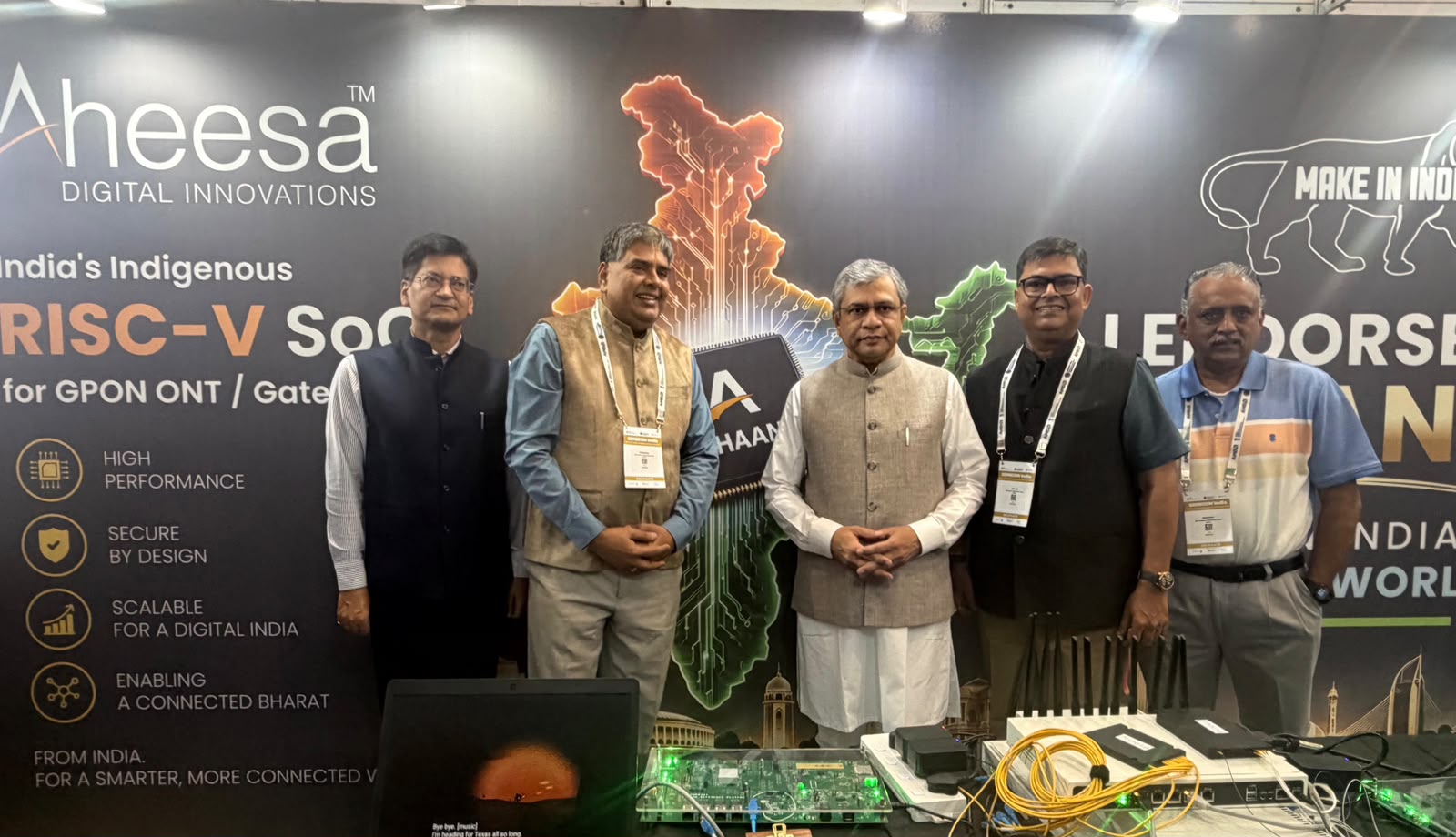
New Delhi, 21 September 2026: Aheesa Digital Innovations, a fabless semiconductor company, unveiled Vihaan-I, India’s first indigenously designed broadband networking chip, in the presence Union Minister for Electronics & IT Shri Ashwini Vaishnaw at Semicon India 2026, at Yashobhoomi, New Delhi.
Vihaan-I’s journey is tied to two of the nation’s defining dates. The chip was taped out on Republic Day, 26 January 2026, and achieved first-pass silicon success on Independence Day, 15 August 2026, validating India’s semiconductor ambitions.
“Unveiling Vihaan-I in the presence of Union Minister Shri Ashwini Vaishnaw, who is steering India’s semiconductor mission, was a proud moment for everyone at Aheesa. Vihaan-1 is proof that a Viksit Bharat can use advanced technology and design it,” said Sridharan Mani, Founder and CEO, Aheesa Digital Innovations.
“With Vihaan-I, we have a working silicon designed in India, by an Indian team, for India’s networks. Our focus is now on getting this chip into the hands of India’s broadband and telecom equipment makers,” Saket Singh, Director & Chief Growth Officer, Aheesa Digital Innovations.
Vihaan-I is India’s first home-designed chip for broadband and fibre networks. It brings the core functions of the internet equipment found in homes and offices onto a single Indian-designed chip, built on the open-standard RISC-V architecture and powered by the indigenous VEGA processor developed by C-DAC. It serves as a Made-in-India alternative to the imported silicon that powers most of the country’s telecom and broadband networks today.
At Semicon India 2026, Shri Ashwini Vaishnaw set out the six pillars of Semicon 2.0, with chip design named as the first pillar. Vihaan-I was among the Made-in-India chips he spotlighted, a working example of the design-led, indigenous milestone the mission is built to produce, and of the Atmanirbhar Bharat vision of designing strategic technology at home. Shri Ashwini Vaishnaw on Vihaan-I:
Path to commercialisation
With Vihaan-I’s silicon now validated, Aheesa is moving decisively from design to market. The company has signed partnerships across the chip’s path to deployment including a packaging MoU with Optilink Networks, which will support product development from prototyping through to packaging and the joint development of broadband customer equipment built on Vihaan-I. They have also signed a distribution partnership with The Zigma Technologies India. Aheesa is now preparing for commercialisation targeted for early 2027, and expects the Vihaan roadmap to extend across the broadband, telecom and cybersecurity domains that form its core focus.
21, Sep 2026
Apurva.ai Evolves Apurva LENS from an Organisational Product to a Platform for the Development Ecosystem
- Rohini and Nandan Nilekani-supported Apurva.ai evolves Apurva LENS from a knowledge workspace into a platform for cross-organisational learning and collaboration
- Apurva LENS is open for practitioners and organisations to explore and experience its capabilities firsthand
BENGALURU, India, Sept. 21, 2026 /PRNewswire/ — Apurva.ai, an AI-enabled public-good digital infrastructure working with over 50 global organisations, today announced a new platform model for Apurva LENS, extending it from a product that helps individual organisations work with their knowledge to a platform that enables knowledge to travel across the wider development ecosystem. Apurva LENS is already being used and tested by organisations addressing complex social challenges across the Global South and beyond.

Apurva.ai is a unit of C4EC Foundation, co-founded by Nilekani Philanthropies to support change leaders working to respond to complex social challenges with speed, at scale, and sustainably.
As social and development challenges grow in scale and complexity, no single organisation has all the knowledge or answers needed to respond effectively. There is a growing need for ways to bring together what different actors and communities know, make sense of it collectively, and respond at scale.
Apurva LENS, part of a suite of AI-enabled products, was designed to help actors across the development ecosystem, including funders, governments, NGOs and change leaders, make sense of knowledge that often remains siloed across research, evaluations, programme experience and conversations. At its core are the voices and lived experiences of communities, so that those closest to a problem can help shape what happens next. Today, Apurva LENS has helped surface more than half a million voices and perspectives from across the development ecosystem in the Global South.
The new platform model transforms Apurva LENS from an organisation-level product into a platform for cross-organisational learning and collaboration. Multiple actors across an ecosystem can now learn from knowledge made available by each other, while retaining control over what they keep private and what they choose to share. This allows learning generated in one part of an ecosystem to become useful elsewhere, without losing its context or ownership.
The shift reflects a larger premise behind Apurva LENS: as AI makes more knowledge available, the challenge is no longer simply accessing information but making sense of it. By bringing together research, evidence, and organisational learning with the voices and lived experiences of communities from the outset, Apurva LENS enables a more bottom-up approach where those closest to a problem help shape how it is understood and how solutions are designed. This approach is already being explored across different development contexts.
- SELCO Foundation initially used Apurva LENS to bring together organisational knowledge spanning archival information, everyday conversations and sector-focused assets, enabling teams to query it, surface patterns and synthesise insights. The collaboration has since extended beyond SELCO Foundation through the Platform for Collective Wisdom (PCW), an initiative enabled by Apurva.ai. PCW brings together community voices, practitioner perspectives and institutional knowledge across the development sector, allowing knowledge that would otherwise remain siloed to be connected and built upon across the wider ecosystem.
- Resilience Action Network Africa (RANA) used Apurva LENS to organise, analyse and synthesise community dialogues and research across Kenya, Uganda, Sierra Leone and South Africa, spanning climate resilience, health, livelihoods, food systems, gender, governance and financing. The work helped surface themes across countries while reinforcing an important principle: AI-assisted analysis was most useful when combined with human contextual judgment grounded in local realities, political economy and systems dynamics.
- In Brazil, Museu da Pessoa, one of the world’s earliest virtual museums, has built an archive of 20,000 life stories and approximately 11,000 hours of recorded material, capturing experiences across generations, regions and communities. Using Apurva LENS, the team prototyped a subset of voices to explore experiences around longevity, surfacing patterns and differences across individual life stories. The work points to a larger opportunity: turning a vast archive into living, accessible knowledge, that enables insights rooted in local experience to travel across languages and geographies and inform understanding far beyond where those stories originated.
- Rare’s Fish Forever works with fishers, local leaders, governments, funders and NGOs across Central and South America, Africa and Asia-Pacific to restore coastal fisheries and enable communities to manage them sustainably. As the programme expanded, knowledge accumulated across reports, presentations, field notes, chats and informal conversations. Fish Forever brought in Apurva LENS to help organise this collective knowledge, enabling teams to connect what they know with what they are learning and how conditions are changing. Its longer-term ambition is a living knowledge ecosystem where new insights from communities can continually inform learning across the programme.
Aggrey Aluso, Executive Director, Resilience Action Network Africa (RANA), said, “Working across countries, communities and interconnected development challenges, we see firsthand how knowledge can remain fragmented across programmes, partners and contexts. Our work with Apurva LENS has shown the value of bringing community voices together with research and systems knowledge to see connections that would otherwise be difficult to surface. The opportunity of a platform approach is to take this further, enabling learning to travel across actors and ecosystems while retaining the local context that gives it meaning. AI can help make those connections, but human judgment remains essential to understanding and acting on them.”
Dr. Harish Hande, CEO, SELCO Foundation, said, “Some of the most valuable learning comes from communities and practitioners solving real problems every day, yet those experiences rarely travel far enough. When they can be connected across organisations and geographies, we can build on what has already been learned rather than repeatedly starting from scratch. Our work with Apurva.ai is about creating that possibility at scale, while ensuring that community knowledge and lived experience remain at the heart of how solutions are shaped.”
Nandan Nilekani, Co-Founder and Chairman, Infosys and Chairman of EkStep Foundation, said, “AI’s real opportunity is to make intelligence useful at scale, across varied societal contexts. India has shown how open infrastructure can enable ecosystems whose impact can extend far beyond its borders. Apurva.ai is bringing that thinking to knowledge – connecting research, organisational learning and community experience so that insights can travel across organisations and geographies. I hope more organisations will join us to explore what we can build together.”
Anand Rajan, Co-Founder and Mission Leader, Apurva.ai, said, “The development sector does not lack knowledge. It already exists across organisations, research, programmes and, importantly, within communities themselves. The challenge is turning all of this into understanding that people can act on. With Apurva LENS becoming a platform, we are moving from helping individual organisations make their knowledge work for them to asking what becomes possible when that knowledge can travel across an ecosystem. AI can help us make sense of this complexity at a scale that was not possible before. But judgment, context and action remain fundamentally human.”
Apurva LENS is open for practitioners and organisations to explore and experience its capabilities firsthand. The experience brings to life a question at the heart of Apurva.ai’s approach: What if communities were not simply the recipients of solutions, but helped shape them from the start?
About Apurva.ai
Apurva.ai is a public-good, sense-making infrastructure for systems change. Through its AI-powered suite of products, it enables change leaders and organisations to unlock the collective wisdom within their networks by connecting community voices and lived experiences with knowledge from across the wider ecosystem. With communities at the centre, Apurva.ai helps surface connections, build shared understanding and enable more contextually relevant action on complex social challenges. Its suite of products supports a continuous cycle of listening, learning and acting, helping ecosystems move from fragmented knowledge towards collective understanding and systemic change. Apurva.ai is a unit of C4EC Foundation.
For more on Apurva.ai visit: https://apurva.ai/about-us/

 View original content to download multimedia:https://www.prnewswire.com/in/news-releases/apurvaai-evolves-apurva-lens-from-an-organisational-product-to-a-platform-for-the-development-ecosystem-302884360.html

21, Sep 2026
Huawei Upgrades Stellar AI WAN Solution to Drive All Intelligence Across Industries
SHANGHAI, Sept. 21, 2026 /PRNewswire/ — At HUAWEI CONNECT 2026, Huawei unveiled its upgraded Stellar AI WAN Solution. Centered on ultimate computing efficiency and multi-dimensional security, this solution addresses cross-region computing challenges in efficiency, cost, and security, driving all intelligence across industries in the AI era.
Stellar AI WAN for Intelligent Connectivity
Amid the rapid expansion of AI computing power, deploying new compute infrastructure in the West has made remote invocation the new norm. However, traditional networks face three critical issues relating to cross-region computing.
- Severe efficiency loss: Invoking computing power across 1,000 km can incur a 37% efficiency loss from a mere 0.073% packet loss.
- High on-premise costs: Local compute deployment costs from 1 million RMB per branch.
- Expensive private lines: Enterprises spend around 1.2 million RMB annually on 10G private lines.
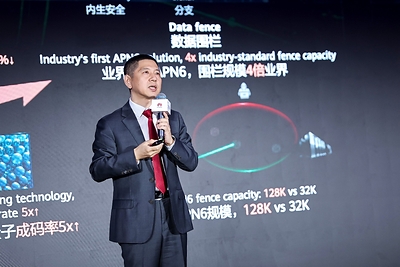
To address this, Leon Wang, President of Huawei’s Data Communication Product Line, introduced the Stellar AI WAN Solution, enabling lossless delivery of computing power over 1,000 km for a local-like remote computing experience. The XH computing-network appliance uses a unique layerwise model partitioning algorithm to run the initial and final layers of inference locally while offloading intermediate layers to remote infrastructure. With the network transmitting only high-dimensional vectors, raw data remains on-premises. The appliance requires just two xPUs to match a traditional 8-xPU setup, slashing xPU costs by 75%. The updated Starnet lossless algorithm cuts bandwidth idle time by over 80% and reduces required bandwidth fivefold, further lowering cross-region computing costs.
Stellar AI WAN for Security
As global security threats intensify, novel vectors like APTs and HNDL attacks continue to emerge. To address these, Huawei provides a three-layer defense for WANs.
- Device layer: Intrinsic security boards detect and block intrusions in real time, tracing threats within minutes at over 95% accuracy.
- Link layer: Built-in QKD delivers robust quantum security without extra devices or fibers, slashing costs by over 60%. An adaptive noise suppression algorithm extends QKD transmission past 80 km.
- Network layer: APN6-based data fencing enables network-wide control over traffic paths, ensuring data travels exclusively within secure networks with intrinsic security and quantum encryption deployed.
Looking ahead, Huawei will continually upgrade the Stellar AI WAN Solution, deepening its computing-network synergy and multi-dimensional security. Together with partners, Huawei aims to reinforce the intelligent network foundation and accelerate all intelligence across enterprises.
 View original content to download multimedia:https://www.prnewswire.com/in/news-releases/huawei-upgrades-stellar-ai-wan-solution-to-drive-all-intelligence-across-industries-302884377.html

21, Sep 2026
Demand for services rising faster than charities can respond, CAF research finds
LONDON, Sept. 21, 2026 /PRNewswire/ — New research from the Charities Aid Foundation (CAF) finds that charities around the world are facing ever-increasing demand for their services and many are finding it difficult to cope.
CAF’s World Giving Report: Charity Insights explores the trends and challenges facing charities, using research with more than 5,000 charity leaders in 33 countries. The report is being launched at a side event at the United Nations General Assembly and follows the publication earlier this year of the World Giving Report: Donor Insights on global generosity trends.
In the past year, demand has increased for more than two thirds of charities (67%). Nearly half (47%) are finding it hard to cope and the majority expect the demand to increase even further. Those in lower-income countries are the hardest-hit. Many charities have responded by prioritising services based on the severity of need, with one in five (18%) organisations creating a waitlist.
When asked about the key challenges they face, 61% of charities said their primary concern is achieving financial sustainability. To respond to this, 37% of charities have diversified their income, but a third of charities (33%) have used their savings or reserves to cover income shortfalls and a quarter (25%) have reduced employee numbers or downsized.
Fewer than two in five (37%) charities feel financially and operationally set up for success over the next three years. Larger charities feel more confident, while organisations that provide crucial services are among the most pessimistic.
Mark Greer, Managing Director at the Charities Aid Foundation said:
“Around the world, charities are striving to support those in need but facing an extremely challenging operating environment. With escalating conflicts and the effects of climate change, many charities are struggling to cope with the numbers of people who need support from them.
“It’s important that funders consider how to better support charities with flexible and reliable funding, including to help with resilience, particularly as organisations manage reductions in government aid and development spending. We encourage charities to invest time in building their long-term resilience and take inspiration from others have done this, including those in this report.
“When charities are strained, it’s crucial that policymakers and those of us in the sector champion and advocate for the vital role that they play in communities around the world.”
 View original content:https://www.prnewswire.co.uk/news-releases/demand-for-services-rising-faster-than-charities-can-respond-caf-research-finds-302883432.html

21, Sep 2026
Sayaji Raipur Brings the Soulful Flavours of Bengal to the City with a Special Bengali Food Festival
Raipur, Sep 21: Sayaji Raipur is set to take diners on a culinary journey to Eastern India with its Bengali Food Festival, bringing the rich flavours, traditions and culinary heritage of Bengal to Cravings – All Day Dining Restaurant from 25 September to 11 October 2026.

The festival has been curated to celebrate the distinctive character of Bengali cuisine, bringing together time-honoured recipes, aromatic spices, seasonal ingredients and much-loved regional delicacies. From comforting fish preparations and fragrant rice to hearty curries and traditional Bengali sweets, the experience aims to recreate the warmth and nostalgia of a traditional Bengali meal.
The specially curated spread will feature an assortment of authentic Bengali favourites including Mochar Chop, Beguni, Koraishutir Kochuri, Bhetki Fish Fry, Dimer Devil, Bengali Chicken Cutlet, Aloo Posto, Shukto, Dhokar Dalna, Kosha Mangsho, Chingri Malai Curry and Shorshe Maach.
The dessert selection will further celebrate Bengal’s famed sweet traditions with favourites such as Mishti Doi, Nolen Gurer Payesh and Sandesh.
The festival is designed to offer diners more than just a meal—it is an exploration of Bengal’s food culture, where every preparation reflects the region’s distinctive balance of spices, textures and culinary traditions.
Speaking about the festival, Rajendra Singh, Executive Chef, Sayaji Raipur, said:
“Bengali cuisine has an incredibly rich culinary identity, with recipes that carry generations of tradition and storytelling. Through this festival, we want our guests in Raipur to discover the depth and diversity of Bengali food while enjoying the comfort and hospitality of Sayaji.”
The Bengali Food Festival will be available for dinner at Cravings from 7:30 PM to 11:30 PM, with the buffet starting at ₹1,199++ per person.
With its focus on regional authenticity and culinary discovery, the festival is expected to appeal to food enthusiasts, families and guests looking to explore a new regional cuisine without leaving the city.
Event Details
What: Bengali Food Festival
Venue: Cravings, Sayaji Raipur
Dates: 25 September – 11 October 2026
Timings: 7:30 PM – 11:30 PM
21, Sep 2026
Raffles Udaipur Recognized with Two MICHELIN Keys for the Second Consecutive Year, Celebrating a Legacy of Exceptional Hospitality

21, Sep 2026
Vipin Sharma Earns Global Recognition as Kamathipura Express Wins 2026 Bronze Student Academy Award
Sep 21: Vipin Sharma continues to make his mark on the international stage with Kamathipura Express, a Warsaw Film School production directed by Leon Korzyński, which has won the 2026 Bronze Student Academy Award in the Narrative category. The Academy of Motion Picture Arts and Sciences named the film among the winners of the 53rd Student Academy Awards, selected from 2,972 entries submitted by 894 colleges and universities worldwide. The Student Academy Awards ceremony was held for the first time in association with the Toronto International Film Festival.

The win also makes Kamathipura Express eligible to compete in the Live Action Short Film category at the 99th Academy Awards, giving the film a pathway into Oscar consideration. Vipin Sharma plays a pivotal antagonist in the film, adding another distinctive performance to his growing body of international work.
For Sharma, the recognition comes at an important point in a career that has steadily moved between Indian cinema and international productions. Known for his performances in films and series including Taare Zameen Par, Gangs of Wasseypur, Maharani and Dhadak 2, the actor gained international attention with Dev Patel’s directorial debut Monkey Man.
Speaking about his association with Kamathipura Express, Vipin Sharma says,
“I am a huge Polish cinema fan. I think it was they who invented the idea of pitching a film in one sentence. So, when I was offered a role in a film from Warsaw Film School, I immediately met the director, Leon Korzyński. I loved the idea behind the film and said yes to it right away! I have also been supporting young filmmakers who are starting their careers. Their enthusiasm and passion are inspiring, and they bravely experiment!”
Sharma has also recently wrapped shooting with Dev Patel again in The Peasant, an upcoming A24-backed medieval revenge-action thriller. The film follows a 14th-century shepherd who sets out to avenge the destruction of his community by a group of mercenaries. The project marks A24’s first production to be filmed in India and features an international ensemble including Christian Friedel, Sebastian Bull, Vipin Sharma and Anasuya Sengupta.
From the marginalised communities depicted in Monkey Man to the period world of The Peasant and the urgent social concerns explored in Korzyński’s award-winning short, Sharma’s recent work reflects the range of stories and characters he continues to take on across Indian and international cinema.
With Kamathipura Express now recognised at the Student Academy Awards and eligible for consideration at the 99th Academy Awards, the film adds another significant milestone to Vipin Sharma’s growing international profile.
21, Sep 2026
Aadhaar Authentication Mandatory for Subsidised LPG Refills from October 1
New Delhi, September 21, 2026: Domestic LPG consumers will have to complete Biometric Aadhaar Authentication (BAA) to book refills at the regulated retail selling price with applicable subsidy from October 1, 2026, the Ministry of Petroleum and Natural Gas has announced. The new requirement is aimed at ensuring that subsidised cooking gas reaches eligible consumers and at improving transparency in subsidy delivery.
According to the ministry, 27.43 crore active domestic LPG consumers, or 89.9 per cent of the total, had already completed biometric authentication as of September 19. Consumers who have completed the process do not have to undertake it again and can continue booking their LPG refills as before.
For consumers who have not completed BAA, the key change will take effect from October 1. Their refill booking at the regulated retail selling price with applicable subsidy will become available once the Aadhaar authentication is completed. The government has clarified that the measure is intended to verify the beneficiary associated with each LPG connection rather than stop genuine households from accessing cooking gas.
The government has said the authentication system is designed to make LPG subsidy delivery more targeted. Linking an LPG connection to an Aadhaar-authenticated consumer is expected to help identify duplicate or ineligible connections and reduce the possibility of subsidised domestic cylinders being diverted for commercial or industrial use.
Consumers who have not yet completed the authentication can use several routes. BAA can be completed during LPG cylinder delivery, with the delivery personnel using the oil marketing company’s mobile application. Customers can also visit their LPG distributor’s showroom to complete the process.
There is also an option to complete the process digitally. Indane customers can use the IndianOil ONE app, Bharatgas customers can use HelloBPCL, while HP Gas customers can use the HP PAY app. The government has also made tutorial material available through the Pradhan Mantri Ujjwala Yojana portal to assist consumers with self e-KYC.
The new requirement does not mean that consumers who do not authenticate will be completely denied LPG. According to the ministry, customers who are unwilling or unable to complete BAA can still receive LPG, but they must register their choice through the oil marketing company’s digital channels, which may include the consumer portal, mobile app, WhatsApp chatbot or IVRS.
Such consumers, however, will not receive the applicable subsidy and will have to purchase LPG at the market price. The government has said that 5-kg and 10-kg cylinders can be supplied to such customers, subject to availability with the respective oil marketing company.
The authentication drive has been running for several months. The original deadline was set for June 30, 2026, but it was extended repeatedly to provide additional time to consumers. The final extension took the deadline to September 14, after which the government announced that biometric authentication would become mandatory for subsidised refill bookings from October 1.
The financial implications of the LPG subsidy also form part of the policy backdrop. The government said the implicit subsidy on a 14.2-kg domestic LPG cylinder was around ₹210 in September 2026, compared with about ₹721 in June. It has also been providing compensation to public-sector oil marketing companies to help keep domestic LPG affordable.
The government has maintained that the authentication process is intended to improve the targeting of public support while ensuring that eligible households continue to receive subsidised LPG. With nearly 90 per cent of active domestic consumers already authenticated, the remaining consumers have a limited window to complete the process if they want to continue receiving refills at the regulated price with applicable subsidy.
For LPG consumers, the practical message is straightforward: those who have already completed biometric Aadhaar authentication need to take no further action, while those who have not should complete BAA through their distributor, during delivery or through their oil marketing company’s mobile application. From October 1, authentication will be required for subsidised domestic LPG refills at the regulated retail selling price.


